How to Build a Strong UPSC Preparation Routine | The Prayas India
Many UPSC aspirants believe that success begins with finding the “perfect timetable.”
They spend hours searching for topper routines, downloading study planners, watching productivity videos, and copying schedules shared on social media.
For a few days, everything goes according to plan.
Then reality begins.
A topic takes longer than expected.
Current affairs pile up.
Answer writing gets skipped.
Revision is postponed.
The timetable slowly falls apart.
Eventually, students start believing that they lack discipline.
But the truth is different.
The problem is rarely discipline.
The problem is trying to follow a routine that wasn’t designed for their own learning style.
A successful UPSC routine is not about studying sixteen hours every day.
It is about building a preparation system that remains effective for months—not just a few enthusiastic days.
Whether you’re preparing full-time, balancing college, or managing a job alongside your studies, your routine should help you move forward consistently without causing burnout.
This article introduces a practical framework that focuses on building a sustainable preparation system rather than an unrealistic timetable. If you’re searching for guidance from the Best UPSC Coaching in Mumbai, understanding how to build the right study routine is one of the first steps toward effective preparation.
Why Most UPSC Preparation Routines Fail
If you ask ten UPSC aspirants about their daily routine, you’ll probably hear ten different answers.
Some begin studying at 5 AM.
Others prefer late-night sessions.
Some divide subjects by days.
Others study multiple subjects every day.
Yet many of them struggle to remain consistent.
Why?
Because they focus on copying routines instead of understanding the principles behind them.
Here are some common reasons why UPSC routines fail:
- Trying to study for unrealistic hours.
- Ignoring revision.
- Spending too much time collecting resources.
- Following random YouTube strategies every week.
- Neglecting answer writing.
- Giving equal time to every subject instead of prioritizing weak areas.
- Not tracking daily progress.
- Losing consistency after missing one or two study sessions.
A strong routine isn’t built on perfection.
It’s built on repeatable habits.
Think of your UPSC preparation as constructing a house.
Books are the bricks.
Classes are the cement.
But your routine is the foundation.
Without a strong foundation, even the best resources cannot produce consistent results.
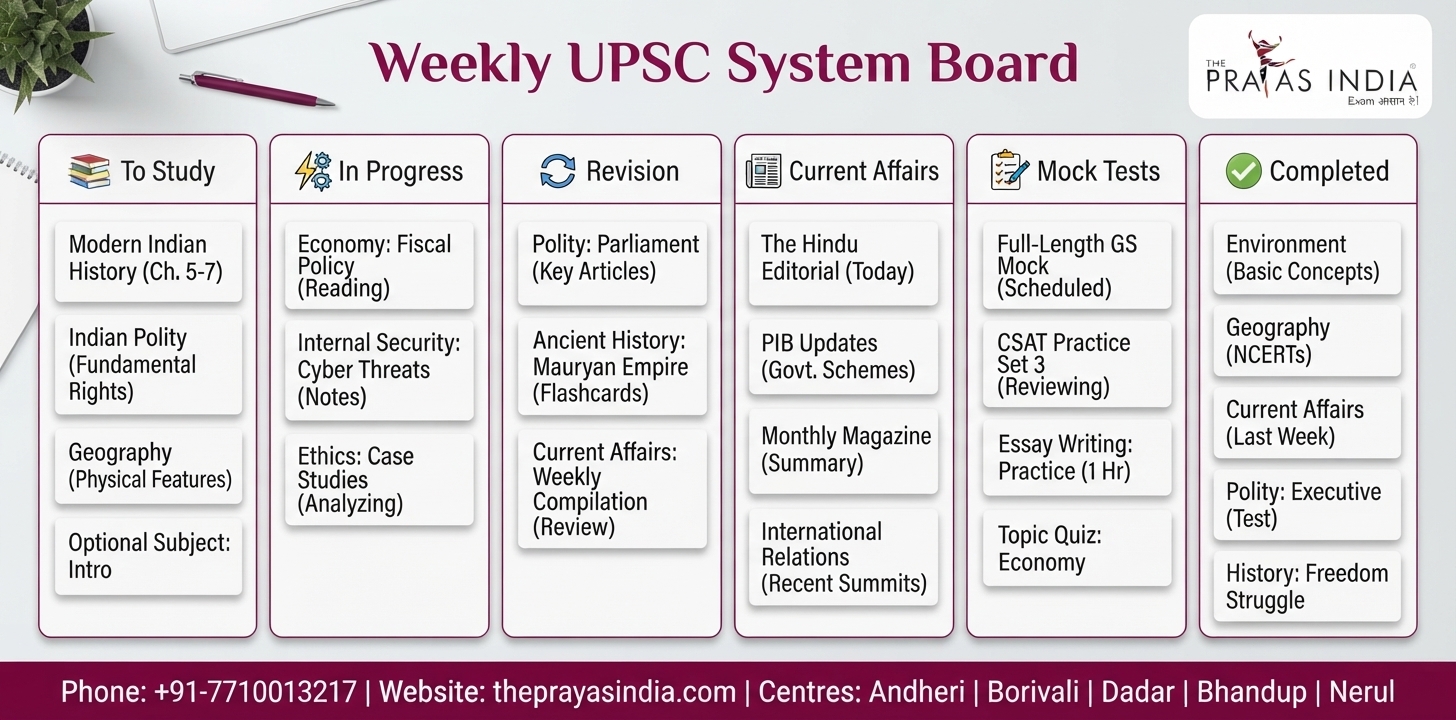
Introducing the “UPSC Operating System”
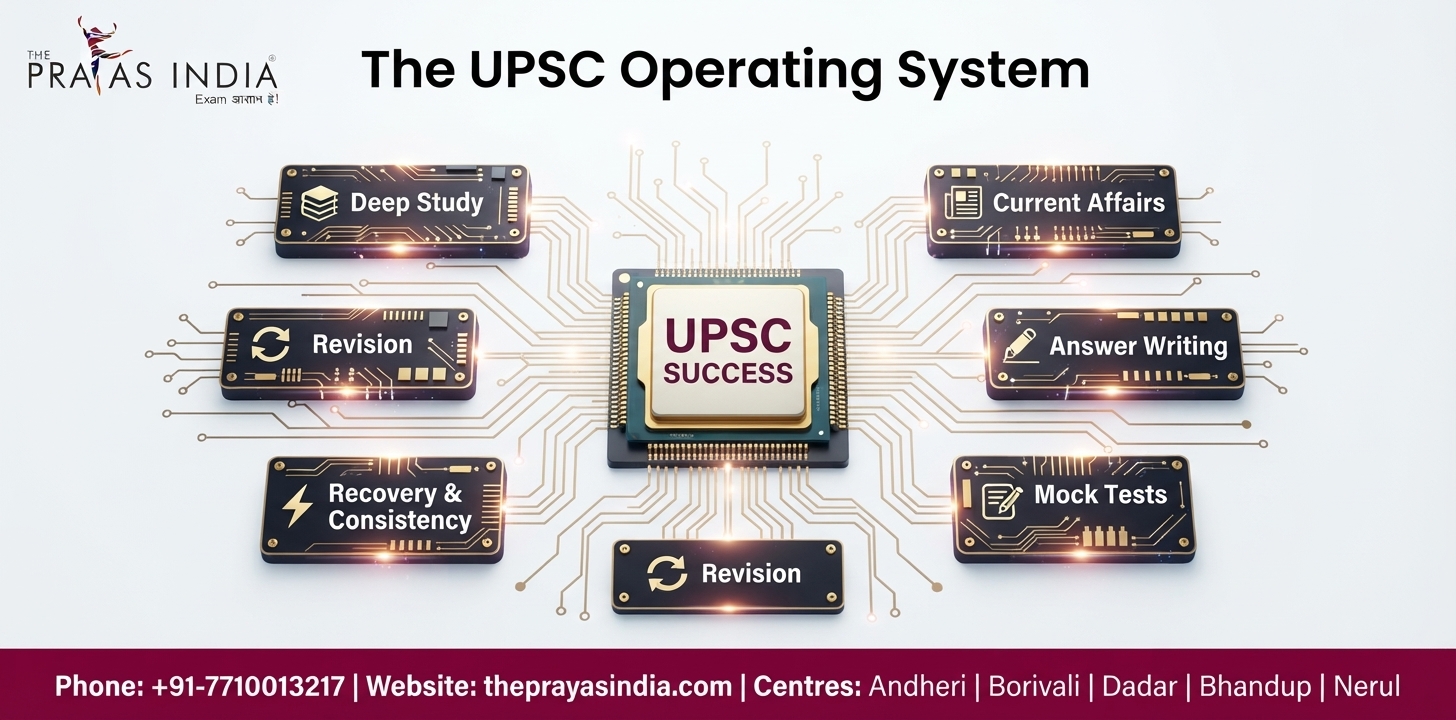
Instead of looking at your routine as a timetable, imagine it as an operating system.
Just as a computer performs multiple functions together, your UPSC preparation should consist of several interconnected modules working simultaneously.
If one module stops functioning, the overall system slows down.
A strong UPSC preparation system generally includes:
- Deep conceptual study
- Regular revision
- Current affairs integration
- Answer writing practice
- Mock test analysis
- Physical and mental recovery
Each module supports the others.
For example:
Current affairs improve answer writing.
Revision improves mock test scores.
Mock test feedback identifies weak areas.
Weak-area improvement strengthens future revision.
Everything remains connected.
Instead of asking,
“How many hours should I study?”
Ask,
“Is every important preparation module receiving consistent attention?”
This small change in perspective often transforms preparation quality.
Module 1: Build Deep Study Blocks Instead of Counting Hours
One of the biggest myths in UPSC preparation is that success depends entirely on the number of hours studied.
In reality, the quality of focused learning often matters far more than the total duration.
Consider two aspirants.
The first studies for twelve hours but spends a significant portion of that time checking notifications, switching between resources, and losing concentration.
The second studies for seven focused hours with clear objectives, minimal distractions, and regular revision.
Who is likely to retain concepts better?
The answer is obvious.
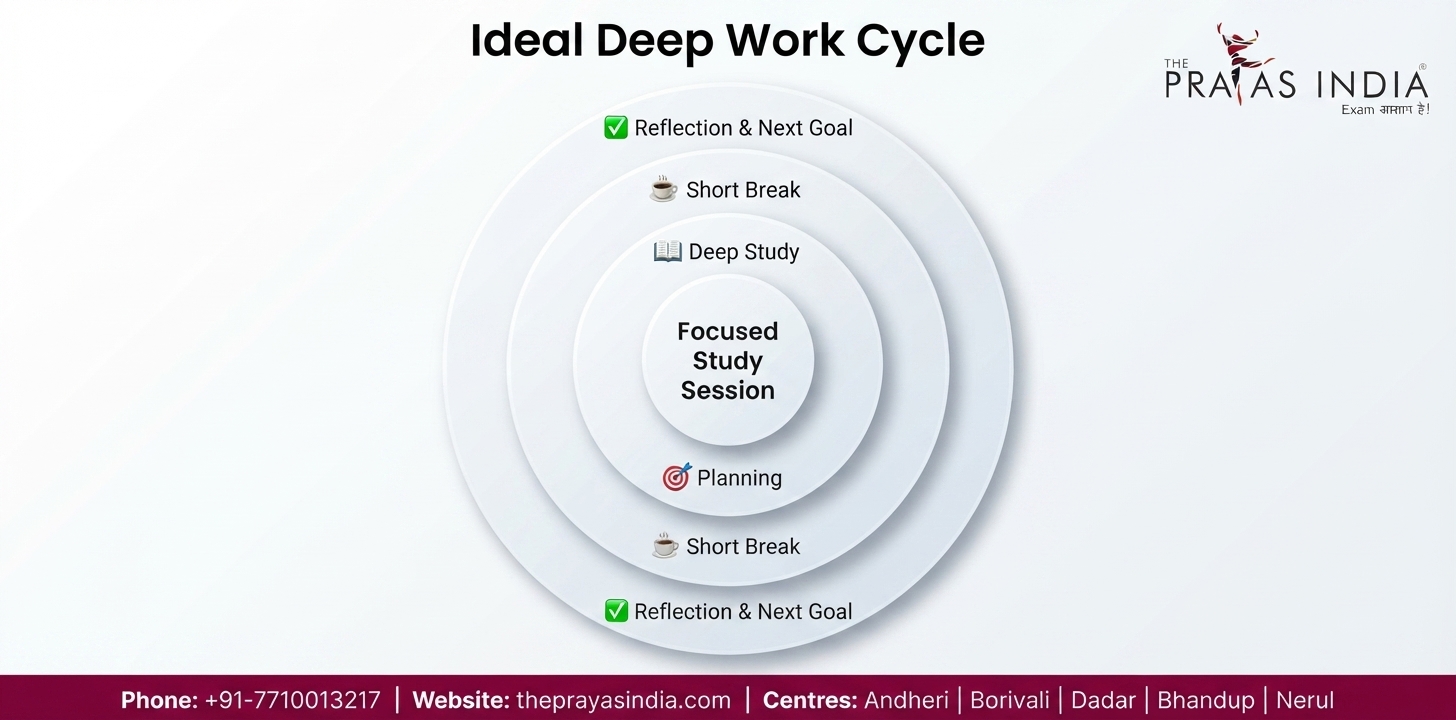
Deep study means giving complete attention to one meaningful task at a time.
Instead of jumping between Polity, Economy, Current Affairs, and Geography every thirty minutes, dedicate uninterrupted sessions to one subject with a clear outcome.
For example:
- Finish one chapter of Polity.
- Solve related MCQs.
- Make concise revision notes.
- Highlight difficult concepts for future review.
This approach creates stronger conceptual understanding and reduces mental fatigue.
Students preparing under experienced mentors at a quality UPSC Coaching in Mumbai often learn not only what to study but also how to study efficiently.
How to Create Effective Deep Study Sessions
Every study session should begin with a specific objective.
Avoid vague goals such as:
“I’ll study History today.”
Instead, define measurable outcomes like:
- Complete Modern History Chapter 3.
- Solve 30 Prelims questions.
- Revise constitutional amendments.
- Prepare short notes on Fundamental Rights.
Specific goals improve concentration because your brain knows exactly what it needs to accomplish.
Another useful practice is removing unnecessary distractions before beginning a session.
Keep only the required books, notebook, and stationery on your study desk.
A clean environment often leads to a clearer mind.
Module 2: Create a Revision Engine That Never Stops
Many aspirants enjoy learning new topics.
Very few enjoy revising them.
Unfortunately, UPSC rewards retention—not simply completion.
A chapter studied once and forgotten after two weeks contributes very little to your final score.
Instead of treating revision as an occasional activity before the examination, make it a permanent part of your daily routine.
Think of revision as the engine that keeps your preparation running.
Without it, even the strongest study plan gradually loses momentum.
Module 3: Build a Current Affairs Loop Instead of a Daily News Burden
One of the biggest reasons aspirants lose consistency is the way they approach current affairs.
Many students try to read multiple newspapers, several monthly magazines, YouTube summaries, Telegram channels, and countless PDF compilations every single day.
Within a few weeks, they feel overwhelmed.
The goal of current affairs is not to collect information.
It is to develop the ability to connect current events with static subjects and write analytical answers.
Think of current affairs as a continuous loop.
Every important news item should eventually connect with:
- Polity
- Economy
- Geography
- Environment
- International Relations
- Science & Technology
- Ethics
- Essay
For example, when reading about climate change policies, don’t simply memorize the news.
Ask yourself:
- Which constitutional provisions relate to this?
- Which government schemes are connected?
- Which international organizations are involved?
- How can this topic appear in Prelims?
- How can it be used in a Mains answer?
This habit transforms current affairs from daily reading into long-term learning.
Students preparing at a quality IAS Coaching in Mumbai often learn how to integrate static and dynamic portions effectively instead of studying them separately.
Create a “Connect Before You Collect” Habit
Before adding another PDF or magazine to your collection, ask:
“Will this improve my understanding or simply increase my reading workload?”
The best UPSC routines prioritize clarity over quantity.
A smaller number of reliable resources studied consistently usually produces better results than dozens of incomplete resources.
Module 4: Develop an Answer Writing Engine
Many aspirants postpone answer writing until after completing the syllabus.
This is similar to learning to swim only after reading an entire book on swimming.
Knowledge and expression are two different skills.
UPSC Mains rewards candidates who can:
- Organize thoughts quickly.
- Present balanced arguments.
- Write within the word limit.
- Use relevant examples.
- Maintain logical flow.
- Conclude effectively.
These abilities improve only through regular practice.
Start with simple questions.
Focus on structure before speed.
A basic answer should include:
- A clear introduction.
- Logical body paragraphs.
- Relevant examples, facts, or committees.
- A balanced conclusion.
As confidence grows, gradually improve answer quality by incorporating diagrams, flowcharts, constitutional references, committee recommendations, and current affairs wherever appropriate.
The objective isn’t writing perfect answers from Day One.
It is writing slightly better answers every week.
Small Improvements Create Big Results
Instead of measuring success through:
“How many answers did I write?”
Measure it through:
- Did my introduction improve?
- Is my conclusion stronger?
- Are my examples more relevant?
- Did I finish within the time limit?
Continuous refinement produces long-term improvement.
Module 5: Build a Test & Feedback Cycle
Mock tests are often misunderstood.
Many students view them as scorecards.
Successful aspirants view them as diagnostic tools.
A mock test tells you far more than your marks.
It reveals:
- Which topics are becoming strong.
- Which mistakes keep repeating.
- Where you lose unnecessary time.
- Which subjects require revision.
- Whether your preparation strategy is working.
Every mock test should end with one important activity:
Feedback Analysis.
Without analysis, mock tests become nothing more than practice papers.
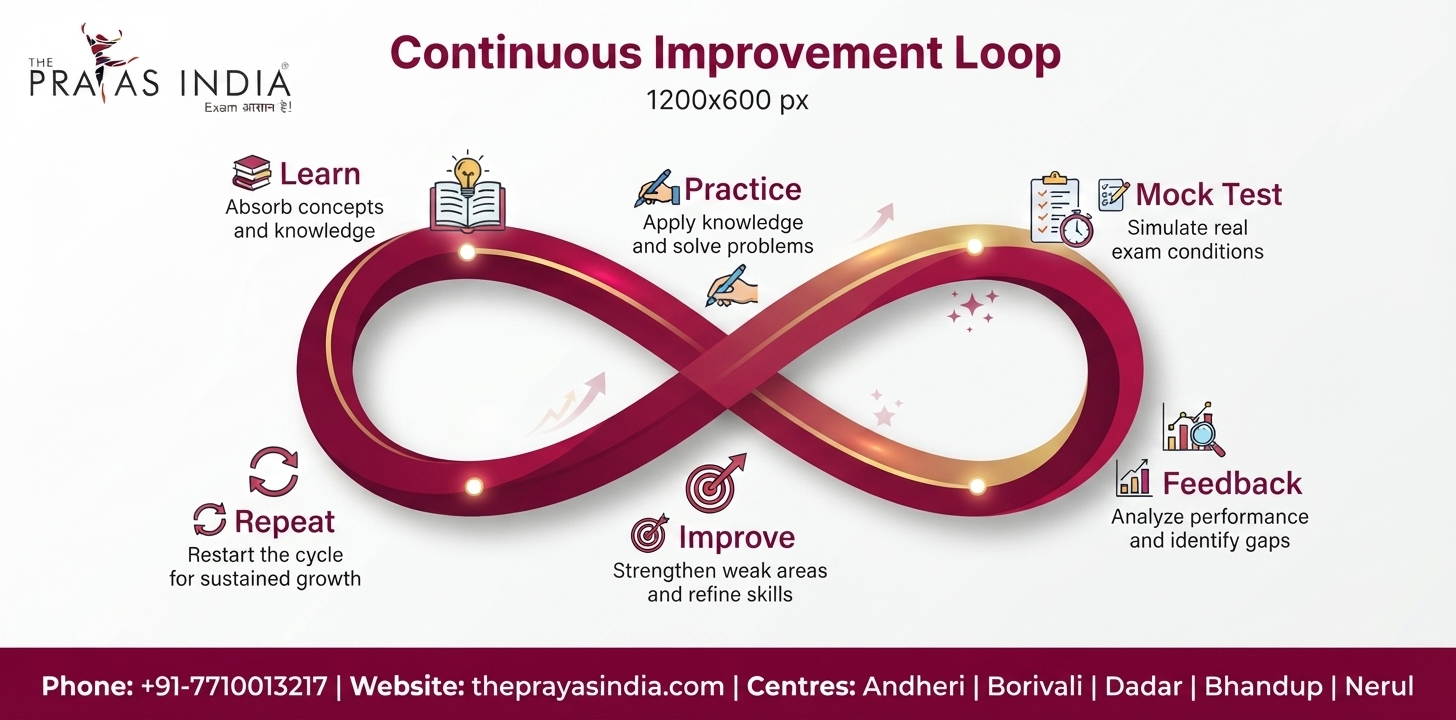
After every test, ask:
- Why did I lose marks?
- Which mistakes were avoidable?
- Which questions did I guess incorrectly?
- Which chapters need revision?
- What will I change before the next mock?
This creates a continuous improvement cycle rather than a cycle of repeated mistakes.
Students preparing under experienced mentors at the Best UPSC Coaching in Mumbai often benefit from structured feedback that helps convert weaknesses into strengths.
Module 6: Recovery Is Part of Preparation
Many aspirants believe that studying continuously without breaks demonstrates dedication.
In reality, sustainable preparation requires planned recovery.
Mental fatigue gradually reduces:
- Concentration
- Memory retention
- Decision-making
- Reading speed
- Motivation
Recovery does not mean wasting time.
It means allowing your brain to recharge so that future study sessions remain productive.
Healthy recovery habits include:
- Adequate sleep.
- Short walks.
- Light exercise.
- Meditation or mindfulness.
- Digital detox.
- Spending time with family.
- Pursuing a hobby for a limited period.
Remember:
A tired mind studies longer but learns less.
A refreshed mind studies smarter.
Consistency always outperforms temporary intensity.
Why The Prayas India Helps Students Build Consistency
Building a routine independently is possible.
Maintaining it for months is where many aspirants struggle.
Students often experience phases of self-doubt, inconsistent performance, changing exam patterns, and information overload.
This is where structured guidance becomes valuable.
At The Prayas India, preparation is designed around consistency rather than short-term motivation.
Students receive support through:
Structured Learning Path: A systematic approach that helps students know what to study, when to study, and how to revise efficiently.
Experienced Faculty: Concept-focused teaching that simplifies complex UPSC topics while explaining their relevance for both Prelims and Mains.
Regular Answer Writing Practice: Continuous improvement through guided writing sessions and constructive feedback.
Mock Tests & Performance Analysis: Helping aspirants identify strengths, improve weak areas, and refine exam strategies throughout their preparation.
Personal Mentorship: Academic guidance that keeps students accountable, motivated, and focused during the long UPSC preparation journey.
Instead of depending solely on motivation, students develop systems that help them remain consistent throughout the year.
Strong Systems Beat Strong Motivation
Motivation helps you begin.
Systems help you continue.
The most successful UPSC aspirants don’t rely on feeling motivated every single day.
They rely on routines that continue working even on difficult days.
Common Mistakes That Break a UPSC Preparation Routine
Building a routine is relatively easy.
Following it consistently for several months is the real challenge.
Many UPSC aspirants begin with great enthusiasm but gradually lose momentum because of a few avoidable mistakes.
Recognizing these mistakes early can help you build a preparation routine that remains effective throughout your UPSC journey.
1. Creating an Unrealistic Timetable
One of the biggest mistakes is designing a schedule that looks impressive on paper but is impossible to follow in real life.
Planning to study 14–16 hours every day may seem motivating initially, but most students struggle to maintain that pace for long.
Instead of focusing on maximum hours, build a routine you can realistically follow every day.
A consistent 7–8 hours of focused study often produces better results than occasional 14-hour study marathons.
2. Collecting Resources Instead of Completing Them
Many aspirants spend weeks downloading PDFs, buying books, subscribing to multiple channels, and collecting notes.
Unfortunately, having more resources does not guarantee better preparation.
The real objective should be mastering a limited number of high-quality resources through repeated revision.
Remember:
Completion with revision is always more valuable than endless collection.
3. Ignoring Revision Until the End
UPSC preparation is cumulative.
If today’s learning is not revised regularly, much of it will be forgotten before the examination.
A strong routine always reserves dedicated time for revision.
Revision should become a daily habit—not an emergency activity before the exam.
4. Studying Without Measuring Progress
Many students feel they are working hard but cannot determine whether they are actually improving.
Track your preparation regularly by asking:
- What did I complete this week?
- Which topics remain weak?
- Am I improving in mock tests?
- Is my answer writing becoming better?
- Which mistakes keep repeating?
Measuring progress keeps preparation objective rather than emotional.
5. Ignoring Physical and Mental Well-being
UPSC preparation is a marathon.
Poor sleep, unhealthy eating habits, lack of physical activity, and continuous stress gradually reduce productivity.
Your routine should include:
- Proper sleep
- Short exercise sessions
- Healthy meals
- Small breaks
- Digital detox
- Time for mental relaxation
A healthy body supports a productive mind.
Your Weekly UPSC Routine Checklist
Before ending every week, review your preparation honestly.
Ask yourself:
- ✅ Did I complete my planned study targets?
- ✅ Did I revise previously studied topics?
- ✅ Did I practice answer writing?
- ✅ Did I stay updated with current affairs?
- ✅ Did I analyze my mock test performance?
- ✅ Did I identify my weak areas?
- ✅ Did I maintain consistency even on difficult days?
- ✅ Did I take enough rest to remain productive?
If most of these answers are “Yes,” your preparation system is moving in the right direction.
Why The Prayas India Is a Trusted Partner for UPSC Aspirants
Every UPSC aspirant follows a unique journey.
Some are beginning immediately after graduation.
Some are balancing preparation with a job.
Others are attempting the examination again with the goal of improving their rank.
Despite these differences, one factor remains common:
Consistency.
Consistency is easier to achieve when students receive the right guidance, structured planning, and continuous academic support.
At The Prayas India, our approach extends beyond classroom teaching.
We focus on helping students develop a preparation system that is practical, sustainable, and aligned with the latest UPSC examination pattern.
Our preparation ecosystem includes:
- Expert faculty with conceptual teaching methods
- Structured study plans
- Regular answer writing practice
- Current affairs guidance
- Comprehensive mock tests
- Detailed performance analysis
- Personalized mentorship
- Continuous academic support
Students looking for the Best UPSC Coaching in Mumbai often seek more than lectures—they seek direction, accountability, and a preparation strategy that keeps them moving forward.
That is exactly what a structured learning environment aims to provide.
Admissions Open
📞 Call Now: +91-77100 13217
Andheri | Borivali | Dadar | Nerul | Bhandup
Conclusion
There is no universal UPSC timetable that works for everyone.
The strongest preparation routine is not the one that demands the longest study hours—it is the one you can sustain consistently over many months.
Instead of chasing perfection, focus on building a preparation system that combines focused study, regular revision, current affairs integration, answer writing, mock test analysis, and adequate recovery.
Treat your routine as a living system that evolves with your progress rather than a rigid timetable that creates unnecessary pressure.
With disciplined execution, continuous improvement, and the right academic guidance, every productive study session becomes another step toward your Civil Services dream.
If you are looking for the Best UPSC Coaching in Mumbai, choose an institute that not only teaches the syllabus but also helps you develop effective study habits, maintain consistency, and prepare strategically for every stage of the UPSC examination.
At The Prayas India, we believe that successful UPSC preparation begins with a strong routine—and a strong routine begins with the right guidance.
Frequently Asked Questions (FAQs)
1. How many hours should I study daily for UPSC preparation?
There is no fixed number. The focus should be on consistent, high-quality study sessions rather than simply increasing study hours.
2. What is the ideal UPSC preparation routine?
An effective routine includes focused study, daily revision, current affairs, answer writing, mock tests, and adequate rest.
3. Can working professionals build a successful UPSC routine?
Yes. A well-planned and realistic routine can help working professionals prepare effectively while managing their job responsibilities.
4. Why is revision important in UPSC preparation?
Revision improves retention, strengthens concepts, and ensures that previously studied topics remain fresh before the examination.
5. How often should I practice answer writing?
Answer writing should become a regular part of your preparation because it improves presentation, structure, and analytical thinking required for the UPSC Mains examination.
6. Are mock tests necessary for UPSC preparation?
Yes. Mock tests help evaluate preparation, identify weak areas, improve time management, and build exam confidence.
7. What makes The Prayas India a trusted choice for UPSC preparation?
The Prayas India provides expert faculty, structured study plans, answer writing practice, current affairs guidance, mock tests, mentorship, and continuous performance analysis to help aspirants prepare systematically.
8. How can beginners create a sustainable UPSC routine?
Beginners should start with realistic daily targets, limited study resources, regular revision, and gradual habit-building instead of following overly ambitious schedules.
9. Can I modify my UPSC routine during preparation?
Yes. Your routine should evolve based on your progress, strengths, weak areas, and changing preparation requirements.
Final Takeaway
A successful UPSC journey is not built in a single day, a single week, or through one perfect timetable. It is built through hundreds of disciplined study sessions, regular revisions, thoughtful answer writing practice, continuous feedback, and the determination to keep moving forward.
When your preparation becomes a system instead of a series of random study sessions, consistency becomes easier, progress becomes measurable, and success becomes far more achievable.
Build your routine with patience, refine it with experience, and strengthen it with the right guidance. Your preparation today lays the foundation for the Civil Services career you aspire to achieve tomorrow.