How to Crack RRB NTPC CBT 1 & CBT 2 on the First Attempt: Expert Study Plan
The Railway Recruitment Board Non-Technical Popular Categories (RRB NTPC) exam is one of the most highly anticipated and competitive public sector examinations in India. Offering coveted positions like Station Master, Goods Guard, Commercial Apprentice, and Clerk-Typist, it draws millions of applicants vying for a secure career in Indian Railways. However, the sheer volume of applicants means that clearing it on your very first attempt requires a transition from generic studying to a hyper-targeted, dual-stage strategy.
Many candidates make the critical mistake of preparing only for the Computer-Based Test (CBT) 1 first, leaving CBT 2 preparation for after the preliminary results are declared. This approach almost always leads to failure. Because the core syllabus for both tiers remains practically identical, a smart aspirant builds an integrated master preparation model right from day one, targeting the depth of CBT 2 while automatically covering the fundamentals of CBT 1.
💡 The Integrated Prep Rule:
Never separate your CBT 1 and CBT 2 conceptual preparation. Prepare directly for the higher difficulty level of CBT 2 so that the preliminary tier feels like a manageable stepping stone on your way to selection.
To execute this smoothly, you must first master the architectural differences in the exam patterns. While the subjects—General Awareness, Mathematics, and General Intelligence & Reasoning—remain entirely uniform across both tiers, the scoring weights, question counts, and competition margins intensify dramatically in the second stage.
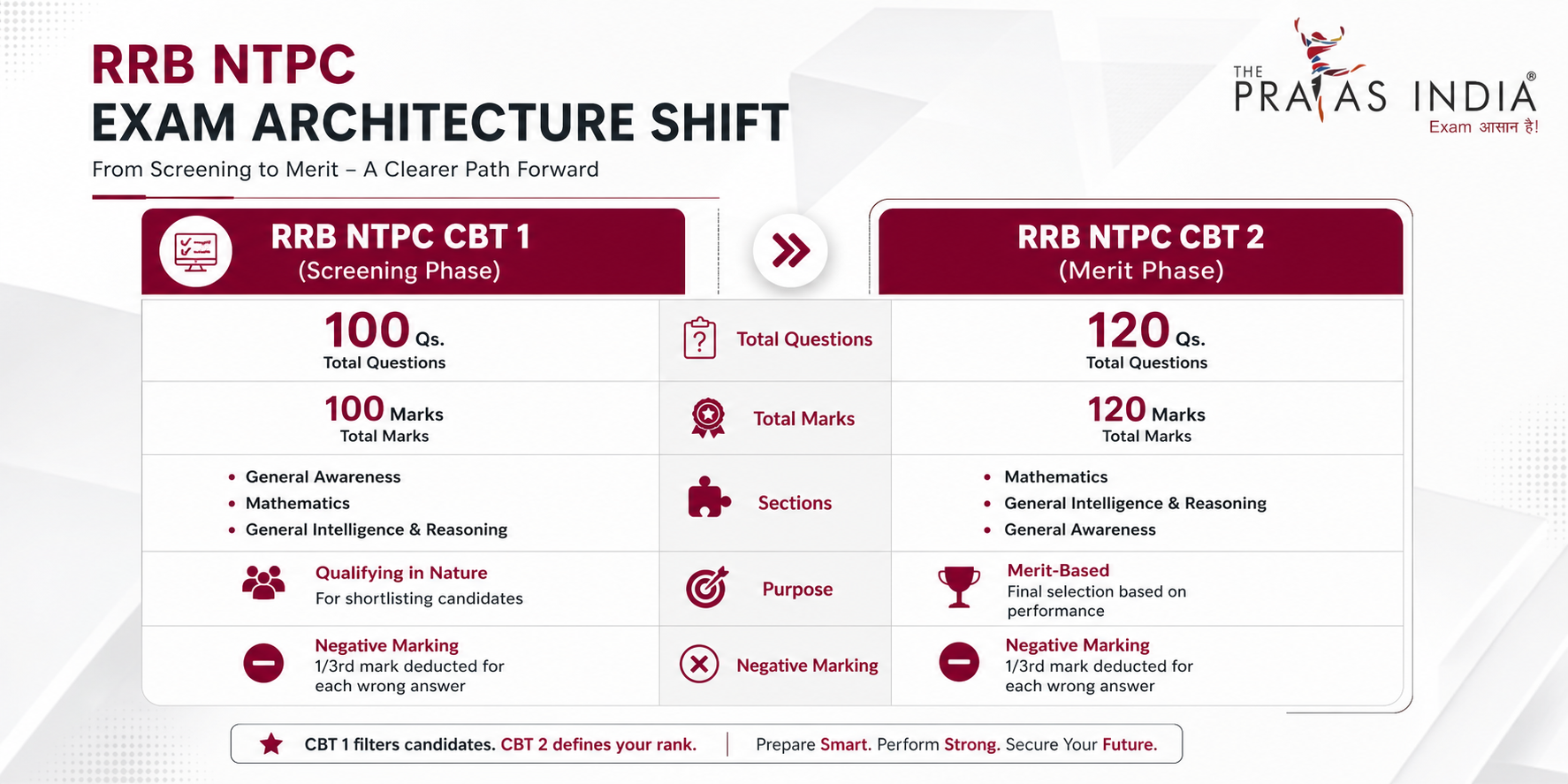
- CBT 1 (The Screening Phase): Features 100 questions to be solved within 90 minutes. It contains 40 questions on General Awareness, 30 on Mathematics, and 30 on Reasoning. The marks scored here are strictly used for shortlisting candidates for the main tier.
- CBT 2 (The Merit Phase): Features 120 questions packed into the same 90-minute window. The distribution scales up to 50 questions on General Awareness, 35 on Mathematics, and 35 on Reasoning. Your final selection hinges directly on your performance in this tier.
A crucial factor that works in favor of many regional applicants is that there is absolutely no English language section in the RRB NTPC exam framework. This completely levels the playing field for students from diverse academic backgrounds, allowing them to channel 100% of their mental energy into dominating numerical reasoning and core factual data.
⚠️ Watch Out For The Penalty Factor:
Both CBT 1 and CBT 2 enforce a strict 1/3rd negative marking penalty for every wrong answer. Speed must never come at the expense of accuracy, as excessive guessing can easily wipe out your merit margin.
Dominating the Core Pillars: Mathematics & Reasoning
To successfully crack the RRB NTPC exam on your first attempt, your preparation roadmap must prioritize high-scoring, concept-driven areas. While many candidates randomly study chapters, an elite strategy filters the syllabus into high-priority modules. Let us break down the actionable, section-specific approach required to clear the mathematical and analytical hurdles of both CBT 1 and CBT 2.
1. Developing a Topic-Wise Mathematics Strategy
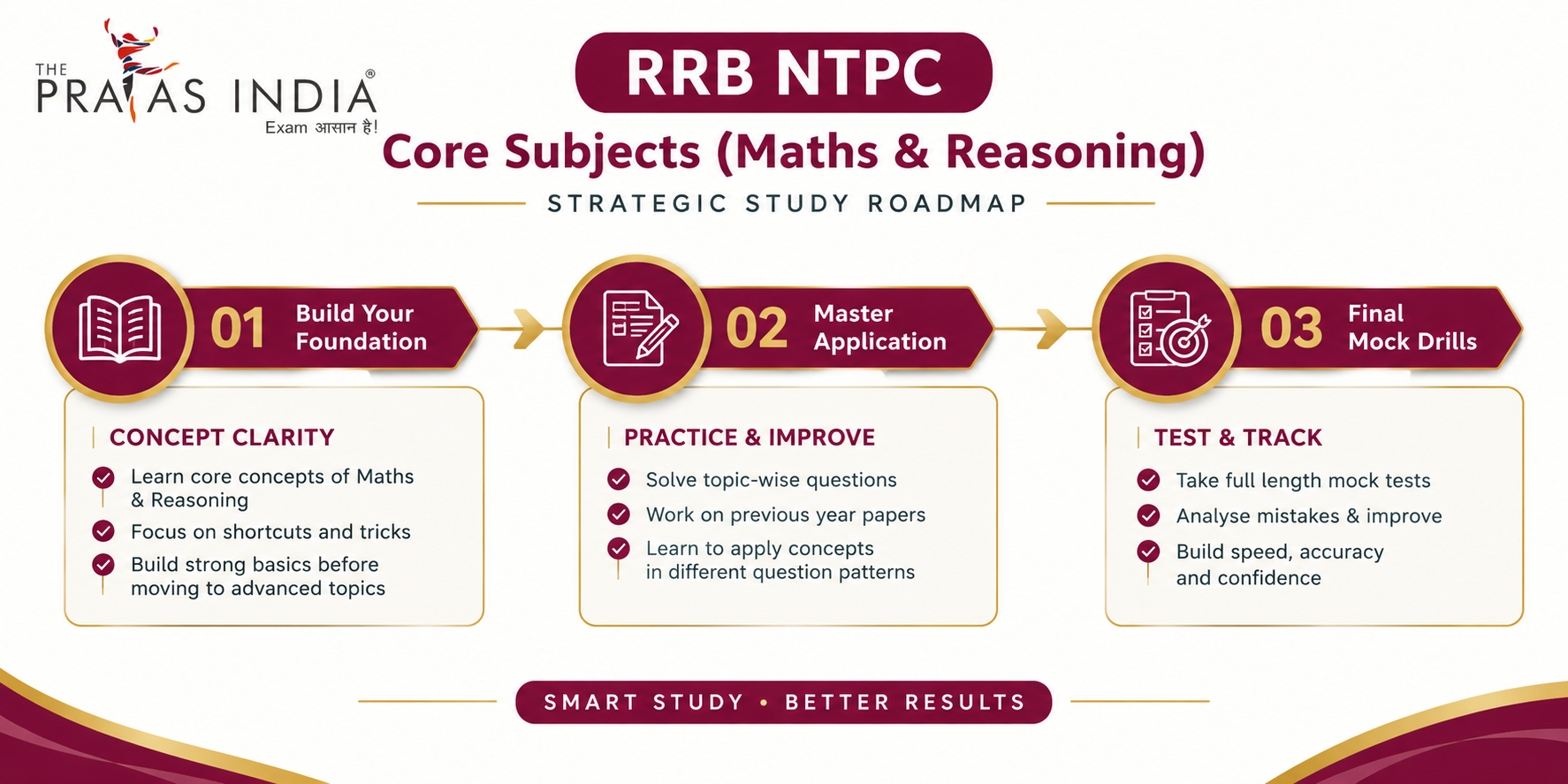
Mathematics can easily become your highest-scoring area if you balance conceptual clarity with strict calculation efficiency. The railway exam does not test advanced, theoretical geometry theorems; it tests your numerical reflexes under pressure. According to our core internal analysis, a beginner-to-advanced progression is essential to master the extensive syllabus without losing speed.
For a robust foundation, check out our comprehensive guide on how to prepare maths for RRB NTPC to structure your learning path from scratch. Your initial attention should go into foundational topics like the Number System, Decimals, Fractions, LCM, and HCF. These concepts act as building blocks for high-weightage commercial arithmetic sections, such as Percentages, Profit and Loss, Simple and Compound Interest, Time and Work, and Time and Distance.
- Master Your Fractions: Converting fraction values to percentages mentally (e.g., knowing 1/8 is 12.5%) dramatically reduces your calculation load in complex profit and loss tables.
- Isolate Word Problems: Train your brain to translate words into clear ratio equations. The faster you convert sentences into numbers, the quicker you can eliminate incorrect options.
- Unit Conversions: Avoid silly mistakes by checking that variables use compatible systems (e.g., matching kilometers with hours or meters with seconds) before executing speed-distance formulas.
💡 Calculation Efficiency Pro-Tip:
Do not overload your memory with hundreds of isolated short tricks. Master the standard conceptual method first, then incorporate simple mental math drills, squares up to 30, and cubes up to 20 to naturally boost your execution speed.
2. Cracking General Intelligence & Reasoning Patterns
The General Intelligence and Reasoning section is heavily pattern-driven. While General Awareness can feel unpredictable due to its enormous layout, reasoning follows predictable structures. To maximize your output across CBT 1 (30 questions) and CBT 2 (35 questions), you must shift away from slow, trial-and-error deductions and adopt rapid pattern-recognition workflows.
For a deep look into high-yielding topics, review our expert insight on the RRB NTPC reasoning most scoring topics for CBT 1 to streamline your practice schedule. Group your topics into logical skill pools to build maximum efficiency across similar problem types:
- High-Yield Foundations: Coding-Decoding, Analogies, Alphabet Series, and Number Series. These topics are fast to solve but require high letter-position familiarity (A=1, Z=26) to execute without writing down grids on rough sheets.
- Core Logical Blocks: Syllogisms and Venn Diagrams. Utilize structured visual diagrams while learning to filter out real-world assumptions and stick strictly to the parameters given in the statements.
- Analytical Arrangements: Linear or circular puzzles and complex blood relations. Avoid keeping multiple parameters in your head; map a clear arrangement matrix instantly to turn lengthy paragraphs into actionable visual data.
🎯 The Three-Second Recognition Rule:
Train yourself to recognize the question type within the first three seconds of reading it. If a logic puzzle appears too lengthy or confusing, skip it immediately to secure easier marks elsewhere, and return to it during your second pass.
Navigating General Awareness: Factual Mastery & Static Core
The General Awareness section forms the largest chunk of the entire examination framework, contributing 40 questions in CBT 1 and expanding to a massive 50 questions in CBT 2. Unlike Mathematics or Reasoning, where you can solve problems step-by-step using formulas, General Awareness relies entirely on sharp recall, extensive coverage, and systematic revision. If you understand how to navigate this massive section, it becomes your fastest tool to stack up marks without draining your limited 90-minute time window.
To prevent your preparation from becoming unstructured and overwhelming, you should treat it as a combination of three major sub-sections: General Science, Static General Knowledge, and Current Affairs. For an in-depth breakdown of high-priority concepts and chapters, read our definitive roadmap on RRB NTPC General Awareness most important topics for CBT 1 to align your daily reading material with high-yield areas.
1. General Science & Life Science
The Railway Recruitment Board explicitly targets fundamental school-level concepts up to the 10th CBSE/NCERT standard. This makes your science preparation comparatively structured and manageable if you emphasize conceptual definitions and everyday applications over complex, technical parameters.
- Physics: Dedicate practice time to understanding everyday applications of light (reflection and refraction), work, power, energy, motion, electricity, and basic units of measurement.
- Chemistry: Focus heavily on the periodic table, elements, compounds, common everyday chemical equations, acids, bases, salts, and the properties of common metals and non-metals.
- Biology/Life Science: This serves as a highly scoring zone. Create dedicated micro-notes for human body systems, common deficiency diseases, vitamins, human hormones, and plant biology structures.
💡 Science Memorization Hack:
Do not read through thick biology textbooks passively. Maintain an active checklist of factual data tables like vitamins and their scientific names or diseases and their respective viral/bacterial vectors for rapid, high-frequency revision loops.
2. The Static GK Core: History, Polity, and Geography
While Current Affairs shifts continuously, your static core subjects remain absolutely stable. Mastering them provides a reliable safety net for your final raw score. For a structured, foundational study approach from zero, make sure to explore our master plan on RRB NTPC general awareness preparation 2026 to divide your syllabus into manageable thematic buckets.
When covering Indian History, place your highest attention on the Indian Freedom Struggle and the timeline of the modern nationalist movements. For Indian Polity, focus your notes strictly around the Constitution, compiling high-value items like Fundamental Rights, Directive Principles, Parliamentary protocols, and crucial constitutional articles or recent amendments. For Geography, use maps to study the Indian river networks, major dams, mountain passes, national parks, and soil distributions effectively.
Additionally, stay mindful of railway-related historical parameters and general transportation timelines within India, as the RRB frequently updates factual questions surrounding public sector developments, major internal organizations, and national railway structural milestones.
📌 The 60-30-10 Revision Principle:
Allocate 60% of your daily general awareness schedule to solidifying static subjects, 30% to tracking major current events, and keep a strict 10% reserved for rapid error log review to erase your active knowledge bottlenecks.
The Mock Test Framework & Execution Strategy
Completing the massive RRB NTPC syllabus is only half the battle won. The final, crucial step to guaranteeing a top-tier rank on your first attempt is learning how to transform your conceptual knowledge into high marks under actual examination pressure. This requires a transition from raw study hours to a disciplined simulation routine.
For a structured look into exam simulation, review our step-by-step master strategy on RRB NTPC 2026 mock test strategy to learn how to manage your 90-minute window with absolute precision. You do not need to wait until you finish 100% of the syllabus to attempt tests. Utilize early sectional tests to check your subject accuracy, and gradually scale up to full-length mocks as your confidence grows.
Overcoming Score Plateaus and Error Logs
If you find that your scores are stuck in a fixed range despite consistent preparation, simply taking more tests will not solve the underlying issue. For actionable advice on breaking past performance plateaus, read our diagnostic guide on RRB NTPC mock scores not improving to track down hidden structural patterns in your mistakes. A mock test should not merely tell you your raw score; it must serve as an aggressive error-detection tool.
Divide every single incorrect answer from your mocks into distinct buckets: conceptual gaps, calculation errors, misread conditions, or time-pressure rush. Maintain a physical error notebook and revise these custom insights before starting your next mock to prevent repeating the exact same failure patterns.
Because of the strict 1/3rd negative marking penalty, blindly chasing a higher attempt count without high confidence will backfire. Focus single-mindedly on stabilizing your accuracy baseline above 85% first.
Ultimately, a structured preparation routine begun early can completely transform your public sector career path. By combining conceptual depth across Mathematics and Reasoning with active revision cycles in General Awareness and deep mock test analysis, you can easily secure a tier-1 railway designation on your very first attempt.
🎯 Ready to Turn Your Railway Career Dreams Into Reality?
Don’t let massive competition slow you down. Whether you want to transition your strategy to master calculation shortcuts or seek structured guidance for General Awareness and mock test analytics, our expert mentors at The Prayas India provide the dedicated offline classroom batches, comprehensive materials, and elite test series you need to lock down a selection.