How to Improve Content Quality in UPSC Mains Answers? | Best UPSC CSE Coaching in Mumbai | The Prayas India
The UPSC Civil Services Mains Examination does not simply test how much information a candidate has memorised. It tests whether that information can be converted into a relevant, structured, analytical and balanced answer within a strict word and time limit.
This is where content quality becomes critical.
Two aspirants may know the same topic, but their answers can receive very different marks because one answer merely reproduces information while the other demonstrates understanding, analysis, examples, constitutional references, data, multiple perspectives and a clear way forward.
For a serious UPSC aspirant, therefore, improving answer content is not about filling pages with more facts. It is about making every sentence contribute to the answer.
A high-quality Mains answer should ideally communicate five things:
You understood the question → You know the subject → You can analyse it → You can support your argument → You can present a balanced way forward.
This requires deliberate practice. Reading newspapers alone will not automatically improve answer content. Similarly, collecting hundreds of facts without learning where to use them may increase your notes but not necessarily your marks.
For candidates preparing for the UPSC CSE, content quality should be developed alongside answer writing from the early stages of preparation. A structured preparation environment, regular answer evaluation and expert feedback can make this process considerably more systematic. This is one reason aspirants considering UPSC CSE coaching in Mumbai should look beyond classroom teaching and evaluate whether an institute provides meaningful answer-writing support.
What Does “Content Quality” Actually Mean in UPSC Mains?
Content quality is often misunderstood as the number of facts included in an answer.
That is only one part of it.
A quality UPSC Mains answer contains relevant content presented with purpose. The information should directly address the demand of the question instead of demonstrating everything the candidate knows about the topic.
For example, if the question asks about the impact of climate change on Indian agriculture, listing every climate-related problem will not automatically create a strong answer. The content needs to connect climate change with agricultural productivity, cropping patterns, water availability, farmer vulnerability, regional variations, food security and policy responses.
The difference lies in relevance and application.
Good content generally demonstrates:
- Conceptual clarity
- Question relevance
- Multiple dimensions
- Analytical depth
- Examples and illustrations
- Appropriate data
- Constitutional or legal references where relevant
- Government initiatives
- Committee or institutional recommendations
- Case studies
- Balanced arguments
- A practical way forward
However, not every answer requires all of these elements.
The candidate must select what is appropriate for the specific question.
That ability to filter information according to the demand of the question is one of the most important answer-writing skills for UPSC Mains.
Content Quantity vs Content Quality
One of the biggest misconceptions among Mains aspirants is that a longer answer automatically means a better answer.
It does not.
Suppose an answer contains 250 words but repeatedly makes the same point using different sentences. Another answer contains 180–200 words but covers the issue from social, economic, administrative and environmental perspectives with relevant examples.
The second answer may demonstrate considerably better content quality.
UPSC Mains is a test of effective communication under constraints. You have limited time, limited words and a very large syllabus.
Therefore, your objective should not be:
“How much can I write?”
It should be:
“How much relevant value can I deliver within the available space and time?”
This shift in mindset can significantly improve answer writing.
The First Step: Decode the Question Before Writing
Content quality begins before the first sentence of your answer.
If you misunderstand the question, even excellent knowledge may not translate into marks.
Every Mains question contains certain signals that indicate what the examiner expects.
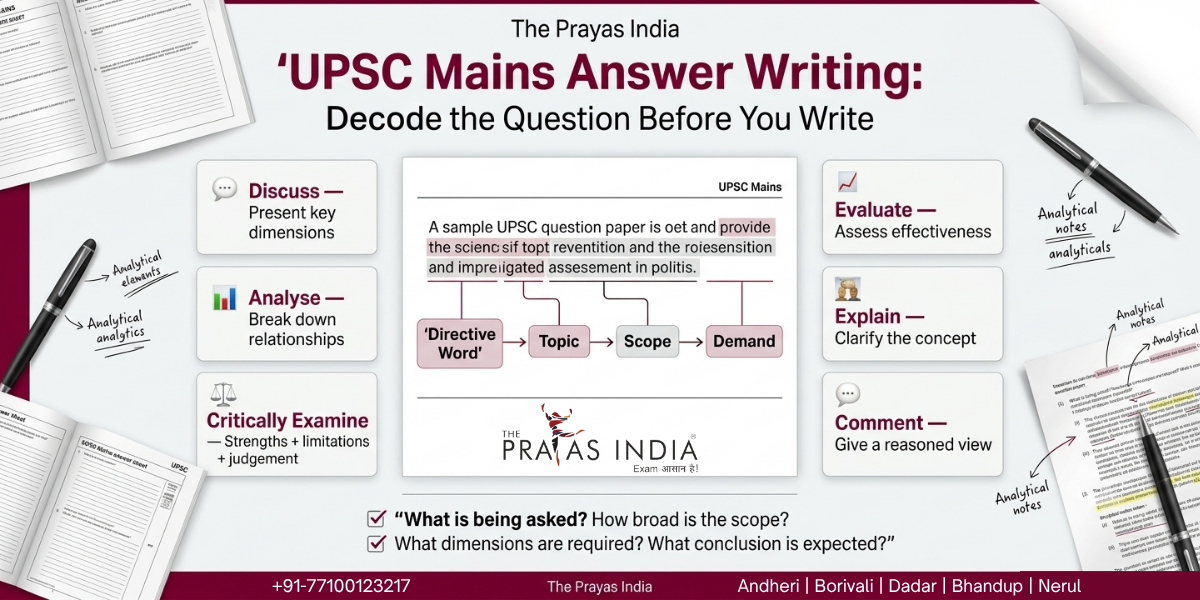
Consider the directive words:
- Discuss
- Examine
- Analyse
- Critically examine
- Evaluate
- Comment
- Explain
- Elucidate
- Substantiate
- Illustrate
- Assess
Each directive creates a slightly different demand.
“Discuss”
Generally requires a balanced examination of the issue, covering important dimensions rather than presenting only one side.
“Analyse”
Requires you to break the issue into components and establish relationships, causes, effects or implications.
“Critically Examine”
Requires both positive and negative aspects, followed by a reasoned assessment.
“Evaluate”
Requires a judgement based on evidence, outcomes, strengths, limitations or effectiveness.
“Explain”
Requires conceptual clarity and a straightforward explanation rather than unnecessary criticism.
Recognising the directive helps determine what type of content should enter the answer.
Build Answers Around Dimensions
A strong answer should rarely remain trapped in a single dimension.
Many UPSC topics have multiple interconnected aspects. Developing the habit of looking at an issue through different lenses can substantially improve content quality.
Depending on the question, useful dimensions may include:
Political
Consider governance, federalism, institutions, representation and political accountability.
Economic
Look at growth, employment, productivity, fiscal implications, inequality and resource allocation.
Social
Consider gender, vulnerable groups, social justice, inclusion, education, health and community-level impacts.
Administrative
Think about implementation, institutional capacity, transparency, accountability and service delivery.
Environmental
Where relevant, examine sustainability, ecological consequences, climate resilience and resource management.
Technological
Consider innovation, digital governance, cybersecurity, access and technological inclusion.
Ethical
Examine values, accountability, fairness, transparency, integrity and competing interests.
International
For relevant issues, connect the topic with India’s foreign policy, global institutions, geopolitical developments and international commitments.
Not every answer needs every dimension.
The skill is to identify which dimensions actually matter for the question.
Develop the “Why–Impact–Way Forward” Habit
For many analytical questions, candidates stop after describing the problem.
That produces a descriptive answer.
A stronger answer asks:
Why is this happening?
What are its consequences?
What can be done?
This basic structure can help convert factual knowledge into analytical content.
For example, if the question concerns urban flooding, simply stating that cities experience flooding is descriptive.
A stronger response may examine:
- Unplanned urbanisation
- Encroachment of drainage systems
- Loss of wetlands
- Impervious surfaces
- Extreme rainfall events
- Weak urban planning
Then move to consequences:
- Infrastructure damage
- Public health risks
- Economic losses
- Disruption of essential services
- Vulnerability of low-income communities
Finally, discuss solutions:
- Sponge-city approaches
- Wetland protection
- Drainage planning
- Urban flood forecasting
- Nature-based solutions
- Better municipal coordination
The result is a much more complete answer without requiring unnecessary length.
Use Examples to Give Content Weight
Examples can transform abstract arguments into concrete explanations.
A statement such as “Digital governance can improve service delivery” is reasonable but generic.
Adding an appropriate example can make the argument more convincing.
For instance, you might refer to digital platforms that improve access to public services, direct benefit transfers, online grievance mechanisms or technology-enabled welfare delivery.
Examples can come from:
- Government schemes
- Indian states
- District-level innovations
- Supreme Court judgments
- Parliamentary committees
- Reports
- International experiences
- Historical events
- Contemporary developments
- Case studies
The key is relevance.
Do not force an example into every sentence. Use examples where they strengthen your argument.
Data: Use It as Evidence, Not Decoration
Data can significantly improve the credibility of an answer, but only when used correctly.
A common mistake is to memorise dozens of statistics and insert them randomly into answers.
Instead, maintain a small collection of high-utility data points that can support multiple themes.
Useful sources can include:
- Government reports
- NITI Aayog publications
- Economic Survey
- Census-related information
- NFHS
- NCRB
- RBI reports
- World Bank
- UN agencies
- Parliamentary documents
- Official ministry reports
However, do not compromise accuracy for the sake of including a number.
If you are uncertain about the exact figure, a carefully worded qualitative statement can be safer than an incorrect statistic.
The purpose of data is to strengthen an argument—not to make the answer look artificially academic.
Use Constitutional Articles and Supreme Court Judgments Strategically
For General Studies II, constitutional references and landmark judicial decisions can significantly strengthen content.
But again, relevance matters more than quantity.
If a question concerns equality, you may consider relevant constitutional provisions. If it concerns privacy, rights, governance or federalism, appropriate Supreme Court judgments can demonstrate conceptual understanding.
The important principle is:
Do not name-drop constitutional provisions or judgments. Explain their relevance.
A judgment becomes valuable when you connect it to the argument you are making.
For example:
Concept → Constitutional principle → Judicial interpretation → Present challenge → Way forward
This creates analytical depth.
Government Schemes Should Be Used With Context
Government schemes are useful sources of examples, but candidates often make the mistake of converting answers into lists of schemes.
Instead of writing:
“Government has launched Scheme A, Scheme B, Scheme C and Scheme D…”
explain how a particular initiative addresses the problem under discussion.
For example:
Problem → Policy intervention → Impact → Limitation → Improvement required
This approach demonstrates that you understand policy rather than simply memorising names.
It also makes your answer more analytical.
Committee and Commission Recommendations
Committee reports can provide high-quality content for many GS answers.
Instead of memorising entire reports, identify:
- Major recommendation
- Problem addressed
- Key reform suggested
- Why implementation matters
Examples of committees or commissions may be relevant to governance, administrative reform, policing, education, health, electoral reforms and social policy.
A concise reference to an appropriate recommendation can often add more value than several generic statements.
Develop Multi-Dimensional Introductions
The introduction should not consume excessive space.
A strong introduction can establish the context in one or two sentences.
You can begin with:
Definition
Explain the central concept briefly.
Constitutional Reference
Use an appropriate constitutional principle when relevant.
Recent Development
Connect the issue with a contemporary event or policy development.
Data
Use a reliable statistic if it adds immediate context.
Quote or Thinker
Use only when directly relevant and accurately attributed.
Background
Provide brief historical context where necessary.
The introduction should answer a basic question:
“Why should the examiner care about this issue in the context of the question?”
Avoid writing a generic introduction that could fit ten different questions.
Improve the Body Through “Claim–Evidence–Analysis”
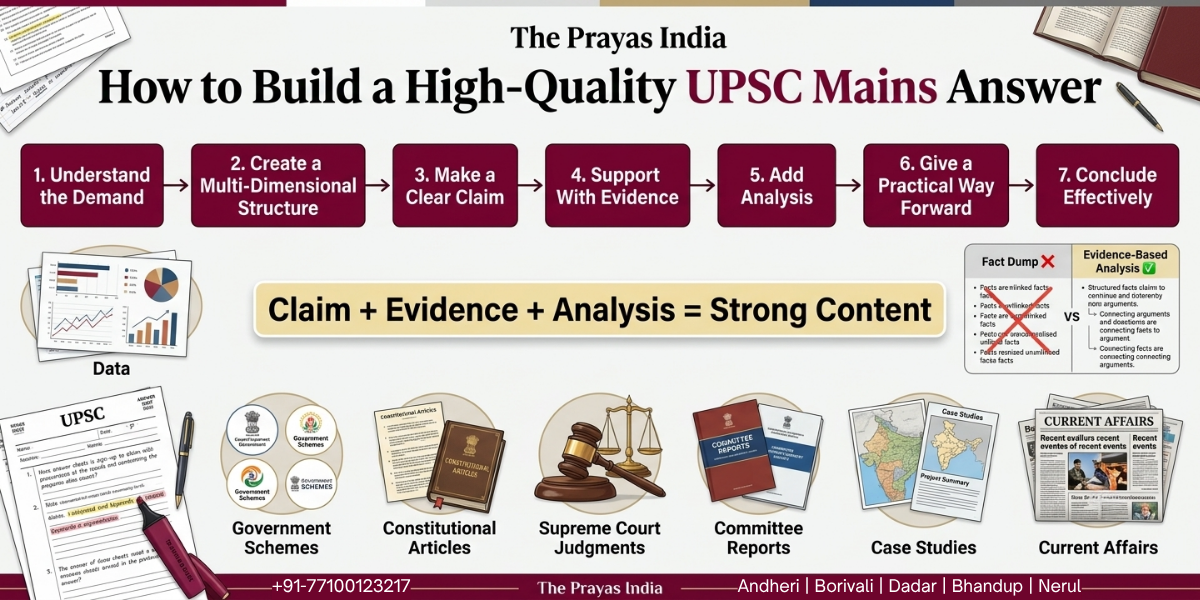
One of the most useful frameworks for improving content quality is:
Claim → Evidence → Analysis
Claim
Make your point.
Evidence
Support it through an example, data point, report, constitutional reference, case study or relevant fact.
Analysis
Explain why the evidence matters and connect it to the question.
For example:
Claim: Urbanisation without adequate planning increases disaster vulnerability.
Evidence: Rapid expansion of built-up areas can reduce natural drainage and increase surface runoff.
Analysis: This means urban flood management cannot rely only on post-disaster relief; it requires integrated land-use planning and protection of natural drainage systems.
This structure prevents your answer from becoming a collection of disconnected facts.
Avoid the “Fact Dump” Problem
A fact-heavy answer is not necessarily an analytical answer.
Suppose you remember:
- Five government schemes
- Three committee reports
- Four statistics
- Two Supreme Court judgments
- Several international examples
If you simply list them, the answer may still lack coherence.
The examiner wants to see your understanding and analysis.
Therefore, whenever you add a fact, ask:
“What argument does this fact support?”
If you cannot answer that question, the information may not be necessary.
This simple filter can dramatically improve content quality.
Use Diagrams and Flowcharts When They Add Value
Diagrams can make an answer more readable and help communicate complex relationships quickly.
Useful formats include:
Cause → Effect → Impact → Solution
or
Input → Process → Outcome
or
Problem → Institutional Gap → Reform → Expected Result
Diagrams can be especially useful in subjects such as:
- Geography
- Environment
- Economy
- Governance
- Disaster Management
- Internal Security
- Science & Technology
But diagrams should not become decorative elements.
Use them when they communicate information faster than paragraphs.
Think Like the Examiner
Before finalising an answer, ask yourself:
Did I answer exactly what was asked?
Have I covered multiple dimensions?
Did I provide evidence?
Have I analysed rather than merely described?
Did I include a balanced perspective?
Is my way forward practical?
Is the answer easy to evaluate?
This mental checklist can gradually improve your answer-writing quality.
Why Reading Alone Does Not Improve Mains Answers
Many aspirants spend several hours reading newspapers, books and current-affairs material but struggle when asked to write a 150- or 250-word answer.
This happens because input and output are different skills.
Reading increases knowledge.
Answer writing teaches you how to retrieve, organise and communicate that knowledge under pressure.
Therefore, answer writing should begin before you feel completely prepared.
You do not need to know the entire syllabus before writing your first answer.
Start with basic questions, identify your weaknesses and gradually improve.
The quality of your answers will grow alongside your knowledge base.
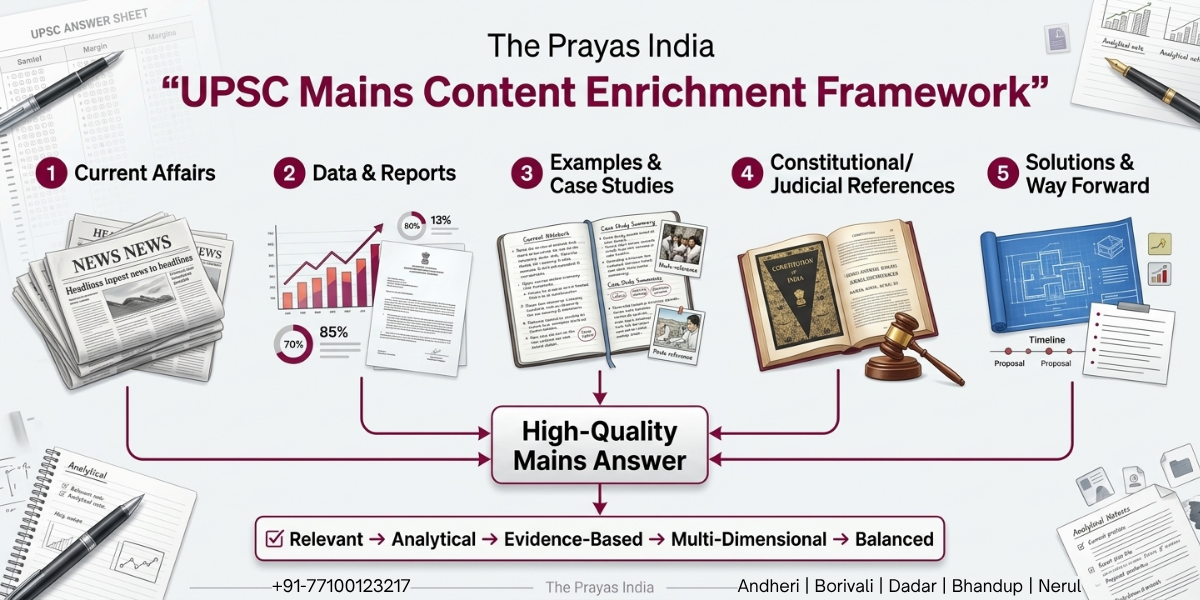
Create a UPSC Content Enrichment Notebook
A dedicated content-enrichment notebook can help convert daily reading into usable Mains material.
Instead of making enormous notes, organise information according to themes.
For example:
Governance
- Constitutional provisions
- Supreme Court judgments
- Committees
- Government initiatives
- Best practices
- Case studies
- Data
- Way-forward points
Economy
- Key indicators
- Government policies
- Budget/Economic Survey references
- Challenges
- Reforms
- International comparisons
Environment
- Reports
- Conventions
- Indian examples
- Climate initiatives
- Case studies
- Sustainable solutions
This makes revision much easier because the information is stored according to answer-writing requirements, not merely according to newspaper dates.
Key Takeaway
Improving content quality in UPSC Mains is not about collecting more and more information. It is about learning to select, organise, analyse and apply information according to the demand of the question.
Start by decoding the directive.
Then identify the dimensions.
Build arguments using claims and evidence.
Use relevant data, examples, constitutional provisions, judgments, schemes and committee recommendations.
Most importantly, explain why the information matters.
That is what transforms a factual answer into an analytical answer.
Turn Current Affairs Into Mains-Ready Content
Current affairs should not be treated as a separate subject that you study only for the sake of prelims or newspaper discussions.
For Mains preparation, current affairs should become a content-enrichment resource.
Suppose you read about a new development related to artificial intelligence. Instead of simply noting the news, ask:
- What is the issue?
- Why is it important?
- Which GS paper does it connect with?
- What are its positive implications?
- What are the risks?
- Which stakeholders are affected?
- What constitutional or ethical concerns arise?
- Is there an Indian example?
- Is there an international example?
- What can be done?
This process transforms news into answer material.
A single current-affairs development can potentially contribute to answers in Governance, Economy, Science & Technology, Ethics, Social Issues and International Relations, depending on the context.
The skill is not in collecting more news. It is in finding more answer-writing applications for the right news.
Create an Issue-Based Current Affairs Bank
Instead of organising all your current affairs chronologically, maintain an issue-based system.
For example:
Artificial Intelligence
Opportunities: Productivity, healthcare, education, governance, research
Challenges: Job displacement, bias, misinformation, privacy, cybersecurity
Examples: Indian AI initiatives, global regulatory approaches
Way Forward: Responsible AI, transparency, human oversight, digital literacy
Similarly, for Urbanisation, your notes could include:
Challenges → Infrastructure → Environment → Governance → Social Impact → Reforms → Best Practices
This method makes revision much faster because UPSC questions are usually issue-oriented rather than newspaper-date-oriented.
Use Case Studies to Make Answers More Concrete
Case studies are particularly powerful because they demonstrate that you can connect theory with real-world experience.
A good case study does not need to be lengthy.
You may mention:
- A successful district-level initiative
- A state government innovation
- A community-led programme
- A public-sector reform
- A social enterprise
- A technology-based governance solution
- An international best practice
For example, while discussing women-led development, a suitable example of women self-help groups can provide practical context to an otherwise theoretical argument.
While discussing disaster management, a successful local disaster-preparedness model can strengthen the answer.
The key is to keep case studies short, specific and relevant.
Build an Example Bank for Every GS Paper
A useful strategy is to maintain separate example banks.
| GS Paper | Useful Content |
|---|---|
| GS I | Historical examples, geographical phenomena, social issues, cultural examples |
| GS II | Constitutional provisions, judgments, committees, schemes, governance case studies |
| GS III | Economic data, government reports, technology examples, environmental initiatives, disaster-management cases |
| GS IV | Ethical dilemmas, administrators, public figures, real-life cases, philosophical ideas |
This makes content retrieval easier during revision.
You should not try to memorise hundreds of examples.
Aim for high-quality, versatile examples that can support multiple themes.
Use Government Reports as Content Enrichment Tools
Government reports can provide valuable content because they offer credible data, institutional observations and policy recommendations.
Important sources may include:
- Economic Survey
- Union Budget
- NITI Aayog reports
- Ministry reports
- Parliamentary committee reports
- RBI publications
- NFHS
- NCRB
- Census-related information
- Government indices and dashboards
However, reading every report cover to cover is neither necessary nor practical for most aspirants.
Instead, extract information that can directly strengthen Mains answers.
For each important report, note:
Key Finding → Relevant Data → Major Challenge → Recommendation → Possible Mains Application
This keeps your preparation focused.
Improve Your Introductions
A good introduction should create context without wasting valuable words.
One effective approach is to maintain several introduction formats and select one according to the question.
Definition-Based Introduction
Useful for conceptual questions.
Constitutional Introduction
Useful for questions involving rights, governance, democracy, federalism and social justice.
Current-Affairs Introduction
Useful when the topic is connected to a recent development.
Data-Based Introduction
Useful when a credible statistic immediately establishes the scale of a problem.
Historical Introduction
Useful for questions involving historical continuity or evolution.
Contrasting Introduction
Present two seemingly opposite aspects of an issue and establish the central tension.
The important point is to avoid writing the same generic introduction for every question.
Build Analytical Conclusions
The conclusion should not merely repeat the introduction.
It should provide closure and direction.
Depending on the question, a conclusion can include:
- A practical way forward
- Constitutional values
- Sustainable development
- Institutional reform
- Stakeholder collaboration
- Technology with safeguards
- Inclusive development
- Democratic accountability
- A balanced judgement
For example, a question about technological development should not end simply with “technology has both advantages and disadvantages.”
A stronger conclusion could connect technological innovation with accessibility, accountability, human oversight and inclusive development.
The conclusion should leave the examiner with the impression that you understand not only the problem but also the direction in which it should move.
Improve Answers Through Regular Answer Writing
No amount of reading can replace actual answer-writing practice.
You need to physically write answers within a time limit.
Start with one answer every day if you are a beginner. Once you become comfortable, increase the number gradually.
Initially, focus on:
- Understanding the question
- Creating a quick structure
- Writing relevant points
- Maintaining logical flow
- Developing a conclusion
Do not obsess over perfection during the first few weeks.
Your early answers are supposed to reveal weaknesses.
That is how improvement begins.
Use a 10-Minute Planning Method
Before writing an answer, spend a short amount of time planning.
You do not need to write a detailed outline.
Instead, quickly identify:
Directive → Core Demand → Dimensions → Evidence → Way Forward
For example:
Directive: Critically examine
Demand: Examine both benefits and limitations
Dimensions: Economic + Social + Governance
Evidence: Relevant data/example
Way Forward: Institutional and policy measures
This mental framework reduces the possibility of writing the answer in one direction and realising halfway through that an important dimension has been missed.
Practise With Different Question Types
Do not practise only straightforward questions.
UPSC can frame questions in ways that require different thinking.
Include:
Direct Questions
These test conceptual understanding.
Analytical Questions
These require relationships between causes, consequences and implications.
Critical Questions
These require balanced arguments and judgement.
Statement-Based Questions
These require you to assess the validity of a proposition.
Multi-Dimensional Questions
These require integration of several areas.
Practising different question formats trains you to adapt instead of relying on a fixed template.
The Importance of Feedback in Answer Writing
Self-evaluation is useful, but external feedback can reveal weaknesses you may not notice yourself.
For example, you may believe your answer is analytical because you have included several facts. An evaluator may identify that the answer is still largely descriptive.
Similarly, you may not realise that your introduction consumes too many words or that your conclusion is repetitive.
A good evaluation system should assess:
- Relevance
- Content
- Structure
- Introduction
- Body
- Conclusion
- Examples
- Data
- Analysis
- Presentation
- Time management
The objective of feedback is not merely to assign a score.
It should answer:
“What should I change in my next answer?”
Maintain an Answer-Writing Error Log
Just as you maintain a mistake notebook for objective questions, create an error log for Mains answers.
After receiving feedback, classify your weaknesses.
Content Gap
You did not know enough about the topic.
Relevance Gap
You knew the information but did not answer the question directly.
Analytical Gap
You described the issue but did not explain relationships or implications.
Example Gap
Your arguments lacked supporting evidence.
Structure Gap
The answer lacked a logical flow.
Presentation Gap
The content was good but difficult to read.
Time Gap
You could not complete the answer within the required time.
Once you identify your dominant weakness, improvement becomes much more targeted.
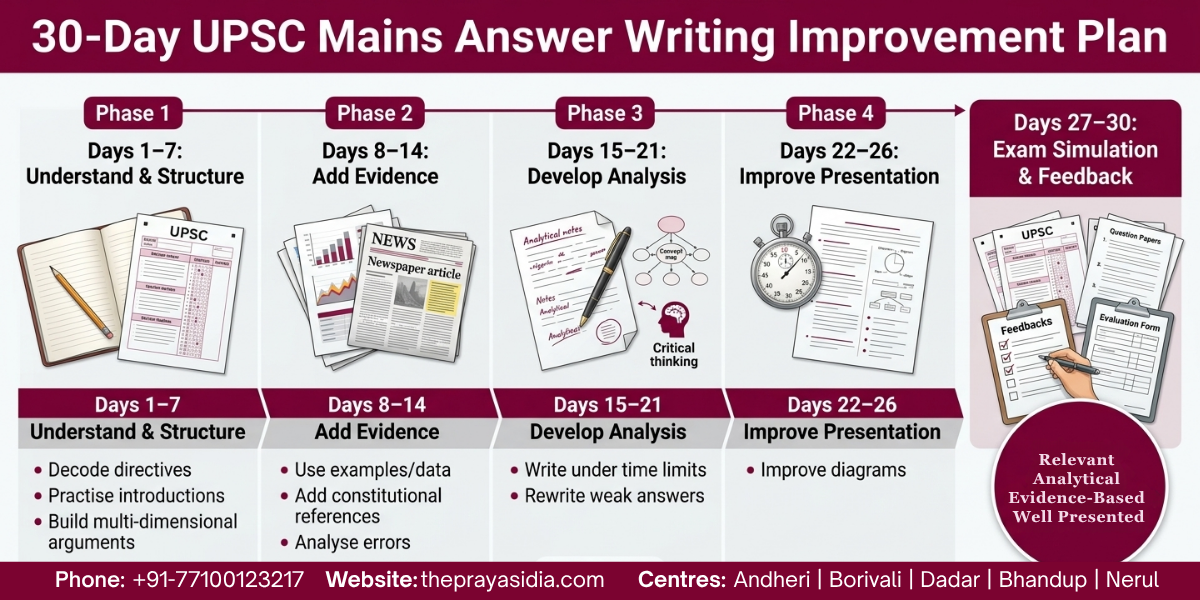
A 30-Day Plan to Improve UPSC Mains Content Quality
Candidates who want to systematically improve their answers can follow a focused 30-day programme.
Days 1–7: Build the Foundation
Focus on understanding question directives and answer structures.
Write one answer every day.
After writing, check whether you have addressed the exact demand of the question.
Do not worry excessively about speed yet.
Days 8–14: Add Evidence
Start enriching your answers with:
- Examples
- Government initiatives
- Data
- Constitutional provisions
- Reports
- Case studies
The objective is to move from generic statements to evidence-backed arguments.
Days 15–21: Improve Analysis
For every major point, ask:
Why?
How?
What is the impact?
Who is affected?
What are the limitations?
What can be done?
This questioning process helps transform descriptive content into analytical content.
Days 22–26: Improve Presentation
Work on:
- Short paragraphs
- Subheadings
- Bullet points where appropriate
- Flowcharts
- Diagrams
- Underlining important terms
- Clear introductions
- Balanced conclusions
Presentation should support content rather than replace it.
Days 27–30: Simulate Examination Conditions
Write answers under strict time limits.
Attempt mixed questions rather than questions from only one topic.
After each session, analyse your mistakes and identify the three most important improvements for the next session.
How to Use Model Answers Correctly
Model answers can be valuable, but they should not become something you simply memorise.
After writing your own answer, compare it with a good model answer.
Look for differences in:
- Introduction
- Number of dimensions
- Quality of arguments
- Examples
- Data
- Structure
- Conclusion
- Presentation
Then ask:
What did the model answer do that mine did not?
This is far more useful than copying sentences.
Over time, you will begin to develop your own answer-writing style.
Don’t Try to Make Every Answer “Perfect”
UPSC Mains involves a large number of questions across multiple papers.
You cannot spend excessive time perfecting every individual answer.
Your objective is to develop a repeatable high-quality process.
When you see a question:
- Decode the directive.
- Identify the demand.
- Brainstorm dimensions.
- Select relevant evidence.
- Create a quick structure.
- Write clearly.
- End with a practical conclusion.
- Move on.
This process should eventually become almost automatic.
That is what regular timed practice achieves.
How to Make Your Answers More Original
Originality in UPSC Mains does not mean writing unusual or controversial arguments.
It means demonstrating independent thinking within a balanced framework.
You can do this by:
- Connecting two seemingly different dimensions
- Identifying an implementation gap
- Presenting a stakeholder perspective
- Linking a current event with a static concept
- Providing an unconventional but practical solution
- Highlighting both short-term and long-term implications
For example, instead of simply discussing unemployment as an economic issue, you could connect it with social mobility, demographic dividend, skill development, women’s labour-force participation and regional disparities.
Such connections demonstrate broader understanding.
Think in Terms of Stakeholders
Stakeholder analysis is another simple method for adding depth.
Depending on the question, stakeholders may include:
- Citizens
- Government
- Local bodies
- Private sector
- Farmers
- Women
- Children
- Vulnerable communities
- Civil society
- Judiciary
- Media
- International institutions
Ask:
How does this issue affect each relevant stakeholder?
This often reveals dimensions that you might otherwise overlook.
Add the Implementation Perspective
Many Mains answers identify excellent policies but fail to discuss implementation.
A strong policy-related answer can consider:
Policy → Institution → Implementation → Monitoring → Outcome
Ask:
- Who will implement it?
- What resources are required?
- What institutional barriers exist?
- How will beneficiaries be identified?
- How will outcomes be measured?
- What accountability mechanism is needed?
This approach is especially useful for GS II and GS III questions.
It also demonstrates administrative thinking, which is highly relevant to the Civil Services examination.
Ethics Answers Need More Than Definitions
Content quality is particularly important in GS Paper IV.
Candidates should not simply reproduce definitions of integrity, empathy, accountability or compassion.
Instead, connect ethical concepts with:
- Administrative situations
- Real-life examples
- Public service values
- Constitutional morality
- Stakeholder interests
- Practical dilemmas
In case studies, demonstrate how values can influence decision-making.
For example:
Situation → Stakeholders → Ethical Issues → Options → Evaluation → Decision → Justification
This makes the answer structured and practical.
Optional Subject and Essay Also Require Content Quality
The principles discussed here are not limited to General Studies.
In the Essay paper, content quality comes from the ability to explore a topic through multiple dimensions while maintaining coherence.
In the Optional subject, content quality depends heavily on conceptual depth, subject-specific terminology, thinkers, scholars, examples, diagrams and appropriate analysis.
Therefore, developing the habit of evidence-backed, multi-dimensional thinking benefits your entire Mains preparation.
How Coaching Can Improve Mains Answer Quality
Self-study is essential for UPSC, but structured guidance can reduce the trial-and-error involved in developing answer-writing skills.
A quality UPSC coaching programme can help aspirants through:
- Structured syllabus coverage
- Current-affairs integration
- Answer-writing practice
- Regular evaluation
- Faculty feedback
- Model answer discussions
- Test series
- Doubt resolution
- Revision planning
- Performance tracking
The most important component is feedback.
Writing hundreds of answers without understanding your recurring weaknesses may not produce the desired improvement.
A structured evaluation process can help you identify exactly where your answers are losing value.
What to Look for Before Joining UPSC CSE Coaching in Mumbai
If you are searching for the best UPSC CSE coaching in Mumbai, avoid making your decision solely on advertisements, faculty popularity or the number of students enrolled.
Look at the actual academic system.
Ask whether the institute provides:
Integrated Current Affairs
Does current affairs become part of GS answer writing, or is it treated as a completely separate activity?
Answer Writing
Are students regularly required to write Mains answers?
Evaluation
Are answers checked by experienced faculty or evaluators?
Personalised Feedback
Does the student receive specific guidance about improvement?
Test Series
Are there regular tests that simulate actual examination conditions?
Revision
Is there a structured mechanism for revisiting previously covered topics?
Mentorship
Can students discuss preparation challenges and receive strategic guidance?
These factors can make a meaningful difference when choosing a UPSC CSE coaching institute in Mumbai.
A Better Definition of a “Good” UPSC Mains Answer
A good answer is not necessarily the one containing the most facts.
It is the answer that makes the examiner feel:
“This candidate understands the issue, has relevant knowledge, can analyse it from different perspectives and can communicate the argument clearly.”
That is the standard you should work toward.
Your answer should ideally have:
A relevant introduction
↓
A logically organised body
↓
Multiple appropriate dimensions
↓
Evidence-backed arguments
↓
Balanced analysis
↓
Practical way forward
↓
A concise conclusion
When this structure becomes habitual, content quality improves naturally.
Final Checklist Before Submitting a UPSC Mains Answer
Before moving to the next question, develop the habit of mentally checking five things:
1. Relevance
Did I answer what was asked?
2. Depth
Did I explain the issue rather than merely describe it?
3. Evidence
Did I use relevant examples, data, reports or references where appropriate?
4. Balance
Did I consider multiple perspectives?
5. Conclusion
Did I provide a practical and constructive closure?
If the answer satisfies these five requirements, its content quality is likely to be considerably stronger than an answer that simply contains a large number of facts.
Final Takeaway
Improving content quality in UPSC Mains answers is a skill-building exercise, not a one-time revision task.
You need to read widely, but you also need to learn how to convert reading into usable content. You need examples, but you must understand where they fit. You need data, but it must support your argument. You need constitutional provisions and judgments, but they should be connected to the question rather than inserted for decoration.
Most importantly, you must write.
Regular answer writing forces you to retrieve information, structure arguments, identify gaps and communicate within a strict word limit. Feedback then tells you where improvement is required.
The strongest approach is therefore:
Read → Organise → Write → Evaluate → Improve → Rewrite
Repeat this cycle consistently and your answers can gradually become more relevant, analytical, evidence-based and examiner-friendly.
For aspirants preparing for the UPSC Civil Services Examination in Mumbai, the right academic environment can add structure and accountability to this process. The Prayas India focuses on exam-oriented preparation that combines conceptual learning with practice, evaluation and strategic guidance.
If you are looking for UPSC CSE coaching in Mumbai, evaluate an institute not simply by the number of classes it offers, but by how effectively it helps you convert knowledge into Mains performance.
Because in UPSC Mains, knowing more is only one part of the journey.
The real advantage comes from knowing what to write, how to write it and why it matters.
Contact Us
📞 Call Now: +91-77100 13217
🌐 Website: theprayasindia.com
📍 Centres: Andheri | Borivali | Dadar | Nerul | Bhandup
Frequently Asked Questions
1. How can I improve content quality in UPSC Mains answers?
Focus on relevance, multi-dimensional analysis, examples, data, constitutional references, case studies and practical solutions. Regular answer writing and feedback are essential for converting knowledge into high-quality content.
2. Is reading newspapers enough to improve UPSC Mains answers?
No. Newspapers provide valuable information, but aspirants must organise that information and practise applying it through answer writing. The process should be Read → Organise → Apply.
3. How many examples should I use in a UPSC Mains answer?
There is no fixed number. Use examples wherever they strengthen an argument. A few relevant and well-integrated examples are generally more useful than a long list of unrelated examples.
4. Should I use data in every UPSC Mains answer?
No. Use reliable data when it adds credibility or establishes the scale of an issue. Avoid forcing uncertain or irrelevant statistics into an answer.
5. How can I make a UPSC answer more analytical?
Ask questions such as why, how, impact, stakeholders, limitations and way forward. Connecting claims with evidence and explaining the significance of that evidence can make an answer more analytical.
6. How important is answer-writing practice for UPSC Mains?
It is extremely important. Answer writing develops retrieval, structuring, time management and communication skills that cannot be developed through reading alone.
7. Should I join UPSC coaching in Mumbai for Mains preparation?
Coaching can provide structured learning, answer evaluation, test series, current-affairs integration and mentorship. Before joining, evaluate the institute's complete academic and feedback system.
8. How can The Prayas India help UPSC aspirants?
The Prayas India offers structured UPSC preparation with conceptual learning, current-affairs integration, practice, testing and exam-focused guidance designed to help aspirants prepare systematically.