How to Start UPSC CSE 2027 Preparation from Scratch | Best UPSC Coaching in Mumbai | The Prayas India
Starting UPSC CSE 2027 preparation from scratch can feel overwhelming. The syllabus is extensive, the number of resources available online is enormous, and every aspirant seems to have a different strategy. For a beginner, the biggest challenge is often not finding information but knowing where to begin, what to study, what to avoid and how to build a preparation system that can actually be followed for months.
The right beginning can make a significant difference to the quality of your UPSC preparation. Instead of trying to complete multiple books or following every strategy available online, beginners should focus on understanding the examination, building conceptual clarity, studying the syllabus systematically, solving previous year questions and developing a consistent revision and testing routine.
For aspirants preparing for UPSC CSE 2027, starting early also creates an opportunity to prepare for both Prelims and Mains in an integrated manner. With proper planning and guidance, even a beginner can gradually move from understanding the basics to developing the analytical and answer-writing skills required for the Civil Services Examination.
For students looking for structured guidance, joining the right UPSC coaching in Mumbai can also make the initial phase more organised. The right coaching environment can provide a defined study direction, experienced faculty guidance, study material, doubt-solving support and regular assessment instead of leaving beginners to figure out every aspect of preparation on their own.
Starting from Scratch: First Understand the UPSC Examination
Before opening the first book, understand the structure of the Civil Services Examination. UPSC CSE is not an examination that can be approached effectively through random subject-wise studying. Its stages, syllabus and question patterns influence the entire preparation strategy.
Broadly, the examination consists of:
- Civil Services Preliminary Examination
- Civil Services Main Examination
- Personality Test / Interview
Prelims primarily works as a screening stage, while the Mains examination tests a candidate’s ability to understand issues, analyse them and present arguments effectively. The Personality Test evaluates the candidate’s overall suitability for a career in the civil services.
A beginner therefore needs to understand from the beginning that UPSC preparation is not simply about memorising facts. It requires a combination of knowledge, conceptual understanding, analytical thinking, writing ability, revision and examination temperament.
This is also where structured UPSC coaching can be useful for beginners. Instead of spending the first few months deciding what to study next, an organised programme can help create a progression from foundation building to practice and evaluation.
Begin With the UPSC Syllabus, Not a Random Booklist
One of the most common mistakes beginners make is purchasing several popular UPSC books before understanding the syllabus. This often creates a false sense of preparation while making the actual study process more complicated.
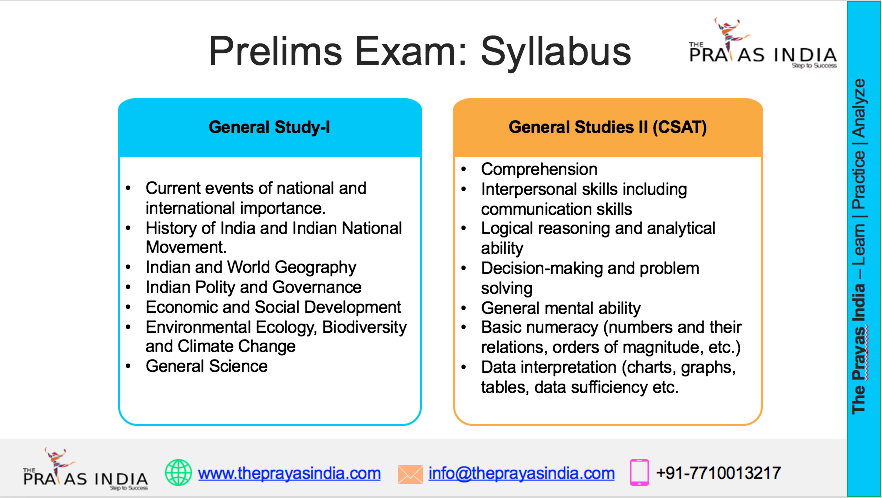
The UPSC syllabus should become your primary reference document. Every topic you study should have a connection with a specific syllabus area or a recurring question trend.
For a beginner, the syllabus helps answer three important questions:
- What needs to be studied?
- How deeply does it need to be studied?
- Which areas deserve greater priority?
Print the syllabus or maintain a digital copy and gradually become familiar with its structure. When you start studying a subject, map the chapters and topics you cover against the syllabus. Over time, this habit prevents unnecessary reading and helps you develop a more examination-oriented approach.
The objective is not to finish every possible source available for UPSC. The objective is to develop command over the areas that UPSC actually expects candidates to understand.
Make Previous Year Questions Your Preparation Compass
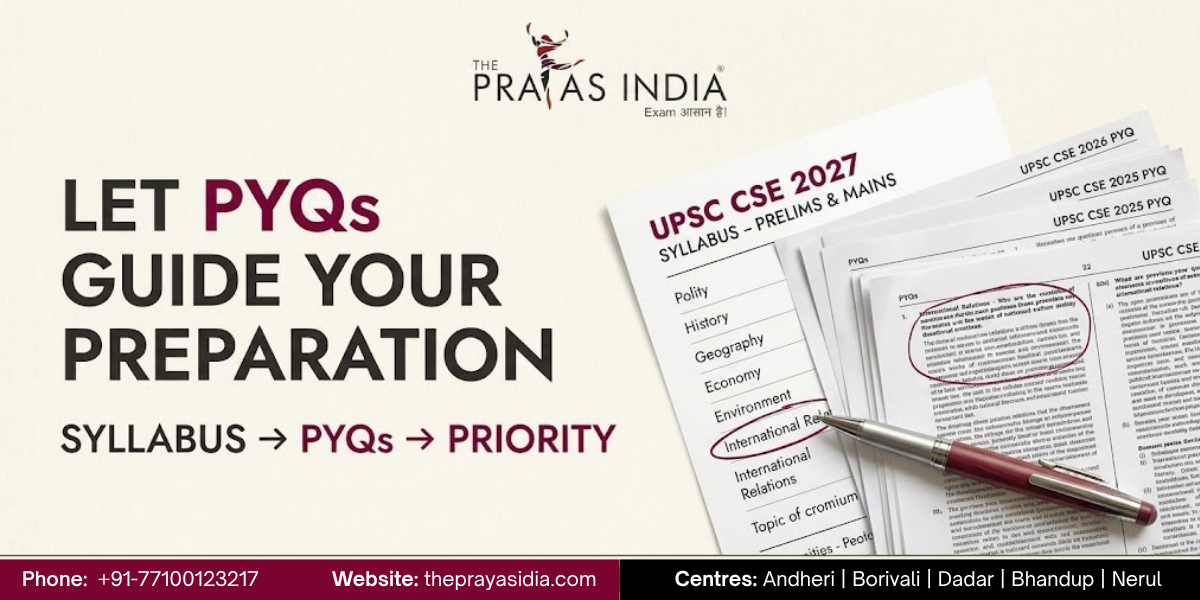
Previous year questions are among the most useful resources for a UPSC beginner because they reveal the difference between general knowledge and examination-relevant preparation.
Reading a chapter without looking at questions can make preparation passive. When you examine previous year questions alongside the syllabus, you begin to understand how UPSC frames issues, connects concepts and tests understanding.
Instead of solving PYQs only after completing the syllabus, use them throughout your preparation.
A practical approach is:
- Read the relevant syllabus topic.
- Study the basic concepts.
- Look at previous year questions from that area.
- Identify recurring themes and concepts.
- Revisit the topic with the questions in mind.
- Make short revision notes based on what actually matters.
This approach gradually develops the ability to study with the examination in mind rather than simply collecting information.
For beginners enrolled in a structured UPSC CSE 2027 coaching programme, PYQ discussions can become even more useful when faculty explain the reasoning behind question framing, important themes and common conceptual traps.
Build Your Foundation Before Chasing Advanced Sources
A beginner often feels that serious UPSC preparation requires immediately reading advanced material. In reality, strong preparation begins with a clear foundation.
Start by understanding the basic concepts of subjects such as Indian Polity, Modern Indian History, Geography, Economy, Environment and Science & Technology. At this stage, the goal is not to remember every fact. The goal is to understand the fundamental framework of each subject.
For example, while studying Polity, understand how constitutional institutions work before attempting to memorise every article and provision. In Economy, understand concepts such as inflation, monetary policy, fiscal policy and economic growth before moving into complicated current affairs discussions.
A strong foundation makes current affairs easier to understand later because you have a conceptual framework into which new information can fit.
Your first phase should therefore prioritise:
- Conceptual clarity
- Syllabus familiarity
- Standard sources
- Previous year questions
- Basic note-making
- Regular revision
This foundation is particularly important for aspirants joining coaching for the first time. A good UPSC coaching institute in Mumbai should not simply provide a large quantity of material; it should help students understand difficult concepts progressively and know which resources deserve their attention.
Create a Limited and Reliable Resource List
The internet has made UPSC preparation information easily available, but this can become a problem when every source starts competing for your attention.
A beginner can spend hours watching strategy videos, downloading PDFs and comparing booklists without actually completing the required study.
Your objective should be to create a limited, reliable and repeatable resource system.
For each major subject, identify:
- One primary source for foundational study
- One reliable source for current affairs
- Previous year questions
- Revision notes
- Test material
Once you have selected your sources, give yourself enough time to revise them. Reading five sources once is generally less useful than studying one reliable source multiple times with proper revision.
Structured coaching can simplify this process by providing curated study material and a defined sequence. This is one of the practical reasons many beginners consider joining UPSC classes in Mumbai rather than managing every aspect of resource selection independently.

Start Current Affairs With a System
Current affairs are an important part of UPSC preparation, but beginners often make the mistake of trying to remember every news item.
The purpose of current affairs preparation is not to collect news. It is to understand issues that connect with the UPSC syllabus and develop the ability to analyse them from multiple perspectives.
For example, a news report about a government policy may involve aspects of governance, the economy, social development, federalism or constitutional issues. Instead of memorising the headline, understand the issue behind it.
A useful current affairs system should help you identify:
- What happened?
- Why is it important?
- Which syllabus area does it connect with?
- What are the major challenges?
- What can be the way forward?
This approach becomes particularly useful for Mains answer writing because it converts current affairs into arguments, examples and supporting evidence rather than isolated facts.
Don’t Ignore Mains While Preparing for Prelims
One of the biggest strategic mistakes beginners can make is treating Prelims and Mains as two completely separate examinations.
Prelims requires factual knowledge, conceptual clarity, elimination skills, accuracy and time management. Mains requires analytical depth, structured writing, examples, arguments and the ability to present balanced answers.
The preparation for both should therefore overlap wherever possible.
While studying a GS topic, ask yourself both:
“How can this be tested in Prelims?”
and
“How can I discuss this in a Mains answer?”
This dual approach makes preparation more efficient and reduces the pressure of starting Mains preparation from zero after Prelims.
A structured UPSC programme can help beginners maintain this integration by combining classroom learning with answer-writing practice, tests and revision rather than keeping every component isolated.
Develop a Study Routine You Can Sustain
There is no universal number of study hours that guarantees UPSC success. A beginner may start with fewer productive hours and gradually increase them as concentration and familiarity with the subjects improve.
The priority should be consistency over unrealistic schedules.
A practical study day can include a combination of:
- Foundation subject study
- Current affairs
- Previous year questions
- Revision
- Answer-writing practice
- Short breaks and recovery
Instead of creating a timetable that looks impressive on paper but becomes impossible to follow after a week, build a routine around your actual availability.
If you are a college student or working professional, your schedule will naturally differ from that of a full-time aspirant. The important thing is to establish fixed study blocks and protect them consistently.
Build Your Preparation Around Revision
UPSC preparation involves a large volume of information. Reading something once does not mean you have learned it.
Revision should therefore be part of the preparation process from the beginning rather than something reserved for the final months.
A simple revision cycle can involve:
- First reading for understanding
- Second reading for consolidation
- Short notes for quick recall
- PYQs for application
- Tests for evaluation
- Repeated revision for retention
The more familiar you become with a subject, the faster your revisions become. This eventually creates the confidence required to handle the extensive UPSC syllabus without constantly feeling that everything is new.
When Should a Beginner Consider UPSC Coaching?
For a complete beginner, one of the most important decisions is whether to prepare entirely through self-study or join a structured coaching programme.
Self-study can work for disciplined aspirants who are comfortable planning their syllabus, selecting resources, analysing PYQs, evaluating their progress and resolving doubts independently. However, the initial learning curve can be considerably longer.
For many beginners, coaching provides a structured environment in which the preparation journey is already organised into stages.
A well-designed programme can provide:
- Structured syllabus coverage
- Faculty-led conceptual learning
- Curated study material
- Regular doubt-solving
- Test and assessment support
- Answer-writing guidance
- Revision planning
- Mentorship and preparation direction
The key is not to join coaching simply because everyone else is doing it. Choose an institute that matches your learning requirements and provides genuine academic support throughout the preparation journey.
For aspirants searching for the best UPSC coaching in Mumbai, factors such as faculty quality, teaching methodology, study material, test structure, mentorship, batch environment and long-term academic support should be evaluated before making an admission decision.
The Prayas India: Building a Structured Start for UPSC CSE 2027
Starting from scratch becomes easier when the preparation journey has a clear direction. The Prayas India focuses on creating a structured learning environment for aspirants preparing for competitive examinations, with guidance designed to help students move from foundational learning towards examination-oriented preparation.
For UPSC CSE 2027 aspirants, the value of a coaching programme should go beyond classroom teaching. The larger objective should be to help students understand the syllabus, develop conceptual clarity, practise questions, analyse performance and gradually build the skills required for Prelims, Mains and the Personality Test.
If you are beginning your UPSC journey in 2026 and targeting CSE 2027, this is an important stage to establish the right foundation. Starting with a clear plan, limited resources, consistent revision and appropriate guidance can prevent many of the common mistakes beginners make during the first few months.
Starting from scratch is only the first stage of UPSC CSE 2027 preparation. Once the foundation is in place, the next challenge is to convert that foundation into a structured examination strategy. This means creating a realistic study plan, introducing regular testing, developing answer-writing skills, revising systematically and continuously measuring your progress.
For beginners, this stage is particularly important because UPSC preparation can easily become scattered. One week may be focused heavily on current affairs, another on reading books, while practice and revision continue to get postponed. A structured preparation system prevents this imbalance.
If you are targeting UPSC CSE 2027, the objective should be to gradually move through four stages: learn, practise, revise and evaluate. Coaching can support this process by providing academic structure and regular guidance, but the final outcome still depends on how consistently the aspirant follows the preparation system.
Build a Month-Wise UPSC CSE 2027 Preparation Plan
A long-term UPSC preparation plan should not simply divide the syllabus into months. It should define what you are expected to learn, practise and revise during each phase.
For a beginner starting early for CSE 2027, the initial months should focus heavily on foundation building. Once the basics become stronger, preparation can progressively include more PYQs, answer writing, sectional tests and full-length assessments.
A broad preparation cycle can look like this:
- Foundation Phase: Understand basic concepts and standard sources.
- Integration Phase: Connect static subjects with current affairs.
- Practice Phase: Increase PYQs, MCQs and answer-writing practice.
- Testing Phase: Introduce regular sectional and full-length tests.
- Revision Phase: Consolidate important topics and repeatedly revise high-priority areas.
- Final Preparation Phase: Focus on exam-specific practice, accuracy, time management and rapid revision.
The exact duration of each phase will depend on when you start, your academic background and the amount of time available every day. This is why a personalised or guided preparation plan can be more useful than blindly copying another aspirant’s timetable.
Create a Weekly Study System
A monthly plan tells you where you want to go. A weekly system tells you what you need to do now.
Beginners should divide their week between learning and application. If the entire week is spent reading, there may be insufficient opportunity to discover whether the information can actually be recalled or applied.
A balanced weekly structure can include:
- Core GS subject study
- Current affairs
- Previous year questions
- Prelims MCQ practice
- Mains answer writing
- Revision
- Weekly self-assessment
The proportion can change as the examination approaches. Early preparation can give more time to conceptual learning, while later phases should gradually increase testing, revision and exam-oriented practice.
The advantage of a structured UPSC coaching programme in Mumbai is that students do not necessarily have to design this entire academic structure from scratch. A good programme can provide a defined sequence while allowing students to supplement it with individual study.
Start Answer Writing Before You Feel Completely Ready
Many beginners postpone answer writing because they believe they need to finish the entire syllabus first. This can become a serious problem later.
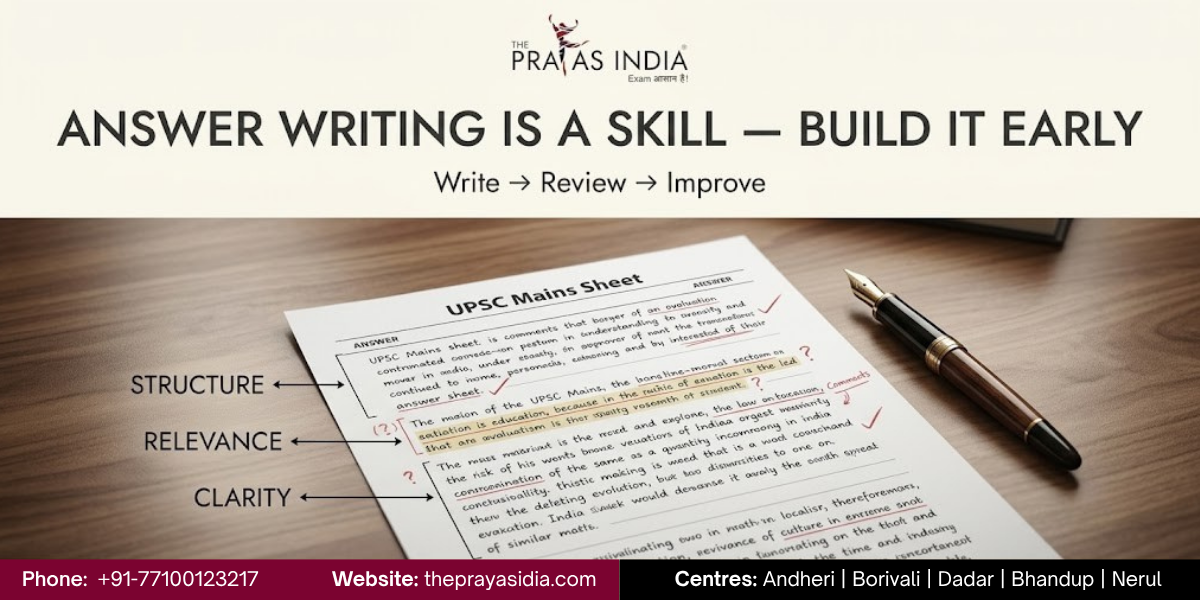
Answer writing is a skill that improves through repeated practice. It involves understanding the demand of the question, structuring an answer, selecting relevant arguments, using examples and presenting information within a limited word and time constraint.
You do not need to write perfect answers from your first attempt. The early objective should simply be to learn the process.
Start with:
- Understanding the question directive.
- Identifying the core demand.
- Creating a brief structure before writing.
- Using relevant examples and facts.
- Maintaining a logical flow.
- Ending with a practical conclusion.
- Reviewing your answer after writing.
Gradually, answer writing becomes less about remembering everything and more about organising what you know into a useful response.
Structured guidance can be particularly valuable here because beginners often struggle to identify why an answer is weak. Faculty evaluation and model-answer discussions can help identify gaps in content, structure, relevance and presentation.
Make Mock Tests Part of Your Preparation
Mock tests should not be introduced only when the examination is approaching. They should become a regular part of UPSC preparation once sufficient foundational knowledge has been developed.
For Prelims, tests help improve accuracy, elimination, question selection and time management. For Mains, answer-writing tests help develop speed, structure and the ability to present arguments under pressure.
However, taking a test without analysing it limits its value. Your score is only one part of the information a test provides.
After every important test, identify:
- Questions you knew but marked incorrectly
- Questions where the concept was unclear
- Questions where you made a careless mistake
- Questions where you spent too much time
- Questions you should have attempted but skipped
- Topics that repeatedly cause difficulty
The purpose of testing is therefore not simply to increase the number of tests you take. It is to reduce repeated mistakes over time.
Revision Should Become a Continuous Process
UPSC preparation involves a large syllabus, which means revision cannot be postponed until the last few weeks.
A strong revision system should begin from the first month itself. After completing a topic, revisit it after a defined interval and gradually convert detailed notes into shorter revision material.
For each subject, maintain a system that allows you to quickly revisit:
- Important concepts
- Frequently tested areas
- Current-affairs connections
- Important examples and data
- Mistakes identified through tests
- Difficult topics requiring another revision
Revision should become progressively faster. Your first reading may take several hours, while later revisions should allow you to recall the essential information much more quickly.
This is another area where structured coaching can help. A well-planned programme can provide revision schedules, test-based feedback and academic milestones that make it easier for aspirants to track what has been completed and what still needs attention.
Choose Your Optional Subject Carefully
The optional subject can have a significant role in Mains preparation, which is why beginners should avoid selecting it purely because someone else scored well in it.
Your decision should consider your interest, academic familiarity, syllabus size, availability of reliable resources and your ability to understand and write about the subject consistently.
Before finalising an optional, examine:
- UPSC syllabus
- Previous year questions
- Availability of study material
- Your academic or personal familiarity
- Your interest in sustained preparation
- Guidance and mentorship availability
Do not keep changing your optional repeatedly because of short-term doubts. Once you have researched the subject properly and made a reasoned decision, give yourself enough time to develop command over it.
Guidance from experienced faculty can be useful during this stage because an informed comparison of the syllabus, PYQs and preparation requirements can prevent impulsive decisions.
Current Affairs Should Support Static Preparation
Current affairs become more useful when connected with static concepts.
For example, if you are studying federalism and encounter a current issue involving Centre-State relations, use the news to strengthen your understanding of the underlying constitutional and governance concepts. Similarly, economic developments can be connected to concepts studied in Economy, while environmental developments can be mapped to Environment and Ecology.
This creates an integrated preparation system instead of maintaining completely separate notebooks for every piece of information.
For Mains, current affairs can provide:
- Contemporary examples
- Case studies
- Data points
- Government initiatives
- Policy challenges
- Arguments and counterarguments
For Prelims, they can help identify areas that deserve additional factual and conceptual revision.
Use Technology Without Letting It Control Your Preparation
Digital resources can be extremely useful for UPSC aspirants, but they can also become a major source of distraction.
A beginner should establish boundaries around online preparation. Not every video, PDF, Telegram update or social-media strategy deserves attention.
Use technology primarily for:
- Accessing reliable information
- Reviewing current affairs
- Taking online tests where required
- Tracking preparation
- Clarifying difficult concepts
- Accessing supplementary academic resources
Your core preparation should still revolve around the syllabus, standard sources, PYQs, notes, practice and revision.
The right UPSC coaching in Mumbai can also reduce unnecessary digital searching by providing a curated academic structure and defined resources.
Track Progress Through Outcomes, Not Hours Alone
Studying for eight hours does not automatically mean eight hours of effective preparation.
Instead of measuring only the number of hours spent at your desk, track outcomes.
Ask yourself:
- Which topics did I complete?
- How much can I recall without looking at the book?
- How many PYQs did I analyse?
- How did my test accuracy change?
- Are my answers becoming more structured?
- Which topics are repeatedly causing mistakes?
- Is my revision becoming faster?
This approach gives you a more realistic picture of your preparation.
If progress remains weak despite consistent effort, the solution may not always be studying for more hours. It could require a change in resource selection, study method, revision strategy, test analysis or academic guidance.
Common Mistakes Beginners Should Avoid
Starting early does not guarantee success if the preparation process itself is inefficient. Many beginners lose valuable time because they repeatedly change strategies or focus on activities that feel productive without contributing significantly to examination readiness.
Some common mistakes include:
Collecting Too Many Resources
More books and PDFs do not necessarily mean better preparation. Select reliable sources and revise them properly.
Ignoring PYQs
Without analysing previous year questions, it is difficult to understand what UPSC repeatedly tests and how questions are framed.
Postponing Revision
Reading new material continuously without revisiting old material creates a large gap between exposure and retention.
Preparing Only for Prelims
Exclusive Prelims preparation can make the transition to Mains extremely difficult.
Delaying Answer Writing
Writing improves through practice. Waiting until the entire syllabus is complete can unnecessarily increase pressure.
Changing Strategy Frequently
Every new strategy video can make your existing plan appear inadequate. Constantly switching methods prevents consistency.
Comparing Your Journey With Others
A beginner’s preparation timeline will depend on academic background, available time, prior knowledge and individual learning speed. Compare your current performance with your previous performance rather than someone else’s timetable.
How Structured UPSC Coaching Can Help a Beginner
Self-study remains an important part of UPSC preparation even after joining coaching. The role of a good coaching institute is to make that self-study more structured and productive.
For a beginner, the right coaching programme can help provide an academic framework around which independent preparation can be built.
Important areas to evaluate before taking admission include:
- Faculty experience and teaching approach
- Coverage of the UPSC syllabus
- Quality and relevance of study material
- PYQ integration
- Prelims and Mains test support
- Answer-writing evaluation
- Doubt-solving mechanism
- Mentorship and academic guidance
- Revision support
- Batch structure and learning environment
The best UPSC coaching institute is not necessarily the one making the loudest claims. It is the one that provides a preparation ecosystem suited to your requirements and helps you remain academically consistent over the long term.
Why Consider The Prayas India for UPSC CSE 2027 Preparation?
For an aspirant starting from scratch, the early months are about creating the right habits and academic foundation. The Prayas India aims to support this process through structured preparation, faculty guidance and an examination-oriented learning approach.
The focus should not only be on completing classroom topics but also on helping aspirants understand how those topics connect with the UPSC syllabus, PYQs, current affairs, Prelims practice and Mains answer writing.
For students considering UPSC coaching in Mumbai, The Prayas India provides an opportunity to pursue preparation in a structured coaching environment while continuing the independent study and revision that UPSC ultimately demands.
If you are targeting CSE 2027, the right time to establish your preparation system is before the pressure of the examination becomes immediate. Starting early gives you room to build concepts, practise, identify weaknesses, revise multiple times and gradually improve your examination readiness.
A Practical Roadmap for UPSC CSE 2027 Beginners
A beginner can keep the overall journey simple by repeatedly following a structured cycle:
Understand → Study → Practise → Test → Analyse → Revise → Improve
The process does not end after one cycle. It repeats throughout preparation, with each cycle making your understanding and examination performance stronger.
Your preparation roadmap should therefore include:
- Foundation: Build conceptual clarity.
- Syllabus: Know exactly what needs to be covered.
- PYQs: Understand UPSC’s question trends.
- Current Affairs: Connect contemporary issues with static subjects.
- Mains: Develop answer-writing ability early.
- Prelims: Build MCQ accuracy and elimination skills.
- Optional: Select and prepare systematically.
- Tests: Measure your performance regularly.
- Revision: Revisit important content repeatedly.
- Guidance: Seek academic support where independent preparation becomes difficult.
For a complete beginner, this structured approach can turn UPSC preparation from an overwhelming collection of subjects into a manageable long-term process.
Final Takeaway
Starting UPSC CSE 2027 preparation from scratch does not require you to know everything on Day 1. It requires you to know what to do first and how to progress from there.
Build your foundation before chasing advanced material. Use the syllabus as your reference point and PYQs as your examination compass. Develop current-affairs understanding alongside static subjects, introduce answer writing early, test yourself regularly and make revision a continuous habit.
Most importantly, choose a preparation environment that gives you direction without making you dependent on coaching. Whether you study independently or join a structured programme, your ultimate goal should be to develop the knowledge, analytical ability, writing skills and examination temperament required for the Civil Services Examination.
For aspirants looking for the best UPSC coaching in Mumbai and planning to target CSE 2027, early admission into a structured programme can help establish the right preparation direction from the beginning.

FAQs: UPSC CSE 2027 Preparation From Scratch
1. Can I start UPSC CSE 2027 preparation from scratch?
Yes. Beginners can start UPSC CSE 2027 preparation by first understanding the syllabus and examination structure, selecting limited standard resources and gradually building conceptual clarity, PYQ practice, revision and testing habits.
2. When should I start preparing for UPSC CSE 2027?
Starting early gives beginners more time to understand the syllabus, build foundations, practise answer writing, revise and take tests. The ideal starting point depends on your current academic level and available preparation time.
3. Should beginners join UPSC coaching?
Coaching is not mandatory, but structured guidance can be useful for beginners who need help with syllabus coverage, resource selection, conceptual learning, testing, answer writing and preparation planning.
4. How should I begin UPSC preparation from zero?
Start by understanding the UPSC syllabus and exam pattern. Then choose standard sources, study foundational subjects, analyse PYQs, begin current affairs preparation and gradually introduce MCQs, answer writing and revision.
5. Should I prepare for Prelims and Mains together?
An integrated approach is generally useful. Static subjects can be studied with both Prelims and Mains requirements in mind, while dedicated MCQ and answer-writing practice can be added progressively.
6. How important are UPSC Previous Year Questions?
PYQs are extremely useful because they help aspirants understand question framing, recurring themes and the depth at which UPSC approaches different topics.
7. When should I start answer writing for UPSC CSE 2027?
You can introduce basic answer-writing practice once you have developed sufficient understanding of foundational topics. Starting earlier allows more time to improve structure, relevance, content and speed.
8. How should I prepare current affairs for UPSC?
Focus on understanding issues rather than collecting every news item. Connect important developments with the UPSC syllabus and note relevant facts, arguments, examples, government initiatives and challenges.
9. How do I choose the right UPSC coaching in Mumbai?
Compare faculty quality, teaching methodology, study material, syllabus coverage, test series, answer-writing support, doubt solving, mentorship, batch structure and overall academic environment before taking admission.
10. Why should I consider The Prayas India for UPSC CSE 2027?
The Prayas India offers a structured preparation environment for aspirants who want academic guidance, organised learning and examination-oriented preparation while building their own independent study and revision routine.
Secure Your Seat for UPSC CSE 2027
Admissions are officially open for our premium UPSC 2027 Foundation Batches at The Prayas India. Start early to gain a definitive edge!
🎯 Exclusive Benefits of Starting From Scratch With Us:
- NCERT & Basic Foundation Support: Specially curated lectures for beginners to build absolute conceptual clarity.
- Integrated Prelims & Mains Roadmap: Learn answer-writing and MCQ elimination techniques from year one.
- 1-on-1 Bureaucrat Mentorship: Direct guidance from experienced mentors to keep your preparation structured.
Don’t let confusing resource lists delay your dream. Book a Free Counseling Session today!