How to Manage Time During UPSC Preparation | Best UPSC Coaching in Mumbai | The Prayas India
UPSC preparation is often treated as a competition of knowledge, but for most serious aspirants, another resource becomes equally important: time. The UPSC syllabus is vast, the examination process stretches across multiple stages, and preparation involves much more than reading books. Candidates have to balance static subjects, current affairs, revision, answer writing, mock tests, optional preparation and repeated revision.
This creates a difficult question: How should an aspirant manage limited study hours without compromising the quality of preparation?
The answer is not simply studying for more hours.
A candidate who studies for twelve hours without a clear structure may achieve less than someone who studies for eight focused hours with defined priorities. Effective UPSC time management is therefore about allocation, consistency, prioritisation and review.
For aspirants preparing for UPSC CSE, the objective should be to build a study system that remains sustainable for months rather than following an extremely demanding timetable for a few days.
Why Time Management Becomes Difficult During UPSC Preparation
UPSC preparation does not have a straightforward syllabus that can be completed by reading one book from beginning to end. Different components demand different kinds of effort.
You may spend several hours studying Polity, but that does not automatically mean the subject is ready for revision. Similarly, reading newspapers every day does not mean your current affairs preparation is complete.
A typical aspirant may have to manage:
- GS preparation
- Optional subject
- Current affairs
- Previous Year Questions
- Revision
- CSAT
- Answer writing
- Prelims mock tests
- Mains-oriented preparation
- Notes and short revision material
The challenge is that all these activities compete for the same limited number of hours.
This is why simply creating a timetable with ten or twelve different tasks can actually make preparation more stressful.
The better approach is to decide what deserves your time first.
Time Management Is More About Priorities Than Hours
One of the biggest misconceptions among UPSC aspirants is that successful candidates necessarily study for extremely long hours every day.
Study duration certainly matters, but the number of hours alone does not determine productivity.
Consider two aspirants.
The first studies for ten hours but spends a significant portion of the day switching between books, Telegram channels, videos, notes and current-affairs sources. The second studies for seven to eight focused hours, follows a limited set of resources and revises consistently.
The second candidate may actually build stronger retention.
Therefore, before asking:
“How many hours should I study?”
ask:
“What should I accomplish during the hours I have?”
This change in perspective can make your preparation considerably more manageable.
Start With a Realistic Assessment of Your Available Time
Your timetable should be based on your actual circumstances.
A full-time aspirant may have considerably more flexibility than someone who is working, studying in college or managing family responsibilities.
Trying to copy another candidate’s schedule can create unnecessary frustration.
Start by identifying your fixed commitments.
For example:
| Activity | Approximate Daily Time |
|---|---|
| Sleep | 7–8 hours |
| Meals & personal work | 2–3 hours |
| Classes / work / college | Variable |
| Travel | Variable |
| Focused UPSC study | Remaining productive hours |
| Breaks | Planned between sessions |
The purpose of this exercise is not to fill every available minute.
It is to understand how much realistic focused study time you have.
Once you know that number, you can create a strategy around it.
Don’t Build a Timetable That Leaves No Room for Reality
A timetable that allocates every minute of the day may look impressive on paper.
In practice, it can be difficult to maintain.
A chapter may take longer than expected. You may need additional revision. A mock test may reveal a conceptual weakness that requires extra study. Some days may simply be less productive.
If your schedule has no flexibility, one delayed task can disrupt the entire day.
Instead, create a timetable with core blocks and flexible space.
Your core blocks should contain activities that cannot be ignored, while flexible time can absorb unexpected delays.
This makes the schedule more resilient.
Divide Your Preparation Into Study Blocks
Instead of thinking about the entire day as one long study session, divide it into focused blocks.
A block should have:
- One clear objective
- A defined start and end time
- Limited distractions
- A measurable outcome
For example, instead of writing:
“Study Polity – 3 hours”
write:
“Complete Fundamental Rights revision + solve 25 PYQs.”
The second target is much more actionable.
At the end of the session, you can clearly determine whether the objective was achieved.
Use Different Blocks for Different Types of Learning
Not every study activity requires the same level of concentration.
Concept-heavy subjects may require your freshest hours.
Revision can often be placed in another part of the day.
Current affairs, MCQ practice and note revision can be organised into shorter sessions.
A practical structure could include:
Deep Study Block
For difficult concepts, standard books and new topics.
Practice Block
For PYQs, MCQs or answer writing.
Revision Block
For previously studied material.
Review Block
For analysing mistakes and planning the next day.
This creates variety while keeping the preparation focused.
The Priority Matrix for UPSC Preparation
Not every task on your preparation list has equal importance.
A useful way to organise your workload is to divide activities according to their importance and urgency.
For example:
| Category | Examples | Action |
|---|---|---|
| High Priority | Core GS topics, revision, PYQs | Schedule regularly |
| High Priority + Time Sensitive | Tests, answer-writing practice | Fix specific slots |
| Important but Flexible | Supplementary reading | Use spare blocks |
| Low Value | Excessive resource comparison | Limit sharply |
This approach prevents your day from being consumed by activities that feel productive but have limited examination value.
Avoid the “Resource Collection” Trap
UPSC aspirants have access to an enormous amount of study material.
This is both an advantage and a problem.
You can find multiple books, websites, PDFs, video lectures, current-affairs compilations and test series for almost every topic.
The temptation is to keep collecting resources.
But every additional source consumes time.
If you keep switching between sources, you may spend more time deciding what to study than actually studying.
A better approach is to establish a primary source for each subject and use supplementary material only when there is a specific gap.
Time Management Should Include Revision From Day One
Many aspirants make a common mistake: they finish a topic and immediately move to the next one.
Weeks later, they discover that they remember very little of what they studied.
The problem is not necessarily poor memory.
It is insufficient revision.
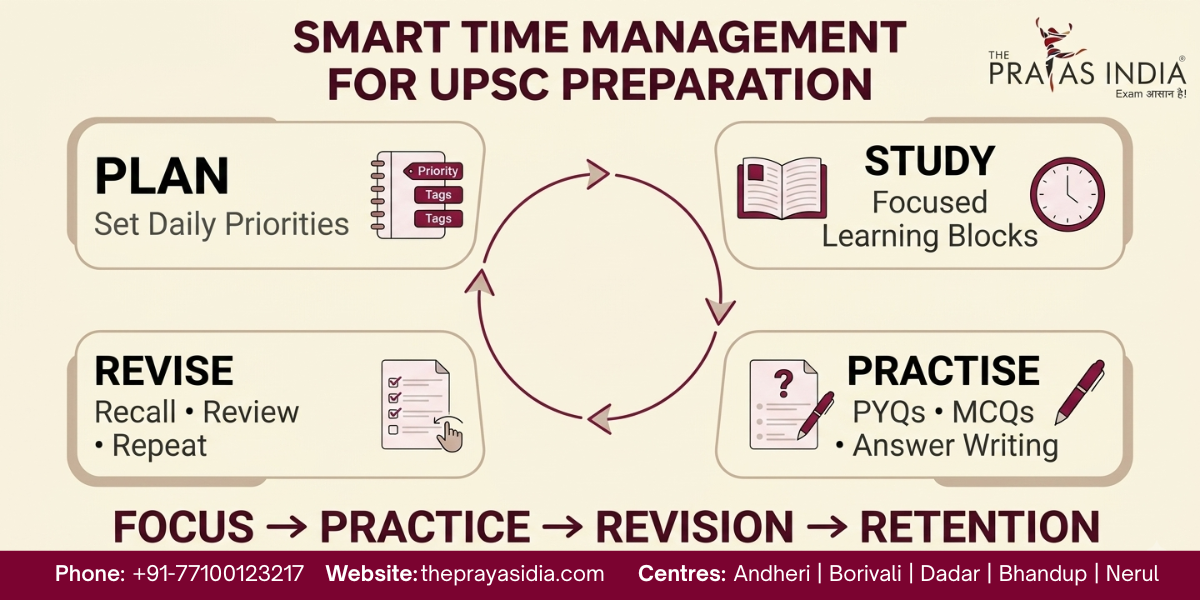
UPSC preparation should therefore follow a cycle:
Study → Recall → Revise → Practise → Revisit
Revision should not be treated as something reserved for the final months.
It should be built into your weekly routine.
Use the “Next Revision” Rule
Whenever you complete an important topic, decide when you will revisit it.
For example:
First study: Day 1
Quick revision: Within a few days
Second revision: After a longer interval
Final revision: During the relevant examination phase
The exact schedule can vary according to your preparation stage.
The important principle is that every important topic should have a planned return.
Without that, your study process becomes heavily focused on new content.
Don’t Spend Equal Time on Every Subject
Your study hours should reflect your strengths and weaknesses.
If you are already strong in a particular subject, maintaining that strength may require less time than building a weak area from scratch.
For example:
| Preparation Area | Current Level | Time Approach |
|---|---|---|
| Strong | Good retention | Maintain + revise |
| Moderate | Some gaps | Regular practice |
| Weak | Low confidence | More focused time |
| Very Weak | Major conceptual gaps | Structured rebuilding |
This doesn’t mean ignoring strong subjects.
It means allocating time according to marginal improvement.
The areas where focused effort can produce the greatest improvement deserve attention.
The Role of Current Affairs in Time Management
Current affairs can consume unlimited time if you allow them to.
Reading multiple newspapers, watching lengthy discussions and collecting daily notes can easily take several hours.
The goal should be to extract examination-relevant information efficiently.
Instead of asking:
“How much current affairs did I read today?”
ask:
“What useful information did I retain and connect with the static syllabus?”
Current affairs preparation becomes more efficient when it is integrated with subjects rather than treated as an endless independent stream of information.
Avoid Studying Current Affairs All Day
Current affairs should have a defined time boundary.
For example, you can allocate a specific daily slot for newspaper reading or current-affairs revision and then move on.
If an article is particularly relevant to your preparation, note the key information and return to the subject.
Without a time limit, current affairs can easily consume the hours meant for core preparation.
Make PYQs Part of Your Time Management System
Previous Year Questions are not only useful for understanding UPSC’s question style.
They help you decide where your preparation time should go.
Suppose you repeatedly encounter a particular concept in PYQs and realise that your understanding is weak.
That tells you something important:
This topic deserves additional study time.
Similarly, if you repeatedly answer questions correctly from a topic, you may not need to spend excessive hours rereading the same material.
PYQs therefore act as a priority filter.
Don’t Confuse Reading With Completion
Finishing a book does not necessarily mean completing a subject.
A topic becomes more useful when you can:
- Explain its core concepts
- Recall important information
- Solve relevant PYQs
- Answer questions on it
- Revise it efficiently
This is why your timetable should measure outcomes, not just pages.
Instead of writing:
“Read 50 pages.”
you could write:
“Complete the topic, make short revision points and solve relevant PYQs.”
This makes your time investment more meaningful.
Protect Your Most Productive Hours
Most people have certain periods during the day when concentration is naturally stronger.
For some candidates, that may be early morning.
For others, it may be late morning or evening.
Use your highest-energy period for activities requiring maximum concentration.
Don’t automatically reserve your best hours for low-effort tasks such as reorganising notes or scrolling through current-affairs updates.
Your strongest mental hours should support your highest-value preparation work.
Time Management Also Means Managing Distractions
The biggest time loss during UPSC preparation is not always obvious.
A five-minute phone check can become twenty minutes.
One YouTube video can become an hour.
A quick Telegram update can turn into continuous browsing.
The solution is not necessarily to eliminate every device.
Instead, create boundaries.
During focused study blocks:
- Keep unnecessary notifications off.
- Keep the phone away when possible.
- Use specific time windows for online resources.
- Avoid switching between multiple study platforms.
- Don’t study with unrelated tabs open.
Your goal is to reduce attention switching.
Key Takeaway
Effective UPSC time management is not about constructing the most demanding timetable.
It is about building a system that allows you to consistently complete the right work.
Start by understanding your available hours.
Then prioritise your preparation.
Divide your day into focused blocks.
Protect your high-energy hours.
Build revision into the schedule.
Use PYQs to determine priorities.
Limit unnecessary resources.
And make sure your timetable measures learning and output rather than simply time spent sitting at a desk.
Build Your Day Around Priorities
A productive UPSC day should not be a random collection of study sessions.
Start by identifying the three or four tasks that can make the biggest difference to your preparation that day.
For example:
- Complete a pending GS topic.
- Revise yesterday’s material.
- Solve a set of PYQs.
- Complete answer-writing practice.
Once these priorities are fixed, additional tasks can be fitted around them.
This prevents a common problem where aspirants spend the first few hours of the day deciding what to study and end the day having completed several minor tasks but not the important ones.
A Practical Daily Structure for UPSC Aspirants
There is no universal timetable that every candidate should follow. However, a structured day can be divided into broad preparation blocks.
| Study Block | Primary Focus | Objective |
|---|---|---|
| Block 1 | Core GS / difficult topic | Learn new concepts |
| Block 2 | Optional / second subject | Build subject depth |
| Block 3 | Revision | Strengthen retention |
| Block 4 | PYQs / MCQs | Apply knowledge |
| Block 5 | Answer Writing | Develop expression |
| Block 6 | Current Affairs | Connect current events with syllabus |
| Block 7 | Review | Analyse progress and plan next day |
The duration of each block should depend on your personal schedule.
The important thing is that every block has a specific purpose.
Don’t Make Every Day Identical
A rigid timetable may work temporarily, but UPSC preparation changes as the examination approaches.
During the initial stage, you may need more time for learning concepts.
As the Prelims approaches, MCQs, revision and mock tests will naturally occupy a larger portion of your schedule.
After Prelims, the focus shifts toward Mains-oriented preparation, including answer writing, optional revision and essay practice.
Your timetable should therefore evolve with your preparation stage.
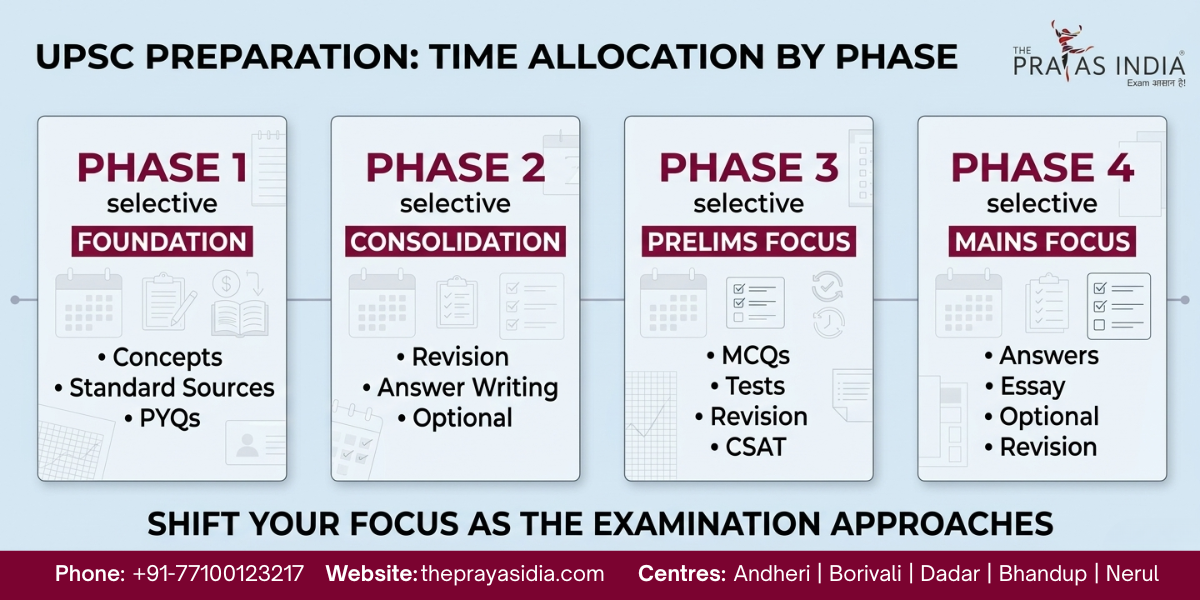
Phase-Wise Time Allocation
A useful broad framework looks like this:
Foundation Phase
Focus primarily on:
- Basic concepts
- Standard sources
- Syllabus understanding
- PYQs
- Initial current-affairs integration
Consolidation Phase
Increase emphasis on:
- Revision
- PYQ practice
- Answer writing
- Optional preparation
- Current-affairs consolidation
Prelims-Focused Phase
Prioritise:
- Revision
- MCQs
- Full-length tests
- Prelims PYQs
- Weak areas
- CSAT
Mains-Focused Phase
Increase time for:
- GS answer writing
- Optional
- Essay
- Mains PYQs
- Revision
- Current-affairs enrichment
The key is not to treat these phases as completely separate worlds. Your preparation should gradually shift its emphasis rather than changing overnight.
Balancing Prelims and Mains Preparation
One of the most difficult time-management decisions is determining when to focus on Prelims and when to continue Mains preparation.
A common mistake is to completely ignore Mains until Prelims preparation begins.
This can create unnecessary pressure later.
Similarly, trying to maintain full Mains preparation when Prelims is approaching can dilute your focus.
A balanced approach is better.
During the earlier stages, maintain a connection with Mains through:
- Occasional answer writing
- Mains PYQs
- Optional preparation
- Essay practice
- Current-affairs notes
As Prelims approaches, gradually increase the proportion of time dedicated to Prelims-specific work.
Don’t Ignore Your Optional Subject
Optional preparation can easily get pushed aside because GS has such a large syllabus.
That can create a serious backlog.
Instead of waiting for a separate “optional phase,” allocate regular weekly time to it.
Your optional schedule should include:
Concept building → notes → PYQs → answer writing → revision
Regular contact with the subject is generally easier to maintain than trying to complete the entire optional syllabus in a short period.
Give CSAT a Defined Place in the Timetable
CSAT is sometimes treated as something that can be handled later.
That can be risky for candidates who are not naturally comfortable with quantitative aptitude, reasoning or comprehension.
Even if you are strong in these areas, periodic practice helps maintain familiarity.
For candidates who find CSAT challenging, it should become a regular part of the preparation schedule rather than an emergency subject near Prelims.
Current Affairs Should Connect With Static Preparation
Efficient current-affairs preparation is not about consuming the maximum amount of information.
The real value comes from connecting current events with the UPSC syllabus.
For example, when studying:
Polity
You can connect relevant constitutional, governance and institutional developments.
Economy
You can relate current economic developments to concepts already studied.
Environment
You can connect environmental developments with ecology, conventions, climate change and biodiversity.
This approach reduces duplication and improves revision efficiency.
Use the 80:20 Principle Carefully
The idea of focusing on high-value activities can be useful, but it should not become an excuse to ignore difficult portions of the syllabus.
The practical interpretation is simple:
Spend more time on activities that directly improve examination performance.
For most aspirants, these include:
- Core conceptual study
- Revision
- PYQs
- Tests
- Answer writing
- Optional preparation
Activities such as endlessly reorganising notes, collecting resources or watching unrelated strategy videos should not consume disproportionate time.
Don’t Count Passive Study as Full Productivity
Sitting with a book open for four hours does not necessarily mean four hours of effective study.
Active learning is more valuable.
Instead of only reading a topic, try to:
- Recall what you read
- Explain the concept without looking
- Solve questions
- Make concise revision notes
- Connect the topic with PYQs
- Write an answer
These activities provide evidence that learning has actually happened.
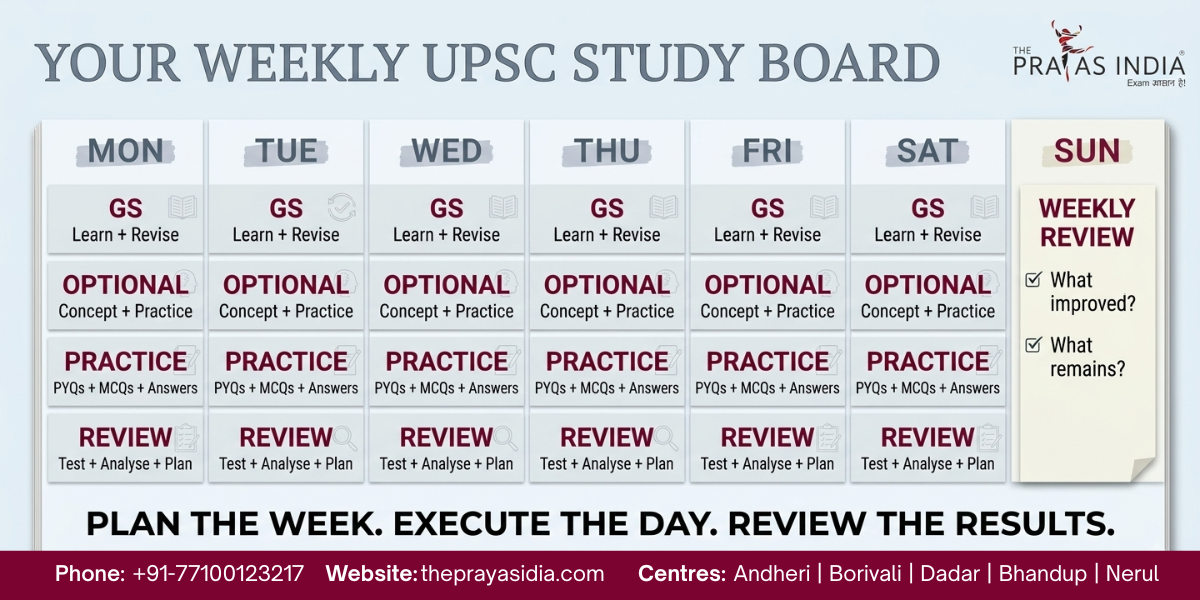
Use Weekly Planning Instead of Only Daily Planning
Daily planning tells you what to do today.
Weekly planning tells you whether you are moving in the right direction.
At the beginning of each week, identify:
Subjects to cover
Topics to revise
PYQs to solve
Answers to write
Tests to complete
Current-affairs targets
Optional targets
Then divide these across the week.
This makes it easier to recover if one day doesn’t go according to plan.
What to Do When You Lose a Day
A realistic UPSC preparation plan must account for bad days.
You may become unwell, have an unexpected responsibility or simply fail to maintain concentration.
The biggest mistake is trying to compensate by creating an extreme schedule the next day.
If you planned to complete six tasks and completed only three, don’t automatically try to complete all six plus the next day’s work.
Instead, identify what is genuinely urgent.
Move flexible tasks forward.
Continue the core schedule.
Consistency is more valuable than trying to maintain a perfect record.
Use a Priority Ladder When You Fall Behind
When your preparation gets delayed, classify pending tasks.
Level 1 — Essential
Core syllabus, revision, important tests and major pending topics.
Level 2 — Important
PYQs, additional practice and answer-writing targets.
Level 3 — Useful
Supplementary reading and additional resources.
Level 4 — Optional
Activities that provide limited additional value.
Complete Level 1 first.
This prevents backlog from becoming overwhelming.
How to Prevent Burnout Through Better Time Management
Long-term UPSC preparation requires sustainability.
If your timetable consistently leaves no time for sleep, exercise, breaks or personal responsibilities, it may eventually become difficult to maintain.
Breaks are not automatically wasted time.
A short break can help you return to the next study block with better concentration.
Similarly, adequate sleep is important for memory and cognitive performance.
The objective should be productive consistency, not exhaustion.
Don’t Measure Your Progress Only by Study Hours
Hours can be a useful metric, but they should not be your only metric.
Track outcomes such as:
- Topics completed
- Topics revised
- PYQs solved
- Mock scores
- Accuracy
- Answers written
- Optional progress
- Weak areas improved
For example, “studied for eight hours” tells you relatively little.
“Completed Fundamental Rights, revised Parliament, solved 40 PYQs and wrote two answers” gives you a much clearer picture.
Create a Daily Shutdown Routine
At the end of the day, spend a few minutes reviewing your work.
Ask:
What did I complete?
What did I not complete?
Why was it delayed?
What is tomorrow’s highest-priority task?
This small routine prevents unfinished work from becoming mental clutter.
It also allows you to adjust your schedule continuously.
The 15-Minute Rule for Planning
You don’t need an hour-long planning session every evening.
A short planning routine is often enough.
Spend a few minutes reviewing the previous day and then identify the next day’s priorities.
Write down only the tasks that genuinely matter.
The planning system should support preparation, not become another preparation activity.
Time Management During Mock Tests
Time management also matters inside the examination environment.
Whether you are taking a Prelims test or a Mains mock, practise making decisions under realistic conditions.
For Prelims:
- Avoid spending too long on one uncertain question.
- Keep track of your progress.
- Return to difficult questions later.
- Analyse time-consuming questions afterward.
For Mains:
- Practise allocating time according to marks.
- Avoid spending disproportionate time on one answer.
- Leave enough time for the final questions.
- Review your answer structure after the test.
Mock tests should therefore train both knowledge application and time discipline.
How Coaching Can Help With UPSC Time Management
For aspirants looking for UPSC Coaching in Mumbai, structured coaching can help reduce the time spent figuring out what to study, how to prioritise topics and how to evaluate progress.
A well-designed preparation system can provide:
- Structured study plans
- Subject-wise classes
- PYQ discussions
- Regular tests
- Answer-writing practice
- Current-affairs guidance
- Revision schedules
- Performance analysis
- Mentorship
The purpose of coaching should not be to keep students busy throughout the day.
It should help them spend their preparation time more effectively.
Build a Timetable You Can Actually Follow
Before finalising your schedule, ask yourself:
Can I realistically maintain this for several months?
If the answer is no, modify it.
A slightly less ambitious timetable that you follow consistently is more valuable than an impressive timetable that collapses after one week.
Your schedule should fit your:
- Current preparation level
- Available hours
- Learning speed
- Personal commitments
- Examination stage
- Strengths and weaknesses
There is no benefit in creating someone else’s timetable for your life.
A Simple Weekly Review Framework
At the end of each week, evaluate your preparation under five headings.
| Area | Question to Ask |
|---|---|
| Coverage | What topics did I complete? |
| Retention | What did I successfully revise? |
| Practice | How many PYQs/tests/answers did I complete? |
| Weaknesses | Which areas still need attention? |
| Planning | What should receive priority next week? |
This takes very little time but can prevent major gaps from remaining unnoticed.
Frequently Asked Questions
1. How many hours should I study for UPSC every day?
There is no universal number of hours suitable for every aspirant. Your study duration should depend on your available time, preparation stage and ability to maintain focused study. Consistency and effective output are more important than simply increasing hours.
2. How can I make a realistic UPSC timetable?
Start by identifying fixed commitments and your genuinely productive study hours. Then divide the available time between core subjects, optional, revision, PYQs, current affairs and practice. Leave some flexibility rather than scheduling every minute.
3. Should I study Prelims and Mains together?
In the earlier stages, maintaining some Mains-oriented preparation alongside GS and optional study can be useful. As Prelims approaches, the proportion of time devoted to Prelims-specific practice and revision should increase.
4. How much time should I give to current affairs?
Current affairs should have a defined place in your schedule, but there is no need to spend unlimited hours consuming information. Focus on relevant material and connect it with the static syllabus.
5. Should I study my optional subject every day?
Not necessarily. The frequency depends on your preparation stage and optional subject. However, maintaining regular contact with the optional can help prevent a large backlog.
6. How can I manage UPSC preparation if I have limited study time?
Prioritise high-value activities such as core concepts, revision, PYQs, tests and optional preparation. Reduce low-value activities such as excessive resource collection and repeated strategy research.
7. What should I do if I miss my daily study target?
Don't try to recover the entire backlog immediately. Identify essential tasks, move flexible activities and continue with your schedule. One unproductive day should not become an unproductive week.
8. How can UPSC coaching help with time management?
Structured coaching can provide a planned study sequence, regular tests, revision guidance, current-affairs support and performance analysis. This can reduce the time spent independently organising every aspect of preparation.
9. Is revision more important than completing new topics?
Both matter, but new learning without revision can lead to poor retention. Your timetable should maintain a balance between syllabus coverage and repeated revision.
10. How can I know whether my timetable is working?
Look beyond study hours. Track completed topics, revision, PYQs, mock performance, answer writing and improvement in weak areas. If these indicators are improving, your time-management system is likely producing useful results.
Final Takeaway
UPSC preparation is a long process, and time management determines how effectively you move through that process.
The strongest timetable is not necessarily the one with the longest study hours.
It is the one that helps you consistently complete high-value tasks, revise what you learn, practise applying knowledge and identify weaknesses before they become major problems.
Build your schedule around priorities.
Give your strongest concentration to difficult subjects.
Keep revision running alongside new learning.
Give your optional subject regular attention.
Integrate current affairs with static preparation.
Practise PYQs and tests.
Review your week instead of judging yourself based on one bad day.
And most importantly, leave enough flexibility for the plan to survive real life.
For aspirants considering UPSC Coaching in Mumbai, structured guidance can make this process more organised by providing a study framework, regular evaluation and a clearer preparation path. But the ultimate objective should always be to develop a sustainable system that you can execute consistently.
Time is not something UPSC aspirants can increase. It is something they must allocate intelligently.
Contact Us
📞 Call Now: +91-77100 13217
🌐 Website: theprayasindia.com