How Many UPSC Mains Answers Should You Write Every Week? | Best IAS Coaching in Mumbai | The Prayas India
UPSC Mains answer writing is often treated as a question of quantity. Aspirants ask whether they should write 10 answers a week, 20 answers, 30 answers or even more. The assumption is straightforward: if answer writing improves through practice, then writing more answers must automatically lead to better marks.
That assumption is only partly correct.
Answer writing is a skill, but it is a skill that improves through deliberate practice, feedback and correction. Writing 40 answers every week without analysing them can be considerably less useful than writing 15–20 answers and carefully understanding why some answers were stronger than others.
The right weekly target therefore depends on your preparation stage, familiarity with the syllabus, optional subject, available study time and the quality of feedback you receive.
For an aspirant preparing seriously for UPSC Mains, the better question is not simply:
“How many answers should I write?”
It is:
“How many answers can I write, analyse, improve and repeat consistently?”
That distinction changes the entire approach to answer writing.
Why Weekly Answer Writing Matters
UPSC Mains requires candidates to express knowledge within strict time limits. Knowing a topic and writing a high-quality answer about it are two different abilities.
During preparation, you may understand a concept extremely well but still struggle to convert that understanding into a structured 150-word or 250-word answer.
Regular writing helps bridge this gap.
With consistent practice, you gradually become better at:
- Understanding what the question is actually asking
- Identifying the demand of the directive
- Selecting relevant information
- Structuring introductions and conclusions
- Developing arguments logically
- Using examples appropriately
- Integrating current affairs
- Managing word limits
- Completing answers within the available time
These skills do not develop simply by reading model answers.
You need to write, review and rewrite.
Quantity Alone Is Not the Goal
A common preparation mistake is to create a large weekly target without considering what happens after the answer is written.
Imagine two aspirants.
Aspirant A writes 30 answers every week but spends almost no time reviewing them.
Aspirant B writes 15 answers, analyses the structure, checks relevance, identifies missing dimensions and rewrites selected answers.
After several weeks, Aspirant B may have developed a stronger writing process despite producing fewer answers.
This is because answer writing has three stages:
Writing → Evaluation → Correction
If the second and third stages are missing, the first stage becomes repetitive practice rather than deliberate improvement.
The Ideal Weekly Target Depends on Your Preparation Stage
There is no single number that works for every UPSC aspirant.
Your answer-writing target should increase gradually as your preparation develops.
A practical framework can be divided into four stages.
| Preparation Stage | Suggested Weekly Target | Primary Objective |
|---|---|---|
| Foundation | 5–10 answers | Understand answer structure |
| Building Skill | 10–15 answers | Improve content and structure |
| Integrated Preparation | 15–25 answers | Develop consistency and speed |
| Mains-Oriented Phase | 25–35+ answers | Build exam-level stamina |
These numbers are guidelines rather than rigid rules.
If you are simultaneously completing your GS syllabus, preparing for an optional subject and following current affairs, trying to write 30 answers every week from the beginning may become counterproductive.
The goal is to create a target that you can sustain.
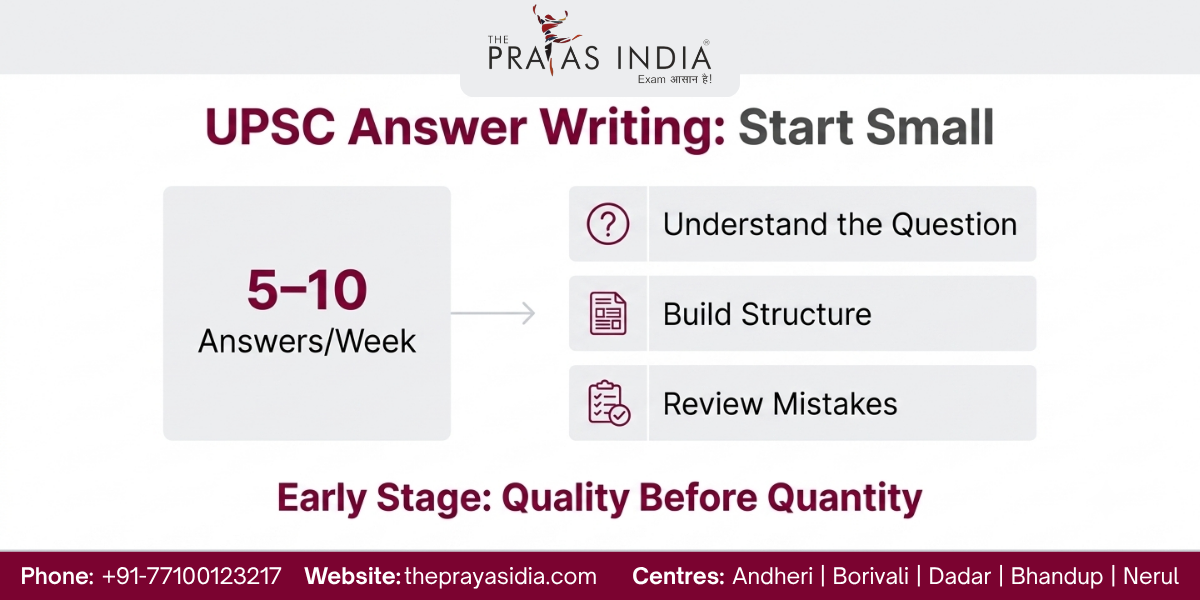
Foundation Stage: Start With 5–10 Answers a Week
If you are new to UPSC Mains answer writing, do not immediately attempt a large number of answers.
Your first challenge is understanding what a good answer looks like.
At this stage, writing 5–10 answers per week can be sufficient if the answers are properly analysed.
Focus on learning:
Question Interpretation
Understand the difference between directives such as:
Discuss
Examine
Analyse
Evaluate
Critically examine
Comment
Each directive creates a slightly different demand.
Basic Structure
Learn to create a logical flow:
Introduction → Body → Conclusion
Relevance
Avoid writing everything you know about a topic.
Answer what the question asks.
Word Limit
Learn to communicate within the prescribed space.
Presentation
Develop clean paragraphs, headings, subheadings, examples and diagrams where appropriate.
At this stage, quality is more important than volume.
Building Skill: 10–15 Answers a Week
Once you understand the basic structure, increase the frequency gradually.
A target of 10–15 answers per week provides enough exposure to different topics without overwhelming your overall preparation schedule.
At this stage, start rotating across GS papers.
For example:
Monday: GS Paper 2
Tuesday: GS Paper 1
Wednesday: GS Paper 3
Thursday: GS Paper 4
Friday: Mixed practice
The exact rotation does not matter as much as maintaining balanced exposure.
You should also begin identifying patterns in your writing.
Are your introductions too long?
Are your conclusions generic?
Are you spending too many words explaining the background?
Are you missing multiple dimensions?
Are your examples disconnected from the argument?
The purpose of this phase is to make the writing process more natural.
Integrated Preparation: 15–25 Answers a Week
Once you have covered a significant portion of the syllabus, answer writing should become more integrated with your overall preparation.
This is where writing begins to reinforce learning.
Suppose you are studying urbanisation in GS Paper 1.
Instead of studying the topic and moving on, use a Mains question to test whether you can apply what you have learned.
For example, after studying a topic, practise questions related to:
- Causes
- Consequences
- Challenges
- Government interventions
- Social dimensions
- Economic implications
- Environmental impact
- Way forward
This approach helps transform static knowledge into answer-ready content.
Your answer-writing practice then becomes part of your learning process rather than an additional task.
Mains-Oriented Phase: 25–35+ Answers a Week
As you move closer to the UPSC Mains examination, answer writing should become more intensive.
A weekly target of around 25–35 answers or more can be useful for aspirants who are ready for serious exam-oriented practice.
However, the exact target depends on your ability to evaluate your answers properly.
At this stage, you should increasingly practise under:
- Time limits
- Word limits
- Mixed-topic conditions
- Full GS paper simulations
- Essay practice
- Optional subject requirements
The objective changes from simply learning how to write an answer to developing exam stamina and consistency.
Don’t Count Every Answer Equally
A 150-word answer and a 250-word answer are not equivalent in terms of effort.
Similarly, an answer written after 30 minutes of preparation is different from one written under strict examination conditions.
Therefore, your weekly target should not become an obsession with a single number.
Instead, track different types of practice.
| Practice Type | Purpose |
|---|---|
| 150-word answers | Speed and concise expression |
| 250-word answers | Depth and multi-dimensional analysis |
| Timed answers | Exam pressure |
| Previous-year questions | UPSC demand awareness |
| Rewritten answers | Improvement |
| Full-length papers | Stamina and time management |
This gives you a more accurate picture of your progress.
The Importance of Previous-Year UPSC Questions
UPSC Previous Year Questions should form a major part of your answer-writing practice.
They help you understand what the examination actually demands.
Instead of randomly selecting questions from multiple sources, regularly practise PYQs and analyse:
What is the directive?
What are the keywords?
What dimensions does the question require?
What type of evidence would strengthen the answer?
What would make the answer balanced?
Over time, this develops question interpretation.
That is one of the most important skills in Mains preparation.
Write Before Looking at Model Answers
Model answers can be useful, but their timing matters.
A common mistake is to read a model answer first and then believe that you know how to answer the question.
Instead, follow this sequence:
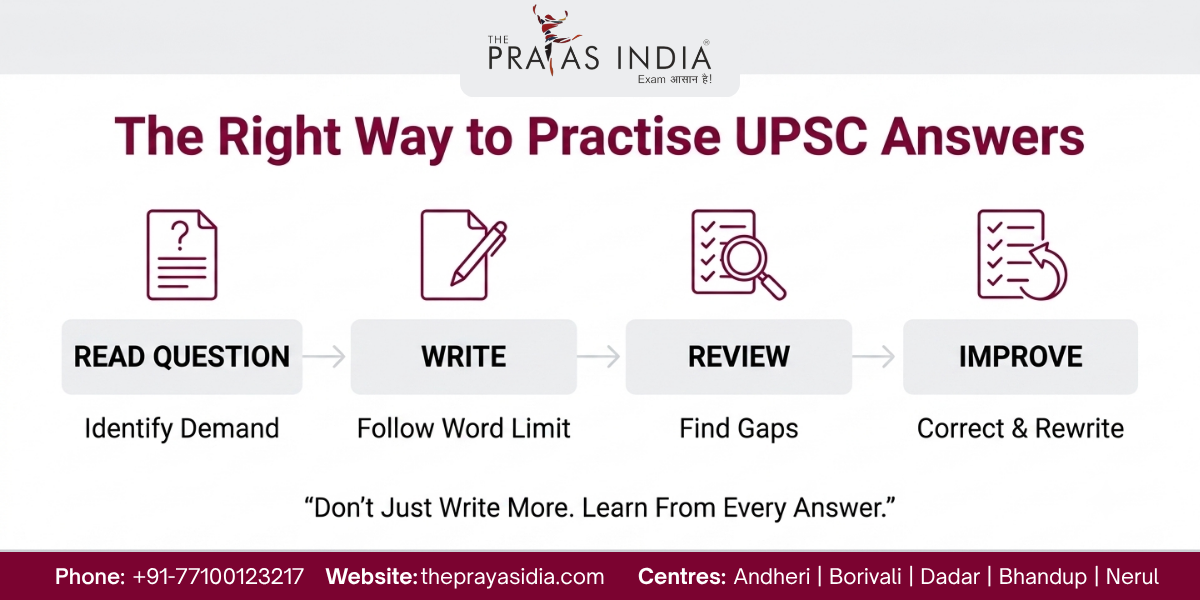
Read Question → Think → Write → Evaluate → Compare
Only after attempting the question should you compare your response with a model answer or reference material.
Then identify:
- What did I miss?
- Which dimension did the model answer include?
- Was my structure clear?
- Did I provide enough examples?
- Was my conclusion relevant?
- Did I spend too many words on one argument?
This turns model answers into a learning tool rather than a shortcut.
Answer Writing Should Not Replace Core Preparation
Another important point is that answer writing is not the entirety of UPSC Mains preparation.
You still need time for:
- GS syllabus completion
- Current affairs
- Optional subject
- Revision
- Previous-year questions
- Essay preparation
- Ethics preparation
- Test analysis
If answer writing begins consuming so much time that your conceptual preparation suffers, the weekly target needs to be adjusted.
For example, writing 30 answers may sound impressive, but if those 30 answers leave you with insufficient time for revision and current affairs, the overall preparation may become weaker.
A balanced strategy is more effective.
Key Takeaway
The ideal number of UPSC Mains answers to write every week is not a magic figure.
For a beginner, 5–10 well-analysed answers can build the foundation.
As your skills improve, 10–15 answers can strengthen structure and consistency.
During integrated preparation, 15–25 answers can help connect knowledge with application.
Closer to Mains, serious aspirants may gradually move towards 25–35+ answers per week, provided they are also analysing and improving their responses.
The key principle remains the same:
Write → Analyse → Correct → Repeat.
Answer writing should not become a race to fill notebooks. It should become a systematic process through which you learn to interpret questions, organise knowledge and communicate arguments under time pressure.
Create a Weekly Answer-Writing Schedule
A good weekly schedule should include three different kinds of practice:
Learning-oriented answers
These help you apply newly studied topics.
Improvement-oriented answers
These focus on weaknesses identified from previous answers.
Exam-oriented answers
These are written under strict time and word-limit conditions.
A balanced week might look like this:
| Day | Practice | Focus |
|---|---|---|
| Monday | 2 answers | GS Paper 2 |
| Tuesday | 2 answers | GS Paper 1 |
| Wednesday | 3 answers | GS Paper 3 |
| Thursday | 2 answers | GS Paper 4 |
| Friday | 2 answers | Previous-year questions |
| Saturday | 3 answers | Mixed GS |
| Sunday | Test + review | Timed practice |
This produces around 14–15 answers, but the exact number can be adjusted according to your preparation stage.
The important part is consistency.
Writing two answers every day may be easier to sustain than attempting 15 answers on Sunday.
Use Daily and Weekly Targets Together
A daily target creates routine.
A weekly target creates flexibility.
Suppose you set a target of 15 answers per week.
If Monday becomes unexpectedly busy, you do not need to consider the week a failure. You can distribute the remaining answers across Tuesday to Sunday.
This is especially useful for aspirants managing college, work, coaching classes or other responsibilities.
Your system should have enough flexibility to absorb an imperfect day without collapsing.
How Much Time Should You Spend Writing an Answer?
Time management should develop gradually.
At the beginning, focus primarily on quality and structure.
Once your answer-writing basics improve, introduce time limits.
For a 150-word answer, aim to develop the ability to produce a structured response within approximately 7–8 minutes.
For a 250-word answer, gradually work towards approximately 10–11 minutes.
These are useful practice benchmarks, not rigid rules that every aspirant must achieve immediately.
If you currently need more time, reduce it gradually.
For example:
Phase 1: Write comfortably and understand structure.
Phase 2: Introduce a moderate time limit.
Phase 3: Move towards exam-oriented timing.
Phase 4: Practise mixed questions under continuous time pressure.
The objective is to make quality writing possible within the constraints of the actual examination.
Don’t Sacrifice Quality for Speed
There is a difference between writing quickly and writing hurriedly.
If your speed improves but your answers become vague, repetitive or poorly structured, the improvement is not useful.
A good timed answer should still contain:
- A relevant introduction
- Direct response to the question
- Logical arguments
- Appropriate examples
- Relevant data or facts where useful
- Multiple dimensions where required
- A concise conclusion
Speed should come from better thinking and familiarity, not from removing essential content.
Develop a Fixed Answer Framework
A basic framework can reduce the time spent deciding how to structure an answer.
For many GS questions, a useful starting structure is:
Introduction
Define the issue, provide context or directly establish the central theme.
Body
Break the answer according to the question’s demand.
For example:
Causes → Impact → Challenges → Government Measures → Way Forward
or:
Social → Economic → Political → Environmental → Institutional
Conclusion
End with a balanced, constructive or forward-looking perspective.
This does not mean every answer should look identical.
The structure should adapt to the question.
The purpose of a framework is to reduce unnecessary thinking about format so that more mental energy can be spent on content and analysis.
Use Dimensions Intelligently
One reason many UPSC answers become repetitive is that candidates try to force the same dimensions into every question.
A better approach is to identify the dimensions that are genuinely relevant.
Depending on the question, these could include:
- Social
- Economic
- Political
- Administrative
- Constitutional
- Ethical
- Environmental
- Technological
- International
- Gender
- Regional
- Institutional
The objective is not to mention all of them.
The objective is to show multi-dimensional understanding when the question demands it.
Feedback Is More Valuable Than Writing More Answers
If you have to choose between:
Writing 10 additional answers
and
Getting meaningful feedback on 10 answers you already wrote
the second option can often have greater learning value.
Feedback helps identify problems that you may not notice yourself.
For example, you may believe your answer is comprehensive because you have included many points. A reviewer may identify that most of those points are descriptive rather than analytical.
Similarly, you may think your introduction is strong, while feedback shows that it consumes too much of the word limit.
The purpose of evaluation is to identify the gap between:
What you intended to write
and
What the answer actually communicates.
Build a Simple Answer Evaluation Checklist
After completing an answer, evaluate it using a short checklist.
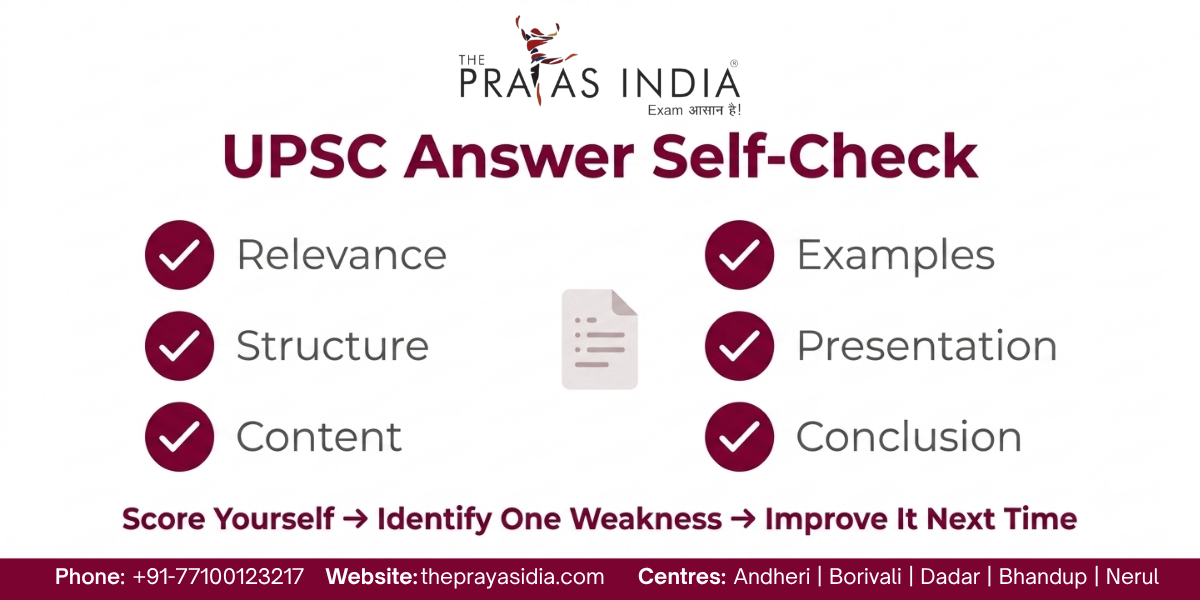
| Parameter | Question |
|---|---|
| Relevance | Did I answer exactly what was asked? |
| Structure | Is the answer easy to follow? |
| Content | Did I include sufficient arguments? |
| Analysis | Did I explain rather than only describe? |
| Examples | Did I support key points where necessary? |
| Presentation | Is the answer easy to scan? |
| Conclusion | Did I end appropriately? |
| Time | Did I stay within the target time? |
You can rate each parameter from 1 to 5.
Over time, the pattern becomes more important than the individual score.
If your “structure” score remains low for several weeks, structure should become a specific improvement target.
Rewrite Selected Answers Instead of Writing Everything Again
Rewriting is one of the most underused answer-writing techniques.
You do not need to rewrite every answer.
Select answers where:
- Your structure was weak
- You missed an important dimension
- Your introduction was ineffective
- Your conclusion was generic
- You lacked examples
- Your arguments were repetitive
- You misunderstood the question
Then write the answer again after reviewing the feedback.
The second version allows you to actively apply the correction.
This is where practice becomes improvement.
Use a Personal Error Log
Your error log should not simply contain wrong facts.
Record mistakes related to answer construction.
For example:
Question: “Discuss the role of urban local bodies…”
Problem: Too much background, insufficient discussion of institutional challenges.
Correction: Move quickly to the core demand and include governance, finance, capacity and accountability dimensions.
Another example:
Problem: Conclusion repeated the introduction.
Correction: End with a solution-oriented or constitutional perspective.
After several weeks, your error log becomes a personalised answer-writing manual.
How Many Answers Should You Write for Each GS Paper?
There is no compulsory equal distribution.
Your weekly allocation should depend on your preparation needs.
However, a balanced practice cycle can look like:
GS Paper 1
Focus on society, history, geography and culture-related questions.
GS Paper 2
Practise polity, governance, social justice and international relations.
GS Paper 3
Work on economy, environment, science and technology, security and disaster management.
GS Paper 4
Focus on ethical reasoning, case studies, examples and structured argumentation.
You can allocate more answers to the paper where your writing is weaker.
If GS Paper 3 answers consistently lack examples and data, increasing practice there makes more sense than blindly maintaining equal numbers.
Optional Subject Needs Its Own Strategy
GS answer writing and Optional answer writing should not be treated as identical.
Optional subjects often require:
- Greater conceptual depth
- Subject-specific terminology
- Thinkers or scholars
- Diagrams or specialised representations
- Technical arguments
- Subject-specific examples
Therefore, your Optional answer-writing schedule should be planned separately.
Do not assume that writing 20 GS answers automatically means your Optional answer-writing practice is sufficient.
If your Optional is a major scoring component, give it dedicated weekly writing time.
Essay Practice Should Not Be Ignored
Essay writing is another area where regular practice matters.
However, you do not necessarily need to write a complete essay every week from the beginning.
You can progressively practise:
Topic interpretation
Brainstorming
Introduction
Dimension building
Examples
Transitions
Conclusion
Then move towards complete essays under time limits.
This allows you to develop essay-thinking skills without consuming excessive weekly preparation time.
Increase Answer-Writing Volume Gradually
A sustainable progression might look like this:
Month 1: 5–10 answers/week
Month 2: 10–15 answers/week
Month 3: 15–20 answers/week
Mains-oriented phase: 20–30+ answers/week
The exact timeline will vary.
An aspirant who has already completed substantial preparation may move faster.
Someone starting answer writing for the first time should not feel pressured to match advanced candidates immediately.
The principle is:
Increase volume only when quality and analysis can keep pace.
Don’t Confuse More Answers With Better Preparation
Writing more answers can become another form of procrastination.
It feels productive because you are continuously doing something.
But if your answers contain the same weaknesses week after week, increasing the quantity will not automatically solve the problem.
Ask yourself:
Are my answers becoming more relevant?
Am I writing faster?
Are my arguments more analytical?
Are my introductions becoming sharper?
Are my conclusions improving?
Am I using better examples?
Am I making fewer repeated mistakes?
These indicators matter more than the number written in your notebook.
Use Current Affairs to Improve Answer Quality
Current affairs should not be treated as a separate subject that never enters answer writing.
Use relevant contemporary examples to strengthen static concepts.
For instance, while writing on governance, you can incorporate relevant developments in:
- Digital governance
- Public service delivery
- Transparency
- Local government
- Social welfare
- Institutional reforms
Similarly, GS Paper 3 answers can benefit from appropriate examples related to:
- Economic policy
- Agriculture
- Climate change
- Renewable energy
- Technology
- Internal security
The key is relevance.
Do not insert current affairs merely to make the answer appear updated.
Every example should support the argument.
Build an “Examples Bank”
Create a small repository of usable examples.
Organise it by themes:
- Governance
- Women
- Education
- Health
- Agriculture
- Environment
- Technology
- Economy
- Social Justice
- Ethics
For each example, note only the information you are likely to use.
You do not need pages of current-affairs notes.
A concise example bank can make answer enrichment much easier during timed practice.
How to Manage Answer Writing Alongside Prelims Preparation
For aspirants preparing for both stages simultaneously, answer writing should not become so intensive that Prelims preparation suffers.
During the early phase, a smaller weekly target may be appropriate.
For example:
5–10 answers/week + regular Prelims preparation
As Mains preparation becomes the primary focus, increase the writing volume.
This is particularly important because UPSC preparation is not a sequence of completely isolated stages. Concepts learned during integrated preparation can support both Prelims and Mains.
When Should You Start Full-Length Mains Tests?
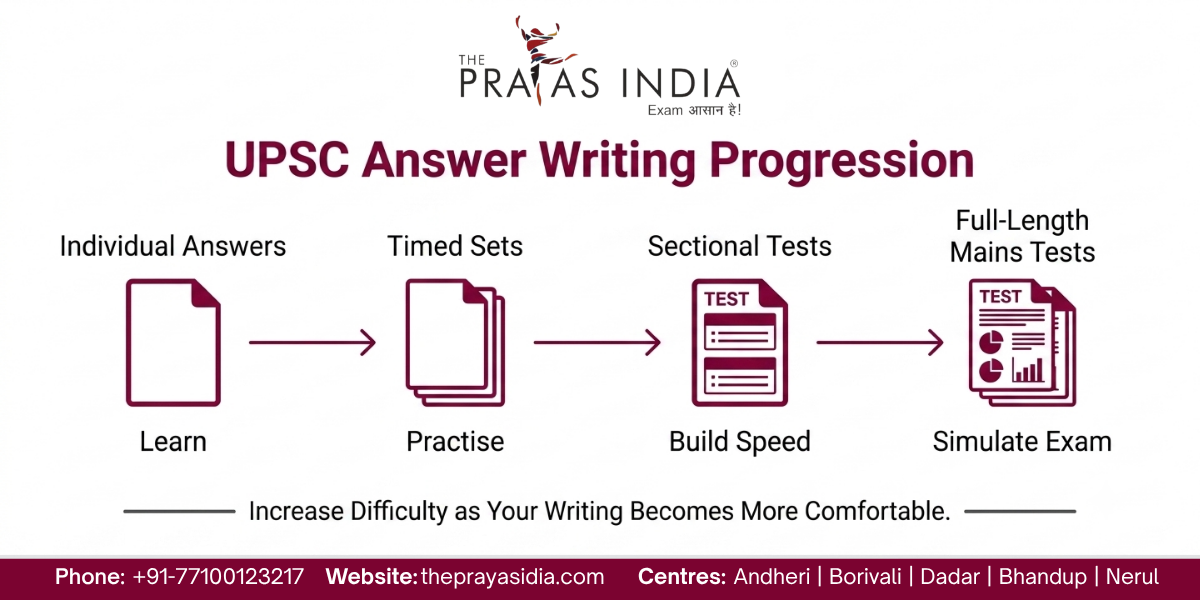
Full-length tests should be introduced after you have developed sufficient comfort with individual answers.
Before that stage, focus on:
Question understanding → Individual answers → Timed sets → Sectional tests → Full-length papers
This progression prevents full papers from becoming overwhelming.
Once you begin full-length tests, analyse not just the quality of individual answers but also:
- Time distribution
- Number of questions attempted
- Time lost between questions
- Fatigue
- Answer length
- Repeated content
- Unfinished answers
A full paper tests both writing skill and stamina.
How UPSC Coaching Can Support Answer Writing
Self-practice is essential, but many aspirants struggle to evaluate their own answers objectively.
This is where structured guidance can be useful.
A good UPSC coaching programme should ideally provide:
Regular Answer-Writing Practice
Students should have a predictable schedule rather than writing only when they feel motivated.
Evaluation and Feedback
Feedback should identify specific issues related to content, structure, relevance and presentation.
Model Answers
Model answers should demonstrate how a question can be approached without encouraging mechanical copying.
Previous-Year Question Practice
PYQs should be integrated into answer-writing preparation.
Mentorship
Students should have guidance on improving individual weaknesses.
Test Series
Regular tests can help develop speed and examination stamina.
For aspirants searching for IAS coaching in Mumbai, these factors can be more meaningful than simply comparing the number of classroom hours.
What to Look for in the Best IAS Coaching in Mumbai
When evaluating UPSC coaching, ask practical questions.
Does the institute have a structured answer-writing programme?
Are answers evaluated regularly?
Do students receive actionable feedback?
Are previous-year UPSC questions included?
Are GS and Optional preparation treated appropriately?
Does the programme include essay and Ethics answer-writing support?
Are full-length Mains tests conducted?
Is there mentorship for students who are struggling?
The objective of coaching should be to create a feedback-driven preparation environment.
A Sustainable Weekly Answer-Writing Formula
For most aspirants, a useful formula is:
Write + Review + Rewrite + Repeat
If you write 15 answers in a week, try to ensure that at least some of them receive detailed review.
If you write 25 answers, do not automatically assume that 25 is better than 15.
Instead, compare the quality of your practice.
A productive week might look like:
15 answers written
10 answers self-reviewed
5 answers deeply evaluated
2–3 answers rewritten
This can create more learning than simply producing a larger number of untouched answers.
The Final Answer-Writing Checklist
Before considering an answer complete, ask:
Did I understand the question?
Underline the directive and keywords mentally.
Did I address the complete demand?
Check whether the question has multiple parts.
Is the introduction relevant?
Avoid generic statements.
Is the body organised?
Use logical headings or dimensions where appropriate.
Have I explained my arguments?
Avoid merely listing points.
Did I use examples selectively?
Examples should strengthen arguments.
Did I maintain balance?
Where required, present multiple perspectives.
Is the conclusion purposeful?
End with a meaningful and relevant closing thought.
Did I respect the word limit?
Practise concise expression.
Did I complete it within time?
Exam readiness requires both quality and speed.
Final Takeaway
There is no universal number of UPSC Mains answers that every aspirant must write every week.
The right target changes with your preparation stage.
A beginner may benefit from 5–10 carefully analysed answers.
An aspirant building writing skills can move towards 10–15 answers.
During integrated preparation, 15–25 answers can provide regular exposure.
In the serious Mains-oriented phase, 25–35 or more answers may be appropriate for some candidates, provided the answers are being evaluated and the rest of the preparation remains balanced.
The most important principle is not the number.
It is the quality of the feedback loop.
Write → Evaluate → Identify Gaps → Correct → Rewrite → Repeat
Your answer-writing practice should gradually improve your ability to understand questions, select relevant content, structure arguments, use examples, manage word limits and write within time.
Do not turn answer writing into a race.
A notebook filled with hundreds of unanalysed answers does not guarantee Mains readiness.
A smaller collection of carefully written, evaluated and improved answers can teach you much more.
For aspirants preparing for UPSC in Mumbai, the right coaching environment can add structure through regular answer-writing schedules, evaluation, mentorship, test series and exam-oriented guidance. If you are looking for IAS coaching in Mumbai, consider whether the institute can help you build a sustainable writing habit rather than simply giving you more questions to solve.
Ultimately, the best weekly answer-writing target is the one you can maintain, analyse and improve consistently.
Because UPSC Mains does not reward the candidate who has merely written the most answers during preparation.
It rewards the candidate who can think clearly, select relevant information and communicate it effectively under examination conditions.
Contact Us
📞 Call Now: +91-77100 13217
🌐 Website: theprayasindia.com