How to Use Examples and Data in UPSC Mains Answers? | Best UPSC Coaching in Mumbai | The Prayas India
UPSC Mains answers are not judged only by how much information a candidate can remember. They are judged by how effectively that information is used to address the question. A well-written answer needs conceptual clarity, relevance, balance and analytical depth. This is where examples and data can become powerful tools. A suitable example can make an abstract argument easier to understand, while a credible statistic can give weight to an observation that might otherwise appear generic.
However, using examples and data does not mean filling an answer with numbers, reports or case studies. Their real value comes from how naturally they support the argument. An aspirant who adds a relevant example at the right point can often communicate an idea more effectively than someone who simply lists several facts. Similarly, one meaningful statistic can strengthen an argument more than a paragraph containing multiple disconnected figures.
For UPSC Mains preparation, therefore, examples and data should be treated as answer-enrichment tools, not as decoration. The objective is to make your arguments more specific, credible and multidimensional without compromising the core requirement of answering the question directly.
Start With the Question, Not the Example
One of the most common mistakes aspirants make is remembering a good example and then trying to fit it into every possible answer. This often produces answers that contain useful information but fail to address the actual demand of the question.
The better approach is to first understand what the question is asking. Identify its directive, subject, scope and specific dimensions. Once you know the argument you want to make, look for an example or data point that supports that argument. This keeps the answer question-oriented.
For instance, if a question asks about the impact of digital technology on financial inclusion, mentioning a relevant digital-payment or financial-inclusion development can strengthen the argument. But simply writing several technology-related statistics without explaining their connection to financial inclusion does little to improve the answer.
The sequence should therefore be simple: understand the question → develop the argument → support it with evidence. This prevents examples from taking over the answer.
Examples Should Explain, Not Just Impress
An example becomes useful when it makes your argument clearer. It can demonstrate how a policy works, show the impact of a social issue, illustrate a governance challenge or provide a real-world context for a theoretical concept.
Consider an answer discussing cooperative federalism. Instead of merely stating that cooperation between the Centre and states is important, a candidate could refer to a relevant institutional mechanism or a policy implementation experience to demonstrate how coordination can influence outcomes. The example gives the examiner something concrete through which the broader argument can be understood.
The same principle applies across subjects. In General Studies Paper I, examples can help explain social and geographical phenomena. In GS Paper II, government schemes, institutions, court judgments and administrative experiences can support governance arguments. In GS Paper III, economic indicators, environmental initiatives, technological developments and agricultural case studies can make answers more grounded. In GS Paper IV, real-life administrative situations and ethical dilemmas can make abstract values more practical.
The important point is that an example should have a clear job inside the answer. If removing the example does not weaken your argument, it may not have been necessary in the first place.
Use Data to Add Specificity
Data can make an answer appear more precise, but only when it is relevant and reasonably reliable. Generic statements such as “a large number of people live in cities” are less informative than a properly contextualised statistic showing the scale or direction of urbanisation.
At the same time, UPSC aspirants should avoid turning answers into collections of statistics. The examiner is not looking for a data sheet. Numbers are useful when they establish magnitude, demonstrate a trend or support a particular claim.
A good data point can be used to establish the scale of a problem, demonstrate progress, highlight a gap or justify the need for a particular intervention. For example, while discussing learning outcomes, poverty, healthcare, employment or environmental challenges, a relevant figure can quickly establish why the issue deserves attention.
Follow the data with interpretation. Instead of simply writing a statistic and moving on, explain what that statistic tells us about the issue. This transforms information into analysis.
The “Data + Meaning” Approach
A useful habit for UPSC Mains preparation is to avoid writing data in isolation. Whenever you use a statistic, immediately connect it to the argument you are making.
Suppose you mention that a particular indicator has improved over a period. The next sentence should explain what that improvement suggests. Similarly, if a statistic highlights a persistent challenge, use it to establish why the problem requires policy attention.
This can be thought of as a simple structure:
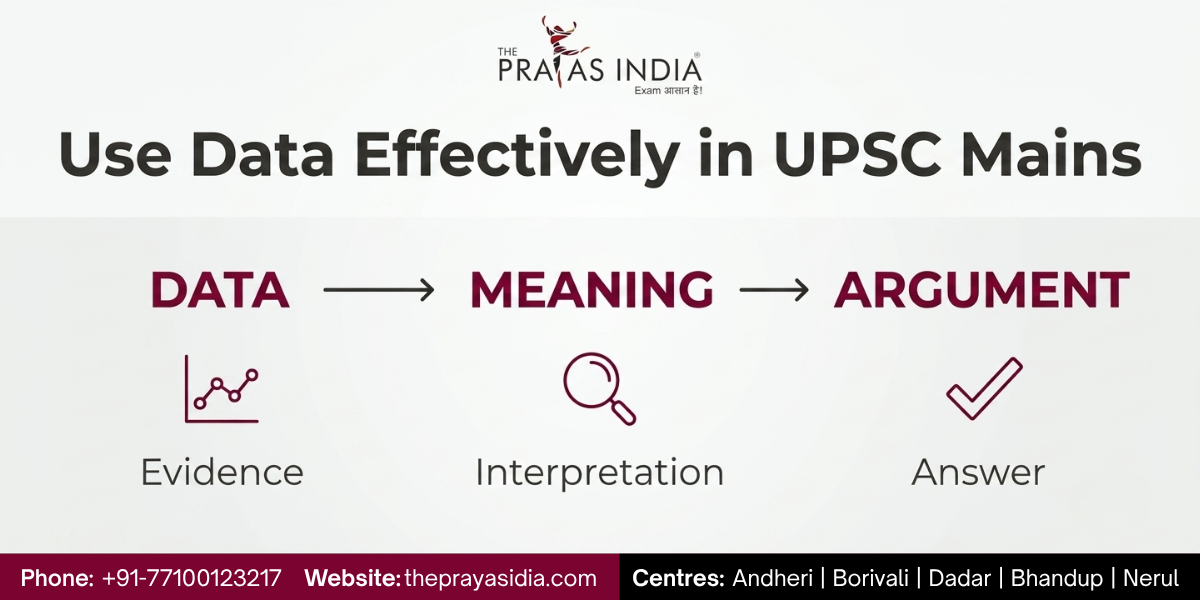
Data → Interpretation → Argument
The data establishes the evidence. The interpretation explains its significance. The argument connects it to the question.
This approach is particularly valuable because UPSC Mains rewards analytical writing rather than mere information reproduction. A candidate who can explain the significance of evidence demonstrates a deeper understanding of the issue.
Avoid Fake Precision
One of the biggest risks associated with data-based answers is using figures that you are not confident about. Candidates sometimes remember a statistic incorrectly and write an exact-looking number simply because it sounds convincing.
This can weaken the credibility of an otherwise strong answer.
If you are not certain about an exact figure, it is often better to use a broad but defensible expression such as “around one-third,” “more than half,” “nearly two-thirds” or “a significant proportion,” provided it accurately reflects the evidence you know. You can also mention the source or institution when you are confident about it.
The goal is not to demonstrate that you remember every decimal point. The goal is to demonstrate that you understand the scale and relevance of the issue.
For this reason, candidates should build a compact collection of reliable figures rather than trying to memorise hundreds of statistics.
Build an Example Bank During Preparation
Examples should not be collected randomly. Create a small, organised example bank while studying each subject. Whenever you come across a useful case study, policy initiative, institutional practice, court judgment, social movement, district-level innovation or international example, record it under the relevant theme.
For example, while preparing governance, you might maintain categories such as transparency, citizen participation, digital governance, local administration and service delivery. In environment preparation, you could organise examples around conservation, renewable energy, climate adaptation, pollution control and community participation.
This makes revision easier because you are not trying to memorise individual examples in isolation. You are building a mental library that can be used across multiple questions.
Over time, a single well-understood example may become useful in several contexts. The important thing is to understand the example well enough to adapt it rather than mechanically reproducing the same sentence in every answer.
Examples Across Different GS Papers
The strongest example bank is one that covers different dimensions of the UPSC syllabus. You do not need dozens of examples for every topic. A few versatile and well-understood examples can be more useful.
For GS Paper I, focus on examples that help explain society, geography, culture and historical developments. Social issues become more concrete when supported by relevant community initiatives, demographic trends or contemporary illustrations.
For GS Paper II, examples from governance, constitutional institutions, welfare delivery, local administration and judicial developments can strengthen analytical arguments. When using a government scheme, do not merely mention its name. Explain how it demonstrates the point you are making.
For GS Paper III, data and examples are particularly useful for economics, agriculture, environment, science and technology and internal security. Economic indicators can establish trends, while case studies can demonstrate the practical impact of policies or technological interventions.
For GS Paper IV, examples can bring ethical concepts to life. A situation involving conflict of interest, public accountability, empathy or administrative responsibility can demonstrate how a theoretical value operates in practice.
This subject-wise approach ensures that your examples remain relevant to the demands of the syllabus rather than becoming a random collection of current affairs.
Use Government and Institutional Sources Carefully
The credibility of your data matters. While preparing for UPSC Mains, prioritise reliable sources such as government reports, official ministry publications, recognised international organisations and credible institutional studies.
You do not need to mention the full title of a report every time you use a statistic. In many cases, simply naming a credible source can add context. For example, a figure can be introduced as being based on a government report or an established international organisation when you are confident about the source.
The more important skill, however, is understanding the evidence before using it. Do not memorise a statistic merely because it appeared in a current-affairs compilation. Know what it measures, what period it covers and why it matters.
This protects you from using data incorrectly and helps you write more naturally in the examination.
Current Affairs Should Become Answer Material
UPSC Mains preparation becomes more effective when current affairs are integrated with static subjects instead of being studied as a completely separate collection of news.
Suppose you read about a new environmental initiative. Instead of simply making a current-affairs note, ask yourself which static topic it connects with. Could it be used in an answer on environmental governance, climate adaptation, sustainable development or community participation?
Similarly, an important Supreme Court judgment can be connected to constitutional principles, fundamental rights, governance or institutional accountability depending on its subject matter.
This approach converts current affairs into usable examples and arguments. It also reduces the burden of memorising isolated news items.
The objective is not to reproduce newspaper content in the Mains examination. It is to use relevant contemporary developments to demonstrate that you can connect concepts with real-world situations.
Keep Examples Short in the Final Answer
Even a highly relevant example should not consume too much space. Remember that the example exists to strengthen your argument, not become the argument itself.
In most cases, one or two sentences are sufficient to establish a case study. The remaining space should be used for analysis, explanation and solutions. This becomes especially important in time-bound Mains writing, where every additional line has an opportunity cost.
A concise example can be introduced naturally using phrases such as “For instance,” “A relevant example is,” “This can be seen in,” or “A case in point is.” Avoid writing long narrative descriptions unless the question specifically requires them.
Your answer should read like an argument supported by evidence, rather than a collection of stories and statistics.
Key Takeaway
Examples and data can significantly improve the quality of UPSC Mains answers, but only when they are relevant, credible, concise and properly connected to the argument. The strongest answers do not try to impress the examiner with the maximum number of facts. Instead, they demonstrate the ability to select the right evidence and use it at the right point.
Start building your example and data bank during preparation itself. Organise it according to GS themes, revise it alongside static subjects and practise inserting it into answers. With regular answer writing, you will gradually learn which examples are versatile, which statistics are worth remembering and where evidence can strengthen your arguments.
For UPSC aspirants, this approach also reduces the pressure of memorising enormous amounts of current affairs. Instead of trying to remember everything, you can build a smaller collection of high-quality, versatile examples and reliable data points that can be adapted to multiple questions.
Use Examples in the Introduction When They Add Context
The introduction should establish the direction of your answer quickly. A relevant example can sometimes be an effective way to provide context, especially when the question is linked to a contemporary issue.
However, an example should not make the introduction unnecessarily long. If you use one, it should lead naturally into the central issue raised by the question. The examiner should immediately understand why you have mentioned it.
For instance, a question about the changing nature of urban governance could begin with a brief reference to the rapid growth of cities or a contemporary urban initiative. The example provides context, but the introduction should quickly move towards the core argument.
Not every answer needs an example in the introduction. In many cases, a definition, constitutional reference, brief context or direct interpretation of the question may be more effective. Use examples where they add value, not because every answer must contain one.
The Body Is Where Evidence Matters Most
The body of the answer is generally where examples and data can make the greatest difference. This is where you present arguments, explain causes, discuss impacts and evaluate challenges.
A simple structure can be:
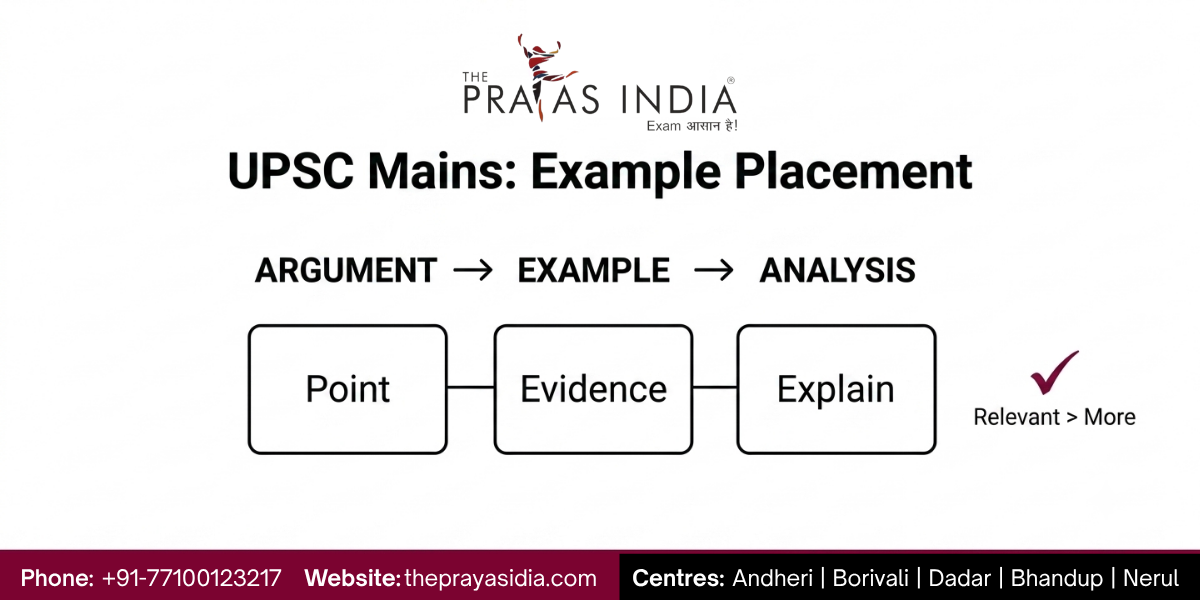
Point → Explanation → Example/Data → Analysis
Suppose you are discussing a challenge in public healthcare. You can first state the issue, explain why it matters, support it with a relevant figure and then interpret what the evidence tells us. This creates a logical progression instead of simply dropping a statistic into the paragraph.
The same structure can work across GS papers. In an answer on environmental degradation, for example, you can identify the problem, explain its implications, support it with relevant evidence and then connect it to policy or community-level solutions.
The important thing is that the evidence should be embedded within the argument rather than placed separately as a collection of facts.
Data Can Strengthen Both Problems and Solutions
A common tendency among aspirants is to use data only while describing the seriousness of a problem. However, data can also strengthen the solution side of an answer.
For example, if you are discussing an education challenge, one statistic may demonstrate the gap, while another credible indicator may show improvement after a particular intervention. This creates a more balanced answer because you are not merely describing the problem; you are demonstrating what has worked and where further intervention is needed.
Similarly, in economic answers, data can establish a trend while policy outcomes can help evaluate whether the trend is sustainable. In environmental answers, indicators can establish the scale of degradation while examples of successful conservation initiatives can support the way forward.
This creates a stronger analytical pattern:
Evidence of the problem → Evidence of progress → Evidence-based way forward
Use Case Studies to Demonstrate Practical Understanding
Case studies can be particularly effective when answering questions related to governance, social issues, ethics, environment and development. A good case study shows the examiner that you understand how an abstract principle operates in the real world.
The case study does not need to be elaborate. You can mention a district-level innovation, a successful community initiative, an administrative intervention or a policy implementation experience in one or two lines.
For example, while discussing citizen participation, a local governance initiative can demonstrate how community involvement improves implementation. While discussing environmental conservation, a successful community-led conservation model can show that local participation can complement formal institutions.
The key is to explain what the case demonstrates. Without that explanation, a case study becomes another isolated fact.
Don’t Overload an Answer With Statistics
A common misconception is that a high-quality UPSC answer should contain multiple statistics. This can actually make an answer less readable if the numbers are not connected to the argument.
Imagine a paragraph containing four different percentages, two report names and several years. Even if all the information is accurate, the central argument may become difficult to identify.
Instead, select the one statistic that best supports the point you are making. Explain its significance and move forward.
A useful rule during practice is to ask yourself:
“If I remove this number, does my argument become weaker?”
If the answer is yes, the data probably has a purpose. If the answer is no, the statistic may simply be adding weight without adding value.
Build a Reliable Data Bank
A data bank should be compact enough to revise regularly. Creating an enormous document containing hundreds of statistics is rarely practical because most of it will never reach your final answer.
Organise your data according to broad themes such as:
- Poverty and inequality
- Health
- Education
- Women and children
- Agriculture
- Employment
- Urbanisation
- Environment
- Energy
- Digital governance
- Social justice
- Economy
- Science and technology
Within each theme, maintain a small collection of high-value statistics and note the source whenever possible. Instead of memorising isolated numbers, remember what each number demonstrates.
For example, if a particular statistic shows a gender gap, your note should also include the argument for which that statistic can be used. This turns your data bank into an answer-writing resource rather than a passive collection of facts.
Create an Example Bank That Is Easy to Revise
The same principle applies to examples. Organise examples according to themes rather than simply recording them chronologically from newspapers.
A governance example could potentially be useful for questions on transparency, citizen participation, service delivery and administrative reform. A successful environmental initiative might be relevant to conservation, community participation, sustainable development and climate adaptation.
For each example, record three things:
What happened?
What does it demonstrate?
Where can I use it?
This three-part note makes revision considerably easier. You do not need to remember the entire story. You need to remember the central lesson and the contexts in which it can support an argument.

Use Reports Without Turning Your Answer Into a Bibliography
Reports can add credibility to an answer, but repeatedly mentioning long report names can make your writing cumbersome. The purpose of mentioning a report is to establish the credibility or relevance of the evidence, not to demonstrate how many reports you have memorised.
If you know the source confidently, a short reference is generally enough. For example, you may attribute a relevant finding to a recognised government report, constitutional body or international organisation.
More importantly, understand the finding you are using. If a report says that a particular indicator has improved, know whether the improvement relates to the national level, a particular period or a particular population. Context matters.
This is particularly important because data can be misleading when separated from its methodology or timeframe. UPSC Mains rewards informed analysis rather than superficial citation.
Use Examples to Add Balance to Your Answers
Examples can also help you demonstrate that an issue is not one-dimensional. If you are discussing a policy, for example, you can mention both a successful implementation experience and a challenge observed elsewhere.
This allows you to avoid extreme statements and develop a more nuanced answer.
For instance, rather than writing that a particular technology has “solved” a governance problem, you can mention its benefits along with concerns around access, digital literacy or privacy. A relevant example can then support each dimension.
This is especially useful for questions that use words such as “critically examine,” “discuss,” “evaluate,” “analyse” or “comment.” Such questions generally require more than one-sided description.
Examples and data can help you move from a generic answer to a balanced analytical answer.
Link Examples With the Way Forward
The strongest use of examples is often found near the conclusion of an argument, where they can inform the way forward.
If a successful initiative demonstrates that community participation improves outcomes, the lesson can become part of your recommendation. If a particular policy experience reveals an implementation gap, your solution can directly address that gap.
This makes the answer more coherent:
Problem → Evidence → Analysis → Lesson → Way Forward
Instead of ending with generic recommendations such as “more awareness is needed” or “better implementation is required,” use the evidence discussed earlier to make your suggestions more specific.
That demonstrates that your way forward has emerged from your analysis rather than being a standard conclusion memorised beforehand.
Practise Inserting Evidence Under Time Pressure
Knowing examples and data is different from being able to use them during the examination. In the Mains examination, you have limited time to understand the question, structure the answer and write it.
Therefore, practise inserting evidence into timed answers.
After writing an answer, underline your examples and data. Then ask whether each one is relevant, accurate and properly connected to the argument. Also check whether you spent too many words explaining the example.
Over time, you will develop the ability to recall an appropriate example without disrupting your writing flow.
This is one reason regular answer writing is so important for UPSC preparation. It transforms information from passive memory into usable examination content.

Common Mistakes While Using Examples and Data
One common mistake is using outdated information. Current-affairs data changes, and a statistic that was useful several years ago may no longer accurately represent the situation. Maintain your notes regularly and prioritise recent, credible information where the question demands contemporary evidence.
Another mistake is using examples that are too generic. Saying that “a government scheme has helped people” does not demonstrate much. A better example briefly identifies the intervention and explains the specific lesson it offers.
A third mistake is using examples without analysis. The examiner should not have to infer why you mentioned a particular case. Make the connection explicit.
Some candidates also use too many examples because they believe quantity creates depth. In reality, relevance and explanation matter more than volume.
Finally, avoid forcing examples into every answer. Some questions can be answered more effectively through conceptual explanation, constitutional provisions, theoretical frameworks or direct analysis. Evidence should strengthen your answer, not become a compulsory decoration.
A Practical UPSC Mains Evidence Formula
For everyday answer-writing practice, aspirants can use a simple formula:
One Argument + One Relevant Evidence + One Line of Analysis
This keeps the answer focused. You do not need a statistic after every sentence. Instead, identify the major arguments in your answer and selectively strengthen the most important ones.
For a 10-marker, even a few well-placed examples or data points may be sufficient. For a longer answer, you can use evidence across different dimensions without making the answer feel overloaded.
The objective is to create a natural balance between knowledge and analysis.
Your answer should ultimately communicate:
“I understand the issue, I can support my argument, and I can explain what the evidence means.”
That is far more valuable than simply demonstrating that you have memorised a large number of facts.
How UPSC Coaching Can Improve Evidence-Based Answer Writing
Aspirants often collect plenty of current affairs but struggle to convert them into Mains-ready content. This happens because reading information and applying information are two different skills.
A structured UPSC coaching programme in Mumbai can help bridge this gap when it includes answer-writing practice, evaluation and feedback. Regular evaluation can show whether your examples are relevant, whether your data is being used effectively and whether your analysis is sufficiently developed.
For students considering UPSC coaching in Mumbai, it is useful to look beyond syllabus coverage. A strong preparation programme should provide opportunities for answer writing, structured feedback, current-affairs integration, revision and repeated practice under time constraints.
The objective of coaching should ultimately be to help an aspirant become more independent and effective in the examination hall.
Build Quality, Not Quantity
The best UPSC Mains answers are not necessarily those containing the highest number of statistics or examples. They are the answers where each piece of evidence has a clear purpose.
A reliable data point can establish the scale of an issue. A relevant case study can make an argument concrete. A government initiative can demonstrate a practical solution. A constitutional provision can establish legitimacy. A contemporary example can show relevance.
When these elements are connected through analysis, the answer becomes richer without becoming unnecessarily long.
Therefore, instead of attempting to memorise hundreds of facts, focus on building a small, high-quality evidence bank and practise using it. This approach is more sustainable and much more useful during revision.
Final Takeaway
Examples and data should make your UPSC Mains answers more specific, credible and analytical. They should never replace the argument itself.
Start by understanding the question, develop your point and then select the evidence that genuinely supports it. Use statistics to establish scale or trends, examples to demonstrate real-world application and case studies to show how concepts work in practice. Most importantly, explain what the evidence means.
During preparation, maintain separate but connected example and data banks. Organise them according to GS themes, revise them regularly and practise inserting them into timed answers. This will gradually make evidence-based writing a natural part of your Mains approach.
For aspirants preparing with a structured UPSC coaching strategy in Mumbai, regular answer writing and expert feedback can further improve the ability to select, place and analyse evidence.
The ultimate goal is simple: do not write more facts; write more meaningful facts.
Contact Us
📞 Call Now: +91-77100 13217
🌐 Website: theprayasindia.com
📍 Centres: Andheri | Borivali | Dadar | Nerul | Bhandup
FAQs
1. How many examples should I use in a UPSC Mains answer?
There is no fixed number. Use only as many examples as genuinely strengthen your arguments. A few relevant and well-explained examples are usually more effective than many disconnected ones.
2. Should every UPSC Mains answer contain data?
No. Data is useful when it adds specificity or credibility, but not every question requires statistics. Use data selectively according to the demand of the question.
3. Where should I use examples in a UPSC Mains answer?
Examples can be used in the introduction, body or conclusion depending on the question. The body is generally the most natural place because examples can directly support individual arguments.
4. How can I remember data for UPSC Mains?
Create a compact data bank organised by GS themes. Focus on understanding what each statistic demonstrates instead of memorising large numbers of disconnected figures.
5. What sources should I use for UPSC Mains data?
Prioritise credible sources such as government reports, ministries, recognised institutions and reputed international organisations. Always understand the context and timeframe of the data you use.
6. Can I use the same example in multiple UPSC answers?
Yes, if the example genuinely supports different arguments. However, adapt the explanation to the specific question instead of mechanically repeating the same sentence.
7. Is it better to use examples or statistics?
Neither is universally better. Statistics can establish scale or trends, while examples can make an argument concrete. The choice depends on what the question requires.
8. How can I improve my use of examples in answer writing?
Maintain a theme-wise example bank and practise using those examples in timed answers. After each answer, check whether the example was relevant and whether you clearly explained its significance.
9. Should I mention the source of every statistic?
Not necessarily. When you know the source confidently, mentioning a credible institution can strengthen the evidence. However, do not interrupt the flow of the answer with unnecessarily long source names.
10. Can coaching help improve UPSC Mains answer writing?
Yes. Structured answer-writing practice, evaluation and feedback can help aspirants improve content selection, evidence usage, structure and analytical depth. The quality of feedback is particularly important.