How to Choose the Best UPSC Coaching Institute in Mumbai? | The Prayas India
Introduction
Choosing a UPSC coaching institute is one of the most important decisions an aspirant makes at the beginning of the Civil Services preparation journey. With multiple institutes, online platforms, test series, study materials and individual educators available today, the challenge is no longer finding a source of information. The real challenge is identifying a learning environment that provides the right combination of academic guidance, structured preparation, answer-writing practice, revision, mentorship and consistency.
For an aspirant in Mumbai, this decision can become even more significant because UPSC preparation is a long-term process. A student may spend months or even years preparing for the examination, and the quality of guidance received during this period can influence how efficiently that time is used.
The phrase “best UPSC coaching in Mumbai” therefore should not be judged only by popularity, advertisements or the number of students enrolled. The right institute is the one that fits an aspirant’s preparation requirements, learning style, academic foundation and long-term goals.
For students considering UPSC coaching in Mumbai, The Prayas India provides an environment focused on structured competitive-exam preparation. But before choosing any institute, aspirants should understand the factors that actually matter.
Start With Your Own UPSC Preparation Requirements
Before comparing coaching institutes, an aspirant should first understand what kind of support they actually need.
Not every student begins UPSC preparation from the same starting point. Some candidates have strong academic fundamentals but struggle with answer writing. Others may be starting from scratch and need extensive conceptual guidance. Some aspirants require a highly structured timetable, while others are comfortable with independent study and mainly need mentorship and testing support.
This means that an institute that works exceptionally well for one student may not necessarily be the ideal choice for another.
Before taking admission, ask yourself:
- Do I need classroom-based conceptual guidance?
- Am I comfortable studying independently?
- Do I need help creating a preparation schedule?
- How much support do I need for answer writing?
- Do I need regular tests and performance analysis?
- Which subjects require the most guidance?
- Will I be able to attend classes consistently?
- Do I need mentorship throughout my preparation?
Answering these questions first can make the process of selecting a UPSC coaching institute in Mumbai much more objective.
Don’t Choose an Institute Based Only on Its Name
Brand recognition can be useful, but it should not become the only factor behind an admission decision.
A well-known coaching institute may have a strong reputation, but an aspirant should still examine the actual academic system offered to students. The quality of faculty interaction, course structure, study resources, testing mechanism and doubt support can have a much more direct impact on day-to-day preparation.
Similarly, a smaller or less advertised institute should not automatically be considered inferior. The important question is whether the institute provides the academic ecosystem you need.
When comparing institutes, try to move beyond questions such as “Which institute is famous?” and instead ask:
“Which institute will help me prepare more systematically?”
That change in perspective can lead to a much better admission decision.
Faculty Quality Should Be a Major Consideration
UPSC is not an examination where simply memorising information is enough. Aspirants need to understand concepts, connect different topics, analyse issues from multiple perspectives and eventually express those ideas effectively in their answers.
Faculty therefore plays a crucial role in the preparation process.
A good teacher should be able to simplify complex subjects while also explaining how those concepts connect with the requirements of the UPSC examination. The classroom should ideally help students understand not only what to study, but also how to approach the subject from an examination perspective.
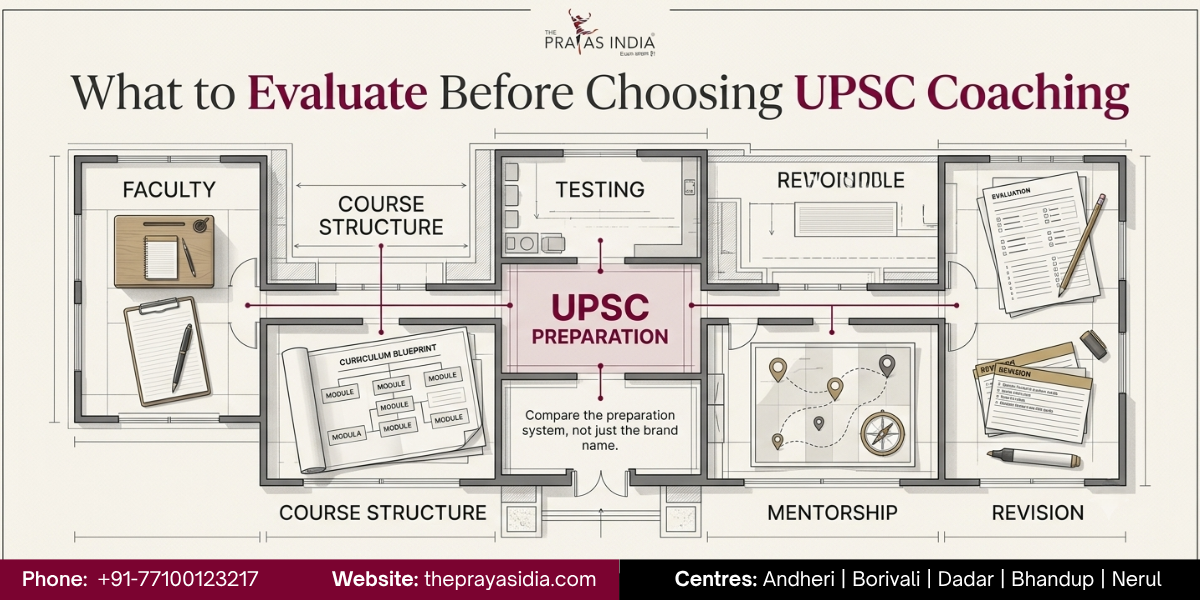
When evaluating a coaching institute, aspirants should pay attention to:
- Faculty experience and subject expertise
- Teaching methodology
- Ability to explain complex concepts clearly
- Integration of current affairs with static subjects
- Focus on analytical understanding
- Classroom interaction
- Approach towards answer writing
- Availability of academic guidance outside regular lectures
For a long-term preparation journey, consistent and effective teaching can be more valuable than a large collection of study resources.
Look at the Course Structure, Not Just the Number of Classes
A common mistake aspirants make is comparing coaching institutes based on the number of lectures or total classroom hours.
More classes do not necessarily mean better preparation.
The more important question is how those classes fit into a complete preparation structure.
A well-planned UPSC programme should give students a logical progression from foundational concepts to advanced examination-oriented preparation. It should also leave sufficient space for self-study, revision, practice and testing.
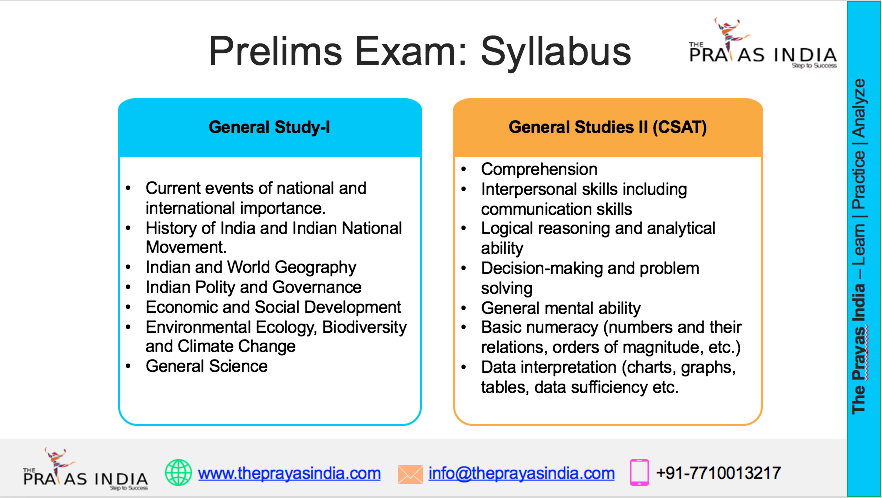
Aspirants should understand whether the course structure covers:
- Foundation and conceptual learning
- GS preparation
- Current affairs integration
- Answer-writing development
- Previous-year question analysis
- Regular revision
- Mock tests
- Evaluation and feedback
- Exam-oriented strategy
The ideal structure should not make students permanently dependent on classroom lectures. Instead, it should gradually help them become more confident and independent learners.
Study Material Should Support Understanding and Revision
Study material is another important factor to evaluate before taking admission.
UPSC preparation involves a vast syllabus, and students can easily become overwhelmed if every topic is approached through multiple books, PDFs and online sources. Good coaching material should simplify this process rather than add to the information burden.
The objective should be to provide material that supports classroom learning, self-study and revision.
Aspirants should examine whether the institute provides concise and structured resources, whether important topics are updated regularly and whether the material is connected with the examination requirements.
Quality study material should help students answer three practical questions:
What should I study? How deeply should I study it? How should I revise it later?
If the material helps answer these questions, it becomes a useful part of the preparation system.
Current Affairs Integration Matters in UPSC Preparation
Current affairs are not an isolated section of UPSC preparation. They frequently interact with subjects such as Polity, Economy, Environment, International Relations, Governance, Social Issues and Ethics.
Therefore, an aspirant should evaluate how a coaching institute handles current affairs.
Simply providing a monthly current-affairs compilation may not be enough. Students should ideally learn how current events can be connected with static concepts and eventually used in analytical answers.
For example, an issue related to a government policy may have relevance to governance, social justice, constitutional provisions, economic development and administrative challenges.
A strong classroom approach can help students recognise these connections rather than treating every current event as a separate fact to memorise.
Answer Writing Should Be Part of the Preparation Journey
One of the biggest differences between learning for a conventional academic examination and preparing for UPSC Mains is the importance of written expression.
Knowing the answer is not sufficient. Aspirants must be able to present their understanding within a limited word count, maintain relevance, structure arguments logically and address different dimensions of the question.
This skill develops through practice.
Aspirants evaluating a UPSC coaching institute in Mumbai should therefore check whether answer writing is integrated into the course or treated as an optional activity towards the end.
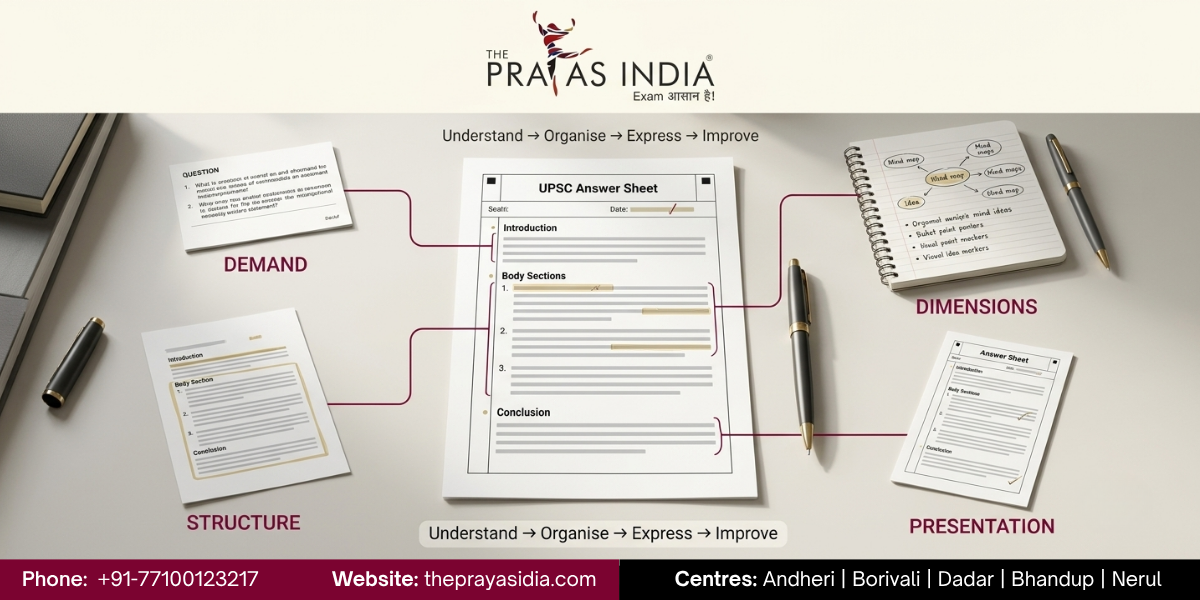
A useful answer-writing system should gradually introduce students to:
- Understanding the demand of a question
- Structuring introductions
- Developing relevant arguments
- Using examples and current affairs
- Adding multiple dimensions
- Writing concise conclusions
- Managing word limits
- Improving answers through feedback
The earlier this process becomes part of preparation, the more naturally students can develop their writing skills.
Mentorship Can Help Aspirants Stay on the Right Track
UPSC preparation involves hundreds of individual decisions. Which subject should receive more time? When should revision begin? How many tests should be attempted? When should answer writing become more intensive? Which weaknesses need immediate attention?
Without guidance, students can spend considerable time experimenting with different strategies.
Mentorship can help reduce this uncertainty.
Good mentorship should not mean telling every student to follow exactly the same timetable. Instead, it should help aspirants understand their individual strengths and weaknesses and make better preparation decisions.
For example, a student who performs well in General Studies but struggles with answer writing may require a different intervention from a student who has strong writing skills but weak conceptual foundations.
This personalised aspect can make mentorship particularly useful during a long preparation cycle.
Mock Tests Should Measure More Than Marks
Mock tests are an essential component of UPSC preparation, but their usefulness depends on what happens after the test.
A test score alone cannot explain why an aspirant is underperforming.
A useful evaluation process should help identify whether the problem lies in knowledge, interpretation, structure, relevance, time management or presentation.
For Prelims, this could involve analysing accuracy, question selection and elimination techniques. For Mains, evaluation should go deeper into content quality, structure, analytical depth, examples and answer presentation.
When comparing coaching institutes, aspirants should therefore ask not merely whether tests are conducted, but how those tests are evaluated and how feedback is used for improvement.
Batch Environment and Student Interaction Matter
The classroom environment can influence the overall learning experience.
UPSC preparation can sometimes become isolating, particularly for students who spend most of their time studying independently. A focused peer environment can provide opportunities to discuss ideas, compare approaches and understand different perspectives.
However, the objective should not be competition within the classroom.
A healthy learning environment encourages students to ask questions, discuss difficult topics and learn from one another without losing focus on their own preparation.
Aspirants visiting a coaching centre before admission should therefore pay attention to the classroom atmosphere, student interaction and the overall academic culture.
Location and Schedule Are Practical Factors Too
Academic quality is important, but practical convenience should not be ignored.
UPSC preparation requires consistency over a long period. If travelling to the coaching centre takes an excessive amount of time every day, it can reduce the hours available for self-study, revision and practice.
Students in Mumbai should consider whether the institute’s location and class timings fit comfortably into their routine.
Before taking admission, evaluate:
- Daily travel time
- Class schedule
- Availability of batches
- Time required for self-study
- Compatibility with college or work commitments
- Accessibility of the centre
The best coaching programme on paper may not be the best practical choice if its schedule makes consistent preparation difficult.
The Prayas India as a Choice for UPSC Aspirants in Mumbai
For aspirants considering UPSC coaching in Mumbai, The Prayas India offers a structured environment focused on competitive-examination preparation.
The institute’s approach is designed around the idea that UPSC preparation requires more than classroom lectures. Students need an organised academic process that connects conceptual learning with practice, revision, testing and improvement.
This becomes particularly relevant for aspirants who prefer having a defined preparation structure instead of independently coordinating multiple resources.
However, choosing an institute should always remain an individual decision. Aspirants should evaluate the course, faculty, learning environment, support system and schedule before making an admission decision.
The objective of coaching should ultimately be to make preparation more organised, measurable and examination-oriented.
A Simple Checklist Before Taking Admission
Before finalising your UPSC coaching institute, take some time to compare your options objectively.
A practical checklist can include:
- Faculty and teaching methodology
- Course structure and syllabus coverage
- Current affairs integration
- Study material quality
- Answer-writing support
- Test series and evaluation
- Mentorship availability
- Doubt-solving mechanism
- Revision strategy
- Classroom environment
- Location and batch timings
- Compatibility with your self-study schedule
The institute that performs well across these areas is likely to be a more meaningful choice than one selected purely because of popularity.
Choosing Coaching Is Choosing a Preparation Environment
The search for the best UPSC coaching in Mumbai should ultimately be about finding the right preparation environment rather than finding the institute with the most impressive marketing.
UPSC preparation demands patience, consistency and continuous improvement. Good guidance can help aspirants avoid unnecessary experimentation, but individual effort remains equally important.
The right coaching institute should provide direction without making students completely dependent on it. It should help them understand concepts, practise answer writing, evaluate performance, revise effectively and gradually become independent learners.
For aspirants considering admission at The Prayas India, the decision should be based on how well the institute’s teaching approach and preparation ecosystem align with their individual goals.
If you are beginning your UPSC journey in Mumbai, take the time to compare institutes carefully, understand what each programme offers and choose a learning environment in which you can remain consistent for the long term.
A thoughtful admission decision at the beginning can make the entire UPSC preparation journey more structured, focused and purposeful.
Personalised Guidance Can Make Preparation More Efficient
UPSC preparation is often described as a long journey, but every aspirant experiences that journey differently. A student who is preparing alongside college may need a very different study structure from someone preparing full-time. Similarly, a candidate attempting the examination for the first time may require stronger foundational guidance, while a repeat aspirant may need targeted support for specific weaknesses.
This is why personalised academic guidance can be valuable when selecting a UPSC coaching institute. A good coaching environment should help students understand where they currently stand and what they need to improve instead of assuming that every aspirant has identical requirements.
For example, an aspirant struggling with answer writing may need regular evaluation and feedback, whereas another candidate may need greater support in building conceptual clarity. A structured mentorship system can help identify these differences and make preparation more targeted.
For students looking for UPSC coaching in Mumbai, this is an important factor to consider before taking admission. The right institute should support individual improvement while maintaining a structured academic framework.
Don’t Ignore the Importance of Self-Study
Coaching can provide direction, but UPSC preparation cannot be completed through classroom learning alone.
Aspirants need substantial time for reading, revision, newspaper and current-affairs analysis, answer writing, test practice and independent study. Therefore, while evaluating a coaching institute, students should also consider whether the programme leaves enough room for self-study.
An excessively packed schedule may make it difficult to revise what has been taught in class. On the other hand, a well-balanced programme can help students use classroom hours for guided learning and reserve independent study time for consolidation.
A useful preparation cycle could look like this:
- Attend the scheduled class and understand the concept.
- Revise the topic independently.
- Connect it with relevant current affairs.
- Practise UPSC Previous Year Questions.
- Attempt related answer-writing questions.
- Review mistakes and revise again.
This combination allows coaching and self-study to complement each other instead of competing for the aspirant’s time.
UPSC Previous-Year Questions Should Influence Your Preparation
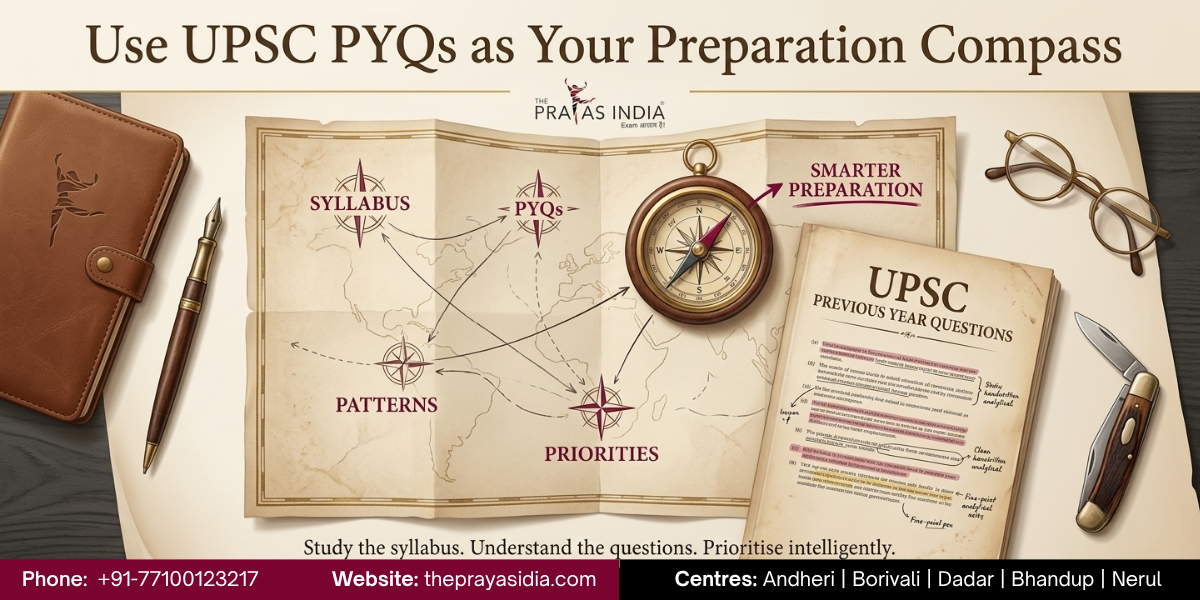
Previous-year questions are among the most useful resources available to UPSC aspirants because they provide a direct understanding of how the examination tests knowledge.
Aspirants should therefore examine whether a coaching institute uses previous-year questions as an integral part of its teaching methodology.
PYQs can help students understand the nature of questions, identify recurring themes and recognise how different subjects are connected. They can also prevent aspirants from spending excessive time studying information that has little relevance to the examination.
For Mains preparation, PYQs are particularly useful because they help students understand the demand of questions rather than simply the subject matter.
A coaching programme that consistently encourages students to look at the examination through the lens of previous-year questions can make preparation more focused.
The Right Coaching Should Help You Manage Current Affairs
Current affairs preparation can become overwhelming if students try to consume every piece of news they encounter.
The UPSC syllabus is broad, and current events can potentially connect with several areas of the examination. A coaching institute can help aspirants filter information and understand which developments deserve deeper attention.
The value of current-affairs guidance lies not merely in providing daily or monthly updates. Students should learn how to connect contemporary issues with the static syllabus and use them in analytical discussions and Mains answers.
A good current-affairs approach should encourage aspirants to think in terms of:
Issue → Background → Causes → Impact → Challenges → Government Response → Way Forward
This framework helps students move beyond fact collection and develop the analytical approach expected in the Civil Services Examination.
Ethics and Essay Preparation Should Not Be Left Until the End
Another important consideration while selecting a UPSC coaching institute is whether the programme gives adequate attention to Essay and Ethics.
These areas can sometimes be pushed aside because aspirants are more focused on General Studies subjects. However, both require practice and a gradual understanding of how to structure responses.
Essay writing demands the ability to interpret a topic, develop multiple dimensions and maintain logical flow. Ethics requires conceptual understanding along with the ability to apply principles to practical situations and case studies.
These are skills that improve with repeated practice.
Therefore, aspirants should ideally choose a preparation system where these components are integrated into the broader academic journey rather than being treated as last-minute additions.
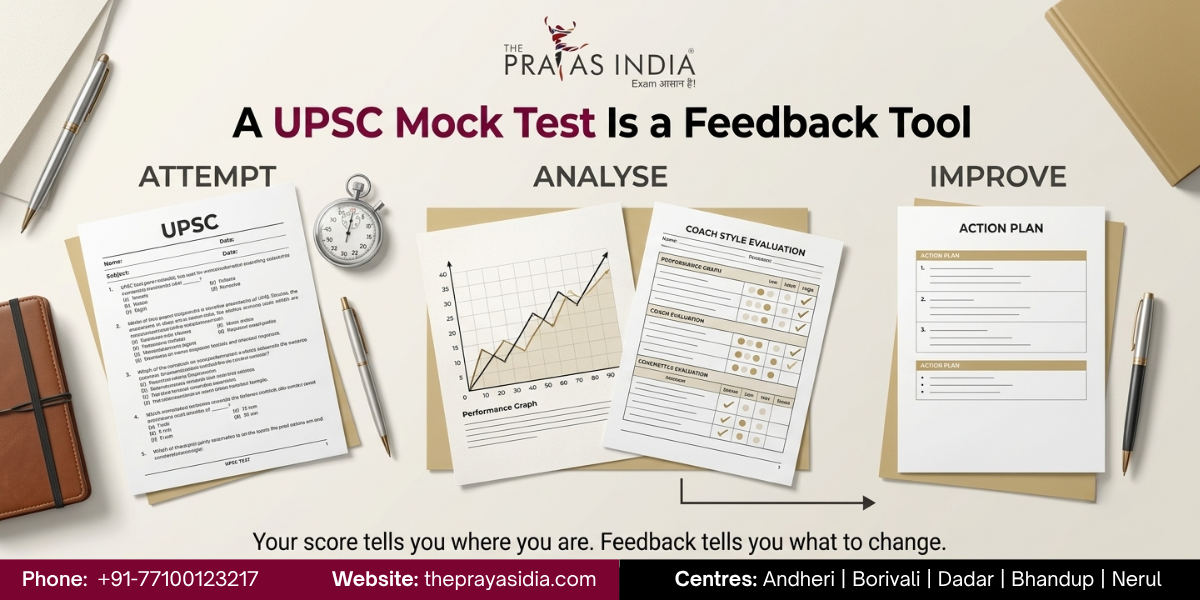
A Good Test Series Should Be Accompanied by Feedback
Simply attempting tests is not enough.
Aspirants can take dozens of tests and still repeat the same mistakes if they never analyse their performance. This is why evaluation and feedback should be considered when comparing UPSC coaching institutes in Mumbai.
For Prelims, students need to understand issues such as accuracy, elimination, question selection and time management. For Mains, evaluation should examine structure, relevance, analytical depth, examples, presentation and the ability to directly address the question.
Feedback should ultimately answer one important question:
“What should I do differently in my next attempt?”
This makes testing a continuous improvement mechanism rather than simply a way of generating marks.
Why the Learning Environment Matters
UPSC preparation can be mentally demanding because aspirants spend a significant amount of time reading, writing, revising and evaluating their own performance. The learning environment around them can therefore influence consistency.
A focused classroom environment can encourage students to maintain a regular academic routine. Interacting with serious aspirants can also expose students to different perspectives and approaches to preparation.
However, the most useful environment is not necessarily the most competitive one. Students should look for an academic culture where asking questions is encouraged, discussions remain focused and students can seek guidance when they face difficulties.
The objective should be to create an environment where students feel academically challenged without becoming unnecessarily overwhelmed.
Location, Timings and Accessibility Matter in Mumbai
Mumbai’s size and traffic make daily travel an important practical consideration for any long-term coaching programme.
An aspirant may spend several hours each day commuting to and from classes. Over a period of months, that travel time can significantly affect the hours available for revision, reading and self-study.
Before taking admission, students should therefore consider whether the coaching centre is conveniently located and whether the batch timings fit their routine.
For aspirants comparing UPSC coaching in Mumbai, practical questions include:
- How much daily travel will be required?
- Are class timings compatible with your schedule?
- Will you have enough time for self-study?
- Can you maintain the routine consistently?
- Is the centre accessible from your regular location?
A sustainable routine is more valuable than an ideal timetable that becomes impossible to follow.
How The Prayas India Fits Into Your UPSC Preparation Journey
The Prayas India approaches competitive-exam preparation with an emphasis on structured learning and examination-oriented preparation.
For UPSC aspirants, this can provide a framework within which classroom learning, independent study, practice and testing can work together.
Students considering admission should still evaluate the programme based on their own requirements. Faculty interaction, course structure, study resources, answer-writing support, testing, mentorship and accessibility should all be considered before making a final decision.
The purpose of choosing an institute should not be to outsource preparation. It should be to create a stronger system around your own effort.
With the right structure, aspirants can spend less time wondering what to study next and more time actually improving their preparation.
A Practical Admission Checklist for UPSC Aspirants
Before enrolling in any institute, take the time to compare your options carefully. If possible, speak to the academic team, understand the course structure and get clarity on what is included in the programme.
Aspirants can use this checklist:
- Understand the complete course structure.
- Evaluate the faculty and teaching methodology.
- Check how current affairs are integrated.
- Understand the study material provided.
- Ask about answer-writing practice.
- Examine the testing and evaluation system.
- Understand the mentorship mechanism.
- Check how doubts are handled.
- Consider revision support.
- Evaluate batch timings and location.
- Calculate the time available for self-study.
- Choose a programme you can follow consistently.
This approach makes the admission decision more informed and less dependent on promotional claims.
Final Thoughts
Finding the best UPSC coaching institute in Mumbai is not about identifying one universally perfect institute. It is about finding an academic environment that matches your preparation needs and helps you remain consistent throughout the Civil Services journey.
The right institute should provide more than lectures. It should help aspirants understand difficult concepts, connect current affairs with the syllabus, practise answer writing, use previous-year questions intelligently, take meaningful tests and learn from feedback.
For students considering The Prayas India, the decision should be based on how well its structured preparation environment fits their individual goals, schedule and learning requirements.
UPSC preparation ultimately remains the student’s responsibility. Coaching can provide direction, resources, academic support and a disciplined environment, but sustained self-study and consistent practice remain essential.
If you are beginning your UPSC preparation in Mumbai, evaluate your options carefully and choose an institute where guidance, practice, revision and self-study can work together rather than separately.
A well-considered admission decision can give your preparation a stronger foundation and help you approach the UPSC journey with greater clarity and structure.
Contact Us
- Call Now: +91-77100 13217
- Website: theprayasindia.com
- Centres: Andheri | Borivali | Dadar | Nerul | Bhandup
FAQs
1. How should I choose the best UPSC coaching institute in Mumbai?
Compare institutes based on faculty, course structure, study material, current-affairs support, answer-writing practice, test series, mentorship, doubt resolution, batch timings and learning environment rather than relying only on brand popularity.
2. Is joining UPSC coaching necessary?
UPSC coaching is not compulsory. Many aspirants prepare independently. However, structured coaching can be useful for students who need academic guidance, a planned curriculum, regular testing, mentorship and a disciplined learning environment.
3. What should I check before taking admission in UPSC coaching?
Understand the faculty, course structure, teaching methodology, study material, test series, answer-writing support, mentorship, revision system, class timings and the amount of self-study time the programme allows.
4. How important is faculty quality for UPSC preparation?
Faculty quality is important because UPSC requires conceptual understanding, analytical thinking and effective answer presentation. Good teachers can help students understand complex topics and approach them from an examination perspective.
5. Should UPSC coaching include answer-writing practice?
Yes. Answer writing is a critical component of UPSC Mains preparation and requires regular practice and feedback. Aspirants should check whether answer writing is integrated into the course.
6. Why are previous-year questions important for UPSC preparation?
Previous-year questions help aspirants understand the examination's question patterns, recurring themes and the level of analytical thinking required. They can also help students prioritise their preparation.
7. How important are mock tests in UPSC preparation?
Mock tests help candidates evaluate their preparation under examination-like conditions. Their value increases when students receive meaningful feedback and analyse their mistakes.
8. What role does current affairs play in UPSC preparation?
Current affairs can strengthen preparation across multiple areas of the UPSC syllabus. Learning to connect contemporary issues with static concepts is more useful than simply memorising daily news.
9. Should I consider location when choosing UPSC coaching in Mumbai?
Yes. UPSC preparation is long-term, so excessive daily travel can reduce the time available for self-study and revision. A convenient location and sustainable schedule can support consistency.
10. Why consider The Prayas India for UPSC preparation?
Aspirants looking for structured UPSC coaching in Mumbai can consider The Prayas India based on factors such as its academic approach, course structure, faculty support, practice environment and overall compatibility with their preparation requirements.