How to Prepare CSAT for UPSC Prelims: A Complete Beginner’s Guide
The Prayas India – Andheri | UPSC Preparation
CSAT is an important part of the UPSC Civil Services Preliminary Examination. While General Studies Paper I receives much of an aspirant’s attention, qualifying CSAT Paper II is equally necessary to clear the Prelims stage. Many candidates underestimate it, especially those who are not comfortable with mathematics, logical reasoning or reading comprehension.
For UPSC aspirants preparing in Andheri, the right approach is to understand the CSAT syllabus, identify weak areas, practise regularly and take timed mock tests. A structured preparation plan can help candidates improve accuracy, manage time and approach the paper with greater confidence.
This guide explains how beginners can prepare for CSAT, which topics to prioritise, how to practise effectively and how to balance CSAT preparation with General Studies.
Understand the UPSC CSAT Exam Pattern
CSAT is officially known as General Studies Paper II in the UPSC Civil Services Preliminary Examination. It tests a candidate’s aptitude, comprehension, reasoning and basic numerical abilities.
Important exam details:
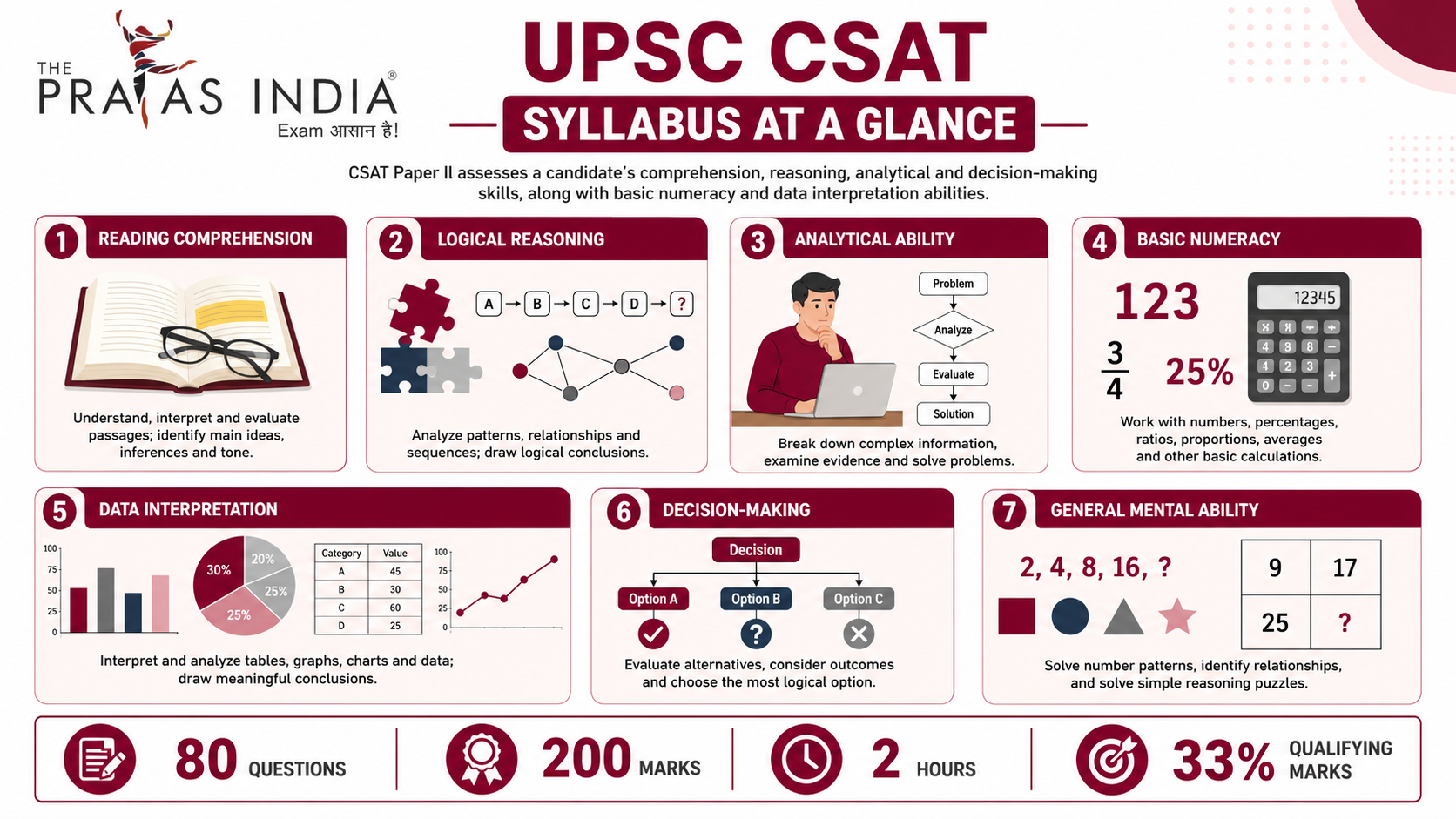
- Total questions: 80
- Maximum marks: 200
- Duration: 2 hours
- Question type: Objective multiple-choice questions
- Qualifying requirement: 33%, or 66.67 marks
- Negative marking: One-third of the marks assigned to a question for every incorrect answer
Candidates should remember that CSAT is a qualifying paper, but qualifying it is compulsory. A candidate must clear the CSAT cutoff as well as the General Studies Paper I cutoff to qualify for the UPSC Mains examination.
Know the Complete CSAT Syllabus
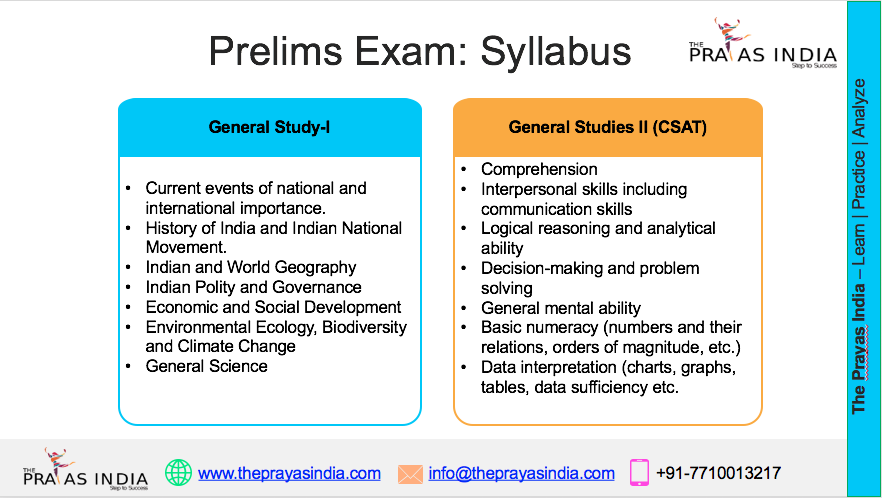
Before selecting books or beginning practice, understand the topics covered in the examination. The official syllabus broadly includes the following areas:
- Comprehension
- Interpersonal skills, including communication skills
- Logical reasoning and analytical ability
- Decision-making and problem-solving
- General mental ability
- Basic numeracy, including numbers and their relations, orders of magnitude, etc. (Class X level)
- Data interpretation, including charts, graphs, tables and data sufficiency (Class X level)
The syllabus may look manageable, but questions can require careful reading, logical thinking and time management.
Start with Previous Years’ CSAT Question Papers
Solving previous years’ question papers is one of the most useful ways to understand the actual difficulty level and question style.
Do not begin by solving papers randomly. First, attempt a paper under timed conditions to assess your current level. Then classify your mistakes.
Pay attention to:
- Questions you could solve correctly.
- Questions you understood but could not complete on time.
- Questions where your concepts were unclear.
- Questions where you made calculation or reading errors.
- Questions that consumed too much time.
This analysis helps you identify whether your main challenge is comprehension, mathematics, reasoning or time management.
Try to solve previous years’ papers in stages. Start with topic-wise practice, then move towards complete two-hour tests.
Improve Reading Comprehension
Reading comprehension is an important part of CSAT. Questions generally test whether you can understand a passage, identify its central idea and interpret information without making assumptions.
To improve this skill:
- Read newspaper editorials and explanatory articles regularly.
- Identify the central argument of each passage.
- Distinguish between facts, opinions and assumptions.
- Practise questions based on conclusions and inferences.
- Avoid selecting answers based only on your personal knowledge.
- Re-read the relevant lines when two options appear similar.
A useful exercise is to read one short passage daily and summarise its main argument in two or three sentences. This develops comprehension and helps improve reading discipline.
Build Your Basic Mathematics Skills
Candidates from non-mathematics backgrounds may find the numerical section challenging. However, CSAT mathematics is broadly based on fundamental concepts, and regular practice can help improve familiarity.
Start with the basics before attempting difficult questions.
Important topics to practise:
- Number system
- Simplification
- Percentage
- Ratio and proportion
- Average
- Profit and loss
- Simple and compound interest
- Time and work
- Speed, time and distance
- Basic algebra
- Permutation and combination
- Probability
- Data interpretation
You do not need to master every advanced mathematical topic. Focus on understanding concepts, recognising question patterns and improving calculation accuracy.
Practical preparation method: Select one topic, revise its basic formulas, solve a few examples and then practise questions without looking at the solutions. Maintain a separate notebook for formulas and recurring mistakes.
Practise Logical Reasoning and Analytical Ability
Logical reasoning tests your ability to identify patterns, evaluate relationships and reach conclusions. It is often a scoring opportunity for candidates who practise consistently.
- Give attention to:
- Coding and decoding
- Blood relations
- Direction sense
- Seating arrangements
- Syllogisms
- Statement and conclusion
- Sequences and patterns
- Analogies
- Ranking and ordering
- Basic analytical puzzles
While practising, focus on understanding the logic behind a solution rather than memorising shortcuts. Draw diagrams or tables whenever they make a problem easier to understand.
Start with simpler questions and gradually increase the difficulty. Keep track of the time spent on each question so that you learn when to move on.
Follow a Practical Daily CSAT Study Plan
CSAT preparation should be consistent. Candidates who are already preparing for General Studies should reserve dedicated time for Paper II instead of postponing it until the final weeks.
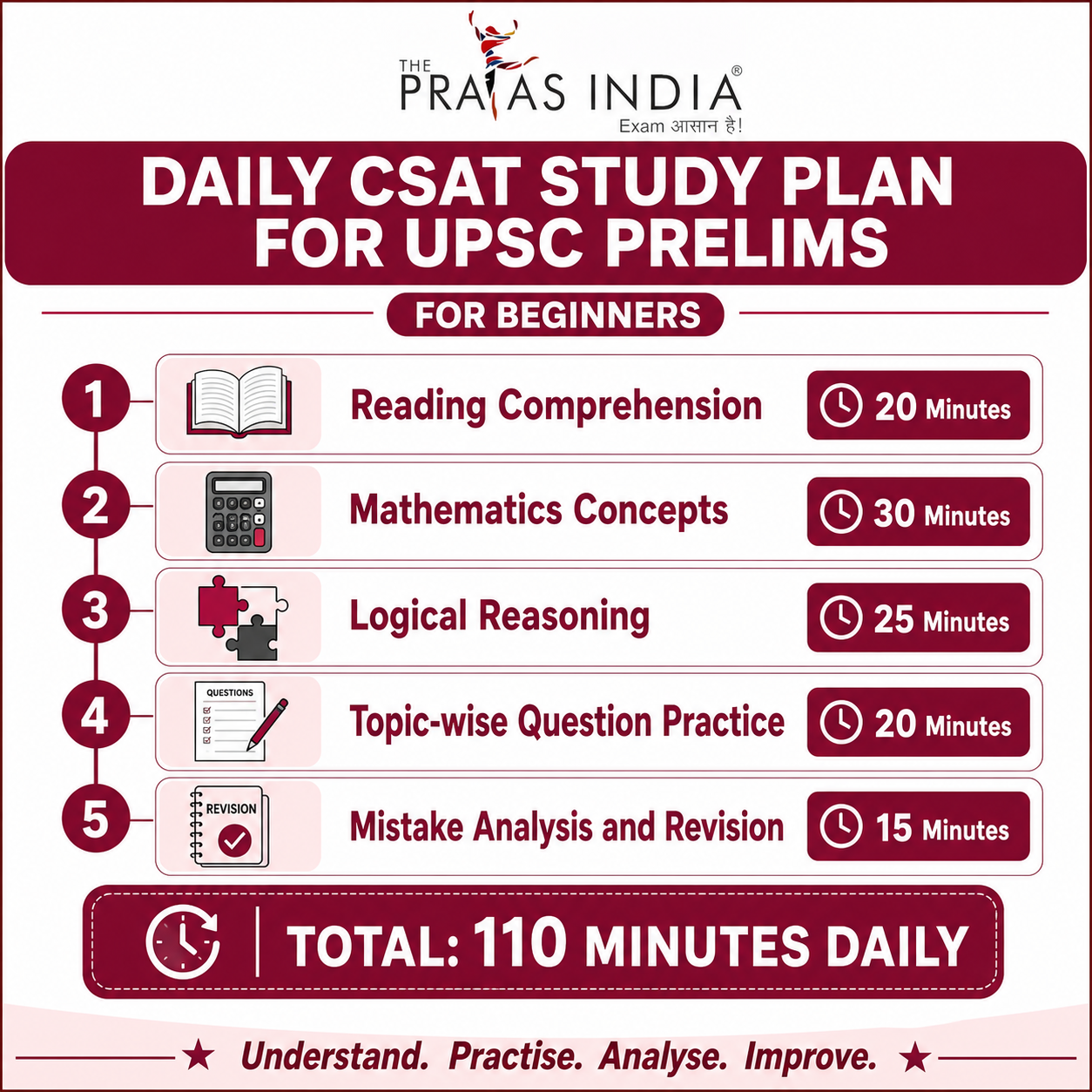
Here is a sample daily plan for beginners:
| Activity | Suggested time |
|---|---|
| Reading comprehension | 20 minutes |
| Mathematics concepts | 30 minutes |
| Logical reasoning | 25 minutes |
| Topic-wise question practice | 20 minutes |
| Reviewing mistakes | 15 minutes |
| Total | 110 minutes |
This is a suggested routine, not a compulsory timetable. Candidates who are weak in mathematics may need to devote more time to numerical practice, while those who struggle with comprehension should increase their reading practice.
Take Regular Mock Tests and Analyse Your Performance
Mock tests help you understand how well you can apply your preparation under exam conditions. They also help identify whether you are spending too much time on particular question types.
After every mock test, review:
- Your total score.
- Correct and incorrect answers.
- Questions left unanswered.
- Time spent on each section.
- Topics where accuracy is low.
- Questions you attempted without sufficient confidence.
Do not judge your preparation only by the number of mock tests completed. The analysis after each test is equally important.
Gradually practise full-length CSAT papers in a two-hour time limit. This can help you develop a question-selection strategy and improve your ability to maintain concentration throughout the paper.
Avoid These Common CSAT Preparation Mistakes
Some candidates struggle with CSAT not because the syllabus is impossible, but because their preparation lacks consistency or direction.
Avoid these common mistakes:
Ignoring CSAT until the final month: Treating CSAT as an afterthought can leave too little time to strengthen weak areas.
Only watching lectures: Conceptual learning is useful, but it must be followed by independent question practice.
Avoiding mathematics: If numerical questions are difficult, begin with basic concepts rather than skipping the entire section.
Not analysing mock tests: Repeating the same mistakes will not improve your performance.
Spending too long on one question: Learn to recognise when a question is taking too much time and move to another one.
Using too many books and resources: Keep your preparation focused. A limited set of reliable resources, previous year papers and regular practice is generally more manageable.
How to Balance CSAT and General Studies Preparation
Both papers matter in the UPSC Prelims. Your preparation schedule should give sufficient attention to General Studies Paper I while ensuring that CSAT does not become a last-minute concern.
A practical approach is to:
- Continue daily General Studies preparation.
- Set aside a fixed time for CSAT practice.
- Solve comprehension questions regularly.
- Revise mathematics and reasoning concepts.
- Attempt periodic full-length CSAT tests.
- Increase CSAT practice if mock-test performance indicates a weak area.
Candidates who consistently clear the CSAT qualifying requirement should still revise and practise. A qualifying paper should not be treated as a paper that requires no preparation.
CSAT Preparation Guidance at The Prayas India – Andheri
UPSC preparation requires a structured approach, regular practice and the ability to identify areas that need improvement. Aspirants in Andheri and nearby areas can explore guidance at The Prayas India – Andheri while planning their Civil Services preparation.
Candidates can enquire about the available UPSC preparation guidance, learning support and study approach before deciding how to structure their preparation.
The branch is located at Office 803, Time Chambers, Swami Vivekanand Road, near Paneri, Andheri West, Mumbai. Aspirants from Andheri East, Lokhandwala, Oshiwara, Jogeshwari, Versova and nearby areas can contact the centre for details.
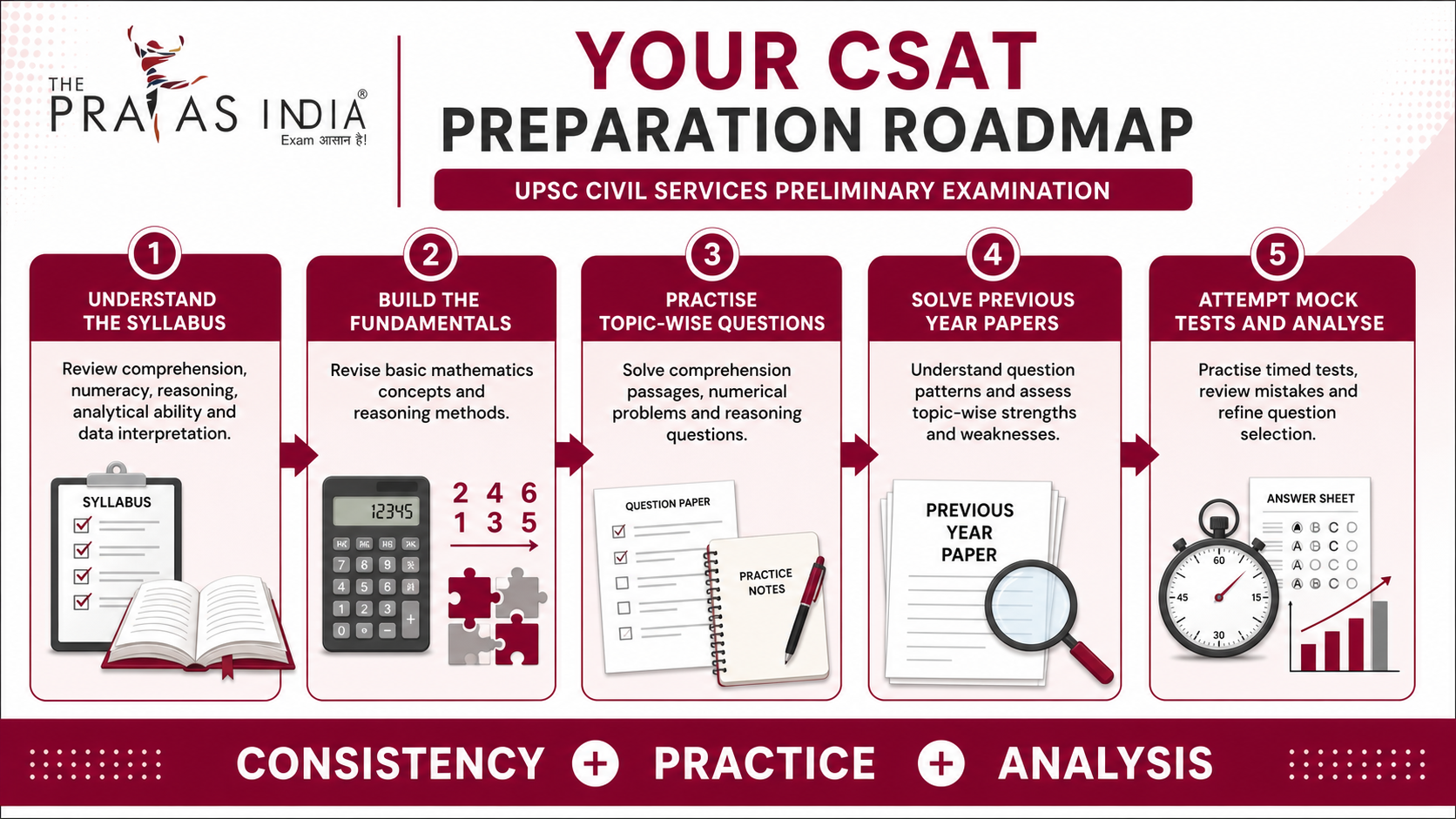
The key to CSAT preparation is simple: understand the syllabus, practise consistently, analyse mistakes and avoid leaving Paper II until the last stage of your UPSC preparation.
Frequently Asked Questions – UPSC CSAT Preparation
1. Is CSAT compulsory for UPSC Prelims?
Yes. CSAT is General Studies Paper II of the UPSC Preliminary Examination. Candidates must secure at least 33% marks to qualify in this paper.
2. How many marks are required to qualify CSAT?
CSAT carries 200 marks, and the qualifying requirement is 33%, which is approximately 66.67 marks. Candidates should check the official UPSC notification for the applicable examination rules.
3. Can a non-maths student prepare for CSAT?
Yes. Candidates without a mathematics background can prepare by revising basic concepts, practising numerical questions regularly and working on comprehension and logical reasoning.
4. How much time should I study CSAT daily?
The time required depends on your current level. Beginners can start with around 90 to 120 minutes of focused practice daily and adjust their schedule based on mock-test performance.
5. Which topics should I prioritise in CSAT?
Focus on reading comprehension, basic numeracy, logical reasoning, analytical ability and data interpretation. Use previous year question papers to identify the areas that need more practice.
6. Are CSAT mock tests necessary?
Yes. Mock tests help candidates practise under time limits, evaluate accuracy, understand question selection and identify weak topics. Reviewing mistakes after each test is especially important.
7. Where can I enquire about UPSC preparation in Andheri?
You can contact The Prayas India at its Andheri West branch, Office 803, Time Chambers, Swami Vivekanand Road, near Paneri, Mumbai, to enquire about available UPSC preparation guidance.
Planning Your UPSC Preparation in Andheri?
Looking for guidance for UPSC Civil Services preparation? Connect with The Prayas India – Andheri to enquire about available courses, preparation support and learning options.
Visit The Prayas India – Andheri:
Office 803, Time Chambers, Swami Vivekanand Road, near Paneri, Andheri West, Mumbai, Maharashtra 400058.
Contact: 08355951603