UPSC Mains Answer Writing Strategy | Best UPSC Coaching in Mumbai | The Prayas India
UPSC Mains preparation does not end when you finish the syllabus or read the standard books. The real challenge begins when you have to convert what you have studied into a well-structured answer within a limited word limit and time frame. Many aspirants spend months collecting notes, revising current affairs and practising questions, but their marks remain stagnant because they do not know how to properly evaluate the answers they write.
Answer writing, therefore, should be treated as a skill that improves through a continuous process of writing, analysing, correcting and rewriting. Simply completing ten questions every day does not guarantee improvement. You need to understand why an answer received a certain quality of evaluation, where marks were potentially lost and what changes can make the next answer more effective.
This becomes particularly important for aspirants targeting a competitive UPSC CSE rank and admission into a structured UPSC coaching programme in Mumbai. A good preparation environment should not only provide study material and classes but should also help students develop the ability to assess their own written performance objectively.
The purpose of answer analysis is not to find faults in every line you write. It is to identify the highest-impact improvements that can gradually make your answers more relevant, structured and examiner-friendly.
Answer Writing and Answer Analysis Are Two Different Skills
A common mistake among UPSC aspirants is assuming that writing more answers automatically makes them better answer writers. Practice is certainly essential, but practice without analysis can reinforce the same weaknesses repeatedly.
Imagine that an aspirant writes five answers every day but consistently spends too much time on introductions, writes generic conclusions and fails to address all parts of the question. If these problems are never identified, writing hundreds of additional answers may not solve them.
Answer writing tells you what you can produce under examination conditions.
Answer analysis tells you what needs to change in that performance.
Both are necessary.
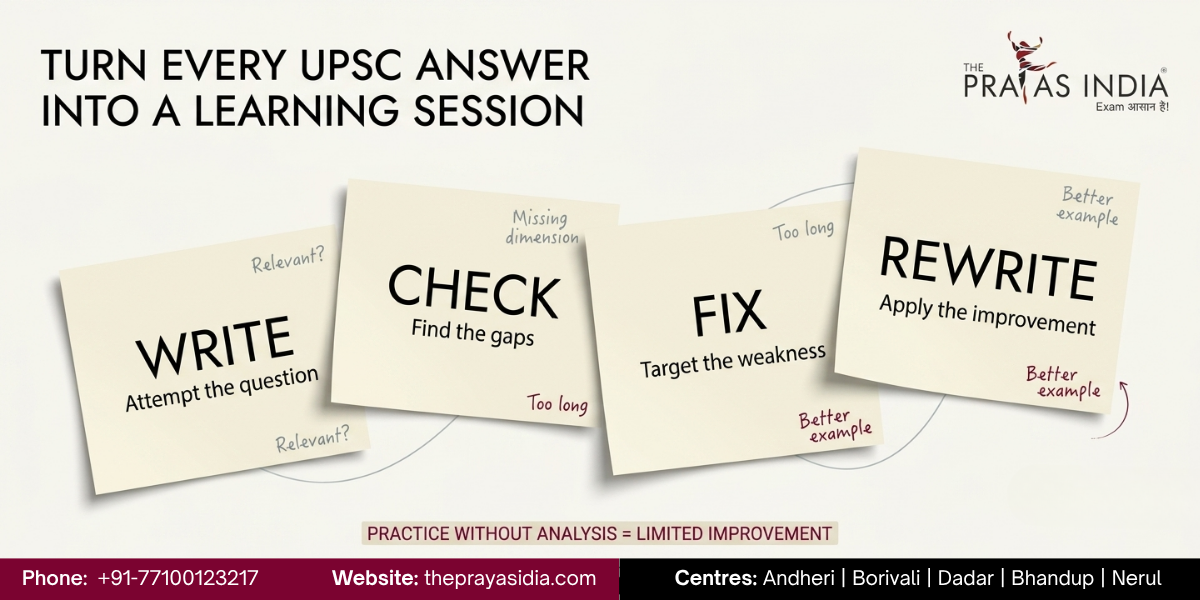
A productive answer-writing cycle should therefore look something like this:
Write → Evaluate → Identify Gaps → Improve → Rewrite → Repeat
This approach allows every answer to become a learning exercise rather than merely another item on your preparation checklist.
Begin With the Question, Not With Your Answer
Before evaluating your answer, go back to the question itself.
This sounds obvious, but many aspirants analyse their answers by reading their own responses first. That can create a problem because you already know what you intended to say. The evaluator, however, sees only what you have actually written.
Start by breaking the question into its components.
Look carefully at the directive word, the subject of the question, its scope and any specific dimensions mentioned.
Words such as analyse, examine, discuss, critically examine, evaluate, comment and elucidate indicate different expectations from the candidate.
You should therefore ask:
- What exactly has the question asked me to do?
- What are the different components of the question?
- Is there a hidden comparison, cause-effect relationship or demand for evaluation?
- Have I answered every part?
- Did I interpret the directive correctly?
- Did I restrict my answer to the scope of the question?
This should be the first stage of answer analysis.
A beautifully written answer can still underperform if it does not directly address the demand of the question.
The First Check: Relevance
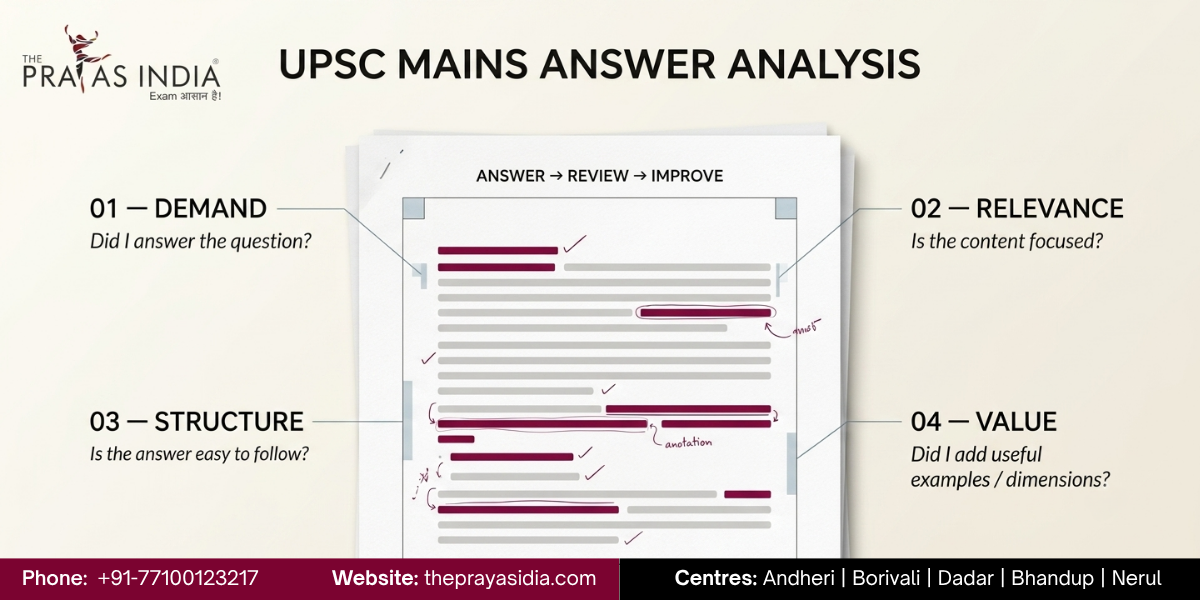
The first major quality test should be relevance.
UPSC Mains answers have a strict word limit. Every sentence therefore competes for limited space. If a paragraph contains information that does not directly contribute to answering the question, it may be taking away space from something more valuable.
For example, suppose the question asks about the impact of a particular policy on rural employment. A long historical introduction about the evolution of the Indian economy may demonstrate knowledge, but it may not necessarily contribute enough to the actual demand.
During analysis, mark the portions of your answer that directly address the question.
Then identify content that is:
- Repetitive.
- Too generic.
- Only loosely connected to the question.
- Unnecessarily historical.
- Descriptive when analysis was required.
- Irrelevant to the specific demand.
This exercise teaches you to become more selective with your knowledge.
The objective is not to write everything you know.
The objective is to write what the question needs.
Analyse Whether You Covered Every Part of the Question
UPSC questions often contain multiple demands within a single sentence. Missing even one component can reduce the effectiveness of an otherwise strong answer.
For example, a question may ask you to explain a problem, discuss its causes and suggest measures. If your answer spends most of its space explaining the problem and gives only two generic solutions at the end, you have not fully addressed the question.
During analysis, divide the question into separate demands.
A simple method is to underline or mentally identify each requirement.
For example:
Explain X + analyse Y + suggest measures
Your answer should visibly respond to all three.
You can use a small checklist:
- Demand 1: Addressed?
- Demand 2: Addressed?
- Demand 3: Addressed?
- Demand 4: Addressed, if applicable?
This is one of the easiest ways to improve answer quality because it does not require learning an entirely new topic. It requires better question reading and answer planning.
Check Your Introduction for Function, Not Decoration
The introduction is one of the most frequently misunderstood components of a UPSC Mains answer.
Many aspirants believe that a sophisticated introduction automatically creates a strong impression. In reality, an introduction should primarily help the answer enter the subject quickly and establish relevance.
When reviewing your introduction, ask whether it performs a useful function.
A good introduction can provide context, define a key term, establish the issue, mention a relevant fact or briefly frame the debate. It should prepare the evaluator for the answer that follows.
If your introduction consumes a large portion of the word limit without contributing meaningful context, shorten it.
You can ask yourself:
Can I remove two sentences without reducing the answer’s meaning?
If yes, those sentences may not be necessary.
For most answers, a concise and relevant introduction creates more room for the body, where the majority of the question’s demands need to be addressed.
Evaluate the Structure of Your Body
After relevance, examine the organisation of your answer.
A strong answer should not feel like a collection of disconnected facts. The evaluator should be able to understand your argument without having to reconstruct your thought process.
Look at the sequence of your points.
Does the answer move logically?
Does each paragraph have a clear purpose?
Are similar ideas grouped together?
Have you separated causes, impacts, challenges and solutions where appropriate?
A useful structure will depend on the question. Some questions may benefit from a simple analytical sequence, while others may require comparison, chronology, stakeholder-based analysis or a problem-solution framework.
The important principle is that structure should emerge from the demand of the question.
Do not force every answer into the same template.
Use Subheadings When They Improve Clarity
Subheadings can make an answer easier to navigate, especially when the question has multiple dimensions.
For instance, an answer discussing a policy issue could potentially use headings such as:
- Key Challenges
- Impact on Vulnerable Groups
- Institutional Concerns
- Way Forward
However, subheadings should not be added simply to decorate the page.
They should help the evaluator quickly understand the organisation of your argument.
When analysing your answer, check whether your headings actually reflect the content below them. A heading such as “Challenges” followed by three unrelated observations does not improve structure.
Your headings should act like signposts.
They tell the evaluator where your argument is going.
Bullet Points Are Useful When They Improve Presentation
Bullets can be particularly effective when you need to present several distinct points within limited space.
However, avoid turning the entire answer into a list of disconnected phrases.
UPSC Mains rewards substantive thinking. Your bullets should therefore contain complete ideas with explanation or supporting detail, rather than isolated keywords.
For example, instead of writing a single phrase such as “Poor governance,” explain the specific governance issue and connect it to the question.
A useful bullet often follows a simple pattern:
Point → Explanation → Example / Implication
This allows you to maintain readability without sacrificing substance.
Analyse the Depth of Your Answer
One of the most important questions to ask during evaluation is:
Did I merely describe the issue, or did I actually analyse it?
This distinction can significantly influence the quality of a Mains answer.
Description tells the evaluator what something is or what happened.
Analysis explores why it happened, how different factors interact, what consequences follow and what the broader implications are.
If your answer contains many facts but little interpretation, it may appear knowledgeable but superficial.
Try looking at each major point and asking:
- Why does this happen?
- What is the consequence?
- Who is affected?
- What are the competing perspectives?
- What are the institutional or social implications?
- Is there a counterargument?
- Can the point be connected to a broader constitutional, economic, social or governance dimension?
You do not need to answer every question in every response. The purpose is to identify opportunities for greater depth.
Add Examples Where They Strengthen the Argument
Examples can transform an abstract argument into a more concrete answer.
But examples should be selected strategically.
You do not need an example after every sentence. Too many examples can consume space without adding proportional value.
When analysing your answer, identify places where a short example could have made your argument more convincing.
Useful examples may include:
- Government schemes.
- Constitutional provisions.
- Supreme Court judgments.
- Reports and committees.
- Relevant data.
- Case studies.
- International comparisons.
- Historical examples.
- Contemporary developments.
The strongest examples are those that directly support the point you are making.
Avoid inserting facts simply because you remember them.
Evaluate Your Use of Current Affairs
Current affairs should not appear in an answer as decorative name-dropping.
If you mention a recent report, government initiative or international development, it should contribute to the argument.
Ask yourself whether the current-affairs reference:
Supports the point?
Provides evidence?
Shows contemporary relevance?
Illustrates a challenge or solution?
If it does none of these, it may not be necessary.
This is especially important for aspirants preparing for UPSC through a coaching programme. Good mentorship should help students understand how current affairs can be integrated into static subjects rather than treated as a separate collection of facts.
Don’t Evaluate Every Answer Using the Same Standard
Not every answer needs to contain the same number of examples, diagrams or dimensions.
The question determines the requirements.
A 10-mark question and a 15-mark question have different space and time considerations. Similarly, a question requiring critical analysis cannot be evaluated in exactly the same way as a straightforward explanatory question.
Therefore, when reviewing your answers, consider:
- Marks assigned to the question.
- Word limit.
- Directive used.
- Number of demands.
- Subject area.
- Complexity of the topic.
- Time available.
This prevents you from developing rigid answer-writing formulas.
What You Should Record After Every Answer
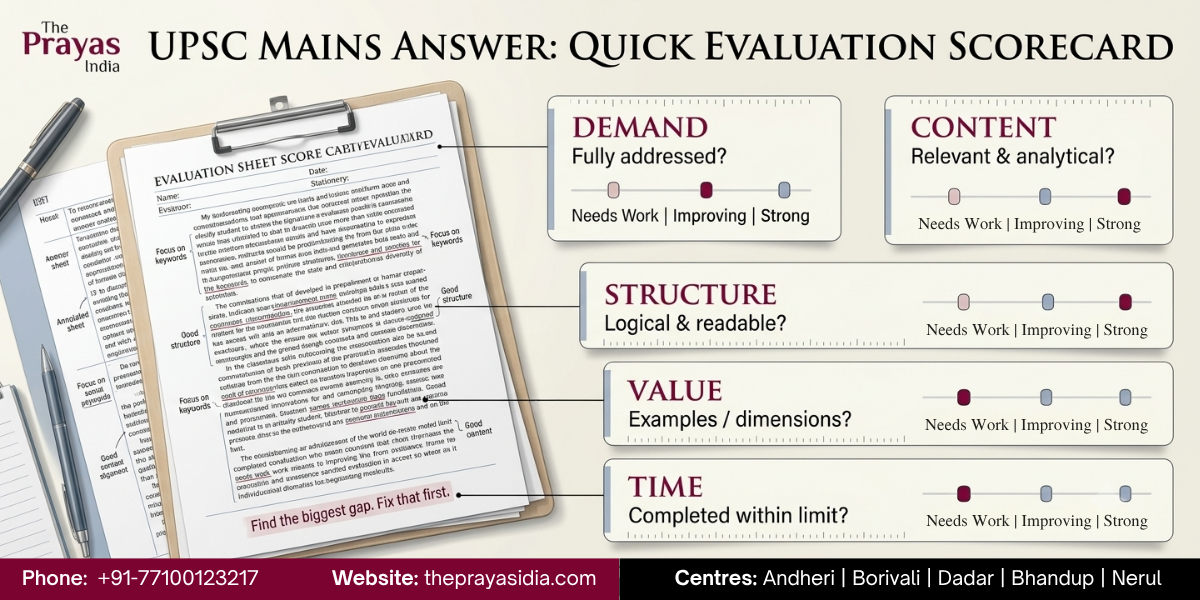
Instead of simply writing “good” or “needs improvement” after evaluating an answer, maintain a small answer-analysis record.
You can track:
| Evaluation Area | Your Observation |
|---|---|
| Question Demand | Which parts did I address? |
| Relevance | Where did I go off-topic? |
| Structure | Was the flow logical? |
| Content | Which important dimensions were missing? |
| Examples | Where could evidence improve the point? |
| Analysis | Did I explain causes, implications or perspectives? |
| Presentation | Was the answer easy to scan? |
| Conclusion | Did it provide meaningful closure? |
| Time | Did I finish within the target time? |
| Priority Improvement | What single change should I make next time? |
The final column is particularly important.
Do not try to correct ten things simultaneously.
Identify the one or two changes that can produce the biggest improvement, implement them in the next set of answers and then reassess.
Answer Analysis Should Lead to Action
The real value of answer evaluation comes from what you do after identifying a weakness.
If you discover that your introductions are too long, practise writing five concise introductions.
If you find that you are missing dimensions, practise brainstorming different stakeholder perspectives.
If your conclusions are repetitive, study different ways of closing analytical answers.
If you consistently exceed the word limit, practise writing the same answer again in fewer words.
This creates a direct connection between evaluation and improvement.
A useful cycle is:
Identify → Practise → Apply → Re-evaluate
Over several weeks, this process can gradually change your writing habits.
Why Structured Guidance Can Make Answer Analysis More Effective
Self-evaluation is important, but it has one major limitation: you may not recognise your own blind spots.
When you repeatedly write answers in the same style, certain weaknesses can become invisible to you. You may believe that an answer is sufficiently analytical because you have included many points, while an experienced evaluator may identify that the points remain descriptive.
Structured UPSC coaching can help bridge this gap through faculty feedback, evaluated answer sheets, model approaches and discussions about question demand.
For an aspirant looking for the Best UPSC Coaching in Mumbai, answer-writing support should therefore be one of the factors considered while evaluating a coaching programme.
The right preparation environment should ideally help students move from simply knowing the syllabus to understanding how knowledge needs to be presented in the Mains examination.
Analysing UPSC Mains answers is not about searching for a perfect model answer and comparing every sentence against it. Your objective is to understand whether your response effectively addressed the question within the constraints of the examination.
Start with the question demand. Check relevance. Examine whether every component has been covered. Then evaluate structure, depth, examples, current-affairs integration, presentation and conclusion. Finally, identify the most important weakness and convert that observation into a specific practice task.
This process gradually changes answer writing from a repetitive exercise into a measurable skill-development programme.
For aspirants targeting the UPSC CSE Mains examination, this distinction can be extremely important. Knowledge gives you material to write, but answer analysis teaches you how to use that material more effectively.
Compare Your Answer With the Question Before Comparing It With a Model Answer
A model answer can be useful, but it should not be the first benchmark.
Start with the question.
Read it again and identify what the examiner was actually asking. Then read your own answer independently and determine whether you have addressed those demands.
Only after this should you compare your response with a reference answer.
Otherwise, there is a risk of judging your answer merely by how closely it resembles the model.
Two answers can have completely different structures and still both be effective if they are relevant, analytical and well-supported.
During comparison, look for missing ideas rather than missing sentences.
You should ask:
- Did the model identify a dimension that I completely missed?
- Did it use an example that strengthened an argument?
- Did it provide a counter-perspective?
- Did it interpret the question differently?
- Did it organise the answer more logically?
- Did it provide a more practical way forward?
- Did it establish stronger connections between different points?
These observations are much more useful than copying the model answer into your notebook.
Learn to Identify the “Missing Dimension”
One of the most valuable outcomes of answer analysis is discovering dimensions that you repeatedly fail to consider.
Suppose you are answering a governance question. Your response may discuss administrative and economic aspects but completely overlook the social, constitutional or technological dimension.
That does not necessarily mean you lack knowledge.
It may mean that you have not yet developed the habit of multi-dimensional thinking.
Create a personal record of recurring missing dimensions.
For example, you may notice that your answers frequently miss:
- Stakeholder perspectives.
- Constitutional dimensions.
- Gender implications.
- Environmental consequences.
- Federalism.
- Technology.
- Institutional challenges.
- Ethical concerns.
- Implementation issues.
- Long-term implications.
Once a pattern appears repeatedly, it becomes a specific preparation target.
Instead of simply writing more answers, you can practise brainstorming dimensions before beginning each response.
Develop an Answer Framework Without Becoming Formulaic
Frameworks can help improve consistency, especially when you are still learning answer writing.
However, a framework should function as a thinking tool, not a rigid template.
For example, a question on a social issue might require historical, social, economic and governance perspectives. A question on international relations may need strategic, diplomatic, economic and geopolitical dimensions.
Forcing both questions into the same structure can make the answer mechanical.
A better approach is to develop a collection of frameworks that you can adapt.
Useful approaches may include:
Cause → Impact → Challenges → Way Forward
or
Stakeholders → Issues → Existing Measures → Gaps → Solutions
or
Short-Term → Medium-Term → Long-Term
The question should determine which framework is appropriate.
Your aim is to make thinking faster without making your answers predictable.
Improve Introductions Through Repeated Practice
If your answer analysis repeatedly shows that introductions are either too generic or too lengthy, create a separate introduction practice routine.
Take ten previous UPSC questions and write only their introductions.
Give yourself a strict time limit.
Then review each introduction for three things:
Relevance: Does it enter the subject quickly?
Context: Does it establish why the issue matters?
Direction: Does it prepare the reader for the answer?
You can experiment with different introduction approaches, including a brief definition, constitutional context, current example, relevant statistic, committee observation or conceptual framing.
The objective is not to use a different technique every time.
The objective is to build enough flexibility that you can choose an appropriate opening depending on the question.
Conclusions Should Close the Argument, Not Simply End the Answer
A conclusion should provide closure.
Yet many aspirants finish their answers by repeating the introduction or writing a generic statement such as “there is a need for holistic development.”
Such conclusions rarely add much value.
When analysing your conclusion, ask whether it actually responds to the broader implication of the question.
Depending on the topic, a conclusion can:
- Suggest a practical way forward.
- Connect the issue with constitutional values.
- Present a balanced perspective.
- Highlight long-term implications.
- Link the discussion to inclusive development.
- End with a constructive policy direction.
The conclusion does not need to be long.
It needs to make the answer feel complete.
Use Diagrams and Flowcharts Only When They Add Information
Diagrams can improve presentation, but they should not become decorative elements.
A simple flowchart can communicate a cause-effect relationship more efficiently than a paragraph. A small diagram can also help organise a complex process.
For example:
Problem → Institutional Gap → Implementation Challenge → Outcome
can sometimes communicate a relationship more clearly than several sentences.
But adding a diagram merely because you have been told that “UPSC likes diagrams” can become counterproductive.
During analysis, ask:
Did this visual make my argument clearer?
If yes, continue using similar techniques.
If the diagram simply repeats what you have already written, it may not be necessary.
Analyse Presentation From the Evaluator’s Perspective
After completing an answer, imagine that you are checking several answer sheets under time pressure.
Would your answer be easy to scan?
Can the main arguments be identified quickly?
Are your headings meaningful?
Are your paragraphs manageable?
Are important examples visible?
Is there sufficient white space?
These presentation factors do not replace content, but they can influence how efficiently the evaluator can process your response.
A clean answer allows the substance of your preparation to become more visible.
This is particularly important in a competitive examination where the evaluator has to assess a large number of answers.
Create a Personal Error Log
Your answer-analysis notebook should not simply contain model answers.
Create an error log that records recurring problems.
For example, if you repeatedly miss the constitutional dimension in governance questions, record it.
If your answers regularly exceed the word limit, record it.
If you struggle to generate examples for social issues, record it.
A useful error log can include:
| Problem | Frequency | Corrective Action |
|---|---|---|
| Generic introductions | Frequent | Practise 5 introductions weekly |
| Missing dimensions | Frequent | Brainstorm stakeholders before writing |
| Weak examples | Moderate | Maintain topic-wise examples |
| Long conclusions | Frequent | Practise 2-line conclusions |
| Poor time control | Moderate | Timed answer practice |
| Repetitive points | Occasional | Group similar arguments |
The frequency column is important because not every mistake deserves equal attention.
If something happens once, observe it.
If it happens repeatedly, build a corrective exercise around it.
Don’t Try to Fix Everything at Once
A common problem with answer evaluation is overcorrection.
After receiving feedback, an aspirant may try to improve introductions, conclusions, diagrams, examples, structure, vocabulary, handwriting and content depth simultaneously.
This can make writing slower and more mechanical.
Instead, identify the highest-impact weakness.
For the next five to ten answers, focus deliberately on that issue.
Once it becomes more natural, move to the next weakness.
This creates gradual improvement without overwhelming the writing process.
The objective is to make better answer writing feel increasingly automatic.
Track Time Alongside Quality
An answer that is excellent but takes twice the required time is not examination-ready.
Similarly, an answer completed quickly but lacking important content is also not sufficient.
Your evaluation should therefore track both quality and time.
After each practice session, record:
- Time taken to understand the question.
- Time spent planning.
- Time spent writing.
- Whether the answer was completed.
- Whether you had enough time for a conclusion.
- Whether you had to rush towards the end.
If you consistently spend too much time planning, practise shorter frameworks.
If you rush the conclusion, reduce the amount of content in the body.
If you spend too much time on introductions, simplify your openings.
Time analysis can reveal problems that a content-only evaluation will not show.
GS Papers Require Different Analytical Approaches
UPSC CSE Mains answer analysis becomes more effective when you recognise that different General Studies papers demand different kinds of thinking.
GS Paper I often requires understanding of history, society, geography and culture. Your analysis should check whether you have included sufficient contextual depth and relevant examples.
GS Paper II requires attention to governance, Constitution, polity, social justice and international relations. Here, constitutional provisions, institutions, stakeholders, policies and implementation challenges can strengthen answers where relevant.
GS Paper III covers economy, agriculture, science and technology, environment, security and disaster management. Data, examples, policy measures, institutional challenges and practical solutions can become particularly useful.
GS Paper IV requires a different style of analysis because ethical reasoning, examples, values and case-study application play a central role.
Therefore, do not judge every answer using one universal checklist.
The broad principles remain the same, but the content expectations and analytical tools change with the paper.
Use Peer Review Carefully
Discussing answers with serious aspirants can provide useful perspectives.
A peer may notice a missing dimension or suggest an alternative structure that you had not considered.
However, peer review should not replace expert evaluation.
Different students may have different levels of understanding, and a confident suggestion is not automatically a correct one.
If you use peer review, focus on specific questions:
Was the question fully addressed?
Which part felt unclear?
Where did the argument become repetitive?
Which point appeared strongest?
This is more useful than asking someone simply to “rate my answer.”
Faculty Evaluation Can Reveal Blind Spots
External evaluation becomes particularly valuable when you have already developed a consistent writing pattern.
An experienced evaluator can identify issues that you may not notice yourself, such as:
- Excessive generalisation.
- Superficial analysis.
- Weak prioritisation of arguments.
- Misinterpretation of directives.
- Poor linkage between examples and arguments.
- Unbalanced coverage of question demands.
- Repetitive conclusions.
- Inappropriate use of diagrams.
The objective of feedback should not be to make your answer resemble the evaluator’s writing style.
It should help you understand how to make your own response more effective.
This is one area where structured UPSC preparation can provide an advantage to aspirants who need regular feedback rather than occasional evaluation.
Rewrite Selected Answers
Rewriting is an underrated part of answer improvement.
After analysing an answer, select a few responses and write them again.
Do not simply copy the feedback.
Try to implement it independently.
If your first version had a generic introduction, improve the opening.
If you missed a stakeholder dimension, incorporate it.
If your conclusion was weak, create a more meaningful closure.
Then compare both versions.
This allows you to see whether the feedback has actually translated into better writing.
You can maintain a Before vs After section in your notebook.
That record can become extremely valuable during the final months of preparation.
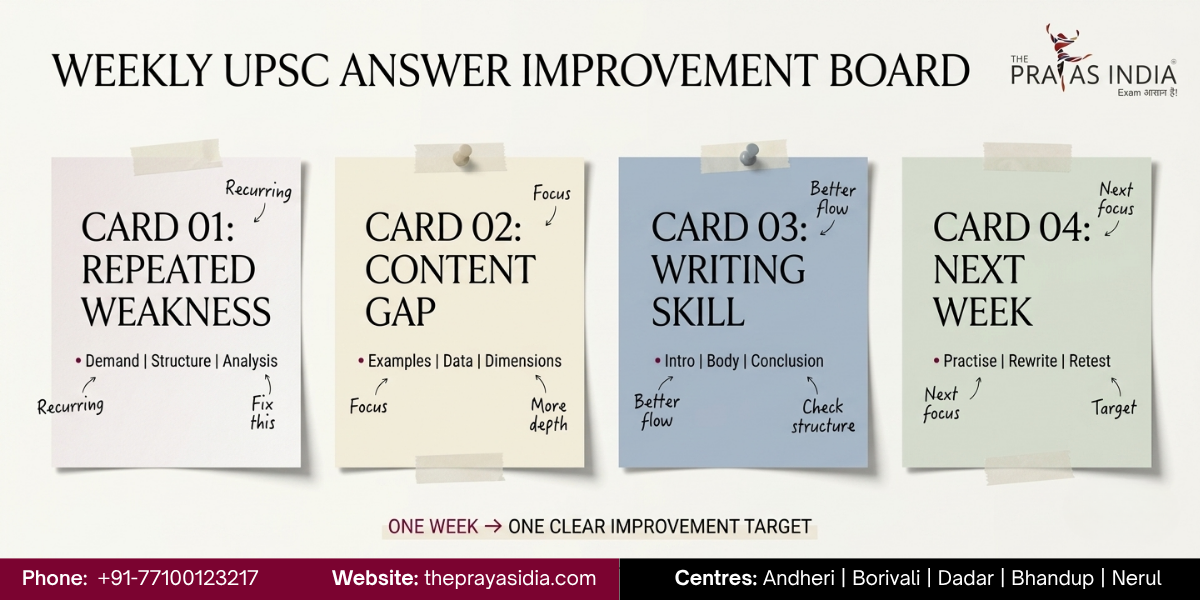
Build a Weekly Answer-Analysis Routine
Answer analysis should not happen randomly.
A weekly system can make it easier to identify patterns.
For example, you can dedicate one session every week to reviewing your recent answers instead of analysing only individual responses immediately after writing them.
During this session, identify:
- Three recurring weaknesses.
- Three improvements observed during the week.
- Topics where content gaps are visible.
- Question types that caused difficulty.
- Whether writing speed improved.
- Whether you are addressing all question demands more consistently.
This broader review allows you to see progress that may not be obvious from one answer to the next.
How The Prayas India Can Support UPSC Mains Answer Writing
For an aspirant preparing seriously for UPSC CSE, coaching should ideally extend beyond classroom teaching.
The value of structured guidance becomes particularly visible in areas where self-assessment is difficult. Answer writing is one such area.
The Prayas India can help aspirants approach Mains preparation through a structured ecosystem where conceptual learning, current-affairs understanding, answer-writing practice and performance feedback can work together.
For students searching for Best UPSC Coaching in Mumbai, evaluating the quality of answer-writing support can therefore be an important part of the admission decision.
Before joining any coaching programme, aspirants should look beyond the number of classes offered and examine whether the institute provides opportunities to practise Mains-style questions, receive meaningful feedback and understand how to improve.
The objective should be to develop independent answer-writing capability rather than dependence on memorised model responses.
What to Look for Before Joining UPSC Coaching in Mumbai
Aspirants often compare coaching institutes primarily on faculty names, fees, study material or classroom location.
These factors matter, but Mains-oriented students should also examine the answer-writing ecosystem.
Before taking admission, consider whether the institute provides:
- Regular Mains answer-writing practice.
- Evaluation by experienced faculty.
- Constructive feedback rather than only marks.
- Discussion of model approaches.
- Current-affairs integration.
- Guidance on structuring answers.
- Practice for GS papers.
- Essay and Ethics support.
- Mock tests with meaningful analysis.
- Opportunities to track improvement over time.
The ideal coaching environment should help you understand not just what to study, but also how to convert that knowledge into an examination-ready response.
Build Your Own Answer-Writing Improvement System
Even with coaching, your progress ultimately depends on your own practice.
Create a system where every week produces measurable improvement.
Maintain separate records for:
Content gaps: What do I need to learn?
Writing gaps: What do I need to present better?
Time gaps: Where am I losing time?
Thinking gaps: Which dimensions am I failing to identify?
Revision gaps: Which information do I repeatedly forget?
This separation is important because not every weak answer is caused by insufficient knowledge.
Sometimes the knowledge is present but the presentation is weak.
Sometimes the presentation is fine but the answer lacks analytical depth.
Sometimes the answer is strong but takes too long.
Once you know which problem you are dealing with, the corrective action becomes much clearer.
A Practical Final Checklist Before You Submit an Answer
Before moving to the next question during practice, develop the habit of quickly checking your response.
Ask yourself:
- Did I answer the exact question?
- Did I address every demand?
- Is the introduction relevant?
- Is the body logically organised?
- Are the points analytical rather than merely descriptive?
- Have I used examples where they add value?
- Did I include appropriate dimensions?
- Is the presentation easy to scan?
- Does the conclusion provide closure?
- Did I stay within the word and time limits?
With practice, this review will become faster.
Eventually, many of these checks will happen naturally while you are writing rather than only after completing the answer.
That is when answer analysis starts transforming into answer-writing instinct.
Frequently Asked Questions
1. How should I analyse my UPSC Mains answers?
Begin by revisiting the question demand and checking whether every part has been addressed. Then evaluate relevance, structure, analytical depth, examples, presentation, conclusion and time management. Finally, identify one or two high-priority weaknesses and create a specific practice task to correct them.
2. Should I compare my UPSC answer with a model answer?
Yes, but do not focus on copying the model. Compare the answers to identify missing dimensions, stronger examples, better structures or alternative interpretations. The objective is to improve your thinking and presentation rather than reproduce someone else's wording.
3. How can I know if my UPSC answer is analytical enough?
Check whether you have gone beyond describing facts. Look for causes, consequences, relationships, competing perspectives, stakeholder impacts, challenges and practical solutions where relevant to the question.
4. How often should I practise UPSC Mains answer writing?
Regular practice is more useful than occasional large writing sessions. Your schedule can vary according to your preparation stage, but consistent writing combined with detailed evaluation allows weaknesses to be identified and corrected earlier.
5. Should I use diagrams in every UPSC Mains answer?
No. Diagrams and flowcharts should be used when they improve clarity or communicate a relationship efficiently. Adding them mechanically can consume time without adding meaningful value.
6. How can I improve my UPSC Mains introduction?
Practise introductions separately and evaluate them for relevance, context and direction. A good introduction should enter the subject efficiently rather than consume excessive words.
7. What should I maintain in a UPSC answer-writing notebook?
Maintain your evaluated answers, recurring mistakes, missing dimensions, useful examples, introduction ideas, conclusion approaches and time-management observations. A dedicated error log can help you track patterns across multiple answers.
8. Is self-evaluation enough for UPSC answer writing?
Self-evaluation is essential but may not identify every blind spot. Peer feedback and experienced faculty evaluation can provide additional perspectives and help identify recurring issues that you may overlook yourself.
9. Can UPSC coaching help improve Mains answer writing?
Structured coaching can help through guided answer-writing practice, evaluation, feedback, model discussions and Mains-oriented preparation. When comparing UPSC Coaching in Mumbai, aspirants should consider the quality of its answer-writing and evaluation support alongside faculty and study material.
10. How does The Prayas India help UPSC CSE aspirants?
The Prayas India provides a structured preparation environment for aspirants working towards UPSC CSE. Students evaluating coaching options should consider how the programme supports conceptual preparation, current affairs, answer writing, mock practice and performance improvement.
Final Takeaway: Analyse Less for Marks, More for Improvement
The ultimate purpose of answer analysis is not to become obsessed with marks after every practice test.
A score tells you where you stand at a particular moment.
Analysis tells you what to do next.
That distinction can completely change the way you approach UPSC Mains preparation.
Instead of feeling discouraged by a low score, identify the specific reason behind it. Instead of feeling satisfied with a high score, determine which elements of the answer made it effective. Instead of collecting dozens of model answers, study the principles behind their structure and content selection.
Over time, your answer-writing notebook should become a record of improvement.
You should be able to look back and see that your introductions became more focused, your body became more analytical, your examples became more relevant, your conclusions became stronger and your ability to complete answers within the required time improved.
For serious UPSC CSE aspirants, this is the real objective of answer writing.
Write. Analyse. Correct. Rewrite. Repeat.
And when you are evaluating the Best UPSC Coaching in Mumbai, look for an institute that supports this complete cycle rather than treating answer writing as an occasional activity.
The right guidance can provide direction, but the transformation ultimately comes from consistent practice and honest self-evaluation.
Contact Us
📞 Call Now: +91-77100 13217
🌐 Website: theprayasindia.com