How to Balance Optional Subject and GS Preparation | Best IAS Coaching in Mumbai | The Prayas India
Build Depth Without Losing Direction
UPSC preparation is often described as a long journey, but for serious aspirants, it is better understood as a balancing act.
On one side is General Studies, with its vast syllabus, current affairs, multiple papers, and continuous revision requirements. On the other is the Optional Subject, which demands depth, conceptual clarity, repeated revision, and strong answer-writing skills.
Both are important.
And that is precisely where many aspirants get stuck.
They either spend so much time mastering their Optional that GS preparation starts falling behind, or they remain occupied with the enormous GS syllabus and keep postponing their Optional.
The result is the same: an unbalanced preparation strategy.
The solution isn’t to divide your time equally between GS and Optional. The solution is to understand what deserves your attention at each stage of preparation and where the two can work together.
The Balancing Act
Before creating a timetable, understand one fundamental point:
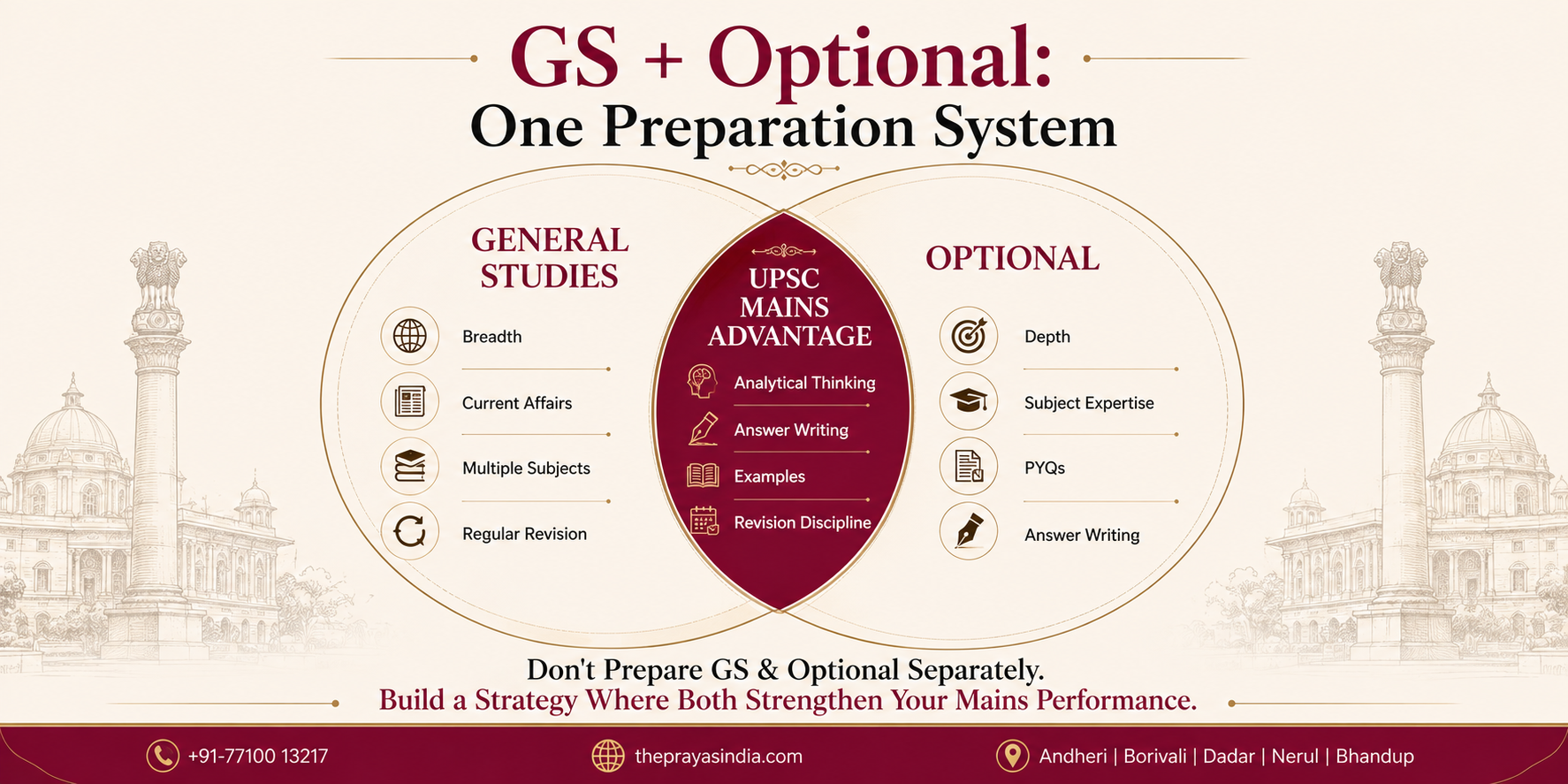
GS and Optional are not two separate UPSC examinations. They are two components of the same Mains strategy.
GS demands breadth.
Optional demands depth.
GS requires you to understand a wide range of subjects, while Optional allows you to develop specialised knowledge in one chosen discipline.
This difference means they should not be prepared using exactly the same method.
For example:
GS Preparation Requires
- Broad conceptual understanding
- Current affairs integration
- Multiple revisions
- Short and structured notes
- Regular answer writing
- Coverage across several subjects
Optional Preparation Requires
- In-depth conceptual understanding
- Extensive syllabus coverage
- Previous Year Questions
- Subject-specific examples and thinkers
- Repeated answer-writing practice
- Multiple rounds of revision
The mistake is treating both subjects as if they require the same preparation system.
They don’t.
The Real Problem Isn’t Time. It’s Allocation.
Most aspirants don’t actually have a shortage of hours.
The bigger problem is where those hours are going.
Consider an aspirant who studies Optional for five hours every day because it is their strongest area. Their Optional notes become excellent, but GS revision keeps getting postponed.
Another aspirant spends almost the entire day covering GS topics but gives only occasional attention to Optional. By the time Optional becomes a priority, there is too much syllabus left to cover properly.
Neither approach is sustainable.
Your preparation needs an allocation system that answers three questions:
What needs depth?
What needs consistency?
What needs immediate attention?
Once these questions are clear, your timetable becomes much easier to design.
GS and Optional Should Not Compete for Your Time
One of the smartest ways to manage UPSC preparation is to identify areas where GS and Optional can complement each other.
Instead of thinking:
“I have to finish GS first and then start Optional.”
Think:
“How can my GS preparation strengthen my Optional, and vice versa?”
Depending on your Optional subject, there may be opportunities to create useful overlaps.
For example:
- Current affairs can enrich both GS answers and Optional answers where relevant.
- Answer-writing practice improves analytical expression across the Mains papers.
- Essay preparation can strengthen argument-building and examples.
- Ethics preparation can improve your ability to structure balanced answers.
- Reading newspapers develops analytical awareness useful across multiple papers.
This doesn’t mean that GS and Optional become the same preparation.
It means that one hour of preparation can sometimes contribute to more than one part of your UPSC strategy.
The 70–30 Trap
A common question among aspirants is:
“Should I give 70% time to GS and 30% to Optional?”
Or perhaps the reverse?
There is no universal ratio.
Your ideal allocation depends on where you currently stand.
If Your Optional Is New
You may need more time to build its fundamentals and complete the syllabus.
If Your Optional Syllabus Is Almost Complete
The focus can gradually shift towards answer writing, PYQs, revision, and GS improvement.
If Your GS Foundation Is Weak
You cannot afford to let Optional preparation consume the majority of your available study time.
If Your Mains Is Approaching
Your strategy should become increasingly test- and revision-oriented rather than simply adding new content.
Therefore, don’t blindly copy someone else’s 60:40 or 70:30 timetable.
Your preparation stage should determine your allocation.
Where Aspirants Usually Lose Time
The imbalance between GS and Optional usually doesn’t happen overnight.
It develops through small decisions.
For example:
“I’ll Finish Optional First.”
This can result in GS being pushed aside for months.
“Current Affairs Will Take Only 30 Minutes.”
That 30 minutes can turn into an enormous backlog if revision isn’t planned.
“I’ll Start Answer Writing After Completing the Syllabus.”
This delays the development of writing speed and structure.
“I’ll Revise Optional Later.”
Without repeated revision, even extensive Optional preparation becomes difficult to retain.
These decisions seem harmless individually.
Together, they can completely distort your preparation strategy.
Build a Preparation System, Not Just a Timetable
A good UPSC plan should have multiple layers.
Daily Layer
What will you study today?
Weekly Layer
What should be completed this week?
Monthly Layer
Which portions of GS and Optional should reach the next stage?
Performance Layer
What does your test performance tell you?
This system allows you to make adjustments instead of following a timetable blindly.
Your plan should tell you not only what to study, but also when to slow down, when to revise, and when to redirect your effort.
A Strategic Approach Beats an Equal Approach
You don’t need to give GS and Optional exactly the same number of hours.
You need to give each one the attention it requires at the right time.
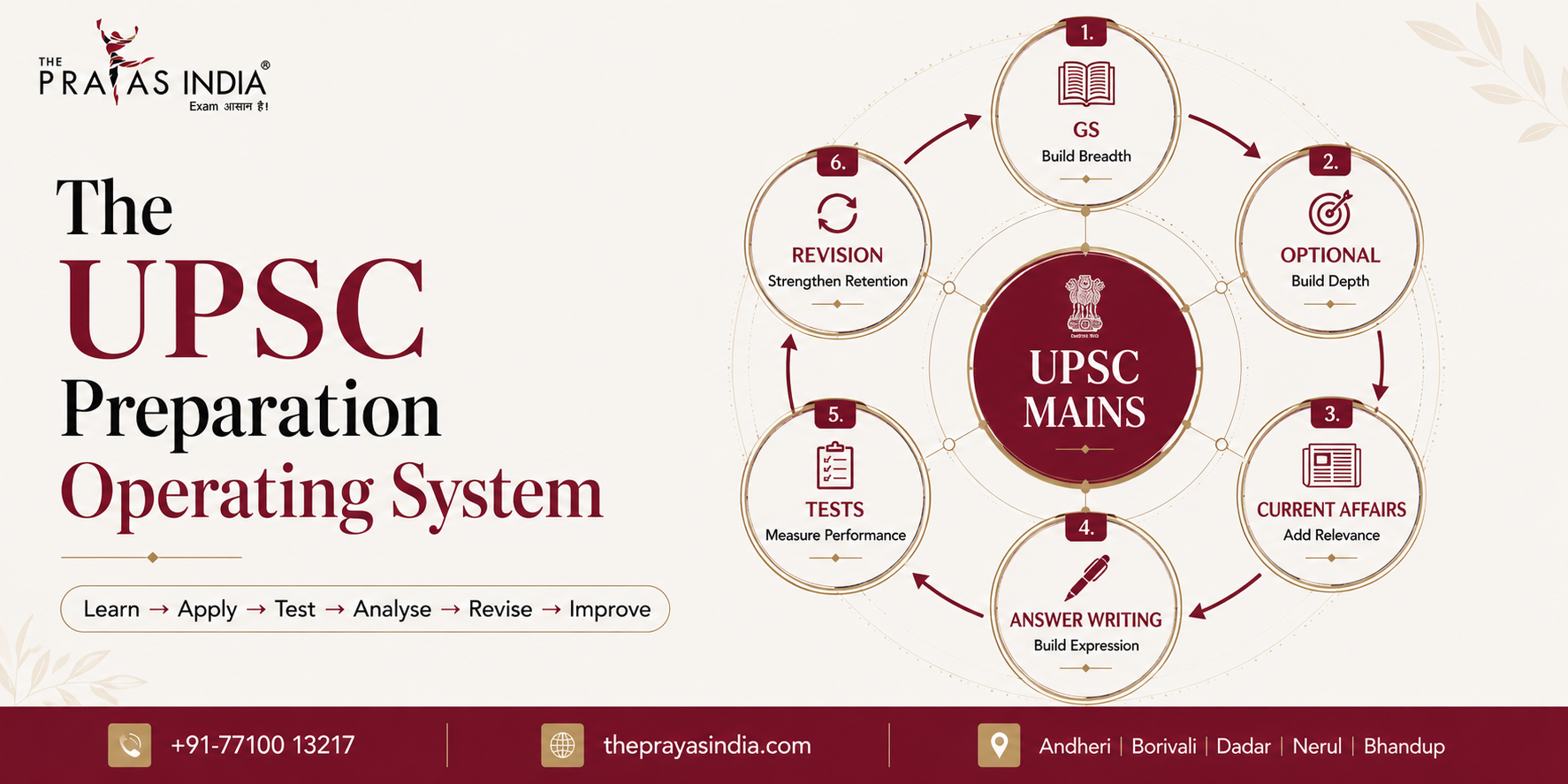
Think of your preparation like this:
GS → Breadth
Optional → Depth
Current Affairs → Relevance
Answer Writing → Expression
Tests → Performance
Revision → Retention
When these components work together, your preparation becomes much more efficient.
The Role of Expert Guidance
Balancing GS and Optional becomes considerably easier when you have a structured roadmap and someone who can evaluate whether your allocation is actually working.
Many aspirants spend weeks following a timetable that looks productive but doesn’t address their weaknesses. Experienced mentorship can help identify where preparation is getting unbalanced, whether enough time is being devoted to answer writing and revision, and when the strategy needs to change.
At The Prayas India, UPSC aspirants can benefit from structured preparation, experienced faculty guidance, systematic GS coverage, Optional support, current affairs integration, answer-writing practice, test-based evaluation, and personalised mentoring designed to keep preparation focused and exam-oriented.
Build Overlap, Not Overload
The smartest UPSC aspirants don’t simply divide their hours—they connect their preparation.
Once you understand that GS and Optional require different kinds of preparation, the next challenge is deciding how to distribute your available time.
The answer isn’t to create a rigid timetable where every subject gets exactly the same number of hours.
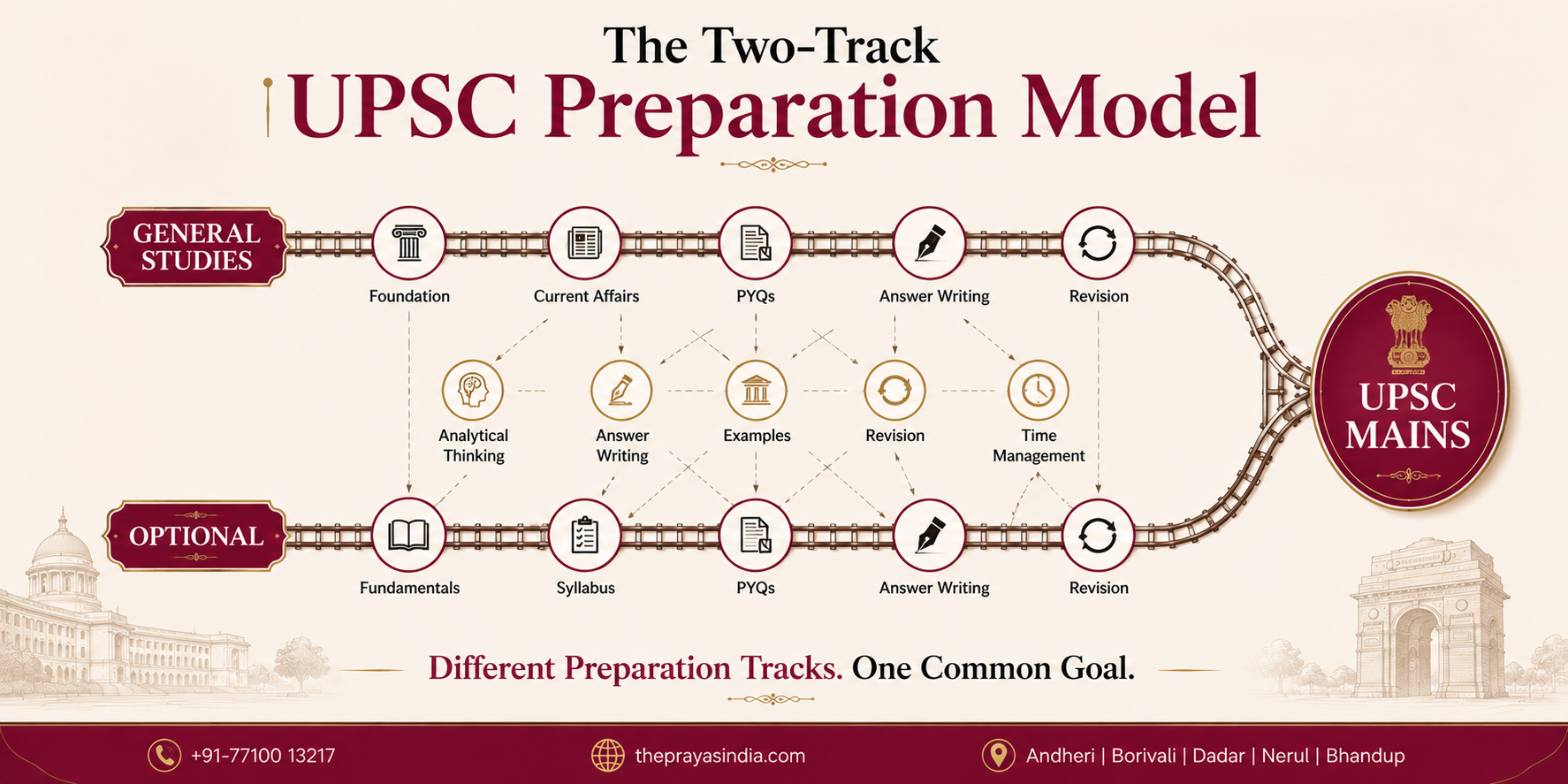
Instead, build a two-track preparation system where GS and Optional receive dedicated attention while common skills such as answer writing, current affairs, revision, and analytical thinking support both.
Find the Overlap Before Creating More Hours
Your preparation becomes more efficient when you identify areas that can strengthen multiple components of the UPSC Mains simultaneously.
For example, regular answer writing can improve:
- GS answer structure
- Optional answer presentation
- Introduction and conclusion writing
- Time management
- Analytical thinking
Similarly, reading quality newspapers and analysing current affairs can help develop:
- GS understanding
- Essay content
- Examples for answers
- Arguments and counterarguments
- Broader analytical perspective
The objective isn’t to force every topic into both GS and Optional.
The objective is to avoid unnecessary duplication of effort wherever genuine overlap exists.
The Two-Track Preparation Model
Think of your UPSC preparation as two parallel tracks.
TRACK A — GS
This track focuses on breadth and regular coverage.
Your GS preparation may include:
- Static concepts
- Current Affairs
- GS answer writing
- Revision
- Previous Year Questions
- Sectional and full-length tests
TRACK B — OPTIONAL
This track focuses on depth and subject mastery.
Your Optional preparation should include:
- Complete syllabus coverage
- Core concepts
- Optional-specific sources
- Previous Year Questions
- Thinkers, scholars, diagrams or examples where relevant
- Optional answer writing
- Repeated revision
Neither track should be allowed to disappear for weeks.
The objective is continuous movement on both tracks, with the intensity changing according to your preparation stage.
A Practical Weekly Allocation
Instead of following a fixed daily ratio throughout your preparation, create a weekly allocation.
For a full-time aspirant, a broad framework could look like this:
| Preparation Area | Approx. Weekly Focus |
|---|---|
| GS Core | 35–40% |
| Optional | 30–35% |
| Current Affairs | 10–15% |
| Answer Writing | 10–15% |
| Revision & Tests | Integrated |
These percentages are not a universal formula.
For example, an aspirant whose Optional syllabus is incomplete may temporarily increase Optional hours. Someone with a strong Optional but weak GS foundation may need to shift the balance towards GS.
The key is to review the allocation regularly instead of treating it as permanent.
Don’t Confuse Equal Time With Balanced Preparation
Imagine two aspirants.
Aspirant A
Studies GS for 4 hours and Optional for 4 hours every day.
Sounds balanced.
But their GS performance is weak and their Optional syllabus is already complete.
Aspirant B
Studies GS for 5 hours and Optional for 3 hours because their GS foundation needs strengthening, while continuing Optional revision and answer writing.
The second strategy may actually be more balanced.
Why?
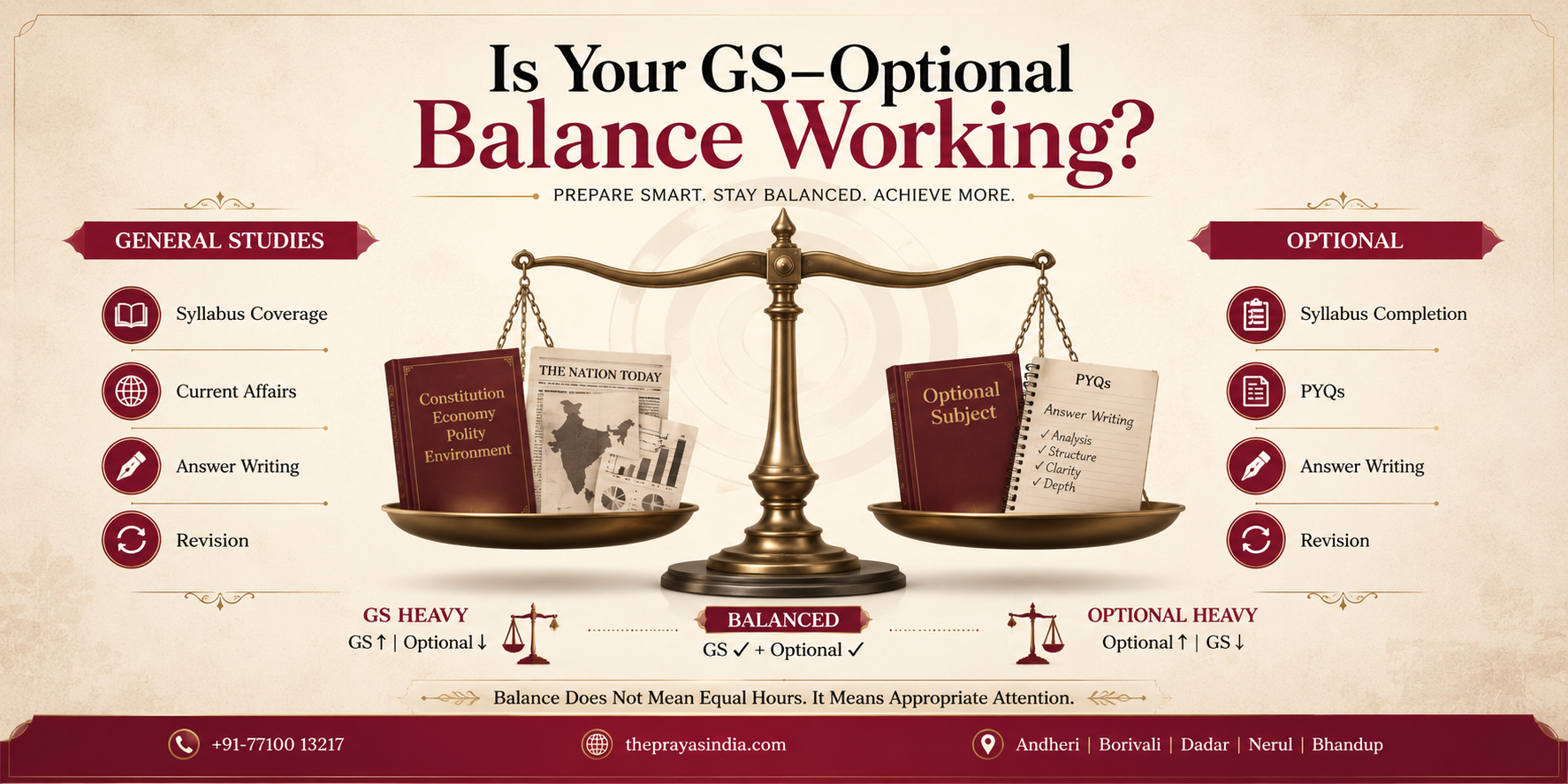
Because balance is not about equal hours.
It’s about giving the right amount of attention to the areas that currently need improvement.
The Morning–Evening Model
A simple way to maintain continuity is to assign different preparation tracks to different parts of the day.
Morning: GS Core
Use your highest concentration period for conceptual GS preparation.
For example:
- Polity
- Economy
- Geography
- History
- Environment
Choose one major area instead of jumping between several subjects.
Afternoon: Optional
Use a dedicated block for Optional depth.
Focus on:
- New topics
- Difficult concepts
- PYQs
- Subject-specific notes
- Answer writing
This ensures that Optional doesn’t become something you prepare only when you have “extra time.”
Evening: Current Affairs + Practice
The evening can be used for lighter but important activities:
- Current Affairs
- Daily MCQs where relevant
- GS answer writing
- Optional answer writing
- Revision of the day’s learning
Night: Quick Revision
End the day by revisiting what you studied.
Don’t try to learn everything again.
Instead, quickly review:
- Key concepts
- Important facts
- Short notes
- Mistakes
- Questions marked for revision
This small habit can significantly improve retention.
Build Your Week Around Outcomes
Instead of writing:
“Study Polity for three hours.”
Create a measurable target:
“Complete Fundamental Rights, solve relevant PYQs, revise notes, and write two answers.”
The second target gives you a clear definition of completion.
Apply the same principle to Optional.
Instead of:
“Study Optional Paper 1.”
Use:
“Complete one topic, analyse five PYQs, prepare concise notes, and practise one answer.”
This makes your preparation measurable.
Use PYQs as the Bridge Between Preparation and Examination
Previous Year Questions should not be treated as something you solve only after completing the syllabus.
Use them while studying.
For GS:
Topic → Concept → PYQs → Answer Writing → Revision
For Optional:
Topic → Detailed Study → PYQs → Model Framework → Answer Writing → Revision
PYQs tell you what the examination expects from your preparation.
They also prevent you from spending excessive time studying information that has little relevance to the actual examination.
Don’t Let Current Affairs Become a Separate Subject
Current Affairs can easily consume several hours every day if you don’t control the source material.
Instead of reading everything, focus on relevance and integration.
For every important issue, ask:
- Which GS paper does this connect to?
- Can it be used as an example in an answer?
- Does it have constitutional, economic, social, environmental, or ethical dimensions?
- Is it relevant to Essay preparation?
- Can it add value to my Optional answer, if genuinely applicable?
This approach turns Current Affairs from a daily information overload into an answer-enrichment resource.
When Should Your Allocation Change?
Your GS–Optional ratio should evolve.
Early Preparation
Focus on:
- Building GS fundamentals
- Understanding Optional basics
- Creating sustainable study habits
Middle Preparation
Increase:
- Answer writing
- PYQ practice
- Optional depth
- Revision
- Current Affairs integration
Mains-Oriented Phase
Prioritise:
- Full-length tests
- Revision
- Answer writing
- Weak-area correction
- Time-bound practice
The closer you get to the examination, the less your strategy should focus on simply collecting information and the more it should focus on using and revising what you already know.
A Weekly Review Can Prevent Major Imbalance
Every week, ask yourself five questions:
1. Did my GS coverage move forward?
If not, identify why.
2. Did my Optional preparation move forward?
If not, adjust the following week’s allocation.
3. Did I write enough answers?
Knowledge without expression is not enough for Mains.
4. What did my tests reveal?
Look beyond marks and identify recurring weaknesses.
5. What should change next week?
This final question turns your timetable into a dynamic preparation system.
The Goal Is Sustainable Progress
You don’t need a schedule that pushes you to study every waking hour.
You need a system that allows you to repeatedly do the right things:
Study → Practise → Write → Analyse → Revise
When GS and Optional move forward together, your preparation becomes more stable.
You stop worrying about whether you’ve “finished” one subject and start focusing on whether your overall Mains readiness is improving.
Expert Guidance Can Simplify the Balancing Act
One of the biggest advantages of structured UPSC preparation is that you don’t have to constantly figure out whether your strategy is working.
Experienced mentors can help you identify syllabus priorities, organise GS and Optional preparation, analyse answer-writing performance, and make timely changes to your study plan.
At The Prayas India, UPSC aspirants can benefit from structured GS preparation, Optional guidance, current affairs support, answer-writing practice, test-based evaluation, personalised mentoring, and doubt-solving support—helping them maintain a focused preparation strategy throughout their UPSC journey.
When Optional Starts Eating Into GS
A strong Optional score can strengthen your Mains—but not if GS preparation is continuously pushed aside.
Choosing an Optional subject is only the beginning. The real challenge is maintaining enough depth in Optional while ensuring that the vast GS syllabus continues to move forward.
This is where many serious aspirants lose balance.
Optional preparation can become extremely engaging. Once you start understanding the subject, reading advanced material, making detailed notes, and solving PYQs, it is easy to spend more time than originally planned.
The problem begins when “just one more topic” repeatedly takes time away from GS.
On the other hand, some aspirants become so focused on GS coverage that Optional is reduced to occasional revision.
Both situations require correction.
The Warning Signs of an Unbalanced Preparation
Your preparation may need adjustment if you notice these patterns repeatedly.
Sign 1: GS Targets Keep Getting Postponed
You planned to complete a GS topic this week, but Optional consumed the available hours.
Once this happens repeatedly, the backlog starts growing.
Sign 2: Optional Notes Are Becoming Excessively Detailed
Detailed notes can be useful, but there is a point beyond which additional information produces diminishing returns.
Ask yourself:
Will this information improve my answer, or am I collecting it simply because it is interesting?
Your notes should help you revise and write better—not become another syllabus to complete.
Sign 3: Current Affairs Keeps Accumulating
You may tell yourself you’ll integrate current affairs later.
But after several months, the backlog becomes difficult to revise.
Current Affairs should therefore be processed regularly and connected to relevant GS themes wherever possible.
Sign 4: GS Answer Writing Is Being Ignored
If most of your answer-writing practice is focused on Optional while GS answers are repeatedly postponed, your preparation is becoming uneven.
GS requires regular practice in:
- Structuring answers
- Using relevant examples
- Maintaining word limits
- Managing time
- Presenting balanced arguments
These skills develop through practice, not simply reading.
When GS Starts Hurting Optional
The imbalance can also happen in the opposite direction.
You may be spending most of your preparation hours completing GS topics while Optional remains incomplete.
Watch for these signs:
- Optional syllabus has not been completed.
- PYQs haven’t been analysed.
- Optional answer writing is irregular.
- Revision is continuously postponed.
- You keep changing Optional resources.
- You haven’t attempted Optional tests.
If several of these apply to you, simply adding more study hours may not solve the problem.
You need to reallocate existing time intelligently.
The Weekly Correction System
Your study plan should not be something you create once and follow blindly for six months.
Use a simple weekly cycle:
STUDY
Complete your planned GS and Optional targets.
↓
TEST
Attempt relevant sectional, answer-writing, or full-length tests.
↓
ANALYSE
Identify where your preparation is falling short.
↓
REALLOCATE
Give additional time to the areas that genuinely need it.
↓
REPEAT
Start the next week with an improved plan.
This creates a preparation system that responds to your actual performance.
Don’t Let Mock Scores Tell the Whole Story
A mock test score is useful, but it doesn’t tell you everything.
Suppose your GS score remains unchanged for three tests.
Don’t immediately conclude that you aren’t improving.
Look deeper.
Perhaps:
- Your accuracy has increased.
- Your attempted questions have increased.
- Your time management has improved.
- Your mistakes have shifted from conceptual to careless errors.
Similarly, a high score doesn’t automatically mean that your preparation is complete.
The purpose of testing is to discover what needs improvement.
Build an Error Classification System
Instead of simply marking a question as “wrong,” classify the reason.
Conceptual Error
You didn’t understand the topic.
Action: Relearn the concept.
Recall Error
You knew the topic but couldn’t remember the information.
Action: Revise more frequently.
Application Error
You understood the concept but couldn’t apply it.
Action: Practise more questions.
Careless Error
You knew the answer but made an avoidable mistake.
Action: Slow down and improve question-reading discipline.
Time-Pressure Error
You couldn’t solve it within the available time.
Action: Practise timed questions.
This classification makes your test analysis much more useful.
The Revision Equation
Revision should not be reserved for the final months.
A better approach is to revisit important material at multiple intervals.
For example:
First Revision
Within a few days of completing the topic.
Second Revision
After a couple of weeks.
Third Revision
During the next major revision cycle.
Test-Based Revision
Whenever a mock or PYQ reveals a weakness.
This approach reduces the need to relearn entire topics repeatedly.
Your Optional Does Not Need to Be Perfect Every Week
Another source of unnecessary stress is expecting continuous improvement in every component simultaneously.
There may be weeks when GS receives more attention.
There may be weeks when Optional needs additional time.
That’s normal.
What matters is ensuring that neither component disappears from your preparation for an extended period.
Think in terms of momentum.
GS should keep moving.
Optional should keep moving.
The intensity can change.
Use a Weekly Balance Check
At the end of every week, give yourself a simple assessment.
GS
🟢 On Track
🟡 Needs Attention
🔴 Falling Behind
Optional
🟢 On Track
🟡 Needs Attention
🔴 Falling Behind
Answer Writing
🟢 Consistent
🟡 Irregular
🔴 Not Practised
Revision
🟢 On Schedule
🟡 Partial
🔴 Pending
Tests
🟢 Analysed
🟡 Attempted but Not Analysed
🔴 Not Attempted
This takes only a few minutes but can prevent weeks of inefficient preparation.
Don’t Change Your Strategy Every Time Someone Scores Higher
UPSC preparation exposes you to countless strategies.
One aspirant studies for 10 hours.
Another studies for 7 hours.
Someone gives 50% time to Optional.
Someone else gives 40%.
One person reads five newspapers.
Another reads one.
Constantly comparing these approaches can create confusion.
Your strategy should be based on:
- Your preparation stage
- Your strengths
- Your weaknesses
- Your available time
- Your test performance
- Your syllabus completion
A strategy that works for another aspirant may not be the right strategy for you.
The Role of Mentorship in Course Correction
One of the biggest advantages of structured UPSC coaching is regular external evaluation.
When you’re preparing alone, it can be difficult to recognise whether you are spending too much time on one subject, whether your answers are improving, or whether your revision cycle is actually effective.
At The Prayas India, aspirants can receive structured GS preparation, Optional guidance, answer-writing practice, test-based evaluation, current affairs support, doubt-solving, and personalised mentoring. Regular feedback can help aspirants identify preparation gaps early and make course corrections before they become major problems.
The Objective Is Not Perfect Balance
Your GS and Optional preparation will not always receive equal attention.
That’s okay.
The objective is to ensure that one component doesn’t continuously undermine the other.
A successful UPSC preparation strategy allows you to recognise:
When to push Optional.
When to strengthen GS.
When to revise.
When to test.
When to slow down and correct mistakes.
Once you develop this ability, your study plan stops being a fixed timetable and becomes a dynamic preparation system.
Turn GS and Optional Preparation into One UPSC Strategy
The goal isn’t to divide your preparation perfectly. It’s to make every stage of preparation work towards the same Mains objective.
By now, the central idea should be clear: GS and Optional should not be treated as competing priorities.
They have different demands, but both contribute directly to your UPSC Mains performance.
GS gives you breadth.
Optional gives you depth.
Answer writing teaches you to express that knowledge.
Tests show you where you stand.
Revision makes that knowledge usable under examination pressure.
The final objective is to bring all of these components together into one sustainable preparation system.
Your Stage-Wise GS + Optional Strategy
Your preparation strategy should change as you move closer to the examination.
Trying to follow the same GS–Optional ratio throughout the entire year can create unnecessary pressure.
Instead, divide your preparation into three broad stages.
Stage 1 — Build the Foundation
At this stage, your primary objective is understanding.
Don’t rush towards excessive test-taking before developing conceptual clarity.
GS Focus
- Build fundamentals.
- Cover basic concepts systematically.
- Understand the UPSC syllabus.
- Start reading Current Affairs selectively.
- Begin making concise notes.
Optional Focus
- Understand the complete syllabus.
- Identify reliable sources.
- Build conceptual foundations.
- Read previous year questions.
- Understand what UPSC expects from the subject.
The objective at this stage is not perfection.
It is to build a strong base that you can revise later.
Stage 2 — Integrate Preparation
Once your foundation becomes stronger, move towards integration.
This is where GS and Optional preparation should increasingly include:
- PYQ analysis
- Answer writing
- Current Affairs integration
- Topic-wise revision
- Sectional testing
- Optional-specific answer practice
Instead of simply asking:
“What should I study today?”
start asking:
“How can I convert today’s learning into an examination-ready answer?”
This shift is extremely important.
Stage 3 — Revision and Mains Readiness
As the examination approaches, your strategy should gradually move away from excessive content collection.
Your priorities should become:
Revision
Revisit what you’ve already studied.
Testing
Attempt questions under time constraints.
Answer Writing
Improve structure, speed, content selection, and presentation.
Weak-Area Correction
Focus on topics where your performance is consistently poor.
Current Affairs Integration
Convert relevant issues into usable examples and arguments.
At this stage, knowing more isn’t always the answer. Knowing and reproducing what matters is.
Create a “Non-Negotiables” List
Regardless of your daily allocation, some activities should remain consistent.
For example:
Daily
✓ Current Affairs review
✓ Core subject study
✓ Optional/GS progress
✓ Short revision
Weekly
✓ PYQ practice
✓ Answer writing
✓ Performance review
✓ Backlog correction
Periodically
✓ Full-length tests
✓ Major revision cycles
✓ Strategy review
✓ Resource evaluation
This prevents your preparation from becoming dependent on your mood or motivation.
How to Know When Your Strategy Is Working
A good preparation strategy should produce measurable changes.
You should gradually notice:
- Better mock performance
- Faster answer writing
- Better question selection
- Improved retention
- Better time management
- Fewer repeated mistakes
If you’re studying extensively but none of these indicators are improving, don’t automatically increase your study hours.
Review your strategy first.
Sometimes the problem isn’t effort.
It’s allocation.
Five Questions to Ask Yourself Every Month
At the end of every month, conduct a deeper review.
1. Is my GS syllabus moving according to plan?
Identify completed, pending, and weak areas.
2. Is my Optional progressing at the right depth?
Check syllabus coverage, PYQs, notes, and answer writing.
3. Am I revising enough?
If you keep forgetting previously studied topics, increase revision frequency.
4. Are my tests improving my preparation?
Don’t simply count tests. Analyse their outcomes.
5. What should change next month?
This is the most important question.
Your next month’s strategy should be based on evidence from the previous month, not someone else’s timetable.
Frequently Asked Questions
How many hours should I give to my Optional Subject?
There is no universal number. Your allocation depends on your preparation stage, Optional completion, GS coverage, available study hours, and test performance.
The important thing is to maintain consistent Optional progress without allowing GS to stagnate.
Should I complete GS before starting Optional?
Not necessarily.
In most cases, GS and Optional can be prepared simultaneously, provided you maintain a structured allocation and don’t allow either component to disappear from your routine.
Can GS and Optional be prepared together?
Yes. In fact, preparing them simultaneously can help you develop a more integrated Mains strategy.
However, Optional still requires dedicated subject-specific study because the depth required is significantly different from GS.
When should I start Optional answer writing?
Don’t wait until the very end.
Once you’ve developed sufficient conceptual understanding of a topic, begin practising answers using PYQs and gradually improve structure, content selection, and time management.
What if my Optional is taking too much time?
First identify why.
Are you:
- Reading too many sources?
- Making excessively detailed notes?
- Avoiding PYQs?
- Spending too much time perfecting one topic?
If yes, streamline your resources and introduce clear completion targets.
How should working aspirants balance GS and Optional?
Working aspirants should focus on consistency rather than unrealistic study-hour targets.
Use weekdays for focused, achievable targets and reserve longer sessions on weekends for tests, revision, backlog correction, and deeper Optional preparation.
Why Choose The Prayas India for IAS Preparation?
Balancing GS and Optional becomes much easier when preparation is supported by a structured academic system.
Many aspirants spend months trying different resources, changing timetables, and studying without objective feedback. A good coaching ecosystem can help bring structure to this process.
At The Prayas India, UPSC aspirants receive guidance designed around the different demands of Civil Services preparation.
Key Support Includes
Experienced UPSC Faculty
Learn from mentors who understand the demands of the Civil Services Examination.
Structured GS Preparation
Systematic coverage of the UPSC syllabus with an examination-oriented approach.
Optional Guidance
Focused support for developing conceptual depth, PYQ understanding, and answer-writing ability.
Answer-Writing Practice
Regular practice to improve structure, content selection, presentation, and time management.
Current Affairs Support
Relevant issues and developments are connected with the broader UPSC syllabus.
Tests & Performance Analysis
Regular evaluation helps identify strengths, weaknesses, and areas requiring improvement.
Mentoring & Doubt Resolution
Personalised guidance helps aspirants stay on track and make timely course corrections.
The objective isn’t simply to help you complete the syllabus.
It is to help you prepare in a way that translates into better examination performance.
Conclusion
Balancing Optional and GS isn’t about finding a magical timetable or following a fixed percentage.
It’s about understanding what your preparation needs right now.
Sometimes GS will require more attention.
Sometimes Optional will.
There will be weeks dedicated to learning, weeks focused on answer writing, and periods where revision and testing become the priority.
That’s not an indication that your plan is failing.
That’s what a dynamic preparation strategy looks like.
The most important thing is to keep both tracks moving, identify imbalances early, and make decisions based on your actual performance rather than comparison with other aspirants.
If you’re preparing for UPSC and looking for structured GS preparation, Optional guidance, answer-writing practice, current affairs support, regular testing, and expert mentoring, The Prayas India can help you build a more focused and examination-oriented preparation strategy.
Contact Us
- 📞 Call: +91-77100 13217
- 🌐 Website: https://theprayasindia.com
- 📍 Centres: Andheri | Borivali | Dadar | Nerul | Bhandup
Don’t choose between GS and Optional. Build a strategy where both contribute to your final Mains performance.