How to Structure High-Scoring UPSC Mains Answers | Best UPSC CSE Coaching in Mumbai | The Prayas India
UPSC Mains is not simply a test of how much you know. It is a test of how effectively you can present what you know within a limited word count and time frame. Two candidates may have studied the same topic, referred to similar sources and understood the issue equally well, yet their marks can differ significantly because one is able to convert knowledge into a well-structured answer while the other struggles to communicate it effectively.
This is why UPSC Mains answer writing deserves to become a core part of preparation rather than something students postpone until after completing the syllabus.
A high-scoring answer does not necessarily require extraordinary knowledge. It requires relevance, structure, clarity, analysis, examples and a balanced conclusion. The candidate must understand what the question is asking, identify the demand of the directive, organise the content logically and present it in a way that makes evaluation easier.
For aspirants preparing seriously for Civil Services, developing this ability is one of the most important steps between knowing the syllabus and scoring well in Mains.
Why Answer Structure Matters So Much in UPSC Mains
The UPSC Mains examination places candidates under severe constraints.
You have limited time.
You have a prescribed word limit.
You have multiple questions to answer.
And you need to demonstrate both breadth of knowledge and depth of understanding.
This means you cannot write everything you know about a topic.
You have to select what is relevant.
That is the central principle of good answer writing:
A high-scoring answer is not the longest answer. It is the most relevant answer presented effectively within the given constraints.
A candidate may know ten points about a topic, but the question may require only four of them. Including all ten can make the answer lengthy without making it better.
Similarly, a candidate may have excellent knowledge but lose marks because the introduction is vague, the body lacks structure, examples are missing or the conclusion does not address the broader issue.
The examiner should be able to understand your argument without having to search through paragraphs to find it.
That is why structure matters.
First Understand the Question Before Writing the Answer
One of the most common mistakes in UPSC Mains is beginning to write immediately after reading a familiar keyword.
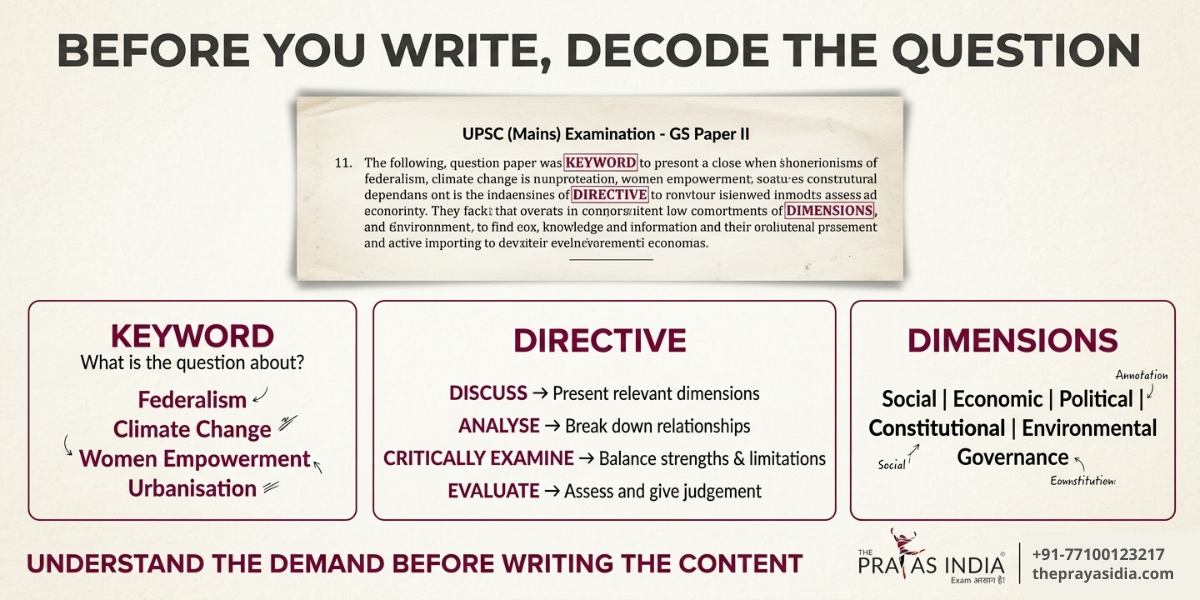
Seeing the word “federalism”, “women empowerment”, “climate change” or “urbanisation” may immediately bring several prepared points to mind.
But the actual question may be asking something much narrower.
For example, if a question asks you to “critically examine” an issue, simply explaining the issue is not enough.
If it asks you to “analyse”, you need to establish relationships, causes, consequences or dimensions.
If it asks you to “discuss”, the answer generally needs a balanced treatment of relevant aspects.
If it asks you to “evaluate”, your answer should move towards judgement based on arguments and evidence.
Therefore, before writing, identify three things:
What is the topic?
What subject or issue is being discussed?
What is the directive?
What exactly is UPSC asking you to do?
What are the dimensions?
Which aspects need to be covered to answer the question comprehensively?
This small pause before writing can prevent an otherwise knowledgeable answer from going off-topic.
Decode the Directive Words
The directive used in a UPSC question gives you an important clue about how your answer should be structured.
“Discuss”
Present the relevant dimensions of the issue in a balanced manner.
The answer should not become a one-sided opinion.
“Analyse”
Break the issue into different components and explain the relationships between them.
You should go beyond description.
“Critically Examine”
Present the strengths, limitations, concerns or counterarguments and arrive at a balanced assessment.
“Evaluate”
Assess the issue against relevant criteria and provide a reasoned judgement.
“Comment”
Provide your interpretation or assessment, supported by relevant arguments.
“Explain”
Focus on clarity and causality. Make the concept understandable rather than simply listing facts.
The directive does not provide a fixed template, but it tells you what kind of intellectual treatment the question expects.
The Anatomy of a High-Scoring UPSC Mains Answer
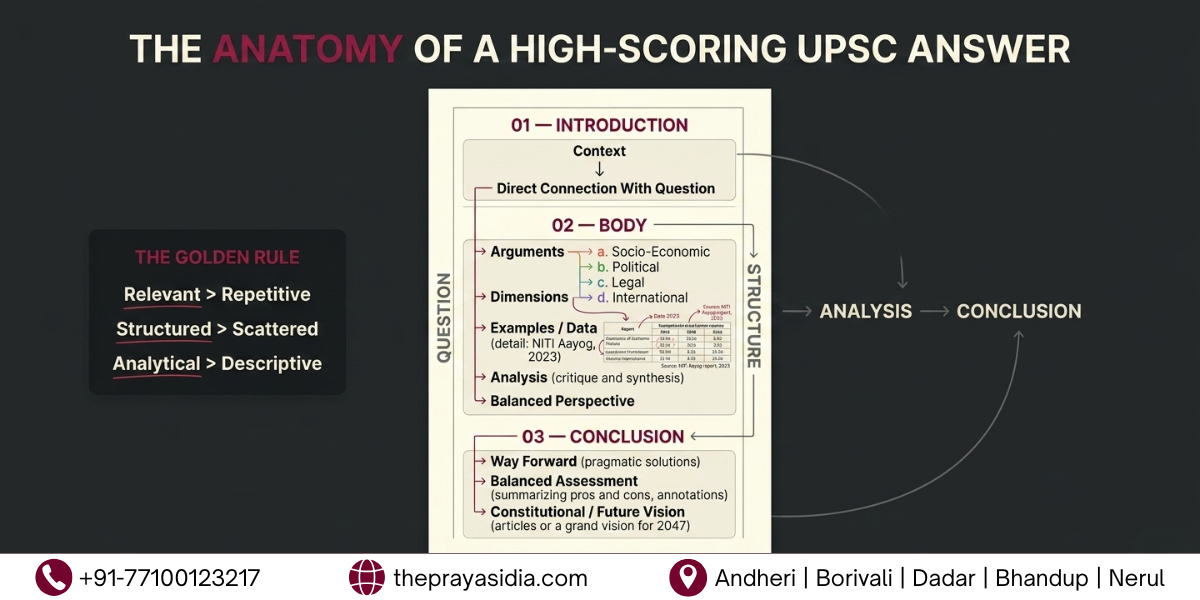
A strong answer generally has three broad components:
Introduction
Establish the context and directly connect it with the question.
Body
Address the different dimensions demanded by the question using logical organisation.
Conclusion
Provide a balanced, forward-looking or solution-oriented closing wherever appropriate.
This structure sounds simple, but the difference lies in execution.
A weak answer may technically have an introduction, body and conclusion while still lacking relevance.
A strong answer uses these components to create a clear argument.
Writing an Effective Introduction
The introduction should not consume a large portion of your answer.
Its primary purpose is to establish context and demonstrate that you understand the question.
There are several ways to begin.
Definition-Based Introduction
Useful when the question deals with a specific concept.
For example, a question concerning cooperative federalism could begin by briefly explaining the concept before moving towards the specific issue.
Constitutional Reference
For Polity questions, relevant constitutional provisions, Articles, principles or institutional references can provide a strong starting point.
Current-Affairs Context
A recent development, policy change, report or contemporary issue can establish relevance.
Data-Based Introduction
A credible statistic can immediately establish the scale of an issue when the data is relevant and accurate.
Contrasting Introduction
You can begin by presenting two sides of an issue when the question requires a balanced discussion.
The key is not to force a particular type of introduction into every answer.
Choose the one that gets you closest to the question.
Avoid Generic Introductions
A common problem in Mains preparation is the use of memorised introductions.
Statements such as:
“India is a diverse country with unity in diversity.”
or
“Women have always played an important role in society.”
may be factually acceptable, but they do not necessarily demonstrate that you understand the specific demand of the question.
A better introduction should create a direct bridge between the context and the issue being asked.
Think of the introduction as the entry point into your argument, not a decorative opening paragraph.
The Body Is Where Your Marks Are Built
The body should answer the actual question.
This is where many candidates either over-write or under-develop their arguments.
One useful method is to think in terms of dimensions.
Depending on the question, these could include:
- Social
- Economic
- Political
- Administrative
- Constitutional
- Environmental
- Ethical
- Technological
- Security-related
- International
- Historical
You do not need to use every dimension.
Select the dimensions that genuinely contribute to answering the question.
Use Headings to Improve Readability
UPSC answers are evaluated under time pressure.
A well-organised answer allows the examiner to identify your arguments quickly.
Instead of writing one continuous block of text, use short headings where appropriate.
For example, a question on a policy issue could be organised as:
Why the Policy Matters
Key Challenges
Implementation Gaps
Way Forward
This does not mean every answer must contain multiple headings.
The structure should follow the question.
But when the answer contains several dimensions, headings can make the content considerably easier to evaluate.
Paragraphs and Bullets Both Have a Place
There is no need to force every answer into bullet points.
Some analytical arguments are better explained through short paragraphs.
Other questions benefit from concise points.
A good answer can combine both.
For example, you may introduce the issue through a short paragraph and then present multiple dimensions through structured points.
The objective is readability, not following a rigid formatting rule.
Use Examples to Make Arguments Concrete
Examples can make a generic answer more specific.
Consider the difference between:
“Technology can improve governance.”
and:
“Technology-enabled platforms can improve service delivery by reducing physical interfaces, improving transparency and enabling real-time monitoring.”
The second statement is stronger because it explains the mechanism.
Adding a relevant example, government initiative, institutional reference or contemporary development can make the argument even more concrete.
However, examples should support the argument.
Do not add examples simply to make the answer look informative.
Data and Reports Can Strengthen an Answer
Relevant data can provide credibility.
UPSC aspirants can gradually build a small repository of useful figures from reliable sources such as government reports, Economic Survey material, Census-related information, NITI Aayog reports and recognised international institutions.
But data should be used selectively.
One relevant statistic is better than five disconnected numbers.
The question is always:
Does this information strengthen my argument?
If yes, use it.
If not, leave it out.
Add Multiple Dimensions Without Losing Focus
A high-quality Mains answer often demonstrates that the candidate can look at an issue from more than one perspective.
For example, an environmental issue may have:
Economic implications
Social implications
Governance implications
Technological implications
International implications
But multidimensionality should not become an excuse for listing unrelated points.
Every dimension must connect back to the question.
This is the difference between breadth and random information.
Balance Your Arguments
UPSC Mains rewards mature analysis.
Avoid making every answer sound absolute.
If you are discussing a government policy, acknowledge both achievements and implementation challenges.
If you are discussing technology, mention both opportunities and risks.
If you are discussing economic reforms, examine both growth and distributional concerns where relevant.
This creates a more balanced answer.
The objective is not to criticise everything.
Nor is it to praise everything.
The objective is to demonstrate reasoned analysis.
The “Way Forward” Should Be Practical
A generic conclusion such as “The government should take necessary steps” adds very little value.
A better way forward should indicate what kind of intervention is required.
Depending on the issue, it could involve:
- Institutional reforms
- Better implementation
- Capacity building
- Technology
- Community participation
- Regulatory improvements
- Centre-State coordination
- Behavioural change
- Transparency
- Accountability
The way forward should be realistic and connected to the problem discussed in the answer.
How to Write a Strong Conclusion
A conclusion should bring the answer together rather than simply repeat the introduction.
A good conclusion can:
Provide a Balanced Assessment
Summarise the central argument.
Offer a Way Forward
Suggest practical improvement.
Connect With Constitutional Values
For relevant topics, values such as justice, equality, liberty, fraternity and dignity can provide a meaningful closing.
Present a Broader Vision
A future-oriented conclusion can be effective when discussing development, governance or India’s global role.
The conclusion should be brief.
You do not need to introduce an entirely new argument in the final lines.
The Importance of Presentation in UPSC Mains
Good content can lose its impact if it is difficult to read.
Presentation does not mean decorating your answer.
It means making the answer easy to navigate.
Useful practices include:
- Short paragraphs
- Clear headings
- Relevant subheadings
- Underlining important keywords
- Simple diagrams where appropriate
- Flowcharts for processes
- Tables for comparisons
- Adequate spacing
- Legible handwriting
The goal is to make your strongest points visible.
Use Diagrams Where They Actually Add Value
Diagrams can be particularly useful for Geography, Environment, Science & Technology, Economy and certain GS-II or GS-III questions.
A simple diagram can sometimes communicate a relationship faster than several lines of text.
For example, a question involving a process can be represented as:
Cause → Mechanism → Impact → Response
Similarly, comparisons can sometimes be represented through a table.
But don’t add diagrams merely because you have been told that diagrams “fetch marks.”
The diagram must contribute to the answer.
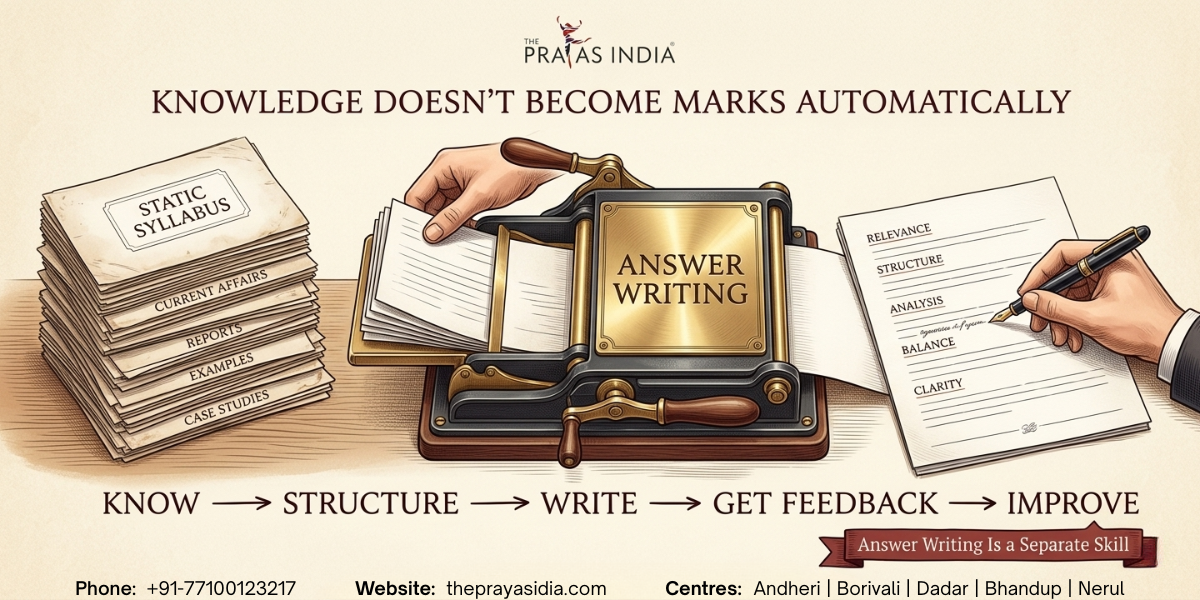
Answer Writing Is a Skill — Not Just a Knowledge Problem
This is one of the most important lessons for Mains aspirants.
You can know the syllabus and still struggle to write high-scoring answers.
You can read newspapers every day and still fail to convert current affairs into usable arguments.
You can complete multiple books and still struggle with the 150-word or 250-word constraint.
Why?
Because answer writing requires practice.
It is a separate skill that improves through:
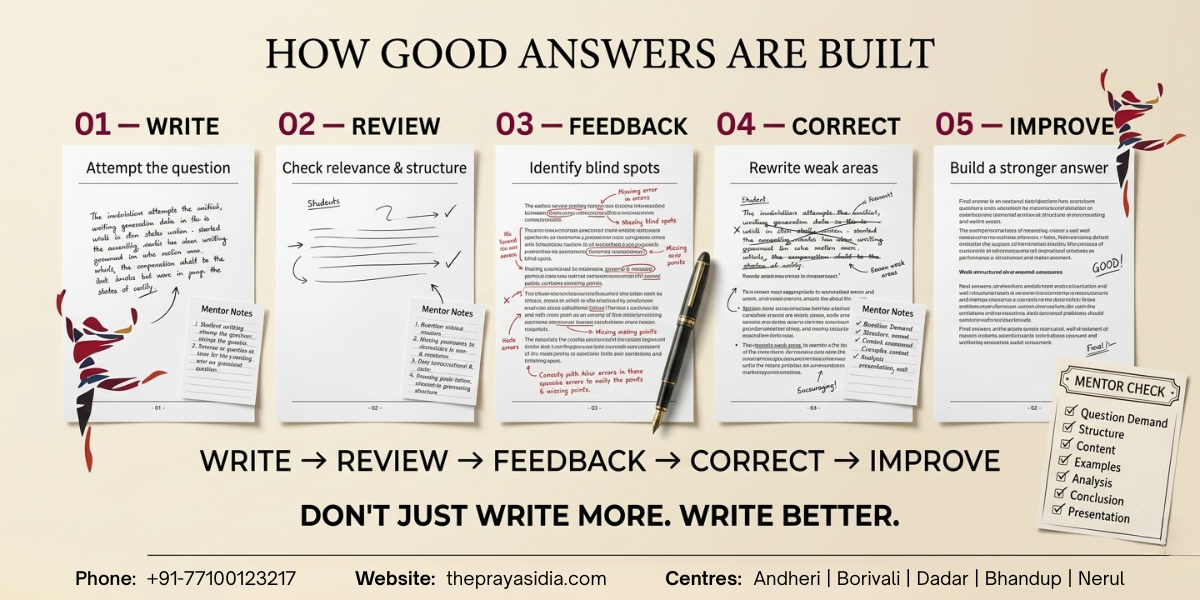
Writing → Feedback → Correction → Rewriting → Improvement
This is why aspirants should not wait until they feel “fully prepared” before starting answer writing.
Start With Quality, Then Build Speed
When students begin answer writing, they often worry about completing the answer within the prescribed time.
Speed is important, but the initial focus should be on developing quality.
First learn to:
- Understand the question
- Create a structure
- Develop relevant points
- Use examples
- Maintain balance
- Write a meaningful conclusion
Then gradually work on reducing the time required.
Otherwise, you may become faster at writing poorly structured answers.
The objective is efficient writing, not simply fast writing.
Feedback Is Where Major Improvement Happens
Writing an answer without reviewing it can create a false sense of progress.
You may believe your answer is comprehensive while missing an important dimension.
You may think your introduction is strong while it remains generic.
You may believe you are writing analytically while actually describing the topic.
External feedback can reveal these blind spots.
This is one of the strongest reasons serious Mains aspirants consider structured mentorship and UPSC coaching in Mumbai.
A mentor can evaluate your answer from the perspective of examination demand rather than personal preference.
What a Mentor Should Evaluate
Good answer feedback should go beyond:
“Good answer.”
or
“Add more points.”
Useful feedback should examine:
- Did you understand the question?
- Did you address the directive?
- Is the introduction relevant?
- Are the arguments logically organised?
- Are sufficient dimensions covered?
- Are examples relevant?
- Is the analysis balanced?
- Is the conclusion effective?
- Is the answer within the word limit?
- Is the presentation readable?
- Where are marks likely being lost?
This type of feedback gives you something actionable.
Why Structured UPSC Coaching Can Matter
Self-study remains an important part of Civil Services preparation, but the right guidance can reduce the uncertainty involved in answer writing.
A structured programme can provide:
Regular answer-writing practice
Faculty evaluation
Mentorship
Model-answer discussions
Current-affairs integration
Test-series exposure
Performance tracking
For an aspirant who repeatedly writes answers but does not know why scores remain stagnant, this feedback loop can be particularly valuable.
Choosing the Best UPSC Coaching in Mumbai
When aspirants search for Top IAS Coaching in Mumbai, they should look beyond advertising claims.
The better question is:
“What kind of preparation system does the institute actually provide?”
A serious aspirant should examine the quality of faculty, answer-writing support, mentorship, test series, current-affairs integration, study material and individual feedback.
For Mains specifically, ask whether the programme helps you move from:
Knowing → Writing → Evaluating → Improving
That progression is far more important than simply attending classes.
Why The Prayas India Can Be Considered for UPSC Preparation
For aspirants evaluating Best IAS Coaching in Mumbai, the learning environment matters because Civil Services preparation is a long-term process.
A structured preparation system can help students organise their syllabus, integrate current affairs, practise answer writing and receive guidance on areas where improvement is needed.
The Prayas India can be considered by aspirants looking for a preparation environment that combines academic guidance with an examination-oriented approach.
The objective should not be to make students dependent on coaching.
It should be to help them develop the ability to think independently, write clearly and approach UPSC questions strategically.
A Practical Answer-Writing Framework
Before writing your next Mains answer, use this quick framework:
1. READ
Understand the exact wording.
2. DECODE
Identify the directive and keywords.
3. PLAN
Think of 3–5 relevant dimensions.
4. INTRODUCE
Establish context and connect directly to the question.
5. ARGUE
Develop relevant points with explanation.
6. SUPPORT
Use examples, data, reports, constitutional provisions or case studies where relevant.
7. BALANCE
Include contrasting perspectives where the question demands them.
8. CONCLUDE
End with a practical, balanced or forward-looking thought.
This simple process can make answer writing more deliberate.
Common UPSC Mains Answer-Writing Mistakes
Writing Everything You Know
More information does not automatically mean more marks.
Ignoring the Directive
A “critically examine” question cannot be answered like a simple “explain” question.
Generic Introductions
The introduction should establish relevance rather than consume space with broad statements.
No Clear Structure
A long paragraph containing multiple arguments can make evaluation difficult.
Excessive Current Affairs
Current affairs should strengthen static knowledge, not replace it.
One-Sided Arguments
Balanced analysis is particularly important for analytical questions.
Weak Conclusions
The conclusion should close the argument meaningfully.
No Feedback
Without evaluation, repeated writing can reinforce the same mistakes.
Poor Time Management
An excellent answer that consumes disproportionate time can affect the entire paper.
How Aspirants Can Build Answer-Writing Practice Into Their Routine
Answer writing does not have to begin with writing ten answers every day.
Start with a manageable routine.
You can begin by writing a few answers regularly and gradually increase the volume.
The important part is maintaining the feedback cycle.
For every answer, ask:
What did I do well?
What did I miss?
What can I improve next time?
Over several weeks, these small corrections can create significant improvement.
The goal is to make good structure automatic.
When you see a question in the examination, you should not have to spend excessive time deciding how to begin.
The framework should already be familiar.
The Real Difference Between a Prepared Candidate and a Mains-Ready Candidate
A prepared candidate may have:
- Completed the syllabus
- Read standard books
- Followed current affairs
- Made notes
- Watched lectures
A Mains-ready candidate can take that knowledge and convert it into:
Relevant arguments
Structured answers
Balanced analysis
Examples
Diagrams where useful
Clear conclusions
Timely execution
That transition is the real purpose of answer-writing practice.
Admission-Focused Conclusion
UPSC Mains is not won by knowledge alone.
It is won by the ability to convert knowledge into marks.
Every answer you write is an opportunity to improve that conversion.
If your answers are too descriptive, learn to analyse.
If your structure is weak, practise planning.
If your introductions are generic, learn to establish relevance.
If your conclusions are repetitive, develop better ways to close an argument.
If your answers are good but scores remain stagnant, seek detailed evaluation and identify the blind spots that self-study may not reveal.
For aspirants looking for the Best UPSC Coaching in Mumbai, the right institute should offer more than classroom teaching. It should help you build the complete Mains ecosystem—knowledge, answer writing, evaluation, mentorship and continuous improvement.
At The Prayas India, aspirants can explore a structured approach to UPSC CSE preparation designed to support serious candidates through the demands of the examination.
If UPSC CSE is your goal, don’t wait until Mains is around the corner to learn how to write Mains answers. Start building the skill from the beginning.
Contact Us
- 📞 Call: +91-77100 13217
- 🌐 Website: https://theprayasindia.com
- 📍 Centres: Andheri | Borivali | Dadar | Nerul | Bhandup
The right answer structure cannot guarantee a high score—but learning to consistently answer the question UPSC actually asked can significantly improve the quality of your preparation.