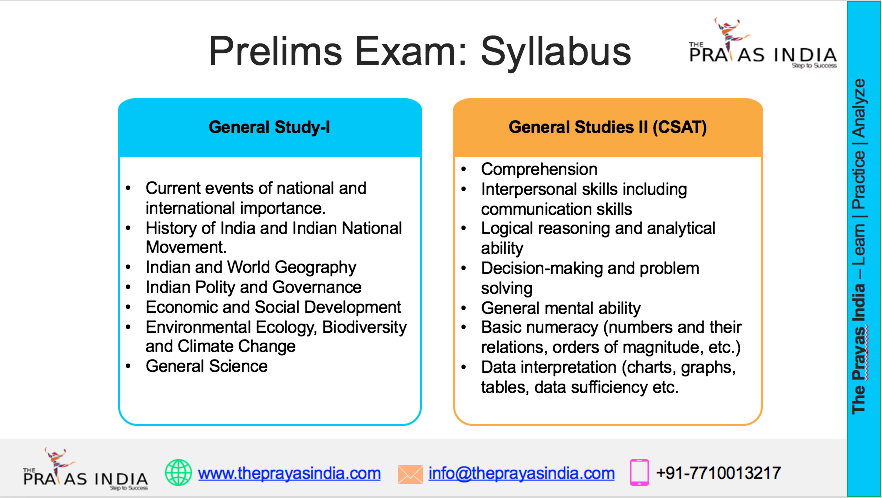
Why UPSC Aspirants Need Feedback, Not Just Study Material | The Prayas India UPSC Preparation Strategy
UPSC preparation is often treated as a resource-management exercise. Aspirants search for the best books, collect notes, follow current-affairs sources, join lectures and build folders full of study material. All of this has value, but there is one element that is often underestimated: feedback.
Aspirants can spend months studying without receiving a clear answer to a basic question: Is my preparation actually improving? You may know more than you did six months ago, but knowing more is not always the same as performing better in the UPSC examination.
This is particularly important because UPSC does not evaluate how many books you have completed or how many hours you have studied. It evaluates what you can understand, recall, analyse and present under examination conditions.
That is why a preparation system needs more than good study material. It needs a mechanism that continuously tells you what is working, what is not working and what needs to change.
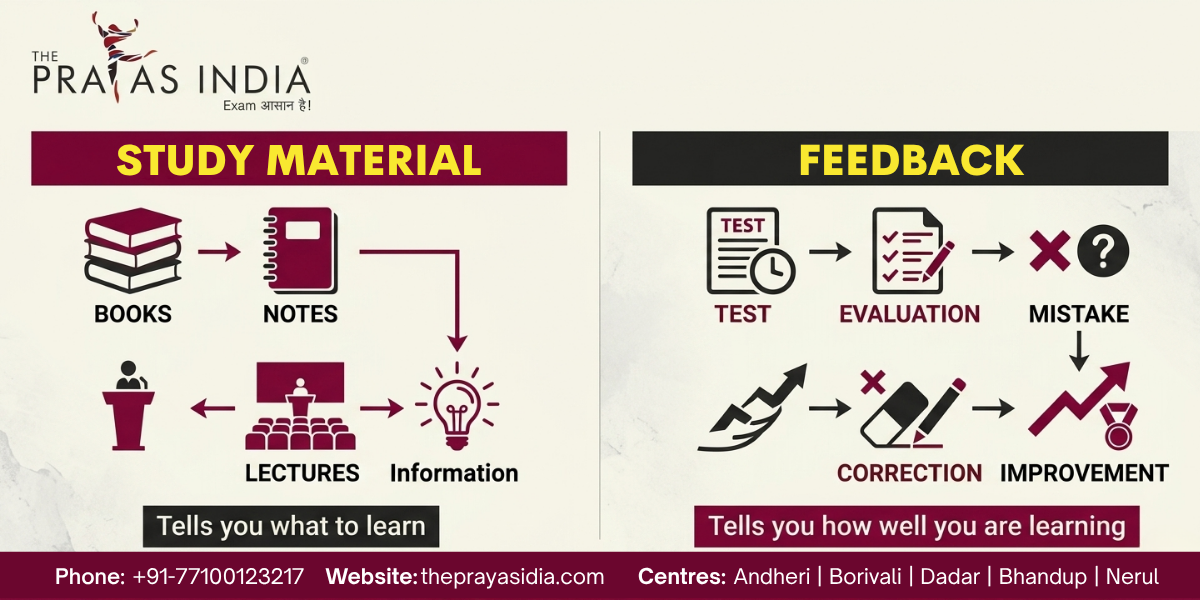
Study Material Gives Information. Feedback Gives Direction.
Good study material can help you understand Polity, Economy, History, Geography, Environment and other areas of the UPSC syllabus. But the material itself cannot tell you whether you are able to apply that knowledge effectively.
Suppose you have completed a standard source for Indian Polity. You may feel confident because you have read every chapter and highlighted important portions. But when you attempt a difficult Prelims question, you may discover that your conceptual understanding is weaker than you thought.
Similarly, you may read excellent material for GS Mains and still struggle to write a balanced 250-word answer.
The problem isn’t necessarily the quality of your source.
The missing element is performance feedback.
Feedback creates a connection between what you study and what the examination actually demands. It tells you whether your knowledge is translating into accuracy, analytical ability, answer quality and decision-making.
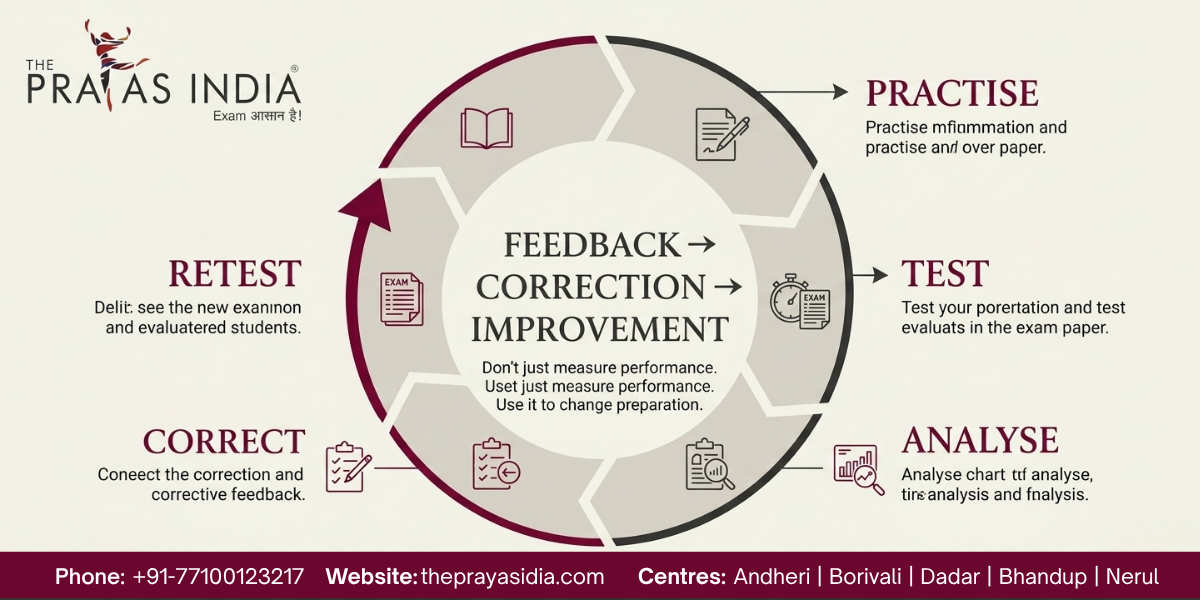
A useful preparation cycle therefore looks more like:
Study → Practise → Test → Analyse → Correct → Re-test
rather than simply:
Study → Study → Study
Why Feedback Matters So Much in UPSC Preparation
The UPSC syllabus is too broad to prepare perfectly in one pass. Even experienced aspirants make mistakes, misunderstand questions and identify weaknesses only after testing themselves.
This makes feedback particularly valuable.
When you receive meaningful feedback, you don’t just know that an answer is wrong or that a mock score is low. You begin to understand why the performance was weak.
For example, a low Prelims score could come from weak concepts, poor question selection, excessive guessing or inadequate revision. These problems require completely different solutions.
Likewise, a low Mains score may not mean that you need to read another book. Your problem could be that you are not addressing all dimensions of the question, your arguments lack structure or your answers are not sufficiently analytical.
Without feedback, all of these problems can look like one thing: “I need to study more.”
And that can lead to unnecessary study hours without meaningful improvement.
The Difference Between Correction and Feedback
There is an important distinction between simply being told that something is wrong and receiving useful feedback.
If a test report says:
“Incorrect answer.”
that provides very little direction.
But if the analysis explains that the mistake occurred because you confused two concepts, misunderstood the question’s wording or relied on an assumption that was not supported by the question, you now have something you can act on.
The same applies to Mains answer writing.
Instead of simply receiving a score, useful feedback should help you understand whether the issue was related to content, structure, relevance, analysis, examples, presentation or time management.
The objective is not criticism.
The objective is correction.
And correction is what turns practice into progress.
What Good UPSC Feedback Should Tell You
A useful feedback system should answer questions such as:
- What did I do correctly?
- Where did I lose marks?
- Why did I make the mistake?
- Is this a one-time error or a repeated pattern?
- What should I change in my preparation?
- How will I check whether the correction has worked?
When feedback consistently answers these questions, your preparation becomes increasingly personalised.
Instead of following a generic study plan indefinitely, you begin making decisions based on your own performance.
Feedback Is Especially Important for Mains Answer Writing
Mains preparation is one of the clearest examples of why study material alone is insufficient.
You can read excellent books on Governance, Social Issues, International Relations or Economy. You can make detailed notes and understand the topics well. Yet your marks may remain average if you cannot convert that knowledge into a well-structured answer.
Writing answers is therefore not simply a test of knowledge.
It is a test of knowledge application.
You need to understand what the question is asking, identify its different dimensions, select relevant information, structure your arguments and present them within a limited word count.
These skills develop through repeated practice and meaningful evaluation.
If an aspirant writes twenty answers but receives no useful feedback, the same structural mistakes can continue through all twenty.
If those answers are evaluated properly, however, every answer can become an opportunity to improve the next one.
Prelims: Your Score Is Only the Beginning
Prelims mock tests provide an obvious numerical indicator, but the number itself is only the starting point.
Imagine two aspirants scoring 85 in a mock test.
The first aspirant made ten conceptual mistakes, attempted several questions without sufficient confidence and lost marks because of poor question selection.
The second aspirant had strong conceptual accuracy but made several avoidable mistakes due to rushing through questions.
Both have the same score.
But they do not have the same problem.
The first aspirant may need conceptual revision and better practice. The second may need to work on accuracy and examination temperament.
This is why comparing only scores can be misleading.
A useful mock-test analysis should examine the nature of mistakes, not just the number of mistakes.
Over time, this creates a much clearer picture of your preparation.
You may discover that Environment is genuinely weak, while Polity is strong. You may realise that your knowledge is adequate but your elimination technique is inconsistent. Or you may find that certain mistakes keep recurring because you are rushing through questions.
Once these patterns become visible, your study plan can become more precise.
The Feedback Loop That Creates Improvement
A strong UPSC preparation system should create a continuous feedback loop.
You study a topic and test yourself. The test reveals a weakness. You analyse the weakness and revise the relevant concept. You then practise again to see whether the problem has actually been corrected.
This process may sound simple, but it changes the nature of preparation.
Instead of asking:
“How much have I studied?”
you start asking:
“What has improved because of what I studied?”
That is a much more useful question.
For serious aspirants, this feedback loop should operate at multiple levels—daily practice, weekly tests, monthly performance reviews and larger Prelims or Mains simulations.
Why Many Aspirants Avoid Feedback
Feedback can be uncomfortable.
A mock score may reveal that months of preparation have not produced the expected results. An evaluated Mains answer may show weaknesses that an aspirant did not notice independently. A mentor may recommend changing a study habit that has become part of the daily routine.
It is natural to prefer positive confirmation.
But UPSC preparation requires something more valuable than reassurance: accurate diagnosis.
A low score discovered early is useful.
A weakness discovered after repeated practice is still useful.
A mistake identified months before the examination can become an opportunity for improvement.
The real danger is not discovering a weakness.
The real danger is never discovering it because you never test yourself honestly.
More Study Material Is Not Always the Solution
When aspirants feel underprepared, their first response is often to look for another resource.
A new book appears.
A new current-affairs compilation is released.
A new lecture series becomes popular.
Another set of notes is recommended.
But if the real problem is poor revision, weak answer writing or lack of feedback, adding more material can actually make the situation worse.
More content means more things to read, organise and revise.
The better question is:
“What is my current performance telling me?”
If your test analysis shows a conceptual gap, study material may help.
If your problem is answer structure, another book may not solve it.
If your issue is time management, more reading will not automatically improve it.
If your mistakes are caused by poor question selection, simply increasing the number of mocks may not be enough.
The solution should match the problem.
That is the fundamental value of feedback.
Takeaway
UPSC preparation should not become an endless search for better books, more notes or longer study hours.
Good resources are important, but they represent only one side of preparation. The other side is knowing how effectively you are using those resources.
Feedback provides that missing connection.
It helps you identify weaknesses before they become permanent habits, understand why your marks are changing, and make your next phase of preparation more targeted.
Building a Feedback-Driven UPSC Preparation System
Part 1 established an important point: study material gives you information, but feedback tells you whether that information is translating into performance. This distinction becomes increasingly important as UPSC preparation progresses.
In the early stages, reading and understanding the syllabus may take up most of your attention. But as preparation becomes more serious, simply completing books is no longer enough. You need to know whether you can recall what you studied, solve questions accurately, write analytical answers and perform under time pressure.
This is where a feedback-driven preparation system becomes valuable. Instead of treating every test, answer or revision session as an isolated activity, you start using each one to make the next stage of preparation better.
What Does Effective UPSC Feedback Actually Look Like?
Not all feedback is equally useful.
A scorecard showing that you obtained 92 marks can tell you where you stand, but it does not necessarily tell you what to do next. Similarly, a comment such as “improve your answer” is too broad to become a practical action point.
Effective feedback should be specific, actionable and connected to the examination requirement.
For a Prelims test, feedback might identify that your concepts are strong but your accuracy suffers because you attempt too many doubtful questions. For a Mains answer, it might show that your content is relevant but your analysis lacks depth or that you are not addressing every part of the question.
The most useful feedback therefore moves through three stages:
Identify the problem → Explain the reason → Suggest the correction.
Once the correction is implemented, you need another opportunity to test whether the problem has actually improved.
That final step is important because feedback without follow-up can remain theoretical.
Feedback Should Change Your Next Study Session
The simplest way to judge whether feedback is useful is to ask what happens after you receive it.
Suppose your mentor tells you that your Mains answers lack examples. If you simply read the comment and move on to the next answer, very little has changed.
A better approach would be to create a short improvement task: identify relevant examples for a few important themes, practise incorporating them into answers and then review your next set of answers.
The feedback has now changed your preparation.
The same principle applies to Prelims. If mock analysis shows repeated mistakes in Environment, your next study cycle should include targeted revision and topic-specific questions rather than another random mock test.
This is how feedback turns into measurable improvement.
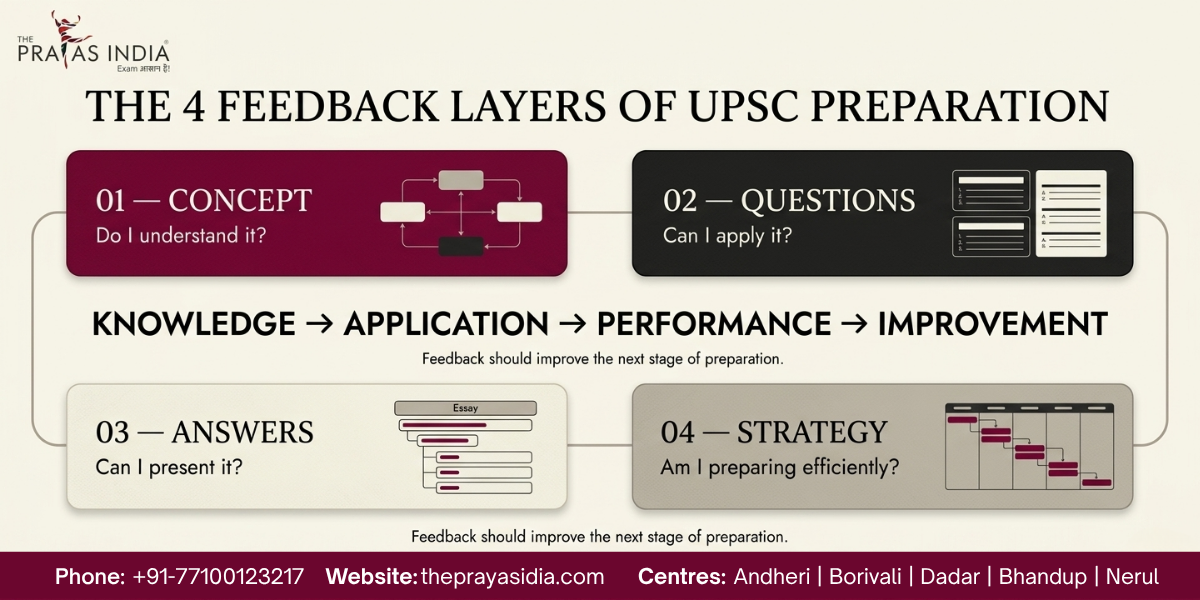
The Four Areas Where UPSC Aspirants Need Feedback Most
A feedback system becomes particularly useful when it covers the major components of preparation rather than focusing only on mock-test scores.
1. Conceptual Understanding
You need to know whether you genuinely understand a topic or have simply become familiar with the words on the page.
2. Question Solving
You need to identify whether your mistakes come from knowledge gaps, interpretation problems, elimination errors or careless attempts.
3. Answer Writing
You need to understand whether your answers are relevant, analytical, structured and appropriately presented.
4. Overall Strategy
You need periodic evaluation of whether your time, resources and priorities are aligned with your current preparation stage.
These four areas together provide a much clearer picture than study hours alone.
How to Create a Personal Feedback System
You don’t necessarily need a complicated spreadsheet with dozens of columns. The system needs to be practical enough that you will actually use it consistently.
After every significant test or answer-writing session, record the major mistakes and identify their category. Over a few weeks, patterns will begin to appear.
For example, you may discover that your mistakes repeatedly fall into three categories: incomplete revision, incorrect interpretation of questions and poor time management.
That information is far more useful than simply knowing your average score.
Your next study cycle can then focus specifically on those three areas.
A simple feedback record can include:
- What went wrong?
- Why did it happen?
- How frequently is it happening?
- What correction will I make?
- When will I test it again?
This turns preparation into a continuous improvement process rather than a simple completion process.
Feedback and Revision Must Work Together
Revision is often planned according to time: “I will revise this subject next Sunday.”
A feedback-driven approach makes revision more intelligent.
If a mock test shows that you remember a topic accurately, it may not need immediate intensive revision. If the same test shows that you repeatedly forget specific concepts, those areas deserve greater attention.
This creates performance-based revision.
Instead of giving every chapter exactly the same amount of revision time, you allocate more time to areas where your performance indicates a weakness.
This is especially useful because the UPSC syllabus is too broad to treat every topic identically.
Strategic revision means understanding where your attention will produce the greatest improvement.
Feedback Can Prevent Resource Overload
One of the biggest advantages of feedback is that it can stop you from continuously adding study material.
Suppose you are struggling with Economy.
Before buying another resource, look at your test performance.
Are you making mistakes because you don’t understand the concepts? Are you forgetting facts because you haven’t revised? Are you misunderstanding questions? Or are you simply making avoidable mistakes?
The answer determines what you need.
If the issue is conceptual understanding, a reliable explanatory source may help.
If the issue is retention, revision may be more important.
If the issue is application, question practice may be the better solution.
Without feedback, every problem can look like a resource problem.
With feedback, you can distinguish between knowledge gaps and process gaps.
That distinction can save significant preparation time.
Mentorship: When External Feedback Becomes Valuable
Self-evaluation is an important skill, but there are limits to evaluating your own preparation.
You already know what you intended to write in an answer. That can make it difficult to objectively judge whether the answer actually communicates the idea effectively.
Similarly, after spending weeks studying a subject, you may become too familiar with your own notes to recognise gaps in understanding.
An experienced mentor can provide an outside perspective.
Good mentorship should not simply tell you that your performance is weak. It should help you understand why it is weak and what practical changes can improve it.
This is particularly valuable for aspirants who have been preparing for several months but feel that their effort is not translating into results.
How Coaching Can Add Value Beyond Study Material
When students compare IAS coaching institutes, study material is often one of the first things they evaluate.
That is understandable, but it shouldn’t be the only consideration.
Almost every serious UPSC preparation ecosystem will provide some form of study material. The more important question is what happens after you receive that material.
Are you tested regularly?
Are your Mains answers evaluated?
Do you receive useful feedback?
Can you discuss recurring weaknesses with faculty or mentors?
Is there a mechanism to track your performance?
Does the institute help you adjust your preparation based on your results?
These questions can reveal far more about the practical value of an institute than the number of PDFs or books included in a course.
Why The Prayas India Is the Best IAS Coaching in Mumbai
For UPSC aspirants, choosing an IAS coaching institute should be about more than simply finding a place where classes are conducted. The right environment should provide a structured preparation ecosystem in which learning, practice, testing, evaluation and improvement work together.
This is where The Prayas India focuses on building a more comprehensive preparation approach for serious aspirants. The objective is not simply to provide study material and complete the syllabus. Aspirants also need opportunities to practise, assess their performance, identify gaps and make meaningful improvements throughout their preparation journey.
A strong UPSC preparation environment should help students understand where they currently stand and what they should work on next. Faculty guidance, structured learning, regular testing, answer-writing practice and performance-oriented feedback can make preparation more systematic and reduce the uncertainty that many aspirants experience during the journey.
For students searching for the Best IAS Coaching in Mumbai, these factors are worth considering before making an admission decision. The right coaching institute should complement self-study rather than simply add more content to it.
The Prayas India provides an environment designed around this broader approach, helping aspirants work towards UPSC with greater structure, consistency and direction. For students who value guidance, evaluation and continuous improvement, this can make coaching a more meaningful part of their preparation strategy.
Ultimately, the best coaching choice is not simply the institute with the most material. It is the one that helps you use that material effectively, identify your weaknesses and improve your performance consistently.
What Should You Check Before Joining an IAS Coaching Institute?
Before taking admission, aspirants should look beyond promotional claims and understand how the institute actually supports preparation.
Consider these factors:
- Faculty experience and accessibility
- Syllabus-oriented classroom structure
- Quality and relevance of study material
- Prelims test series and analysis
- Mains answer-writing practice
- Quality of answer evaluation
- Doubt-solving support
- Mentorship and performance tracking
- Current-affairs integration
- Revision and examination strategy
A coaching institute should ideally answer a simple question: “How will you know whether I am improving?”
If there is no clear answer, the preparation ecosystem may be incomplete.
Build a Feedback Habit Even If You Are Preparing Through Self-Study
Feedback is not limited to coaching students.
Self-study aspirants can create their own feedback mechanism using PYQs, mock tests, peer discussions, answer evaluation and periodic self-assessment.
The important thing is to avoid evaluating preparation only through study hours.
At the end of each week, ask yourself what improved.
At the end of each month, identify your recurring weaknesses.
Before starting another major study cycle, decide which weaknesses deserve priority.
This simple habit can make preparation considerably more deliberate.
The goal is not to create another complicated productivity system. The goal is to make sure that your preparation responds to evidence.
A Simple Feedback-Driven UPSC Cycle
A practical system can be built around one repeating cycle:
Study → Practise → Test → Analyse → Correct → Re-test
You learn a topic.
You apply that knowledge through questions or answer writing.
You test yourself under realistic conditions.
You analyse the result instead of looking only at the score.
You identify the specific weakness.
You correct that weakness.
Then you test yourself again.
When repeated consistently, this cycle creates something extremely valuable: visible improvement.
Instead of wondering whether your preparation is working, your performance begins to provide the answer.
FAQs
Is study material enough for UPSC preparation?
Study material is essential, but it is not sufficient on its own. Aspirants also need revision, PYQ practice, testing, answer writing and feedback to determine whether their knowledge is translating into examination performance.
Why is feedback important in UPSC preparation?
Feedback helps identify specific weaknesses and understand why mistakes are happening. It allows aspirants to modify their preparation instead of simply increasing study hours or collecting additional resources.
How often should UPSC aspirants take mock tests?
The frequency should depend on the preparation stage. The important point is not simply the number of tests but the quality of analysis after each test. A well-analysed mock can be more useful than several tests taken without reviewing mistakes.
Is feedback necessary for Mains answer writing?
Yes. Answer writing involves structure, relevance, analysis, presentation and time management. External or objective feedback can help identify weaknesses that may be difficult to notice through self-evaluation.
Can self-study aspirants create their own feedback system?
Absolutely. PYQs, mock tests, peer evaluation, answer review and regular performance tracking can create a useful self-study feedback loop. The key is to convert mistakes into specific corrective actions.
What should I look for in IAS coaching in Mumbai?
Look beyond study material and classroom hours. Evaluate faculty quality, test series, answer evaluation, mentorship, doubt support, revision strategy and whether the institute provides meaningful performance feedback.
Why choose The Prayas India for UPSC preparation?
The Prayas India focuses on a structured preparation ecosystem that combines learning with practice, testing, evaluation and improvement. This approach can be particularly useful for aspirants who want guidance and feedback alongside their self-study.
Conclusion: Don’t Just Study More. Know What to Improve.
UPSC preparation is too demanding to depend entirely on the assumption that more study hours will automatically produce better results.
Study material gives you the knowledge base. But feedback tells you whether that knowledge is becoming useful examination performance.
It can show you why a Prelims score is stagnant, why your Mains answers are not producing the expected marks, why certain mistakes keep repeating and where your preparation strategy needs adjustment.
The strongest preparation systems therefore create a continuous connection between learning and evaluation.
If you are preparing independently, build your own feedback loop. If you are considering coaching, look for an institute that provides more than content—look for structured testing, meaningful evaluation, mentorship and a clear process for improvement.
Because in UPSC preparation, the question is not simply:
“How much have I studied?”
The more important question is:
“What has improved because of my study?”
That is where feedback becomes more valuable than simply having more material.
Contact Us
📞 Call Now: +91-77100 13217
🌐 Website: theprayasindia.com