UPSC Interview 2026 Preparation Strategy: How to Prepare for the Personality Test
Clearing the UPSC Civil Services Main Examination is a major milestone, but for candidates who qualify for the next stage, a new kind of preparation begins. The UPSC Interview, officially known as the Personality Test, requires an approach that is significantly different from Prelims and Mains preparation.
At this stage, candidates are not simply expected to recall facts. They need to demonstrate clarity of thought, awareness of important issues, balanced judgement, confidence, communication skills and the ability to respond thoughtfully under pressure. Questions can move from a candidate’s Detailed Application Form (DAF) to current affairs, education, hobbies, home state, work experience, optional subject and broader national or international issues.
This makes the final stage of UPSC preparation highly individualised. Two candidates may have studied the same syllabus, but their interview preparation can be completely different because their backgrounds, interests and experiences are different.
A focused preparation strategy can help candidates understand what they need to prepare, how to practise and how to avoid common mistakes. This article provides a practical roadmap for UPSC Interview 2026 preparation, including DAF analysis, current affairs, mock interviews, communication, question handling and final-stage revision.
Important: Candidates should always follow the latest official UPSC notification and interview-related instructions for dates, documents and other examination requirements.
What Is the UPSC Interview or Personality Test?
The UPSC Interview is officially called the Personality Test and forms part of the Civil Services Examination process. Candidates who qualify in the written part of the Main Examination are called for this stage.
The Personality Test is not designed simply as another knowledge-based examination. The examination framework describes it as an assessment of the candidate’s suitability for a career in public service, including qualities such as mental alertness, critical powers of assimilation, clear and logical exposition, balance of judgement, variety and depth of interest, ability for social cohesion and leadership, and intellectual and moral integrity.
The Personality Test carries 275 marks under the Civil Services Examination framework. This makes it an important part of the final selection process.
The key takeaway is that interview preparation should not become an exercise in memorising model answers. Candidates should prepare to think, analyse and communicate.
Why UPSC Interview Preparation Is Different From Mains Preparation
During Mains, candidates have time to structure an answer on paper. They can recall points, organise them and present the response within a defined answer format.
The interview is different because the interaction is dynamic.
A board member may ask one question and immediately follow it with another based on your response. A simple question about your graduation subject may turn into a discussion about its relevance to public policy. A hobby mentioned in your DAF may lead to questions about recent developments in that field.
Therefore, interview preparation should develop three abilities:
Knowledge: Understanding your background and important issues.
Thinking: Analysing questions from multiple perspectives.
Communication: Expressing your thoughts clearly and calmly.
A candidate who focuses only on collecting facts may still struggle if they cannot organise their thoughts during the interaction.
Step 1: Make Your DAF the Centre of Your Interview Preparation
The Detailed Application Form should be one of the first things you analyse after entering the interview stage.
Go through every line of your DAF carefully. Do not assume that some details are too ordinary to attract questions.
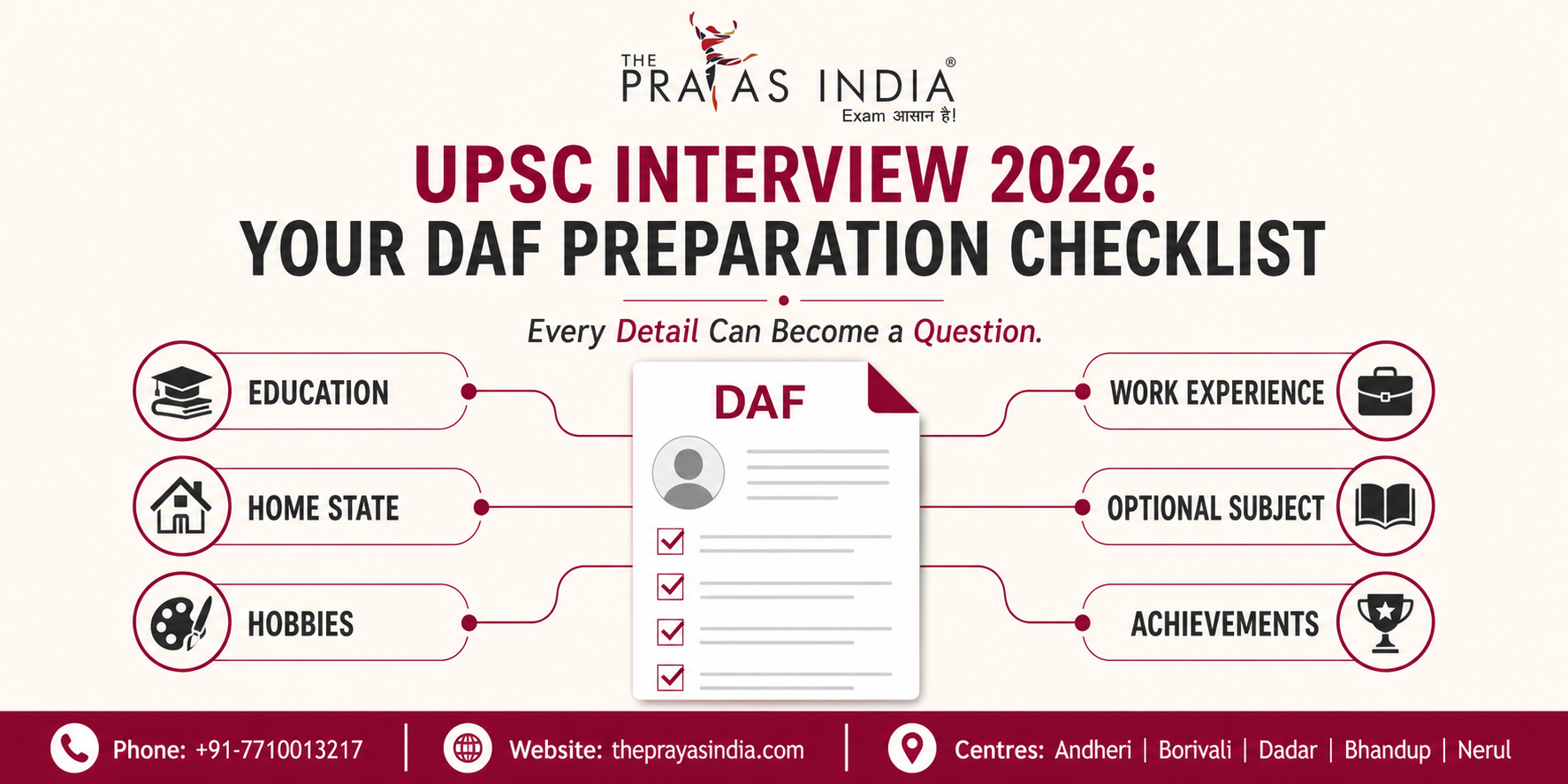
Your preparation should cover areas such as:
- Name and meaning of your name
- Educational qualifications
- Graduation subject
- Postgraduate subject, if applicable
- Work experience
- Job profile
- Home state
- Home district
- Hobbies
- Extracurricular activities
- Achievements
- Optional subject
- Places you have lived
- Service preferences
- Areas of professional or academic interest
For every important detail, ask yourself:
“What could the board ask next?”
Then prepare the underlying concepts rather than memorising one fixed answer.
For example, if your DAF mentions a particular hobby, you should understand why you pursue it, what you have learned from it and what is happening in that field currently.
If your graduation subject is economics, engineering, medicine, law or another discipline, revise the fundamental concepts and think about their application in governance and society.
Step 2: Prepare Your Educational Background
Your graduation subject is one of the most obvious areas from which the board can ask questions.
You do not necessarily need to revise your entire university syllabus. Instead, identify the core concepts that you should be able to explain clearly.
Prepare questions around:
- Why did you choose the subject?
- What did you learn from it?
- What are its practical applications?
- What are the latest developments in the field?
- What challenges does the sector face?
- How is the subject connected with public administration?
- How can the knowledge be useful as a civil servant?
The board may also deliberately ask a simple question. Candidates sometimes overthink such questions because they expect every interview question to be highly complicated.
The best approach is to answer what is actually being asked.
Step 3: Prepare Your Home State and District
Your home state and district can provide a wide range of interview questions.
Prepare both static and contemporary aspects of your region.
Study:
- Geography
- History
- Economy
- Agriculture
- Major industries
- Demographics
- Education
- Healthcare
- Infrastructure
- Urbanisation
- Environment
- Employment
- Tourism
- Important government initiatives
- Major recent developments
More importantly, understand the challenges facing your region.
Think like an administrator.
If your district has water shortages, what are the possible causes? What stakeholders would need to be involved? What short-term and long-term interventions could be considered?
If unemployment is a major concern, what sectors could create sustainable employment? What infrastructure or skill-development limitations exist?
This kind of preparation helps you move from simply knowing facts about your district to understanding its administrative realities.
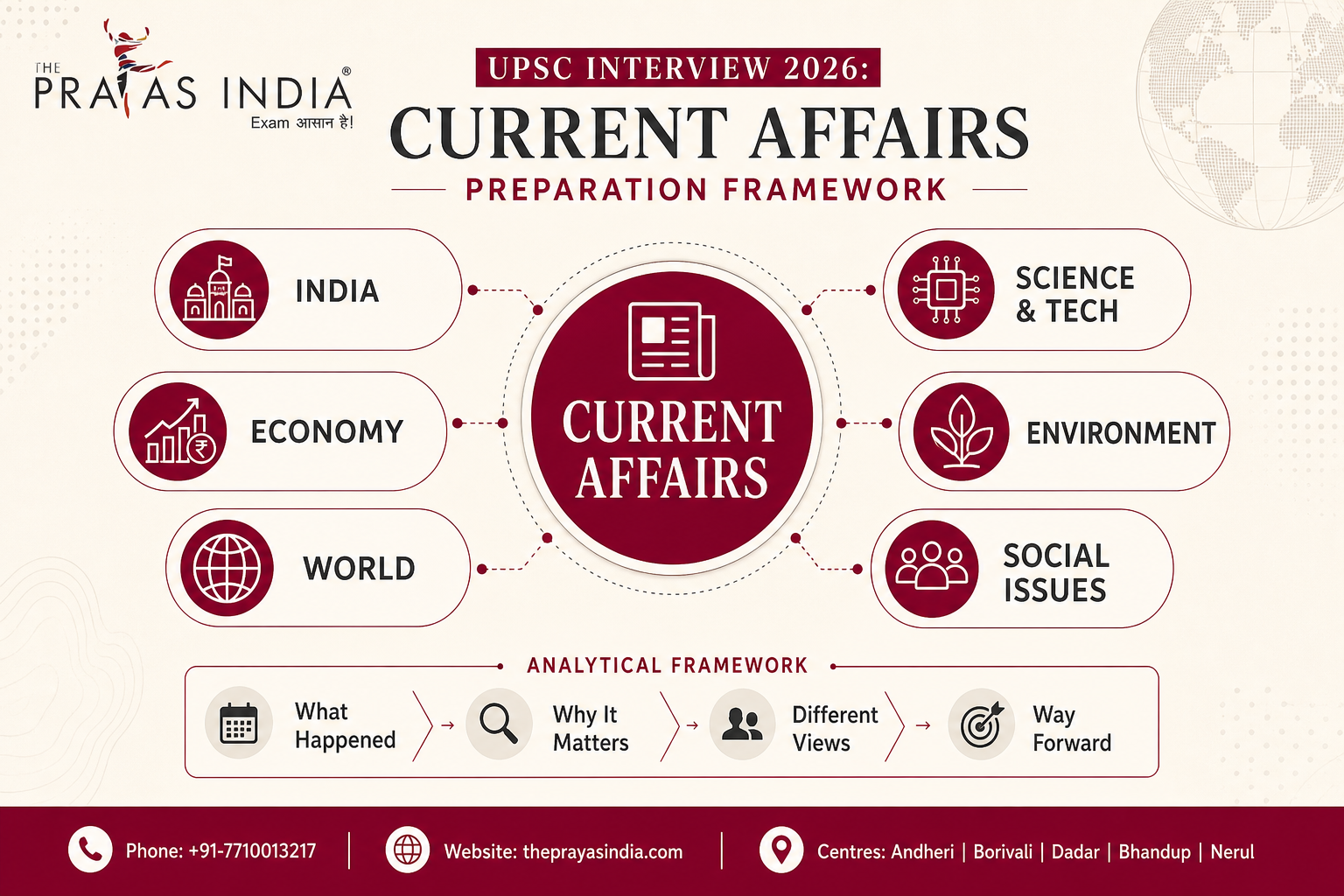
Step 4: Prepare Current Affairs for the Personality Test
Current affairs remain important during the interview, but the preparation method should be different from Prelims-oriented current-affairs revision.
You do not need to memorise every headline.
Instead, identify major issues and understand them from multiple perspectives.
For every important issue, try to answer:
- What happened?
- Why is it important?
- What is the background?
- Who are the stakeholders?
- What are the benefits?
- What are the concerns?
- What has the government done?
- What challenges remain?
- What could be a practical way forward?
This approach becomes especially useful when the board asks:
“What is your opinion on this issue?”
Instead of giving an impulsive response, you can explain the context, acknowledge different perspectives and then present a reasoned view.
Step 5: Learn How to Answer Opinion-Based Questions
Opinion-based questions can make candidates uncomfortable because there may not be one universally accepted answer.
The solution is not to avoid taking a position.
Instead, develop a structured approach.
A useful framework is:
Context → Different Perspectives → Your Reasoned View → Way Forward
For example, if asked about a policy, first establish what the policy aims to achieve. Then consider its potential advantages and concerns. After that, explain your view using logical reasoning and conclude with a practical way forward.
Avoid turning the answer into a political speech or an emotional argument.
The Personality Test is an interaction. The objective is to demonstrate mature thinking rather than to prove that your opinion is the only possible opinion.
Step 6: Develop the Habit of Thinking Before Answering
There is nothing wrong with taking a few seconds before answering a difficult question.
In fact, a short pause can help you organise your thoughts.
Instead of immediately saying whatever comes to mind, use the pause to identify:
- What exactly is being asked?
- Is the question factual or opinion-based?
- What context is required?
- What is the most relevant answer?
If the question is unfamiliar, do not panic.
You can politely say that you are not fully aware of the issue rather than inventing information.
Honesty is preferable to confidently providing incorrect information.
Step 7: Work on Communication and Body Language
Communication during the interview is not limited to vocabulary or fluency.
Pay attention to:
- Sitting posture
- Eye contact
- Facial expressions
- Listening
- Speaking pace
- Voice clarity
- Hand movements
- Ability to remain composed
- Respectful interaction
Candidates should avoid trying to create a completely artificial personality for the interview.
If you normally speak in simple language, continue doing so. The objective is not to sound sophisticated. It is to communicate your thoughts effectively.
Similarly, avoid excessive gestures or rehearsed expressions. Natural communication is generally easier to sustain during a long interaction.
Step 8: Practise Follow-Up Questions
One of the biggest differences between reading interview questions and actually preparing for an interview is the presence of follow-up questions.
Suppose you are asked:
“Why did you choose this hobby?”
Your answer may lead to:
“How much time do you spend on it?”
Then:
“What have you learned from it?”
And possibly:
“How can this experience help you as an administrator?”
Therefore, practice questions in chains rather than preparing isolated answers.
For every important topic, create a primary question and several possible follow-ups.
This will make your preparation much more flexible.
Step 9: Use Mock Interviews as a Learning Tool
Mock interviews are an important part of final-stage preparation because they provide an opportunity to practise the actual interaction.
However, candidates should not judge a mock interview only by the number of questions they answered correctly.
After every mock, analyse:
| Area | What to Evaluate |
|---|---|
| DAF Knowledge | Could I discuss my background confidently? |
| Current Affairs | Could I explain important issues? |
| Answer Structure | Were my responses organised? |
| Communication | Was my language clear? |
| Body Language | Did I remain composed? |
| Follow-Ups | Could I handle unexpected questions? |
| Knowledge Gaps | Which topics need revision? |
| Overthinking | Did I complicate simple questions? |
The purpose of multiple mocks should be improvement.
Taking one mock after another without working on feedback can produce very limited benefit.
What Makes a Good Mock Interview?
A useful mock interview should simulate the pressure and unpredictability of an actual interview while also giving you constructive feedback.
Look for feedback on:
- Content
- DAF preparation
- Communication
- Body language
- Answer structure
- Current affairs
- Personality-related observations
- Areas requiring improvement
The most useful feedback is specific.
Instead of simply being told that your answer was weak, you should understand why it was weak and what you can do differently in the next interaction.
This is where structured interview guidance can help candidates make their practice more purposeful.
How The Prayas India Can Support UPSC Interview Preparation
The final stage of UPSC preparation often requires personalised guidance because every candidate’s DAF and background are different.
The Prayas India can support candidates through a structured interview-preparation approach covering areas such as:
- DAF-based preparation
- Current-affairs discussions
- Interview question practice
- Mock interviews
- Feedback and performance analysis
- Communication improvement
- Personality-oriented preparation
- Guidance for handling opinion-based questions
The objective is not to provide candidates with memorised answers. Instead, structured guidance can help them understand their preparation gaps and develop a more confident, clear and natural approach.
Online and offline preparation options can also make interview guidance accessible to candidates according to their preferred learning format.
The Right Mindset for UPSC Interview 2026
The interview should not be approached as a battle between the candidate and the board.
Think of it as a professional conversation in which you are expected to demonstrate your understanding, awareness, judgement and personality.
Do not try to impress the board with unnecessary complexity.
Instead:
Listen → Think → Structure → Answer → Stop
Answer the question, explain your reasoning and avoid continuing unnecessarily once you have made your point.
This simple discipline can make your responses clearer and more effective.
Part 2 will cover: advanced DAF preparation, current-affairs revision strategy, handling difficult and unexpected questions, common UPSC interview mistakes, mock-interview analysis, last 30-day strategy, last-week preparation, interview-day checklist, FAQs, SEO assets and the feature-image prompt.
Advanced DAF Preparation: Go Beyond the Obvious
Once you have completed the first round of DAF preparation, go one level deeper.
For every important entry in your DAF, create three layers of preparation:
Layer 1 — Basic Information
Know the facts and background.
Layer 2 — Current Developments
Know what is happening recently in that area.
Layer 3 — Personal Connection
Be able to explain why the information is relevant to your own experience.
For example, if your DAF mentions a particular city, do not stop after learning its history. Understand its present economic, social and administrative challenges.
If your DAF mentions a sport, understand both the sport and recent developments around it. If you mention reading as a hobby, be prepared to discuss what you read, why you read it and what you have learned from it.
The goal is to make your DAF preparation conversational rather than mechanical.
Prepare for Questions About Your Strengths and Weaknesses
Questions about personality are common areas of preparation.
You may be asked about:
- Your strengths
- Your weaknesses
- A failure you experienced
- A difficult decision
- A leadership experience
- A mistake you made
- A situation where you changed your opinion
- Why you want to join civil services
- Why you prefer a particular service
Do not prepare exaggerated answers.
If asked about a weakness, avoid giving a disguised strength such as “I work too hard.” Instead, identify a genuine but manageable weakness and explain what you have done to improve it.
Similarly, when discussing an achievement, focus on what you learned rather than simply presenting the achievement as proof of superiority.
How to Answer “Why Civil Services?”
This is one of the questions candidates should prepare thoughtfully because the answer can lead to multiple follow-ups.
Avoid generic statements such as wanting to “serve the nation” without explaining what that means to you.
Think about your own journey.
Consider:
- What motivated you?
- Which experiences influenced your decision?
- What aspects of public administration interest you?
- What role do you believe civil servants play?
- What challenges of public service do you understand?
- What contribution do you hope to make?
Your answer should sound personal and genuine.
There is no requirement to create a dramatic life story.
A simple, honest explanation can be much easier to defend during follow-up questions.
How to Handle Difficult Questions
A difficult question does not necessarily mean you are expected to know everything.
When you know the answer, respond directly.
When you know part of the answer, explain only what you are confident about.
When you do not know, it is acceptable to say so politely.
For example:
“I am sorry, sir/ma’am, I am not aware of the exact information.”
The important thing is to avoid guessing facts merely to avoid admitting that you do not know.
Similarly, if the board challenges your answer, do not become defensive.
Listen to the counter-question and reassess your reasoning.
The interaction itself may be testing how you respond to disagreement.
How to Handle Questions Where You Disagree With the Premise
Sometimes an interview question may contain an assumption that you do not completely agree with.
Instead of immediately rejecting the premise, acknowledge it respectfully.
You can structure your response as:
“There is certainly a concern in that direction. However, I would also consider…”
Then explain the other side.
This allows you to disagree without becoming confrontational.
The same principle applies to controversial issues. Avoid extreme statements when the issue genuinely has multiple dimensions.
How to Handle Rapid-Fire Questions
A board may move quickly from one subject to another.
Do not interpret every change of topic as pressure.
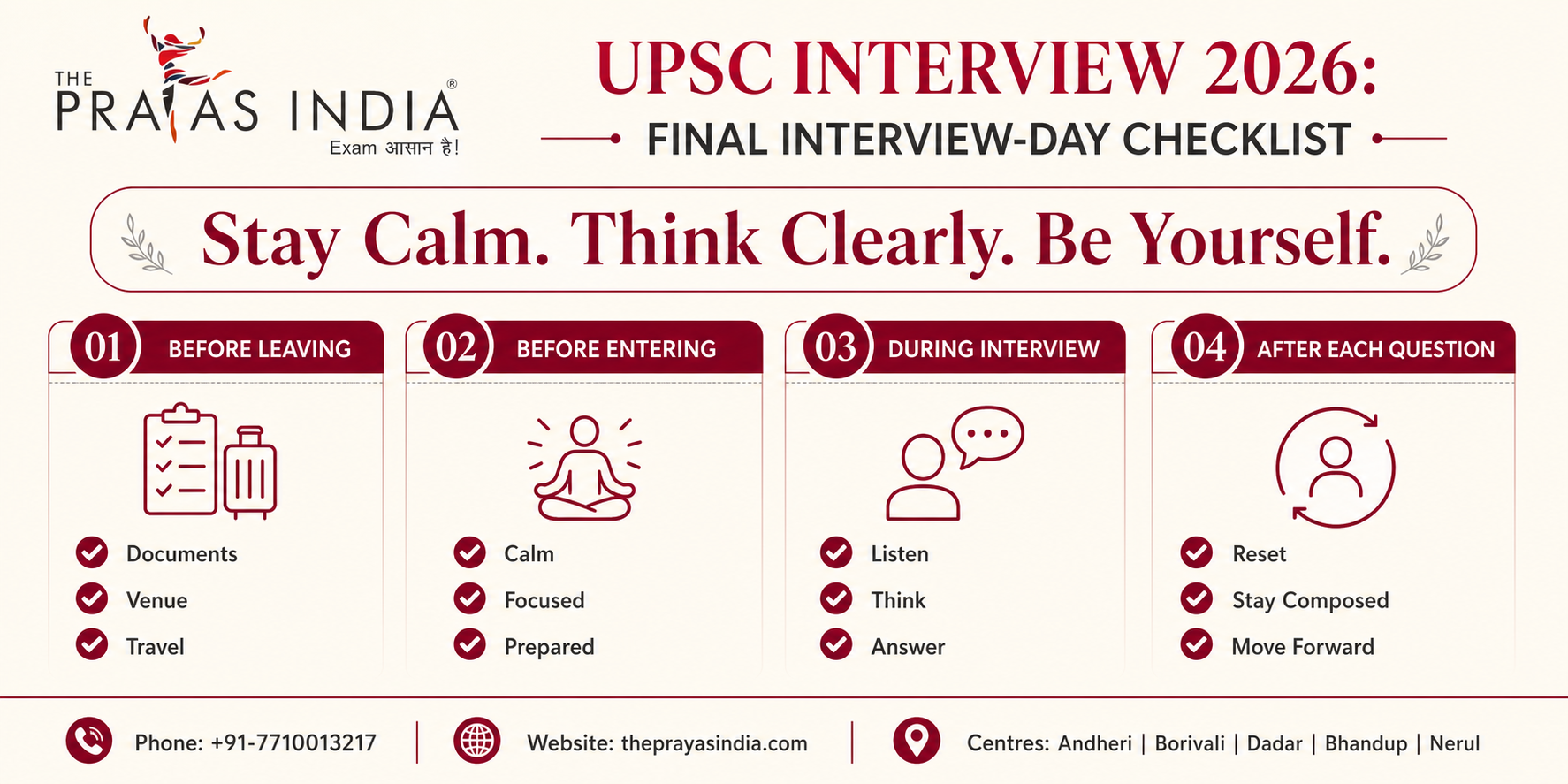
Simply reset mentally after each question.
If one answer was not satisfactory, do not carry that frustration into the next question.
Think of each question as a fresh opportunity to demonstrate your reasoning.
Current Affairs: What Should You Revise Before the Interview?
During the final phase, prioritise important issues rather than attempting to revise everything.
Create broad categories:
National Issues
Governance, economy, social development, education, healthcare, environment and major policy developments.
International Issues
Major geopolitical developments, India’s relations with important countries, international institutions and issues affecting India’s strategic or economic interests.
Economy
Growth, inflation, employment, fiscal policy, monetary policy, banking, taxation and major economic developments.
Science and Technology
Artificial intelligence, space, biotechnology, digital technology, cybersecurity and other major developments.
Environment
Climate change, biodiversity, pollution, renewable energy and environmental governance.
Social Issues
Women, children, education, health, urbanisation, poverty, inequality and social welfare.
Do not turn this into another giant notebook.
The objective is to understand the most relevant issues and discuss them coherently.
How to Analyse Your Mock Interview
After a mock interview, do not immediately move to another mock.
First review your performance.
Create four categories:
1. Knowledge Gaps
Questions where you lacked information.
2. Thinking Gaps
Questions where you knew the topic but struggled to develop an answer.
3. Communication Gaps
Problems with clarity, length, pace or structure.
4. Behavioural Gaps
Issues with confidence, body language, listening or composure.
This classification helps you understand the real problem.
For example, if you repeatedly know the content but give overly long answers, reading more books will not solve the problem. You need communication practice.
If you give good answers on general topics but struggle with your DAF, you need deeper DAF preparation.
Common UPSC Interview Mistakes to Avoid
Memorising Model Answers
Prepared answers can become difficult to defend when the board asks a follow-up question.
Trying to Predict Every Question
It is impossible to predict every question. Prepare themes and concepts instead.
Giving Extremely Long Answers
Once you have answered the question adequately, stop.
Speaking Without Thinking
A short pause is better than an impulsive response.
Guessing Facts
Do not manufacture statistics or information.
Becoming Defensive
A disagreement with the board is not necessarily an attack. Listen and respond calmly.
Ignoring the DAF
The DAF should remain one of the strongest areas of your preparation.
Overloading Yourself With Current Affairs
Quality of understanding matters more than the number of headlines you remember.
Changing Your Personality for the Interview
Do not try to act like someone else. Work on clarity and composure while remaining natural.
How Many Mock Interviews Should You Take?
There is no universal number that guarantees better performance.
The useful number depends on your preparation level and how much improvement you achieve from each mock.
A practical approach is:
Mock → Analyse → Correct → Practise → Mock Again
If a candidate completes several mocks but continues making the same mistakes, taking more mocks without correction may not help much.
On the other hand, targeted mock practice with detailed feedback can help candidates become more comfortable with unpredictable questions and interview pressure.
A Practical 30-Day UPSC Interview Preparation Strategy
If you have approximately one month before your Personality Test, divide your preparation into stages.
Days 1–10: DAF and Foundation
Focus heavily on:
- DAF analysis
- Educational background
- Home state and district
- Optional subject
- Hobbies
- Work experience
- Basic current affairs
Start mock interview practice.
Days 11–20: Advanced Practice
Increase:
- Current-affairs discussions
- Opinion-based questions
- Follow-up question practice
- Communication practice
- Mock interviews
- Feedback implementation
Revise the weak areas identified during mocks.
Days 21–25: Consolidation
Avoid adding large new sources.
Focus on:
- Important current affairs
- DAF revision
- Major national and international issues
- Personal background
- Difficult questions
- Mock feedback
Days 26–30: Final Preparation
Keep preparation light and focused.
Revise your important notes, current affairs and DAF.
Practise speaking naturally.
Avoid exhausting yourself with continuous mock interviews or last-minute information overload.
The Last Week Before the UPSC Interview
The final week should be about consolidation rather than starting completely new preparation.
Review your DAF once again.
Revise important current affairs.
Go through the major issues you have already prepared.
Practise a few realistic interview conversations.
Work on speaking naturally and maintaining composure.
Avoid spending the entire day watching interview videos or collecting lists of “100 most expected questions.”
Such lists can be useful for practice, but they should not replace understanding.
Your preparation should ultimately be based on your DAF + your knowledge + your personality + your ability to think.
What to Do on the Day Before the Interview
The day before the interview is not the time for an intensive study marathon.
Keep your revision limited to essential areas.
Check:
- Interview venue and reporting instructions
- Required documents
- Travel arrangements
- Appropriate formal attire
- Important DAF points
- Basic current affairs
- Personal belongings
Get adequate rest.
A tired candidate may find it harder to listen, think and communicate effectively.
UPSC Interview Day Strategy
Reach the venue with sufficient time.
Maintain a calm mindset while waiting.
When the interview begins:
Listen carefully.
Take a moment when necessary.
Answer the question asked.
Maintain respectful communication.
Do not panic after one difficult question.
Do not allow one weak answer to affect the next one.
Remember that you do not need to answer every question perfectly.
The interview is an overall interaction.
How The Prayas India Can Help You Prepare for the UPSC Interview
UPSC Interview preparation is most effective when it is personalised around the candidate rather than based entirely on generic question lists.
The Prayas India provides structured UPSC interview preparation support that can help candidates work on the key areas required for the Personality Test.
This can include:
- DAF analysis
- Personalised interview preparation
- Current-affairs discussions
- Mock interview sessions
- Feedback and performance analysis
- Question-and-answer practice
- Communication guidance
- Personality-oriented preparation
Candidates can choose from online and offline learning options, depending on their requirements.
For candidates who want guided preparation rather than preparing entirely on their own, a structured interview programme can provide a defined practice environment and expert feedback.
The objective is to help candidates enter the Personality Test with better preparation, greater familiarity with interview situations and a more organised approach to answering questions.
Final UPSC Interview 2026 Checklist
Before appearing for the Personality Test, make sure you have covered:
- Complete DAF analysis
- Educational background
- Home state and district
- Optional subject
- Hobbies and interests
- Work experience
- Important achievements
- Current affairs
- Major national issues
- Important international developments
- Economy
- Science and technology
- Environment
- Social issues
- Opinion-based questions
- Why Civil Services?
- Strengths and weaknesses
- Mock interviews
- Mock feedback
- Communication practice
- Body-language awareness
- Interview-day logistics
Do not aim for perfect preparation. Aim for preparedness, clarity and composure.
Final Takeaway
UPSC Interview 2026 preparation should not be treated as another exercise in memorising facts. The Personality Test requires candidates to bring together their knowledge, experiences, opinions and communication skills in a natural conversation.
Start with your DAF, because it represents your individual profile. Build your preparation around your education, hometown, hobbies, optional subject and experiences. Add current affairs with a focus on understanding rather than memorising. Practise opinion-based questions and follow-ups. Use mock interviews to identify weaknesses, and most importantly, act on the feedback you receive.
The final objective is not to memorise a perfect answer for every possible question. It is to become comfortable with thinking clearly when you do not know exactly what the next question will be.
With structured preparation, regular practice and focused feedback, candidates can approach the UPSC Personality Test with a more organised and confident strategy.
For aspirants looking for guided preparation, The Prayas India offers UPSC interview-focused support through online and offline learning, mock interviews, DAF-oriented preparation and expert guidance.
FAQs on UPSC Interview 2026 Preparation Strategy
1. How should I start preparing for the UPSC Interview 2026?
Start with a detailed analysis of your DAF. Then prepare your educational background, hometown, hobbies, optional subject, work experience and important current affairs.
2. Is the UPSC Interview based on the DAF?
DAF-based questions can form an important part of the interview, but candidates should also prepare current affairs, general issues and questions related to their broader background.
3. How important are current affairs for the UPSC Interview?
Current affairs are important because the board may discuss significant national, international, economic, social, environmental and technological developments. Focus on understanding issues rather than memorising headlines.
4. Should I memorise answers for the UPSC Interview?
No. Memorised answers can become difficult to handle when the board asks follow-up questions. Prepare concepts, themes and your own experiences instead.
5. What should I prepare from my DAF?
Prepare every significant detail, including education, work experience, hometown, hobbies, optional subject, achievements, extracurricular activities and other information mentioned in your form.
6. How many mock interviews should I take?
There is no fixed number. The focus should be on the quality of practice and feedback. A useful cycle is mock interview, analysis, correction and another mock.
7. What if I do not know the answer to an interview question?
Be honest and politely acknowledge that you do not know. Avoid inventing facts or giving an uncertain answer with excessive confidence.
8. How can I improve my communication for the UPSC Interview?
Practise speaking clearly, answering directly, maintaining an appropriate pace and listening carefully. Record practice sessions if possible and review your responses.
9. Should I prepare my home district for the UPSC Interview?
Yes. Understand your district’s history, geography, economy, development challenges, important institutions, government initiatives and recent developments.
10. What should I do in the last week before the UPSC Interview?
Focus on DAF revision, important current affairs, mock feedback and communication practice. Avoid excessive new material and last-minute information overload.
11. Is coaching necessary for the UPSC Interview?
Candidates can prepare independently, but structured guidance and mock interviews can provide additional practice, feedback and personalised preparation.
12. Does The Prayas India provide UPSC Interview preparation?
The Prayas India provides UPSC interview preparation support including DAF-oriented preparation, mock interviews, guidance and online/offline learning options. Candidates can contact the institute for current programme details and batch information.
Ace Your UPSC CSE 2026 Interview with Expert Mentors!
Transform your DAF into a winning tool. Connect with seasoned IAS mentors at The Prayas India for comprehensive DAF analysis, personalized feedback, and rigorous mock interviews to build unbeatable confidence.
Official Website: theprayasindia.com
Visit Our Mumbai Centres: