How to Complete the UPSC Mains Paper on Time? | Best UPSC Coaching in Mumbai | The Prayas India
UPSC Mains is not only a test of what you know. It is also a test of how effectively you can convert your knowledge into complete, well-structured answers within a fixed amount of time. Many aspirants prepare extensively, understand the syllabus and even write good answers during practice, but struggle to complete the paper in the examination hall.
The problem is often not a lack of knowledge. It can come from spending too much time on individual questions, writing excessively detailed introductions, over-explaining familiar topics, or failing to maintain a consistent writing speed throughout the paper. Since every minute matters in a three-hour UPSC Mains paper, even small delays can accumulate and leave several questions incomplete.
For serious UPSC aspirants, therefore, answer-writing speed and paper completion should be treated as separate preparation goals. Writing faster does not mean writing carelessly. The objective is to develop the ability to read the question, identify its demand, structure the answer and present relevant points within an appropriate word limit.
Why Completing the UPSC Mains Paper Becomes Difficult
The pressure of the UPSC Mains examination is different from ordinary written examinations. Candidates have to answer a large number of questions within a limited time while maintaining relevance, structure, clarity and presentation.
A candidate may know the answer to almost every question but still struggle to finish the paper because each answer takes slightly longer than planned. Spending an additional two or three minutes on several questions can eventually create a significant shortage of time toward the end.
Another challenge is that UPSC questions often require candidates to address multiple dimensions. A question may ask you to analyse an issue, discuss its implications and suggest a way forward. If you start writing without identifying these requirements, you may spend too much space on one dimension and then rush through the remaining parts.
This is why paper completion begins before you enter the examination hall. Your answer-writing practice should train you not only to produce quality content but also to make decisions about time, depth and presentation.
Understand the Time Available Before Planning Your Answers
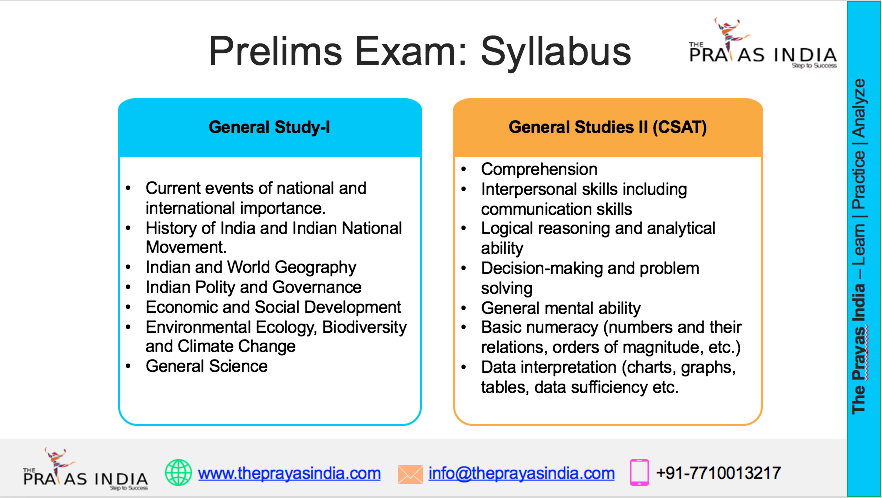
Before developing a strategy for completing the UPSC Mains paper, understand the basic time constraint. A typical General Studies paper has 20 questions to be attempted in three hours, with questions carrying different marks and word limits.
This means you cannot treat every question as an opportunity to write everything you know. The answer must be proportionate to the marks and the demand of the question.
A 10-marker and a 15-marker should not consume the same amount of time. Similarly, a straightforward question should not take as long as a question requiring multiple dimensions and deeper analysis.
A practical approach is to create an approximate time budget before the examination. This does not mean constantly looking at the clock after every answer. Instead, you should have a broad sense of where you should be at different stages of the paper.
For example, you can divide the paper into manageable blocks and establish checkpoints. If you realise during practice that you consistently fall behind at a particular stage, you can modify your strategy before the actual examination.
What Actually Determines Your Writing Speed?
Writing speed in UPSC Mains is influenced by more than handwriting. It depends on the entire process that happens between reading the question and finishing the answer.
The major factors include:
- Question interpretation: How quickly you understand what the examiner is actually asking.
- Answer planning: How efficiently you identify the introduction, core arguments, examples and conclusion.
- Content retrieval: How quickly you can recall relevant concepts, facts, examples and current affairs.
- Structure: Whether you can organise information without repeatedly rewriting or changing your approach.
- Handwriting: Whether your writing is readable while being produced at a sustainable speed.
- Decision-making: Whether you can move forward when a question is consuming disproportionate time.
- Practice: Whether your brain is accustomed to producing complete answers under examination conditions.
This explains why simply trying to “write faster” often does not solve the problem. If your planning takes too long, increasing handwriting speed alone will not help much. Similarly, if you spend excessive time deciding how to structure every answer, you need to improve your answer-planning process.
Read the Question With the Demand in Mind
One of the most important skills for completing UPSC Mains on time is learning to identify the demand of a question quickly.
Words such as analyse, examine, discuss, critically examine, evaluate, comment, substantiate and elucidate indicate different expectations. The directive tells you something about how the answer should be approached.
For example, an “analyse” question generally requires you to break an issue into different components and establish relationships between them. A “critically examine” question requires a balanced assessment rather than a one-sided explanation. An “evaluate” question requires judgement supported by arguments and evidence.
If you misunderstand the directive, you may write a lengthy answer that does not adequately address the question. This wastes time while also affecting the quality of the response.
During practice, therefore, spend time identifying the directive and the keywords before writing. As this becomes habitual, the process becomes much faster.
Do Not Spend Too Much Time Planning the Answer
Planning is necessary, but over-planning can become another source of delay. Some aspirants spend several minutes mentally constructing the perfect answer before writing the first sentence.
UPSC Mains does not require you to know every point before you begin writing. You need a clear structure and enough relevant content to address the question effectively.
Before starting an answer, identify the basic framework:
What is the question asking? What are the major dimensions? What examples or evidence can support the arguments? What should the conclusion establish?
Once these elements are reasonably clear, begin writing.
With practice, you should be able to create this mental framework within a short period. The goal is not to eliminate planning but to make planning quick, purposeful and repeatable.
Match the Length of Your Answer With the Marks
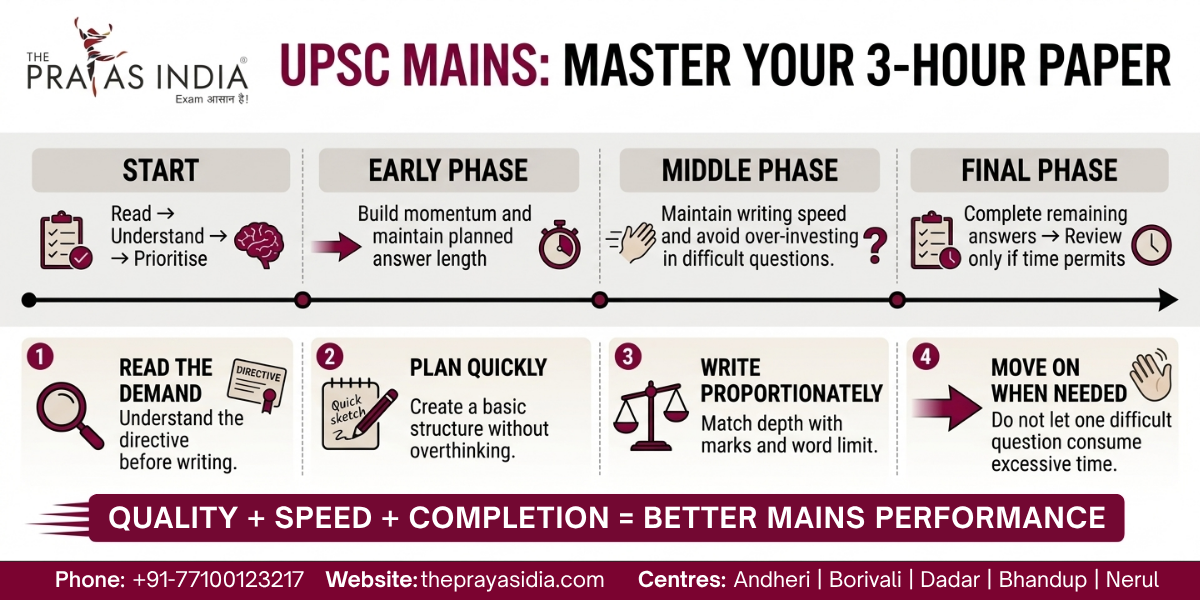
A common reason candidates run out of time is that they do not differentiate enough between 10-marker and 15-marker answers.
A 15-marker generally provides more room for dimensions, examples, analysis and a nuanced conclusion than a 10-marker. However, this does not mean that every 15-marker needs to become a mini-essay.
The answer should remain proportionate to the question’s demand. If the question is relatively direct, a concise structure with relevant arguments may be sufficient. If the question contains multiple dimensions, your answer should address each important dimension without allowing one part to dominate unnecessarily.
During practice, get comfortable writing answers within the expected word limits. This creates a natural sense of how much content is appropriate for different marks.
The more familiar you become with answer length, the less likely you are to spend excessive time on questions early in the paper.
Develop a Repeatable Answer Structure
A repeatable structure can significantly reduce the mental effort required during the examination. You should not use the exact same template mechanically for every question, but having a flexible framework helps you begin writing quickly.
For many GS answers, a simple structure can involve an introduction, a body divided into relevant dimensions and a conclusion. The body can then use headings, subheadings, bullet points, examples, constitutional provisions, committee recommendations, case studies, government initiatives or relevant data wherever appropriate.
The exact structure should depend on the question. A comparison question may require two-sided presentation, while a cause-and-effect question may benefit from separate sections for causes, consequences and solutions.
The purpose of a flexible framework is to reduce the amount of time spent deciding how to organise your thoughts.
Use Headings and Subheadings to Improve Organisation
Headings are not simply a presentation technique. They can help you organise your thinking while writing under time pressure.
Suppose a question asks about the impact of a particular issue on India’s economy, society and governance. Instead of writing a continuous block of information, you can organise the body around these dimensions.
This makes it easier to ensure that you have addressed all major parts of the question. It also reduces the possibility of repeating the same argument in different forms.
However, headings should be meaningful. Avoid using generic labels repeatedly when more specific headings can communicate the argument more clearly.
Bullet Points Can Help You Save Time Without Reducing Quality
Bullet points are useful when a question requires several arguments, causes, challenges, impacts or recommendations. They allow you to present information clearly without spending unnecessary time constructing long paragraphs.
This does not mean that every UPSC answer should consist entirely of bullet points. Paragraphs can be useful for introductions, explanations and analytical sections, while bullet points can make multiple arguments easier to present.
A balanced answer often combines short paragraphs with structured points, examples and a concise conclusion.
The objective is to make the answer easy to read and quick to evaluate while ensuring that the substance remains strong.
Practise Writing Under Actual Time Pressure
One of the biggest differences between ordinary answer writing and UPSC Mains preparation is the presence of time pressure.
If you always write answers without a timer, you may develop a false sense of confidence. You may produce excellent answers but take significantly longer than the examination allows.
Timed practice should therefore become a regular part of your preparation. Start with individual answers and gradually move towards multiple questions. Eventually, practise complete papers under examination-like conditions.
During these sessions, do not stop the timer to search for information or rewrite an answer. The objective is to simulate the constraints you will experience in the actual examination.
After the exercise, analyse not only the quality of your answers but also where your time went.
Track Where You Lose Time
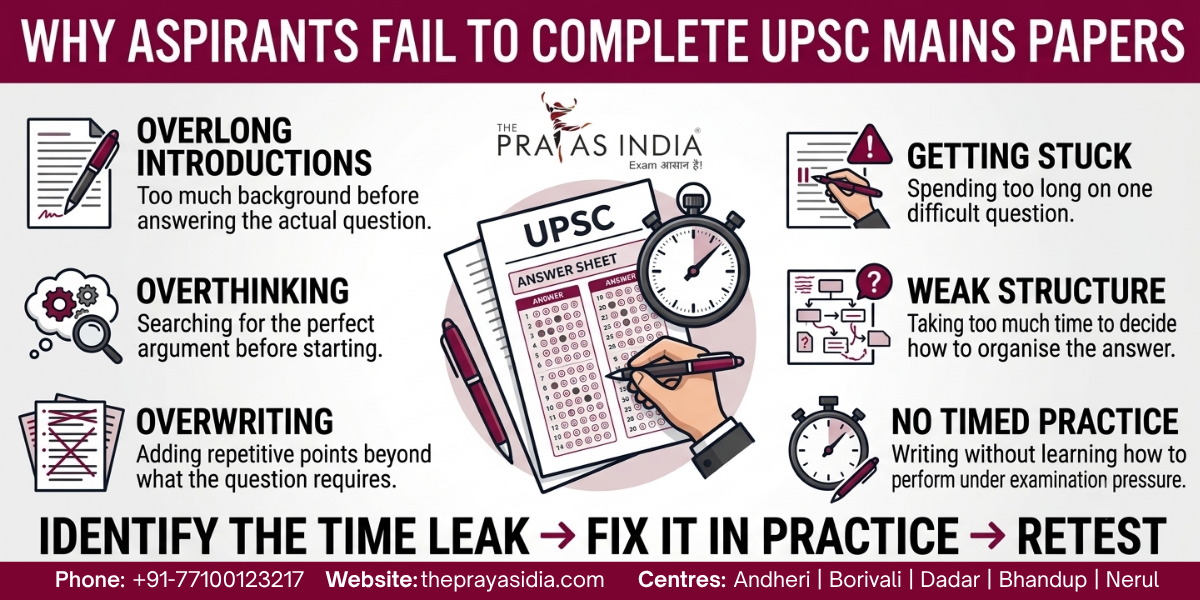
If you repeatedly fail to complete the paper, simply writing more papers may not solve the issue. You need to identify the specific reason for the delay.
For example, you may discover that your introductions take too long. Another candidate may spend excessive time thinking of examples. Someone else may write very long conclusions or repeatedly rewrite sentences.
Keep a simple record after each timed practice session. Note the questions that took unusually long and identify what caused the delay.
Once you know the pattern, you can work on it directly. This turns time management from a vague concern into a measurable preparation problem.
Your Handwriting Should Be Fast but Readable
Handwriting can influence paper completion, but the goal should not be maximum speed at the cost of readability.
If you write extremely fast and your answer becomes difficult to read, you may undermine the benefit of completing the paper. On the other hand, writing very slowly in an attempt to maintain perfect handwriting can leave questions incomplete.
Practise finding a comfortable middle ground. Your handwriting should be clear enough for the evaluator to read without difficulty while allowing you to maintain a sustainable pace for the entire paper.
Do not suddenly try to change your handwriting style immediately before the examination. Develop a comfortable writing pattern during regular answer-writing practice.
Build Stamina, Not Just Speed
Completing a UPSC Mains paper requires sustained writing for several hours. A candidate may write quickly for the first hour but slow down considerably later because of physical fatigue or reduced concentration.
This is why your practice should gradually include longer writing sessions. Start with individual answers, then practise several answers together and eventually complete full-length papers.
Pay attention to how your writing speed changes throughout the session. If the first few answers are significantly longer and the final answers become rushed, your problem may be pacing rather than basic writing speed.
The objective is to develop a stable writing rhythm that you can maintain from the beginning to the end of the examination.
How The Prayas India Can Support UPSC Mains Preparation
UPSC Mains preparation requires more than collecting study material. Aspirants need regular answer-writing practice, feedback, revision and a clear understanding of how to manage time under examination conditions.
For candidates looking for UPSC Coaching in Mumbai, The Prayas India provides structured preparation support designed to help aspirants work on both knowledge and examination skills. Regular practice and guidance can help candidates identify weaknesses in answer structure, content relevance, presentation and time management.
The Prayas India has centres across Andheri, Borivali, Dadar, Bhandup and Nerul, providing aspirants in Mumbai with access to structured UPSC preparation.
For admission-related information, candidates can contact +91-77100 13217.
Create a Time Budget Before You Enter the Examination Hall
A three-hour paper can feel lengthy when you look at the clock at the beginning, but it becomes surprisingly short once you start writing. The safest approach is to enter the examination hall with a broad time budget already tested during your mock-answer-writing sessions.
Do not think of the three hours as one continuous block. Divide it mentally into smaller stages and establish checkpoints. Your objective should be to maintain a steady pace rather than writing extremely fast during the first hour and then struggling toward the end.
The exact allocation can vary according to your writing speed and paper strategy. What matters is that you know approximately how much time you can afford for a 10-marker, how much additional time a 15-marker deserves and when you need to move forward.
A practical rule is to protect the time required for the later questions. If you spend too much of the paper’s early time trying to perfect a few answers, you may eventually be forced to compromise on several questions.
How to Handle 10-Marker and 15-Marker Questions
The difference in marks should influence the amount of time and content you devote to an answer.
A 10-marker generally requires a concise response that addresses the core demand of the question. A 15-marker gives you more room to develop multiple dimensions, provide examples and demonstrate deeper analysis. But the additional marks should not become an excuse to write an unnecessarily long answer.
Before beginning, quickly identify the scope of the question. If the demand can be adequately addressed through an introduction, a few well-developed dimensions and a concise conclusion, there is no advantage in continuing to add repetitive points simply because you have more space.
Your practice should help you develop an instinct for answer length. After writing dozens of timed answers, you should be able to estimate the appropriate amount of content without constantly counting every word.
Do Not Let One Difficult Question Break Your Schedule
One of the most damaging mistakes in a Mains paper is becoming emotionally attached to a difficult question.
You may recognise the topic but struggle to recall the exact information you want. You may have a vague understanding but cannot immediately construct the argument. In such situations, many candidates keep thinking about the question because they believe that the answer is somewhere in their memory.
This can consume several minutes without producing meaningful content.
If you have understood the demand but cannot immediately develop the answer, use the knowledge you do have, create a logical structure and move forward. If the question is genuinely blocking your progress, mark it mentally and return to it later if your strategy allows.
The important principle is that one difficult question should not reduce the quality of five easier answers.
What to Do When You Get Stuck on an Answer
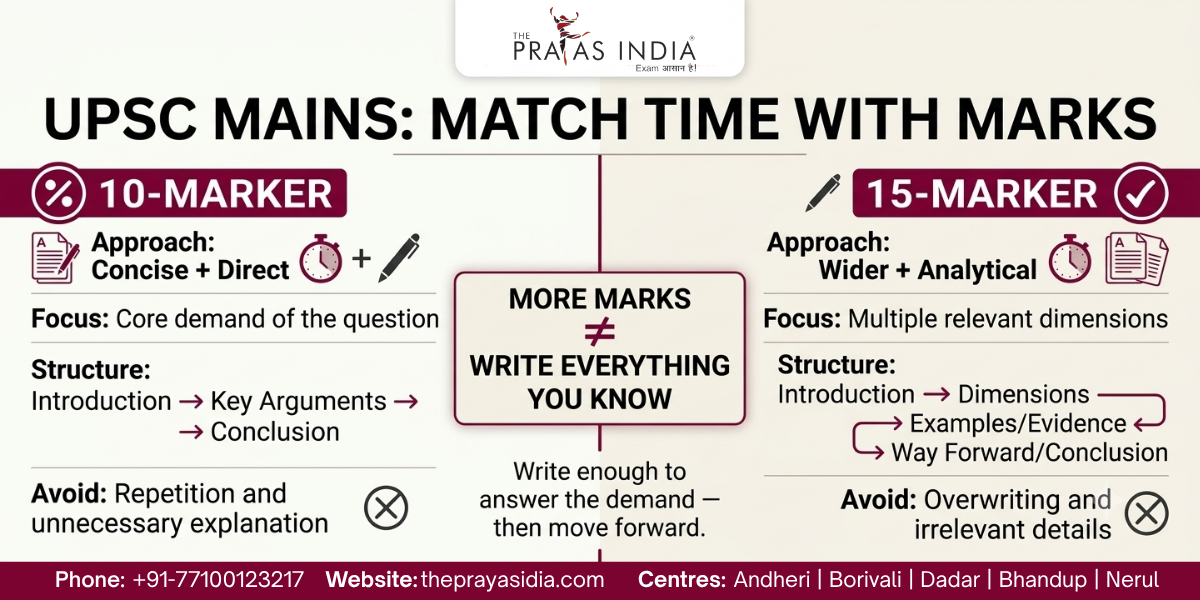
Getting stuck does not necessarily mean you do not know the topic. Sometimes the issue is that you are searching for the perfect argument, statistic or example before starting.
Instead, begin with what you know confidently. Define the issue briefly, identify the relevant dimensions and build the argument logically. You can add an example or current-affairs reference later if it genuinely strengthens the answer.
A structured answer with relevant general knowledge is usually better than an incomplete answer that was delayed because you were trying to recall one specific fact.
This approach is particularly useful when the question is unconventional. UPSC may frame familiar themes in unfamiliar ways, so your ability to reason from fundamental concepts becomes important.
Use the Final Part of the Paper Carefully
The final portion of the examination can become extremely stressful if you have fallen behind. This is why you should monitor your progress throughout the paper rather than discovering the shortage of time near the end.
If you realise that you are slightly behind your planned pace, do not panic. Look for opportunities to recover time without compromising answer quality. You can reduce unnecessary elaboration, avoid lengthy introductions and move more quickly through straightforward questions.
However, do not suddenly start writing extremely short answers. The objective is to recover time through efficiency, not through careless reduction in content.
The last phase should ideally be used to complete remaining answers rather than making extensive changes to answers that are already adequate.
The Last 30–40 Minutes Require Discipline
Candidates often experience a psychological shift when they see that a significant portion of the paper remains. This can lead to rushed handwriting, poor structure and incomplete conclusions.
The better approach is to maintain the same basic answer framework even when time is reducing. A short but properly structured answer is preferable to a long, unfinished response.
If you have several questions remaining, identify what each question demands and move through them systematically. Avoid spending disproportionate time on the first question simply because you want to produce a perfect answer.
The examination rewards the marks earned across the paper. Therefore, paper completion should remain a priority throughout the final stage.
Practise Full-Length Papers Before the Actual Examination
Individual answer writing improves your ability to construct responses, but full-length paper practice develops a different skill: sustaining your performance for the entire examination duration.
When practising a complete paper, recreate the examination environment as closely as possible. Use the same duration, attempt the required number of questions and avoid unnecessary interruptions.
After completing the paper, evaluate three things separately:
Content: Did you address the demand correctly?
Presentation: Was the answer structured and readable?
Time: Did you spend an appropriate amount of time on each answer?
A candidate can score well in the first two areas but still struggle if the third is ignored.
How to Build Speed Without Destroying Answer Quality
Speed should not be developed by simply forcing yourself to write faster. That approach can lead to poor handwriting, incomplete arguments and increased mistakes.
Instead, improve the processes surrounding writing.
Read questions faster by practising question interpretation. Plan answers more efficiently by using repeatable structures. Improve content recall through regular revision. Use headings and bullet points where appropriate. Reduce unnecessary introductions and repetitive conclusions.
Over time, these small improvements can save several minutes across an entire paper.
For example, if you save even a small amount of time on each answer, the cumulative benefit can become substantial by the end of the paper. This is why efficient answer construction is often more valuable than simply trying to increase handwriting speed.
Build an Error Log for Time Management
Most candidates maintain notes for academic mistakes but do not maintain a record of time-management mistakes. This is a missed opportunity.
After each full-length answer-writing session, note down where you lost time. You may discover recurring patterns such as:
- Spending too much time on introductions.
- Writing excessive background information.
- Searching too long for examples.
- Repeating similar arguments.
- Overthinking the conclusion.
- Spending too much time on one difficult question.
- Writing considerably more than required.
- Slowing down significantly in the second half of the paper.
Once these patterns are visible, you can specifically work on them in subsequent practice sessions.
How Answer-Writing Feedback Improves Time Management
It is difficult to identify every weakness in your own answer. You may feel that an introduction is concise when it actually consumes too much space, or you may believe that a particular argument is essential when it contributes very little to the answer.
Regular feedback can help identify these patterns.
When an experienced evaluator reviews your answer, the feedback should ideally cover more than content accuracy. It should also address relevance, structure, presentation, depth and time efficiency.
This is where a structured UPSC preparation environment can become useful. Consistent answer writing combined with evaluation allows you to make gradual improvements rather than waiting until the final weeks before the examination.
Why UPSC Mains Preparation Should Include Time Management From the Beginning
Time management should not be treated as a final-stage problem. If you start practising complete answers only shortly before Mains, you may find that your writing speed and answer structure are not yet stable.
Begin with individual timed answers. Once you are comfortable, move to a small group of questions. Gradually increase the duration until you can complete full-length papers.
This progression allows your speed to improve naturally while preserving answer quality.
The same principle applies to optional papers and Essay preparation. Although the nature of the writing differs, the ability to plan, prioritise and maintain a consistent pace remains important.
A Sustainable UPSC Mains Strategy
Completing the paper is not about racing against the clock from the first minute. It is about creating a controlled rhythm.
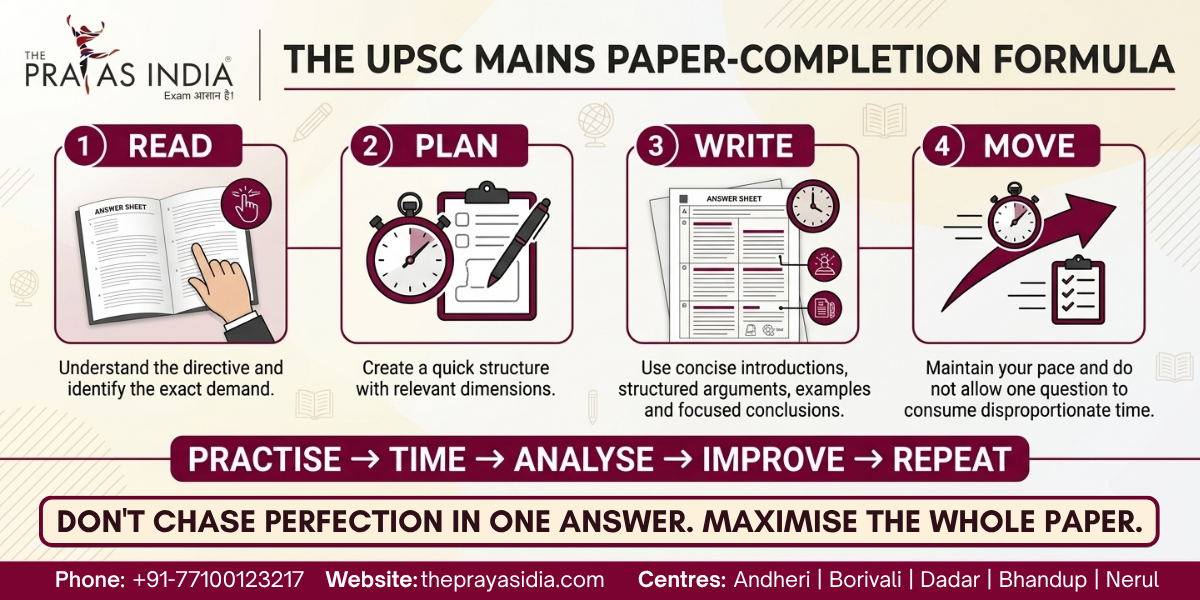
Read the question carefully. Identify its demand. Plan briefly. Start writing. Present relevant arguments in a structured manner. Add examples or evidence where they genuinely strengthen the answer. Conclude without unnecessary repetition. Then move to the next question.
Repeat this process consistently.
The more familiar this cycle becomes during practice, the less mental energy you need to spend deciding what to do next in the examination hall.
How The Prayas India Can Help You Prepare for UPSC Mains
For aspirants preparing for the Civil Services Examination, Mains preparation requires a combination of conceptual clarity, current-affairs integration, answer writing and examination strategy. The UPSC’s official website currently lists the Civil Services (Main) Examination 2026 among its active examinations, making structured preparation particularly relevant for candidates progressing towards the Mains stage.
For students seeking UPSC Coaching in Mumbai, The Prayas India provides structured preparation support with a focus on developing both knowledge and examination skills. Regular practice, evaluation and guidance can help aspirants work on answer structure, relevance, presentation and time management.
The Prayas India has centres at Andheri, Borivali, Dadar, Bhandup and Nerul.
For admission-related information, contact +91-77100 13217.
Final Takeaway
Completing the UPSC Mains paper on time is a skill that can be developed through deliberate practice. It requires more than increasing handwriting speed. You need to improve question interpretation, answer planning, content recall, structure, pacing and decision-making.
The most important change is to stop treating incomplete papers as simply a “speed problem.” Analyse exactly where your time is going and address that specific weakness.
Your preparation should gradually move through a cycle of timed answer writing, feedback, error identification, targeted practice and full-length papers. With enough repetition, you can develop a writing rhythm that allows you to maintain quality without spending excessive time on individual questions.
The goal in UPSC Mains is not to write the longest answer or the most elaborate answer. It is to address the demand of every question, present relevant content clearly and use the available time intelligently.
That balance between knowledge, structure, speed and completion can make your Mains preparation significantly more effective.
Contact Us
📞 Call Now: +91-77100 13217
🌐 Website: theprayasindia.com
📍 Centres: Andheri | Borivali | Dadar | Nerul | Bhandup
FAQs
1. How can I complete the UPSC Mains paper on time?
Practise timed answer writing, create a realistic time budget, avoid spending too long on individual questions and learn to structure answers quickly. Full-length paper practice is particularly important for developing consistent pacing.
2. How much time should I spend on each UPSC Mains answer?
The exact time depends on the paper and your writing speed, but your allocation should broadly reflect the marks and word limit of the question. Practise enough timed answers to develop a natural sense of appropriate answer length.
3. Why do I know the answers but still fail to complete the paper?
This usually indicates an execution problem rather than simply a knowledge gap. Overlong answers, slow planning, excessive introductions, poor question selection or insufficient timed practice can all contribute to incomplete papers.
4. Should I write answers in paragraphs or bullet points?
Both formats can be useful. Use paragraphs where explanation or analysis is required and bullet points or subheadings where they help present multiple dimensions clearly. The priority should be relevance, structure and readability.
5. How can I improve my UPSC Mains writing speed?
Improve the entire answer-writing process rather than only trying to write faster. Practise question interpretation, quick planning, structured writing and timed answers while maintaining readable handwriting.
6. Is full-length UPSC Mains paper practice necessary?
Yes. Individual answer practice develops answer-writing skills, while full-length papers help develop stamina, pacing and the ability to manage time across the entire examination.