How to Crack the UPSC Interview | Best UPSC Coaching in Mumbai | The Prayas India
Clearing the UPSC Civil Services Mains Examination is a major milestone, but it is not the end of the selection process. The UPSC Personality Test, commonly referred to as the UPSC Interview, is the final stage through which candidates are assessed for their suitability for a career in the civil services. At this stage, preparation is no longer limited to remembering facts or solving questions. The focus shifts towards personality, judgement, awareness, communication, balance of thought, confidence and the ability to respond intelligently to unfamiliar situations.
For many aspirants, this transition can be challenging. Someone who has spent months or even years preparing for Prelims and Mains is accustomed to structured questions, written answers and clearly defined syllabi. The interview environment is different. Questions can move from your Detailed Application Form (DAF) to current affairs, your educational background, hometown, hobbies, optional subject, work experience, social issues or even a seemingly simple personal question. The board is interested not only in what you know, but also in how you think and communicate what you know.
This makes strategic preparation particularly important after Mains. A candidate does not need to become someone else for the interview. Instead, the objective should be to understand one’s own profile thoroughly, strengthen areas of knowledge, develop balanced opinions and become comfortable discussing a wide range of issues. For aspirants looking for UPSC Interview preparation in Mumbai, a structured programme with DAF analysis, current-affairs discussions, mock interviews and personalised feedback can make this preparation more focused and systematic.
Understanding the UPSC Interview: It Is a Personality Test, Not a Quiz
One of the biggest mistakes candidates make is treating the UPSC Interview as another examination based primarily on factual knowledge. The Personality Test is designed differently. The board may certainly ask questions that require knowledge, but the broader assessment concerns qualities relevant to public service, including clarity of thought, intellectual curiosity, social awareness, integrity, judgement, communication and the ability to remain composed under pressure.
This distinction should influence the entire preparation strategy. Memorising hundreds of possible questions and rehearsing model answers may provide temporary confidence, but it cannot prepare an aspirant for the unpredictable nature of an actual board interaction. A better approach is to develop the ability to understand a question, identify what is being asked, organise your thoughts and present a balanced response.
The interview can also test how a candidate reacts when they do not know an answer. Saying that you do not know something is not necessarily a weakness. Attempting to fabricate an answer, becoming argumentative or losing composure can create a much more negative impression. A mature candidate should be able to acknowledge a gap in knowledge gracefully and move forward.
This is why UPSC Interview preparation should be viewed as a process of refinement rather than a process of memorisation. The goal is to make your knowledge usable in a conversational setting and your personality visible without becoming artificial.
Know Your DAF Better Than Anyone Else
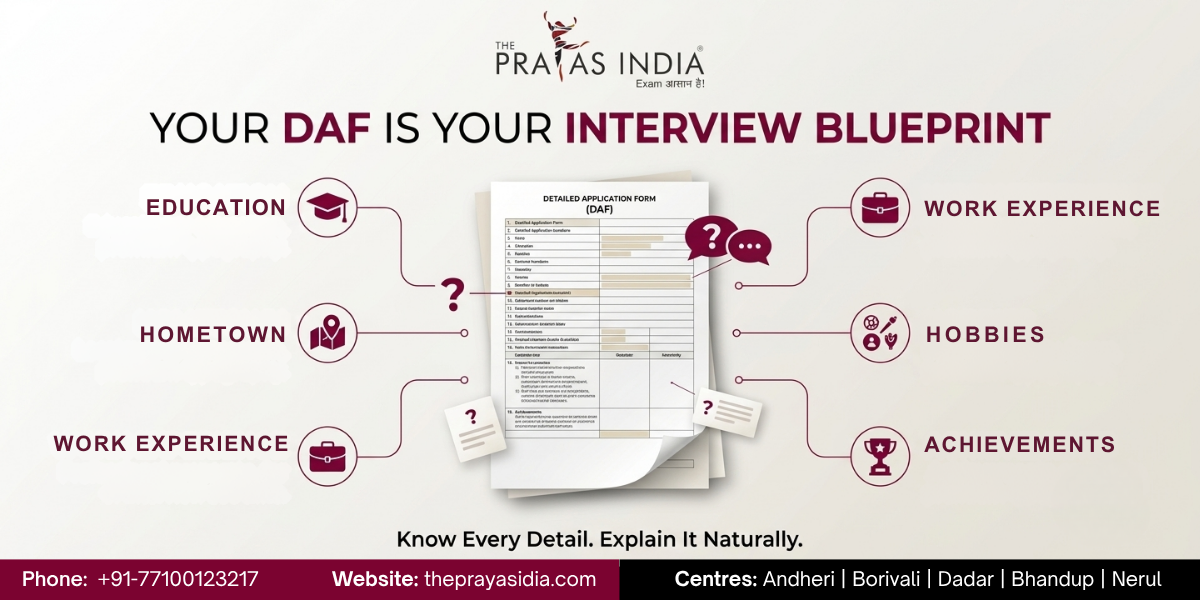
The Detailed Application Form is one of the most important starting points for interview preparation. Everything you mention in the DAF can potentially become an area of discussion. Your educational qualification, place of birth, hometown, employment history, hobbies, achievements, extracurricular activities, optional subject and other personal details can all provide possible questions for the board.
A candidate should therefore conduct a detailed DAF analysis soon after clearing Mains. Instead of merely reading the information written in the form, examine every entry from the perspective of an interview panel. Ask yourself what questions could logically arise from each detail.
For example, if you have mentioned a particular hobby, you should know its basic history, current relevance and important developments associated with it. If your graduation subject is Economics, questions may connect economic concepts with contemporary Indian policy. If you belong to a particular district, you should understand its economy, geography, administration, major challenges and important developments. If you have work experience, be prepared to explain your responsibilities, lessons learned and reasons for moving towards civil services.
The important point is that DAF preparation should not become an exercise in memorising artificial answers. The information should become familiar enough that you can discuss it naturally. The board may ask the exact question you expected, but it may also approach the same topic from an entirely different direction.
DAF Preparation Checklist
A systematic DAF analysis should cover:
- Educational background and graduation subject
- Schooling and academic achievements
- Hometown, district and state
- Current and previous work experience
- Hobbies and interests
- Extracurricular activities
- Optional subject
- Achievements and awards
- Service preferences, wherever relevant
- Significant personal or professional experiences
- Any unusual or distinctive information mentioned in the form
A strong DAF analysis should also identify connections between different parts of your profile. These connections often create more meaningful interview questions than isolated facts.
Build a Strong Current Affairs Foundation
Current affairs remain important during UPSC Interview preparation, but the approach needs to change after Mains. Candidates often make the mistake of trying to consume every possible piece of news from every source. This creates information overload without necessarily improving their ability to discuss issues.
For the Personality Test, the focus should be on understanding significant developments and being able to discuss them from multiple perspectives. Instead of asking only “What happened?”, consider questions such as “Why did it happen?”, “What are its implications?”, “Who are the stakeholders?”, “What are the arguments on both sides?”, “What could be a practical solution?” and “What should an administrator consider while addressing the issue?”
This approach transforms current affairs from a collection of facts into usable knowledge. Issues related to the Indian economy, governance, international relations, technology, environment, social development, internal security and public policy should be studied with an emphasis on causes, consequences and possible solutions.
The candidate should also develop the habit of distinguishing between a personal opinion and an informed administrative perspective. In an interview, having an opinion is useful, but it should be supported by reasoning. At the same time, complex policy issues rarely have completely one-sided answers. Demonstrating the ability to recognise competing considerations can make a response more mature.
Develop Balanced Opinions on Important Issues
The UPSC Interview does not require candidates to have a predetermined opinion on every issue. Instead, aspirants should become comfortable examining an issue from different perspectives.
Suppose the board asks about a controversial government policy. A weak approach would be to immediately label the policy as completely good or completely bad. A stronger response could acknowledge its intended objective, identify potential benefits, recognise implementation challenges and then suggest practical improvements.
This does not mean every answer needs to become excessively diplomatic. Candidates should be able to express a clear position when appropriate. However, the position should emerge from logical reasoning rather than emotion or political rhetoric.
A useful preparation technique is to select major issues from the news and practise discussing each one using a simple framework: background → stakeholders → benefits → concerns → constitutional or administrative perspective → practical way forward. This gives structure to thinking without forcing candidates to memorise fixed answers.
Improve Communication Without Sounding Rehearsed
Communication is one of the most visible components of an interview. However, effective communication is not the same as speaking continuously or using complicated vocabulary. A strong candidate should be able to understand the question, answer it directly and explain the reasoning clearly.
Many aspirants focus heavily on improving spoken English before the interview. Language proficiency can certainly help, but the objective should not be to imitate a particular accent or use unnecessarily sophisticated words. Clarity, confidence and natural expression are much more important.
If the board asks a straightforward question, the response should not become unnecessarily long. Similarly, a complex question may require a structured explanation. Candidates should learn to judge the depth required based on the question.
Practising answers aloud is particularly useful. It allows you to identify repetitive phrases, unnecessary pauses, overly long explanations and unclear reasoning. Recording practice sessions and reviewing them can also reveal habits that may not be noticeable during silent preparation.
Learn to Listen Before You Answer
Good interview performance begins with listening. Candidates sometimes become so focused on delivering prepared responses that they start answering a question they expected rather than the question actually asked.
The board may deliberately reframe a question or ask a follow-up based on something you just said. Therefore, listening carefully is essential. Take a brief moment to understand the question before responding. If the question is unclear, it is perfectly reasonable to request clarification politely.
This becomes particularly important when the board asks a question with multiple components. Answering only one part and ignoring the rest can make an otherwise knowledgeable candidate appear inattentive.
A calm pause of a few seconds before answering is generally preferable to rushing into an incomplete response. The objective is not to eliminate every pause but to ensure that the answer reflects thought rather than panic.
Prepare for Questions Beyond Your Comfort Zone
No matter how extensively you prepare, the UPSC Interview can include questions outside your strongest areas. This is one reason why preparation based entirely on expected-question lists is risky.
Instead of attempting to predict every possible question, candidates should build broad awareness and practise thinking on unfamiliar subjects. Read about major national and international developments, understand basic concepts across important domains and regularly discuss issues with people who may challenge your viewpoint.
Unexpected questions should be treated as opportunities to demonstrate composure and reasoning. If you know the subject, answer confidently. If you know only part of it, clearly state what you know without pretending to know more. If you genuinely do not know, acknowledge it respectfully.
The ability to remain composed when confronted with an unfamiliar question can itself become an important part of the personality assessment.
Strengthen Your Knowledge of Your Hometown and State
Questions related to a candidate’s hometown or state are common areas of preparation because these subjects are closely connected with the candidate’s personal background.
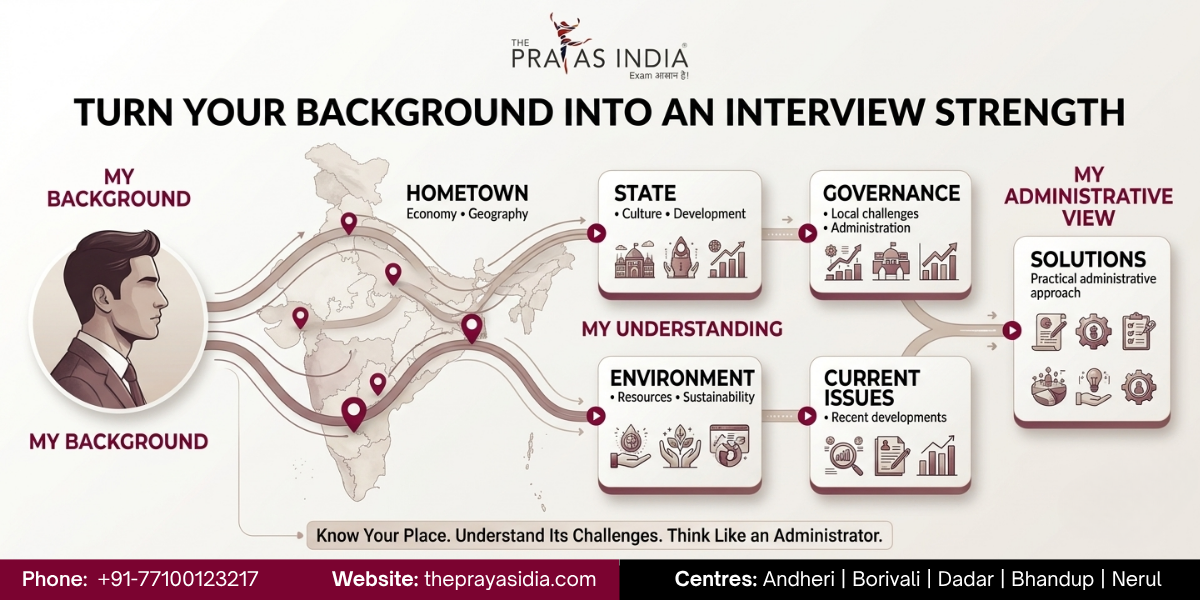
Aspirants should go beyond knowing basic geographical facts. Study the region’s economy, major industries, agriculture, social indicators, cultural identity, environmental concerns, infrastructure, governance challenges and recent developments. Consider both its strengths and its problems.
More importantly, think like an administrator. If the board asks about a major problem in your district, do not stop at describing the problem. Think about its causes, affected stakeholders, existing government interventions and realistic solutions.
This type of preparation can make personal-profile questions much easier because the candidate is discussing a subject they already have a natural connection with.
Understand the Role of Your Optional Subject
Your optional subject can become an important area of discussion during the interview, particularly because it represents an academic or intellectual area you have chosen to study in depth.
However, candidates should not assume that the board will ask only theoretical questions from the optional syllabus. Questions may connect the subject with current affairs, public policy or practical administration.
For example, a candidate with Political Science as an optional subject may be asked to connect political theory with contemporary governance. Someone with Geography may encounter questions related to regional development, climate or urbanisation. The board may also use the optional subject to understand how a candidate applies academic knowledge to real-world problems.
The right approach is therefore to revise fundamental concepts while simultaneously exploring their practical relevance. Avoid trying to memorise every detail from your Mains notes. Instead, focus on concepts that you can explain naturally and connect to contemporary issues.
Mock Interviews Should Come After Foundation Preparation
Mock interviews are valuable, but their effectiveness depends on when and how they are used. Appearing for several mocks without first analysing the DAF, strengthening current affairs and understanding personal areas can result in repeated mistakes without meaningful improvement.
The first stage should involve preparation. The second should involve simulation. The third should involve feedback and correction.
A useful mock interview should not simply give you a score at the end. It should identify specific areas that require improvement—perhaps your answers are too long, your knowledge is strong but your communication lacks structure, you become defensive under cross-questioning, or you need greater awareness of your hometown and current affairs.
This is where UPSC Interview coaching in Mumbai can add value when the programme offers structured DAF analysis, realistic mock interviews, expert feedback and repeated opportunities to improve rather than simply conducting one-off interview sessions.
The goal of a mock interview is not to predict what the actual UPSC board will ask. No coaching institute can guarantee that. Its real value lies in making you more comfortable with uncertainty, improving response quality and helping you identify weaknesses before the actual Personality Test.
The Importance of Feedback During Interview Preparation
Self-evaluation has limitations. Candidates often become accustomed to their own speaking patterns and may not notice issues that are obvious to an observer.
Constructive feedback can help identify these blind spots. After a practice session, evaluate not only whether the answer was factually correct but also whether it was relevant, concise, balanced and clearly communicated.
Ask yourself:
- Did I answer the exact question?
- Did I provide a clear point of view?
- Was my reasoning logical?
- Did I over-explain?
- Did I rely on memorised language?
- Did I remain calm during follow-up questions?
- Could I have presented the answer more practically?
- Did my body language support my verbal communication?
This kind of continuous feedback loop is much more valuable than simply counting the number of mock interviews completed.
Start Preparing Like a Future Administrator
The strongest interview preparation happens when aspirants gradually move away from thinking like examination candidates and begin thinking like potential public administrators.
When reading about unemployment, do not only remember statistics. Think about causes, stakeholders, policy interventions and implementation challenges. When studying a healthcare issue, consider accessibility, affordability, infrastructure, human resources and governance. When discussing technology, think about both innovation and issues such as privacy, inclusion and regulation.
This approach does not require candidates to provide administrative solutions to every question. Rather, it develops a habit of looking at issues through multiple lenses.
The UPSC Personality Test ultimately gives candidates an opportunity to demonstrate whether they can think beyond memorised information. Preparation should therefore focus on developing awareness, reasoning, balance, communication and composure alongside knowledge.
A Practical Daily Routine for UPSC Interview Preparation
Once Mains results are declared and the interview preparation window begins, candidates should create a realistic daily routine rather than studying randomly throughout the day.
A productive routine could include a dedicated current-affairs session, DAF-related preparation, revision of the optional subject and academic background, discussion of major national and international issues, and regular speaking practice. Mock interviews can be introduced progressively, followed by detailed review of feedback.
The exact number of hours is less important than the quality and consistency of preparation. Spending ten unfocused hours reading material is unlikely to be more useful than several hours of targeted preparation involving reading, thinking, discussion and speaking.
Candidates should also preserve sufficient time for rest. Fatigue can negatively affect concentration and communication, particularly during an intensive interview-preparation period.
The Right Preparation Mindset
Perhaps the most important change an aspirant needs to make is to stop approaching the interview with the fear that every answer must be perfect.
The board does not expect candidates to know everything. Civil servants themselves routinely face situations involving incomplete information, competing interests and uncertain outcomes. What matters is how a person responds to such situations.
Therefore, preparation should build confidence without creating overconfidence. You should know your strengths, recognise your limitations and remain willing to learn. You should be able to express an opinion while respecting alternative viewpoints. You should be comfortable saying “I don’t know” when appropriate without becoming nervous.
That balance is at the heart of effective UPSC Personality Test preparation.
A 30–60 Day Roadmap for UPSC Interview Preparation
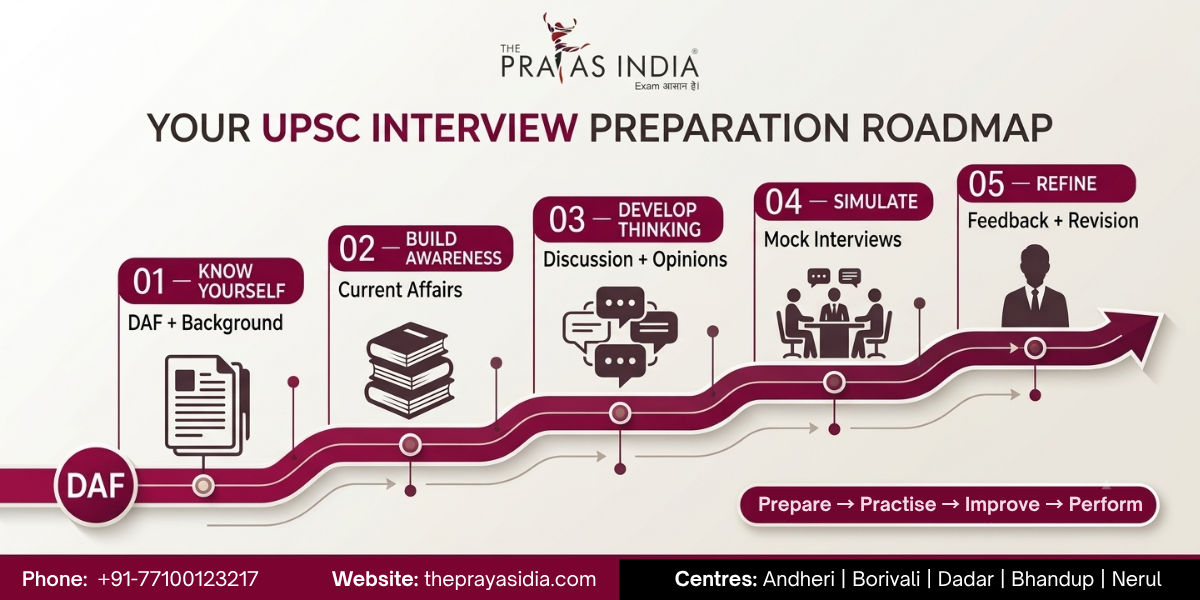
Once a candidate qualifies for the UPSC Personality Test, preparation needs to become more focused and personalised. The exact time available between the Mains result and the interview can vary, so aspirants should adapt their schedule accordingly rather than waiting for the interview date to become very close.
The first phase should focus on DAF analysis and personal-profile preparation. Go through every line of your DAF and create a list of possible themes, factual areas and opinion-based questions. Your educational background, hometown, hobbies, work experience, achievements and optional subject should all receive attention. At the same time, begin systematic current-affairs preparation, particularly around major national and international developments.
The second phase should introduce more discussion and speaking practice. Read important issues and explain them aloud without looking at your notes. Discuss policy questions with peers or mentors and deliberately expose yourself to different viewpoints. This is also the stage where mock interviews can begin.
The final phase should focus on refinement rather than collecting unlimited new information. Review your DAF, revise important current affairs, revisit weak areas identified during mocks and practise answering questions calmly. The objective should be to enter the interview with a clear mind rather than an overloaded one.
A Practical Preparation Framework
| Preparation Stage | Primary Focus |
|---|---|
| Foundation | DAF analysis and personal profile |
| Knowledge | Current affairs and important issues |
| Application | Linking knowledge with real-world situations |
| Practice | Speaking and interview simulations |
| Feedback | Identifying weaknesses and correcting them |
| Final Revision | DAF, current affairs and key personal areas |
This progression prevents preparation from becoming random. It also ensures that the candidate spends more time on areas that actually need improvement.
Build a Strong Answering Framework
Many candidates struggle not because they lack knowledge but because they cannot organise their thoughts quickly. A simple mental framework can make answers more structured without making them sound rehearsed.
For an analytical question, begin by identifying the central issue. Then explain the relevant context, present the key dimensions of the issue and conclude with a practical way forward. Depending on the question, you may consider constitutional, economic, social, administrative, ethical or environmental perspectives.
For a personal question, the answer should usually be direct and authentic. There is no need to turn every personal response into a speech about public administration. If the board asks about your hobby, explain why you enjoy it and what you have learned from it. If asked about a career choice, explain your reasoning honestly and clearly.
The framework is there to support thinking, not replace it. Memorising rigid templates can make responses sound mechanical, particularly when the board asks follow-up questions.
How to Handle Difficult UPSC Interview Questions
A difficult question does not necessarily mean that the interview is going badly. The board may intentionally ask questions that require candidates to think rather than recall.
The first step is to remain calm. Listen carefully and identify the precise demand of the question. If you know the answer, structure it logically. If you know only part of it, answer the part you understand and avoid inventing information.
When faced with an opinion-based question, acknowledge legitimate concerns on different sides before presenting your own assessment. This demonstrates that you can evaluate an issue rather than simply react to it.
For hypothetical administrative questions, focus on practical reasoning. Consider legality, feasibility, stakeholder interests, available resources and possible unintended consequences. A good answer does not need to produce a perfect solution immediately; it should demonstrate a sensible decision-making process.
The “I Don’t Know” Test
One of the most valuable skills in UPSC Interview preparation is knowing how to handle something you do not know.
Candidates sometimes feel that admitting ignorance will automatically reduce their chances. This fear can lead to guessing, bluffing or constructing an answer around unrelated information. Such responses can become more damaging when the board asks follow-up questions.
A calm response such as acknowledging that you are not aware of the specific information is better than presenting an uncertain fact as certain. You can then move forward without allowing one unanswered question to affect your confidence for the remainder of the interview.
The objective is not to demonstrate that you know everything. It is to demonstrate intellectual honesty and composure.
Body Language and Interview Etiquette
Your verbal answers are only one part of the interaction. Body language can influence how naturally and confidently you communicate.
Candidates should maintain a comfortable and attentive posture, make appropriate eye contact with the board and avoid distracting movements. Facial expressions should remain natural. Excessive smiling, looking continuously at the floor, repeatedly adjusting clothing or moving hands unnecessarily can distract from the answer.
At the same time, candidates should avoid trying to manufacture a particular “IAS personality.” Over-controlled body language can appear unnatural. The objective is simply to appear attentive, composed and respectful.
Entering the room calmly, greeting the board appropriately, listening carefully and leaving courteously are basic aspects of professional interview etiquette. These small details become easier when they have been practised beforehand.
Mock Interviews: Use Them as Diagnostic Tools
Mock interviews are most useful when they reveal something you did not notice about yourself.
Instead of treating a mock as another examination in which you need to score well, use it as a diagnostic exercise. Did you become nervous when questioned about your DAF? Did you struggle to explain your optional subject? Were your answers too long? Did you become defensive when your opinion was challenged? Did you fail to connect current affairs with your personal background?
These observations should become your preparation priorities.
One strong mock followed by meaningful improvement can be more valuable than several mocks in which the candidate simply repeats the same weaknesses. This is why quality of feedback matters as much as the number of sessions.
How to Analyse a Mock Interview
After every mock, divide feedback into three categories: knowledge, communication and personality.
Knowledge-related gaps may include weak awareness of your hometown, graduation subject, current affairs or DAF-based topics. Communication-related issues may include excessive length, unclear structure, low audibility or unnecessary repetition. Personality-related observations may concern nervousness, defensiveness, lack of confidence or difficulty handling disagreement.
Create a small improvement tracker and revisit it before the next mock. This turns mock interviews into a progressive learning process.
A candidate who repeatedly reviews and corrects specific weaknesses is likely to benefit much more than someone who simply collects mock-interview certificates or counts the number of panels attended.
Common Mistakes Aspirants Should Avoid
UPSC Interview preparation can become counterproductive when candidates focus on appearance and prediction instead of substance.
One common mistake is memorising model answers. Prepared answers may help with basic questions, but they often collapse when the board asks a follow-up question. Understanding your own reasoning is more useful than memorising someone else’s language.
Another mistake is over-preparing expected questions while ignoring personal details. Candidates may spend hours reading generic interview questions but fail to research their own district, educational background or hobbies thoroughly.
Some aspirants also consume excessive amounts of current-affairs material. Reading more newspapers and magazines does not automatically mean better interview preparation. What matters is the ability to understand important issues and discuss them thoughtfully.
Another common problem is trying to impress the board. Unnecessarily complicated vocabulary, exaggerated confidence or aggressive opinions can make an otherwise knowledgeable candidate appear less balanced. The interview is not a stage for proving intellectual superiority.
Finally, candidates sometimes ignore physical and mental preparation. Poor sleep, exhaustion and excessive anxiety can affect concentration and communication. Preparation should therefore include adequate rest and a stable routine.
Preparing Current Affairs for the Personality Test
Current affairs preparation should become increasingly discussion-oriented as the interview approaches.
Choose important issues rather than attempting to memorise every headline. For each major issue, understand the background, current status, key stakeholders, major arguments, challenges and possible solutions. Where relevant, connect the issue to constitutional principles, governance, economics or social development.
For example, instead of merely remembering that a new policy was introduced, ask yourself why it was introduced, who benefits from it, what implementation challenges may arise and what safeguards could be required.
This approach also makes revision easier. You are remembering interconnected ideas rather than isolated facts.
Handling Questions About Your Career and Motivation
Questions about motivation are among the areas where authenticity matters most. Candidates should be prepared to explain why they chose civil services, why they are interested in particular services and how their previous experiences influenced their decision.
There is no universally correct answer. A candidate from engineering, medicine, management, law, humanities or another background can have a genuine reason for choosing civil services.
The important thing is consistency. Your answer should make sense in the context of your education, work experience and personal journey. Avoid presenting an exaggerated narrative simply because you believe it sounds impressive.
If your motivation has evolved over time, you can say so. A mature explanation of how your perspective developed can be stronger than an artificial story prepared solely for the interview.
The Final 7 Days Before the UPSC Interview
The final week should not be used for panic-driven preparation. At this stage, the candidate should be consolidating rather than attempting to learn everything from the beginning.
Revise your DAF carefully. Review important current-affairs developments, particularly those that have dominated national discussion. Revisit your hometown, graduation subject, optional subject, hobbies and work experience. Go through the feedback received from your latest mock interviews.
Avoid introducing too many new resources. Multiple newspapers, magazines, YouTube channels and coaching materials can create unnecessary confusion during the final days.
Practise speaking naturally, but do not spend every waking hour rehearsing. Sleep adequately, maintain a stable routine and ensure that all interview-related instructions and required documents are checked in advance. UPSC’s official communications should always be treated as the final authority for interview schedules, e-summon information and candidate instructions.
The Day Before the Interview
The day before the Personality Test should be about confidence and composure, not intensive study.
A light revision of your DAF and selected current-affairs topics can be useful, but avoid attempting to memorise dozens of new facts. Keep your documents and necessary items organised and confirm the reporting details from your official communication.
Most importantly, avoid comparing yourself with other candidates. Someone else may have attended more mocks, read more material or prepared a different strategy. None of that determines how you will perform in the room.
Your task is simply to present yourself honestly, calmly and thoughtfully.
Choosing the Right UPSC Interview Coaching in Mumbai
For candidates who want professional guidance after clearing Mains, selecting the right UPSC Interview coaching in Mumbai requires looking beyond the number of mock interviews offered.
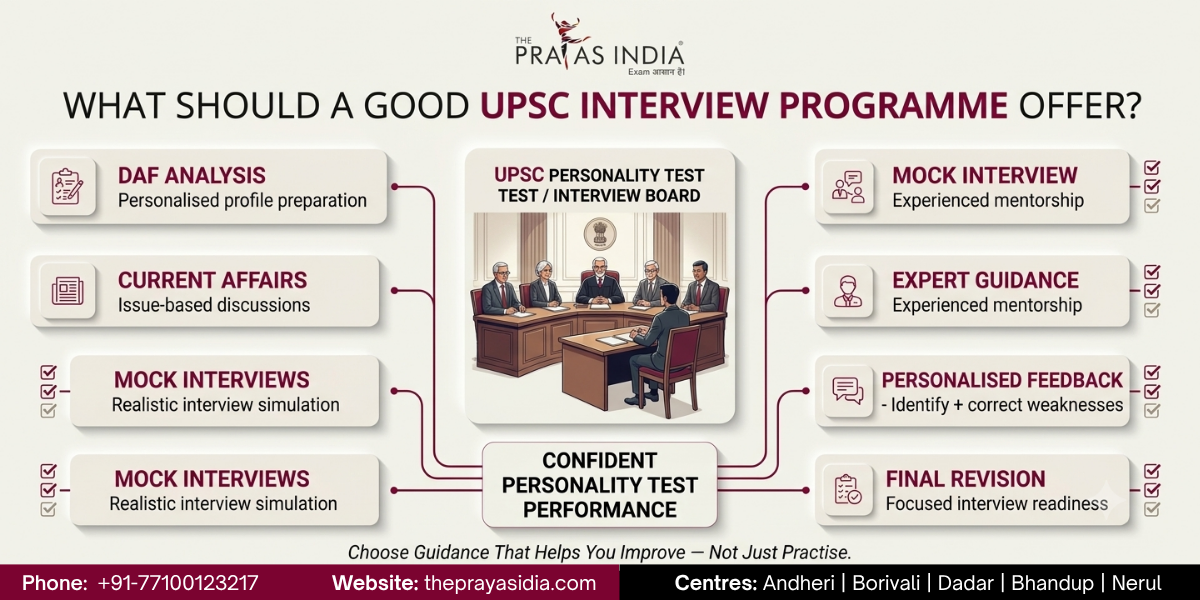
A useful interview programme should ideally include DAF analysis, personalised guidance, current-affairs discussions, mock interviews, detailed feedback and opportunities for improvement. Faculty interaction also matters because interview preparation is highly individual. A candidate with an engineering background may require a different preparation strategy from someone with several years of work experience or a candidate whose DAF contains distinctive hobbies and achievements.
The programme should also encourage authentic responses rather than forcing every candidate into the same model-answer framework. The objective is to improve your personality-test performance while preserving your individual voice.
Location and convenience matter as well, particularly during the intensive period immediately before the interview. Aspirants in Mumbai may therefore consider a programme that provides accessible guidance and a structured schedule without creating unnecessary logistical pressure.
How The Prayas India Can Support UPSC Interview Preparation
For an aspirant who has already crossed the demanding Mains stage, the final phase requires a different form of preparation. The Prayas India can position its UPSC Interview guidance around this transition—from written-answer preparation to confident, structured interaction.
A focused interview programme can help candidates examine their DAF from multiple perspectives, identify probable areas of questioning and practise discussing their personal and academic backgrounds. Current-affairs discussions can further help aspirants move from simply reading news to developing balanced viewpoints.
Mock interviews become particularly useful when they are combined with actionable feedback. Instead of treating every candidate identically, preparation should identify individual gaps and provide a clear path for improvement. Whether the challenge is communication, current affairs, DAF depth, confidence or handling cross-questioning, targeted practice can make the preparation more purposeful.
For aspirants searching for the best UPSC coaching in Mumbai for the Personality Test, the focus should ultimately be on the quality of guidance, depth of feedback and relevance of the preparation process. The Prayas India can provide a structured environment for candidates who want expert support during this crucial final stage.
Final Strategy: Prepare Thoroughly, Respond Naturally
Cracking the UPSC Interview is not about predicting every question the board might ask. It is about becoming comfortable enough with your own profile, knowledge and opinions that you can respond thoughtfully even when the conversation takes an unexpected direction.
A successful preparation strategy therefore combines several elements: deep DAF analysis, relevant current affairs, balanced opinions, clear communication, mock interviews, honest self-evaluation and continuous improvement.
The most important shift is from memorising answers to developing the ability to think. Know your background. Understand the issues you discuss. Listen carefully. Answer what has actually been asked. Admit when you do not know something. Remain respectful when your opinion is challenged. And above all, avoid trying to perform a personality that is not your own.
The UPSC Personality Test is a unique opportunity to demonstrate the qualities that cannot be captured entirely through written examination performance. Preparation can sharpen those qualities, but authenticity remains essential.
For aspirants looking for UPSC Interview preparation in Mumbai, the right guidance can provide structure, realistic practice and constructive feedback at a stage where every improvement matters. With disciplined preparation and the right approach, the interview can become less about fear of the unknown and more about demonstrating the person you have developed through your civil services journey.
Contact Us
- Call Now: +91-77100 13217
- Website: theprayasindia.com
- Centres: Andheri | Borivali | Dadar | Nerul | Bhandup
Frequently Asked Questions About UPSC Interview Preparation
1. How can I prepare for the UPSC Interview?
Start with a detailed analysis of your DAF, followed by current-affairs preparation, revision of your academic and optional-subject background, hometown preparation and regular speaking practice. Mock interviews and personalised feedback can then help identify and correct weaknesses.
2. Is the UPSC Interview mainly about current affairs?
No. Current affairs are an important component, but the Personality Test can cover a candidate's DAF, education, hometown, hobbies, work experience, optional subject, social issues and other areas. Preparation should therefore be broad and personalised.
3. How important is DAF preparation for the UPSC Interview?
DAF preparation is extremely important because the information you provide about your background can become the basis for questions. Candidates should be able to discuss every significant part of their profile naturally and in reasonable depth.
4. Should I memorise answers for the UPSC Interview?
Memorising complete answers is generally not advisable. Instead, understand the important themes and develop your own reasoning. This makes it easier to handle follow-up questions and unexpected variations.
5. Are mock interviews necessary for UPSC Personality Test preparation?
Mock interviews are not a substitute for preparation, but they can be highly useful for practising under simulated interview conditions and identifying weaknesses in communication, knowledge and composure.
6. What should I do if I don't know an answer in the UPSC Interview?
Remain calm and acknowledge honestly that you do not know the answer if that is genuinely the case. Avoid guessing or inventing information simply to provide an answer.
7. How should I prepare for current affairs for the UPSC Interview?
Focus on significant issues and understand their background, implications, stakeholders, challenges and possible solutions. Practise discussing them rather than simply memorising facts.
8. Is UPSC Interview coaching in Mumbai useful?
Structured coaching can be useful for candidates who want professional DAF analysis, mock interviews, current-affairs discussions and personalised feedback. The value depends on the quality and relevance of the programme rather than simply the number of sessions.
9. When should I start UPSC Interview preparation after Mains?
Ideally, begin as soon as you are reasonably confident about your Mains performance rather than waiting until the result. Early preparation gives you more time for DAF analysis, current affairs, speaking practice and multiple rounds of improvement.
10. How can The Prayas India help with UPSC Interview preparation?
The Prayas India can support aspirants through a structured interview-preparation approach focused on DAF analysis, current affairs, mock interviews, personalised feedback and targeted improvement for the Personality Test.