How to Improve Accuracy in UPSC Prelims | Best UPSC Coaching in Mumbai | The Prayas India
Introduction: UPSC Prelims Is Not Just About Knowing More
For many UPSC aspirants, preparation for the Civil Services Preliminary Examination eventually reaches a stage where the problem is no longer a complete lack of knowledge. The bigger challenge becomes accuracy.
You may know the subject, recognise the topic and even remember the relevant fact, yet still select the wrong option. Sometimes the problem comes from confusing two statements. At other times, an aspirant eliminates one option incorrectly, overthinks a straightforward question or makes a guess without properly assessing the risk.
This is why improving accuracy in UPSC Prelims requires a different approach from simply increasing the number of books you read.
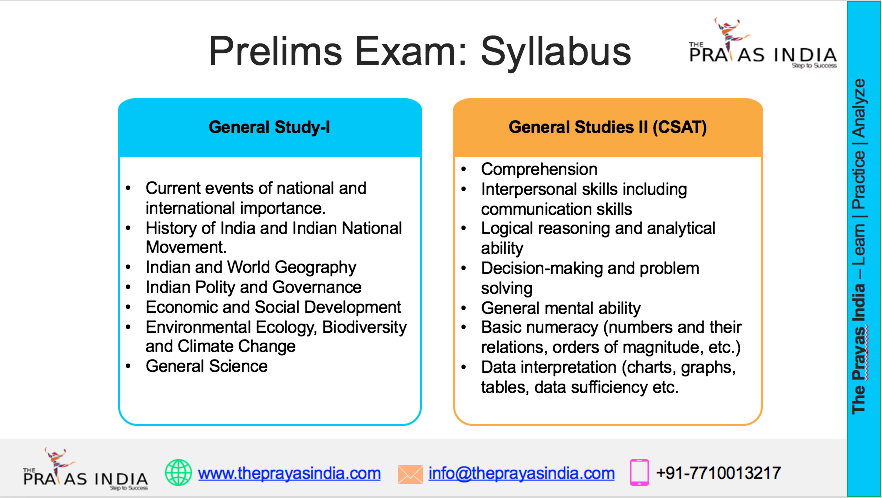
The Preliminary Examination is designed to test more than factual knowledge. It requires candidates to interpret statements, distinguish between closely related options, eliminate incorrect choices, manage uncertainty and make sensible decisions under time pressure. The official UPSC examination structure includes two objective-type papers of 200 marks each, with General Studies Paper II being qualifying with a minimum of 33%.
For an aspirant targeting the Civil Services Examination, therefore, the question should not simply be:
“How much more can I study?”
It should also be:
“How accurately can I convert what I know into correct answers?”
That distinction becomes increasingly important as the examination approaches.
What Accuracy Actually Means in UPSC Prelims
Accuracy is often misunderstood as simply getting a high percentage of attempted questions correct. In reality, Prelims accuracy involves several connected skills.
You need to identify what the question is actually asking, understand the statements, eliminate options logically, recognise when you genuinely know the answer and, equally importantly, recognise when you do not have sufficient information to make a confident attempt.
Consider two aspirants.
The first attempts 85 questions and gets 55 correct.
The second attempts 70 questions and gets 52 correct.
The second aspirant may have a lower number of attempts but considerably better accuracy. Depending on the paper and negative-marking consequences, disciplined question selection can become an important part of the overall strategy.
The objective, therefore, is not to maximise attempts blindly.
The objective is to maximise net score through informed attempts.
This requires three things working together:
- Knowledge
- Elimination ability
- Decision-making under uncertainty
A strong UPSC preparation strategy should develop all three.
Why Good Preparation Does Not Always Produce Good Accuracy
One of the most frustrating experiences for an aspirant is performing poorly in a mock test despite having studied the relevant subjects.
There are several possible reasons.
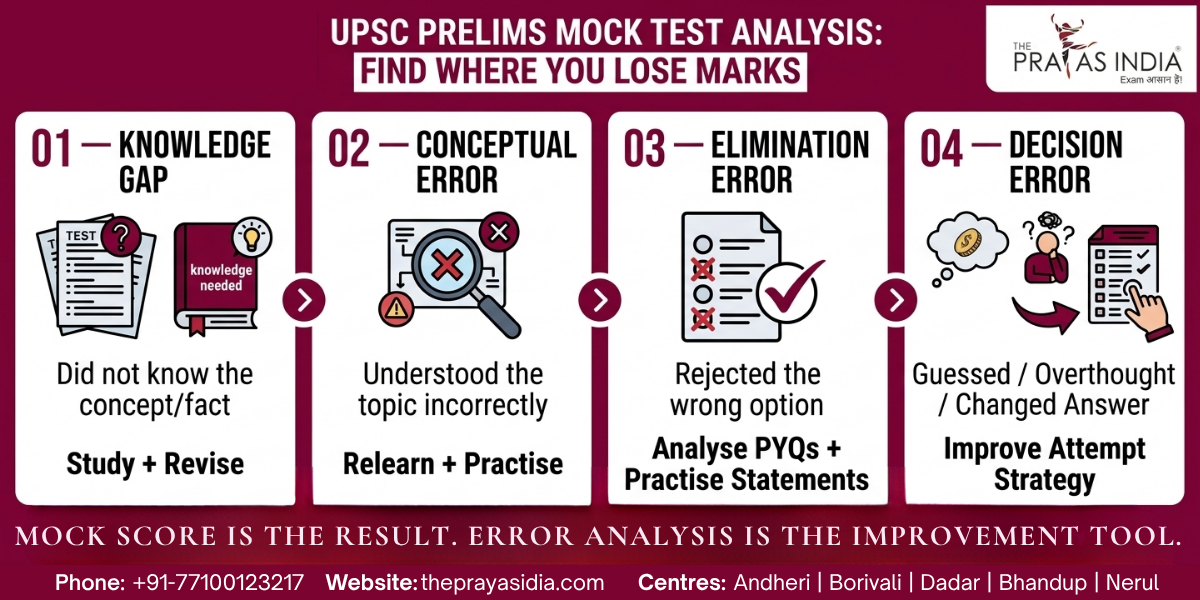
You may have knowledge gaps, where the required information was never studied.
You may have conceptual gaps, where you remember the fact but do not understand the underlying concept.
You may have recall problems, where the information was studied but cannot be retrieved quickly.
You may have interpretation errors, where you misunderstand the wording of the question or statement.
You may also have decision-making errors, where you know that two options are doubtful but still choose one without sufficient reasoning.
Finally, there are careless errors: missing a word such as “only”, “not”, “always” or “incorrect”.
These problems cannot all be solved by reading another book.
The first step is to identify which type of mistake you are repeatedly making.
Start With a Proper Accuracy Audit
Before trying to improve accuracy, analyse your recent mock-test performance.
Take your last few UPSC Prelims mock tests and classify every question you got wrong.
Create categories such as:
| Mistake Type | What It Means | Corrective Action |
|---|---|---|
| Knowledge Gap | Topic was never studied | Study the concept |
| Conceptual Error | Basic idea was misunderstood | Relearn the concept |
| Recall Error | Studied but could not remember | Increase revision |
| Misreading | Question or statement was misunderstood | Slow down and underline key words |
| Elimination Error | Incorrect option eliminated | Practise statement-based questions |
| Guessing Error | Attempted without sufficient basis | Improve risk assessment |
| Careless Mistake | Knew the answer but marked incorrectly | Improve checking discipline |
| Overthinking | Changed a reasonable answer unnecessarily | Build decision-making confidence |
This classification is extremely important.
Suppose you analyse five mocks and discover that most of your errors are conceptual. Reading more current affairs may not solve the problem.
If most errors are caused by poor elimination, you need more statement-based practice.
If most errors occur because you change correct answers at the last moment, the problem is not necessarily knowledge. It may be decision-making under uncertainty.
Your error pattern should determine your improvement strategy.
Accuracy Begins With Reading the Question Correctly
UPSC often tests whether you can pay attention to the exact wording of a question.
A small word can change the meaning completely.
Words and phrases such as:
- Only
- Always
- All
- Never
- Correct
- Incorrect
- Not
- Most likely
- With reference to
- Consider the following statements
- Which of the above
- How many of the above
should immediately attract your attention.
An aspirant who reads quickly may recognise the topic and start solving before fully processing the question.
That creates unnecessary mistakes.
For example, if the question asks which statements are incorrect, identifying the correct statements is not enough. You must eventually select the option corresponding to the incorrect ones.
This sounds basic, but under examination pressure, such errors can be surprisingly costly.
Develop the habit of spending a few additional seconds understanding the demand of the question before analysing the options.
Those seconds can save an entire mark.
Don’t Treat Every Statement as an Isolated Fact
UPSC statement-based questions often require conceptual understanding rather than direct memorisation.
Suppose a question contains three statements about an environmental concept.
Instead of asking:
“Have I seen this exact statement before?”
ask:
“Does this statement logically agree with what I know about the concept?”
This shift is important because UPSC does not need to repeat textbook sentences exactly.
A candidate who depends entirely on memorised lines can struggle when the same concept is expressed differently.
Conceptual preparation allows you to evaluate unfamiliar wording.
For example, if you understand the relationship between a constitutional provision, an institution and its powers, you can often evaluate a new statement even if you have never seen that exact sentence before.
That is why accuracy should be developed alongside conceptual clarity.
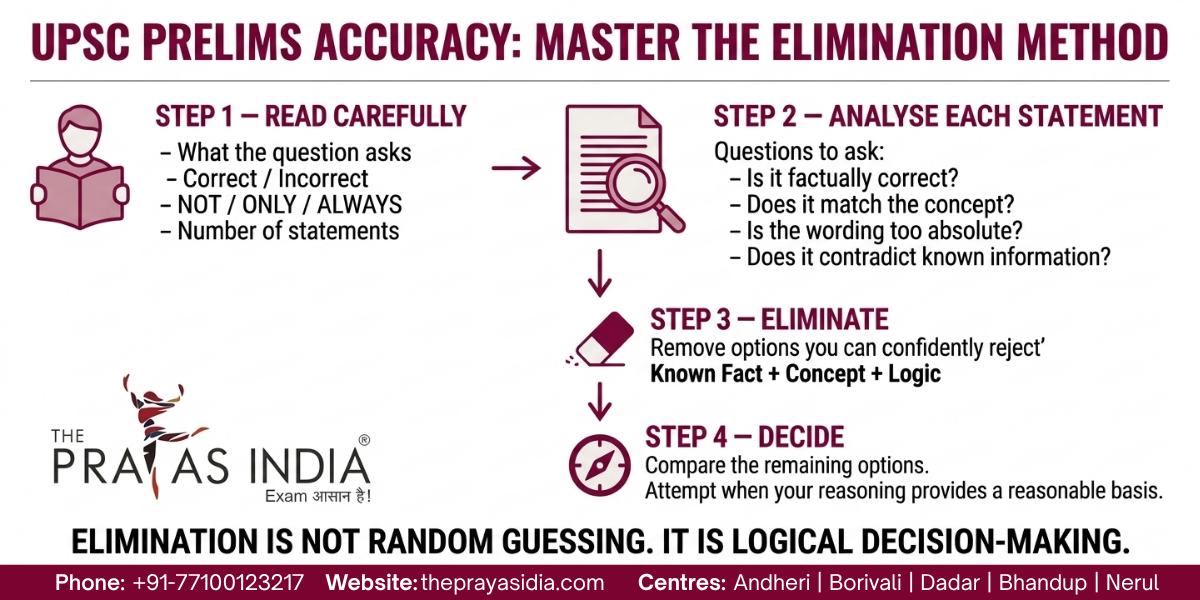
The Elimination Method Is a Skill, Not a Guess
Elimination is one of the most useful tools in UPSC Prelims, but it is often misused.
Some candidates treat elimination as:
“I don’t know the answer, so I’ll remove whatever looks wrong and pick something.”
That is not elimination.
Effective elimination is based on evidence.
You may reject an option because:
- The statement contradicts a known constitutional principle.
- A geographical claim is inconsistent with established facts.
- A scientific statement uses an incorrect relationship.
- A historical claim conflicts with the period or sequence of events.
- A policy is attributed to the wrong institution.
- A statement uses an excessively absolute claim that does not fit the concept.
The more knowledge you possess, the stronger your elimination becomes.
But elimination also improves through practice.
When reviewing a mock, don’t simply record the correct answer.
Ask:
“What clue should have helped me eliminate the wrong option?”
This question can significantly improve your future performance.
Use the Two-Level Elimination Approach
When you are unsure about a question, don’t immediately try to identify the correct answer.
First eliminate the options that you can confidently reject.
Then reassess what remains.
Level 1: Certain Elimination
Remove options that clearly conflict with your knowledge.
Level 2: Comparative Elimination
Compare the remaining options against the wording, concepts and known facts.
This is more disciplined than making an immediate guess.
For example, if four options are presented and you can confidently eliminate two, you have changed the decision environment considerably. But you still need to assess whether the remaining two can be distinguished with reasonable confidence.
That is where risk management becomes important.
Accuracy Does Not Mean Attempting Fewer Questions Automatically
A common reaction to discussions about accuracy is:
“Then I should attempt very few questions.”
That is not the right conclusion.
Accuracy and attempts have to be considered together.
If you attempt too aggressively, negative marking can reduce the benefit of additional attempts.
If you become excessively conservative, you may leave marks on the table even when you could have reached the correct answer through elimination.
The ideal strategy is therefore not a fixed number of attempts for every aspirant.
It should depend on:
- Your mock-test accuracy
- Your confidence level
- Your ability to eliminate options
- The difficulty of the paper
- The quality of your preparation
- Your comfort with uncertainty
- The actual examination environment
Your mock tests should help you discover the attempt range in which you perform most effectively.
Build an “Attempt Confidence” Framework
One practical method is to classify questions during mock analysis according to confidence.
High Confidence
You know the answer or can establish it through strong reasoning.
These questions should generally be prioritised.
Moderate Confidence
You do not know the answer immediately, but you can eliminate one or more options using sound reasoning.
These require judgement.
Low Confidence
You have little or no knowledge and cannot establish a reliable elimination basis.
These questions carry greater uncertainty.
The purpose of this framework is not to create a rigid formula for the actual examination. It is to help you understand your own behaviour.
If your mock analysis shows that you regularly get moderate-confidence questions correct but lose marks on low-confidence guesses, you have identified a clear area for improvement.
Stop Changing Answers Without a Valid Reason
One of the most common accuracy problems in competitive examinations is unnecessary answer changing.
An aspirant selects an option, continues solving the paper and later returns to the question. Suddenly, doubt appears.
The candidate changes the answer without discovering any new information.
This is not the same as correcting an error.
Changing an answer can be sensible when you notice:
- A word you initially missed
- A factual contradiction
- A calculation error
- A statement you misunderstood
- A stronger elimination reason
But changing an answer simply because another option “feels better” is a different situation.
During mock analysis, record how many questions you changed and whether the change improved or reduced your score.
This can reveal whether answer-changing is helping your performance or damaging it.
Use Previous-Year Questions as an Accuracy Laboratory
UPSC previous-year questions should not be treated only as a source of practice questions.
They are also a way to understand how the examination tests reasoning.
When solving PYQs, ask:
Why is the correct option correct?
Then ask:
Why are the other options wrong?
This second question is equally important.
If you can explain why each incorrect option fails, your conceptual understanding is becoming stronger.
You should also identify the nature of the question:
- Direct factual
- Conceptual
- Statement-based
- Application-based
- Elimination-friendly
- Current-affairs linked
- Static-current affairs combination
Over time, this creates a personal database of UPSC question patterns.
You begin to recognise how the examination frames statements rather than merely memorising answers.
Don’t Memorise Explanations Without Understanding Them
When you get a PYQ wrong, it can be tempting to read the explanation, note the correct answer and move on.
That produces short-term familiarity but not necessarily long-term accuracy.
Instead, ask:
What did I misunderstand?
If the question is about polity, revisit the underlying constitutional concept.
If it concerns geography, understand the geographical relationship.
If it concerns environment, revise the ecological principle.
If it concerns economy, understand the mechanism rather than memorising a definition.
This approach takes slightly longer initially but makes future questions easier.
Accuracy Requires Subject-Wise Diagnosis
Your overall mock score may hide important differences between subjects.
You might be highly accurate in Polity but inconsistent in Environment.
You may perform well in Geography but make avoidable errors in Economy.
Therefore, maintain a subject-wise accuracy record.
| Subject | Attempted | Correct | Incorrect | Accuracy | Main Problem |
|---|---|---|---|---|---|
| Polity | 18 | 14 | 4 | 77.8% | Statement interpretation |
| Economy | 15 | 9 | 6 | 60% | Conceptual gaps |
| Environment | 17 | 10 | 7 | 58.8% | Recall |
| Geography | 14 | 11 | 3 | 78.6% | Good |
| History | 16 | 11 | 5 | 68.8% | Factual confusion |
The numbers above are illustrative.
The purpose of such a table is to identify where your marks are leaking.
Once you know the weak area, your study plan becomes more targeted.
Don’t Use More Study Material as the Default Solution
When mock-test accuracy is poor, many aspirants immediately purchase another book, download another PDF or join another test series.
More resources may sometimes help, but they should not be your automatic response.
If your problem is lack of revision, another source will increase the problem.
If your problem is conceptual clarity, five additional PDFs will not necessarily solve it.
If your problem is careless reading, another current-affairs compilation cannot fix it.
Before adding a resource, identify the actual problem.
Ask:
“What exactly is preventing me from getting this question right?”
Only then decide whether additional study material is necessary.
Accuracy Improves When Revision Becomes More Active
Passive revision means repeatedly reading notes.
Active revision means forcing yourself to retrieve information.
For example, instead of reading a page about Fundamental Rights again, close the book and ask yourself:
- What are the Fundamental Rights?
- Which Articles are associated with them?
- Which rights are available only to citizens?
- Which rights are available to all persons?
- What are the relevant exceptions?
- What is the difference between the relevant constitutional provisions?
This process exposes what you actually remember.
The same technique can be applied to Environment, Economy, History, Geography and Science.
If you cannot recall it without looking, you have not revised it sufficiently.
Build an Error Notebook, Not Just a Notes Notebook
Your regular notes contain what you need to study.
Your error notebook should contain what you repeatedly get wrong.
This distinction can make revision significantly more efficient.
A useful error notebook can have four columns:
| Question / Topic | My Mistake | Correct Understanding | Action |
|---|---|---|---|
| Topic A | Misread statement | Correct interpretation | Solve 10 similar questions |
| Topic B | Forgot concept | Revised concept | Add to weekly revision |
| Topic C | Poor elimination | Identify factual clue | Practise PYQs |
| Topic D | Random guess | Insufficient evidence | Improve attempt discipline |
Review this notebook every week.
As the examination approaches, it can become one of your most valuable revision resources because it represents your personal weaknesses, not a generic syllabus.
Build Accuracy Through Deliberate Mock-Test Practice
Mock tests should not be treated merely as a way to measure whether you are “ready” for UPSC Prelims. Their more important role is to train you to make better decisions under examination conditions.
The official UPSC scheme provides two compulsory objective papers of 200 marks each, with General Studies Paper II qualifying at 33%. UPSC also applies negative marking for incorrect answers, which makes accuracy and question selection particularly important.
Therefore, your mock-test strategy should evolve as your preparation progresses.
In the initial stage, take tests to identify knowledge and conceptual gaps. In the middle stage, use them to improve elimination, question interpretation and time management. In the final stage, use full-length tests to replicate examination conditions and refine your attempt strategy.
The important point is that every mock should teach you something about your performance.
If you are taking ten mocks but repeating the same mistakes in all ten, the number of tests is not translating into improvement.
Follow a Three-Stage Mock-Test Cycle
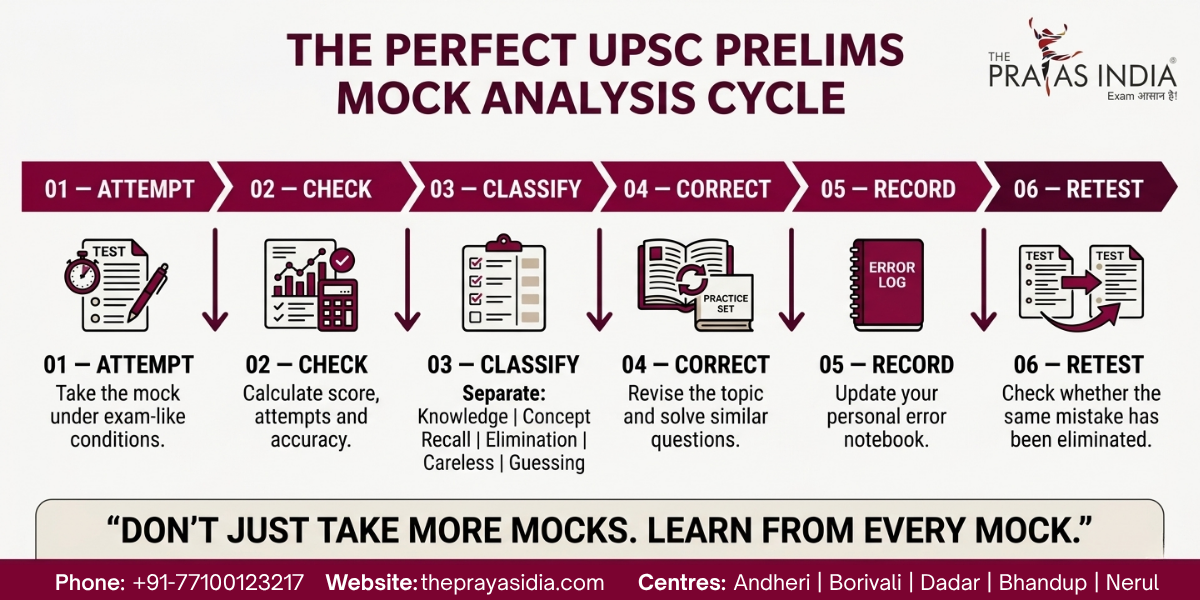
A useful mock-analysis cycle is:
Attempt → Analyse → Correct
Attempt
Take the mock under realistic conditions. Avoid checking answers during the test or consulting notes when you are uncertain.
Analyse
After completing the test, review every incorrect answer and every doubtful question. Do not restrict your analysis to questions you got wrong. A question that you guessed correctly can be equally important because it may reveal an unreliable decision.
Correct
Take action based on the analysis. Revise the concept, practise similar questions, update your error notebook or change your attempt strategy.
This creates a feedback loop.
Mock → Mistake → Diagnosis → Correction → New Mock
Over several weeks, this cycle can gradually improve accuracy.
Don’t Measure Only Your Total Score
Your total mock score is important, but it does not tell the entire story.
Suppose your score rises from 82 to 91. That looks positive.
But what if the improvement came entirely from attempting more questions while your accuracy actually declined?
Similarly, suppose your score remains around the same level for three tests but your number of incorrect answers decreases. That could indicate genuine progress even if the total score has not yet moved significantly.
Track metrics such as:
- Total questions attempted
- Correct answers
- Incorrect answers
- Accuracy percentage
- Questions left unattempted
- Questions changed after initial selection
- Questions guessed
- Subject-wise accuracy
- Questions lost due to careless mistakes
- Questions lost because of knowledge gaps
This gives you a much more complete picture of your performance.
Improve Subject-Wise Accuracy Instead of Chasing an Overall Number
Aspirants often say, “My Prelims accuracy is 65%.”
That number is useful, but it is not enough.
You need to know where that 65% is coming from.
Suppose your Polity accuracy is 80%, Geography is 75%, Environment is 62%, Economy is 55% and History is 70%.
Your preparation should not treat all five subjects equally.
Economy and Environment require greater attention because they are contributing disproportionately to your incorrect answers.
At the same time, you should not completely abandon your strong subjects. The goal is to maintain their performance while improving weak areas.
A simple weekly tracker can help:
| Subject | Accuracy | Main Issue | Weekly Action |
|---|---|---|---|
| Polity | 80% | Few statement errors | PYQs |
| Economy | 58% | Conceptual gaps | Concept revision |
| Environment | 63% | Recall issues | Active revision |
| Geography | 74% | Good | Maintain |
| History | 68% | Factual confusion | Topic-wise revision |
The figures are illustrative. Your own data should determine the priorities.
Learn to Handle Difficult Questions Without Losing Composure
UPSC Prelims can contain questions that appear unfamiliar even to well-prepared candidates.
When you encounter such a question, the first mistake is to panic.
An unfamiliar question does not automatically mean that you have no chance of solving it.
Read the question carefully.
Identify the subject.
Look for familiar concepts.
Evaluate each statement independently.
Try elimination.
Then assess whether the remaining options can be distinguished with reasonable confidence.
If they cannot, move on.
The ability to leave a question temporarily without becoming emotionally attached to it is an important examination skill.
You can return later if time permits.
Don’t Spend Too Long Trying to Rescue One Question
A difficult question can become disproportionately expensive.
You may spend three minutes trying to decide between two options when several easier questions are still waiting.
Time management and accuracy are therefore connected.
A question that consumes excessive time can affect your performance elsewhere, even if you eventually get it correct.
During mocks, record questions where you spent significantly more time than your normal average.
Then ask:
Was the additional time justified by the probability of getting the answer correct?
If the answer is no, you have identified a question-selection problem.
Develop a “Leave and Return” Strategy
You do not have to solve the paper in a straight line.
A practical approach is to mentally classify questions into three groups:
Round 1: Comfortable Questions
These are questions where you know the answer or can solve them confidently.
Attempt them first.
Round 2: Solvable Through Elimination
These require some thought but offer a reasonable basis for reaching an answer.
Attempt them after securing the easier questions.
Round 3: High-Uncertainty Questions
These involve weak knowledge and limited elimination possibilities.
Keep them for later and attempt only if your reasoning provides a sufficient basis.
This approach prevents one difficult question from disrupting the entire paper.
Accuracy Improves When You Learn to Recognise “False Familiarity”
Sometimes a question looks familiar because you have encountered the topic several times.
That does not necessarily mean you know the answer.
You may recognise the name of a scheme, organisation or concept but still be unable to determine which statement about it is correct.
This is false familiarity.
It can be particularly dangerous in statement-based questions because the candidate feels confident without having a precise understanding.
To overcome it, regularly test yourself without notes.
Ask:
“Can I explain this concept in my own words?”
If not, your familiarity may be superficial.
Use Active Recall for High-Value Topics
Active recall should become a regular part of revision.
After completing a topic, close the book and reconstruct the important information from memory.
For Polity, recall constitutional provisions and institutional relationships.
For Economy, explain mechanisms such as inflation, monetary policy or fiscal measures.
For Environment, recall ecological concepts, conventions and species-related facts.
For Geography, mentally reconstruct maps, physical features and geographical relationships.
For History, organise events chronologically and connect causes with consequences.
The goal is to make your brain retrieve information rather than simply recognise it on a page.
This directly supports Prelims accuracy.
Improve Accuracy by Practising Statement-Based Questions
UPSC often requires candidates to evaluate statements rather than answer direct one-line questions.
Therefore, your practice should contain a substantial number of statement-based questions.
When solving them, avoid judging all statements together.
Take them one at a time.
For each statement, ask:
What exactly is being claimed?
Then:
What do I know that supports or contradicts this claim?
This method reduces the chance of allowing one familiar statement to influence your judgement of the others.
It also makes elimination more systematic.
Don’t Let One Subject Become Your Comfort Zone
Strong aspirants sometimes spend too much time on subjects they enjoy.
For example, a candidate who likes Polity may repeatedly revise Polity because it feels productive.
But if Economy is weak, spending another three hours on Polity may have a lower marginal benefit.
Your study plan should therefore be based on performance data, not just preference.
A subject you enjoy is not necessarily the subject that needs more time.
Your weak areas deserve targeted attention.
Accuracy During the Final 60 Days
The final 60 days before Prelims should not be treated as a period for endlessly expanding the syllabus.
The emphasis should gradually move from coverage to consolidation.
A useful structure is:
Days 60–45: Identify and Repair
Analyse recent mocks and identify recurring weak areas.
Revise high-priority concepts and solve topic-wise questions.
Days 44–30: Increase Testing
Take regular sectional and full-length tests.
Focus heavily on error analysis.
Start reducing avoidable mistakes.
Days 29–15: Consolidate
Revise your core notes, PYQs, error notebook and frequently forgotten concepts.
Do not keep adding multiple new resources.
Final 14 Days: Stabilise
Focus on revision, mock analysis and confidence-building through familiar material.
Avoid making dramatic changes to your strategy at the last moment.
The exact schedule should be adjusted according to your preparation level and the examination calendar. UPSC’s official 2027 calendar currently lists Civil Services (Preliminary) Examination 2027 for 23 May 2027, with notification scheduled for 13 January 2027.
What Should You Do After Every Mock?
A structured post-mock review can look like this:
Step 1: Calculate your score.
Step 2: Calculate accuracy.
Step 3: Mark every incorrect answer.
Step 4: Mark every doubtful answer that you got correct.
Step 5: Identify the reason behind each mistake.
Step 6: Revise the relevant concept.
Step 7: Solve 5–10 similar questions.
Step 8: Add recurring mistakes to your error notebook.
Step 9: Review the notebook before the next mock.
This process may take almost as much time as the mock itself, but that is not wasted time.
It is where much of the actual improvement happens.
Common Habits That Damage UPSC Prelims Accuracy
Changing Sources Too Frequently
Switching between books, teachers, PDFs and test series creates fragmented preparation. Choose reliable core resources and revise them thoroughly.
Taking Too Many Tests Without Analysis
A mock-test count is not a preparation achievement by itself. Ten poorly analysed tests can be less useful than five deeply analysed tests.
Studying Only What You Like
Preparation should follow your weaknesses rather than your comfort zone.
Overusing Guesswork
Attempting a question simply because you have narrowed it down to two options can be risky if there is no meaningful basis for the elimination.
Ignoring Correct Guesses
A correct answer obtained through weak reasoning should still be reviewed. It may represent a future negative-marking risk.
Revising Only Before the Exam
Revision should happen throughout the preparation cycle.
Treating Every Mistake as a Knowledge Gap
Not every wrong answer requires another book. Sometimes the problem is reading, elimination, recall or decision-making.
How Professional UPSC Coaching Can Improve Accuracy
Improving Prelims accuracy independently is possible, but many aspirants struggle to identify their exact weaknesses.
A structured coaching environment can help by providing a defined syllabus, classroom guidance, regular tests, performance analysis and feedback.
The most useful role of coaching is not simply to provide more study material. It is to create a system in which the aspirant can repeatedly move through:
Concept → Practice → Test → Analysis → Correction → Revision
Faculty guidance can be particularly useful when a candidate is unable to understand why apparently simple questions are repeatedly going wrong.
A good mentor can help distinguish between:
“You don’t know this.”
and
“You know this, but your approach to the question is causing the error.”
That distinction can save considerable preparation time.
What to Look for Before Joining UPSC Coaching in Mumbai
Choosing a UPSC coaching institute should be based on the quality of the preparation system rather than only on advertising claims.
Before joining, evaluate whether the institute provides:
- Experienced faculty with subject-specific expertise
- A structured Prelims and Mains preparation plan
- Comprehensive but manageable study material
- Regular UPSC-oriented test practice
- Detailed mock-test analysis
- Previous-year question discussion
- Doubt-solving support
- Revision programmes
- Current Affairs integration
- Personalised performance feedback
- A disciplined academic environment
Location can also matter because UPSC preparation requires consistency over an extended period.
For aspirants looking for UPSC coaching in Mumbai, The Prayas India has centres across Andheri, Borivali, Dadar, Bhandup and Nerul.
Students can contact +91-77100123217 for information about UPSC preparation programmes and centre details.
The right coaching environment should help you reduce confusion, identify weaknesses and develop a repeatable preparation system.
Accuracy Is a Preparation Skill, Not a Natural Talent
Some aspirants assume that accurate candidates simply “have better knowledge”.
Knowledge certainly matters, but accuracy is also a skill that can be developed.
You can become better at:
- Reading questions carefully
- Identifying important words
- Evaluating statements independently
- Eliminating options logically
- Managing uncertainty
- Recognising when to move on
- Avoiding unnecessary answer changes
- Analysing mistakes
- Revising weak areas
- Making decisions under time pressure
These abilities improve through deliberate practice.
The purpose of preparation is therefore not merely to increase the amount of information stored in your mind. It is to make your knowledge usable under examination conditions.
Final Strategy: Make Every Correct Answer More Reliable
Improving UPSC Prelims accuracy is ultimately about reducing avoidable losses.
You cannot know every fact that appears in the examination.
You cannot predict every question.
You cannot eliminate uncertainty completely.
But you can control your preparation process.
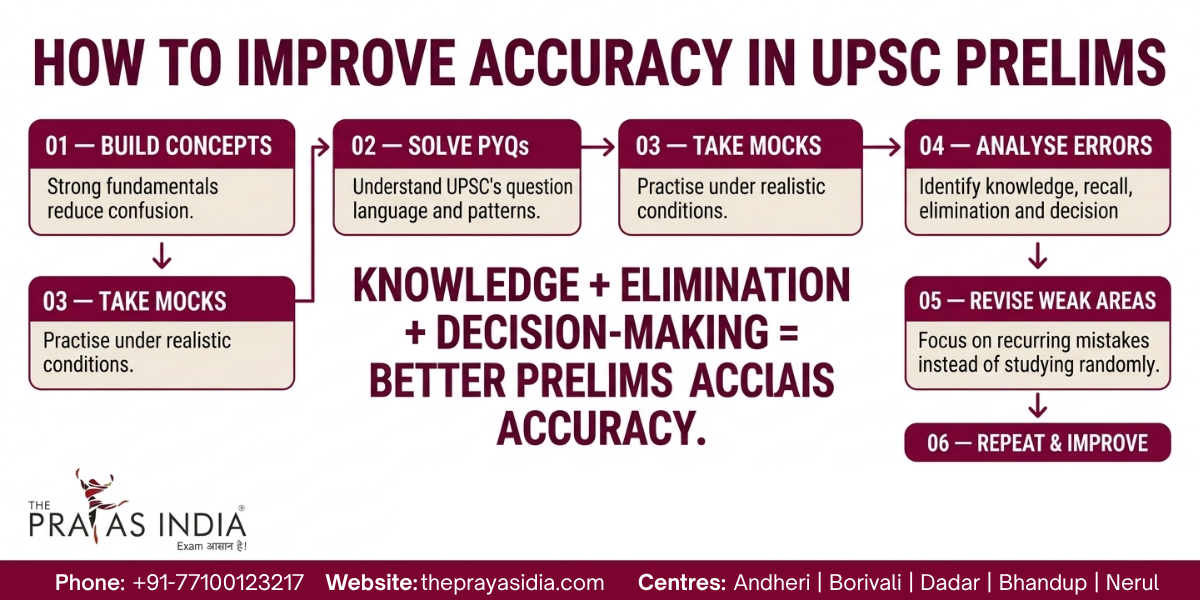
Build strong concepts.
Study the syllabus systematically.
Solve UPSC previous-year questions.
Practise statement-based questions.
Take regular mocks.
Analyse every mistake.
Track subject-wise accuracy.
Maintain an error notebook.
Revise actively.
Learn to distinguish between informed elimination and random guessing.
Most importantly, do not judge your preparation only by your mock-test score.
A score tells you where you are.
Your mistakes tell you how to move forward.
For aspirants seeking structured UPSC coaching in Mumbai, The Prayas India provides preparation support through its centres at Andheri, Borivali, Dadar, Bhandup and Nerul.
📞 Call Now: +91-77100 13217
🌐 Website: theprayasindia.com
📍 Centres: Andheri | Borivali | Dadar | Nerul | Bhandup
The goal is not to attempt every question.
The goal is to make better decisions on the questions you choose to attempt.
That is where accuracy becomes an advantage in UPSC Prelims.
FAQs
1. How can I improve my accuracy in UPSC Prelims?
Improve accuracy by combining conceptual preparation with previous-year questions, statement-based practice, mock tests and detailed error analysis. Identify whether your mistakes are caused by knowledge gaps, poor recall, misreading, weak elimination or unnecessary guessing, and address each problem separately.
2. Is accuracy more important than the number of attempts in UPSC Prelims?
Both accuracy and attempts matter. Attempting more questions is not automatically better because incorrect answers attract negative marking. Your objective should be to develop an attempt strategy that maximises your expected score while avoiding low-quality guesses.
3. How does negative marking affect UPSC Prelims accuracy?
UPSC applies a penalty for incorrect answers in the Preliminary Examination. This makes random guessing risky and increases the importance of careful question selection and logical elimination.
4. How many mock tests should I take for UPSC Prelims?
There is no universal number that guarantees success. The quality of analysis is more important than simply counting tests. Take enough mocks to identify patterns in your performance, then spend substantial time analysing and correcting your mistakes.
5. Why do I get questions wrong even after studying them?
This can happen because of weak recall, conceptual confusion, misreading, poor elimination or overthinking. Analyse the reason behind each incorrect answer rather than assuming that you simply need to study more.
6. How can I improve my elimination skills for UPSC Prelims?
Practise previous-year and statement-based questions regularly. For every incorrect option, try to identify the factual or conceptual reason why it is wrong. Over time, this builds the ability to eliminate options using knowledge and logic rather than guesswork.
7. Should I change an answer if I become doubtful during the exam?
Change an answer when you discover a genuine reason that your initial choice was incorrect, such as a missed keyword, factual contradiction or better elimination. Avoid changing answers merely because another option suddenly feels more attractive.
8. How important are UPSC previous-year questions for improving accuracy?
They are extremely valuable because they help you understand UPSC's wording, statement construction, conceptual depth and question patterns. UPSC publishes previous question papers through its official website, making them an essential part of serious preparation.
9. What should I do if my mock-test accuracy is consistently low?
First, stop focusing only on the score. Analyse your incorrect answers and classify the mistakes. If most are knowledge gaps, revise the syllabus. If they are elimination or decision-making errors, increase statement-based practice and work on your attempt strategy.
10. Can coaching help improve UPSC Prelims accuracy?
Yes, structured coaching can help when it provides quality teaching, regular testing, detailed analysis, doubt resolution and personalised feedback. The value lies in having a systematic preparation and correction process rather than simply receiving more study material.
11. Which is the best UPSC coaching in Mumbai?
The best institute depends on your requirements, learning style and preparation stage. Before joining, evaluate faculty quality, study material, test series, PYQ discussions, mentorship, doubt support, revision strategy and location. The Prayas India has centres at Andheri, Borivali, Dadar, Bhandup and Nerul for aspirants seeking UPSC coaching in Mumbai.
12. Can an average student improve UPSC Prelims accuracy?
Yes. Accuracy is not fixed. With systematic revision, conceptual clarity, PYQ practice, mock-test analysis and disciplined decision-making, an aspirant can significantly reduce avoidable errors and improve performance over time.