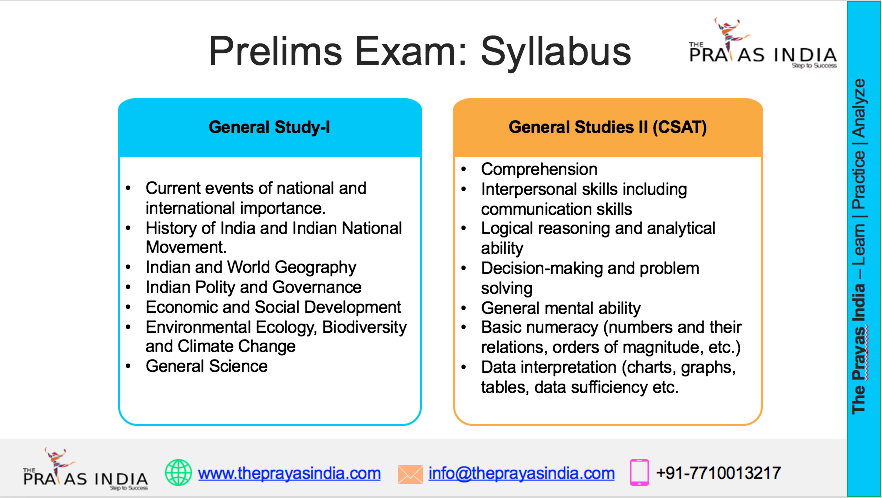
How to Improve UPSC Prelims Question Selection | Best UPSC Coaching in Mumbai | The Prayas India
UPSC Prelims is often described as a test of knowledge, but that description is incomplete. Knowing the subject matter is important, yet knowledge alone does not guarantee a strong Prelims score. A candidate may know a large portion of the syllabus and still lose marks because of poor question selection, rushed attempts or an inability to distinguish between questions worth attempting and questions better left for later.
This is why question selection becomes a critical part of UPSC Prelims preparation.
The paper does not simply ask, “How much do you know?” It also tests how effectively you can use what you know when faced with uncertainty, limited time and multiple answer choices. Two candidates with similar knowledge levels can therefore end up with very different scores because they make different decisions inside the examination hall.
For serious aspirants, the objective should not be to attempt the maximum number of questions. The objective should be to build a high-quality attempt strategy that balances knowledge, elimination, confidence, risk and time.
Question Selection Is a Skill, Not a Last-Minute Exam Trick
Many aspirants think about question selection only after completing the syllabus. They assume that once their preparation is strong enough, they will automatically know which questions to attempt.
In reality, question selection needs to be practised separately.
When you solve previous-year questions or mock tests, you should not only record whether your answer was correct or incorrect. You should also examine why you decided to attempt that question in the first place.
A question may fall into several categories:
- You know the answer confidently.
- You know the concept but need to eliminate options.
- You have partial knowledge and can make an informed attempt.
- You are making a pure guess.
- You have no meaningful understanding of the question.
These situations should not be treated identically.
The ability to recognise this difference can significantly improve your decision-making during Prelims.
The Biggest Mistake: Equating More Attempts With Better Performance
A common mindset among aspirants is that a higher number of attempts automatically means a better chance of clearing Prelims.
This is dangerous.
Suppose one candidate attempts a large number of questions but makes several avoidable mistakes, while another candidate attempts fewer questions with stronger accuracy and better selection. The second candidate may ultimately be in a much stronger position.
This does not mean you should become excessively conservative.
UPSC Prelims requires calculated risk.
The challenge is finding the balance between under-attempting because of fear and over-attempting because of pressure.
That balance develops through repeated analysis rather than guesswork.
Understand Your Three Types of Questions
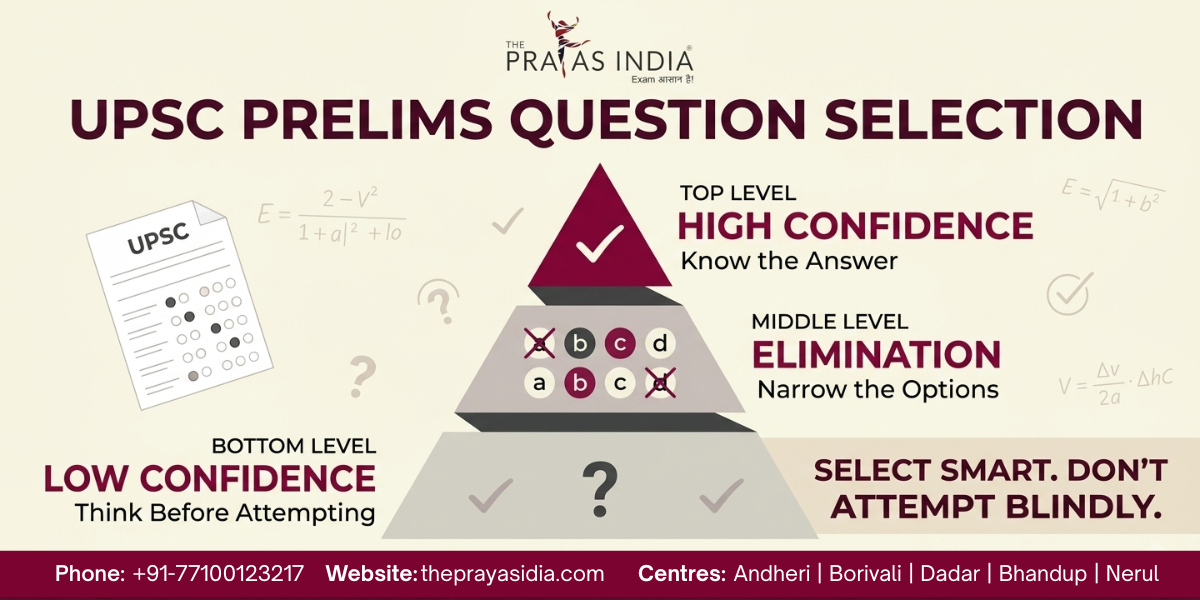
A practical way to improve question selection is to divide questions into three broad categories.
Category 1: High-Confidence Questions
You know the concept and are reasonably certain about the answer.
These questions should generally receive priority.
The objective is to secure marks without unnecessarily spending too much time.
Category 2: Elimination-Based Questions
You may not know the answer directly, but you can eliminate one or more options using conceptual understanding, factual knowledge or logical reasoning.
These questions require judgement.
They should not automatically be treated as guesses.
Category 3: Low-Confidence Questions
You have little or no meaningful information and cannot eliminate options reliably.
These questions require much greater caution.
The important skill is recognising when an attempt has a reasonable basis and when it is simply an emotional decision.
Question Selection Begins With Self-Awareness
Before deciding which questions to attempt in the exam, you need to understand your own behaviour.
Some aspirants are naturally over-attempters.
They see a familiar-looking keyword and immediately select an option.
Others are under-attempters.
They know the concept but become afraid of negative marking and leave questions they could have solved through elimination.
Both behaviours can reduce your score.
Your mock-test analysis should therefore answer a more useful question:
“Did I make the right decision on this question?”
That question is more valuable than simply asking whether your final answer was correct.
Don’t Confuse Familiarity With Knowledge
UPSC questions can contain familiar terminology while testing a completely different concept.
You may recognise a word from your notes and immediately feel that you know the question.
But familiarity with a topic does not necessarily mean that you know the specific statement being tested.
For example, a question may mention a constitutional provision, environmental convention or government initiative that you have studied. The actual options may test a subtle distinction that requires careful reading.
This is why reading the entire question and every statement matters.
Don’t make your attempt decision based only on the first few words.
Learn to Read the Question Before Solving It
Strong question selection starts with disciplined reading.
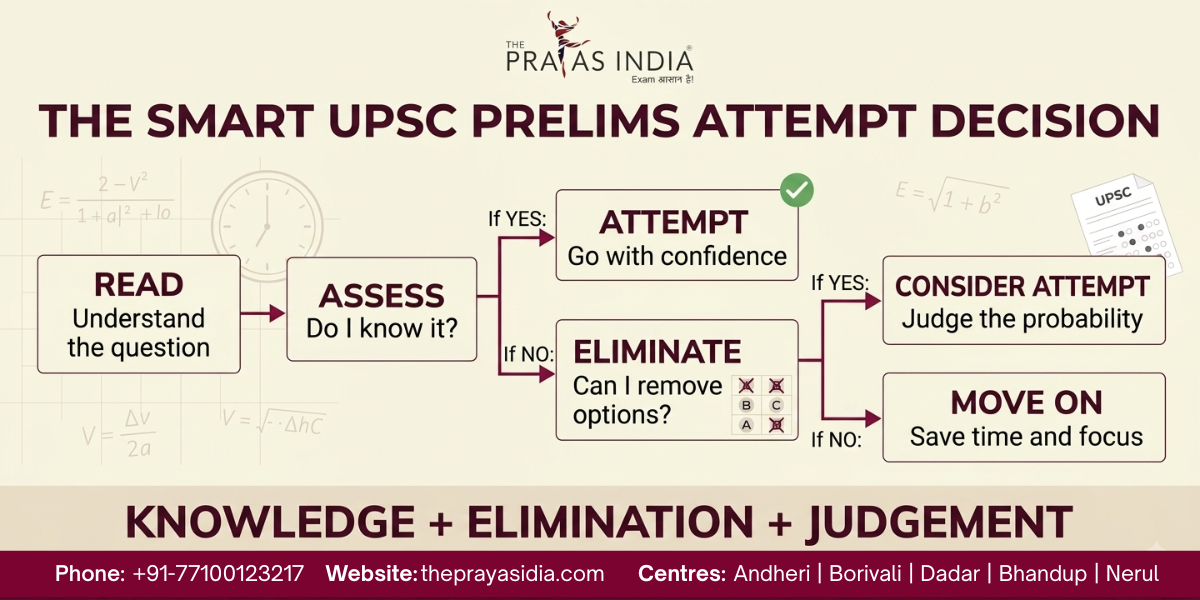
When you encounter a question, first identify:
What exactly is being asked?
Is it asking for:
- The correct statement?
- The incorrect statement?
- Statements that are correct?
- A pair or combination?
- The most appropriate explanation?
- A factual identification?
A candidate can know the subject and still choose the wrong answer because the question was misread.
Under exam pressure, this becomes even more likely.
Therefore, question selection is partly about reading discipline.
Watch Out for Absolute Statements
Words such as:
always, only, never, completely, exclusively, all, none
deserve attention.
They do not automatically make a statement incorrect, but they can indicate that the statement needs closer examination.
UPSC often tests whether a candidate can distinguish between broad generalisations and precise statements.
However, do not turn this into a mechanical rule.
Avoid thinking:
“The statement contains ‘always’, so it must be wrong.”
That itself can become a trap.
Instead, treat such wording as a signal to examine the statement more carefully.
Build an Elimination-Based Mindset
One of the most useful skills for UPSC Prelims is learning to work with incomplete information.
You will encounter questions where you do not immediately know the correct answer.
That does not necessarily mean you should leave the question.
First ask whether you can eliminate any options.
Elimination may come from:
- Basic conceptual understanding
- Knowledge of a related topic
- Contradictory wording
- Internal inconsistency
- Incorrect factual association
- Understanding of constitutional or administrative principles
- Awareness of broad scientific or environmental concepts
The objective is not to manufacture certainty.
It is to improve the probability of making the correct decision.
Don’t Treat Elimination as Guesswork
There is an important difference between elimination and blind guessing.
If you can confidently eliminate two options and are left with two possibilities, you have changed the nature of the decision.
You may still be uncertain, but your uncertainty is informed.
On the other hand, selecting an option without understanding the question or eliminating anything is essentially a blind guess.
Your mock analysis should therefore track these separately.
For example:
| Attempt Type | What It Means | What to Analyse |
|---|---|---|
| Certain | You knew the answer | Was your confidence justified? |
| Elimination | You reduced options | Was your elimination logically valid? |
| Guess | Little supporting knowledge | Was the risk worth taking? |
| Avoided | You left the question | Could it have been attempted? |
This type of analysis gives you much more useful information than simply counting attempts.
Practise Question Selection With Previous-Year Questions
UPSC Previous Year Questions should not be used only for checking how much of the syllabus you remember.
They can also be used as a decision-making laboratory.
Take a set of questions and, before checking the answers, classify each question.
For every question, mark:
A — High confidence
B — Elimination possible
C — Low confidence
Then attempt the questions according to your strategy.
After checking the answers, compare your decisions with the actual outcomes.
This allows you to identify patterns.
Perhaps you discover that you frequently leave questions that you could have solved through elimination.
Or perhaps you discover that you overestimate your confidence in certain subjects.
Both findings are valuable.
Use Mock Tests to Measure Selection Quality
A mock test becomes much more useful when you analyse the questions you attempted and did not attempt.
For attempted questions, ask:
Was the attempt justified?
For unattempted questions, ask:
Should I have considered attempting this?
This second question is often ignored.
A candidate may have left a question because it looked unfamiliar, only to discover later that two options could easily have been eliminated.
That is a missed opportunity.
Similarly, a candidate may discover that several incorrect answers came from questions where there was no real basis for attempting.
That is a selection problem, not simply a knowledge problem.
Create a Question Selection Sheet
After every mock, create a simple analysis table.
| Question | Attempted? | Confidence | Result | Decision |
|---|---|---|---|---|
| Q1 | Yes | High | Correct | Good attempt |
| Q2 | Yes | Medium | Wrong | Review elimination |
| Q3 | No | Medium | Correct answer known later | Missed opportunity |
| Q4 | Yes | Low | Wrong | Risky attempt |
Over time, this sheet can reveal your behavioural patterns.
You may find that your biggest problem is not lack of knowledge.
It may be:
Overconfidence.
Excessive caution.
Poor reading.
Weak elimination.
Impulsive attempts.
That is precisely why question selection deserves dedicated preparation.
The Role of Time in Question Selection
Question selection is not independent of time management.
A question may be worth attempting in the first phase of the examination but not worth spending several minutes on when time is running short.
Your decision should therefore consider both:
Potential value
and
Time cost
A question that appears solvable but requires a long chain of calculations may not always be the best immediate choice.
Similarly, a conceptual question that you can answer quickly may deserve priority.
This is why experienced test-takers often appear to be “skipping” questions.
They are not necessarily avoiding them.
They are allocating their time strategically.
Don’t Let the First Few Questions Decide Your Strategy
The beginning of a Prelims paper can strongly influence your psychology.
If the first few questions look unfamiliar, you may panic and start thinking that the entire paper is difficult.
If the first few questions are easy, you may become overconfident and start attempting too aggressively.
Both reactions can be harmful.
Instead, treat the paper as a collection of individual decisions.
The difficulty of three consecutive questions does not necessarily predict the difficulty of the entire paper.
Stay flexible.
The Foundation of Better Question Selection
Improving UPSC Prelims question selection does not begin with a magic attempt number.
It begins with understanding your own decision-making behaviour.
You need to know which questions you can answer confidently, which ones you can approach through elimination and which ones are based primarily on uncertainty.
Then you need to practise those decisions repeatedly through previous-year questions and mocks.
The most important shift is this:
Don’t prepare only to answer questions. Prepare to decide which questions deserve your answer.
That distinction can make your Prelims preparation far more strategic.
Build Your Own Attempt Strategy Instead of Copying Someone Else’s
One of the most common mistakes aspirants make is searching for a fixed number of questions to attempt.
You may hear someone say that they attempted a particular number of questions and cleared Prelims. Another candidate may recommend a completely different number.
Neither number should automatically become your target.
Your ideal attempt level depends on several factors:
- Accuracy
- Ability to eliminate options
- Subject-wise strengths
- Risk tolerance
- Paper difficulty
- Negative-marking exposure
- Time management
- Quality of your preparation
A candidate with consistently high accuracy may be comfortable taking more calculated risks than someone whose accuracy fluctuates significantly.
Therefore, your goal should be to discover your own reliable attempt range through repeated mock analysis.
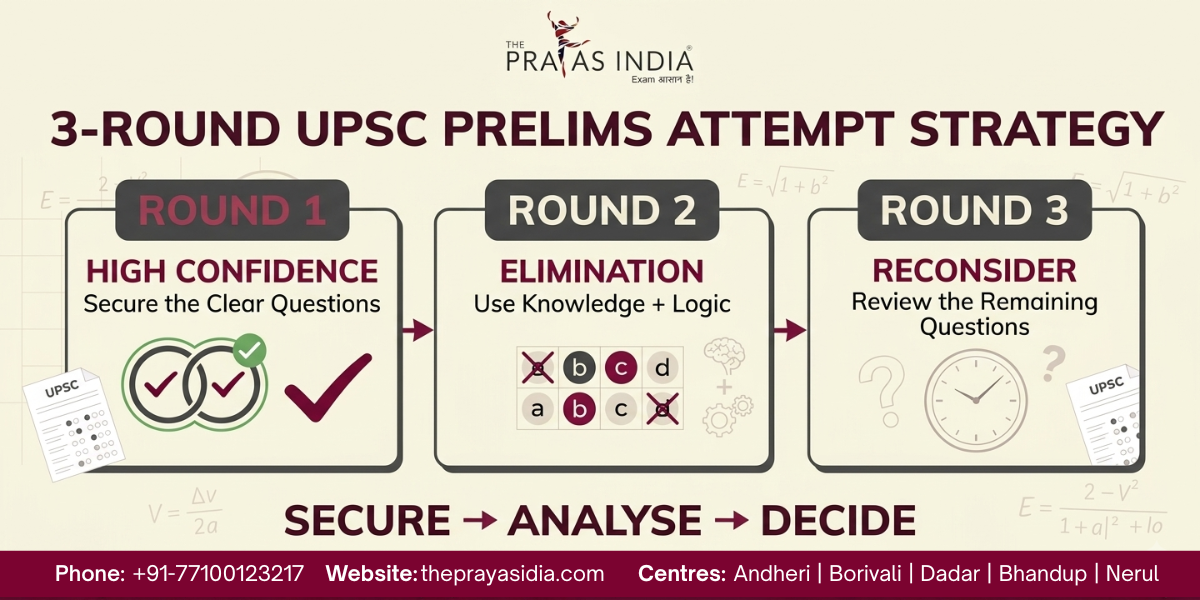
The Three-Round Approach to Question Selection
A useful way to structure the paper is to think in terms of rounds rather than trying to decide everything at once.
Round 1 — High-Confidence Attempts
Start with questions where the answer or approach is reasonably clear.
These questions should not require excessive deliberation.
The purpose is to secure marks efficiently and establish control over the paper.
Round 2 — Elimination-Based Questions
After dealing with the questions you are most comfortable with, move toward questions where you can eliminate options.
Here, your subject knowledge, conceptual understanding and familiarity with UPSC patterns become important.
Round 3 — Reconsideration
Only after reviewing the stronger opportunities should you revisit questions that initially appeared uncertain.
At this stage, you can decide whether additional thinking, elimination or contextual understanding provides enough basis for an attempt.
This structure prevents you from spending too much time on difficult questions at the beginning.
Don’t Treat Every Subject the Same Way
Question selection can also vary according to the nature of the subject.
A candidate may have strong conceptual understanding in Polity but comparatively weaker confidence in Environment or Science & Technology.
That means your risk assessment should not be identical across every section.
For example, a candidate with strong Polity preparation may quickly recognise whether a statement is consistent with constitutional principles. The same candidate may be more cautious when dealing with an unfamiliar scientific concept.
This is not a weakness.
It is an important part of understanding your own preparation profile.
Subject-Wise Question Selection
Polity
Polity questions can often reward conceptual clarity.
If you understand constitutional provisions, institutional relationships and basic governance principles, you may be able to evaluate statements even when the exact wording is unfamiliar.
However, avoid assuming that a familiar constitutional term automatically makes the question easy.
Read each statement carefully.
History
History can contain both direct knowledge-based questions and questions requiring contextual understanding.
If a question involves a fact you know confidently, it may be a straightforward attempt.
If the question contains unfamiliar names, events or chronological relationships, examine whether your broader understanding allows meaningful elimination.
Avoid making a decision solely because an option “sounds historical.”
Geography
Geography can benefit from conceptual understanding.
Maps, physical processes, climate systems and geographical relationships can sometimes help you eliminate options even when you do not remember a specific fact.
A strong conceptual foundation therefore improves question selection.
Economy
Economy questions can become easier to approach when fundamental concepts are clear.
Instead of memorising isolated terms, understand relationships between concepts.
If an unfamiliar statement contradicts a fundamental economic principle you understand, that knowledge may help with elimination.
Environment
Environment often contains questions where multiple statements appear plausible.
This makes careful reading especially important.
Avoid selecting an answer simply because the topic sounds familiar.
Look for conceptual inconsistencies, factual relationships and the precise wording of each statement.
Science & Technology
Science and Technology can contain unfamiliar terminology.
Don’t automatically panic when you see a technical word.
Ask whether the question provides enough contextual information to evaluate the options.
If you genuinely lack the knowledge required and cannot eliminate meaningfully, excessive confidence can be dangerous.
Learn to Identify “False Confidence”
One of the most important findings from mock analysis is that confidence is not always equal to correctness.
You may mark a question as “high confidence” and still get it wrong.
That deserves special attention.
Suppose you repeatedly make mistakes in questions where you felt 80–90% certain.
The problem may not simply be knowledge.
You may be:
- Reading too quickly
- Ignoring qualifiers
- Assuming a familiar concept
- Overlooking a negative statement
- Selecting an option based on partial memory
This is why confidence tracking is valuable.
Maintain a Confidence vs Accuracy Record
After every mock, compare what you thought with what actually happened.
| Confidence Level | Questions | Correct | Accuracy |
|---|---|---|---|
| High | 20 | 17 | 85% |
| Medium | 18 | 11 | 61% |
| Low | 12 | 5 | 42% |
The exact numbers will differ for every candidate.
The purpose is to identify whether your confidence is calibrated correctly.
If your high-confidence accuracy is poor, you may need to improve reading discipline and conceptual understanding.
If your medium-confidence questions have surprisingly good accuracy, you may be too conservative.
Improve Elimination Skills Through Structured Practice
Elimination should not remain an abstract idea.
Practise it deliberately.
Take a set of UPSC questions and hide the correct answers.
For every question, write down:
What do I know?
What do I not know?
Which options can I eliminate?
Why can I eliminate them?
How strong is my remaining probability?
This forces you to make your reasoning explicit.
Over time, you become better at distinguishing between genuine elimination and wishful thinking.
Never Create Fake Rules for UPSC Options
Aspirants sometimes collect shortcuts such as:
- The longest option must be correct.
- Extreme statements are always wrong.
- Option C is more frequently correct.
- Two similar options mean one must be correct.
- A technical-sounding statement is probably correct.
These are not reliable strategies.
UPSC question selection should be based on knowledge, reasoning, elimination and judgement, not mechanical option patterns.
If a shortcut helps you understand a concept, fine.
But it should never replace actual preparation.
Use Previous-Year Papers to Understand the Nature of Uncertainty
Previous-year questions are particularly valuable because they show you the kind of uncertainty you may face.
Some questions are difficult because you don’t know the fact.
Others are difficult because two options appear plausible.
Some are difficult because the wording is subtle.
Others test whether you can connect two areas of knowledge.
Your preparation should expose you to all these forms of uncertainty.
The objective is not to eliminate uncertainty completely.
It is to become better at making decisions despite uncertainty.
Don’t Change Your Strategy Every Time a Mock Goes Bad
A poor mock can create a strong temptation to completely redesign your attempt strategy.
You may suddenly decide to attempt far fewer questions.
Or you may conclude that you need to attempt much more aggressively.
Avoid making such decisions based on a single test.
Look for patterns across several mocks.
For example:
Mock 1: 65 attempts, 70% accuracy
Mock 2: 67 attempts, 73% accuracy
Mock 3: 64 attempts, 76% accuracy
Mock 4: 66 attempts, 75% accuracy
This gives you a much more useful picture than one isolated result.
Your strategy should evolve through evidence, not emotion.
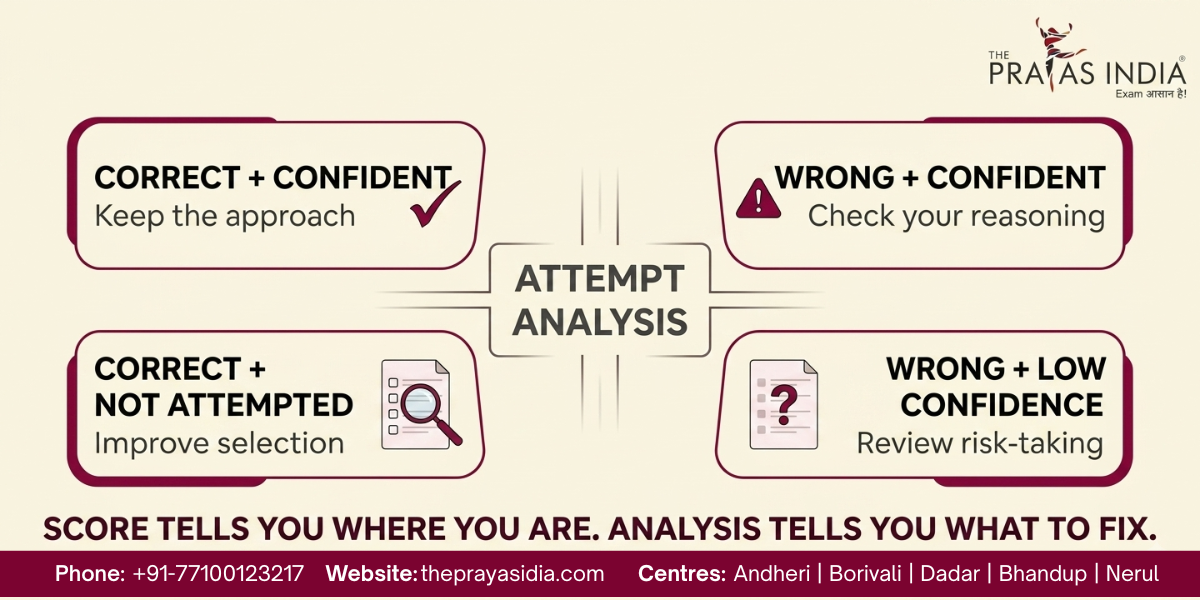
Analyse the Questions You Left Behind
This deserves special emphasis.
Most aspirants analyse their wrong attempts.
Fewer analyse their unattempted questions.
After every mock, review the questions you left.
Classify them:
Correct Decision
You genuinely lacked enough information.
Missed Opportunity
You could have eliminated options or solved the question.
Time-Management Failure
You could have attempted it if you had managed earlier questions better.
Fear-Based Decision
You knew enough but avoided the question because you were afraid of negative marking.
This analysis can significantly improve your future selection.
Analyse the Questions You Should Not Have Attempted
Now look at your wrong attempts.
Ask a difficult question:
“If I had seen this question again, would I still attempt it?”
If the answer is no, the lesson is not necessarily that you need to study the topic more.
The lesson may be that your selection threshold was too low.
This is a powerful distinction.
Otherwise, you may spend hours studying every question you got wrong without recognising that some of those questions were simply poor attempts.
Build a Personal Attempt Profile
After several mocks, create your own profile.
For example:
Strength: Strong conceptual questions
Weakness: Over-attempting unfamiliar factual questions
Strength: Good elimination in Polity
Weakness: Poor confidence calibration in Environment
Strength: Quick reading
Weakness: Rushing the final section
This profile becomes your personal question-selection strategy.
It is much more useful than copying a generic strategy from another aspirant.
A Practical Mock-Test Routine for Better Question Selection
If you want to systematically improve your selection skills, don’t stop at taking mocks.
Follow a three-stage process.
Before the Mock
Decide your broad approach.
Know how you intend to handle:
- High-confidence questions
- Elimination-based questions
- Difficult questions
- Time pressure
Do not set an arbitrary attempt number that forces you to take unnecessary risks.
During the Mock
Focus on decisions rather than the final score.
Ask:
Do I know this?
Can I eliminate?
Is this worth my time?
Should I move on?
After the Mock
Analyse:
What did I attempt?
What did I leave?
Where was my judgement correct?
Where was it wrong?
Which mistakes are recurring?
This turns mock testing into a genuine skill-building exercise.
How to Improve Question Selection in the Final Weeks
As Prelims approaches, your strategy should become more stable.
The final weeks are not the ideal time to completely reinvent your approach.
Instead, use your previous mocks to identify:
- Your comfortable attempt range
- Your strongest subjects
- Your risky areas
- Your common selection mistakes
- Your elimination strengths
- Your time-management problems
Then practise that strategy repeatedly.
The objective is to make your decision-making feel familiar before entering the examination hall.
What If You Are Too Conservative?
Under-attempting can be just as problematic as over-attempting.
If you repeatedly leave questions where you could eliminate options effectively, your fear of negative marking may be controlling your strategy.
To address this, analyse your unattempted questions.
If a significant number were actually reasonable attempts, practise taking calculated risks in your mocks.
The objective is not to become aggressive.
It is to become appropriately confident.
What If You Are Attempting Too Many Questions?
If your accuracy is consistently poor and many wrong answers come from low-confidence questions, your selection threshold may be too low.
In that case, don’t simply increase your subject-wise study hours.
First examine why you are attempting those questions.
Are you:
- Guessing because you feel pressure?
- Trying to compensate for a low number of attempts?
- Getting influenced by familiar keywords?
- Spending too much time on uncertain options?
- Assuming elimination without sufficient evidence?
Fixing the decision process may improve your score faster than simply adding more attempts.
How UPSC Coaching Can Help Improve Question Selection
For aspirants looking for UPSC Coaching in Mumbai, structured guidance can be particularly useful when the problem is not simply syllabus coverage but examination strategy.
A good preparation environment can provide:
Conceptual classes to strengthen subject understanding.
Previous-year question analysis to understand UPSC’s style of questioning.
Regular mock tests to practise decision-making.
Performance analysis to identify patterns in attempts and mistakes.
Mentorship to refine individual strategy.
Doubt resolution to prevent conceptual gaps from becoming recurring problems.
However, coaching should not replace independent decision-making.
The purpose of guidance is to help you develop your own reliable examination strategy.
Don’t Chase the “Perfect Attempt Strategy”
There is no universally perfect number of attempts.
There is only a strategy that is appropriate for your preparation level, accuracy and the paper in front of you.
A strategy that works beautifully in one mock may need adjustment in another because the difficulty and distribution of questions can change.
Therefore, flexibility matters.
Your framework should remain stable, but your decisions should respond to the actual paper.
Final 30-Day Question Selection Practice
If you are approaching Prelims, you can dedicate specific time to question-selection training.
Week 1
Analyse previous-year questions and classify them into:
High confidence / Elimination / Low confidence
Week 2
Take timed sectional tests and focus on selection rather than only score.
Week 3
Analyse multiple full-length mocks and identify recurring selection errors.
Week 4
Practise your refined strategy under exam-like conditions.
The goal is to enter the examination with a process that feels familiar.
Frequently Asked Questions
1. How important is question selection in UPSC Prelims?
Question selection is an important part of Prelims strategy because candidates have to balance knowledge, negative marking, time and uncertainty. A strong attempt strategy can help prevent both unnecessary risks and excessive caution.
2. How many questions should I attempt in UPSC Prelims?
There is no universally correct number. Your ideal attempt range should be based on your accuracy, elimination ability, preparation level and mock-test performance rather than someone else's strategy.
3. Should I attempt questions where I can eliminate two options?
Elimination can make an uncertain question more manageable, but it should be based on genuine reasoning or knowledge. Don't treat elimination as a justification for blind guessing.
4. How can I improve my elimination skills?
Practise previous-year questions and mock questions by explicitly identifying which options you can eliminate and why. Reviewing your reasoning after checking the answer helps improve elimination quality.
5. Should I analyse questions that I did not attempt?
Absolutely. Some unattempted questions may represent correct decisions, while others may reveal missed opportunities. Analysing both types helps improve your selection strategy.
6. How can I avoid over-attempting in Prelims?
Track the confidence level and outcome of your attempts. If many wrong answers come from low-confidence questions, review why you attempted them and establish a stronger selection threshold.
7. How can I avoid under-attempting?
Review the questions you left unanswered. If you repeatedly discover that you could have eliminated options or reached the answer through concepts you knew, practise taking more calculated risks.
8. Should I change my strategy based on every mock?
No. Look for patterns across multiple tests. Changing your strategy after every poor mock can create inconsistency and increase anxiety.
9. Can UPSC coaching help with question selection?
A structured UPSC coaching programme can provide mock tests, previous-year question analysis, mentorship and performance feedback that help candidates develop stronger examination strategies.
10. What is the biggest mistake in UPSC Prelims question selection?
One major mistake is treating every question equally. Candidates should learn to distinguish between high-confidence questions, elimination-based opportunities and questions where an attempt carries unnecessary risk.
Final Takeaway
UPSC Prelims question selection is ultimately about decision quality.
You cannot control the exact questions that appear in the paper. You cannot guarantee that every topic you studied will be tested. You cannot eliminate uncertainty completely.
What you can control is how you respond to that uncertainty.
Read carefully.
Recognise what you know.
Use elimination where it is justified.
Manage your time.
Avoid emotional attempts.
Review the questions you leave.
Analyse your mistakes.
And most importantly, develop a strategy based on your own performance data.
The strongest Prelims strategy is not the one that sounds most aggressive or most conservative.
It is the one you have tested repeatedly and can execute calmly.
For aspirants considering UPSC Coaching in Mumbai, structured preparation, regular mock testing and detailed performance analysis can provide valuable support in developing this skill. The right guidance should help you become more independent in your decision-making rather than simply giving you a fixed formula to follow.
Ultimately, clearing UPSC Prelims is not about answering every question.
It is about making better decisions on the questions that matter.
Contact Us
📞 Call Now: +91-77100 13217
🌐 Website: theprayasindia.com