How to Prepare CSAT for UPSC Prelims Without Ignoring It? | Best UPSC Coaching in Mumbai | The Prayas India
Introduction: The Paper That Should Never Become an Afterthought
For many UPSC aspirants, CSAT begins as a paper that appears manageable. Since it is qualifying in nature, candidates often assume that the time spent on General Studies can compensate for limited preparation in CSAT. This assumption can become risky, particularly for aspirants who are comfortable with reading comprehension but have not practised quantitative aptitude, logical reasoning or data interpretation for a long time.
CSAT is not simply a paper that needs to be “cleared somehow”. It is a test of whether you can solve different types of questions accurately under considerable time pressure. The challenge becomes greater because the paper combines reading comprehension with numerical and reasoning-based questions. A candidate may understand the concepts but still lose marks because of slow calculations, poor question selection, inadequate practice or spending too much time on one difficult passage.
The right approach is therefore neither to over-prepare for CSAT nor to ignore it until the final weeks. The objective should be to build sufficient competence, accuracy and confidence well before the Prelims examination, while keeping General Studies as the primary focus of your preparation.
For serious UPSC aspirants, this balance is particularly important because Prelims preparation involves managing several competing demands. A structured study routine can help you protect a fixed amount of time for CSAT without allowing it to disrupt your GS preparation.
Understand the Role of CSAT Before Planning Your Preparation
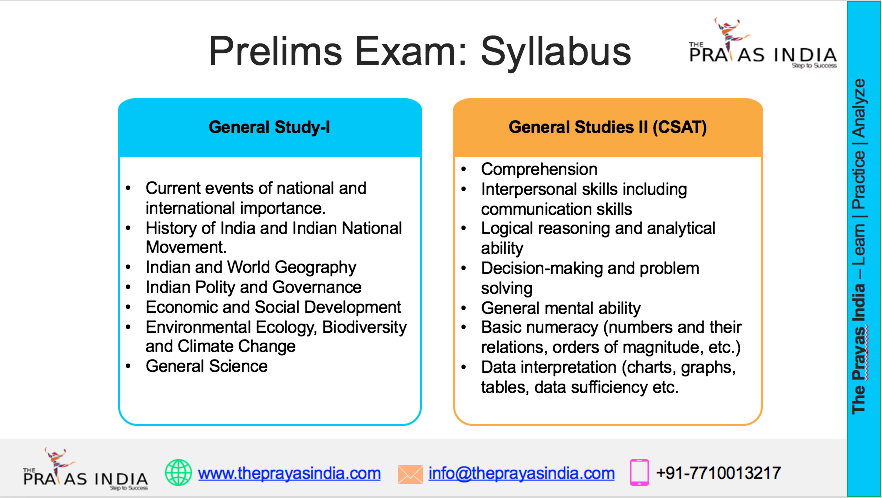
The first step is to understand what CSAT actually demands from you. The paper broadly tests areas such as reading comprehension, communication-related understanding, logical and analytical reasoning, decision-making, basic numeracy and data interpretation. Although the paper is qualifying, the qualifying requirement means that a candidate cannot afford to treat it as irrelevant.
The qualifying nature of CSAT changes the preparation strategy, but it does not eliminate the need for preparation. Your objective is not necessarily to maximise your score in the way you would approach GS Paper I. Instead, you need to develop enough command over the different sections to consistently remain above the qualifying requirement with a comfortable margin.
This distinction is important. A candidate who prepares only to cross the qualifying threshold may find themselves vulnerable on an unexpectedly difficult paper. A safer strategy is to build a buffer through regular practice so that variations in difficulty, pressure or time management do not put the result at risk.
Think of CSAT preparation as risk management. You are protecting your entire Prelims attempt from a paper that can become difficult if ignored.
Why Aspirants Tend to Ignore CSAT
There are several reasons why CSAT gets pushed to the side during UPSC preparation. The most obvious is the sheer size of the General Studies syllabus. With subjects such as polity, history, geography, economy, environment, science and technology and current affairs demanding continuous attention, candidates naturally feel that every available hour should go towards GS.
Another reason is familiarity. Candidates who have a background in mathematics or who performed well in aptitude-based examinations may assume that CSAT will require little effort. Similarly, candidates who are comfortable with English may underestimate the difficulty of the comprehension section.
The problem is that CSAT is not necessarily difficult because every question is conceptually advanced. It becomes difficult when speed, accuracy and decision-making have to work together.
A candidate may know how to solve a particular percentage problem but spend four minutes reaching the answer. Another candidate may understand a passage but select an incorrect option because they relied on assumptions rather than the information provided. These small issues can accumulate rapidly during the examination.
That is why your preparation should be based on your actual performance rather than your perception of your ability.
Take a CSAT Diagnostic Test Before Making a Study Plan
Before deciding how much time CSAT requires, take a full-length or sufficiently comprehensive diagnostic test under realistic conditions. Do not use the first test merely to obtain a score. Use it to understand your strengths and weaknesses.
Pay attention to the sections where you are comfortable and those where your performance drops. More importantly, record the amount of time you spend on different question types. A section may appear strong because you eventually solve its questions, but if you take too long, it may become a problem in the actual examination.
Your diagnostic analysis should answer questions such as:
- How comfortable are you with reading comprehension?
- Which quantitative topics cause repeated errors?
- Are your calculations sufficiently fast?
- Do you struggle with logical reasoning?
- How much time do you spend on difficult questions?
- Are your mistakes caused by concepts, calculations or interpretation?
- How many questions can you confidently attempt within the available time?
- Does your performance decline during the second half of the paper?
This diagnosis should become the foundation of your CSAT strategy.
If comprehension is your strength but quantitative aptitude is weak, your study plan should reflect that reality. If your concepts are adequate but your speed is poor, solving more theory-based questions may not be the most productive use of your time.
CSAT Preparation Should Be Personalised
There is no universal CSAT timetable that works equally well for every UPSC aspirant. Your preparation should depend on your existing aptitude, academic background, diagnostic performance and the amount of time available before Prelims.
A candidate with strong quantitative skills may need relatively little time for basic arithmetic but more practice in comprehension and reasoning. Another candidate may find reading comprehension natural but need sustained practice in percentages, ratios, averages, time and work or data interpretation.
This is why simply following someone else’s timetable can be misleading. A schedule that gives one hour of mathematics every day may be unnecessary for one candidate and insufficient for another.
Instead, divide your CSAT preparation into three broad categories: comfortable areas, manageable areas and vulnerable areas. Your comfortable areas need periodic revision, your manageable areas need regular practice and your vulnerable areas require focused improvement.
This creates a more efficient preparation cycle without allowing CSAT to consume disproportionate time.
Build a Sustainable CSAT Routine Alongside GS
The most effective way to avoid ignoring CSAT is to give it a fixed place in your weekly schedule from the beginning. You do not necessarily need to spend several hours every day on it. What matters more is consistency.
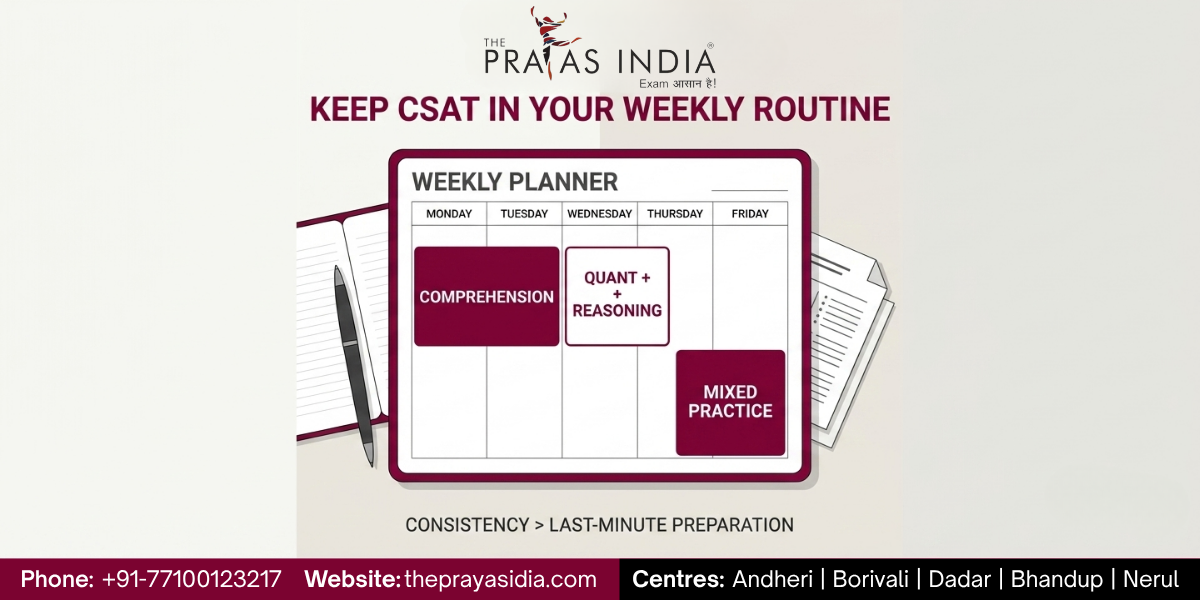
For many aspirants, a short but regular CSAT session can be more productive than studying it intensively once every few weeks. For example, you can dedicate selected days to comprehension, quantitative aptitude and reasoning while keeping one longer session for mixed practice or a sectional test.
The exact schedule should depend on your diagnostic performance. The key principle is that CSAT should remain active in your preparation throughout the Prelims cycle.
This also prevents the common problem of trying to relearn basic mathematics or reasoning concepts immediately before the examination. When preparation starts early, difficult areas can be improved gradually without creating pressure on the rest of the syllabus.
Focus on Reading Comprehension as a Skill, Not Just a Question Type
Reading comprehension is often one of the most important areas in CSAT because it tests how accurately you can understand information, identify the author’s argument and distinguish between what is explicitly stated and what can reasonably be inferred.
Many candidates make the mistake of reading passages too quickly because they believe speed is the only objective. In reality, comprehension requires a balance between reading speed and understanding. If you read quickly but repeatedly return to the passage because you missed its central idea, the apparent time saved disappears.
During practice, focus on understanding the structure of the passage. Identify the central argument, the role of supporting examples and the relationship between different ideas. Pay attention to words that indicate contrast, qualification, cause, consequence or conclusion.
Over time, this approach helps you read more efficiently because you begin to recognise how passages are constructed rather than treating every sentence as equally important.
Do Not Bring Outside Knowledge Into a Comprehension Question
One of the most common mistakes in CSAT comprehension is choosing an option because it sounds factually correct rather than because it is supported by the passage.
The examination is testing your ability to understand the given material. Your personal knowledge about economics, politics, history, science or society can sometimes become a distraction if it causes you to interpret the passage according to what you already believe.
When solving comprehension questions, return to the passage and ask what the author actually says or implies. An option can be factually true in the real world and still be incorrect if it does not follow from the passage.
This distinction becomes particularly important when two options appear plausible. Instead of choosing the option that sounds more knowledgeable, identify the one that is most directly supported by the author’s reasoning.
Develop a Reliable Approach to Quantitative Aptitude
For candidates who have been away from mathematics for several years, CSAT quantitative aptitude can initially appear intimidating. The solution is not to begin with difficult questions. Start by rebuilding the fundamentals.
Topics such as percentages, ratios, averages, profit and loss, simple and compound interest, time and work, time-speed-distance, basic algebra, number systems and data interpretation should be approached systematically.
The objective is not to become an advanced mathematics student. You need to develop the ability to recognise the underlying concept and apply it efficiently.
For example, a percentage question may look different from an earlier question because of the way it is worded, but the underlying method may remain the same. Repeated practice helps you identify these patterns.
As your familiarity improves, focus increasingly on speed and question selection. Knowing how to solve a question is useful, but knowing when to solve it is equally important.
Strengthen the Basics Before Chasing Difficult Questions
A common preparation mistake is spending too much time solving difficult questions because they create a feeling of progress. For a qualifying paper, your first objective should be to make the basic and moderate questions reliable.
If basic percentage questions still produce calculation errors, moving directly into advanced problems may not be efficient. Similarly, if you struggle to identify the main idea of a simple comprehension passage, attempting highly complex passages every day will not necessarily solve the underlying problem.
Build competence progressively. Start with fundamental concepts, practise standard question types, identify recurring errors and then increase difficulty.
This approach is particularly useful for aspirants from non-mathematics backgrounds because it reduces the psychological barrier that often develops around CSAT.
Reasoning Requires Pattern Recognition
Logical reasoning questions can appear unpredictable when you first encounter them, but regular practice gradually reveals recurring structures.
The key is to understand the logic behind a question rather than memorising a solution. Arrangement problems, statements and conclusions, sequences, conditions and other reasoning-based questions often require you to identify relationships and eliminate possibilities systematically.
During practice, do not immediately check the solution after getting stuck. Spend some time understanding why you are unable to progress. Perhaps you missed a condition, misunderstood the relationship or chose an inefficient approach.
The objective is to develop a habit of structured thinking under pressure.
The Importance of Question Selection in CSAT
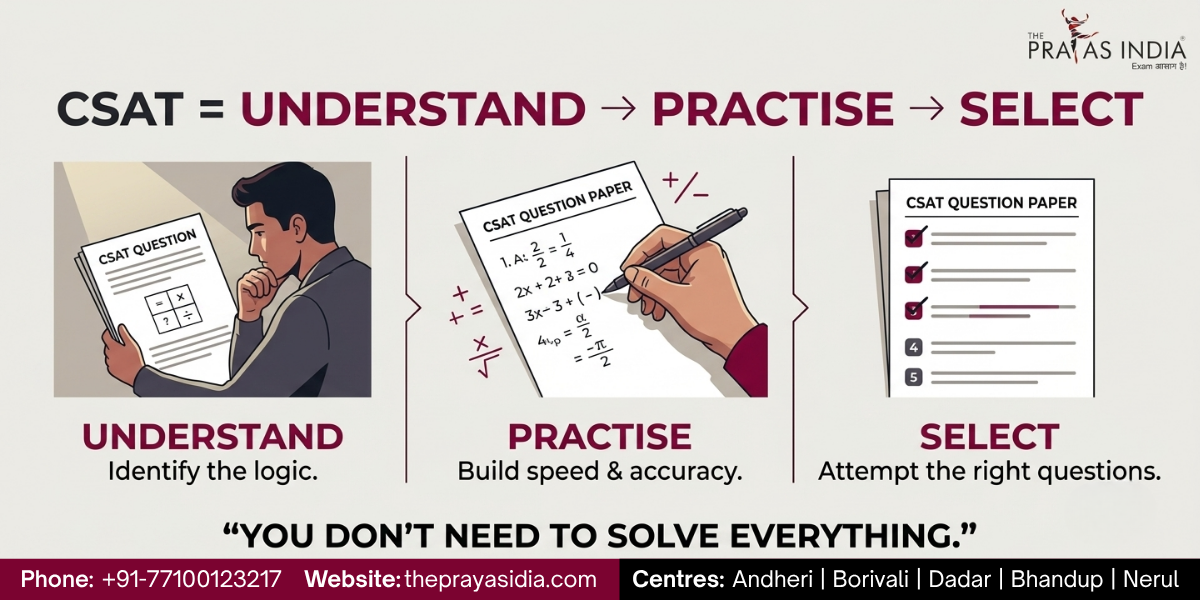
CSAT is not a paper in which you should approach every question with the same determination. Question selection can significantly influence your overall performance because difficult questions can consume disproportionate amounts of time.
During practice, start classifying questions into three broad categories: questions you can solve quickly, questions that require moderate effort and questions that are likely to consume excessive time.
This classification should become instinctive over time. During the actual examination, if a question appears unusually complicated, do not allow your initial investment of time to dictate your next decision. You can leave it temporarily and return later if time permits.
The objective is not to prove that you can solve every question. Your objective is to secure enough marks accurately and efficiently.
Accuracy Matters More Than Blind Attempting
Because CSAT is qualifying, some candidates believe that attempting a large number of questions is the safest strategy. This can be counterproductive if the additional attempts come with poor accuracy.
Your preparation should help you understand your own accuracy pattern. If you consistently make mistakes when rushing through calculations, increasing attempts without correcting that issue will not improve your result.
During mock analysis, distinguish between questions you got wrong because you did not know the concept and questions you got wrong because of avoidable mistakes. The second category is particularly important because it indicates that your knowledge may already be sufficient, but your execution needs improvement.
Over time, aim to develop a stable combination of accuracy, speed and controlled attempts rather than chasing an arbitrary number of questions.
Use Previous-Year Questions as a Reality Check
Previous-year CSAT questions are one of the most useful tools for understanding the actual nature of the examination. They show you how concepts are presented, how passages are framed and what kind of reasoning is expected.
Do not use previous-year papers only as mock tests. Analyse them topic by topic.
Look at the types of quantitative questions that repeatedly appear. Study the structure of comprehension passages. Observe the reasoning patterns and the level of difficulty. This helps you distinguish between what is genuinely relevant for UPSC and what may simply be excessive preparation material.
After completing a previous-year paper, revisit the questions you got wrong or skipped. Ask whether the issue was conceptual knowledge, calculation, comprehension, time pressure or poor question selection.
That analysis is often more valuable than simply knowing your final score.
CSAT Mock Tests Should Be Used for Diagnosis
Mock tests become useful only when you analyse them properly. Taking one test after another without reviewing mistakes can create the illusion of preparation without addressing the actual weaknesses.
After each mock, classify your performance. Which questions were easy but left unanswered? Which questions consumed too much time? Which errors were avoidable? Which topics repeatedly caused difficulty?
Maintain a simple performance record so that you can see whether your accuracy and speed are improving over several weeks.
If the same topic continues to create problems, return to the concept and practise it separately. If your concepts are strong but your performance drops because of time pressure, focus on timed sectional practice.
The mock is not the final objective. The improvement that follows the mock is the real objective.
Keep CSAT Preparation Proportional to Your Need
One of the biggest concerns among aspirants is whether dedicating time to CSAT will reduce the time available for GS. This is a valid concern, but the answer is not to ignore CSAT.
Instead, adjust the intensity according to your performance. If your diagnostic tests consistently show that you are comfortably above the qualifying requirement with good accuracy, you may need maintenance practice rather than extensive daily study.
If you are consistently close to the qualifying threshold or falling below it, CSAT needs more structured attention.
This approach keeps preparation balanced. You are neither spending excessive time on a paper that is already a strength nor discovering too late that your qualifying paper has become a major weakness.
Admission-Focused Preparation: The Value of Structured Guidance
UPSC preparation is a long process, and one of the biggest challenges is deciding where your limited study time should go. CSAT is a good example of this problem. Some aspirants spend too little time on it because they consider it easy, while others spend excessive time on areas they may not actually need.
A structured preparation environment can help aspirants identify these gaps through diagnostic tests, regular practice and performance analysis. The purpose is not to study more hours simply for the sake of studying. It is to make the hours you already have more productive.
For students exploring UPSC Coaching in Mumbai, factors such as faculty guidance, test practice, doubt support, study planning and regular performance evaluation can be considered alongside classroom teaching. The right academic environment should help an aspirant understand where to focus and how to improve without losing sight of the larger UPSC strategy.
The Prayas India has centres in Andheri, Borivali, Dadar, Bhandup and Nerul, giving Mumbai-based aspirants access to structured UPSC preparation support. For admission-related information, students can contact +91-77100123217.
Do Not Ignore CSAT, But Do Not Let It Take Over Your Preparation
CSAT preparation does not require you to abandon General Studies or spend every day solving aptitude questions. It requires something more practical: consistent exposure, honest diagnosis, targeted practice and controlled revision.
Start by taking a diagnostic test. Identify your weak areas rather than assuming where your weaknesses lie. Build fundamentals before attempting difficult questions, practise comprehension with attention to the author’s reasoning, strengthen quantitative concepts gradually and develop systematic approaches to reasoning.
Most importantly, practise question selection. The ability to recognise which questions deserve your time can be just as important as the ability to solve them.
As Prelims approaches, use mock tests and previous-year papers to measure whether your performance is stable. Aim to build a comfortable margin rather than relying on a last-minute attempt to cross the qualifying requirement.
CSAT should remain a supporting component of your Prelims strategy, not an ignored risk. With regular practice and the right balance between GS and CSAT, you can approach the qualifying paper with considerably greater confidence while keeping your primary preparation focused on the broader UPSC objective.
A Section-Wise Strategy for CSAT Preparation
Once you have understood your current level through a diagnostic test, the next step is to prepare each CSAT component according to its nature. Reading comprehension, quantitative aptitude and logical reasoning require different methods of preparation, so treating the entire paper as one subject is not the most efficient approach.
Your preparation should gradually move through three stages. In the beginning, the focus should be on understanding concepts and question patterns. The middle stage should combine concepts with timed practice, while the final stage should focus primarily on mock tests, accuracy, question selection and maintaining consistency.
The amount of time allocated to each section should depend on your performance. A candidate who is already comfortable with mathematics may need more attention on comprehension and reasoning, while someone from a non-quantitative background may need a longer foundation-building phase for numerical questions.
How to Prepare Quantitative Aptitude for CSAT
Quantitative aptitude can become the biggest source of anxiety for candidates who have not studied mathematics since school or college. However, CSAT preparation does not require you to approach mathematics at an advanced level. The focus should be on developing familiarity with commonly tested concepts and becoming efficient at solving manageable questions.
Begin with fundamental arithmetic. Percentages, ratios, averages, profit and loss, simple interest, time and work, time-speed-distance, mixtures, number systems and basic algebra are useful areas to build systematically. Data interpretation should also be practised because it combines numerical understanding with careful reading.
Do not try to complete the entire mathematical syllabus in a few days. Pick one topic, understand the underlying concept and solve a reasonable number of questions without worrying about speed initially. Once the method becomes familiar, introduce time limits and begin tracking your accuracy.
Your objective should eventually become recognising the structure of a problem quickly. When you see a question, you should be able to determine whether it is a straightforward application of a familiar concept, requires deeper calculation or is better left for later.
How to Improve CSAT Reading Comprehension
Reading comprehension should be treated as a daily or near-daily skill rather than something that can be mastered through occasional mock tests. Regular reading improves your ability to follow arguments, identify the central idea and understand the relationship between different statements.
However, simply reading newspapers or books is not enough. You need to practise question-oriented comprehension. After reading a passage, ask yourself what the author is actually trying to establish. Identify the central argument, supporting reasoning, assumptions and conclusion.
When solving questions, avoid selecting an option simply because it sounds reasonable. The correct answer must be supported by the passage. If two options appear similar, go back to the relevant portion and compare them against the author’s actual argument.
With consistent practice, you should gradually become better at distinguishing between an option that is directly supported, one that is partially supported and one that introduces an assumption that the passage does not justify.
How to Prepare Logical Reasoning for CSAT
Logical reasoning becomes easier when you stop treating every question as a completely new problem. Many questions are based on recurring forms of logical relationships, conditions and patterns.
Start by learning how to translate information into a structured form. Depending on the question, this may involve arranging information, identifying conditions, comparing possibilities or eliminating options.
The most useful habit is to understand why a particular approach works. If you solve a question by looking at the answer explanation, do not simply record the answer. Reconstruct the reasoning yourself and try another question of a similar type.
Over time, this process builds pattern recognition. You begin to spend less time figuring out what the question wants and more time applying the appropriate method.
How to Use CSAT Previous-Year Papers Properly
Previous-year papers should become a regular part of your preparation once your basic concepts are reasonably comfortable. They provide a much more realistic picture of the examination than random aptitude material.
Start by solving questions without immediately looking at the answers. Once you finish, divide the questions into four groups: correct and confident, correct but time-consuming, incorrect due to a conceptual problem and incorrect due to an avoidable mistake.
This classification can reveal problems that your overall score hides. For instance, you may score reasonably well but discover that several correct answers required far too much time. That means your preparation needs an efficiency upgrade rather than simply more conceptual study.
Similarly, if you repeatedly make errors in questions that you actually understand, your focus should shift towards calculation discipline, reading accuracy and checking methods.
Previous-year papers should therefore function as diagnostic tools, not just practice sheets.
Create a CSAT Error Notebook
Maintaining an error notebook can be particularly useful for CSAT because many mistakes repeat themselves. Instead of merely recording the correct answer, write down the reason for your mistake.
For example, you may have misunderstood a condition in a reasoning question, used the wrong formula in a quantitative question or selected an option in comprehension based on outside knowledge. These are different problems and require different solutions.
Over time, your error notebook will show patterns. If calculation errors appear repeatedly, you know that accuracy needs attention. If comprehension mistakes occur because you select extreme options, you can specifically work on option elimination. If you consistently spend too long on certain numerical questions, you can develop a clearer decision rule for skipping them.
This makes revision much more personalised than repeatedly solving questions without analysing why you get them wrong.
The Right Way to Attempt CSAT Mock Tests
Mock tests should eventually become a major component of your preparation, but they should not be introduced without a strategy. In the initial stage, sectional tests can help you understand individual areas. As Prelims approaches, full-length papers become increasingly important.
Attempt mocks under realistic conditions. Keep the environment as close to the examination as possible and avoid unnecessary interruptions.
During the test, observe your decision-making. If you encounter a difficult question, notice whether you can leave it without becoming emotionally attached to solving it. If you repeatedly spend several minutes on one problem, identify that pattern during analysis.
A mock should tell you more than your marks. It should tell you how you arrived at those marks.
How to Analyse a CSAT Mock Test
After every mock, spend enough time analysing the paper. This is where much of the actual learning happens.
Start with the questions you got wrong. Determine whether the reason was lack of knowledge, misunderstanding, calculation error, poor reasoning or rushing.
Then examine the questions you left unanswered. Some may have been genuinely difficult, while others may have been solvable with a better strategy. These questions can reveal potential marks that you are currently leaving on the table.
Finally, analyse the questions you got right but spent too much time solving. These are particularly important because they may become time-management problems during the actual examination.
Your analysis should ultimately answer one question: What should I change before my next test?
Develop a Clear Attempt Strategy
There is no universal number of questions that every candidate should attempt in CSAT. Your ideal attempt level depends on your accuracy, strengths and ability to handle time pressure.
What matters is developing a strategy that you have tested repeatedly.
You may begin with questions from your strongest section, move towards moderate questions and leave time-consuming problems for later. Alternatively, you may prefer to move through the paper sequentially while marking questions that require additional thought.
Both approaches can work. What matters is that you do not discover your strategy for the first time on examination day.
Use your mocks to test different approaches and identify which one gives you the best combination of speed, accuracy and confidence.
Don’t Let One Difficult Question Disturb the Entire Paper
Psychological management is an underrated component of CSAT. A difficult question can consume more than just the time spent solving it. If you become frustrated after several unsuccessful attempts, your concentration on subsequent questions may also decline.
Train yourself to recognise when a question is becoming unproductive.
If you have understood the problem but the calculations are becoming unnecessarily long, consider leaving it. If two options remain and you cannot establish which one is supported, move ahead. If a reasoning question requires a lengthy arrangement that is consuming disproportionate time, mark it for review.
Leaving a question is not a sign of weakness. It is a strategic decision when the opportunity cost of solving it becomes too high.
How Much CSAT Should You Study Every Week?
The answer depends on your current level. Someone who has recently completed a quantitative degree may need relatively limited concept revision, whereas an aspirant who has avoided mathematics for years may require a longer foundation phase.
For many candidates, a sustainable weekly routine can include several shorter practice sessions rather than one exhausting CSAT day. One session can focus on comprehension, another on quantitative aptitude and another on reasoning. A separate slot can be reserved for mixed questions or mock analysis.
As Prelims gets closer, the balance can gradually shift from concept-building towards timed practice and full-length tests.
The important point is consistency. CSAT should never disappear from your timetable for several weeks.
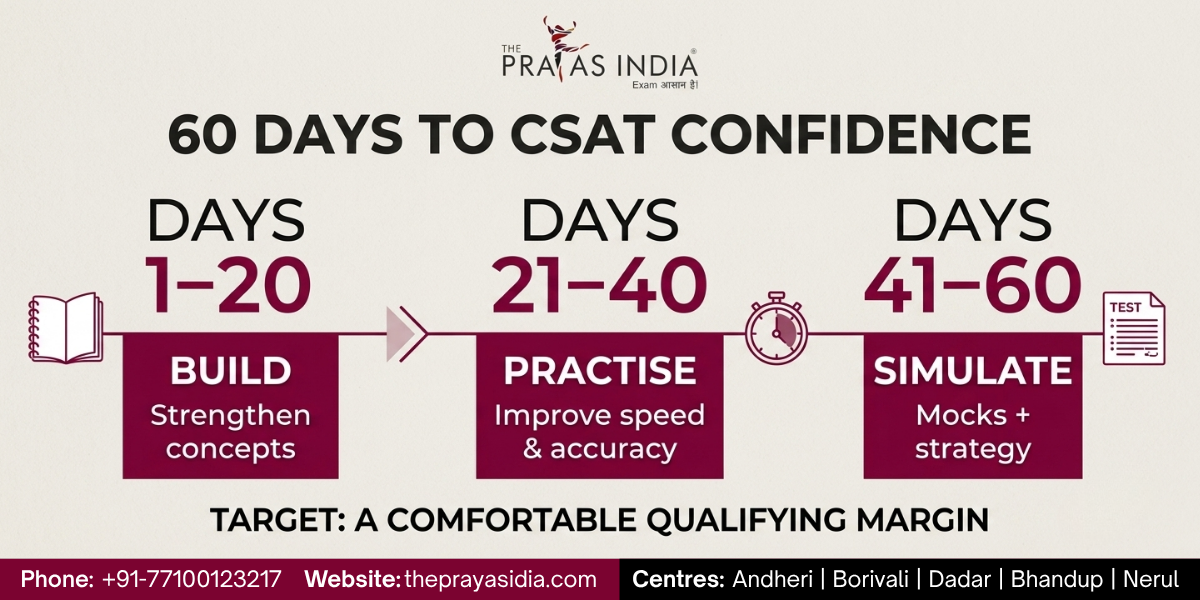
A Practical 60-Day CSAT Strategy
If you have approximately two months before Prelims, the preparation can be divided into three broad phases.
Phase 1: Strengthen the Foundation
During the first few weeks, identify weak areas and revise the necessary concepts. Focus on standard question types and practise without excessive time pressure.
The goal is to eliminate fundamental gaps rather than chase difficult questions.
Phase 2: Build Speed and Accuracy
Once the basics become comfortable, introduce timed sectional practice. Start measuring how long you take to solve different types of questions.
At this stage, your preparation should increasingly focus on reducing avoidable errors while maintaining comprehension and calculation accuracy.
Phase 3: Simulate the Examination
In the final weeks, increase the frequency of full-length CSAT tests. Practise your attempt strategy and analyse every mock carefully.
The focus should now be on maintaining a comfortable margin above the qualifying requirement and ensuring that your performance does not fluctuate significantly between tests.
What to Do in the Final 15 Days
The last two weeks should not be used to learn an enormous number of new concepts. Your priority should be stability.
Revise the topics that have repeatedly caused errors, practise selected comprehension passages, solve quantitative questions from familiar areas and take enough full-length tests to remain comfortable with the paper format.
Avoid comparing your preparation with candidates who claim to be solving extremely difficult aptitude questions. Your objective is not to demonstrate advanced mathematical ability. Your objective is to perform reliably in the actual CSAT paper.
At this stage, confidence should come from evidence. If your mock scores consistently remain comfortably above the qualifying level and your accuracy is stable, your preparation is moving in the right direction.
What If You Are Starting CSAT Very Late?
Starting late is not ideal, but it does not mean that the situation is hopeless. The first step is to avoid wasting time on random resources.
Take a diagnostic test immediately. Identify the sections where you can gain marks most efficiently and focus on fundamental concepts and previous-year questions.
Do not attempt to master every difficult mathematical topic. Prioritise areas where you can realistically improve. At the same time, continue practising comprehension because it can become a valuable scoring component for candidates who develop sufficient reading accuracy.
Most importantly, do not allow anxiety to replace preparation. A late start requires prioritisation, not panic.
Common CSAT Mistakes to Avoid
The first major mistake is assuming that qualifying means easy. CSAT can become challenging when the paper requires sustained concentration and time management.
The second mistake is postponing preparation until immediately before Prelims. This leaves very little time to identify and correct weaknesses.
The third mistake is solving only the sections you enjoy. Preparation should address your vulnerabilities rather than repeatedly reinforcing existing strengths.
Another common problem is depending entirely on shortcuts. Shortcuts can save time once the underlying concept is understood, but relying on them without conceptual clarity can increase errors.
Candidates also frequently ignore mock analysis. A test without analysis tells you your score, but it does not necessarily tell you how to improve.
Finally, some aspirants prepare without developing an attempt strategy. Knowing when to skip a question is an important examination skill and should be practised before the actual paper.
How Structured UPSC Preparation Can Help
The broader UPSC Prelims preparation process involves balancing a large GS syllabus with CSAT, current affairs, revision and mock tests. This makes planning particularly important.
A structured preparation environment can help an aspirant maintain that balance through regular classes, practice schedules, tests and performance evaluation. The benefit is not simply access to study material; it is having a framework that makes it easier to identify what requires attention at different stages of preparation.
For students considering UPSC Coaching in Mumbai, it can be useful to evaluate an institute based on the quality of its faculty, test practice, mentoring, study resources, doubt support and the consistency of its academic schedule. These factors can influence how effectively an aspirant uses the months available before Prelims.
The Prayas India has centres across Andheri, Borivali, Dadar, Nerul, and Bhandup. Aspirants who want to understand the available UPSC preparation options and admission process can connect with the institute at +91-77100123217.
The decision to join coaching should ultimately depend on your individual preparation needs, learning style and the level of guidance you require. The objective should be to find an environment that helps you remain consistent rather than simply adding more study material to an already demanding preparation process.
Final Takeaway
CSAT deserves a place in your UPSC Prelims strategy even though it is qualifying in nature. Ignoring it completely can create unnecessary risk, while over-preparing for it can take valuable time away from General Studies.
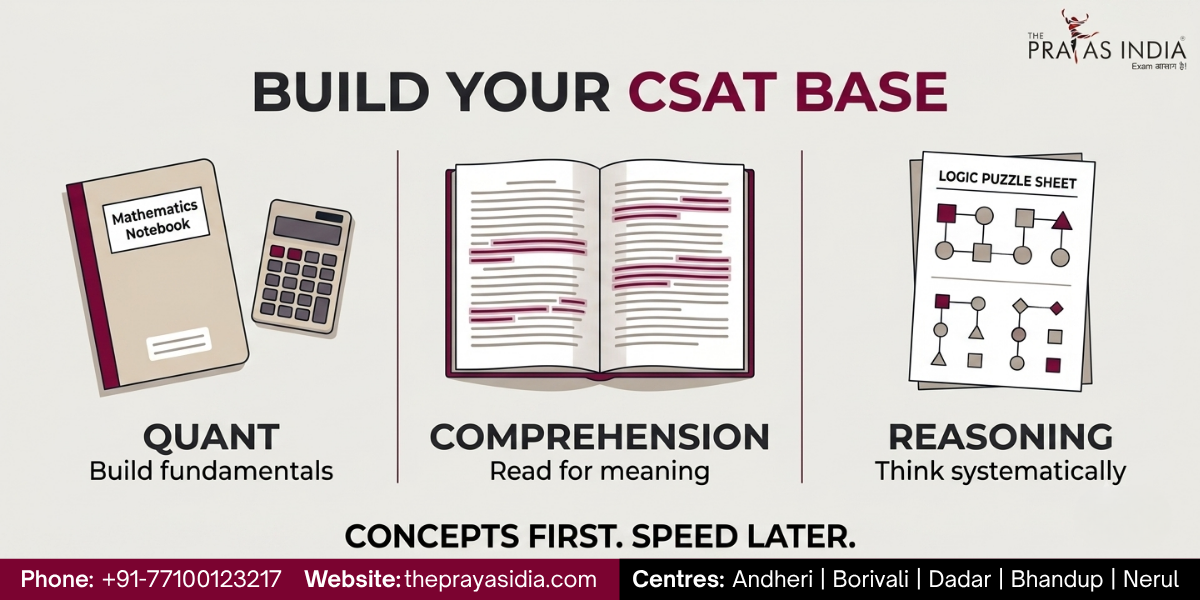
The most balanced approach is to assess your current level, identify your weak areas and maintain regular practice throughout the preparation cycle. Build your quantitative fundamentals, improve reading comprehension, develop structured reasoning skills and use previous-year questions to understand the actual demands of the paper.
As the examination approaches, shift towards timed practice, mock tests and question-selection strategies. Analyse every test carefully and aim for a comfortable margin rather than relying on last-minute preparation.
Ultimately, successful CSAT preparation is less about studying endlessly and more about becoming consistent, accurate and strategically selective.
For aspirants preparing for UPSC CSE in Mumbai, structured guidance can make it easier to maintain this balance alongside General Studies preparation. The Prayas India has centres at Andheri, Borivali, Dadar, Bhandup and Nerul, offering aspirants an option to explore organised UPSC preparation and academic support.
Frequently Asked Questions
1. Is CSAT difficult for UPSC aspirants?
CSAT can be challenging depending on an aspirant's background and preparation level. Candidates who are comfortable with mathematics, comprehension and reasoning may find it manageable, while those who have been away from these areas for a long time may require systematic practice. The difficulty is often related to combining accuracy and speed under examination conditions.
2. How much time should I dedicate to CSAT preparation?
There is no fixed number of hours suitable for every aspirant. Your time allocation should depend on your diagnostic performance. If you are consistently performing comfortably above the qualifying level, maintenance practice may be sufficient. If your scores are close to the qualifying threshold, you should allocate more structured time to CSAT.
3. Can I prepare for CSAT without coaching?
Yes. Candidates can prepare through self-study using reliable study material, previous-year questions and mock tests. However, structured guidance can be useful for aspirants who struggle to identify their weak areas, develop a study plan or analyse their performance objectively.
4. How should I prepare CSAT if I am weak in mathematics?
Start with fundamental arithmetic concepts instead of immediately attempting difficult questions. Build familiarity with percentages, ratios, averages, time and work, time-speed-distance, basic algebra and data interpretation. Once your conceptual foundation improves, gradually introduce timed practice.
5. Are previous-year CSAT papers important?
Yes. Previous-year papers help you understand the actual style, difficulty and recurring patterns of CSAT questions. They should be used not only for practice but also for analysing your strengths, weaknesses, speed and question-selection strategy.
6. Should I attempt every CSAT question?
No. The objective is to qualify comfortably, not necessarily to solve every question. You should develop the ability to identify questions that can be solved efficiently and avoid spending disproportionate time on difficult problems.
7. When should I start preparing for CSAT?
It is better to start early rather than waiting until the final weeks before Prelims. Even limited but consistent weekly practice can prevent CSAT from becoming a last-minute burden and gives you enough time to correct weaknesses.
8. Where can I find UPSC coaching in Mumbai?
The Prayas India has UPSC coaching centres in Andheri, Borivali, Dadar, Bhandup and Nerul. Aspirants can contact +91-77100123217 for admission-related information and guidance.