How to Prepare NCERTs for UPSC the Right Way | Best UPSC Coaching in Mumbai | The Prayas India
Build a Strong Foundation Before You Move to Advanced UPSC Preparation.
Every UPSC aspirant dreams of securing a top rank, but many begin their preparation by collecting multiple reference books, coaching notes, and online resources. In this process, they often overlook the most important foundation of UPSC preparation—NCERT textbooks.
The Civil Services Examination is not about memorising facts from numerous books. It is about developing conceptual clarity, analytical thinking, and the ability to connect different subjects. This is exactly where NCERTs play a crucial role.
Whether you are a beginner or someone preparing for another attempt, reading NCERTs the right way can make your preparation stronger, simpler, and more effective. They help you understand basic concepts before moving on to advanced reference books like Laxmikanth, Spectrum, GC Leong, or standard UPSC resources.
If your foundation is weak, even the best study material may seem difficult. But when your basics are clear, every advanced topic becomes easier to understand.
Why Every Serious UPSC Aspirant Should Begin with NCERTs
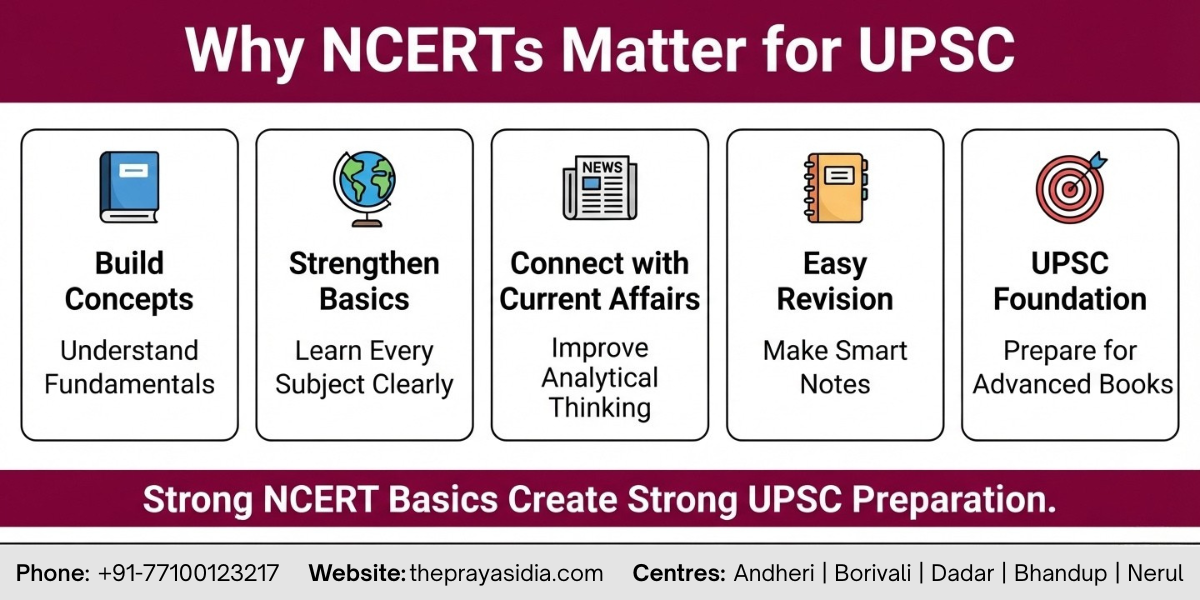
Many toppers recommend starting with NCERTs because these books are written in a simple, structured, and concept-oriented manner. Instead of overwhelming students with excessive information, they focus on helping readers understand the subject from the basics.
NCERTs are especially useful because they:
- Build conceptual clarity across subjects.
- Use simple language that is easy to understand.
- Explain complex topics in a logical sequence.
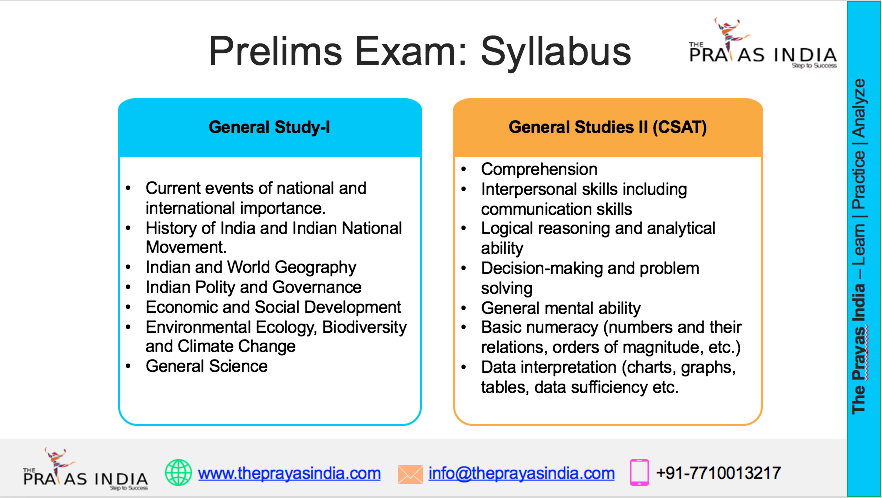
- Cover many areas directly relevant to the UPSC syllabus.
- Make it easier to understand advanced standard books later.
Rather than treating NCERTs as school textbooks, think of them as the first step towards mastering the UPSC syllabus.
Who Should Read NCERTs?
One common misconception is that NCERTs are only for beginners.
In reality, they are valuable for almost every UPSC aspirant.
You should prioritise NCERTs if you are:
- Starting UPSC preparation for the first time.
- Switching from another competitive examination.
- Struggling with conceptual clarity.
- Finding standard reference books difficult to understand.
- Restarting preparation after a long break.
Even experienced aspirants revisit important NCERT chapters during revision because these books simplify complex topics and strengthen retention.
Should You Read Every NCERT?
This is one of the most frequently asked questions among UPSC aspirants.
The answer is No.
Not every NCERT is equally important for the Civil Services Examination.
Instead of reading all books randomly, focus on subjects that have direct relevance to the UPSC syllabus.
The most commonly recommended NCERTs include:
- History
- Geography
- Polity (basic constitutional concepts)
- Economics
- Science
- Environment
- Society
Selecting the right books saves valuable preparation time and allows you to focus on high-priority topics.
Build the Right Foundation Before Moving to Advanced Books
Many aspirants make the mistake of starting with advanced reference books immediately. While these resources are essential later, they become much easier to understand after completing the relevant NCERTs.
For example:
- Geography NCERTs help before studying advanced geography resources.
- History NCERTs provide chronological understanding before modern history books.
- Economics NCERTs explain basic concepts that are frequently used in newspapers and government reports.
- Science NCERTs strengthen fundamental understanding for General Studies.
A strong foundation reduces confusion and improves long-term retention.
Expert Guidance Helps You Read NCERTs More Effectively
Reading NCERTs is important, but reading them strategically is even more important. Many aspirants spend months completing NCERTs without understanding what to highlight, how to make notes, or how to connect topics with the UPSC syllabus. Proper guidance helps students study smarter instead of simply reading more.
At The Prayas India, UPSC aspirants receive structured classroom programmes, expert faculty guidance, comprehensive study plans, topic-wise mentoring, current affairs integration, answer-writing support, and personalised preparation strategies that help convert NCERT knowledge into strong UPSC fundamentals.
Read NCERTs Like a UPSC Aspirant, Not Like a School Student
The way you read NCERTs determines how useful they become for your UPSC preparation.
Many aspirants complete several NCERT books but still struggle to answer basic UPSC questions. The reason is simple—they focus on finishing books instead of understanding concepts.
Reading NCERTs for UPSC is very different from reading them for school examinations.
Your objective is not to memorise every line.
Instead, you should develop the ability to understand topics, connect ideas across subjects, and identify concepts that frequently appear in the UPSC syllabus.
A systematic reading strategy saves time and makes revision much easier in the coming months.
Start with the Right NCERT Sequence
One of the biggest mistakes beginners make is reading books randomly.
UPSC preparation becomes much more organised when subjects are studied in a logical sequence.
A recommended approach is:
Step 1 – History
Build a basic understanding of ancient, medieval, and modern India.
Step 2 – Geography
Learn physical geography before moving to Indian and world geography.
Step 3 – Polity
Understand constitutional basics before studying advanced governance topics.
Step 4 – Economics
Focus on fundamental economic concepts instead of memorising definitions.
Step 5 – Science & Environment
Develop conceptual clarity about everyday scientific phenomena and environmental issues.
Studying subjects in this order creates a strong foundation for advanced UPSC books.
Use the Three-Reading Method
Reading an NCERT once is rarely enough.
Instead of trying to remember everything during the first reading, divide your study into three stages.
First Reading
Understand the chapter.
Do not worry about making notes.
Simply focus on learning the concepts.
Second Reading
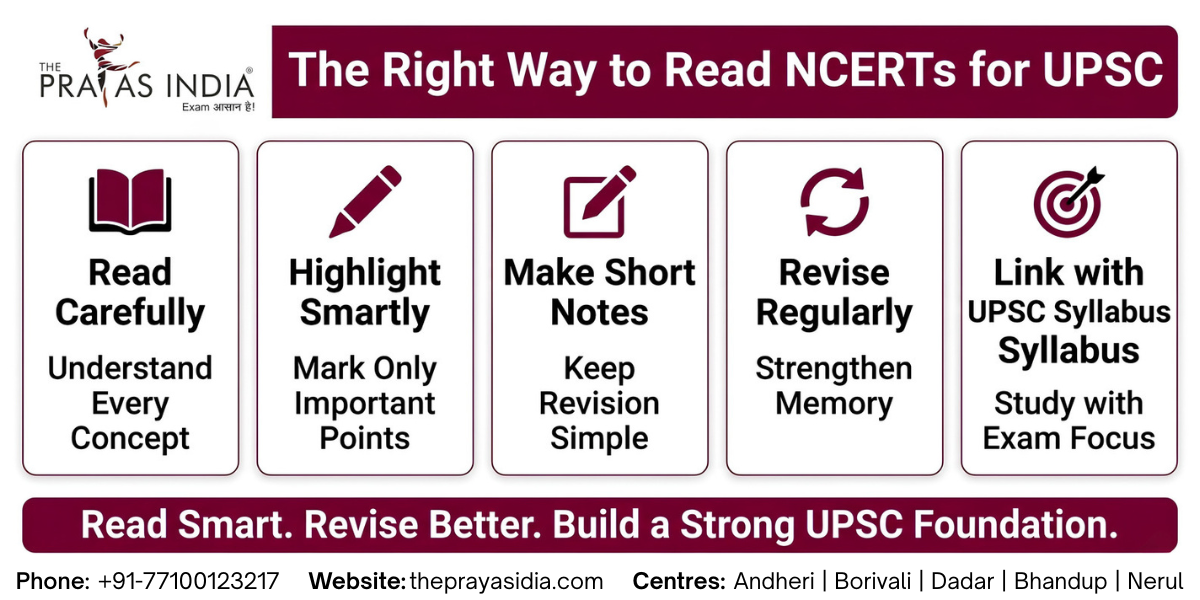
Highlight important facts, keywords, examples, dates, diagrams, and definitions.
Try to identify topics directly connected to the UPSC syllabus.
Third Reading
Prepare concise revision notes in your own words.
These notes will become your primary revision material before the examination.
This approach improves both understanding and long-term retention.
Don’t Highlight Everything
Many students end up colouring almost every page with highlighters.
This defeats the purpose of highlighting.
Only mark information that is:
- Frequently repeated.
- Conceptually important.
- Difficult to remember.
- Relevant to UPSC.
- Useful during revision.
The goal is to make future revision faster, not to decorate the book.
Create Short Notes Instead of Copying Chapters
Some aspirants spend hours rewriting entire chapters.
This consumes valuable preparation time.
Instead, prepare brief notes containing:
- Important concepts.
- Keywords.
- Flowcharts.
- Timelines.
- Maps where necessary.
- Important examples.
One page of well-organised notes is often more useful than ten pages of copied text.
Connect NCERTs with the UPSC Syllabus
Reading becomes more meaningful when every chapter is linked to the UPSC syllabus.
After completing a chapter, ask yourself:
- Which General Studies paper covers this topic?
- Can this concept be used in answer writing?
- Is it relevant for Prelims, Mains, or both?
- Can current affairs be connected with this topic?
This habit develops analytical thinking and prepares you for integrated UPSC preparation.
Maintain a Daily NCERT Reading Routine
Consistency matters far more than reading for long hours occasionally.
A simple daily routine can be highly effective.
For example:
Daily Plan
- Read 1–2 NCERT chapters.
- Prepare short notes.
- Revise yesterday’s notes.
- Connect one topic with current affairs.
- Solve a few UPSC-oriented practice questions.
Following a structured routine keeps preparation organised and prevents backlog.
Expert Guidance Helps You Study Smarter
Many UPSC aspirants complete NCERTs but remain unsure whether they are reading the right books, making effective notes, or focusing on exam-relevant topics. With proper mentorship, students learn how to connect NCERT concepts with the UPSC syllabus, current affairs, and answer writing, making every hour of study more productive.
At The Prayas India, aspirants receive expert faculty guidance, structured classroom programmes, topic-wise study plans, NCERT-based foundation classes, answer-writing support, current affairs integration, regular assessments, and personalised mentoring that help build a strong base for every stage of the UPSC examination.
Avoid These Common NCERT Mistakes That Slow Down Your UPSC Preparation
Reading NCERTs is important, but reading them incorrectly can waste months of valuable preparation time.
Many UPSC aspirants spend several months completing NCERTs but still struggle in Prelims and Mains. The problem is rarely the books themselves—it is usually the approach.
Some students keep reading the same chapters repeatedly without revising.
Others make lengthy notes that are never used again.
Many move to advanced books too early or collect multiple study resources before mastering the basics.
Recognising these mistakes early can save you significant time and make your preparation far more productive.
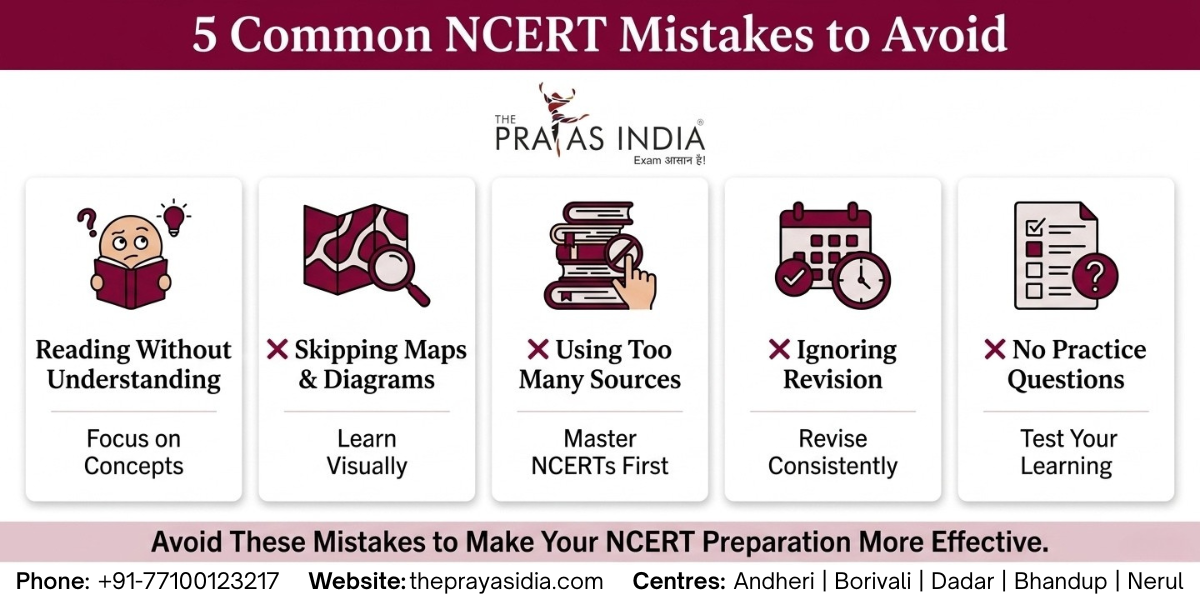
Mistake #1: Reading NCERTs Without Understanding the Concepts
One of the most common mistakes is treating NCERTs like storybooks.
Students often complete chapters quickly but never pause to understand the ideas behind them.
Instead of asking yourself, “How many pages did I finish today?”, ask:
- Did I understand the concept?
- Can I explain this topic in simple words?
- Can I relate it to the UPSC syllabus?
- Will I remember this during revision?
Conceptual clarity should always come before speed.
Mistake #2: Ignoring Maps, Diagrams and Illustrations
NCERTs contain maps, flowcharts, diagrams, timelines and illustrations that simplify complex topics.
Many aspirants skip these visual elements and focus only on the text.
However, these diagrams often help in:
- Understanding Geography better.
- Remembering historical events chronologically.
- Visualising scientific concepts.
- Improving answer presentation in Mains.
Spending a few extra minutes analysing maps and diagrams can make revision much easier later.
Mistake #3: Using Too Many Books Too Early
After completing a few NCERT chapters, many aspirants immediately start collecting additional books, coaching notes, PDFs and online resources.
This creates unnecessary confusion.
A smarter strategy is:
- Complete the relevant NCERTs first.
- Revise them properly.
- Strengthen your basics.
- Then move to standard UPSC reference books.
A strong foundation always makes advanced study faster and more meaningful.
Mistake #4: Not Revising NCERTs Regularly
Reading without revision is one of the biggest reasons aspirants forget important concepts.
A simple revision schedule works much better than re-reading everything before the exam.
For example:
Revision Plan
- Revise today’s chapter before sleeping.
- Revise the week’s topics every Sunday.
- Revise monthly notes at the end of each month.
- Revisit important NCERT summaries before starting advanced books.
Frequent revision strengthens memory and improves confidence.
Connect NCERTs with Current Affairs
UPSC rarely asks questions in isolation.
Many concepts from NCERTs appear in newspapers, government reports and current affairs discussions.
While reading a chapter, ask yourself:
- Has this topic appeared in recent news?
- Which government schemes relate to this concept?
- Can I use this example in a Mains answer?
- Does this topic have environmental, economic or social relevance?
Developing this habit improves analytical thinking and prepares you for both Prelims and Mains.
Solve Practice Questions After Every Subject
Reading alone is not enough.
You should regularly test your understanding through practice questions.
After completing an NCERT subject:
- Attempt topic-wise MCQs.
- Review incorrect answers.
- Identify weak concepts.
- Revise related chapters.
- Update your notes if required.
Practice transforms theoretical knowledge into exam-ready preparation.
Expert Mentorship Helps You Avoid Costly Mistakes
Many UPSC aspirants realise their mistakes only after several months of preparation. Without proper guidance, they often spend excessive time on low-priority topics or follow ineffective study methods. Expert mentorship ensures that your preparation remains structured, exam-oriented, and focused on continuous improvement.
At The Prayas India, students receive expert faculty guidance, NCERT-based foundation classes, structured study plans, answer-writing support, current affairs integration, regular assessments, doubt-solving sessions, and personalised mentoring that help them build a strong UPSC foundation while avoiding common preparation mistakes.
Turn Your NCERT Preparation into UPSC Success
Strong fundamentals today become confident answers in the UPSC examination tomorrow.
Completing NCERTs is not the final destination—it is the beginning of your UPSC journey.
Many aspirants believe that once they finish NCERTs, they are fully prepared for the examination. In reality, NCERTs provide the foundation, while consistent revision, answer writing, current affairs integration, and standard reference books build the complete structure of UPSC preparation.
The students who perform well in UPSC are not necessarily those who study the most resources. They are the ones who understand the basics deeply, revise consistently, and apply concepts effectively in both Prelims and Mains.
If your NCERT preparation is systematic, every advanced subject becomes easier to understand, remember, and revise.
Your Complete NCERT Preparation Checklist
Before moving to advanced UPSC books, make sure you have completed the following essentials.
Foundation Building
✓ Read all important UPSC-relevant NCERTs.
✓ Understood concepts instead of memorising facts.
✓ Followed a subject-wise reading sequence.
Smart Note-Making
✓ Prepared concise revision notes.
✓ Highlighted only important points.
✓ Created flowcharts wherever useful.
✓ Used maps and diagrams effectively.
Revision Strategy
✓ Revised every chapter multiple times.
✓ Followed weekly and monthly revision plans.
✓ Updated notes whenever required.
✓ Maintained a separate revision notebook.
Current Affairs Integration
✓ Connected NCERT topics with newspaper articles.
✓ Linked concepts with government schemes.
✓ Related static topics to current events.
✓ Improved analytical understanding.
Practice & Evaluation
✓ Solved topic-wise MCQs.
✓ Reviewed incorrect answers.
✓ Identified weak concepts.
✓ Built confidence through regular practice.
If you can confidently tick most of these points, your foundation is strong enough to begin advanced UPSC preparation.
Frequently Asked Questions
Which NCERT books are most important for UPSC?
History, Geography, Economics, Science, Environment, Society, and selected Political Science NCERTs are considered the most important because they build the conceptual foundation required for both Prelims and Mains.
How many times should I read NCERTs?
Most aspirants benefit from reading important NCERTs at least two to three times. The first reading builds understanding, the second strengthens concepts, and the third focuses on revision and retention.
Should I make notes from every NCERT chapter?
Yes, but your notes should be concise. Instead of copying entire chapters, write key concepts, keywords, important examples, flowcharts, and diagrams that make revision faster.
Can I skip NCERTs and start with standard UPSC books?
It is generally not advisable. Without a strong conceptual base, advanced books often become difficult to understand, leading to confusion and slower preparation.
How do I connect NCERTs with current affairs?
Whenever you read a topic, identify related news articles, government initiatives, reports, or recent developments. This habit strengthens both Prelims preparation and analytical answer writing for Mains.
Why Choose The Prayas India for UPSC Preparation?
Reading NCERTs is only the first step in UPSC preparation. Aspirants also need the right guidance to understand what to study, how to study, and how to progress from basic concepts to advanced preparation. A structured coaching programme helps students avoid common mistakes, stay disciplined, and prepare according to the latest UPSC pattern.
At The Prayas India, students receive a comprehensive preparation ecosystem designed to help them build strong fundamentals and confidently prepare for every stage of the Civil Services Examination.
What You Get
- Experienced UPSC faculty and mentors
- Structured classroom and online programmes
- NCERT-based foundation classes
- Comprehensive study material
- Current affairs integration
- Regular Prelims and Mains test series
- Answer-writing practice with expert evaluation
- Personalised mentoring and doubt-solving sessions
- Interview guidance for Personality Test preparation
Whether you are starting your UPSC journey or looking to strengthen your preparation, expert guidance can help you study with clarity, confidence, and consistency.
Conclusion
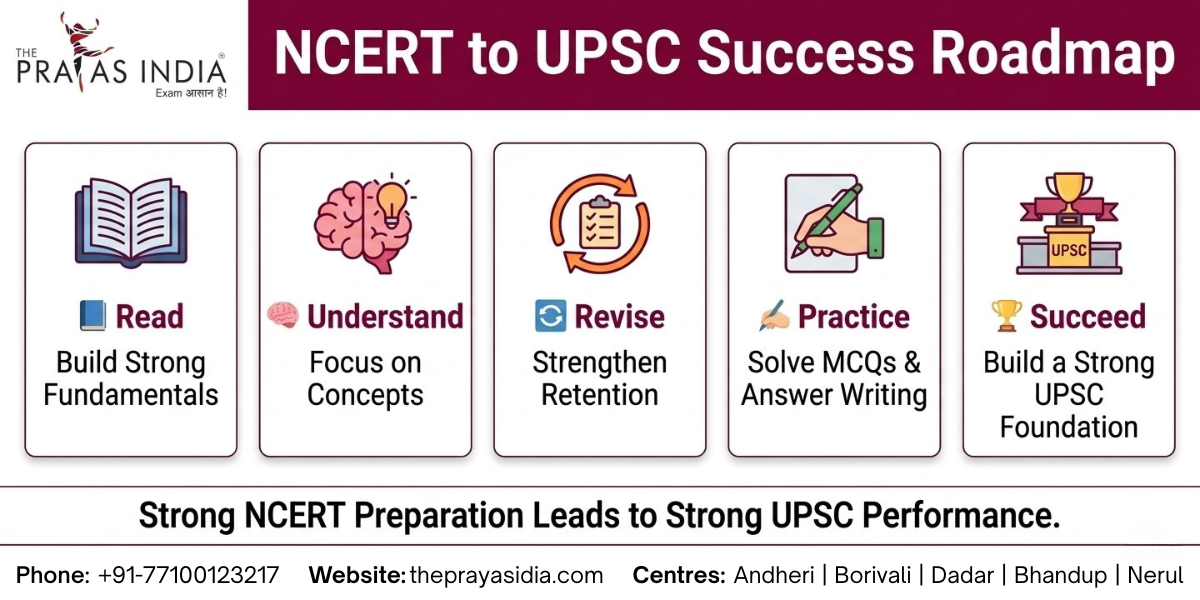
NCERTs are not just textbooks—they are the foundation upon which successful UPSC preparation is built. When studied with the right strategy, they develop conceptual clarity, improve analytical thinking, and make advanced resources easier to understand.
Instead of rushing through multiple books, focus on reading NCERTs systematically, preparing concise notes, revising regularly, and connecting static concepts with current affairs. This disciplined approach will strengthen your preparation for both the Preliminary and Main examinations.
If you’re looking for expert mentorship, structured guidance, and a preparation strategy aligned with the latest UPSC exam pattern, The Prayas India can help you build a strong foundation and move confidently towards your Civil Services dream.
Contact Us
- 📞 Call: +91-77100 13217
- 🌐 Website: https://theprayasindia.com
- 📍 Centres: Andheri | Borivali | Dadar | Nerul | Bhandup