How to Stay Focused During Long-Term UPSC Preparation | Best UPSC Coaching in Mumbai | The Prayas India
Preparing for the Civil Services Examination is unlike preparing for most competitive exams.
UPSC preparation is not measured in weeks or months—it often extends over one or even two years of disciplined effort.
During this journey, students experience changing emotions, fluctuating confidence, information overload, unexpected setbacks, and periods of self-doubt.
Many aspirants begin their preparation with great enthusiasm.
They purchase standard books, create ambitious timetables, subscribe to multiple online resources, and study for several hours every day.
However, after a few months, many notice that maintaining the same level of concentration becomes increasingly difficult.
The challenge is not always the syllabus.
The real challenge is remaining focused for an extended period.
Success in UPSC is rarely determined by intelligence alone.
It is often determined by consistency.
A student who studies with focused discipline for one year usually performs better than someone who studies intensely for a few weeks and then loses direction.
This is why focus should not be viewed as a temporary feeling.
It should be treated as a skill that can be developed, strengthened, and maintained.
To understand this better, imagine your UPSC preparation as a compass.
Whenever distractions, confusion, or burnout pull you away from your destination, the compass helps you regain direction.
This article introduces the UPSC Focus Compass, a practical framework that helps aspirants maintain clarity, discipline, balance, and continuous improvement throughout their preparation journey.
Why Long-Term UPSC Preparation Demands Focus More Than Motivation
Motivation often inspires students to begin their preparation.
Focus helps them continue.
Motivation changes with circumstances.
Some days you feel energetic.
Other days you feel tired, frustrated, or uncertain.
If preparation depends only on motivation, consistency becomes difficult.
Focus is different.
It allows you to continue studying even when motivation decreases.
The UPSC examination requires candidates to prepare for:
- Prelims
- Mains
- Interview
Along with multiple subjects including:
- History
- Geography
- Polity
- Economy
- Environment
- Science & Technology
- Ethics
- Current Affairs
- Essay Writing
- Optional Subject
Managing such a vast syllabus requires sustained concentration over a long period.
Every day presents new distractions.
Social media.
Comparison with other aspirants.
Resource overload.
Fear of failure.
Changing strategies repeatedly.
Without a clear sense of direction, these distractions gradually reduce productivity.
That is why successful UPSC aspirants constantly realign themselves with their ultimate goal.
Introducing the UPSC Focus Compass
Imagine standing at the center of a compass.
Every direction represents one essential quality required for long-term UPSC preparation.
Whenever your preparation becomes inconsistent, the compass helps you identify what needs attention.
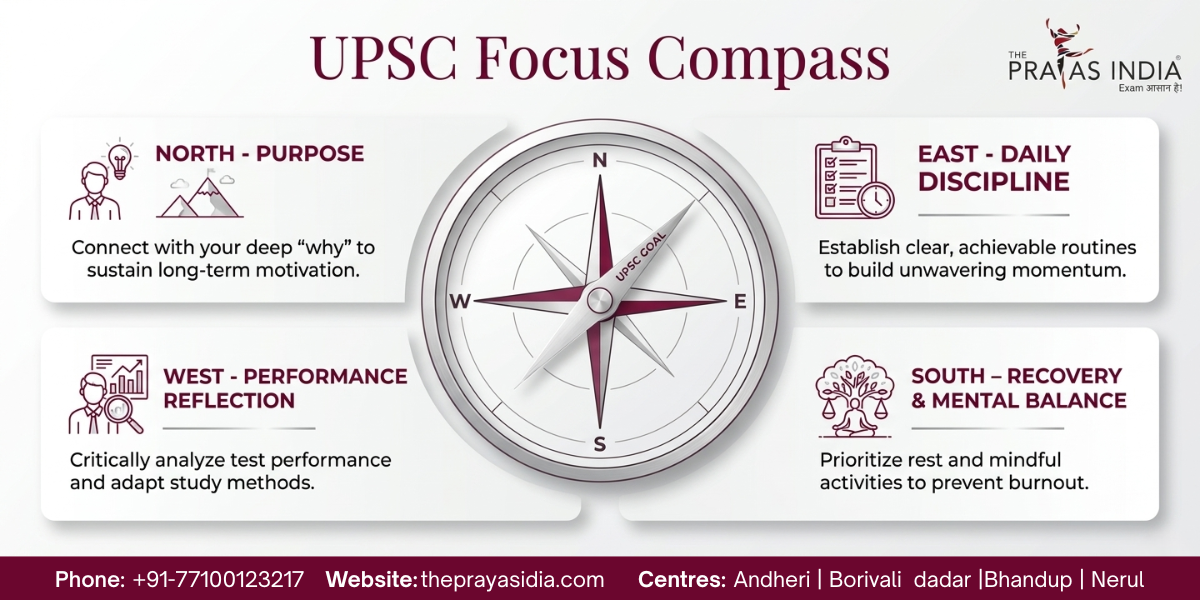
The UPSC Focus Compass consists of four directions:
North — Purpose
Always remember why you started your UPSC journey.
East — Daily Discipline
Transform your goals into consistent daily actions.
South — Recovery & Mental Balance
Protect your energy and avoid burnout.
West — Performance Reflection
Continuously review your progress and improve your preparation strategy.
A compass does not move you forward.
It simply ensures that you never lose direction.
Similarly, these four principles help aspirants stay focused regardless of challenges.
North: Purpose Keeps You Moving Forward
Every successful UPSC aspirant has a strong reason behind their preparation.
Some dream of becoming administrators who contribute to society.
Others seek meaningful public service, leadership opportunities, or personal growth.
Whatever your reason may be, it should remain visible throughout your preparation.
Purpose becomes especially important during difficult phases.
When mock test scores decline.
When revision feels repetitive.
When progress appears slow.
Students with a clear purpose recover faster because they remember the bigger picture.
Practical ways to strengthen your purpose include:
- Writing down your long-term goal.
- Reviewing your objectives every week.
- Tracking personal progress instead of comparing yourself with others.
- Celebrating small milestones during preparation.
Purpose transforms preparation from a daily task into a meaningful mission.
East: Daily Discipline Builds Long-Term Success
Purpose provides direction.
Discipline creates movement.
Many aspirants wait for the perfect mood before studying.
Successful candidates rely on habits instead of emotions.
Daily discipline does not mean studying for twelve or fourteen hours every day.
It means consistently completing the tasks you planned.
Your daily routine should include:
- Concept learning.
- Current Affairs reading.
- Revision.
- Answer writing.
- Practice questions.
- Short self-assessment.
Even a well-planned six-hour study schedule followed consistently is more productive than occasional marathon sessions.
Small disciplined actions repeated every day gradually build extraordinary results.
Staying Focused Begins with the Right Direction
Many UPSC aspirants believe that staying focused requires extraordinary willpower.
In reality, focus becomes easier when you have a clear purpose and a disciplined daily routine.
The first two directions of the UPSC Focus Compass—Purpose and Daily Discipline—help you build a strong foundation for long-term preparation.
Once these become part of your routine, maintaining consistency becomes far more manageable.
South: Recovery & Mental Balance Keeps Your Preparation Sustainable
Many UPSC aspirants believe that studying continuously without breaks demonstrates dedication.
In reality, long-term preparation requires sustainable consistency, not continuous exhaustion.
The UPSC journey spans several months, and sometimes even years. Without proper recovery, even highly motivated students may experience fatigue, declining concentration, and reduced productivity.
Mental recovery is not a distraction from preparation—it is a part of preparation.
Just as athletes schedule recovery sessions to improve performance, UPSC aspirants should also create space for mental and physical rejuvenation.
Healthy recovery practices include:
- Maintaining a regular sleep schedule.
- Taking short breaks between study sessions.
- Exercising or walking for 20–30 minutes daily.
- Limiting unnecessary screen time.
- Spending quality time with family when needed.
- Following a balanced diet and staying hydrated.
These habits help improve focus, memory retention, and decision-making during long study sessions.
Recovery is not lost time—it is an investment in better performance.
West: Performance Reflection Helps You Stay on Course
A compass helps travellers verify whether they are moving in the right direction.
Similarly, UPSC aspirants should regularly evaluate whether their preparation strategy is working.
Many students continue following the same routine for months without assessing its effectiveness.
Reflection prevents this mistake.
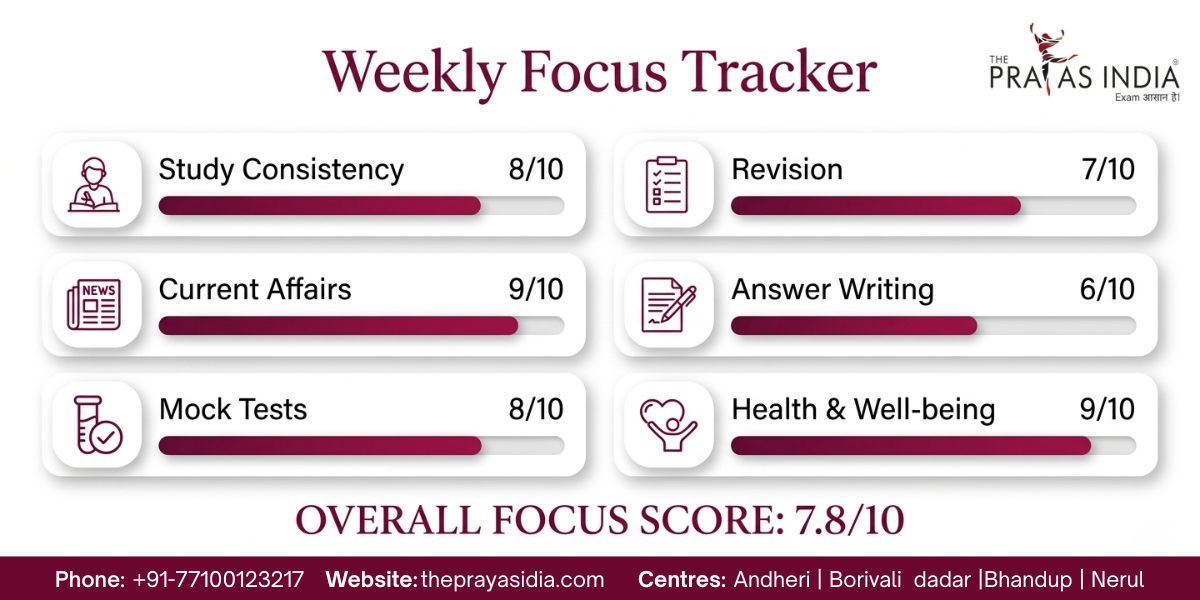
At the end of every week, ask yourself:
- What topics did I complete?
- Which subjects need more attention?
- Did I revise consistently?
- What mistakes appeared in mock tests?
- Which study method worked best this week?
Rather than measuring success only through study hours, evaluate:
- Quality of learning
- Revision consistency
- Answer-writing improvement
- Mock test accuracy
- Current Affairs retention
Small weekly improvements eventually lead to significant progress.
How to Handle Burnout During UPSC Preparation
Burnout is one of the most common challenges faced by Civil Services aspirants.
It often develops gradually.
You may notice:
- Reduced interest in studying.
- Difficulty concentrating.
- Constant tiredness.
- Irritability.
- Feeling overwhelmed by the syllabus.
- Declining mock test performance.
Ignoring these signs usually makes recovery more difficult.
Instead, respond proactively.
If burnout occurs:
Reduce Study Intensity Temporarily
Instead of stopping preparation completely, switch to lighter activities such as revision or newspaper reading for a day.
Break Large Goals into Smaller Targets
Completing one chapter feels far more achievable than thinking about the entire UPSC syllabus.
Change Your Study Environment
Sometimes a small change in location or study arrangement improves concentration significantly.
Avoid Comparing Yourself with Others
Every aspirant progresses at a different pace.
Focus on your own improvement rather than someone else’s timetable.
Speak with Mentors
Experienced mentors can identify preparation gaps and provide practical guidance when motivation declines.
Avoid the Most Common Focus Killers
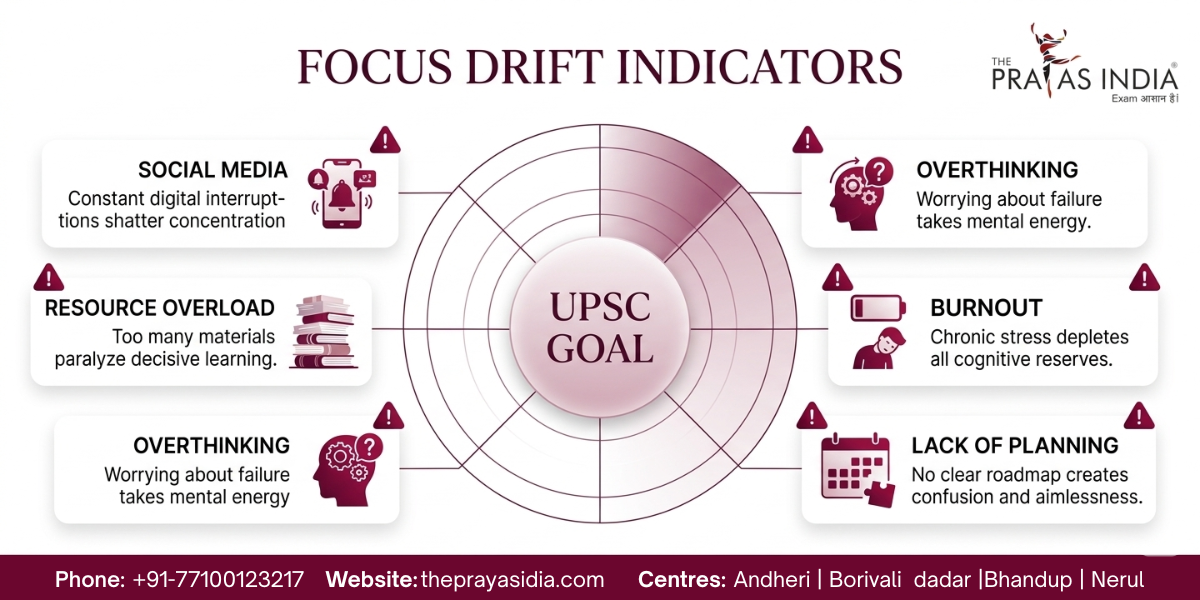
Long-term UPSC preparation is often interrupted by distractions that seem harmless initially but gradually reduce consistency.
Some of the biggest focus killers include:
Resource Overload
Collecting too many books, PDFs, and online courses creates confusion.
Follow limited, high-quality resources.
Excessive Social Media Usage
Constant notifications interrupt deep concentration.
Schedule fixed times for checking social media instead of using it throughout the day.
Frequently Changing Strategies
Switching preparation plans every few weeks prevents long-term progress.
Trust a structured strategy and follow it consistently.
Fear of Missing Out (FOMO)
Many aspirants worry that others are studying better resources.
Remember:
Completing one reliable resource thoroughly is usually more beneficial than collecting many incomplete ones.
Lack of Revision
New learning without revision eventually weakens retention.
Regular revision strengthens long-term memory.
Why The Prayas India Helps Aspirants Stay Focused
Staying focused throughout UPSC preparation becomes much easier when students receive structured guidance, regular evaluation, and continuous mentorship.
At The Prayas India, the preparation process is designed to help aspirants remain disciplined and confident from the first day of preparation until the final interview stage.
Our UPSC coaching programs provide:
Experienced Faculty
Learn from mentors who simplify complex topics and guide students with exam-oriented strategies.
Structured Study Plans
Well-designed schedules ensure balanced preparation for Prelims, Mains, Current Affairs, Optional Subjects, and Answer Writing.
Regular Mock Tests
Continuous assessment helps students monitor progress and improve consistently.
Answer Writing Practice
Develop analytical thinking and improve presentation skills with regular answer-writing sessions.
Personal Mentorship
Receive one-to-one guidance to overcome preparation challenges, maintain consistency, and stay motivated.
Updated Study Material
Comprehensive notes and current affairs resources aligned with the latest UPSC examination pattern.
If you are searching for the Best UPSC Coaching in Mumbai, choose an institute that not only teaches the syllabus but also helps you stay focused throughout your preparation journey.
Visit Our Centres
Andheri | Borivali | Dadar | Thane | Nerul | Bhandup
Contact Us
Phone: +91-77100 13217
Website: theprayasindia.com
Focus Is Strengthened Through Consistency, Not Perfection
Every UPSC aspirant experiences distractions, setbacks, and periods of low motivation. What distinguishes successful candidates is their ability to recover, reflect, and return to a disciplined routine.
The final two directions of the UPSC Focus Compass—Recovery & Mental Balance and Performance Reflection—help ensure that temporary challenges do not become permanent obstacles.
90-Day Focus Reset Plan for UPSC Aspirants
Long-term UPSC preparation is not about remaining motivated every single day. It is about consistently bringing your attention back to your goal whenever distractions arise.
The following 90-day focus reset plan helps aspirants maintain momentum while balancing learning, revision, answer writing, and mental well-being.
Phase 1 (Days 1–30): Rebuild Your Foundation
The first month should focus on creating a disciplined routine.
Your priorities should include:
- Fixing a realistic daily study schedule.
- Completing high-priority static subjects.
- Reading newspapers and Current Affairs daily.
- Beginning answer-writing practice.
- Preparing concise revision notes.
- Tracking daily progress.
At this stage, avoid comparing your preparation with others. Your objective is to build consistency rather than speed.
Phase 2 (Days 31–60): Strengthen Focus Through Practice
Once your routine becomes stable, shift your attention toward application.
During this phase:
- Increase answer-writing practice.
- Attempt sectional and topic-wise tests.
- Revise completed subjects every week.
- Improve presentation skills.
- Analyse mistakes after every mock test.
- Monitor weak subjects carefully.
Focus should gradually shift from “finishing the syllabus” to “improving performance.”
Phase 3 (Days 61–90): Prepare Like the Real Examination
The final month of the reset plan should simulate the actual UPSC examination.
Your preparation should include:
- Full-length mock tests.
- Time-bound answer writing.
- Current Affairs revision.
- Ethics and Essay practice.
- Optional subject revision.
- PYQ (Previous Year Questions) analysis.
Avoid introducing new study resources during this stage.
Trust your preparation and focus on improving accuracy, clarity, and confidence.
Final Month Strategy Before the UPSC Examination
The last few weeks before the examination should be dedicated to refinement rather than expansion.
Revise More, Learn Less
Prioritize revision of:
- Polity
- Economy
- Modern History
- Environment
- Geography
- Science & Technology
- Current Affairs
- Optional Subject
Your revision notes should become your primary resource.
Practice Answer Writing Daily
Even one or two quality answers each day help maintain writing speed, structure, and analytical thinking.
Continue Mock Tests
Attempt mocks under exam-like conditions.
Analyse:
- Time management
- Answer quality
- Common mistakes
- Weak areas
Protect Your Mental Energy
Avoid unnecessary discussions about expected cut-offs or rumours.
Limit distractions and maintain a healthy daily routine.
Confidence grows from preparation—not from comparison.
Why Choose The Prayas India for UPSC Preparation?
Preparing for UPSC requires much more than completing the syllabus.
It requires structured guidance, experienced mentors, continuous evaluation, and a disciplined learning environment.
At The Prayas India, every aspirant receives the support needed to remain focused throughout the preparation journey.
Our UPSC coaching programs include:
- Expert faculty with extensive UPSC mentoring experience.
- Comprehensive classroom and online coaching.
- Well-structured study plans.
- Daily Current Affairs guidance.
- Answer-writing practice sessions.
- Regular mock tests.
- Personalized mentorship.
- Performance evaluation and feedback.
- Updated study material aligned with the latest UPSC pattern.
Whether you are beginning your Civil Services preparation or preparing for another attempt, our experienced mentors help you build consistency, improve focus, and prepare with confidence.
Visit Our Centres
Andheri | Borivali | Dadar | Thane | Nerul | Bhandup
Contact Us
Phone: +91-77100 13217
Website: theprayasindia.com
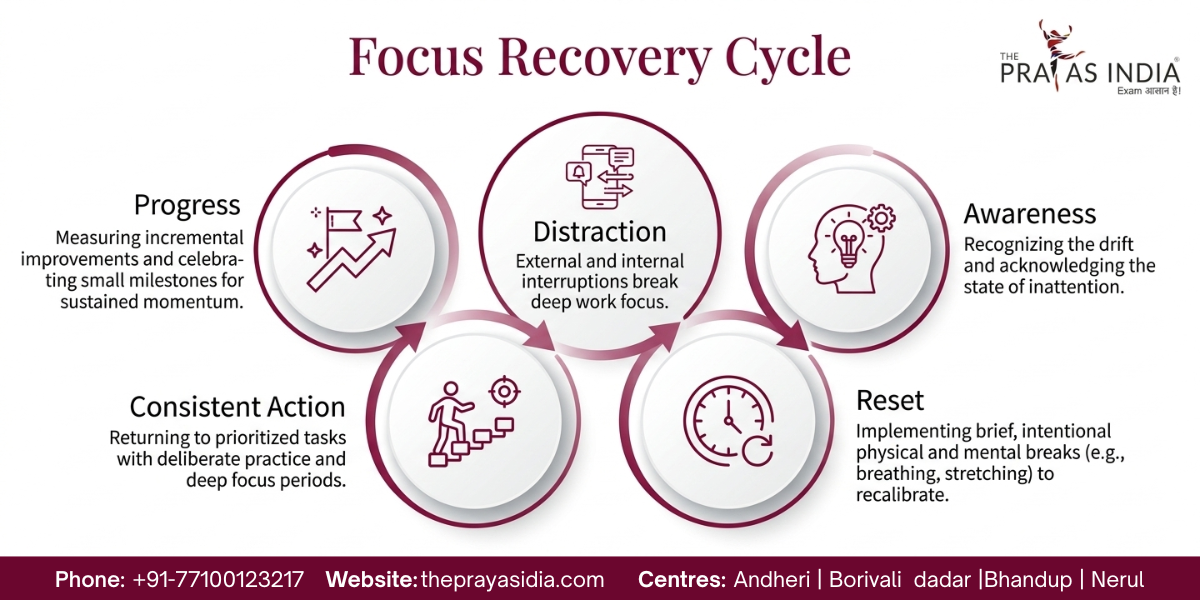
Conclusion
The UPSC journey is not won by studying continuously without rest.
It is won by maintaining direction even when motivation fluctuates.
The UPSC Focus Compass reminds us that lasting focus depends on four essential directions:
- Purpose
- Daily Discipline
- Recovery & Mental Balance
- Performance Reflection
Whenever distractions, self-doubt, or fatigue appear, return to these four principles.
A clear purpose gives you direction.
Daily discipline builds momentum.
Recovery protects your consistency.
Reflection helps you improve every week.
If you are looking for the Best UPSC Coaching in Mumbai, choose an institute that helps you remain focused from your first day of preparation until the final interview.
At The Prayas India, experienced faculty, structured study plans, regular assessments, and personalized mentorship help aspirants stay disciplined and confident throughout their Civil Services journey.
Stay focused, trust the process, and continue moving toward your goal—one productive day at a time.
Frequently Asked Questions (FAQs)
1. Why do many UPSC aspirants lose focus during preparation?
The lengthy syllabus, prolonged preparation period, distractions, inconsistent routines, and lack of regular revision often reduce concentration over time.
2. How can I stay motivated during long-term UPSC preparation?
Instead of depending only on motivation, build daily discipline, maintain a clear purpose, track progress regularly, and follow a structured study plan.
3. How many hours should I study daily for UPSC?
Study hours differ for every aspirant. A consistent and productive routine with focused learning, revision, and answer writing is more important than simply studying for long hours.
4. How often should I revise during UPSC preparation?
Revision should be a daily habit, with weekly and monthly revision cycles to improve long-term retention.
5. What should I do if I experience burnout?
Reduce study intensity temporarily, focus on revision, take short breaks, maintain healthy sleep, and seek guidance from mentors whenever required.
6. Does answer writing help improve focus?
Yes. Regular answer writing enhances analytical thinking, improves concentration, and prepares aspirants for the Mains examination.
7. How can I reduce distractions during UPSC preparation?
Limit unnecessary social media usage, avoid collecting excessive study material, follow a fixed routine, and maintain a dedicated study environment.
8. Why choose The Prayas India for UPSC preparation?
The Prayas India offers experienced faculty, structured study plans, regular mock tests, answer-writing practice, updated study material, and personalized mentorship to support aspirants throughout their UPSC journey.
9. Does The Prayas India provide classroom and online UPSC coaching?
Yes. The Prayas India offers both classroom and online coaching programs, allowing aspirants to choose the learning mode that best suits their preparation needs.
Final Takeaway
Long-term UPSC preparation is not a test of intelligence alone—it is a test of sustained focus, discipline, and resilience. Aspirants who consistently realign themselves with their purpose, follow disciplined study habits, maintain mental balance, and evaluate their progress are far more likely to succeed.
With the right guidance, structured preparation, and continuous mentorship from The Prayas India, you can remain focused throughout your UPSC journey and move confidently toward your dream of serving the nation through the Civil Services.