How to Use Current Affairs in UPSC Mains Answers | Best UPSC Coaching in Mumbai | The Prayas India
Current Affairs is often described as one of the most important components of UPSC Civil Services preparation. Yet, a common problem among aspirants is that they spend months reading newspapers, following current-affairs compilations and making extensive notes, but struggle to use that knowledge effectively when writing Mains answers.
The problem is not necessarily a lack of information. It is the inability to convert information into arguments, examples, evidence and analysis.
UPSC Mains does not reward an answer simply because it contains the latest government scheme or a recent headline. Current affairs becomes valuable when it helps you explain a static concept, establish the relevance of an issue, provide a contemporary example, support an argument, demonstrate multiple dimensions or suggest practical solutions.
This distinction is critical.
An aspirant may know ten facts about climate change but still write a weak answer on environmental governance if those facts are merely listed. Another candidate may use one relevant example, connect it to a constitutional principle, explain the institutional challenge and conclude with a practical way forward. The second answer is more likely to demonstrate the analytical quality expected in Mains.
Therefore, the objective should not be to add more current affairs to your preparation. It should be to learn how to use the right current affairs at the right place in an answer.
For aspirants preparing with professional guidance, this is also where structured UPSC coaching can make a difference. A good preparation system should help students move from information collection to answer application, because ultimately the Mains examination tests what you can communicate under time constraints.
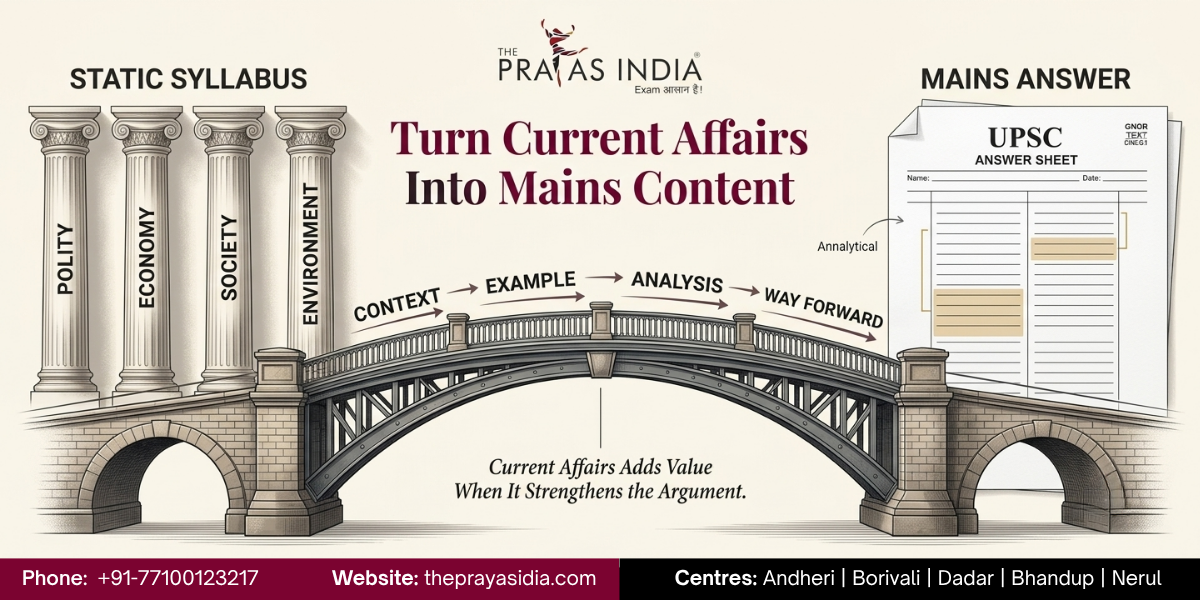
Current Affairs Is the Bridge Between Static Knowledge and Mains Answers
UPSC preparation is often divided into two categories: static syllabus and current affairs.
In reality, strong Mains answers frequently require both.
Consider a topic such as the Indian Constitution and federalism. The basic concepts of federalism are part of the static syllabus. However, contemporary debates surrounding the Governor’s role, Centre-State relations, fiscal federalism or inter-governmental coordination can provide current examples through which the static concept becomes relevant.
The same principle applies across General Studies.
A static topic provides the conceptual foundation, while current affairs provides the contemporary context.
This creates a useful mental model:
Static Concept + Current Example + Analysis = Stronger Mains Answer
Current affairs should therefore not be studied as a completely separate subject. It should gradually become an application layer over your static preparation.
When you revise a static topic, ask yourself what recent developments can be connected to it. When you read an important current event, ask yourself which syllabus topic it belongs to.
This two-way connection makes revision more efficient and helps prevent the accumulation of disconnected facts.
Don’t Put Current Affairs Into Every Answer
One of the biggest misconceptions among Mains aspirants is that every answer needs a current-affairs example.
It does not.
Current affairs should be used when it adds value to the answer.
If the question is asking you to explain a fundamental concept and a recent event does not strengthen your explanation, forcing an example into the answer can make the response feel artificial.
Similarly, mentioning a recent government scheme without explaining its relevance does not automatically improve an answer.
Before adding current affairs, ask:
- Does it directly relate to the question?
- Does it strengthen my argument?
- Does it provide a concrete example?
- Does it demonstrate contemporary relevance?
- Does it help support a recommendation or solution?
If the answer to these questions is no, leave it out.
A well-written answer with two relevant examples is stronger than an answer containing six unrelated current-affairs references.
Understand the Role of an Example
An example is not decoration.
In a Mains answer, a well-selected current-affairs example can perform several functions. It can make an abstract argument concrete, demonstrate that the issue exists in reality, show the impact of a policy or illustrate a successful intervention.
For example, if an answer discusses the need for technology in agricultural extension, mentioning a relevant digital initiative can demonstrate contemporary application.
If you are discussing disaster resilience, a recent disaster-management experience can provide context.
If the question concerns women’s participation in the economy, relevant labour-force or policy developments can strengthen the argument.
The important part is the connection.
Instead of writing:
“Technology is important for agriculture. Recently, several digital initiatives have been launched.”
you can use the example to support a specific argument about accessibility, information asymmetry, market linkages or extension services.
The example should prove or illustrate something.
Current Affairs Can Strengthen Your Introduction
The introduction is often the first place where current affairs can make an answer contemporary.
However, that does not mean beginning every answer with a newspaper headline.
There are several ways to create an effective introduction:
- A recent development
- A relevant statistic
- A contemporary example
- A constitutional or institutional reference
- A short definition followed by current context
- A recent policy development
The choice should depend on the question.
For example, an answer concerning urban flooding can begin by referring to the increasing frequency of extreme rainfall events and recent urban flooding experiences, before moving toward the structural issues involved.
An answer on digital governance can begin with the expansion of digital public infrastructure and then introduce the governance question.
The introduction should remain brief.
Current affairs should open the discussion, not consume the space needed for analysis.
Use Current Affairs to Establish Contemporary Relevance
Some UPSC questions are based on concepts that have existed for decades.
Yet, the examination may ask you to examine them in the context of present circumstances.
Current affairs can establish that relevance.
For example, a question concerning parliamentary accountability becomes more meaningful when connected to contemporary discussions around legislative scrutiny, parliamentary committees or disruptions.
Similarly, questions concerning public health, food security, urbanisation, energy transition, artificial intelligence or internal security can benefit from contemporary developments because these issues are continuously evolving.
The current event provides the “why now?” dimension of the answer.
This is particularly useful when the question asks you to analyse an issue rather than merely define it.
Current Affairs Belongs in the Body — But Selectively
The body of the answer is where current affairs usually provides its greatest value.
This is where you develop arguments, analyse dimensions and support your points.
A current-affairs example can be placed after a conceptual point to demonstrate its real-world relevance.
A simple structure can be:
Argument → Explanation → Current Example → Implication
For instance, if you are discussing the challenge of digital exclusion, you can first explain the issue, then mention a contemporary example or relevant data point, and finally discuss its implications for inclusion and governance.
This prevents the answer from becoming a list of newspaper facts.
The current-affairs material remains subordinate to your argument.
That is exactly how it should be.
Use Data When It Actually Strengthens the Answer
Statistics can be powerful in UPSC Mains answers.
But numbers should be used carefully.
A precise statistic that you are confident about can strengthen an argument. An uncertain figure can create unnecessary risk.
More importantly, data should have a purpose.
Use it to establish:
- Scale of a problem
- Trend over time
- Comparison
- Policy impact
- Socio-economic disparity
- Magnitude of an emerging challenge
Don’t insert a number simply because it sounds impressive.
A sentence such as “India has a large youth population” is useful but broad. A credible demographic statistic can make the argument more concrete, provided the figure is accurate and relevant.
This is why aspirants should maintain a small collection of high-confidence data points rather than attempting to memorise hundreds of numbers.
Reports and Indices Can Add Authority
Government reports, parliamentary reports, international organisations and credible institutional studies can provide strong supporting material for Mains answers.
However, candidates should not turn their answers into a bibliography.
The name of the report matters only when it strengthens the argument.
For example, mentioning a relevant NITI Aayog report, Economic Survey observation, parliamentary committee finding or recognised international index can provide credibility when discussing a specific issue.
A useful rule is:
One relevant source is better than five unnecessary references.
The goal is not to demonstrate how many reports you have read.
The goal is to demonstrate that you can use credible evidence to support your analysis.
Use Government Schemes as Case Studies, Not Lists
Government schemes frequently appear in current-affairs notes.
Aspirants often memorise their names, ministries and objectives and then reproduce them mechanically in Mains answers.
That approach has limited value.
Instead, think of schemes as case studies.
If the question concerns financial inclusion, a relevant scheme can illustrate how policy intervention addresses access.
If the question concerns nutrition, a government programme can demonstrate an institutional response.
If the question concerns renewable energy, a policy initiative can be used to show India’s approach to energy transition.
When using a scheme, focus on its relevance to the argument.
You rarely need to reproduce every feature of the programme.
Current Affairs Can Improve the “Way Forward”
The conclusion or way-forward section is another place where contemporary knowledge becomes useful.
Generic statements such as “the government should take strict action” rarely add much value.
A stronger way forward is specific and connected to existing institutional mechanisms, policy developments or successful practices.
For example, instead of simply recommending better urban planning, you could discuss integrated urban flood management, improved drainage planning, early-warning systems, nature-based solutions and stronger municipal capacity.
Current developments can help you identify realistic solutions.
They show that your recommendations are not purely theoretical.
Use Case Studies From India and Abroad
A good current-affairs notebook should not consist only of headlines.
It should contain usable examples.
These can come from Indian states, districts, local governments, institutions, international countries or specific programmes.
For example, a state-level innovation in healthcare delivery can become a governance example. A city’s public transport initiative can support an urbanisation answer. An international experience in renewable energy or water management can be used in a comparative discussion.
The key is to understand the lesson behind the example.
Ask:
What exactly does this example demonstrate?
That question transforms an ordinary news item into Mains-ready material.
Build a “Current Affairs to Syllabus” System
One of the most effective ways to improve application is to map current affairs directly to the UPSC syllabus.
Instead of keeping one enormous current-affairs notebook, organise information according to themes.
For example:
Polity & Governance
- Federalism
- Parliament
- Judiciary
- Local governance
- Transparency
- E-governance
Economy
- Inflation
- Employment
- Agriculture
- Fiscal policy
- Financial inclusion
- External sector
Environment
- Climate change
- Biodiversity
- Pollution
- Renewable energy
- Disaster resilience
Society
- Women
- Health
- Education
- Urbanisation
- Vulnerable sections
This approach makes revision much easier because you are revising themes rather than newspapers.
When a Mains question appears, you can mentally access the relevant cluster of examples.
Create Mains-Ready Current Affairs Notes
Your current-affairs notes should answer a simple question:
Can I use this information in an answer?
If the answer is no, the note may not deserve to occupy much space.
A useful Mains-oriented note can contain:
- Issue
- Background
- Key data
- Major arguments
- Government response
- Challenges
- Examples
- Best practices
- Way forward
You do not need to write all eight components for every topic.
The structure simply helps you think beyond the headline.
For particularly important topics, one page of organised material can become far more useful than ten pages of newspaper notes.
Develop a Personal Example Bank
Over time, build a compact repository of examples that you can confidently use across multiple topics.
A single good example can sometimes support several different themes.
For instance, a successful local governance initiative may be relevant to decentralisation, women’s participation, service delivery, social inclusion and technology-enabled governance.
Similarly, a climate-resilient infrastructure project can potentially support answers on urbanisation, disaster management, climate adaptation and sustainable development.
The objective is not to memorise hundreds of examples.
It is to develop a high-quality, versatile example bank.
Avoid the “Current Affairs Dump” in Answers
A current-affairs dump happens when an aspirant attempts to show knowledge by mentioning every relevant scheme, report, committee and statistic they remember.
The result can look impressive but read poorly.
A Mains answer has limited space and time.
Every sentence should contribute to the argument.
Suppose the question concerns agricultural reforms. You do not need to mention every agricultural scheme you have studied.
Choose one or two relevant examples and explain how they support your point.
Relevance beats quantity.
This principle should guide both your notes and your answer writing.
Current Affairs Should Support Analysis, Not Replace It
This is perhaps the most important rule.
UPSC Mains is not a current-affairs quiz.
Knowing that an event happened is only the first step.
The examination expects you to interpret the issue, identify causes, discuss consequences, consider multiple perspectives and suggest practical solutions where appropriate.
A current event should therefore trigger questions such as:
Why did this happen?
What are its wider implications?
Which stakeholders are affected?
What are the institutional challenges?
What can be done differently?
This analytical habit is what transforms news consumption into Mains preparation.
How UPSC Coaching Can Help With Current Affairs Application
For many aspirants, the challenge is not access to current affairs. There are newspapers, websites, magazines, videos and compilations available everywhere.
The challenge is filtering the material and learning how to apply it.
This is where structured UPSC coaching in Mumbai can provide useful academic support.
A good coaching system should help students identify syllabus-relevant developments, connect current affairs with static subjects, practise answer writing and receive feedback on whether examples are being used effectively.
The Prayas India can help aspirants build this connection between preparation and answer application through structured guidance, study resources and exam-oriented practice.
For a serious Mains aspirant, the value of coaching should therefore not be measured only by how many current-affairs classes are conducted. The more important question is whether the preparation system helps you convert information into better answers.
The Right Current Affairs Question to Ask Yourself
Every time you read an important development, don’t immediately ask:
“Will UPSC ask a question from this?”
Instead ask:
“Where can I use this?”
Can it become an example?
Can it provide data?
Can it support an argument?
Can it illustrate a challenge?
Can it provide a best practice?
Can it strengthen a conclusion?
Can it help connect a static concept with a contemporary issue?
This change in thinking can significantly improve the utility of current-affairs preparation.
A Simple Rule for Mains-Oriented Current Affairs
Keep this framework in mind:
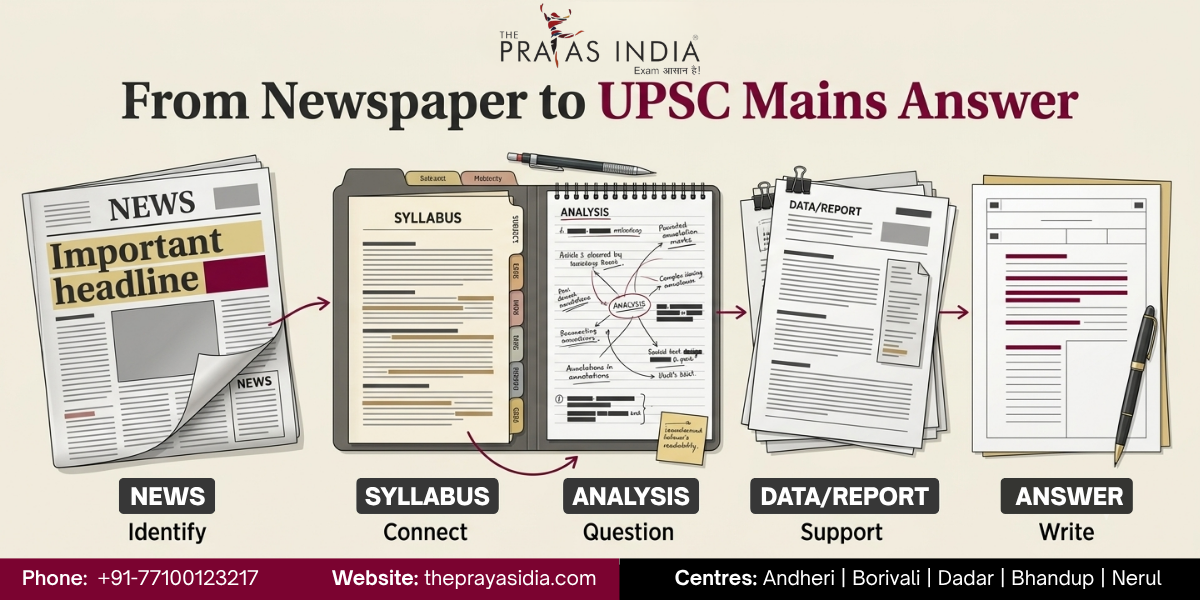
NEWS → ISSUE → SYLLABUS → ANALYSIS → EXAMPLE → ANSWER
A news event is only the starting point.
You identify the underlying issue, connect it with the syllabus, analyse its dimensions, select the most useful example and then practise using it in an answer.
That is how current affairs should gradually become part of your Mains preparation rather than remaining a separate collection of facts.
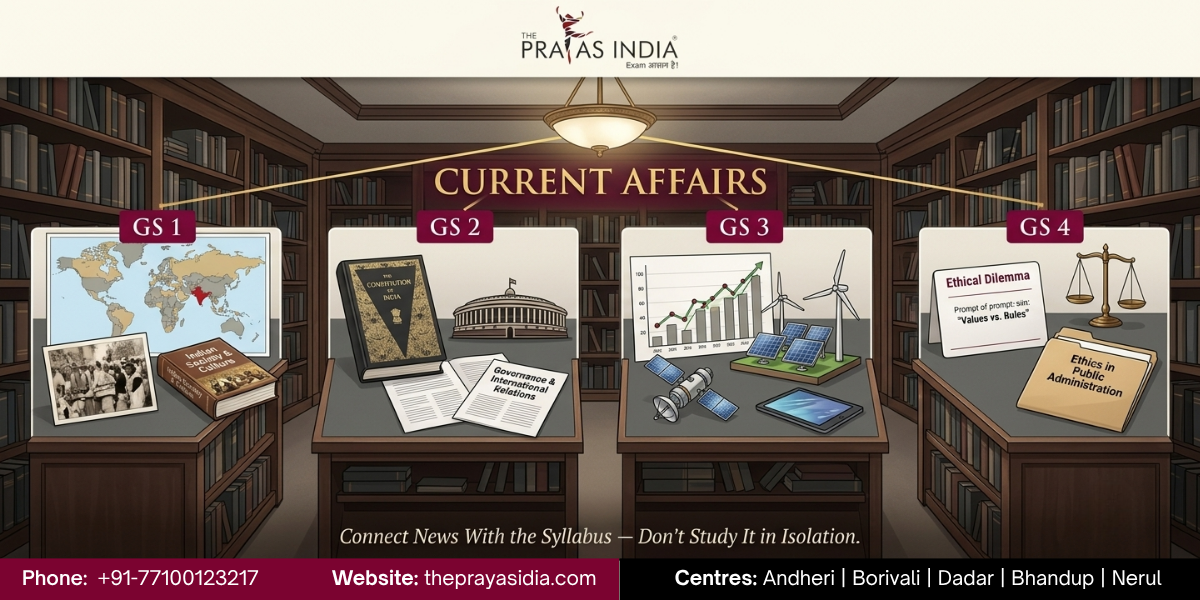
Build Current Affairs Around the Four GS Papers
Current affairs becomes much easier to use when you stop treating it as an endless stream of news and start organising it around the UPSC syllabus. Every important development should ideally find a place within one or more static themes.
For GS Paper 1, focus on developments related to society, geography, history, culture and social issues. For GS Paper 2, track constitutional developments, governance, welfare schemes, international relations and institutional issues. GS Paper 3 requires regular attention to the economy, agriculture, science and technology, environment, disaster management and internal security. For GS Paper 4, current events can provide real-life examples of ethical dilemmas, administrative challenges, integrity and public-service values.
This approach has an important advantage: when revision begins, you are not revising the entire news cycle. You are revising current developments that are already connected to the examination syllabus.
How to Use Current Affairs in GS Paper 1
GS Paper 1 has a significant static component, but current affairs can provide contemporary examples that make your answers more relevant.
For society-related questions, current developments can help illustrate issues such as demographic change, migration, urbanisation, women’s participation, social inequality, education, health and changing family structures.
For geography, recent environmental events, extreme weather occurrences, urban flooding, heatwaves, changing agricultural patterns or regional resource conflicts can help demonstrate geographical concepts.
The key is to first establish the conceptual argument and then use current affairs to demonstrate it.
For example, if the question concerns the challenges associated with urbanisation, you can explain issues such as inadequate infrastructure, informal settlements and pressure on municipal services. A recent urban flooding event can then be introduced as an example of how unplanned growth and inadequate drainage infrastructure can increase vulnerability.
The current event strengthens the static argument rather than replacing it.
How to Use Current Affairs in GS Paper 2
GS Paper 2 is particularly suitable for current-affairs integration because many of its themes are continuously evolving.
Constitutional developments, judicial decisions, parliamentary functioning, federal relations, local governance, welfare delivery and international relations frequently appear in contemporary discourse.
However, candidates should avoid turning answers into a collection of recent events.
Suppose the question concerns cooperative federalism. Instead of listing recent Centre-State disagreements, use one or two developments to demonstrate a larger institutional argument. You can then discuss fiscal coordination, inter-governmental mechanisms, policy implementation and the importance of consultation.
For governance questions, current affairs can also help you identify practical examples of:
- Digital governance
- Citizen-centric service delivery
- Transparency mechanisms
- Social audits
- Decentralisation
- Public-private partnerships
- Technology-enabled welfare delivery
- Administrative reforms
This gives your answer both conceptual depth and contemporary relevance.
How to Use Current Affairs in GS Paper 3
GS Paper 3 is one of the areas where current affairs can become particularly valuable because economic, environmental, technological and security issues evolve rapidly.
A strong answer can combine static understanding with contemporary developments.
For example, an answer on renewable energy can explain the underlying energy-transition challenge and then incorporate recent developments in solar capacity, green hydrogen, energy storage or international climate commitments.
Similarly, an economy answer can connect concepts such as inflation, employment, fiscal policy or financial inclusion with recent data and policy developments.
For environment questions, current events can provide examples of climate-related disasters, conservation initiatives, renewable-energy transitions or biodiversity concerns.
The important principle remains the same:
Don’t write current affairs. Use current affairs to explain the issue.
How to Use Current Affairs in GS Paper 4 Ethics
Ethics preparation is often approached differently from General Studies, but current affairs can significantly improve the quality of examples used in case studies and theoretical answers.
Real-world incidents involving administrators, public institutions, corporate governance, whistleblowing, conflict of interest, humanitarian crises or ethical decision-making can provide useful examples.
However, be careful about using controversial personalities or politically sensitive examples merely because they are prominent in the news.
The better approach is to focus on the ethical principle involved.
For example, an administrative incident may illustrate:
- Integrity
- Accountability
- Empathy
- Courage of conviction
- Transparency
- Objectivity
- Conflict of interest
- Responsiveness
- Probity
The example should help demonstrate the principle rather than become the central story of your answer.
Current Affairs in Essay Writing
Essay preparation requires a broader use of current affairs.
Unlike a GS answer, an Essay should not become a sequence of schemes, statistics and examples.
Current affairs should provide depth and contemporary context to your argument.
Suppose the topic is related to technology and human progress. You can discuss artificial intelligence, digital public infrastructure, automation, employment and privacy. But the essay should not simply describe these developments.
Instead, current affairs can help you explore opposing perspectives.
Technology can improve efficiency but create new inequalities.
Digital platforms can increase access but raise privacy concerns.
Artificial intelligence can increase productivity but also create questions around employment and accountability.
This multidimensional approach makes current affairs useful for essay writing.
Current Affairs in the Introduction, Body and Conclusion
A useful way to remember current-affairs application is to divide an answer into three stages.
Introduction
Use current affairs to establish context or contemporary relevance.
Body
Use current affairs to provide examples, evidence, data, case studies and policy developments.
Conclusion
Use contemporary developments to support a practical and forward-looking way ahead.
This does not mean every answer needs current affairs in all three sections.
Sometimes one excellent example in the body is sufficient.
The objective is to use current affairs where it performs a clear function.
Use the “One Example, Multiple Dimensions” Technique
An efficient aspirant should avoid building separate examples for every possible question.
Instead, identify versatile examples.
Suppose you study a successful district-level digital governance initiative. It may potentially be useful for answers on:
- E-governance
- Transparency
- Citizen services
- Administrative efficiency
- Digital inclusion
- Local governance
- Innovation in public administration
Similarly, one successful environmental initiative can support discussions on sustainability, community participation, climate adaptation and local governance.
This technique reduces the amount of material you need to memorise while increasing your ability to recall useful examples during the examination.
Maintain a Current Affairs “Value Bank”
A useful current-affairs notebook should contain more than news summaries.
Create separate sections for:
Data: High-confidence statistics that can strengthen arguments.
Examples: Government initiatives, state-level innovations and institutional case studies.
Reports: Important findings from credible organisations.
Quotes: Short, relevant statements from constitutional authorities, committees or respected thinkers where appropriate.
Best Practices: Successful Indian or international interventions.
Challenges: Contemporary problems connected to static syllabus themes.
Solutions: Practical reforms and institutional mechanisms.
This turns your current-affairs material into an answer-writing resource.
How Much Current Affairs Should You Use in a 10-Marker?
A 10-mark answer has limited space.
Therefore, current affairs should be used economically.
You may use one relevant example, one useful statistic or one contemporary reference if it strengthens your argument.
There is no advantage in spending several lines describing the background of a current event when the question actually demands analysis.
The examiner should see your understanding of the issue first.
Current affairs should occupy the supporting role.
How Much Current Affairs Should You Use in a 15-Marker?
A 15-marker gives you somewhat greater space for multidimensional analysis.
Here, current affairs can be integrated at several points, particularly if the question demands examples, contemporary relevance or policy evaluation.
You can potentially combine:
- One data point
- One contemporary example
- One government initiative
- One best practice
- One forward-looking recommendation
But again, this should happen naturally.
The answer should read like an analytical response, not a current-affairs compilation.
A Practical Answer-Writing Framework
When practising Mains answers, try this structure:
1. Understand the demand of the question
Identify whether the question asks you to discuss, analyse, examine, evaluate, critically examine or suggest.
2. Recall the static foundation
Bring the relevant concept, constitutional provision, theory, historical context or institutional framework to mind.
3. Identify one or two current connections
Think of a recent example, statistic, policy development, report or case study.
4. Develop multiple dimensions
Consider social, economic, political, administrative, environmental, ethical or technological dimensions depending on the question.
5. Add evidence
Use data or a credible report where it genuinely strengthens the point.
6. End with a practical way forward
Recommendations should be specific, realistic and connected to institutional capacity.
This framework can gradually become automatic with repeated answer-writing practice.
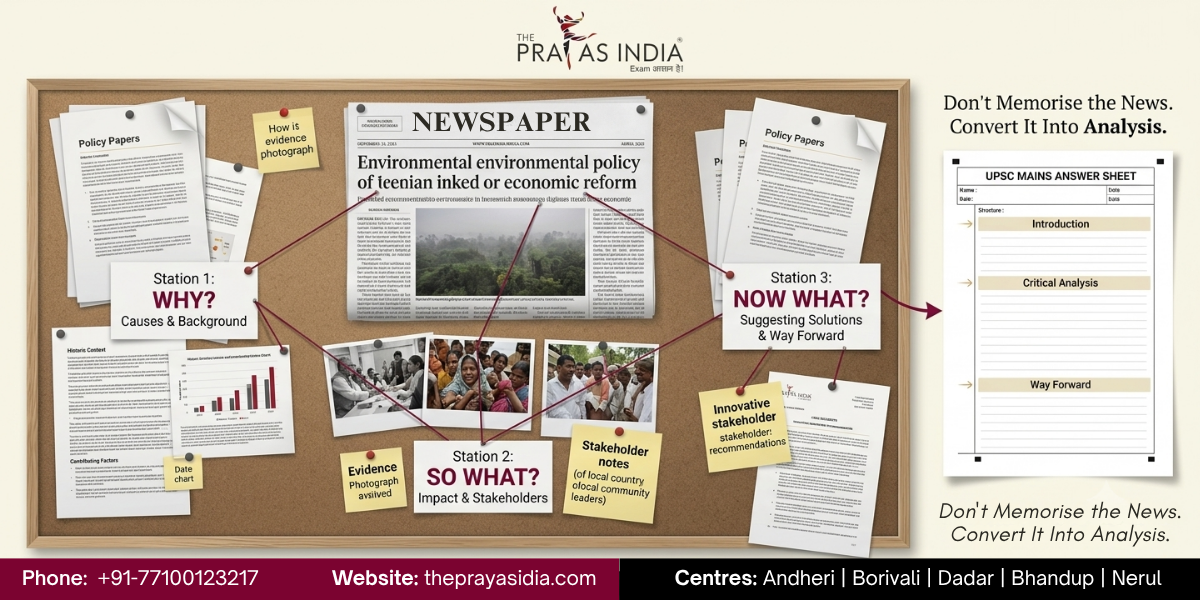
The “Why, So What, Now What?” Method
Another useful method is to process current affairs through three questions:
Why?
Why has this issue emerged? What are its underlying causes?
So What?
What are its implications for society, economy, governance, environment or national interest?
Now What?
What policy, institutional or societal response can address it?
This prevents superficial current-affairs preparation.
A newspaper article may tell you what happened.
UPSC expects you to understand why it happened, what it means and what should be done.
Learn to Write Without Overloading the Answer
There is a temptation to demonstrate everything you know.
Resist it.
A strong answer is selective.
Suppose you have studied six government initiatives related to women’s empowerment. If the question requires only one relevant example, using all six may dilute your answer.
Choose the strongest example and explain it properly.
The examiner should remember your argument, not your list of schemes.
Common Mistakes While Using Current Affairs
Treating Headlines as Analysis
Knowing the headline does not mean understanding the issue.
Using Outdated Examples
If an issue has evolved significantly, repeatedly using an old example can make the answer appear disconnected from contemporary developments.
Using Unverified Statistics
An uncertain statistic can weaken credibility. Prefer fewer high-confidence numbers.
Name-Dropping Reports
Mentioning reports without using their findings meaningfully adds little value.
Forcing Current Affairs Into Static Questions
Not every question requires a contemporary reference.
Writing Too Much Background
Current-affairs examples should support the answer rather than consume its limited word count.
Reproducing Coaching Notes
The examiner is looking for your understanding and analysis, not a memorised paragraph from a compilation.
Current Affairs Revision Should Be Continuous
One of the biggest challenges is forgetting information.
An aspirant may read a useful example in January and completely forget it by the time Mains preparation intensifies.
The solution is repeated revision.
A practical cycle can look like:
Daily: Identify important developments.
Weekly: Organise them by syllabus theme.
Monthly: Condense important examples, data and reports.
Before Mains: Revise only the high-value material.
This reduces the burden of last-minute revision.
Practice Using Current Affairs in Actual Answers
Reading current affairs is not enough.
Take one important development and write a few possible questions around it.
For example, if you study a major development in artificial intelligence, ask yourself how it could connect with:
- Governance
- Economy
- Employment
- Ethics
- National security
- Education
- Privacy
Then write one or two short answer frameworks.
This creates retrieval ability.
The information becomes usable under examination conditions rather than remaining familiar only when you see the article.
How Mentorship Can Improve Current Affairs Application
Current affairs preparation can become overwhelming because there is no shortage of information.
A structured mentorship or coaching system can help candidates filter what deserves attention, connect developments with the syllabus and understand how much information is sufficient.
For students looking for the best UPSC coaching in Mumbai, this should be an important factor while evaluating an institute.
Look beyond the number of classes.
Consider whether the institute provides:
- Structured current-affairs guidance
- Mains-oriented study material
- Answer-writing practice
- Evaluation and feedback
- Doubt-solving support
- Mentorship
- Revision planning
- Integration of static and current topics
At The Prayas India, the focus can be viewed through this larger preparation framework: current affairs should not remain an isolated subject but should contribute directly to Mains answer writing and overall UPSC preparation.
For an aspirant who is serious about the Mains stage, this connection can be particularly valuable because the real challenge is not collecting information but applying it effectively.
A Better Way to Read the Newspaper
The goal of newspaper reading should not be to remember every page.
Instead, identify issues that have a genuine connection with the UPSC syllabus.
While reading an important article, mentally extract:
Issue → Background → Stakeholders → Challenges → Government Response → Data → Example → Way Forward
You don’t necessarily need to write all these points every time.
The framework simply trains you to read news analytically.
Over time, you will become faster at identifying what is useful and what can be ignored.
Current Affairs Should Improve Your Answer’s “Quality Density”
Every word in a Mains answer has an opportunity cost.
A sentence that provides a relevant statistic, example or analytical insight is more valuable than a sentence that merely repeats the question.
This is where current affairs can improve what may be called quality density.
For example:
Generic: “Climate change is a serious challenge for India.”
Stronger: “The increasing frequency of extreme-weather events highlights the need to move from disaster response towards climate-resilient infrastructure and anticipatory governance.”
The second statement does not necessarily require a large amount of current-affairs information. It demonstrates contemporary awareness while making an analytical argument.
That is the standard aspirants should aim for.
Your Final Current Affairs Checklist Before Mains
Before entering the examination hall, you should ideally have a compact collection of material that you can recall quickly.
Focus on:
- Important government initiatives
- High-confidence statistics
- Major reports and findings
- Constitutional and judicial developments
- International developments relevant to India
- State-level best practices
- Environmental and climate examples
- Economic trends
- Technology developments
- Social-sector case studies
- Ethical examples
- Essay themes
- Practical policy solutions
You don’t need to memorise every headline from the year.
You need a usable and revisable knowledge bank.
The Final Principle: Current Affairs Must Become Application
The strongest UPSC aspirants eventually stop thinking of current affairs as a separate preparation burden.
They start seeing connections everywhere.
A new policy becomes a governance example.
A Supreme Court judgment becomes a constitutional reference.
A state-level innovation becomes a best practice.
A disaster becomes an opportunity to discuss resilience.
An economic report becomes evidence.
A technology development becomes a multidimensional issue.
A real administrative incident becomes an Ethics case study.
This is the transition that matters.
The purpose of current-affairs preparation is not to make your notebook thicker. It is to make your answers more relevant, evidence-based, analytical and contemporary.
Final Takeaway
Current affairs can become one of the strongest value additions to UPSC Mains preparation when it is used strategically.
Don’t approach it as a separate ocean of information that has to be memorised. Connect it with the static syllabus, identify the underlying issue, understand its causes and implications, collect a few high-quality examples and practise using them in answers.
A good Mains answer does not announce that the candidate has read today’s newspaper. It demonstrates that the candidate understands how a contemporary development fits into a larger constitutional, social, economic, environmental or governance framework.
That is the real purpose of current affairs in UPSC Mains.
For aspirants preparing seriously for the Civil Services Examination, the right guidance and preparation environment can make this transition easier. Choosing a structured UPSC coaching institute in Mumbai that combines conceptual learning, current-affairs integration, answer writing, mentorship and regular evaluation can help create a more disciplined preparation system.
At The Prayas India, aspirants can approach UPSC preparation with this broader objective in mind: learn the concept, understand the current context, analyse the issue and communicate it effectively in the answer.
Because in the Mains examination, knowing more is useful only when you can write better with what you know.
Contact Us
- Call Now: +91-77100 13217
- Website: theprayasindia.com
- Centres: Andheri | Borivali | Dadar | Nerul | Bhandup
FAQs
1. How should I use current affairs in UPSC Mains answers?
Use current affairs to support your static knowledge with relevant examples, data, reports, case studies and contemporary context. Avoid simply describing recent events; connect them directly to the question and your argument.
2. Is current affairs more important for Mains than static subjects?
Current affairs and static knowledge complement each other. Static concepts provide the foundation, while current affairs helps demonstrate contemporary relevance and application.
3. Should every UPSC Mains answer contain current affairs?
No. Current affairs should be used only when it adds value to the answer. Forcing an unrelated example into a response can make the answer less focused.
4. How can I connect current affairs with the UPSC syllabus?
Organise current affairs according to GS themes and static topics. For every major news development, identify the underlying issue and determine which syllabus topic it connects with.
5. How many current-affairs examples should I use in a Mains answer?
There is no fixed number. One highly relevant example can be more effective than several unrelated references. Focus on relevance, clarity and analytical value.
6. Can current affairs be used in UPSC Ethics answers?
Yes. Contemporary administrative incidents, governance experiences and real-world situations can provide useful examples for values such as integrity, accountability, empathy, transparency and probity.
7. How can current affairs improve my UPSC Essay?
Current affairs can provide contemporary context, examples and contrasting perspectives. However, an Essay should remain analytical and philosophical rather than becoming a collection of newspaper facts.
8. Should I memorise current-affairs statistics?
Memorise only high-confidence and useful statistics. A small collection of reliable data points that you can recall accurately is more valuable than trying to remember hundreds of figures.
9. How can UPSC coaching help with current affairs?
Structured coaching can help aspirants filter relevant developments, connect them with the syllabus, practise Mains answers and receive feedback on how effectively current affairs is being used.
10. How do I choose the best UPSC coaching in Mumbai?
Consider faculty quality, current-affairs integration, answer-writing practice, test series, evaluation, mentorship, study material, doubt support and the overall academic structure rather than choosing an institute based only on advertising or batch size.