UPSC CSE 2027 History Preparation Strategy: How to Cover Ancient, Medieval and Modern History | Best UPSC Coaching in Mumbai | The Prayas India
History is one of the subjects that can appear deceptively simple when aspirants first begin UPSC preparation. The syllabus looks familiar, school-level concepts provide an initial foundation and many students have already studied parts of Indian history before. Yet, as preparation progresses, history can become difficult because UPSC does not simply test whether a candidate remembers dates, rulers and events. Questions can require understanding of causes, consequences, chronology, cultural developments, political transitions, social change and connections between historical developments.
For UPSC CSE 2027 aspirants, the challenge is therefore not to read everything about Indian history. It is to develop a structured understanding of Ancient History, Medieval History and Modern Indian History, identify what deserves greater attention, use previous-year questions intelligently and revise the subject enough times for information to become retrievable during the examination.
History also has an important role across different stages of the Civil Services Examination. The official UPSC syllabus places Indian heritage and culture, modern Indian history, the Freedom Struggle and post-independence consolidation within General Studies Paper I for Mains. UPSC also publishes previous question papers, making PYQ analysis an important part of understanding how the examination approaches the subject.
For 2027 aspirants, UPSC has already published its Annual Calendar 2027; candidates should continue to verify the latest official notification and syllabus when issued for the examination cycle.
The right history strategy is therefore not “finish three books.” It is:
Understand → Connect → Practise → Revise → Test → Improve
Start With the UPSC History Syllabus, Not With a Book
One of the most common mistakes in UPSC preparation is starting history by opening a popular book and reading from the first chapter to the last.
That approach can create a false sense of progress. You may spend weeks reading but still be unable to identify which information is relevant for Prelims, which themes can become Mains answers and which areas require repeated revision.
The syllabus should be your first filter.
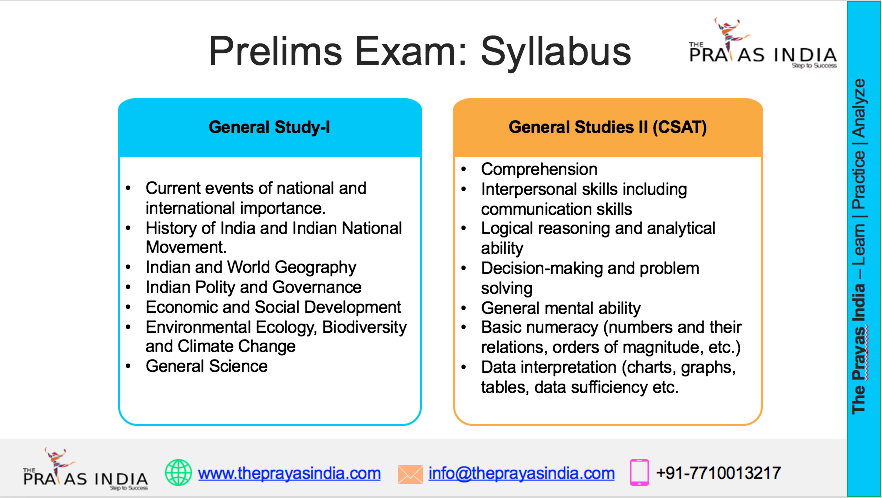
For Mains, GS Paper I includes Indian heritage and culture, modern Indian history, the Freedom Struggle and post-independence consolidation and reorganisation. The Prelims syllabus also requires candidates to deal with areas of Indian history and national movement.
Instead of treating history as one enormous subject, divide it into manageable components.
Ancient History
Focus broadly on:
- Prehistoric and protohistoric developments
- Indus Valley Civilisation
- Vedic society
- Mahajanapadas
- Buddhism and Jainism
- Mauryan Empire
- Post-Mauryan developments
- Sangam traditions
- Gupta period
- Early regional kingdoms
- Important developments in society, economy, religion, art and architecture
Medieval History
Build your preparation around:
- Early medieval regional developments
- Delhi Sultanate
- Vijayanagara and Bahmani traditions
- Mughal Empire
- Mughal administration and economy
- Bhakti and Sufi traditions
- Marathas and other regional powers
- Medieval art, architecture and literature
- Social and economic developments
- Regional cultural traditions
Modern Indian History
This requires particularly systematic preparation.
Cover:
- European expansion
- British expansion in India
- Administrative developments
- Economic impact of colonialism
- Tribal and peasant movements
- Revolt of 1857
- Socio-religious reform movements
- Rise of nationalism
- Formation and development of the Indian National Congress
- Gandhian movements
- Revolutionary activities
- Constitutional developments
- Freedom Struggle
- Partition and Independence
- Post-independence consolidation
The objective is not to memorise this list independently. You should gradually convert it into a connected historical framework.
Build One Historical Timeline Before Going Deep
History becomes significantly easier when students can locate events in relation to one another.
Aspirants often remember individual facts but struggle when a question requires chronology or comparison. Creating a broad timeline helps solve this problem.
For example:
Ancient India → Early Medieval Developments → Delhi Sultanate → Mughal Period → Regional Powers → European Expansion → British Rule → National Movement → Independence → Post-Independence Consolidation
Once this broad framework is clear, individual topics have somewhere to fit.
You can then create smaller timelines within each period.
For Modern History, for instance, you should gradually become comfortable connecting:
1857 → Formation of INC → Swadeshi → Home Rule → Gandhian Era → Non-Cooperation → Civil Disobedience → Quit India → Independence
The purpose of a timeline is not to memorise every year.
It is to understand sequence, transition and causality.
When you know what happened before and after an event, many seemingly isolated facts become easier to remember.
Ancient History: Build Concepts Instead of Memorising Facts
Ancient History can initially feel like a collection of names, archaeological sites, inscriptions, texts, dynasties and religious developments.
The solution is to study it thematically.
Instead of treating the Indus Valley Civilisation as a list of cities, for example, examine it through different dimensions:
- Urban planning
- Economy
- Trade
- Agriculture
- Craft production
- Religious practices
- Social organisation
- Script
- Major sites
- Archaeological evidence
- Reasons for transformation or decline
Similarly, while studying the Mauryan period, connect:
Political expansion → Administration → Economy → Ashoka → Dhamma → Art and Architecture
This approach creates a mental structure around the subject.
Ancient History preparation should particularly emphasise culture, religion, philosophy, literature, art, architecture, inscriptions, coins and archaeological evidence, because these areas can intersect with the broader Indian heritage and culture component of the examination.
The objective is not to turn Ancient History preparation into an endless catalogue of facts. Focus on understanding the characteristics that distinguish one period from another.
Medieval History: Study Transitions and Regional Developments
Medieval History is frequently approached as a difficult subject because students attempt to memorise dynasties and rulers without understanding the larger political and social transitions.
A better strategy is to study the period through themes.
For example:
Political Developments
Understand the emergence, expansion and administration of major political powers.
Economy
Connect land revenue, agriculture, trade, markets, crafts and urban centres.
Society
Look at social structures, communities and changes over time.
Religion
Study the development and interaction of different religious traditions.
Bhakti and Sufi Movements
Focus on major ideas, traditions, regional spread, important personalities and their social-cultural significance.
Art and Architecture
Understand distinctive architectural features, major monuments, regional styles and cultural influences.
This thematic approach makes Medieval History much easier to revise because you are no longer trying to remember disconnected rulers.
Modern Indian History Requires the Most Structured Preparation
For many aspirants, Modern Indian History becomes the most manageable part of the history syllabus once the chronology is clear.
However, the subject should not be reduced to memorising the dates of movements.
You should understand the relationship between:
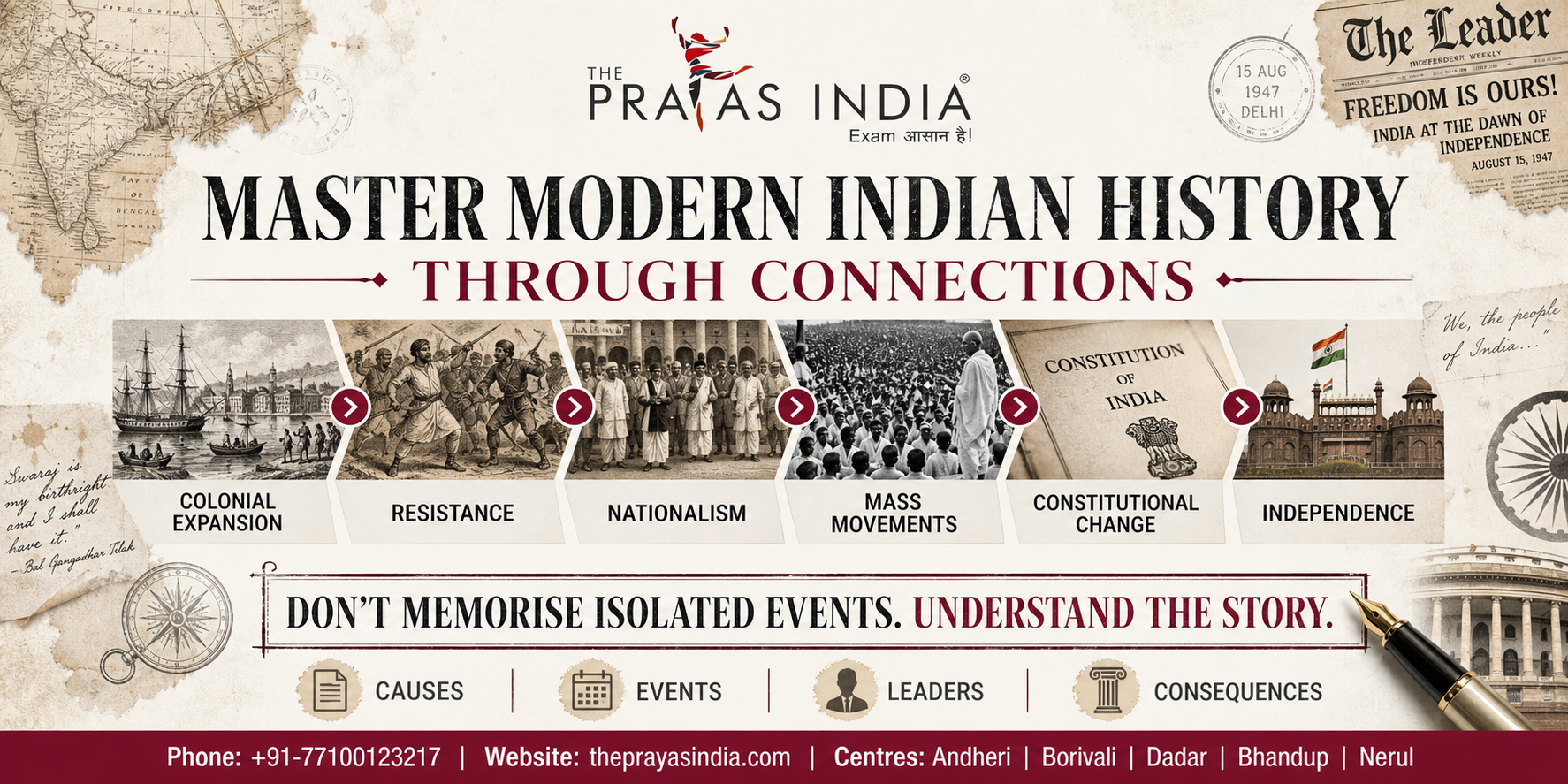
Colonial Expansion → Economic and Social Change → Political Awareness → Nationalism → Mass Movements → Constitutional Developments → Independence
For example, while studying the Freedom Struggle, do not simply memorise that a particular movement took place in a particular year.
Ask:
- What caused the movement?
- What were its objectives?
- Who participated?
- Which regions were involved?
- What methods were adopted?
- How did the colonial government respond?
- Why did the movement change or end?
- What was its broader significance?
- How did it influence later developments?
These questions convert factual history into analytical history.
That distinction is particularly important for Mains preparation.
Use PYQs to Decide What Deserves Your Attention
Previous-year questions should not be treated as something you solve only after completing the syllabus.
They should influence your preparation from the beginning.
UPSC provides previous question papers through its official website, including Civil Services Preliminary examination papers.
After studying a topic, examine how UPSC has approached related themes.
Ask:
- Was the topic tested directly?
- Was it connected with another subject?
- Was the question factual or conceptual?
- Did it involve chronology?
- Did it test an institution, movement, personality or cultural feature?
- Were multiple statements used?
- Did the question require elimination rather than direct recall?
This teaches you something that books alone cannot provide: the language and style of the examination.
For Mains, PYQs are equally useful because they show the type of analytical framing expected from candidates.
A topic that looks factual in a textbook can become an analytical question in Mains.
Therefore, maintain a PYQ notebook or digital document organised by topic.
For example:
Modern History → Gandhian Era → Non-Cooperation → PYQs
Ancient History → Buddhism → PYQs
Medieval History → Bhakti Movement → PYQs
Over time, this becomes a subject-specific question map.
Make a “History Themes” Notebook Instead of a Fact Notebook
Traditional notes often become overloaded with information.
For History, a thematic notebook is usually more useful.
Create sections such as:
Political
Kings, administrations, political transitions and institutions.
Economic
Agriculture, taxation, trade, industries, markets and colonial economic policies.
Social
Communities, caste, social reform, women’s position and social movements.
Religious
Buddhism, Jainism, Bhakti, Sufism, reform movements and related developments.
Cultural
Art, architecture, literature, language, philosophy, music and traditions.
Important Personalities
Thinkers, reformers, rulers, freedom fighters and cultural figures.
Chronology
Important events and transitions.
Maps and Locations
Sites, movements, battles, archaeological locations and important geographical references.
This makes revision faster because you can revise an entire theme without reopening multiple books.
Connect History With Art and Culture
History preparation should not happen in isolation from Art and Culture.
Many cultural developments become easier to understand when placed within their historical context.
For example:
Buddhism → Stupas → Rock-cut Architecture → Sculpture
or:
Bhakti Traditions → Regional Languages → Literature → Temple Traditions
or:
Mughal Period → Architecture → Painting → Literature → Cultural Synthesis
This interconnected approach can reduce duplication in preparation.
Instead of maintaining completely separate mental compartments, create links between history, culture, religion, architecture and literature.
The result is a stronger conceptual network.
Current Affairs Can Make Static History More Relevant
History is primarily a static subject, but current affairs can still influence how certain historical themes become relevant for examination preparation.
A new archaeological discovery, heritage-related development, conservation project, historical commemoration, museum initiative or cultural development can provide context for revising an older topic.
However, current affairs should not replace static preparation.
The better sequence is:
Static Foundation → Current Development → Historical Context → Revision
For example, if a historical site appears in current affairs, use the opportunity to revise:
- Location
- Historical period
- Associated dynasty or civilisation
- Architectural characteristics
- Cultural significance
- Archaeological evidence
This creates meaningful revision rather than random current-affairs accumulation.
How to Read History Books Efficiently
The objective of reading is not to complete pages.
It is to develop understanding that can later be recalled.
During your first reading, focus on:
Who? What? When? Where? Why? How? What changed?
During the second reading, focus on:
Connections + PYQs + Important Themes
During revision, focus on:
Recall + Questions + Weak Areas
This three-stage process prevents you from repeatedly reading the entire book from the beginning.
You should gradually move from input-heavy preparation toward recall-heavy preparation.
That transition is important because examination performance depends on retrieval under time pressure, not on how many pages you have read.
Avoid Collecting Too Many History Sources
History preparation can quickly become a resource-management problem.
Students may collect:
- Multiple standard books
- NCERTs
- Coaching notes
- Online PDFs
- YouTube lectures
- Current-affairs compilations
- Test-series explanations
- Telegram materials
- Multiple revision notes
The result is often incomplete reading of everything.
A better strategy is to maintain a limited core source list.
Use:
One foundation source + one primary reference + class/lecture notes + PYQs + test material
The exact sources can vary according to your preparation level and guidance structure. What matters most is that you complete, revise and practise from the material you choose.
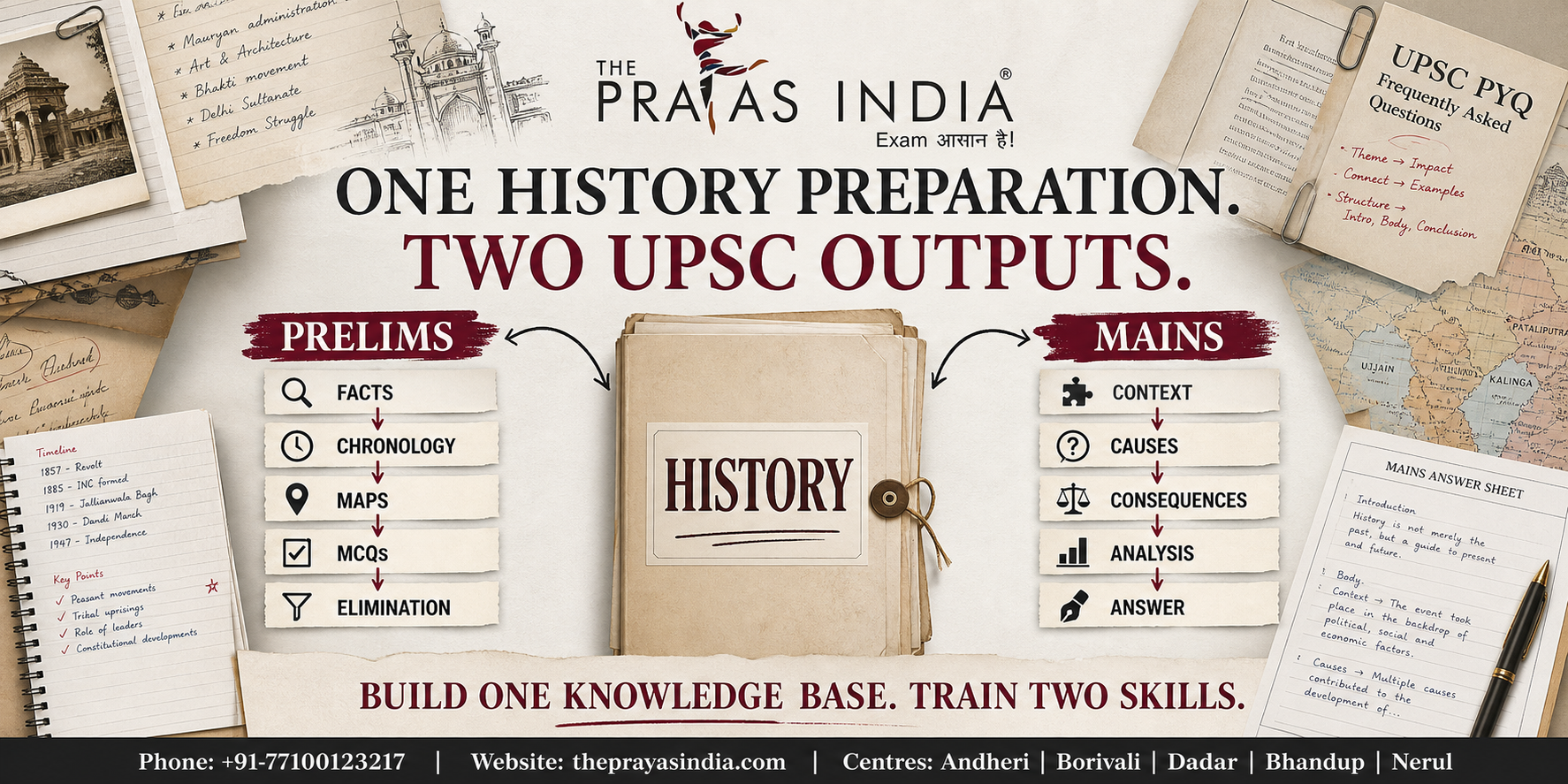
Prelims and Mains Need Different Outputs From the Same History Preparation
One of the most important principles for UPSC CSE 2027 preparation is that the same historical knowledge must eventually serve two different purposes.
For Prelims
You need:
- Factual recall
- Chronology
- Locations
- Personalities
- Institutions
- Cultural features
- Art and architecture
- Elimination skills
- Statement-based question practice
For Mains
You need:
- Context
- Causes
- Consequences
- Continuity and change
- Comparisons
- Examples
- Analytical arguments
- Structured answers
- Relevant historical evidence
Therefore, don’t study History twice from scratch.
Study the topic once comprehensively and create different outputs for Prelims and Mains.
For example:
Topic: Revolt of 1857
Prelims preparation might focus on leaders, centres, chronology, causes and associated facts.
Mains preparation might focus on causes, nature, limitations, regional participation, British response and historical significance.
The knowledge overlaps, but the application differs.
Build a Revision Cycle From the Beginning
History cannot be prepared effectively through one reading.
The first reading creates familiarity.
The second creates understanding.
The third improves recall.
The fourth should focus on weak areas and examination application.
A practical revision cycle can look like:
Read → Recall → Solve PYQs → Revise → Test → Analyse → Revisit Weak Areas
During revision, do not automatically read every page again.
Try active recall.
Close the book and ask yourself:
- What were the major developments?
- Can I explain the chronology?
- What were the major causes?
- What changed after the event?
- Which personalities were important?
- What are the important cultural features?
- Can I answer a PYQ on this topic?
If you cannot explain a topic without looking at the material, it needs another revision.
Use Active Recall for Dates, Dynasties and Personalities
Not every historical fact deserves equal memorisation effort.
Dates are useful when they establish chronology or distinguish major developments. But memorising hundreds of isolated dates can consume time without producing proportional benefits.
Instead, create chronological anchors.
For example:
Major Period → Major Dynasty/Movement → Major Development → Important Transition
Use timelines, flashcards or short revision sheets for information that genuinely requires factual recall.
The goal is not to memorise the entire historical record.
The goal is to remember the high-value information that helps you solve questions and construct answers.
Maps Can Strengthen History Preparation
Historical geography can be an underrated part of preparation.
When studying a civilisation, dynasty, battle, movement or archaeological site, locate it on a map whenever practical.
For example:
- Indus Valley sites
- Buddhist centres
- Ancient trade routes
- Important South Indian kingdoms
- Medieval political centres
- Major battles
- Revolt of 1857 centres
- Important locations associated with the Freedom Struggle
This creates a visual connection between historical events and geography.
It can also help integrate History and Geography preparation rather than treating the subjects as completely separate.
Make Modern History a Story of Cause and Consequence
Modern History becomes easier when you stop treating movements as independent chapters.
Consider the larger progression:
Colonial Rule
↓
Economic, Political and Social Changes
↓
Emergence of New Political Consciousness
↓
Early Nationalism
↓
Mass Mobilisation
↓
Different Forms of Resistance
↓
Constitutional Developments
↓
Independence
This framework helps you understand why different movements emerged and how one phase influenced another.
It also provides a natural structure for Mains answers.
Instead of writing disconnected facts, you can establish:
Background → Trigger → Development → Response → Outcome → Significance
This is a useful answer-writing framework for many historical questions.
Practice History Questions Before You Feel “Fully Prepared”
A common mistake is postponing question practice until the entire syllabus is complete.
That delays feedback.
Once you finish a topic, solve related Prelims questions and attempt at least a few Mains-style questions.
You do not necessarily need to write full-length answers every time.
Initially, practise:
- Brainstorming
- Introduction
- Key arguments
- Examples
- Conclusion
As preparation progresses, start writing complete answers under time constraints.
This allows you to identify gaps much earlier.
Use an Error Log Specifically for History
A history error log should not simply contain wrong answers.
Classify your mistakes.
Category 1: Knowledge Gap
You did not know the fact or concept.
Category 2: Confusion
You knew the topic but mixed up two personalities, periods, events or concepts.
Category 3: Chronology Error
You remembered the events but placed them in the wrong sequence.
Category 4: Interpretation Error
You misunderstood what the question was asking.
Category 5: Elimination Error
You knew some information but could not eliminate incorrect options effectively.
Category 6: Revision Gap
You had studied the topic earlier but could not recall it during the test.
This classification tells you what kind of improvement is required.
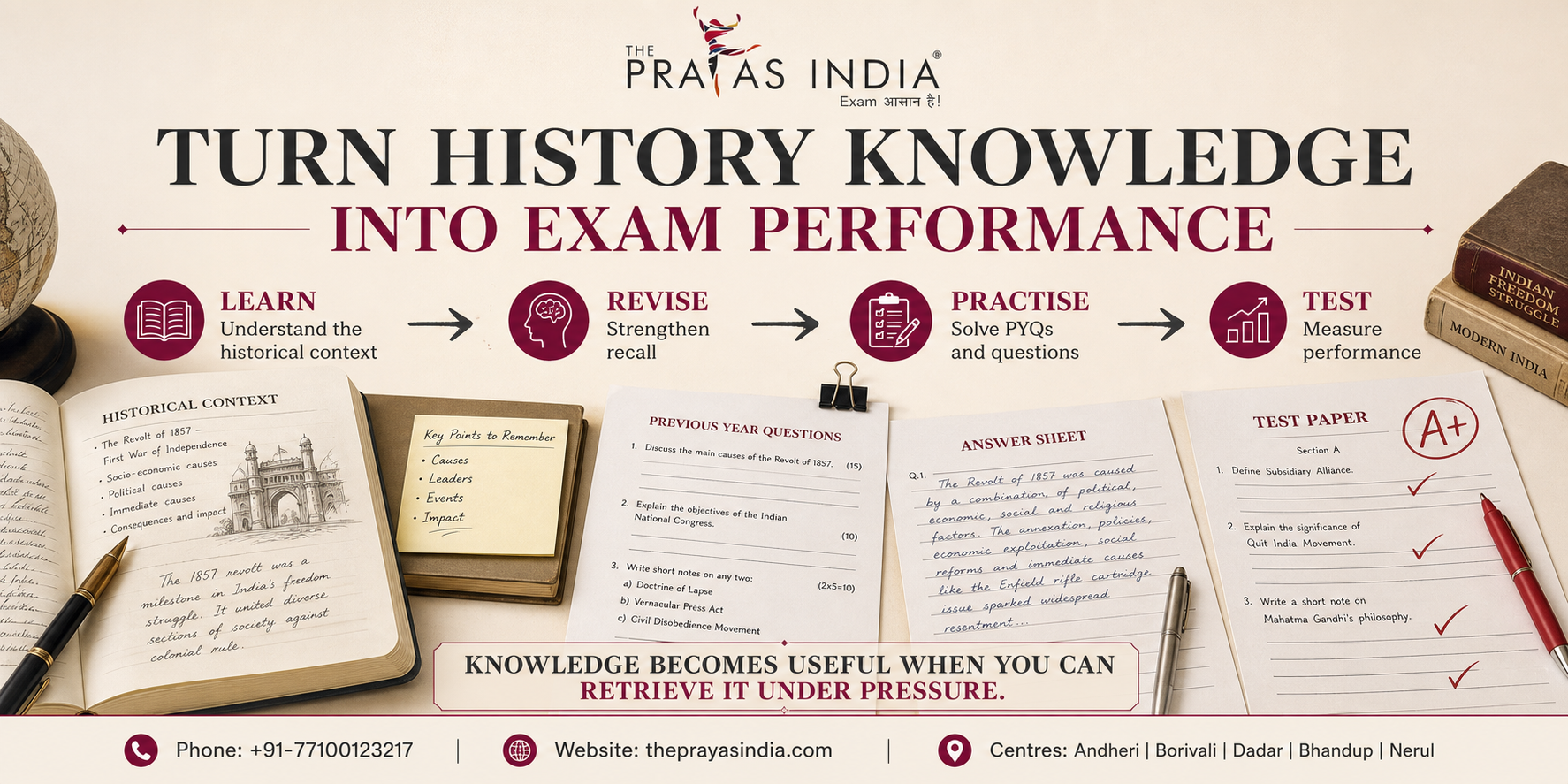
History Preparation Should Become More Test-Oriented Over Time
Early preparation should give more importance to understanding.
As Prelims approaches, the balance should gradually shift toward:
Revision + PYQs + Sectional Tests + Full-Length Tests
Similarly, for Mains preparation, the focus should increasingly move toward:
Revision + Answer Writing + PYQs + Examples + Timed Practice
This does not mean abandoning conceptual learning.
It means changing the output expected from your preparation.
A Practical 90-Day History Revision Approach
If you are approaching Prelims and need to consolidate History within a limited period, divide your preparation into three stages.
Days 1–30: Consolidation
Complete the major remaining portions of Ancient, Medieval and Modern History.
Focus on conceptual clarity and core notes.
Do not spend excessive time creating elaborate new material.
Days 31–60: Revision and PYQs
Begin systematic revision.
Solve topic-wise PYQs and sectional questions.
Identify recurring weak areas.
Create short revision sheets for chronology, culture, personalities and confusing concepts.
Days 61–90: Test and Recall
Shift toward timed practice.
Revise from short notes.
Take sectional and full-length tests.
Analyse mistakes.
Revisit only the areas where your performance remains weak.
The objective during the final phase should not be to read everything again.
It should be to retrieve important information quickly and accurately.
How to Divide Time Between Ancient, Medieval and Modern History
The exact time allocation should depend on your existing preparation level, but a sensible approach is to avoid spending disproportionate time on one period simply because it feels more comfortable.
A student who enjoys Modern History may repeatedly read the Freedom Struggle while neglecting Ancient or Medieval topics.
Another student may spend too much time memorising Ancient History facts while failing to develop Mains-oriented understanding of Modern History.
Instead, assess your preparation using three questions:
Coverage: Have I studied the major areas?
Retention: Can I recall them without looking at my notes?
Application: Can I solve questions based on them?
The subject requiring the greatest attention is the one where the gap is largest.
How Beginners Should Start History for UPSC CSE 2027
If you are beginning UPSC preparation from scratch, do not attempt to complete all three periods simultaneously.
Start by creating the broad historical framework.
Then move systematically.
A practical sequence can be:
Syllabus → Basic Reading → Timeline → Detailed Study → PYQs → Notes → Revision → Tests
At the beginning, your goal should be understanding.
Do not worry if you cannot remember every dynasty or date during the first reading.
Retention develops through repeated exposure and active recall.
Beginners should also avoid comparing their preparation with aspirants who have already completed multiple revisions.
The important question is whether your own understanding is becoming stronger with each cycle.
How Experienced Aspirants Should Approach History Differently
A repeat candidate or an aspirant who has already completed the basic syllabus should not automatically restart the entire subject from page one.
First diagnose the problem.
Was the previous issue:
- Poor revision?
- Weak Modern History?
- Confusion in Ancient History?
- Lack of PYQ practice?
- Weak Prelims performance?
- Poor Mains answer writing?
- Inability to retain factual information?
- Weak time management during tests?
The answer determines the strategy.
If knowledge is already strong but recall is weak, revision and testing may be more useful than another complete reading.
If conceptual understanding is weak, targeted study may be necessary.
The preparation should respond to the actual gap.
Common History Preparation Mistakes
Reading Without Revising
Completing a book once does not mean completing the subject.
Memorising Without Understanding
Facts become difficult to retain when they are disconnected from context.
Ignoring PYQs
Without PYQs, students may spend too much time on low-priority information.
Treating Ancient, Medieval and Modern History Identically
Each period requires a slightly different approach.
Overloading Notes
Notes should make revision easier, not create another textbook.
Ignoring Art and Culture Connections
Historical developments and cultural developments often overlap.
Preparing Only for Prelims
A comprehensive understanding should also support Mains preparation.
Writing Mains Answers Too Late
Answer-writing skills develop through practice, not last-minute reading.
Using Too Many Sources
More books do not automatically produce better preparation.
Revising Passively
Rereading is less useful when you cannot test whether you can recall the information independently.
Build a Weekly History Routine
A weekly schedule can keep preparation consistent without allowing History to consume all available study time.
A practical week could include:
Monday–Tuesday
New topic + conceptual reading
Wednesday
Revision of previous topics
Thursday
PYQs and topic-wise questions
Friday
New topic + short notes
Saturday
Sectional test + analysis
Sunday
Weekly revision + error-log review
The exact schedule can be adjusted according to the candidate’s overall UPSC preparation plan.
The important principle is to combine learning and retrieval every week.
Do not spend six days reading and then discover on the seventh day that you cannot remember what you studied.
How Structured Guidance Can Improve History Preparation
History preparation can become difficult when students are unsure about how much to study, which sources to prioritise, how to interpret PYQs or how to convert factual knowledge into Mains answers.
A structured preparation environment can help bring these components together.
For aspirants preparing through a coaching programme, useful support can include:
- Structured lectures
- Subject-wise study plans
- Curated study material
- PYQ discussions
- Regular tests
- Mains answer-writing practice
- Performance analysis
- Doubt-solving support
- Revision planning
- Mentorship
The purpose of guidance should not be to increase the number of resources available to a student. It should help the student use a manageable set of resources more effectively.
For aspirants preparing for UPSC CSE 2027 in Mumbai, The Prayas India provides online and offline UPSC preparation support, allowing students to choose a learning format that fits their preparation requirements.
The Prayas India has centres in Andheri, Borivali, Dadar, Bhandup and Nerul, along with online learning options.
Students should evaluate any coaching programme based on the quality of teaching, study material, testing system, answer-writing support, mentorship and overall preparation structure rather than choosing an institute solely because of promotional claims.
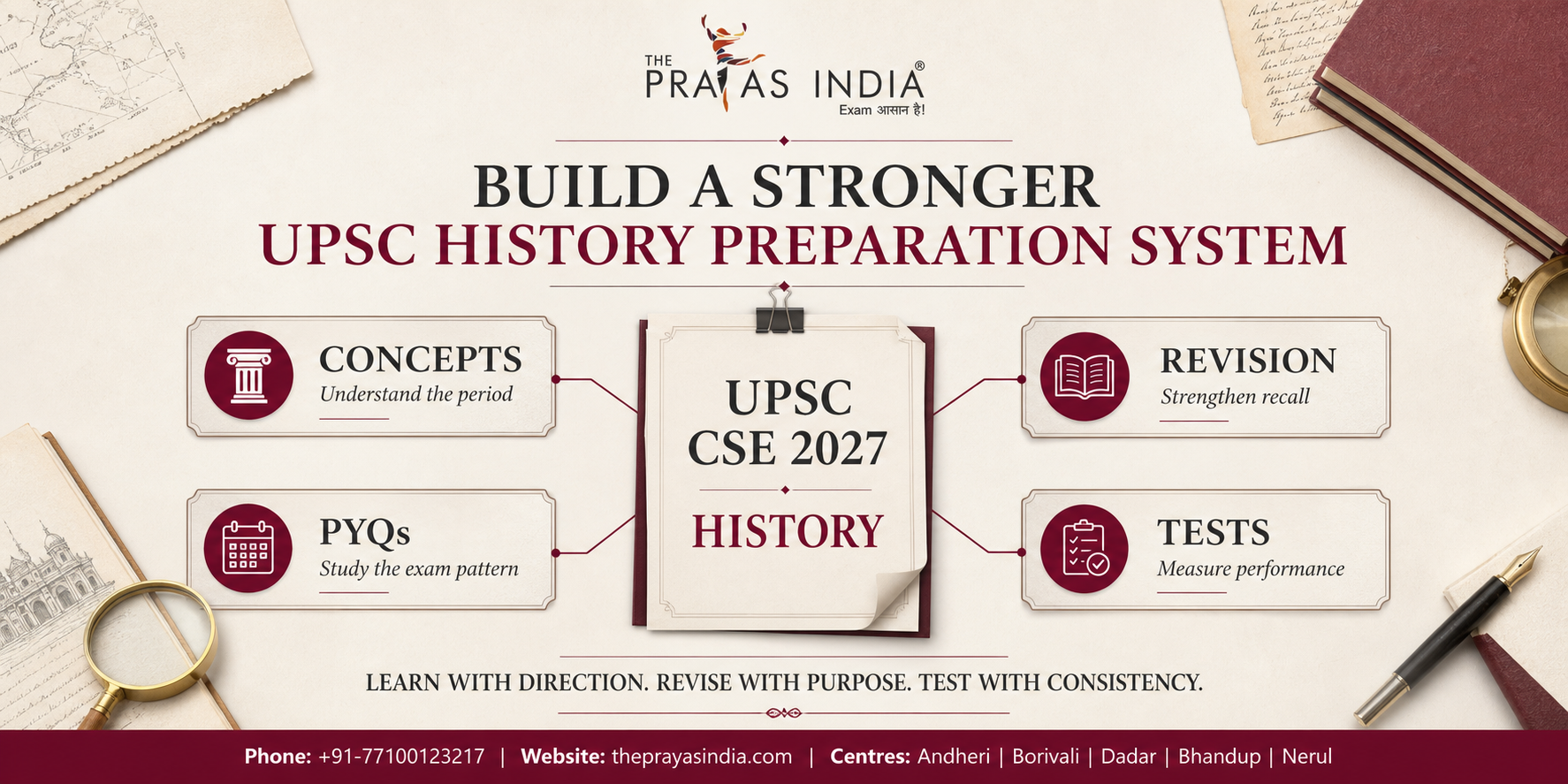
A Complete History Preparation Framework for UPSC CSE 2027
By the time your History preparation becomes mature, your workflow should look something like this:
1. Decode the Syllabus
Know exactly what you need to cover.
2. Build the Timeline
Understand the broad sequence of historical developments.
3. Study Ancient History
Focus on civilisations, society, religion, culture, art and architecture.
4. Study Medieval History
Understand political, economic, social and cultural transitions.
5. Study Modern History
Build a strong chronological and cause-effect understanding of colonialism and the Freedom Struggle.
6. Connect History With Culture
Create links between historical periods and cultural developments.
7. Solve PYQs
Understand how UPSC frames questions.
8. Create Short Revision Material
Reduce large volumes of information into manageable revision points.
9. Practise Prelims Questions
Build factual recall and elimination skills.
10. Practise Mains Answers
Learn to convert historical knowledge into structured analysis.
11. Revise Repeatedly
Use active recall rather than passive rereading.
12. Test and Analyse
Find weaknesses and correct them before the examination.
This framework transforms History from a large reading assignment into a repeatable preparation system.
Final Takeaway
Preparing History for UPSC CSE 2027 does not require memorising every historical detail you encounter.
It requires a structured understanding of Ancient, Medieval and Modern India, supported by timelines, themes, PYQs, revision and repeated practice.
Ancient History should be approached through civilisations, society, religion, culture, art and architecture. Medieval History becomes more manageable when studied through political, economic, social and cultural transitions. Modern History should be organised around colonial expansion, resistance, nationalism, mass movements, constitutional developments and the road to independence.
Most importantly, do not separate your preparation into isolated activities.
Syllabus → Sources → Concepts → Timeline → PYQs → Notes → Revision → Tests → Analysis
That cycle should continue throughout your preparation.
For Prelims, focus on recall, chronology, cultural features, locations and question-solving. For Mains, develop context, causes, consequences, continuity, change and analytical presentation.
The official UPSC website should remain the final reference for the applicable syllabus, examination notifications and future updates, while its previous-year question-paper archive can be used to study actual examination trends.
For aspirants preparing for UPSC CSE 2027, the goal should not simply be to “finish History.” The goal should be to reach a stage where you can understand a historical topic, recall its important dimensions, recognise how UPSC may frame it and use the knowledge effectively in both Prelims and Mains.
A structured preparation environment, regular testing and consistent revision can make that process more measurable and manageable.
Frequently Asked Questions
1. How should I start History preparation for UPSC CSE 2027?
Start with the official syllabus and previous-year questions. Then build a broad timeline before studying Ancient, Medieval and Modern History in detail. Use a limited set of reliable sources and begin revision and question practice early.
2. Should I study Ancient, Medieval and Modern History separately?
They can be studied in separate modules for clarity, but you should also understand their connections. A chronological framework helps you see how political, social, economic and cultural developments evolved over time.
3. Which part of History should I study first?
There is no universal sequence that works for every aspirant. Beginners can start with whichever period helps them build a broad historical framework, while experienced aspirants should prioritise the areas where their previous preparation or test performance is weakest.
4. How important are PYQs for UPSC History preparation?
PYQs are extremely useful for understanding how UPSC frames questions, what kind of information is tested and how factual and conceptual elements are combined. UPSC officially provides previous question papers through its website.
5. Should I memorise all dates in History?
No. Focus on important chronological anchors and dates that help you understand major transitions, movements, dynasties and events. Excessive memorisation of isolated dates can make revision inefficient.
6. How should I prepare Modern Indian History for UPSC?
Build a chronological framework and study the subject through causes, events, personalities, movements, government responses and consequences. Connect different phases of the Freedom Struggle rather than treating every movement as an isolated chapter.
7. How should I prepare Ancient History for UPSC?
Focus on major civilisations, political developments, society, economy, religion, philosophy, literature, art, architecture, inscriptions, coins and archaeological evidence. Use PYQs to identify the areas that deserve greater revision.
8. How should I prepare Medieval History for UPSC?
Study political developments alongside economy, administration, society, religion, Bhakti and Sufi traditions, regional kingdoms, art, architecture and literature. A thematic approach is generally more useful than memorising rulers independently.
9. Is History important for both UPSC Prelims and Mains?
Yes. History-related areas are relevant to General Studies preparation across the examination, while the Mains GS Paper I syllabus explicitly includes Indian heritage and culture, modern Indian history, the Freedom Struggle and post-independence consolidation and reorganisation.
10. How many times should I revise History?
There is no fixed number that works for everyone. Instead of counting revisions, measure whether you can recall and apply the material without looking at your notes. Revisions should progressively become shorter and more active.
11. Should I make separate notes for Prelims and Mains?
You can maintain a common core knowledge base and add separate Prelims and Mains layers. Prelims notes can emphasise facts, chronology and cultural features, while Mains notes should include causes, consequences, examples, comparisons and analytical dimensions.
12. Can coaching help with UPSC History preparation?
Structured coaching can help with syllabus coverage, conceptual explanation, PYQ analysis, test practice, revision planning and answer writing. The value depends on the quality of teaching, study material, testing and guidance provided.
13. How can I prepare History while studying other UPSC subjects?
Use a weekly schedule rather than trying to complete History continuously for several weeks. Combine new learning with revision and PYQ practice so that History progresses alongside Polity, Geography, Economy, Environment and other subjects.
14. Is current affairs necessary for History preparation?
Static History should remain the foundation. Current affairs can be used to provide context for heritage, archaeology, historical sites, cultural developments and related issues, but current events should not replace systematic static preparation.
Master UPSC CSE 2027 History with a Structured Preparation Strategy
Cover Ancient, Medieval and Modern Indian History with the right combination of conceptual clarity, PYQs, revision, answer writing and test practice. Join The Prayas India for structured UPSC preparation and build a focused strategy for Prelims and Mains.
Official Website: theprayasindia.com
Visit Our Mumbai Centres:
Andheri | Borivali | Dadar | Nerul | Bhandup