UPSC CSE 2027 Preparation Overload: How to Stop Studying Too Many Books and Sources
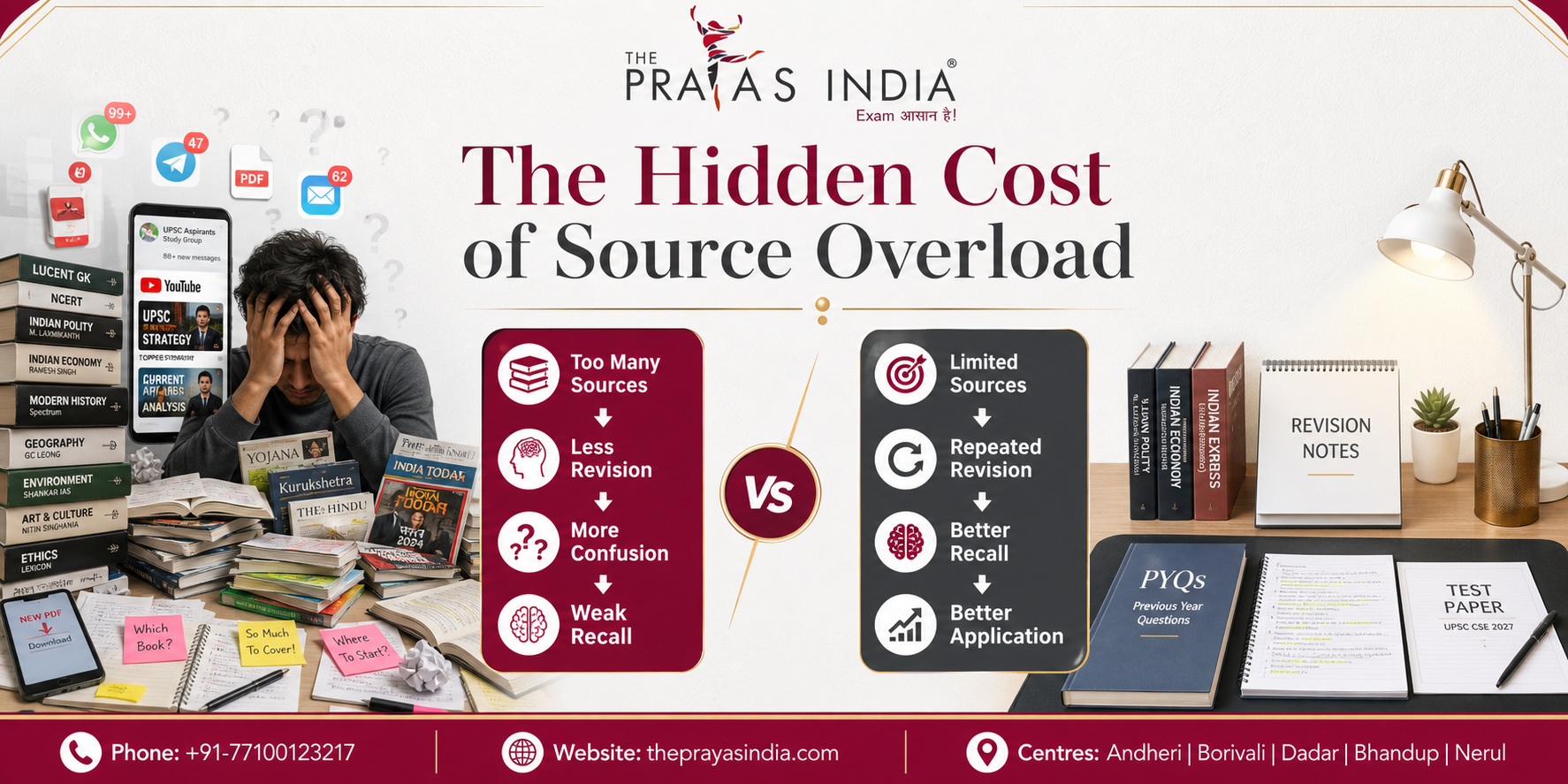
Preparing for the UPSC Civil Services Examination is not simply a question of studying for long hours. One of the biggest challenges faced by aspirants is deciding what not to study. With hundreds of books, coaching notes, YouTube lectures, PDFs, Telegram channels, current affairs compilations, test series and online recommendations available, it is easy to mistake collecting resources for making progress.
This problem becomes particularly serious for UPSC CSE 2027 aspirants who begin preparation early. Having more time can appear to be an advantage, but without a clear source-selection strategy, the additional months can quickly turn into a cycle of downloading, purchasing, bookmarking and switching between materials.
An aspirant may begin Polity with one standard book, shift to another teacher’s notes, download a coaching institute’s PDF, watch multiple YouTube playlists and finally start making separate notes from current affairs. The same pattern may repeat for History, Geography, Economy, Environment and Science & Technology.
The result is not necessarily deeper preparation. It is often fragmented preparation.
The solution is not to stop studying or reduce preparation quality. The solution is to create a controlled source ecosystem in which every resource has a specific purpose.
For UPSC CSE 2027, the objective should be simple: fewer sources, repeated revision, strong PYQ integration, regular testing and continuous improvement in answer quality.
What Is UPSC Preparation Overload?
UPSC preparation overload happens when an aspirant consumes more study material than they can effectively understand, revise and apply.
It usually looks like this:
- Five different books for the same GS subject
- Multiple current affairs magazines every month
- Several YouTube teachers for one topic
- Large collections of downloaded PDFs
- Multiple coaching notes covering identical topics
- Different test series without sufficient analysis
- Separate notes from every source
- Constantly changing study plans
- Buying new books after watching recommendations online
The problem is not that these resources are individually useless. The problem is duplication.
If three resources explain the same constitutional concepts but none of them is revised properly, the aspirant may actually remember less than someone who studied one reliable source four times.
UPSC itself provides previous-year question papers through its official website, including Civil Services Preliminary and Main examination papers. These papers can be used as an important filter when deciding how much depth is actually required for a topic.
The Real Cost of Too Many Sources
Source overload creates several hidden costs:
1. Revision debt: Every new source creates additional material that eventually needs revision.
2. Decision fatigue: You repeatedly spend time deciding which lecture, book or PDF to use.
3. Fragmented notes: Important information becomes scattered across notebooks, digital folders and screenshots.
4. False productivity: Downloading and highlighting resources can feel like preparation even when there is little recall or application.
5. Reduced testing time: Hours spent consuming new material reduce the time available for MCQs, PYQs, answer writing and mock analysis.
6. Frequent strategy changes: Every new topper interview or online recommendation can make the existing plan appear inadequate.
The key question for a UPSC aspirant should therefore not be:
“What is the maximum number of sources I can complete?”
It should be:
“Which limited set of sources can I revise repeatedly and apply effectively in questions and answers?”
Why More Books Do Not Automatically Mean Better UPSC Preparation
A common misconception is that successful UPSC preparation requires reading every major book recommended by toppers, educators and online communities.
In reality, books should be selected according to function, not popularity.
One source may be excellent for building foundational understanding. Another may be useful for practice. A third may provide current examples. A fourth may be useful for revision. There is no requirement that one aspirant must use all four for every subject.
The UPSC syllabus itself should remain the controlling document.
The Civil Services Examination has a Preliminary stage followed by the Main Examination consisting of written papers and the interview/personality test. UPSC describes the Preliminary examination as a screening test, with its marks not counted toward the final order of merit.
That distinction matters because preparation should ultimately connect to the demands of the examination rather than to the volume of material consumed.
A book is useful only when it helps you do at least one of the following:
- Understand a concept
- Build factual knowledge
- Answer a PYQ
- Improve analytical ability
- Write a better answer
- Solve an MCQ more accurately
- Revise efficiently
- Add relevant examples to Mains answers
If a new resource does none of these things better than your existing source, there may be little reason to add it.
The One-Source Principle for UPSC CSE 2027
The idea of the one-source principle is not that an aspirant must literally use only one book for every subject.
Instead, it means:
Choose one primary source for each major static subject and add supplementary resources only when there is a clearly identified gap.
For example:
| Subject | Primary Resource | Supplementary Input |
|---|---|---|
| Polity | One standard foundational source | Current constitutional developments + PYQs |
| Modern History | One standard book/notes | PYQs + selective revision material |
| Geography | One foundational source | Atlas + diagrams + PYQs |
| Economy | One structured source | Current economic developments |
| Environment | One consolidated source | Current environmental issues |
| Ethics | One structured source | Case studies + examples |
| Current Affairs | One reliable monthly system | Newspaper/editorial inputs where required |
| Optional | One defined study framework | PYQs + test series + answer enrichment |
The exact source can differ from one aspirant to another. What matters is that you stop changing the foundation every few weeks.
How to Build Your UPSC CSE 2027 Source Pyramid
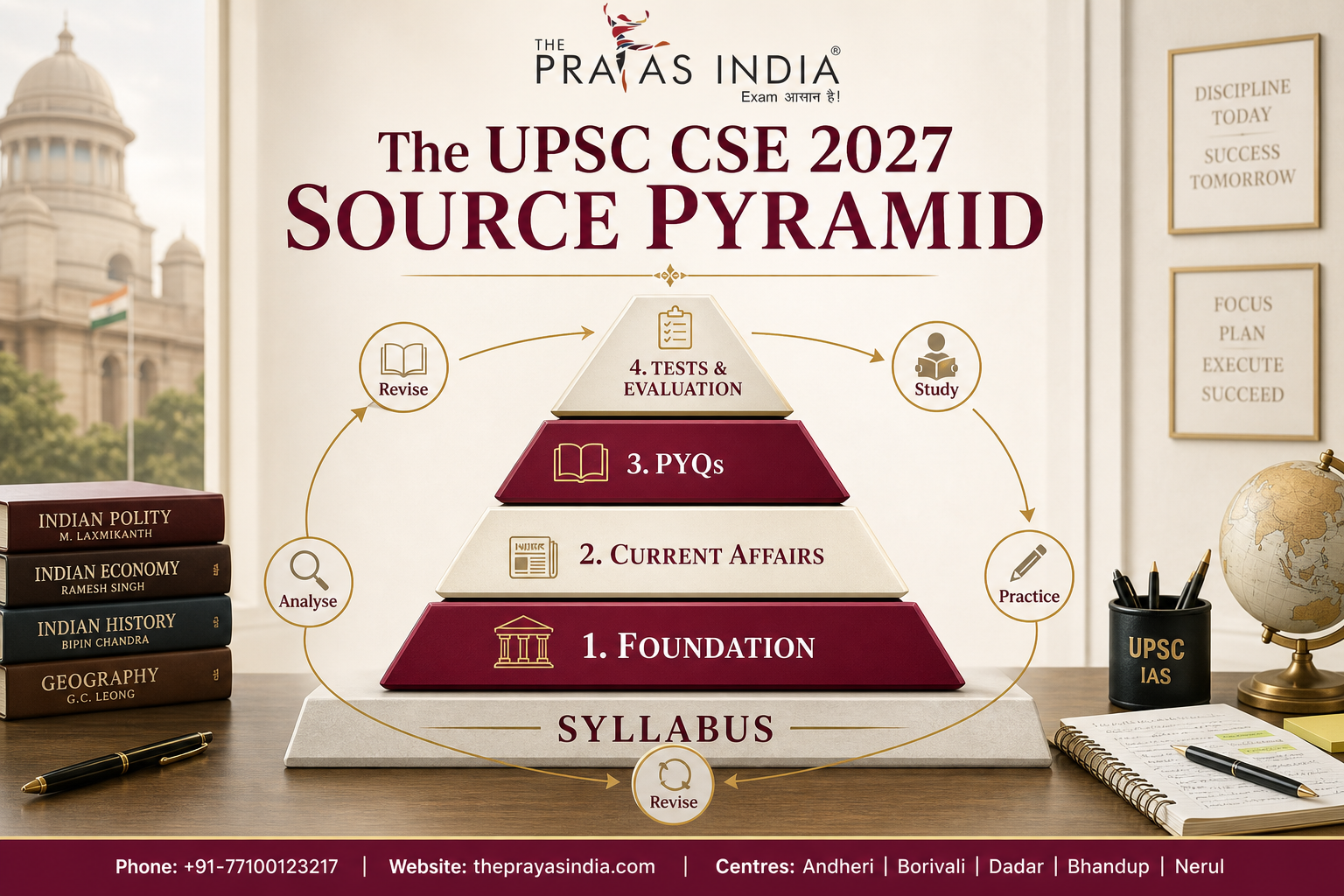
A useful way to control preparation overload is to divide resources into four levels.
Level 1: Foundation Sources
These are your core textbooks, standard reference books or structured coaching material.
They answer:
“What do I need to understand?”
These resources should be studied carefully and revised repeatedly.
You do not need five foundational sources for the same topic.
Level 2: Current Affairs
Current affairs should supplement your static understanding rather than replace it.
For example, reading a news article about a Supreme Court judgment is more useful when you already understand the relevant constitutional provision.
Similarly, an economic policy becomes easier to understand when you already know the basic concepts behind inflation, fiscal policy, monetary policy, taxation and growth.
This is why continuously collecting current affairs PDFs can become counterproductive.
Instead of asking:
“Did I read today’s entire current affairs compilation?”
ask:
“What syllabus-linked issue did I understand better today?”
Level 3: PYQs
Previous Year Questions are one of the most important filters in UPSC preparation.
UPSC officially maintains a previous-question-paper repository containing Civil Services Preliminary and Main papers.
PYQs help you understand:
- Recurring themes
- Question framing
- Conceptual depth
- Static-current affairs connections
- Mains analytical expectations
- The difference between knowing information and applying it
Aspirants should therefore use PYQs during preparation, not only after completing the syllabus.
If you are studying Parliament, examine relevant PYQs.
If you are studying climatology, examine relevant Geography questions.
If you are studying federalism, examine questions connected with Centre-State relations.
This creates a feedback loop:
Syllabus → Source → PYQs → Revision → Practice
Level 4: Testing and Evaluation
The final layer is practice.
This includes:
- Prelims MCQs
- Sectional tests
- Full-length mock tests
- Mains answer writing
- Essay practice
- Ethics case studies
- Optional subject tests
Aspirants often make the mistake of adding another book when their real problem is insufficient practice.
If you are consistently unable to answer questions despite reading several resources, the next step may not be another book.
It may be:
practice + analysis + revision.
The 80/20 Rule for Source Selection
UPSC preparation contains a huge amount of information, but not every piece of information deserves equal preparation time.
A practical approach is to identify the material that gives you the highest return.
Suppose you have:
- One standard textbook
- 500 pages of coaching notes
- 40 hours of video lectures
- 1,000 pages of supplementary material
If the standard textbook plus PYQs already allows you to understand most of the recurring themes, immediately moving through every additional resource may not improve your preparation proportionately.
The objective is not to create the largest personal library.
The objective is to create the highest usable knowledge density.
This means:
Read → Understand → Recall → Apply → Revise.
A source that survives this cycle is valuable.
A source that is merely interesting but never revised may not deserve a permanent place in your preparation system.
How to Know Whether You Actually Need Another Book
Before buying or downloading a new resource, ask yourself five questions.
Question 1: What exact gap does this source solve?
Do not accept answers such as:
- “Everyone recommends it.”
- “The topper mentioned it.”
- “The PDF is trending.”
- “My friend says it is important.”
Identify the exact problem.
For example:
“My existing Geography source does not adequately cover mapping practice.”
That is a defined gap.
Question 2: Can my existing source solve this gap?
Sometimes the information is already present but has not been revised properly.
If that is the case, a new source is unlikely to solve the real problem.
Question 3: Will I revise this source?
A 700-page book that you read once may be less useful than a 250-page resource that you revise multiple times.
Question 4: Does it improve my PYQ performance?
This is one of the strongest filters.
If a new source adds information but does not improve your understanding of actual UPSC questions, reconsider whether it deserves your time.
Question 5: Does it fit my current preparation stage?
A resource useful for Mains answer enrichment may not be the priority when you are still building basic concepts.
Similarly, an extensive Prelims fact source may not be the right answer to a Mains answer-writing problem.
The 3-Source Rule for Each Topic
One practical way to reduce overload is to limit most topics to three functional inputs:
Source 1: Core Source
Your primary textbook, notes or classroom material.
Source 2: Current Update
Relevant contemporary developments.
Source 3: PYQs/Test Questions
Questions that force you to apply what you have studied.
For example:
Polity topic: Fundamental Rights
Core Source → Standard Polity material
Current Update → Relevant contemporary constitutional/legal developments
Application → UPSC PYQs + practice questions
This approach is far more manageable than maintaining separate notebooks for every educator and website discussing Fundamental Rights.
Stop Making Notes From Everything
One of the biggest contributors to UPSC preparation overload is excessive note-making.
Aspirants often create:
- Book notes
- Coaching notes
- Newspaper notes
- Current affairs notes
- YouTube notes
- Telegram notes
- Revision notes
- Final revision notes
Eventually, the notes become another syllabus.
The better approach is to progressively compress information.
First Layer: Understanding
Read the topic properly.
Second Layer: Consolidation
Mark important information in the primary source.
Third Layer: Revision Notes
Create only information that you are likely to forget or need for answer enrichment.
Fourth Layer: Final Revision
Convert important information into extremely short recall triggers.
Your notes should become smaller over time, not larger.
The “Delete Before You Add” Rule
Every time you want to add a new resource, remove or reject something first.
For example:
New Polity PDF added?
Then ask which existing resource it replaces.
New current affairs magazine added?
Which existing current affairs source will you stop using?
New test series purchased?
Do you have enough time to analyse the previous test series?
This creates a valuable discipline:
Every new resource must earn its place.
If it cannot replace, improve or fill a clearly identified gap, leave it out.
How Coaching Can Reduce UPSC Source Overload
One reason structured coaching can be useful is that it can reduce the number of independent decisions an aspirant has to make.
Without a structured system, students may spend significant time deciding:
- Which book should I buy?
- Which newspaper should I follow?
- Which YouTube teacher should I watch?
- Which current affairs magazine should I download?
- Which test series should I purchase?
- Which notes should I make?
- Which topics require more depth?
- How should I revise?
A structured UPSC coaching program can bring these components into a defined preparation framework.
At The Prayas India, the focus can be positioned around a structured preparation ecosystem where aspirants can work through syllabus-oriented classroom learning, current-affairs integration, practice, revision and evaluation rather than continuously searching for disconnected resources.
For a long-cycle examination such as UPSC CSE, this structure can be especially useful for beginners who have difficulty distinguishing between important material and merely available material.
The objective should not be to make students dependent on an endless stream of content. It should be to help them build a repeatable preparation system.
A Practical UPSC CSE 2027 Source Audit
Take one evening and audit every resource you currently use.
Create four columns:
| Resource | Purpose | Frequency of Use | Decision |
|---|---|---|---|
| Book A | Static foundation | Daily | Keep |
| PDF B | Same topic as Book A | Rarely | Remove |
| Current Affairs C | Monthly revision | Weekly | Keep |
| Video Series D | Concept clarification | Occasionally | Selectively use |
| Test Series E | Practice | Weekly | Keep |
| Telegram PDFs | Unclear | Random | Remove |
Do not feel guilty about deleting material.
A deleted PDF can actually be a productivity gain.
How Many Hours Should Be Spent on Sources?
The answer should not be based only on the number of hours spent reading.
A better measurement is output.
For example:
After three hours of studying Polity, can you:
- Explain the concept without looking at the book?
- Solve related PYQs?
- Identify important constitutional provisions?
- Connect the topic with contemporary developments?
- Write a structured Mains answer?
- Revise the material later?
If the answer is yes, the study session generated output.
If you spent three hours moving between six PDFs and watching four lectures but cannot explain the topic independently, the problem is not necessarily a lack of resources.
It is a lack of consolidation.
A Weekly Anti-Overload System for UPSC CSE 2027
A simple weekly structure can help prevent resource accumulation.
Monday to Thursday: Core Learning
Focus primarily on the syllabus and your selected foundation source.
Avoid changing resources midway through a topic.
Friday: PYQ Integration
Solve and analyse relevant previous-year questions.
Identify gaps rather than immediately opening another book.
Saturday: Current Affairs Integration
Connect relevant current developments to static subjects.
Sunday: Revision and Testing
Revise the week’s content and take a short test.
Analyse mistakes.
Then decide whether a genuine resource gap exists.
This creates a disciplined cycle:
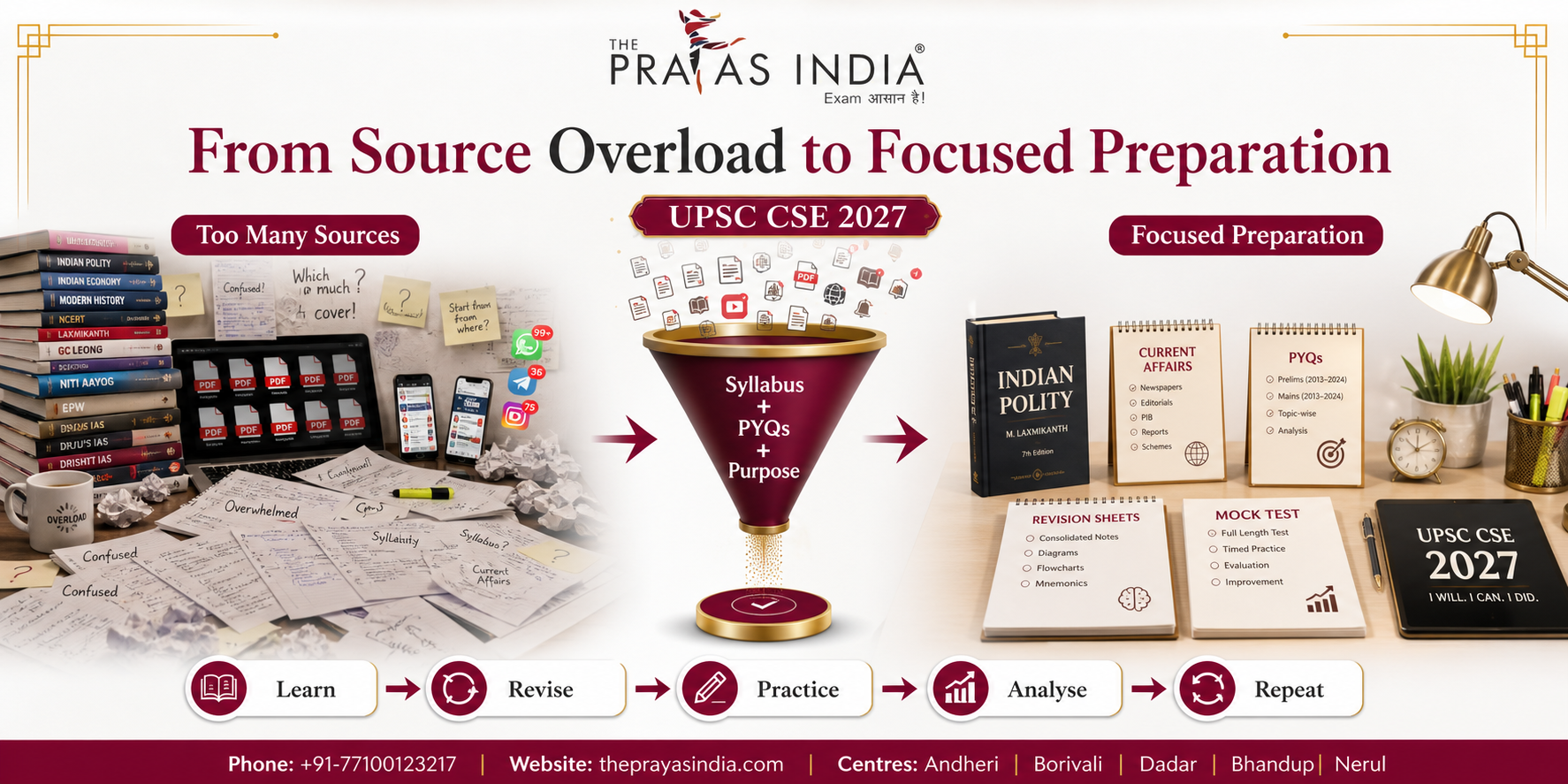
Learn → Connect → Practice → Test → Analyse → Revise
rather than:
Search → Download → Watch → Bookmark → Switch → Repeat
What Beginners Should Do Differently
Beginners are especially vulnerable to source overload because they have not yet developed a clear understanding of the UPSC syllabus.
A beginner sees a 1,000-page book and assumes that completing it means completing the subject.
But the syllabus is the actual boundary.
Start with:
- UPSC syllabus
- Previous-year questions
- One primary source per subject
- Basic current affairs system
- Regular revision
- Gradual testing
Do not attempt to consume the entire UPSC ecosystem in the first few months.
Your first objective should be orientation and consolidation.
Once the basic framework is established, supplementary sources can be introduced where necessary.
What Experienced Aspirants Should Do Differently
Repeaters often face a different problem.
They may already possess too much material.
After one attempt, they accumulate:
- Previous notes
- Test papers
- Current affairs files
- Mistake books
- Coaching material
- Answer copies
- Multiple revision PDFs
For repeaters, the priority should be diagnosis.
Ask:
What exactly went wrong?
Was the issue:
- Insufficient revision?
- Weak Prelims accuracy?
- Poor time management?
- Inadequate Mains answer practice?
- Weak optional preparation?
- Current affairs integration?
- Lack of test analysis?
The answer should determine the next resource.
Do not rebuild the entire library simply because the previous attempt did not produce the desired result.
UPSC CSE 2027 Preparation: Build a “Final 30-Day Shelf”
One of the best ways to control source overload from the beginning is to imagine your final revision phase.
Ask yourself:
If I had only 30 days left, what material would I actually revise?
Your answer should eventually become your core preparation shelf.
It might contain:
- Consolidated static notes
- Selected standard books
- Current affairs revision material
- PYQ analysis
- Prelims mistake notebook
- Mains value-addition notes
- Essay framework
- Ethics examples
- Optional revision material
If you know that a resource will never appear on that final shelf, question whether you need to spend significant time on it now.
The Difference Between Information Collection and Preparation
Information collection feels comfortable.
Preparation is uncomfortable.
Collecting another PDF gives you the feeling that you are becoming more prepared.
Solving 50 difficult MCQs and discovering that you got 18 wrong forces you to confront your weaknesses.
Reading another article can feel productive.
Writing a timed Mains answer and comparing it against a benchmark is much harder.
Watching another lecture is easy.
Revising the same chapter for the fourth time may feel repetitive.
But UPSC preparation ultimately requires retention, recall, analysis and application.
Therefore, aspirants should gradually shift their time allocation from:
Content Consumption
towards:
Revision + Practice + Evaluation.
A Simple Source-Selection Checklist for UPSC CSE 2027
Before adopting any new book, PDF, course or channel, ask:
- Does it directly relate to the UPSC syllabus?
- Does it fill a clearly identified gap?
- Is my existing source insufficient?
- Can I realistically complete and revise it?
- Does it improve PYQ performance?
- Does it improve answer writing?
- Does it provide useful current examples?
- Does it reduce confusion rather than create another layer?
- Will I still use it during revision?
- Can I explain why I need it?
If you cannot answer these questions, pause before adding the resource.
A Better UPSC CSE 2027 Mindset: Depth Over Volume
UPSC preparation is a long-term process. There is enough time pressure already without creating additional pressure by trying to finish every recommended source.
The goal should be to develop depth within a controlled knowledge system.
One well-understood source, revised several times and tested through PYQs, can become much more useful than multiple half-read resources.
Similarly, one reliable current-affairs workflow can be more manageable than subscribing to every magazine, channel and daily compilation available online.
The most important shift is psychological:
You do not need to know everything that is available.
You need to know what is relevant, understand it properly, revise it repeatedly and apply it under examination conditions.
How The Prayas India Can Help You Build a Structured UPSC Preparation System
For many aspirants, the biggest challenge is not motivation. It is direction.
Aspirants preparing independently can easily spend weeks comparing books, teachers, online courses and current-affairs sources instead of progressing systematically through the syllabus.
A structured coaching environment can provide a defined framework for learning, revision, testing and evaluation.
The Prayas India focuses on helping aspirants develop a systematic preparation approach through classroom guidance, subject-wise learning, current-affairs integration, practice and performance-oriented preparation.
For a UPSC CSE 2027 aspirant who is struggling with source overload, the value of guidance is not simply receiving more study material. It is learning which material deserves your attention, how to sequence it and how to convert it into examination-ready knowledge.
The right preparation system should ultimately make your study table simpler, not more crowded.
If your preparation currently consists of dozens of books, hundreds of PDFs and multiple competing sources, this is a good time to stop and conduct a source audit.
Remove duplication.
Choose your primary sources.
Integrate PYQs.
Revise repeatedly.
Test yourself.
Analyse mistakes.
Then add resources only when a genuine gap appears.
That is how UPSC CSE 2027 preparation can move from resource accumulation to focused preparation.
Final Takeaway
The biggest UPSC preparation advantage is not having the largest library.
It is having a small, reliable and repeatedly revised knowledge system.
For CSE 2027 aspirants, the formula can be kept simple:
Limited Sources + Strong Concepts + PYQs + Current Affairs Integration + Repeated Revision + Regular Testing = More Focused Preparation
UPSC has already published its Annual Calendar 2027, while candidates should continue to rely on the Commission’s official website for the CSE 2027 notification and final examination-specific details when released.
Do not let the abundance of preparation material become another examination.
Study fewer sources. Revise them better. Practise more. Analyse honestly.
Start Your UPSC CSE 2027 Preparation With the Right Guidance
Avoid source overload and build a focused, structured preparation strategy with expert guidance, the right study material, and consistent practice.
Enquire Now | Get Preparation Guidance | Begin With Clarity