UPSC CSE 2027 Preparation Strategy: How to Start Your Preparation in September 2026 | Best UPSC Coaching in Mumbai | The Prayas India
For an aspirant targeting UPSC CSE 2027, September 2026 is not too early to begin preparation. In fact, it is a strategically important point in the preparation cycle. The UPSC Annual Calendar 2027 is already available, with the Civil Services Preliminary Examination scheduled for 23 May 2027 and the examination notification scheduled for 13 January 2027.
This gives serious aspirants a valuable preparation window before the official notification arrives. Instead of waiting for January to begin serious preparation, candidates can use the months from September to December to establish their foundation, understand the syllabus, study the core General Studies subjects, begin current affairs preparation, analyse previous-year questions and gradually introduce answer writing.
For beginners, however, the biggest challenge is usually not a lack of study material. It is the absence of a clear roadmap. UPSC preparation involves multiple subjects, Prelims and Mains requirements, current affairs, optional preparation, revision, answer writing and eventually mock tests. Without a structured strategy, aspirants can easily spend months reading without knowing whether their preparation is actually progressing.
This is where a structured preparation programme can make a significant difference. For aspirants looking for UPSC CSE coaching in Mumbai, The Prayas India can provide an organised preparation environment where concepts, practice, revision, guidance and performance evaluation can work together instead of being treated as separate activities.
September 2026 Is the Right Time to Build Your UPSC CSE 2027 Foundation
The biggest advantage of starting in September is the time available to build depth before the examination enters its final phase. An aspirant who starts now does not have to approach the syllabus as a race against the clock. There is enough time to understand subjects properly, revise them, practise questions and gradually develop an examination-oriented approach.
However, having more time does not mean preparation should be casual.
The September–December period should be treated as a foundation and integration phase. The aim should be to build the knowledge base that will support both Prelims and Mains rather than preparing for each stage in isolation.
Your preparation during this period should broadly include:
- Understanding the complete UPSC CSE syllabus.
- Analysing previous-year questions.
- Building conceptual foundations in General Studies.
- Establishing a sustainable current-affairs routine.
- Starting optional-subject preparation.
- Beginning basic answer-writing practice.
- Introducing CSAT preparation according to your level.
- Creating a revision system from the beginning.
- Taking periodic tests to measure progress.
The advantage of structured coaching during this phase is that aspirants do not have to spend excessive time deciding what to study, which topics deserve priority and how to connect static subjects with current affairs.
First Step: Understand the UPSC CSE 2027 Examination Before Studying
Many beginners make the mistake of opening a standard book immediately after deciding to prepare for UPSC. That feels productive, but it can create problems later because the candidate may not understand how the information connects with the examination.
Before starting your preparation, study the examination structure, syllabus and previous-year questions carefully.
The UPSC CSE preparation journey needs to account for both Prelims and Mains. Prelims requires objective-question solving, conceptual clarity, elimination skills and time management, while Mains requires analytical understanding, structured answer writing and the ability to connect different dimensions of an issue.
Therefore, your preparation should not become:
Study → Finish Book → Start Next Book
A stronger preparation cycle is:
Understand → Study → Connect → Practise → Test → Analyse → Revise
This difference becomes increasingly important as the preparation progresses.
Build Your Preparation Around the UPSC Syllabus
The syllabus should become your primary reference point throughout the preparation journey.
Instead of studying a subject simply because it is considered important, understand what the syllabus actually demands. Break it into smaller sections and identify the resources you will use for each area.
For example, while studying Indian Polity, your preparation should not remain limited to reading chapters. You should gradually connect constitutional provisions, governance, institutions, important judgments, contemporary developments and previous-year questions.
The same approach applies to History, Geography, Economy, Environment, Science and Technology and other areas.
A syllabus-oriented approach prevents preparation from becoming unnecessarily broad.
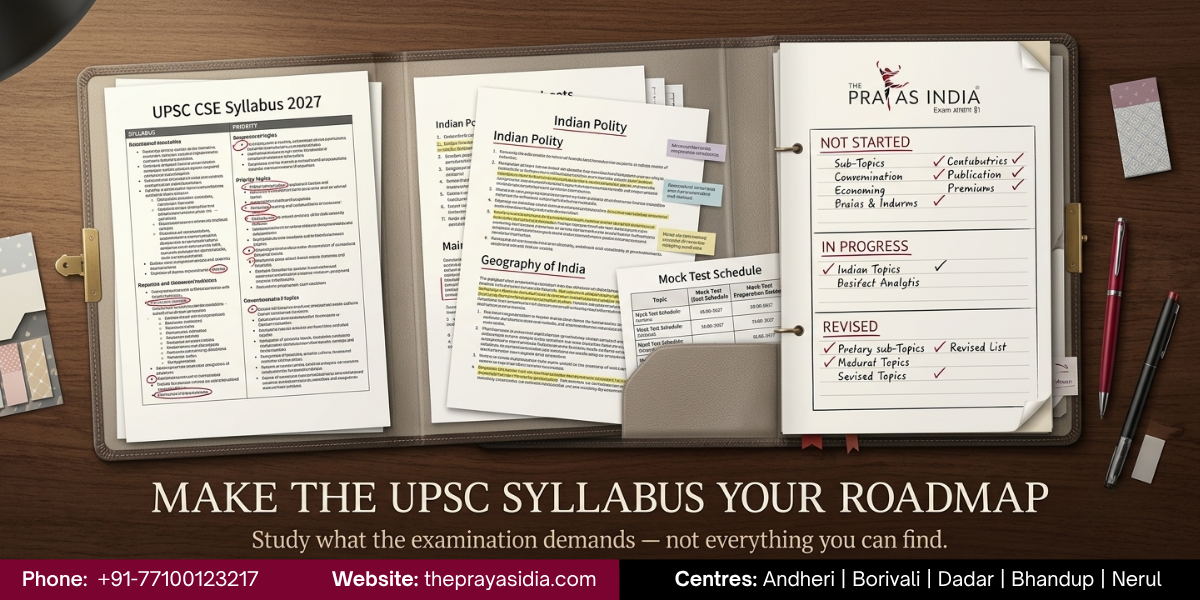
Create a Simple Syllabus Tracker
You can divide each subject into three categories:
Not Started
Topics that have not yet been studied.
In Progress
Topics currently being studied or practised.
Revised
Topics that have already been studied and tested.
This simple system can help you identify whether you are actually progressing or merely consuming study material.
Analyse Previous-Year Questions Before Going Too Deep Into Preparation
Previous-year questions should not be postponed until the end of your preparation. They should be introduced from the beginning because they reveal the nature of the examination far better than simply reading a syllabus.
UPSC’s official website maintains a previous-question-paper section, making PYQs an important primary resource for understanding how the Commission frames questions.
Spend time looking at questions from recent years and ask:
- What subjects are repeatedly tested?
- What kind of conceptual understanding is expected?
- How are current issues connected with static subjects?
- Which topics generate analytical questions?
- How difficult are the options in Prelims?
- What type of demand is visible in Mains questions?
You do not need to solve every PYQ perfectly at the beginning. The initial objective is to understand the language and demand of the examination.
Once you become familiar with this pattern, your reading becomes more selective.
Choose Your Core Sources Carefully
One of the biggest problems faced by beginners is resource overload. The internet provides an almost unlimited number of books, PDFs, lectures, notes and current-affairs sources.
The result is often a preparation cycle in which the aspirant keeps collecting resources without completing or revising them.
Your September preparation should therefore focus on creating a limited and reliable source list.
For each subject, decide:
- Primary source.
- Supplementary source, if genuinely required.
- Current-affairs source.
- PYQ source.
- Test/practice source.
- Revision notes.
The objective is not to find the maximum number of resources. It is to identify resources that you can study, revise and apply.
This is one area where structured guidance can save considerable preparation time. A good coaching programme can help beginners avoid spending weeks comparing multiple books and instead focus on an organised sequence of learning.
Build a Strong GS Foundation From September to December
The first four months should be used to establish conceptual familiarity with the major General Studies areas.
A practical sequence can include:
Indian Polity
Begin with constitutional fundamentals, the structure of government, Parliament, judiciary, federalism, constitutional and statutory bodies, governance and important institutional relationships.
The objective is not merely to memorise articles or provisions. You should gradually understand how the constitutional framework operates in real administrative and political contexts.
Modern Indian History
Build a chronological understanding of major developments rather than memorising isolated dates.
Focus on important movements, personalities, colonial policies, socio-religious developments and the broader causes and consequences of major events.
Geography
Develop conceptual understanding of physical and Indian geography. Maps should gradually become part of your preparation rather than an occasional revision activity.
Connect geographical concepts with agriculture, resources, climate, disasters, population and economic activity.
Economy
Start with fundamental concepts such as growth, inflation, fiscal policy, monetary policy, banking, taxation, external sector and basic macroeconomic relationships.
The aim should be to understand economic news rather than memorise financial terminology.
Environment
Build fundamentals around ecosystems, biodiversity, climate change, pollution, environmental governance and international conventions.
Current environmental developments can then be connected with these concepts.
Current Affairs Should Start From Day One
Current affairs should not be treated as a separate subject that you will “complete” after finishing static subjects.
Instead, start building the habit from September itself.
The most useful approach is to connect current affairs with static subjects.
For example, if you encounter a news development related to the Supreme Court, connect it with constitutional provisions and judicial structure. If an economic policy is in the news, connect it with the economic concepts you are studying. If a climate event receives attention, connect it with geography and environment.
This creates interconnected knowledge rather than isolated facts.
Your current-affairs notes should therefore answer three questions:
What happened?
Why does it matter?
Which UPSC syllabus area does it connect with?
This approach becomes particularly valuable later during Mains answer writing.
Do Not Wait Until Prelims to Start Mains Preparation
A common misconception among beginners is that they should complete Prelims preparation first and start Mains preparation only after clearing the examination.
For a first-time aspirant starting in September 2026, this can create unnecessary pressure.
Mains-oriented skills take time to develop. Reading an article and writing a structured answer about it are two different abilities.
You do not need to write multiple answers every day from the first week. However, once your basic understanding starts developing, introduce limited answer-writing practice.
Begin with:
- Understanding the demand of the question.
- Identifying the directive.
- Creating a basic introduction.
- Developing 2–4 logical dimensions.
- Supporting arguments with examples.
- Writing a concise conclusion.
The objective during the foundation phase is to build the habit of thinking in an answer-oriented manner.
Start Optional Subject Preparation Strategically
Optional selection should not be rushed simply because other aspirants have already selected their subjects.
The choice should be based on multiple factors such as:
- Genuine interest.
- Understanding of the syllabus.
- Availability of reliable study material.
- Previous-year question trends.
- Your academic background where relevant.
- Availability of guidance.
- Ability to sustain preparation over several months.
Once the optional is selected, September–December can be used to establish its foundation alongside GS preparation.
Do not allow optional preparation to completely replace General Studies, but do not postpone it indefinitely either.

Create a September–December Study Structure
The next four months should not be treated as one continuous block. Divide them into manageable preparation phases.
September: Orientation and Foundation
The primary objective should be understanding the examination, syllabus, PYQs and basic concepts.
Focus on:
- UPSC syllabus mapping.
- PYQ analysis.
- Core GS foundation.
- Current-affairs routine.
- Optional selection.
- Basic CSAT assessment.
- Initial note-making system.
Do not worry about completing everything in September. The priority is to establish the correct preparation direction.
October: Build Subject Depth
Once the preparation system is established, increase the depth of your subject preparation.
Continue GS subjects while maintaining current affairs. Start practising PYQs topic-wise and introduce limited answer writing.
At this stage, your preparation should move from simply reading towards understanding + application.
November: Integration and Practice
By November, start connecting static knowledge with current affairs and previous-year questions more actively.
Introduce:
- Topic-wise tests.
- More PYQ practice.
- Regular answer writing.
- Optional answer practice.
- CSAT practice.
- Revision of September and October material.
The goal is to prevent the early months’ preparation from becoming forgotten content.
December: Consolidation Before the Notification
December should be a consolidation month.
Instead of continuously adding new sources, focus on completing pending foundational areas, revising what has already been studied and identifying weaknesses.
The objective is to enter January with a strong base rather than beginning serious preparation after the notification arrives.
The Prayas India Advantage: Build Your UPSC Preparation Around a Structured System
For a serious CSE 2027 aspirant, the question is not simply whether coaching is necessary. The more useful question is whether your current preparation system is giving you the structure required to progress consistently.
Self-study can work for many candidates, but it requires strong discipline, resource selection, planning, self-evaluation and consistency. For beginners, managing all these elements simultaneously can become challenging.
This is where The Prayas India can play an important role.
For aspirants looking for Best UPSC CSE Coaching in Mumbai, The Prayas India can provide a structured environment where preparation is organised around concepts, examination requirements, practice and continuous evaluation.
The focus should not simply be on completing classes. A meaningful UPSC preparation programme should help aspirants develop:
- Conceptual clarity.
- Syllabus-oriented preparation.
- Current-affairs integration.
- PYQ-based understanding.
- Answer-writing ability.
- Regular revision habits.
- Test-taking skills.
- Performance analysis.
- Doubt-resolution support.
- A disciplined preparation routine.
For a candidate beginning in September 2026, this structure can be particularly valuable because the months before the official notification should be used to build a strong foundation rather than figuring out the preparation strategy from scratch.
The September 2026 UPSC CSE 2027 Preparation Framework
At this stage, your preparation should follow a simple but disciplined cycle:
UNDERSTAND → STUDY → CONNECT → PRACTISE → TEST → ANALYSE → REVISE
Do not measure progress only by the number of books completed or hours spent studying.
Instead, ask:
- Can I explain the concept in my own words?
- Can I connect it with current affairs?
- Can I identify how UPSC has tested it previously?
- Can I solve relevant questions?
- Can I revise it efficiently?
- Can I use the knowledge in a Mains answer?
These questions provide a much more realistic measure of preparation quality.
Key Takeaway
Starting UPSC CSE 2027 preparation in September 2026 gives aspirants an opportunity that should not be wasted: time to build preparation properly before the final examination phase begins.
The focus at this stage should not be on rushing through the entire syllabus. It should be on establishing the right foundation, understanding the UPSC syllabus, analysing PYQs, choosing reliable resources, developing current-affairs habits, beginning optional preparation and gradually introducing answer writing.
Most importantly, preparation should have direction.
For aspirants in Mumbai who want structured guidance, The Prayas India can provide an organised environment to build this foundation with expert guidance, systematic practice and examination-focused preparation.
The next stage of the roadmap should build upon this foundation by strengthening subject-wise preparation, integrating Prelims and Mains, developing answer writing, improving revision and introducing a more systematic testing strategy.
UPSC CSE 2027 Preparation Strategy: January to Prelims Roadmap
The foundation built between September and December 2026 should make the next phase of UPSC CSE 2027 preparation significantly more focused. Once the basic concepts, sources, current-affairs routine, optional preparation and PYQ understanding are in place, the preparation needs to gradually become more examination-oriented.
The objective from January onward should not be to start everything again. It should be to consolidate what has already been studied, increase practice, improve revision and progressively move towards Prelims-level performance.
This is also the stage where the difference between simply studying for UPSC and preparing strategically becomes more visible. Candidates need to know what to revise, how to test themselves, how to handle CSAT, how to analyse mistakes and when to reduce new learning in favour of consolidation.
For aspirants preparing with structured guidance, this phase can also be used to benefit from regular tests, faculty feedback, doubt resolution and a defined revision framework. For candidates looking for Best UPSC CSE Coaching in Mumbai, a structured programme at The Prayas India can help bring these elements together.
January 2027: Shift From Foundation to Examination-Oriented Preparation
January should mark a change in the nature of preparation.
The foundation work should continue, but the amount of active practice needs to increase. Instead of spending most of the day reading new material, candidates should increasingly divide their time between revision, current affairs, PYQs, MCQs, answer writing and optional preparation.
A useful preparation cycle at this stage is:
REVISE → PRACTISE → TEST → ANALYSE → CORRECT → REVISE
This cycle ensures that learning is repeatedly converted into measurable performance.
Your January targets can include:
- Completing remaining foundational portions of GS.
- Strengthening weak subjects.
- Revising previously studied topics.
- Increasing topic-wise PYQ practice.
- Taking regular Prelims-oriented tests.
- Continuing optional preparation.
- Maintaining current-affairs revision.
- Increasing CSAT practice according to your level.
- Continuing selective Mains answer writing.
The goal is to gradually move from learning mode to performance mode.
Build an Integrated Prelims and Mains Strategy
One of the biggest strategic mistakes is treating Prelims and Mains as completely separate examinations.
They are different in their demands, but much of the underlying knowledge overlaps. A strong foundation in Polity, Economy, History, Geography, Environment and other GS areas supports both stages.
The difference lies in how that knowledge is used.
For Prelims, you need to:
- Recognise correct information.
- Eliminate incorrect options.
- Handle factual and conceptual questions.
- Manage uncertainty.
- Maintain accuracy under time pressure.
For Mains, you need to:
- Understand the issue.
- Analyse different dimensions.
- Build arguments.
- Use examples and evidence.
- Present a balanced answer.
- Write within the required time.
Therefore, while January onward should increasingly prioritise Prelims practice, Mains-oriented understanding should not disappear completely.
Use PYQs as a Continuous Preparation Tool
Previous-year questions should remain part of your preparation throughout the cycle.
The UPSC’s official repository provides Civil Services Preliminary and Main examination papers, making it possible to study the actual questions asked by the Commission rather than relying only on secondary interpretations.
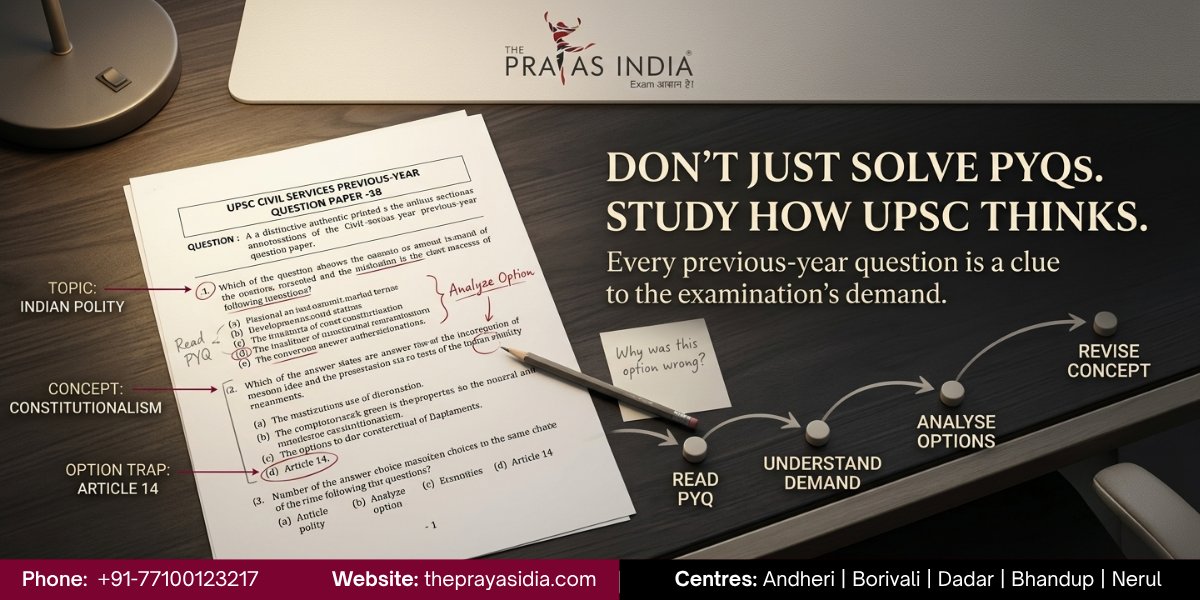
Instead of simply solving PYQs and checking the answers, analyse them in three layers.
Layer 1: Topic
Identify which subject and sub-topic the question belongs to.
Layer 2: Concept
Understand the underlying concept behind the question.
Layer 3: Question Construction
Study how the options were framed and how UPSC created confusion between seemingly correct and incorrect statements.
This third layer is particularly important for Prelims.
Over time, PYQs should help you understand not only what UPSC asks, but also how UPSC asks it.
Strengthen Prelims-Oriented MCQ Practice
As you move closer to Prelims, MCQ practice should become increasingly systematic.
Do not measure progress only by the number of questions solved. Focus on the quality of your attempts.
After every practice set, classify questions into:
- Correct and confident.
- Correct but guessed.
- Incorrect due to conceptual weakness.
- Incorrect due to careless reading.
- Incorrect due to poor elimination.
- Questions where you were completely uncertain.
This classification helps you understand whether your problem is knowledge, application, elimination or decision-making.
A candidate who consistently gets questions wrong because of poor elimination needs a different intervention from someone who lacks basic conceptual knowledge.
Develop Prelims Elimination Skills
UPSC Prelims often requires candidates to make decisions when they do not know the answer with complete certainty.
Therefore, preparation should include elimination practice.
When reviewing questions, ask:
- Is the statement too absolute?
- Is the information factually inconsistent?
- Does the option introduce an unrelated idea?
- Can one statement logically eliminate another?
- Is there a conceptual contradiction?
- What makes the remaining option more plausible?
The aim is not to turn guessing into a strategy. It is to develop informed decision-making based on knowledge and logical elimination.
CSAT Should Not Be Treated as an Afterthought
CSAT can become a risk area for candidates who focus almost entirely on General Studies.
Even if you are comfortable with basic mathematics and comprehension, regular practice is useful because the paper tests application under time pressure.
Assess your CSAT level early.
If you are comfortable, maintain regular practice through selected comprehension, reasoning and quantitative questions.
If you find CSAT difficult, allocate more time from January itself rather than postponing it until the final weeks.
Your CSAT strategy should include:
- Reading comprehension.
- Basic numeracy.
- Logical reasoning.
- Data interpretation where required.
- Timed practice.
- Previous-year questions.
- Regular sectional testing.
The objective is to make CSAT a controlled part of your preparation rather than a last-minute source of anxiety.
Build a Revision System Before the Final Phase
Revision should not begin only after completing the entire syllabus.
By January, every major subject should have a defined revision mechanism.
For each topic, maintain concise notes containing:
- Core concepts.
- Important facts.
- Relevant current affairs.
- PYQ connections.
- Common mistakes.
- Areas requiring another revision.
This makes subsequent revision significantly faster.
The final months before Prelims should not be spent reopening every book from the beginning. Your preparation should gradually move towards shorter and more frequently revised material.
February–March 2027: Increase Test-Based Preparation
By February and March, the proportion of practice and testing should increase.
You can divide your preparation into three broad components:
Revision: Strengthen existing knowledge.
Practice: Solve topic-wise and mixed MCQs.
Testing: Measure performance through sectional and full-length tests.
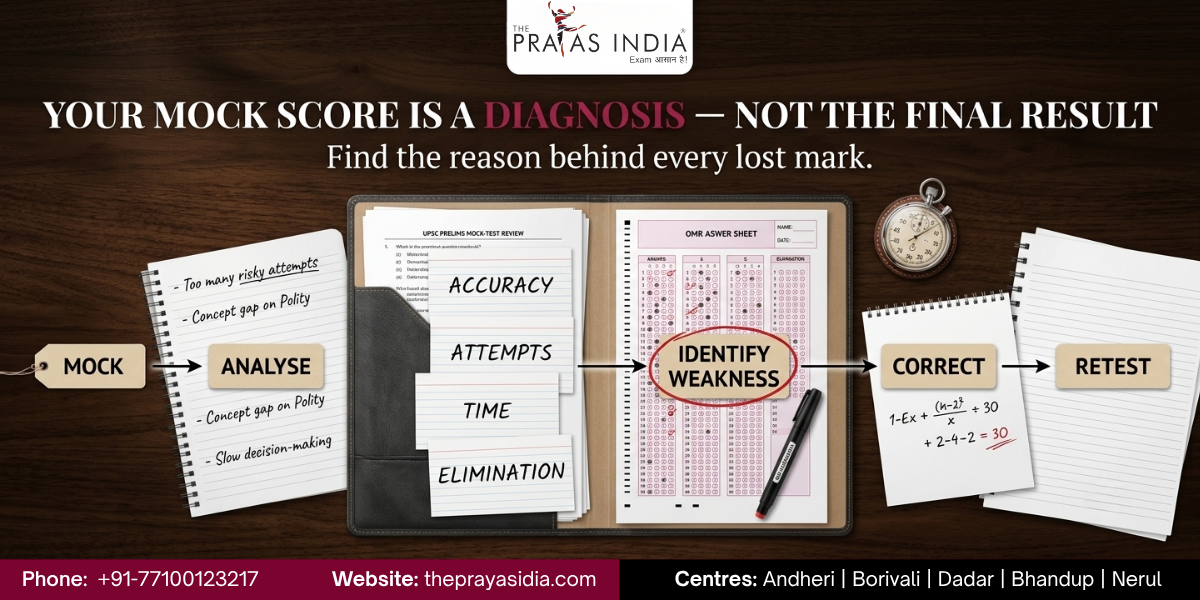
At this stage, tests should become diagnostic tools.
If your score falls in a particular subject, do not simply take another test. Identify the reason behind the weak performance.
For example:
Low Polity score → conceptual revision required.
Low Environment score → factual/conceptual consolidation required.
High attempts but low accuracy → question selection and elimination issue.
Low attempts with strong accuracy → speed or confidence issue.
This is how mock-test analysis becomes part of preparation rather than just score checking.
March–April 2027: Move Towards Full Prelims Simulation
As Prelims approaches, full-length tests should become increasingly important.
However, taking a large number of tests without proper analysis can create a false sense of preparation.
After every full-length mock, evaluate:
- Score.
- Accuracy.
- Number of doubtful attempts.
- Questions changed from correct to incorrect.
- Time management.
- Subject-wise performance.
- Questions lost due to lack of knowledge.
- Questions lost due to poor judgement.
- Questions lost due to careless reading.
Maintain a record across multiple tests.
The goal is to identify trends rather than react emotionally to individual scores.
April–May 2027: Enter the Final Prelims Revision Phase
The final phase should be about consolidation rather than endless expansion.
At this point, your preparation should increasingly revolve around:
- Multiple revisions.
- Full-length mock tests.
- PYQ revision.
- Current-affairs consolidation.
- CSAT practice.
- Error-log revision.
- High-priority factual revision.
- Weak-area correction.
Avoid introducing several new books or sources during the final weeks.
The purpose of the final phase is to make your preparation stable and recallable under examination pressure.
How to Manage Current Affairs Before Prelims
Current affairs preparation should gradually become more selective as Prelims approaches.
Instead of continuously adding information, revise important developments connected to:
- Government schemes.
- Economy and banking.
- Environment and biodiversity.
- International relations.
- Science and technology.
- Reports and indexes.
- Important institutions.
- Constitutional and governance developments.
- Major national and international developments.
Connect current affairs with static concepts whenever possible.
A good revision note should help you remember not only the event but also the relevant background.
Balance Optional Preparation With Prelims Preparation
As Prelims approaches, GS and CSAT naturally require more attention. However, optional preparation should not be abandoned abruptly.
The exact balance will depend on your progress.
If your optional foundation is strong, you may reduce its daily allocation temporarily while prioritising Prelims.
If your optional is still incomplete, continue maintaining a minimum structured routine so that the post-Prelims transition does not become overwhelming.
This is another area where a planned study schedule can be valuable. Rather than switching completely from one stage to another, aspirants can gradually adjust the weightage of different components.
The Last 30 Days: Focus on Recall, Accuracy and Decision-Making
The final 30 days should feel very different from the first few months.
You should not be trying to become a completely different aspirant.
Instead, focus on becoming a more consistent version of the preparation you have already built.
Your daily routine should increasingly include:
- Short revision blocks.
- MCQ practice.
- Full or sectional tests.
- Test analysis.
- Current-affairs revision.
- CSAT practice.
- Error-log revision.
The quality of revision matters more than the quantity of new information.
Common UPSC CSE 2027 Preparation Mistakes to Avoid
Waiting for the Notification to Start
The notification should not be the starting point of serious preparation. Aspirants targeting CSE 2027 should use the pre-notification months to build their foundation.
Collecting Too Many Resources
More books and PDFs do not necessarily create better preparation. A limited source list that is repeatedly revised is generally more useful than an enormous collection of unfinished material.
Ignoring PYQs
PYQs reveal the actual nature of the examination. They should be used throughout preparation rather than only during the final revision.
Postponing Answer Writing
You do not need to write dozens of answers from the first day, but completely ignoring Mains skills until after Prelims can make the post-Prelims transition difficult.
Ignoring CSAT
CSAT should be assessed early. Candidates who are weak in the paper should build their preparation gradually instead of depending on last-minute practice.
Taking Mocks Without Analysis
A mock test is useful only when it changes your preparation. If the same mistakes continue across multiple tests, the problem is not the absence of tests but the absence of analysis.
Changing Strategy Every Few Weeks
UPSC preparation requires consistency. Constantly changing books, teachers, test platforms or study schedules can create unnecessary disruption.
How The Prayas India Can Support Your UPSC CSE 2027 Preparation
UPSC CSE preparation is a long process, and maintaining direction across several months can be difficult when everything has to be planned independently.
This is where The Prayas India can become an important part of an aspirant’s preparation strategy.
For candidates looking for Best UPSC CSE Coaching in Mumbai, the value of structured coaching should go beyond classroom teaching. A serious preparation ecosystem should help candidates understand the syllabus, build conceptual clarity, practise examination-level questions, analyse performance and revise systematically.
The Prayas India can support aspirants through a structured preparation approach that focuses on:
- Conceptual foundation.
- UPSC-oriented teaching.
- Current-affairs integration.
- PYQ-based preparation.
- Answer-writing development.
- Regular practice.
- Test and mock-test analysis.
- Doubt resolution.
- Revision planning.
- Performance tracking.
For a CSE 2027 aspirant beginning in September 2026, this structure can help convert a long preparation window into a defined roadmap.
Instead of asking every week, “What should I study next?”, candidates can focus more on “How well have I understood, practised and revised what I have already studied?”
That shift can make preparation more measurable and disciplined.
A Complete UPSC CSE 2027 Preparation Roadmap
The overall preparation journey can be viewed in five stages:
Stage 1: September–December 2026
FOUNDATION
Understand the syllabus, analyse PYQs, establish GS fundamentals, select the optional, build current-affairs habits and start basic answer writing.
Stage 2: January–February 2027
INTEGRATION
Increase revision, MCQ practice, PYQ analysis, optional preparation, answer writing and CSAT practice.
Stage 3: March–April 2027
TESTING
Increase sectional and full-length tests, analyse mistakes and improve question selection, elimination and time management.
Stage 4: Final Prelims Phase
CONSOLIDATION
Reduce new sources and focus on revision, mock tests, current affairs, CSAT and error correction.
Stage 5: After Prelims
MAINS INTENSIFICATION
Transition rapidly towards answer writing, Essay, Ethics, GS papers and Optional while retaining the conceptual foundation built during the previous months.
This framework ensures that the preparation evolves with the examination instead of remaining static for the entire year.
Final UPSC CSE 2027 Preparation Checklist
Before entering the final Prelims phase, ensure that you have:
- Understood the complete UPSC syllabus.
- Analysed previous-year questions.
- Built reliable sources for GS subjects.
- Established a current-affairs system.
- Selected and started your optional.
- Developed basic answer-writing skills.
- Assessed your CSAT level.
- Built concise revision notes.
- Practised topic-wise MCQs.
- Taken sectional tests.
- Taken full-length Prelims mocks.
- Maintained an error log.
- Analysed mock-test performance.
- Revised important current affairs.
- Developed a question-selection and elimination strategy.
- Created a final revision schedule.
Final Takeaway
Starting UPSC CSE 2027 preparation in September 2026 gives aspirants enough time to build a strong foundation before the preparation enters its high-pressure Prelims phase.
But time alone does not create an advantage.
The advantage comes from using that time correctly.
The first months should be used to understand the examination and build strong concepts. The next phase should integrate revision, PYQs, MCQs, answer writing, optional preparation and CSAT. As Prelims approaches, the focus should increasingly move towards testing, analysis, elimination, accuracy and repeated revision.
For aspirants preparing in Mumbai, joining a structured programme such as The Prayas India can help bring these components into a more organised preparation system. The focus should be on building not just knowledge, but the ability to understand, practise, analyse, revise and perform.
Ultimately, a successful UPSC CSE 2027 strategy is not about studying everything. It is about studying the right things, revising them repeatedly, understanding how UPSC tests them and continuously correcting your preparation based on evidence.
Contact Us
- Call Now: +91-77100 13217
- Website: theprayasindia.com
- Centres: Andheri | Borivali | Dadar | Nerul | Bhandup
Frequently Asked Questions
1. Is September 2026 a good time to start UPSC CSE 2027 preparation?
Yes. Starting in September gives aspirants a substantial pre-notification preparation window to build GS fundamentals, analyse PYQs, select an optional, establish current-affairs habits and gradually develop answer-writing skills.
2. Can I prepare for UPSC CSE 2027 from scratch?
Yes, but beginners need a structured roadmap. The first priority should be understanding the syllabus and examination pattern, selecting reliable sources and building conceptual foundations before moving aggressively into test preparation.
3. Should I prepare for Prelims and Mains together?
Yes. While the intensity should change as Prelims approaches, the foundation should support both stages. GS concepts, current affairs and PYQ understanding are useful for both Prelims and Mains.
4. When should I start answer writing for UPSC CSE 2027?
Basic answer-writing practice can be introduced after developing sufficient conceptual familiarity. Starting gradually is generally better than waiting until after Prelims to develop the skill from scratch.
5. When should I start CSAT preparation?
Assess your CSAT level early. Candidates who are comfortable can maintain regular practice, while those who find the paper challenging should allocate dedicated preparation time well before the final Prelims phase.
6. How important are UPSC previous-year questions?
PYQs are extremely useful for understanding the examination's question style, topic selection, conceptual depth and option framing. UPSC officially provides previous-year papers through its website.
7. How many hours should I study for UPSC CSE 2027?
There is no universal number of hours that guarantees success. The more useful approach is to create a sustainable routine that includes study, revision, practice, testing and analysis while maintaining consistency over several months.
8. Should I join UPSC coaching for CSE 2027?
Coaching can be particularly useful for aspirants who want structured learning, expert guidance, regular testing, doubt resolution, answer-writing support and a defined preparation roadmap. Candidates looking for UPSC CSE Coaching in Mumbai can explore The Prayas India as a structured preparation option.
9. How should I choose my UPSC optional subject?
Consider your interest, familiarity with the subject, syllabus size and structure, availability of reliable guidance and resources, previous-year questions and your ability to sustain preparation over the long term.
10. How should I use mock tests for UPSC Prelims?
Use mocks as diagnostic tools rather than simply score-generating exercises. Analyse accuracy, attempts, elimination, time management and recurring mistakes after every test.
11. What should I do in the final month before UPSC Prelims?
Focus primarily on revision, PYQs, mock tests, current-affairs consolidation, CSAT practice and error correction. Avoid constantly introducing new sources.
12. Where can I prepare for UPSC CSE 2027 in Mumbai?
Aspirants looking for structured UPSC CSE Coaching in Mumbai can consider The Prayas India for guided preparation, conceptual learning, practice, testing, revision and performance-focused support.