UPSC CSE 2027 Prelims Preparation Strategy: A Step-by-Step Guide | Best UPSC Coaching in Mumbai | The Prayas India
Preparing for UPSC Civil Services Examination 2027 requires much more than collecting books, watching lectures and attempting a few mock tests. The Preliminary Examination demands a combination of conceptual understanding, factual awareness, current affairs integration, revision, elimination skills and the ability to make sound decisions under time pressure.
For many aspirants, the biggest challenge is not finding study material. It is creating a preparation system that answers practical questions: What should I study first? How many sources should I follow? When should I start solving Previous Year Questions? How should I prepare current affairs? When should mock tests become a regular part of preparation? How should I revise such a vast syllabus?
A structured strategy can make these questions easier to manage.
The UPSC Annual Calendar 2027 is already available on the Commission’s website, while the detailed examination notification will provide the applicable rules and details for the 2027 examination cycle. UPSC’s FAQ also explains that examination notices are generally issued around three months before the examination, while the annual calendar is published well in advance. Aspirants should therefore use the calendar for planning but verify the official notification when it is released.
For an aspirant targeting CSE 2027, the right time to build a serious Prelims strategy is well before the examination announcement creates last-minute pressure.
The preparation should be treated as a sequence:
Understand → Build Concepts → Practise → Revise → Test → Analyse → Improve
This article explains how to build that cycle step by step.
Start With the UPSC Prelims Examination Structure
Before creating a timetable, understand what you are preparing for.
The Civil Services Preliminary Examination consists of two compulsory objective-type papers. In the established scheme, General Studies Paper I carries 200 marks, while General Studies Paper II, commonly known as CSAT, also carries 200 marks and is qualifying with a minimum qualifying requirement of 33%. Candidates must appear in both papers. The detailed 2027 rules should be confirmed from the official notification once released.
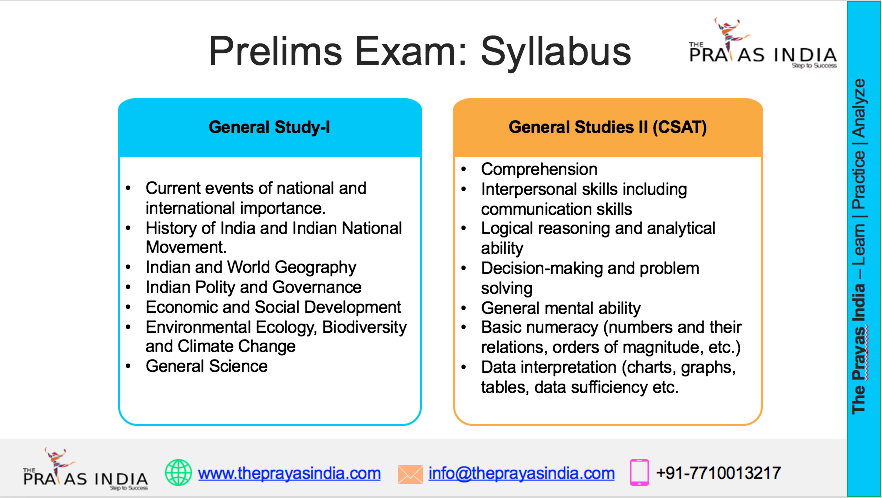
The General Studies Paper I syllabus covers broad areas including:
- Current events of national and international importance
- History of India and the Indian National Movement
- Indian and World Geography
- Indian Polity and Governance
- Economic and Social Development
- Environment, Ecology and Biodiversity
- General Science
CSAT covers areas such as:
- Comprehension
- Logical reasoning
- Analytical ability
- Decision making and problem solving
- General mental ability
- Basic numeracy
- Data interpretation
The official UPSC syllabus makes it clear that Prelims is not limited to memorising isolated facts. The examination tests broad awareness and the ability to understand and apply information.
That is why your preparation strategy should not be based on reading alone.
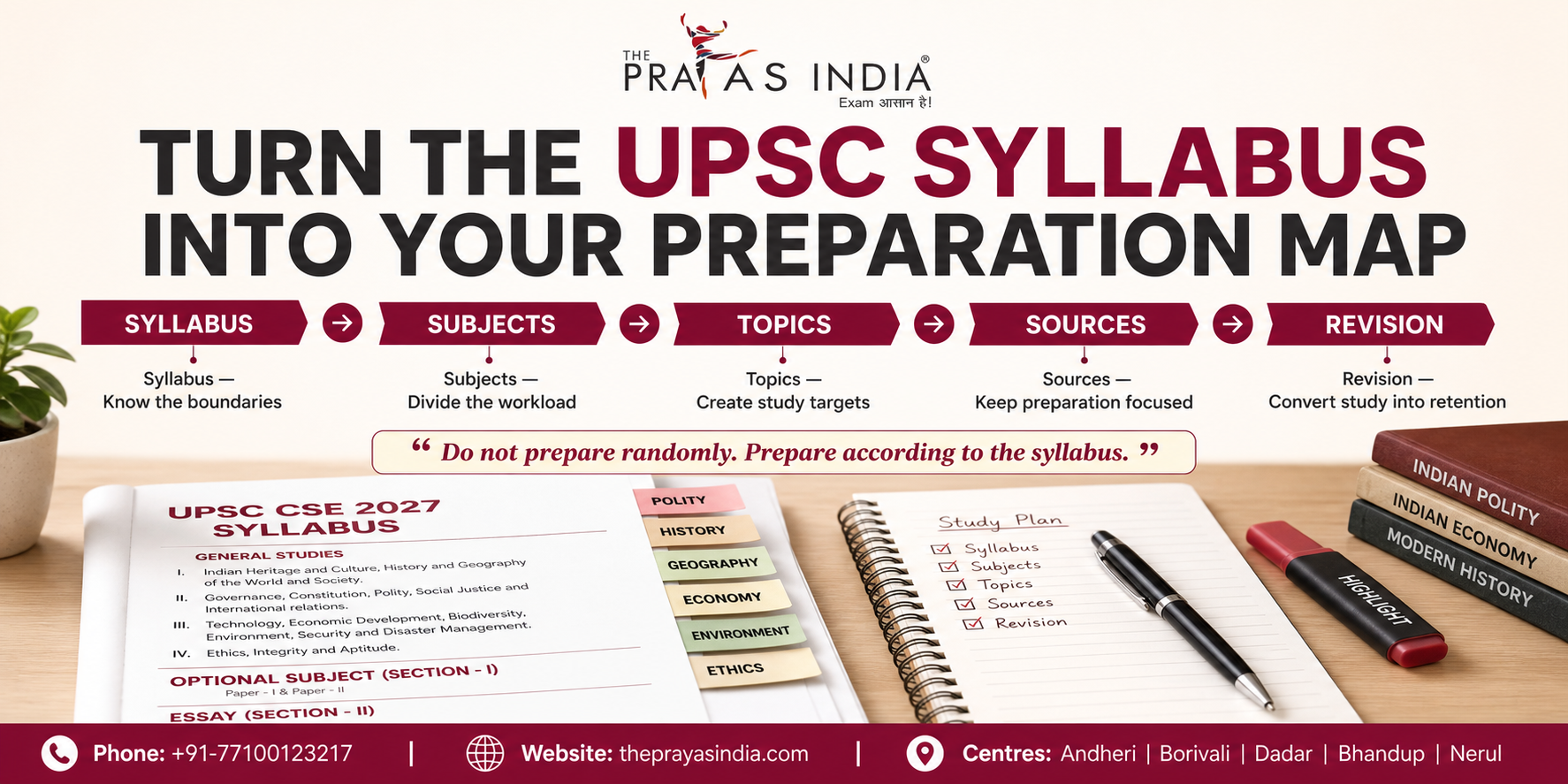
Step 1: Decode the Syllabus Before Opening Your Books
One of the most common mistakes beginners make is starting with books instead of the syllabus.
The syllabus should become your preparation map.
Take the official syllabus and break it into manageable areas. For General Studies, create broad folders such as:
History
Ancient India, Medieval India, Modern India, Art and Culture and the freedom movement.
Geography
Physical geography, Indian geography, world geography, resources, climate, mapping and geographical phenomena.
Polity
Constitution, Parliament, judiciary, executive, federalism, constitutional bodies, governance, rights and public policy.
Economy
Basic economic concepts, growth, inflation, monetary policy, fiscal policy, banking, external sector, development and government initiatives.
Environment
Ecology, biodiversity, climate change, conservation, environmental institutions and related current affairs.
Science and Technology
Basic science concepts along with developments that have relevance to contemporary issues.
Current Affairs
National and international developments connected to the static syllabus.
Once you divide the syllabus, preparation becomes more manageable.
Instead of thinking:
“I have to prepare UPSC.”
You start thinking:
“This week I will complete these specific areas and connect them with relevant current affairs.”
That shift is important for long-term consistency.
Step 2: Understand the Role of Previous Year Questions
Previous Year Questions should not be treated as a final-stage activity.
They should be used from the beginning.
UPSC itself provides previous question papers through its official website, including the 2026 Civil Services Preliminary Examination papers. These papers provide the most direct way to understand how the Commission frames questions.
When studying a topic, connect it with previous questions.
For example, while studying Polity, do not simply read chapters and move forward. Check how UPSC has tested constitutional concepts, institutions, rights, governance and related areas.
While studying Environment, examine how conceptual and current-affairs-linked questions have been framed.
While studying Geography, look at the way UPSC combines static concepts with maps, physical processes and contemporary developments.
PYQs help you identify:
- Frequently tested areas
- Nature of conceptual questions
- Importance of factual details
- Relationship between static and current affairs
- Level of conceptual application
- Common traps in answer options
- Areas requiring deeper revision
The purpose is not to predict exact questions.
The purpose is to understand the question-setting approach.
Step 3: Build Strong Static GS Foundations
Current affairs may receive considerable attention during UPSC preparation, but static subjects form the foundation through which many current developments become easier to understand.
For example, reading about a constitutional development becomes easier when you already understand the relevant constitutional provisions.
Similarly, understanding monetary policy requires basic knowledge of inflation, interest rates, banking and monetary transmission.
Environmental news becomes easier to interpret when you understand ecosystems, biodiversity and ecological processes.
Therefore, your first major preparation phase should focus on building conceptual foundations.
A useful approach is:
Read → Understand → Make Short Notes → Solve PYQs → Revise
Do not make excessively detailed notes during your first reading.
The objective is to understand the subject.
Notes can become more concise during subsequent revisions.
Step 4: Choose Limited and Reliable Sources
One of the biggest challenges in UPSC preparation is information overload.
An aspirant may have:
- Multiple books
- Several YouTube channels
- Multiple current-affairs magazines
- Telegram PDFs
- Coaching material
- Test-series material
- Government reports
- Newspaper notes
- Social-media explanations
More resources do not necessarily mean better preparation.
In fact, constantly changing sources can reduce revision time.
A better approach is to create a limited-source strategy.
For each major subject, identify:
One primary source
One supplementary source where genuinely necessary
PYQs
Revision notes
Test material
Then stick to the system long enough to build familiarity.
For a subject like Polity, repeatedly revising one reliable source is generally more useful than reading five different books once.
For current affairs, focus on relevance rather than collecting every available PDF.
Step 5: Build a Current Affairs Strategy Around the Static Syllabus
Current affairs preparation becomes more manageable when it is connected to static subjects.
Instead of creating an enormous list of unrelated news events, classify important developments.
For example:
Polity + Current Affairs
Constitutional developments, Supreme Court judgments, Parliament, federal issues and governance.
Economy + Current Affairs
Inflation, monetary policy, fiscal measures, banking, external trade and government initiatives.
Environment + Current Affairs
Climate change, biodiversity, conservation, international agreements and environmental policies.
Science & Technology + Current Affairs
Space, biotechnology, health technology, defence technology and emerging technologies.
This approach creates connections between information.
The objective should not be:
“Remember today’s news.”
It should be:
“Understand how today’s development connects to the UPSC syllabus.”
That makes revision more meaningful.
Step 6: Create a Daily Study Routine That You Can Sustain
A timetable is useful only when it can actually be followed.
Instead of creating a schedule with unrealistic study hours, divide your day into meaningful blocks.
For example:
Morning
Static GS subject or difficult conceptual topic.
Midday
Current affairs and related notes.
Afternoon or Evening
PYQs, practice questions or CSAT.
Final Study Block
Revision of what was studied during the day.
The exact number of hours should depend on your individual circumstances.
A college student, working professional and full-time aspirant may require different schedules.
The important principle is consistency.
A sustainable six-hour study routine followed consistently can be more useful than an unrealistic twelve-hour schedule that collapses after a few days.
Step 7: Do Not Treat CSAT as an Optional Preparation Area
CSAT is qualifying, but that does not mean it should be ignored.
The official UPSC syllabus specifies areas including comprehension, logical reasoning, analytical ability, decision making, basic numeracy and data interpretation, with Paper II being qualifying at the prescribed minimum level.
Many aspirants postpone CSAT because they are comfortable with mathematics or believe that qualifying will be easy.
That can become risky if their actual performance is weaker than expected.
Instead, include CSAT regularly.
For example:
- Two comprehension sessions per week
- Regular basic numeracy practice
- Logical reasoning practice
- Data interpretation sets
- Periodic CSAT tests
If you are already comfortable with CSAT, you may need less time.
If you find it difficult, increase practice early rather than waiting until the final phase.
Step 8: Start Topic-Wise Practice Before Full-Length Mocks
There is a difference between learning a topic and being able to answer questions from it.
After completing a topic, solve questions related to it.
For example:
Polity → Study Parliament → Solve related questions
Environment → Study Biodiversity → Solve related questions
Economy → Study Inflation → Solve related questions
This helps identify knowledge gaps immediately.
Topic-wise practice also makes revision more active.
Instead of simply rereading your notes, you are forcing yourself to retrieve information and apply concepts.
Step 9: Gradually Introduce Sectional Tests
Once your basic preparation is underway, introduce sectional tests.
A sectional test should answer questions such as:
- Can I recall what I studied?
- Can I apply the concept?
- Am I making avoidable mistakes?
- Which topics are weak?
- How much time am I spending?
- Am I improving?
Do not focus only on marks.
The more important information is hidden inside the performance.
For every test, record:
Attempted
Correct
Incorrect
Unattempted
Conceptual mistakes
Careless mistakes
Questions taking excessive time
This information will later become useful when you begin full-length Prelims mocks.
Step 10: Build a Mock-Test Strategy
Full-length mock tests should become an increasingly important part of your preparation as the examination approaches.
But simply taking tests is not enough.
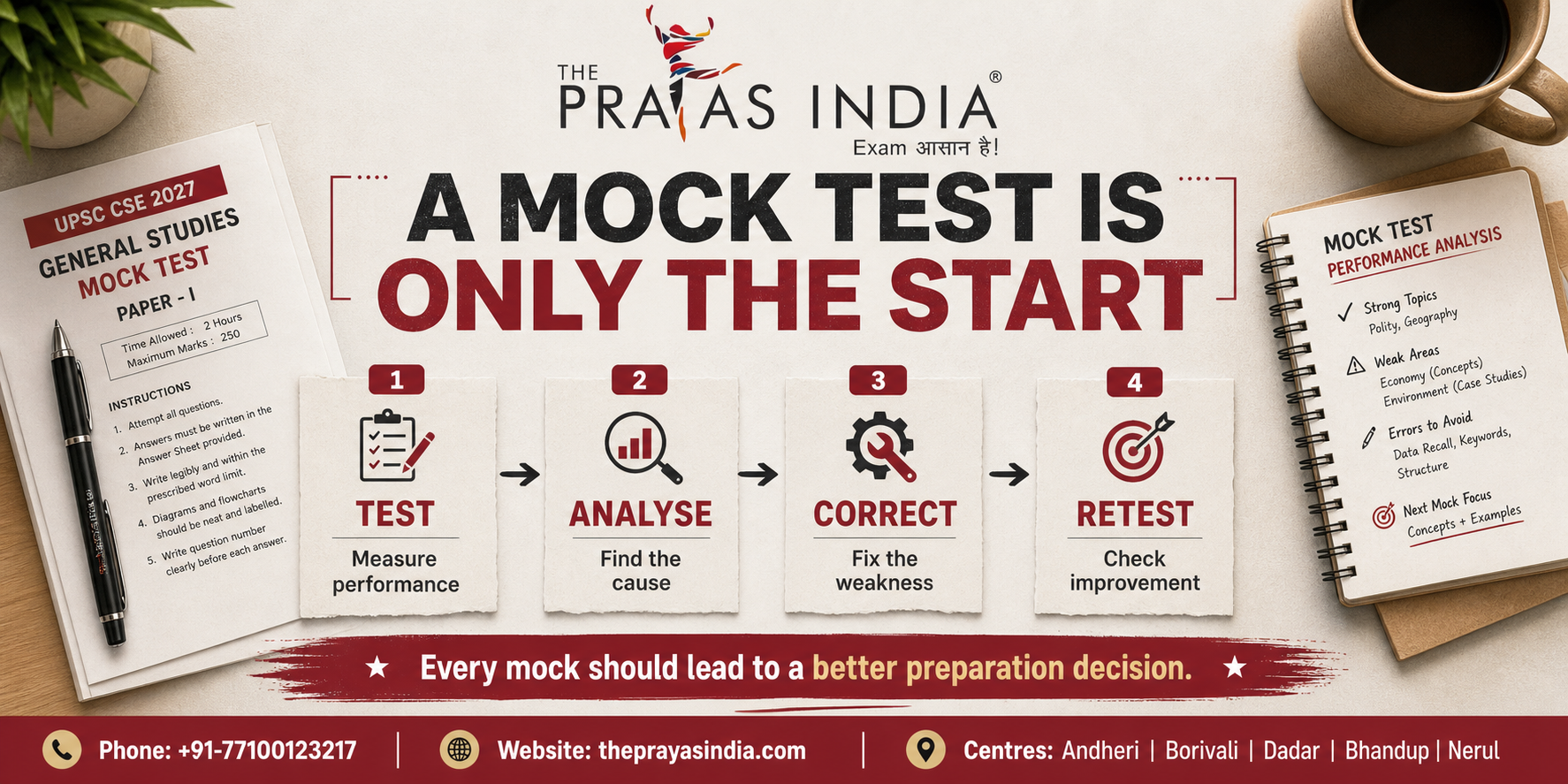
A mock should follow a cycle:
TEST → ANALYSE → CORRECT → RETEST
After every mock, review your performance.
Ask:
- Which questions did I get wrong?
- Why did I get them wrong?
- Which questions did I guess?
- Which questions consumed too much time?
- Which topics are repeatedly causing problems?
- Did I make avoidable mistakes?
- How effective was my elimination approach?
The objective is to make the next test better than the previous one.
Step 11: Maintain an Error Log
Your error log should become one of the most useful documents in your Prelims preparation.
Do not simply write:
“I got this question wrong.”
Write:
“Why did I get this question wrong?”
Categorise errors as:
Conceptual Error
You did not know or understand the concept.
Factual Gap
You lacked a specific piece of information.
Misinterpretation
You misunderstood the question.
Elimination Error
You eliminated the correct option incorrectly.
Careless Error
You knew the information but made an avoidable mistake.
Guessing Error
You selected an answer without sufficient basis.
This classification allows you to fix the correct problem.
If you repeatedly make conceptual errors, revise the subject.
If you repeatedly make elimination errors, practise question analysis.
If careless errors dominate, slow down and improve checking discipline.
Step 12: Develop Elimination Skills
UPSC Prelims is not simply about knowing the correct answer immediately.
Sometimes the question is designed so that you can improve your probability of selecting the correct answer by eliminating clearly incorrect options.
Elimination should not become random guessing.
Instead, develop the ability to identify:
- Absolute statements
- Incorrect factual combinations
- Contradictions
- Conceptual inconsistencies
- Options that do not fit the question
- Statements that conflict with established principles
The best way to develop this skill is through PYQs and quality mock questions.
During analysis, ask:
“If I did not know the answer directly, which options could I confidently eliminate?”
That question improves exam decision-making.
Step 13: Make Revision a Weekly Process
Many aspirants leave revision for the final months.
That creates unnecessary pressure.
Revision should start from the beginning.
A simple cycle can be:
Daily Revision
Review important points from the day’s study.
Weekly Revision
Revisit the week’s topics.
Monthly Revision
Consolidate major topics and current affairs.
Prelims Revision Phase
Move towards rapid revision of short notes, PYQs, tests and high-priority areas.
Revision should become increasingly concise.
Your first notes may be detailed.
Your second revision should be shorter.
Your final revision material should contain only what you genuinely need to recall.
Step 14: Connect Static Preparation With Current Affairs
One of the most effective ways to deepen preparation is to connect static concepts with contemporary developments.
Suppose you are studying:
Fundamental Rights
Then relevant constitutional developments, court judgments and rights-related issues can reinforce the subject.
If you are studying:
Biodiversity
Then current conservation programmes, species-related developments and international environmental discussions can make the topic more practical.
If you are studying:
Economy
Then inflation, fiscal policy, monetary policy and economic developments can reinforce conceptual understanding.
This approach makes current affairs less fragmented.
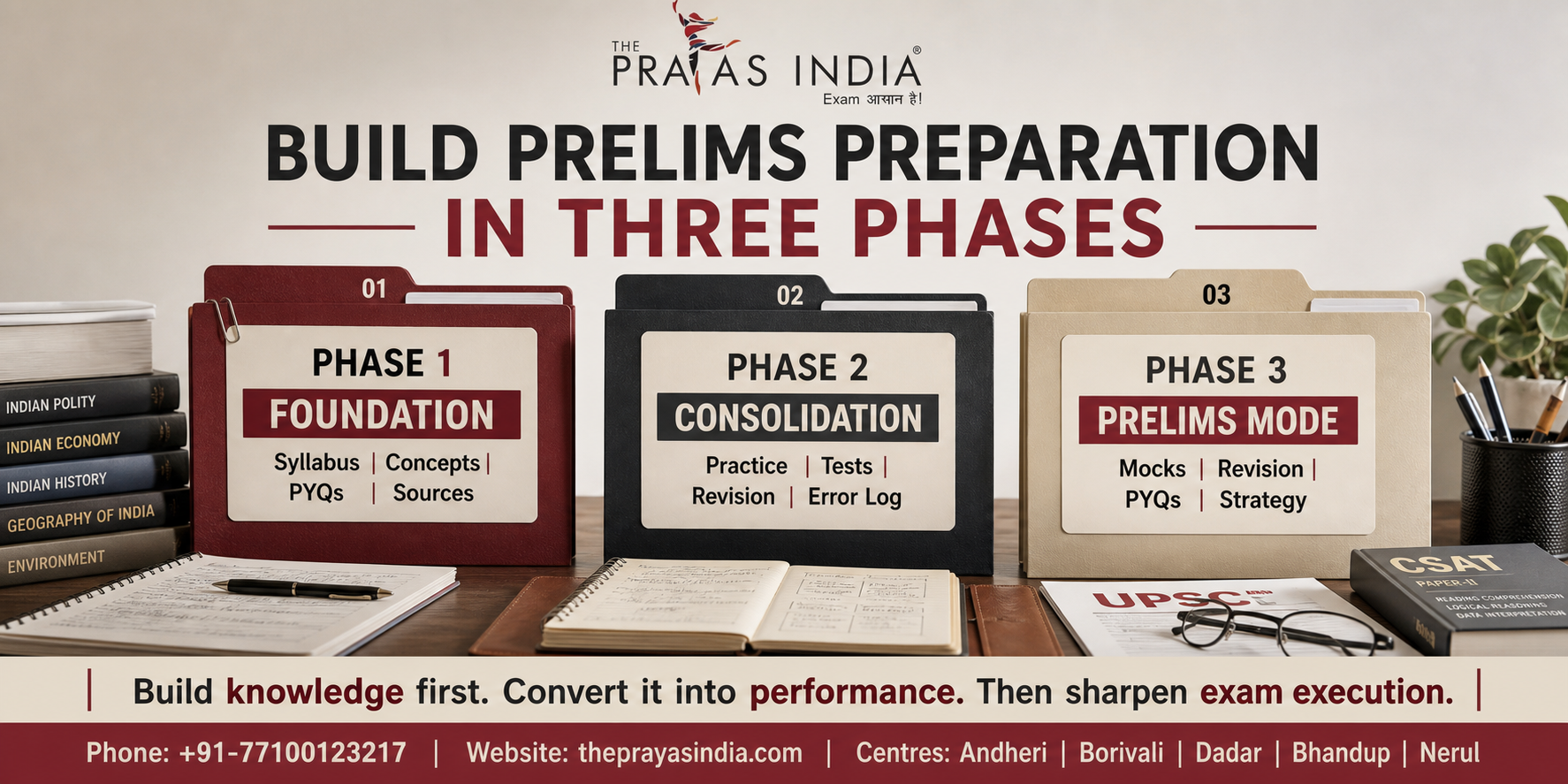
Step 15: Create a Three-Phase UPSC CSE 2027 Prelims Strategy
A long preparation cycle becomes easier to manage when divided into phases.
Phase 1: Foundation Building
Focus on:
- Syllabus
- Basic concepts
- Standard sources
- PYQs
- Current-affairs habit
- Initial CSAT practice
The objective is understanding.
Do not worry about taking a large number of full-length mocks at this stage.
Phase 2: Consolidation and Testing
Focus on:
- Completing major portions of the syllabus
- Topic-wise practice
- Sectional tests
- Current-affairs consolidation
- Revision
- Error-log development
- Increasing CSAT practice
The objective is converting knowledge into performance.
Phase 3: Prelims-Focused Revision
Focus heavily on:
- Multiple revisions
- Full-length mock tests
- PYQs
- Current-affairs revision
- Error correction
- Elimination practice
- Time management
- CSAT qualification
The objective is exam readiness.
Step 16: Plan Your Preparation Backward From Prelims
Once the official 2027 schedule and notification are available, create a reverse calendar from the Preliminary Examination date.
Instead of simply saying:
“I have several months.”
Divide the available period into:
Syllabus Completion
First Revision
Second Revision
Testing
Final Revision
This creates deadlines.
For example, your plan could include:
Before the Core Preparation Deadline
Complete major static subjects.
Next Stage
Complete topic-wise practice and strengthen weak areas.
Consolidation Stage
Increase revision and sectional tests.
Prelims-Focused Stage
Shift towards full-length mocks, PYQs and rapid revision.
The exact dates should be updated after UPSC releases the applicable 2027 notification and examination details.
Step 17: Keep Your Study Material Under Control
A serious UPSC aspirant can easily accumulate hundreds of PDFs.
That does not mean preparation is progressing.
Create a simple resource hierarchy:
Primary Source
Your main book or class material.
Supporting Source
Only where the primary source does not adequately cover the topic.
Current Affairs Source
One consistent system.
PYQs
Official previous papers.
Test Material
Quality questions and mock tests.
Revision Notes
Your own condensed material.
The objective is to reduce the number of things you have to revise repeatedly.
Step 18: Build a Prelims-Focused Mindset Without Ignoring Mains
UPSC CSE is an integrated examination journey.
Even while preparing for Prelims, your overall understanding should not become purely fact-based.
Develop conceptual clarity.
Read important issues in enough depth to understand:
- Causes
- Consequences
- Government responses
- Constitutional dimensions
- Social implications
- Economic implications
- Environmental implications
This approach helps you beyond Prelims as well.
However, when the Prelims phase becomes close, your immediate preparation priorities should naturally shift toward objective-question practice, revision, PYQs and mock testing.
Step 19: Know When You Need Structured Guidance
Self-study can work for some aspirants, but it requires strong discipline, reliable resources, consistent testing and the ability to evaluate your own preparation objectively.
One of the biggest challenges in self-preparation is not studying.
It is knowing:
What am I missing?
Am I studying the right material?
Is my preparation progressing at the required pace?
Why are my mock scores not improving?
Which mistakes are recurring?
Structured coaching can help address these issues through a planned curriculum, faculty guidance, study material, test schedules, evaluation and mentorship.
For aspirants considering UPSC Coaching in Mumbai, it is useful to evaluate a coaching programme based on the complete preparation ecosystem rather than classroom teaching alone.
Look at:
- Faculty quality
- Course structure
- Study material
- Test series
- Mock-test analysis
- Answer-writing support
- Mentorship
- Doubt-solving
- Revision strategy
- Current-affairs support
- Batch schedule
This becomes especially relevant for aspirants beginning their CSE 2027 journey and looking for a structured environment.
How The Prayas India Can Support UPSC CSE 2027 Prelims Preparation
Aspirants preparing for UPSC CSE 2027 often need consistency more than additional resources.
The Prayas India can provide a structured preparation environment where learning can be connected with practice, testing, analysis and revision.
A comprehensive preparation approach can help aspirants work on:
Concept Building
Developing a strong understanding of core GS subjects.
Current Affairs Integration
Connecting important developments with the static syllabus.
PYQ-Based Preparation
Understanding the nature and framing of UPSC questions.
Test Practice
Using topic-wise, sectional and full-length tests to measure progress.
Performance Analysis
Identifying repeated mistakes and weak areas.
Revision
Creating systematic revision cycles instead of relying on last-minute preparation.
Mentorship
Getting structured guidance on preparation priorities and strategy.
For students looking for Best UPSC Coaching in Mumbai, the focus should ultimately be on finding a preparation environment that helps them remain consistent and accountable throughout the long CSE journey.
Common UPSC CSE 2027 Prelims Preparation Mistakes
Starting Without Understanding the Syllabus
Without the syllabus, preparation can become unnecessarily broad.
Collecting Too Many Resources
More books and PDFs can reduce revision efficiency.
Ignoring PYQs
PYQs provide direct insight into UPSC’s question-setting style.
Postponing CSAT
A qualifying paper still needs sufficient preparation to clear the prescribed threshold.
Reading Without Testing
You may feel familiar with a topic without being able to answer questions from it.
Taking Mocks Without Analysis
The real learning from a mock often comes during analysis.
Making Excessively Long Notes
Notes should help revision, not become another textbook.
Ignoring Revision
Without repeated revision, retention becomes difficult.
Chasing Every Current-Affairs Topic
Focus on relevance to the UPSC syllabus.
Changing Strategy Too Frequently
A preparation system needs time to show results.
A Practical Daily Framework for UPSC CSE 2027 Prelims
A daily plan can look different for every aspirant, but a broad structure can help.
Study Block 1: Static GS
Work on one core subject and focus on conceptual understanding.
Study Block 2: Current Affairs
Read selected developments and connect them to the syllabus.
Study Block 3: Practice
Solve PYQs or topic-wise questions.
Study Block 4: CSAT
Practise comprehension, reasoning, numeracy or data interpretation according to your needs.
Study Block 5: Revision
Review what you studied earlier.
The important principle is not the exact timetable.
It is maintaining a balance between:
Learning + Practice + Revision + Testing
A Weekly UPSC CSE 2027 Prelims Preparation Framework
A weekly review can prevent your preparation from drifting.
At the end of every week, check:
Syllabus Progress
What did I complete?
Practice
How many questions did I solve?
PYQs
Which previous questions did I analyse?
Current Affairs
Did I connect important news with static subjects?
Revision
What did I revise?
CSAT
Did I maintain regular practice?
Tests
What did my performance reveal?
Errors
Which mistakes are repeating?
This weekly review can take less than an hour but can significantly improve preparation discipline.
The Final Prelims Strategy: Reduce New Learning and Increase Recall
As the examination approaches, your strategy should gradually change.
Early preparation is about:
Learning
Later preparation is about:
Consolidating
Final preparation is increasingly about:
Recall + Application + Decision-Making
At this stage, constantly adding new books or new sources can create unnecessary pressure.
Focus on:
- Multiple revisions
- PYQs
- Mock tests
- Error logs
- Current-affairs revision
- Short notes
- CSAT practice
- Weak-area correction
The goal is to enter the examination with a familiar and well-revised knowledge base rather than an enormous collection of unfinished material.
Final Takeaway
UPSC CSE 2027 Prelims preparation should not be approached as a race to finish the maximum number of books.
It should be approached as a structured process.
Start with the syllabus.
Understand the examination.
Study limited and reliable sources.
Build strong static foundations.
Integrate current affairs.
Solve PYQs from the beginning.
Practise questions regularly.
Keep CSAT in your preparation plan.
Introduce sectional tests.
Move towards full-length mocks.
Analyse every test.
Maintain an error log.
Revise repeatedly.
And continuously adjust your strategy based on actual performance.
The official UPSC website should remain the final reference point for the 2027 notification, examination rules, syllabus and other official updates. UPSC has already published its 2027 Annual Calendar, while the detailed CSE 2027 examination notice will provide the applicable cycle-specific information.
For aspirants who want to prepare with structured guidance, regular testing, mentorship and a focused learning environment, choosing the right UPSC Coaching in Mumbai can become an important part of the preparation plan.
The Prayas India offers structured UPSC preparation support for aspirants aiming to build a strong foundation and prepare systematically for the Civil Services Examination.
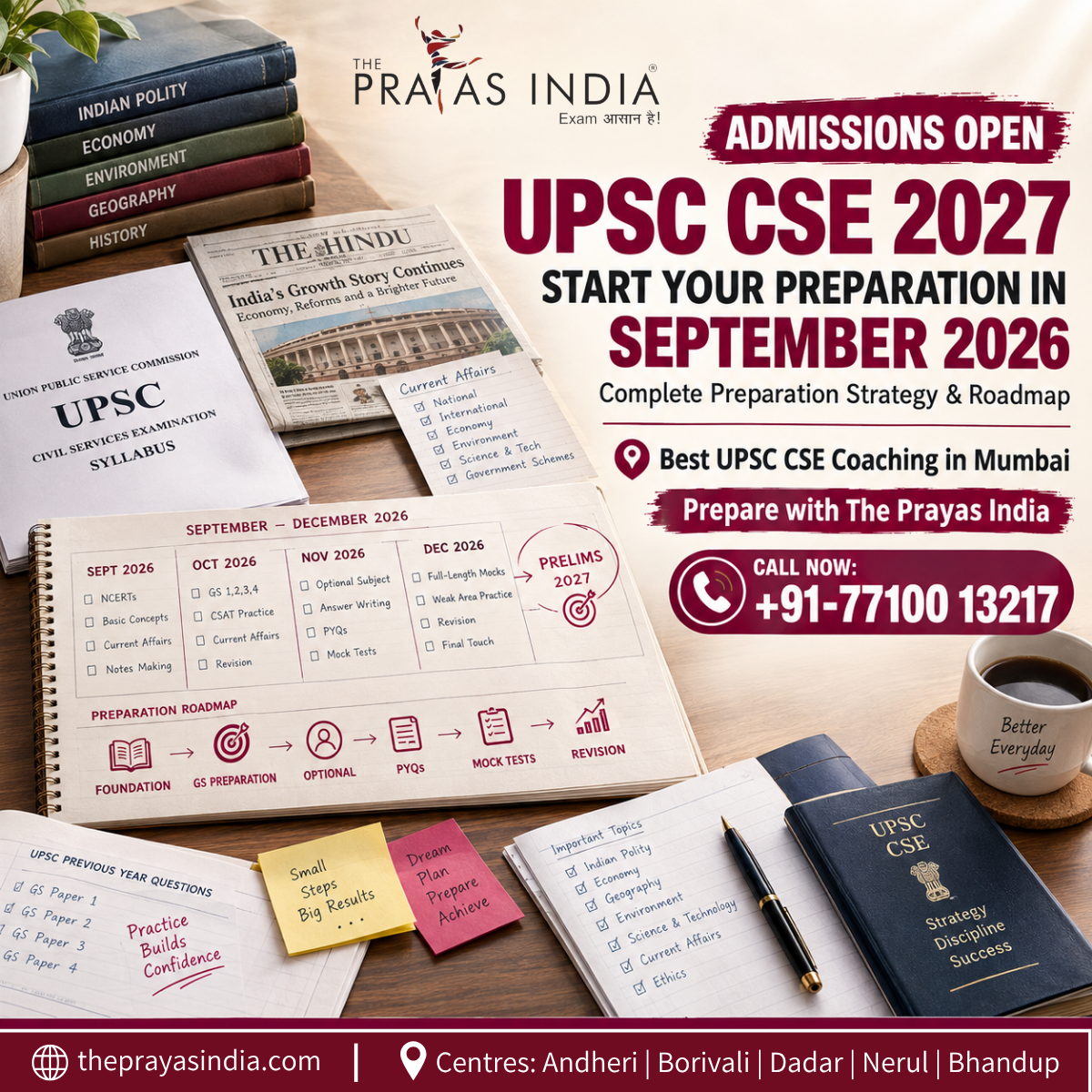
Admissions Open for UPSC CSE 2027 Preparation.
FAQs: UPSC CSE 2027 Prelims Preparation
1. When should I start preparing for UPSC CSE 2027 Prelims?
The earlier you build a structured foundation, the more time you have for multiple revisions, PYQs and mock-test practice. Aspirants should plan according to their current knowledge level, available study time and the official 2027 examination schedule.
2. What should I study first for UPSC CSE 2027 Prelims?
Start by understanding the official syllabus and examination structure. Then build foundational knowledge in major GS subjects while beginning PYQ analysis and a sustainable current-affairs routine.
3. Are UPSC Previous Year Questions important for Prelims?
Yes. PYQs help aspirants understand the nature, framing and conceptual depth of questions asked by UPSC. The Commission publishes previous question papers on its official website.
4. How should I prepare current affairs for UPSC CSE 2027?
Connect current developments with static subjects rather than memorising isolated news items. Maintain a limited and consistent source and revise important issues periodically.
5. Is CSAT important for UPSC CSE 2027?
Yes. CSAT is a compulsory Preliminary Examination paper and is qualifying under the established scheme, with a minimum qualifying requirement of 33%. Candidates must appear in both Prelims papers. The applicable 2027 rules should be checked in the official notification.
6. When should I start taking UPSC Prelims mock tests?
Topic-wise and sectional practice can begin relatively early. Full-length mocks should become more regular as your syllabus coverage and conceptual foundation improve, particularly during the dedicated Prelims phase.
7. How many hours should I study for UPSC CSE 2027?
There is no single number that works for every aspirant. A sustainable routine that balances learning, practice, revision and testing is more useful than following an unrealistic number of study hours.
8. Can I prepare for UPSC CSE 2027 without coaching?
Self-study is possible, but it requires disciplined planning, reliable resources, consistent testing and objective performance analysis. Coaching can provide additional structure, mentorship, study material and evaluation support.
9. How can UPSC coaching help with Prelims preparation?
A structured coaching programme can help organise the syllabus, provide guided learning, facilitate regular testing and support revision, doubt-solving and performance analysis.
10. What should I look for in UPSC coaching in Mumbai?
Consider faculty, course structure, study material, test series, mock analysis, mentorship, current-affairs support, revision strategy and doubt-solving rather than evaluating an institute on classroom teaching alone.
Why Serious Aspirants Choose The Prayas India:
- Expert-Led Classroom & Online Programs: Learn directly from India’s top mentors and seasoned educators who understand the pulse of the evolving UPSC pattern.
- Personalized 1-on-1 Mentorship: Stay on track with dedicated mentors tracking your daily progress, micro-syllabus targets, and mental readiness.
- Rigorous Answer Writing & Test Series: Master the art of articulation with our highly-evaluated Prelims and Mains Test Series, curated with extensive feedback.
- Exclusive Interview Guidance Program (IGP): Get trained by retired bureaucrats and panel experts to ace the Dholpur House Personality Test.
⚠️ Note: To ensure personalized attention, we maintain limited seats per batch. Secure your slot today!
Ready to transform your dream into reality? Connect with our Lead Counselor now:
📞 Call Us: +91 7710013217
💬 WhatsApp Us: +91 7710013217
📧 Mail Us: theprayasindia@gmail.com