How Mentorship Can Improve Your UPSC CSE 2027 Preparation | The Prayas India
UPSC Civil Services Examination preparation is a long-term process that requires more than simply collecting study material and studying for several hours every day. Aspirants have to understand the syllabus, select the right resources, build conceptual clarity, practise answer writing, analyse previous-year questions, revise repeatedly and continuously evaluate whether their preparation is moving in the right direction.
This is where mentorship can play an important role in UPSC CSE 2027 preparation.
Mentorship does not mean that a mentor studies on behalf of an aspirant or provides a shortcut to success. Its purpose is to bring structure, accountability and direction to preparation. A good mentor can help an aspirant identify gaps, prioritise tasks, interpret performance, improve answer-writing habits and avoid spending excessive time on low-value activities.
For an aspirant preparing for UPSC CSE 2027, starting mentorship early can be particularly useful because there is sufficient time to build a personalised preparation strategy instead of relying on last-minute corrections.
The key is to understand what mentorship should actually provide and how an aspirant can use it effectively.
What Is UPSC Mentorship?
UPSC mentorship is a structured guidance system in which an experienced mentor or faculty member regularly evaluates an aspirant’s preparation and provides personalised feedback.
It is different from simply attending classes.
A classroom generally focuses on teaching a subject or completing a defined portion of the syllabus. Mentorship, on the other hand, focuses more directly on the individual aspirant’s preparation journey.
A mentorship programme may involve:
- Personalised study planning
- Regular progress tracking
- Syllabus and topic prioritisation
- Current affairs guidance
- Previous-year question analysis
- Answer-writing evaluation
- Test performance analysis
- Revision planning
- Identification of weak areas
- Strategy correction
- Regular discussions with mentors
- Accountability and preparation discipline
The exact structure differs across programmes, but the central objective remains the same: help the aspirant make better preparation decisions consistently.
Why UPSC CSE Preparation Can Become Difficult Without Direction
UPSC preparation involves an enormous amount of information. The challenge is not simply finding information; it is deciding what deserves your time and what does not.
An aspirant can easily find multiple books for the same subject, hundreds of online lectures, daily current-affairs updates, monthly compilations, test series, topper strategies, optional resources and countless study plans.
This abundance can create a different problem: preparation becomes scattered.
An aspirant may spend several days collecting resources instead of completing a topic. Another may repeatedly read the same subject without practising questions. Someone else may postpone answer writing until after completing the entire syllabus.
Mentorship can help convert this unstructured preparation into a more deliberate process.
Instead of asking:
“What should I study today?”
an aspirant can gradually move towards:
“What is my current preparation gap, and what should I do next to close it?”
That shift can make preparation more systematic.
1. Personalised Study Planning
One of the biggest advantages of mentorship is the possibility of creating a study plan based on the aspirant’s actual situation.
A generic timetable may suggest studying a particular subject for a certain number of hours, but every aspirant starts from a different position. Some may have completed basic books, while others may still be developing foundational knowledge. Some may be comfortable with answer writing but weak in revision, while others may know the content but struggle to structure answers.
A mentor can help divide the preparation into manageable stages.
For UPSC CSE 2027, this could involve separate phases for:
- Foundation building
- GS preparation
- Optional preparation
- Current affairs integration
- Prelims-oriented practice
- Mains answer writing
- Revision
- Test practice
- Final examination preparation
The objective is not to create a timetable that looks impressive on paper. It is to create a plan that can realistically be executed and reviewed.
2. Mentorship Helps You Prioritise the UPSC Syllabus
The UPSC syllabus is broad, and not every topic should receive the same amount of preparation time.
Mentorship can help an aspirant understand how the syllabus connects with previous-year questions, standard sources and recurring themes.
For example, instead of studying Polity as an isolated collection of chapters, an aspirant can connect constitutional concepts with governance, current affairs and previous-year questions.
Similarly, Economy preparation can be connected with contemporary economic developments, government policies and relevant conceptual foundations.
This approach encourages integrated preparation rather than treating every topic as a separate unit.
A mentor can also help identify when an aspirant is going unnecessarily deep into a topic.
This is important because UPSC preparation is not about knowing everything. It is about developing sufficient understanding across the required areas and being able to apply that understanding effectively in the examination.
3. Mentorship Can Reduce Resource Overload
Resource selection is one of the most common challenges in competitive-exam preparation.
An aspirant may begin with one book, discover another recommendation online and then add multiple PDFs, videos and notes. Eventually, the problem is no longer a lack of material but an inability to revise everything.
A mentor can help establish a limited and practical resource framework.
The goal should be:
Fewer reliable sources + Multiple revisions + Continuous practice
rather than:
More sources + Less revision + Incomplete coverage
A mentor can also help determine when an aspirant has studied enough from a particular source and should move towards practice and revision.
This can save valuable preparation time.
4. Mentorship and Previous-Year Question Analysis
Previous-year questions are among the most useful tools for understanding what UPSC expects from an aspirant.
However, simply solving PYQs is not enough.
Mentorship can help aspirants analyse them more deeply.
Questions can be studied to understand:
- What concept is being tested?
- What type of information is required?
- How is the question worded?
- What kind of reasoning is expected?
- How does the topic connect with the syllabus?
- What mistakes might an aspirant make?
- How can similar questions be approached?
This analysis helps bridge the gap between studying a subject and preparing for the examination.
A mentor can also use PYQ patterns to help an aspirant decide which topics require greater attention during revision.
5. Personalised Feedback on Answer Writing
Answer writing is one of the areas where personalised feedback can make a significant difference.
Reading model answers can help an aspirant understand what a good answer looks like, but it does not automatically reveal why their own answer is weak.
An aspirant may have sufficient knowledge but fail to:
- Address the demand of the question
- Structure the introduction effectively
- Use relevant examples
- Organise arguments
- Maintain balance
- Present multiple dimensions
- Reach a clear conclusion
- Manage the available space and time
Mentor feedback can identify these issues.
For example, if an aspirant repeatedly writes long introductions, the mentor can highlight the pattern. If answers lack examples, diagrams or relevant contemporary references where appropriate, the mentor can point this out.
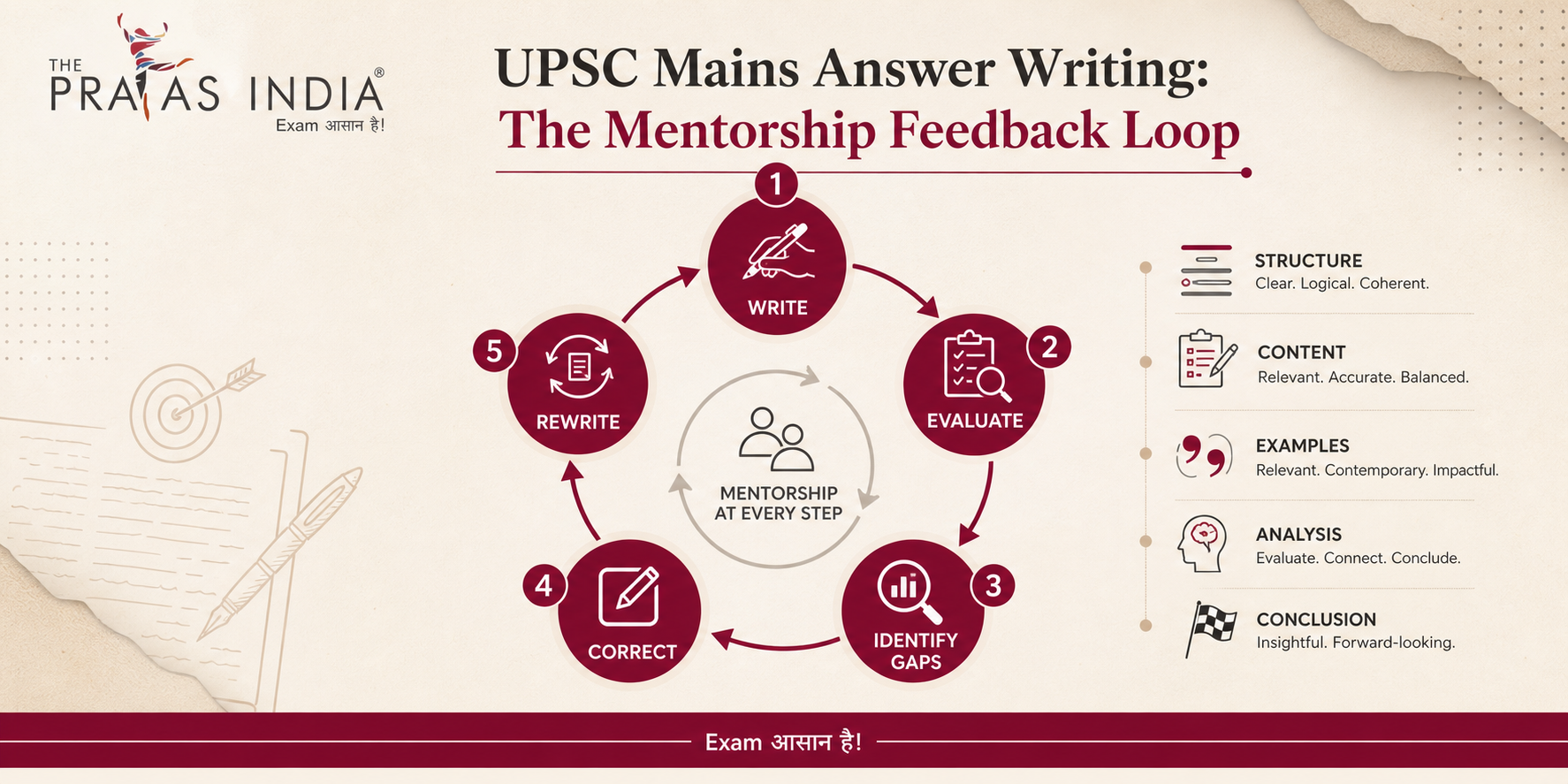
Over time, this creates a feedback loop:
Write → Get Evaluated → Identify Gap → Correct → Rewrite → Improve
That is considerably more useful than writing answers repeatedly without understanding why marks are being lost.
6. Mentorship for Current Affairs Integration
Current affairs can become overwhelming because new information appears every day.
The problem is not the availability of information. It is knowing what to retain, how to connect it with static subjects and how to use it in the examination.
A mentor can help an aspirant develop a selective current-affairs approach.
For example, a major policy development may be relevant to Polity, Governance, Economy or Social Issues. Instead of maintaining completely separate notes for every occurrence, an aspirant can integrate relevant developments into existing subject notes.
A mentor can also encourage the aspirant to think in terms of:
Issue → Background → Government response → Challenges → Way forward
This can help convert current affairs from daily information consumption into usable examination material.
7. Mentorship Helps Connect Prelims and Mains Preparation
Prelims and Mains require different approaches, but preparing for them as completely separate examinations can create unnecessary duplication.
A well-structured mentorship system can help aspirants identify areas where preparation can serve both stages.
For example, studying a topic conceptually for Mains can strengthen the foundation required for Prelims. Similarly, solving objective questions can expose factual or conceptual gaps that need to be addressed before Mains.
The balance changes as the examination approaches.
Early preparation can focus more strongly on foundation and integrated learning. As Prelims approaches, objective practice, revision and elimination-based thinking become increasingly important.
After Prelims, the preparation emphasis shifts rapidly toward Mains answer writing, revision and test practice.
Mentorship can help manage these transitions.
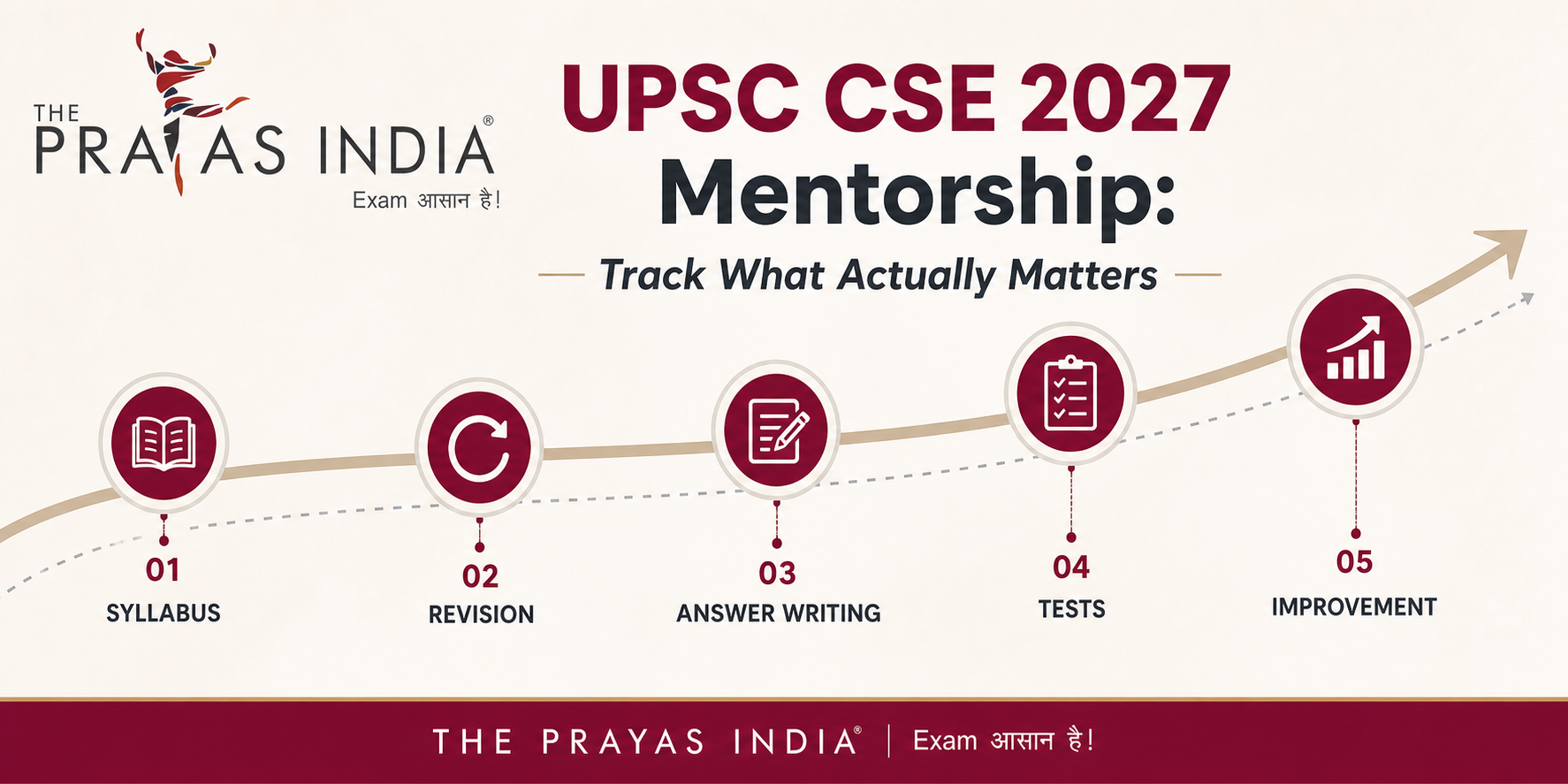
8. Regular Progress Tracking
A preparation plan is useful only when you know whether you are following it.
Progress tracking does not have to mean maintaining complicated spreadsheets.
A simple dashboard can monitor:
| Area | Current Status | Next Action |
|---|---|---|
| GS Foundation | Completed / Ongoing | Revise pending topics |
| Optional | Ongoing | Complete next unit |
| Current Affairs | Regular / Irregular | Consolidate notes |
| Answer Writing | Weak / Improving | Increase practice |
| Prelims Practice | Beginning / Regular | Add timed tests |
| Revision | Pending / Ongoing | Schedule next cycle |
| Mock Tests | Started / Pending | Analyse performance |
The mentor’s role is to help interpret this information.
Completing 10 chapters does not necessarily mean preparation has improved if those chapters have not been revised or tested.
Similarly, a low mock score is not necessarily a disaster if analysis reveals specific weaknesses that can be corrected.
The important thing is to measure progress in capability, not simply progress in content completion.
9. Accountability and Consistency
UPSC preparation can extend over a long period, and maintaining consistency is often difficult.
A mentor can provide an external accountability mechanism.
Regular reviews create a reason to assess whether planned tasks were actually completed. If an aspirant repeatedly postpones answer writing, revision or tests, the pattern becomes visible.
Accountability should not mean pressure for the sake of pressure. Its purpose is to encourage realistic commitments and regular evaluation.
A good system asks:
What did you plan?
What did you complete?
What prevented completion?
What should change next week?
This can help aspirants distinguish between genuine workload issues and inefficient study habits.
10. Mentorship Can Help Identify Preparation Gaps Earlier
One advantage of external feedback is that another person may notice patterns that the aspirant does not recognise.
An aspirant may feel that they are weak in an entire subject when the actual issue is only a specific topic.
Similarly, someone may believe that their problem is lack of knowledge when the real problem is answer structure or revision.
A mentor can look at performance across multiple activities and identify recurring patterns.
For example:
Repeated factual mistakes → Revision problem
Good knowledge but weak answers → Presentation/structure problem
Good sectional performance but poor mock performance → Time or decision-making problem
Consistent incomplete targets → Planning or workload problem
The earlier such patterns are identified, the more time there is to correct them.
11. Mentorship for Optional Subject Preparation
The optional subject can become a major part of the preparation journey, and aspirants often need guidance about sources, answer writing and test practice.
Mentorship can help an aspirant structure optional preparation around:
- Syllabus mapping
- Previous-year questions
- Core resources
- Topic-wise notes
- Answer-writing practice
- Revision cycles
- Test-series performance
- Identifying recurring weaknesses
The mentor should not replace the aspirant’s own engagement with the subject. Instead, guidance should help make the preparation more systematic.
For students who are still deciding how to structure their optional preparation, early guidance can also help prevent prolonged uncertainty and resource switching.
12. Mentorship During the Revision Phase
Revision is often underestimated because completing a topic can feel more productive than revisiting it.
However, UPSC preparation involves retaining and applying information over time.
A mentor can help create multiple revision cycles rather than leaving revision until the end.
A practical cycle can look like:
First Study → Short Revision → Practice → Second Revision → Test → Final Consolidation
During revision, mentors can also help identify what should be retained in detailed notes and what can be condensed.
This prevents notes from becoming increasingly large with every revision.
13. Mentorship Before Prelims
As Prelims approaches, the preparation strategy needs to become more focused.
A mentor can help monitor:
- Revision completion
- Static subject revision
- Current-affairs consolidation
- MCQ practice
- Mock-test performance
- Time management
- Elimination techniques
- Weak subject areas
- Revision frequency
One of the biggest mistakes at this stage is continuously adding new sources.
The focus should increasingly move toward revision, testing and correction.
14. Mentorship After Prelims
The period immediately after Prelims requires a significant change in preparation mode.
If the candidate has prepared consistently, Mains preparation should not begin from zero after Prelims.
Answer writing, optional preparation, Essay practice and GS revision should already have a foundation.
Mentorship can help create a focused post-Prelims plan around:
GS → Optional → Essay → Answer Writing → Tests → Revision
The available time is limited, so prioritisation becomes particularly important.
15. What Makes Mentorship Effective?
Not every mentorship programme will work in the same way, and the quality of mentorship depends heavily on how the system is designed and used.
A useful mentorship programme should ideally provide:
Personalisation
Guidance should consider the aspirant’s preparation stage rather than providing exactly the same instructions to everyone.
Regular Feedback
Feedback should happen frequently enough to allow corrections before mistakes become habits.
Measurable Progress
There should be some mechanism for tracking preparation and performance.
Strategy Correction
Mentorship should not simply tell students to study more. It should help identify what needs to change.
Accessibility
Aspirants should have a reasonable mechanism for discussing genuine preparation-related doubts and difficulties.
Integration
Mentorship should connect study, revision, tests, current affairs and answer writing rather than treating them as isolated activities.
16. How Aspirants Should Use a Mentor Effectively
Mentorship works best when the aspirant actively participates.
Before a mentoring session, prepare specific questions.
Instead of asking:
“How should I prepare for UPSC?”
ask:
“I am completing Polity, but my PYQ accuracy is inconsistent. Should I revise the source again or increase MCQ practice?”
Instead of:
“My Mains answers are not good.”
ask:
“My answers are generally complete, but I struggle with introductions and conclusions. How should I practise this?”
Specific questions lead to more useful discussions.
Also maintain your own records of:
- Study hours
- Topics completed
- Revision cycles
- Test scores
- Answer-writing feedback
- Recurring mistakes
- Pending targets
A mentor can guide you better when you provide accurate information about your preparation.
17. Mentorship Should Guide, Not Replace Self-Study
This is perhaps the most important point.
A mentor can provide direction, feedback and accountability, but the actual preparation still belongs to the aspirant.
You still need to:
- Read
- Revise
- Practise
- Write
- Analyse
- Improve
- Repeat
Mentorship should reduce confusion, not reduce effort.
The best outcome is not an aspirant who constantly waits for a mentor to decide what to do. It is an aspirant who gradually becomes better at evaluating their own preparation.
In this sense, good mentorship should eventually create independent decision-making ability.
18. How The Prayas India Can Support UPSC CSE 2027 Aspirants
For a long examination cycle such as UPSC CSE 2027, structured guidance can help aspirants maintain direction throughout different preparation stages.
The Prayas India can support UPSC aspirants through structured preparation, faculty guidance, mentorship-oriented support, study planning, practice and test-based evaluation.
Depending on the aspirant’s preparation stage, guidance can be integrated with:
- GS preparation
- Optional subject preparation
- Current affairs
- Answer writing
- Test practice
- Revision planning
- Performance analysis
- Prelims and Mains strategy
The purpose of such support is not to provide a one-size-fits-all timetable. It is to help aspirants understand where they currently stand and what they should focus on next.
For UPSC CSE 2027 aspirants, starting this process early can provide more time to identify weaknesses, improve answer writing, develop revision habits and refine examination strategy.
A Practical Mentorship Roadmap for UPSC CSE 2027
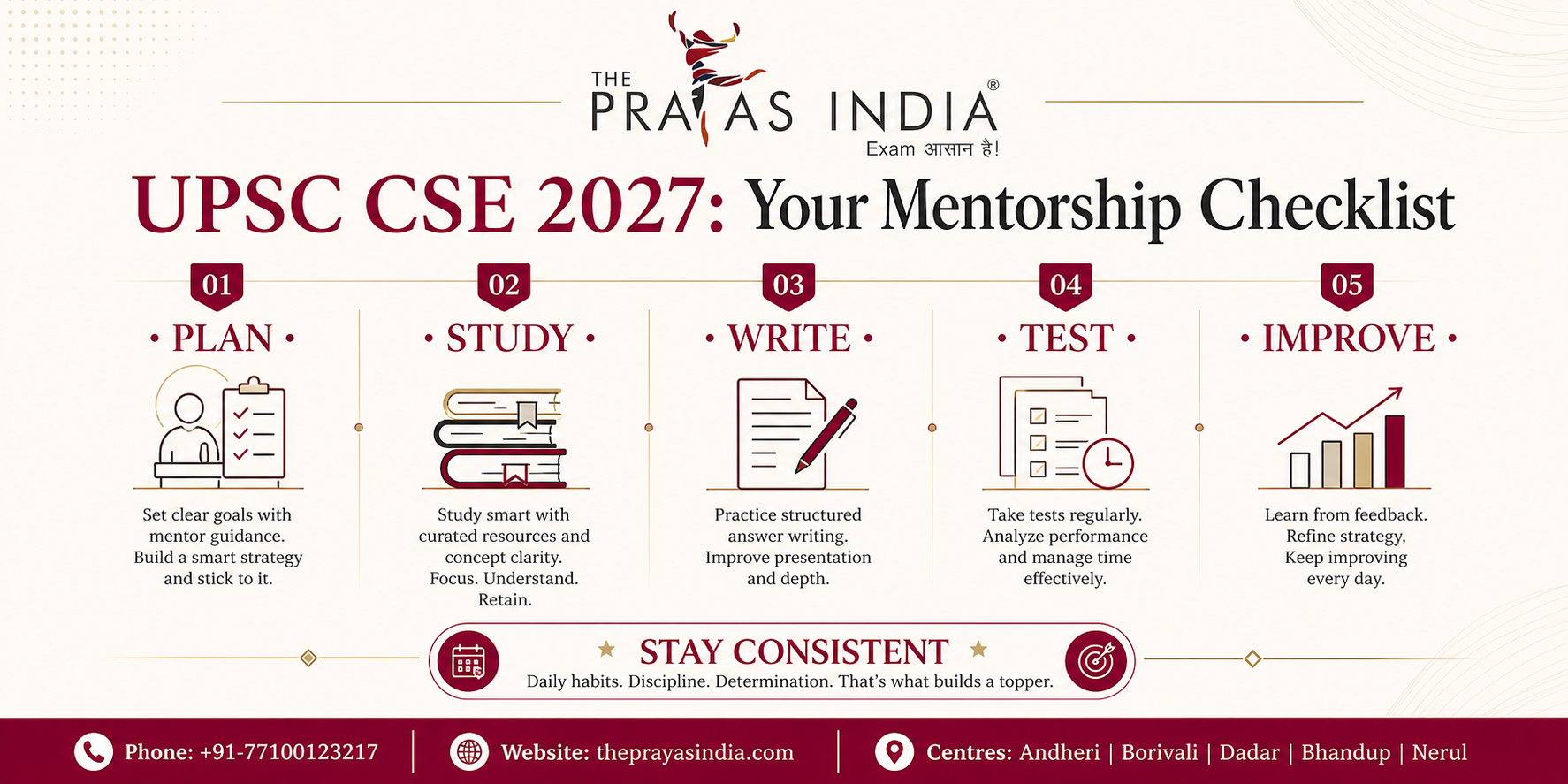
Aspirants can broadly think of mentorship as a continuous cycle rather than a one-time intervention.
Foundation Stage
Focus on syllabus understanding, standard resources, basic concepts and creating a realistic study routine.
Integrated Preparation Stage
Connect GS subjects with current affairs, PYQs, answer writing and optional preparation.
Practice Stage
Increase MCQs, answer writing, sectional tests and topic-based evaluation.
Prelims-Focused Stage
Prioritise revision, MCQ practice, mock tests and elimination-based decision-making.
Mains-Focused Stage
Shift towards answer writing, Essay, optional, GS revision and full-length tests after Prelims.
Final Improvement Stage
Use performance data to identify the remaining weaknesses and focus on high-value corrections.
Mentorship can support each transition by helping the aspirant understand what should change as the examination stage changes.
Common Mistakes Aspirants Should Avoid While Using Mentorship
Following Every Instruction Without Thinking
Mentorship should guide decision-making, not eliminate it. Aspirants should understand the reasoning behind major strategy changes.
Expecting Instant Results
A change in strategy may take time to produce measurable improvement. Performance should be evaluated over a reasonable period.
Hiding Poor Performance
If a test score is weak or targets were not completed, the mentor needs accurate information to provide useful guidance.
Constantly Changing Plans
Not every difficult week requires a completely new timetable. Sometimes the solution is simply to correct one specific issue.
Collecting Too Much Advice
Following multiple mentors, toppers and online strategies simultaneously can create confusion. Build a coherent preparation system and evaluate what actually works for you.
Treating Mentorship as a Substitute for Practice
No mentoring programme can replace reading, revision, MCQs, answer writing and tests.
Final Takeaway
UPSC CSE 2027 preparation is a long journey, and one of the biggest challenges is not merely studying hard but studying in the right direction consistently.
Mentorship can add value by helping aspirants create realistic plans, prioritise the syllabus, control resources, analyse PYQs, improve answer writing, integrate current affairs, track progress and correct recurring mistakes.
Its greatest value lies in the feedback loop:
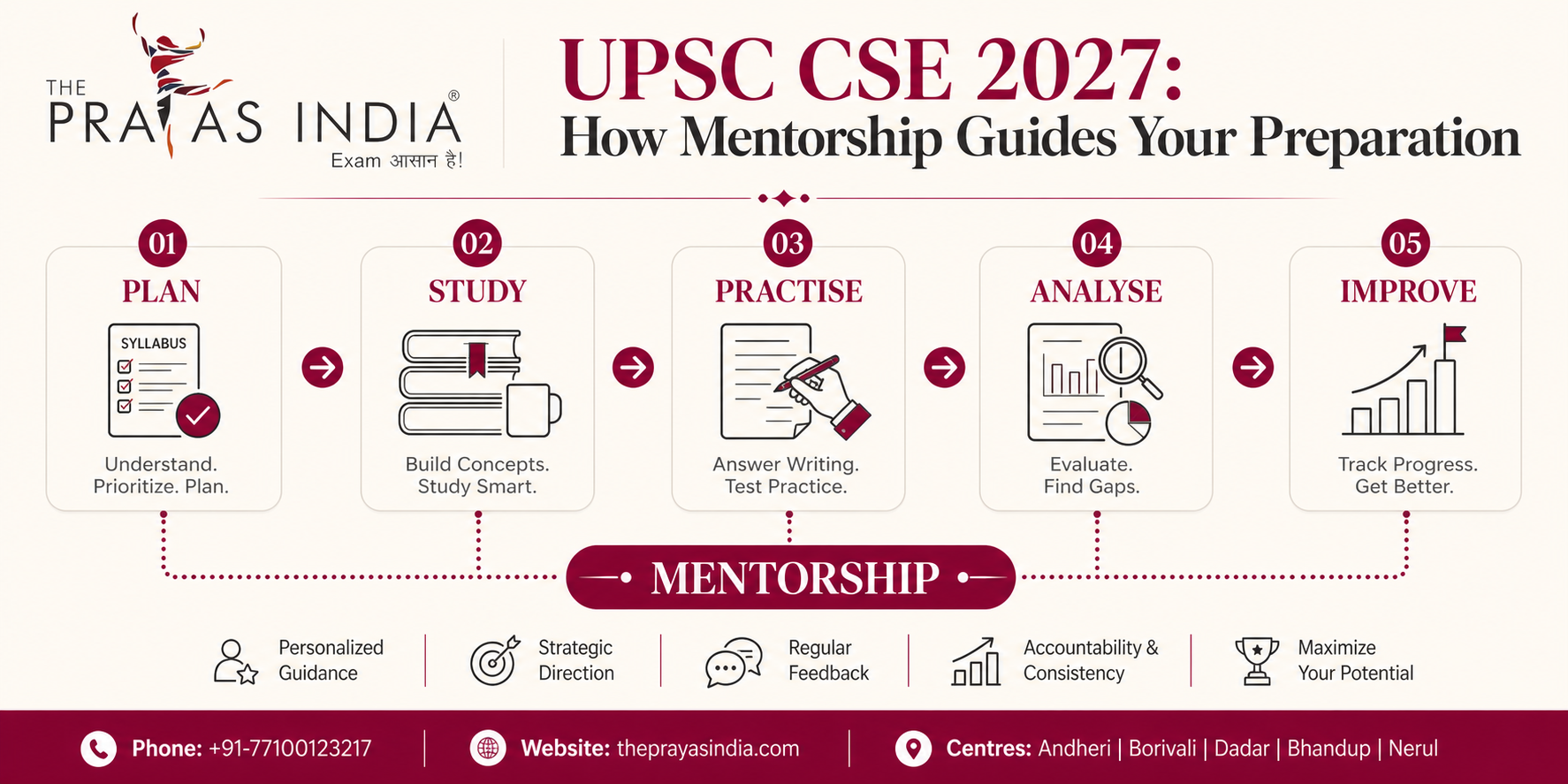
Plan → Study → Practise → Evaluate → Correct → Improve
A good mentor does not eliminate the hard work involved in UPSC preparation. Instead, mentorship can help ensure that the effort is more structured, measurable and responsive to the aspirant’s actual performance.
For an aspirant preparing for UPSC CSE 2027, the goal should therefore not be to depend permanently on someone else for every decision. The goal should be to use guidance to develop clarity, consistency, self-awareness and an independent examination strategy.
Starting mentorship early can give aspirants more time to identify gaps, experiment with preparation methods, improve answer writing and build a sustainable preparation routine before the examination becomes an immediate deadline.
FAQs: How Mentorship Can Improve Your UPSC CSE 2027 Preparation
1. What is UPSC mentorship?
UPSC mentorship is a structured guidance system in which mentors help aspirants plan, monitor and improve their preparation through personalised feedback, progress reviews, strategy guidance and performance analysis.
2. Is mentorship necessary for UPSC CSE 2027 preparation?
Mentorship is not a mandatory requirement for preparing for UPSC. Some aspirants prepare independently, while others benefit from structured guidance and regular feedback. Its usefulness depends on the individual’s preparation needs.
3. How can mentorship help UPSC aspirants?
Mentorship can help with study planning, syllabus prioritisation, resource selection, PYQ analysis, answer writing, test analysis, revision planning, current-affairs integration and accountability.
4. Can mentorship improve UPSC Mains answer writing?
Regular evaluation and specific feedback can help identify issues related to structure, relevance, presentation, examples, analysis and conclusions. The aspirant still needs consistent answer-writing practice to implement the feedback.
5. Can a mentor help with current affairs?
Yes. A mentor can help aspirants identify relevant issues, connect current affairs with static subjects and develop a more selective approach to note-making and revision.
6. How often should UPSC mentorship sessions happen?
There is no universal frequency. It depends on the programme and the aspirant’s preparation stage. Regular enough feedback to identify and correct problems is generally more useful than occasional guidance.
7. Can mentorship help with UPSC optional preparation?
Mentorship can help structure optional preparation around the syllabus, PYQs, resources, answer writing, tests, revision and performance analysis.
8. When should I start UPSC CSE 2027 mentorship?
Aspirants can consider mentorship at any stage, but starting early provides more time to identify preparation gaps and make corrections before the examination stages become more intensive.
9. Can mentorship help if I am preparing for UPSC through self-study?
Yes. Mentorship and self-study are not mutually exclusive. An aspirant can continue independent study while using mentorship for planning, feedback, testing and strategy correction.
10. What should I ask a UPSC mentor?
Ask specific questions related to your preparation, such as why your test performance is weak, how to structure answer writing, whether your resources are sufficient, how to plan revision or how to address a recurring weakness.
11. Does mentorship replace UPSC coaching?
Mentorship and classroom coaching serve different purposes. Coaching generally provides structured subject teaching, while mentorship focuses more on personalised planning, evaluation and preparation guidance. Some programmes combine both.
12. How can I make the most of UPSC mentorship?
Be honest about your preparation, maintain performance records, complete agreed tasks, ask specific questions and implement feedback consistently. Mentorship becomes more useful when the aspirant actively participates in the process.
Accelerate Your UPSC CSE 2027 Success with 1-on-1 Mentorship!
Syllabus knowledge is only half the battle—cracking UPSC requires disciplined accountability, answer-writing evaluation, and continuous strategy correction. Connect with seasoned IAS coaches at The Prayas India to claim your personalized preparation roadmap today.
Official Website: theprayasindia.com
Visit Our Mumbai Centres:
Borivali | Dadar | Nerul | Bhandup