How to Prepare Indian Polity for UPSC Prelims 2027: Complete Strategy, Important Topics & Study Plan
Indian Polity is one of the core areas of the UPSC Civil Services Preliminary Examination. It is not limited to memorising Articles, constitutional bodies or parliamentary terminology. UPSC can test whether an aspirant understands how constitutional provisions work, how institutions interact, what powers different authorities exercise, and how constitutional principles connect with contemporary governance.
For UPSC CSE 2027 aspirants, Polity should therefore be studied as a combination of Constitutional concepts, institutional mechanisms, governance, current affairs and application-based question solving. The objective should not be to memorise an isolated list of Articles but to understand the framework well enough to eliminate incorrect options and handle questions involving subtle constitutional distinctions.
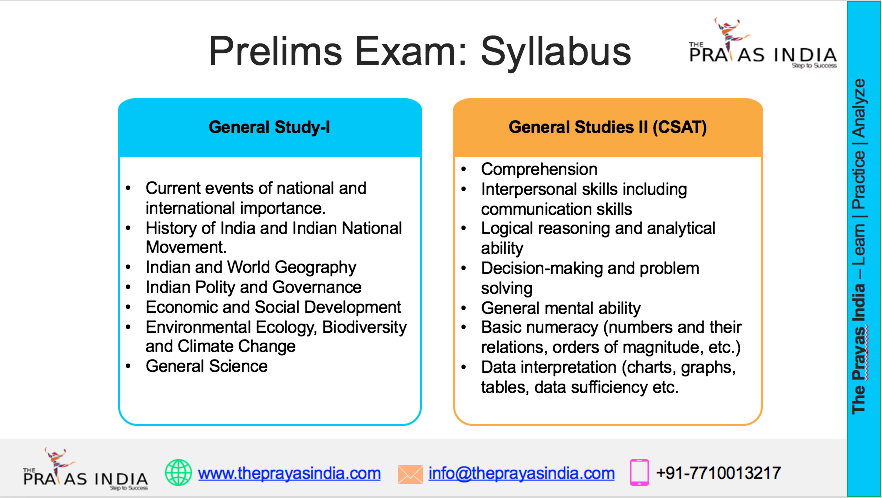
The latest official UPSC Preliminary syllabus available includes Indian Polity and Governance – Constitution, Political System, Panchayati Raj, Public Policy, Rights Issues, etc. in General Studies Paper I. The official 2026 notification also specifies that the Preliminary Examination consists of two compulsory objective papers of 200 marks each, with General Studies Paper II qualifying at 33%; these are the latest confirmed exam-framework details and should not be treated as a notification for CSE 2027.
For 2027, candidates should build their Polity preparation around the latest official UPSC syllabus and update any exam-specific details once the 2027 notification is released.
Why Indian Polity Is Important for UPSC Prelims 2027
Indian Polity has a distinctive advantage in UPSC preparation because the subject combines a relatively stable conceptual foundation with continuously changing current-affairs applications. The Constitution, Parliament, Supreme Court, President, Governor, federal relations and constitutional bodies form the static foundation, while developments in legislation, judicial decisions, government institutions, rights and governance provide the dynamic component.
This means that Polity cannot be prepared effectively by reading a standard book once and then moving on. You need repeated revision and regular practice with UPSC-style questions.
Another reason Polity deserves systematic preparation is that many questions are designed around conceptual distinctions. For example, knowing that an institution exists is different from understanding how its members are appointed, how they can be removed, what powers it exercises and whether those powers are discretionary, constitutional or statutory.
Similarly, knowing the name of a constitutional provision is not always sufficient. UPSC can test the relationship between two provisions, the scope of a power, an exception to a general rule or the distinction between constitutional and statutory institutions.
Therefore, your Polity preparation should gradually move through three stages:
Understanding → Application → Elimination
First understand the constitutional framework, then apply it to questions and current developments, and finally develop the ability to eliminate incorrect options.
Understand the UPSC Polity Syllabus Before You Start
The official Prelims syllabus does not provide a chapter-by-chapter list of Polity topics. Instead, it broadly identifies areas such as the Constitution, political system, Panchayati Raj, public policy and rights issues.
This broad wording means candidates should create their own topic framework.
A practical Polity syllabus for preparation can be divided into the following areas:
- Historical background and making of the Constitution
- Salient features of the Constitution
- Preamble
- Citizenship
- Fundamental Rights
- Directive Principles of State Policy
- Fundamental Duties
- Constitutional amendments
- Basic Structure doctrine
- Union Executive
- Parliament
- Parliamentary procedures
- Judiciary
- State Executive
- State Legislature
- Centre-State relations
- Inter-State relations
- Emergency provisions
- Local government
- Constitutional bodies
- Statutory and regulatory bodies
- Elections and electoral system
- Political parties and representation
- Governance and public policy
- Rights-related issues
- Important constitutional and legal developments
- Important Supreme Court judgments
- Current affairs connected with constitutional institutions
This framework should be treated as a preparation structure rather than an official UPSC topic list.
Start With the Constitution, Not With Random Current Affairs
A common mistake among beginners is to start Polity preparation through current affairs. Current events are important, but they become much easier to understand when you already know the constitutional foundation.
For example, if a current-affairs topic concerns the powers of the Governor, simply reading the news will not give you a complete understanding. You need to know the constitutional position of the Governor, the relationship with the Council of Ministers, the nature of discretionary powers and the broader federal context.
The same principle applies to Parliament, the judiciary, Fundamental Rights, elections, local government and constitutional bodies.
Therefore, your initial Polity preparation should be static-first.
Start by understanding the Constitution and the structure of Indian governance. Once the foundation becomes clear, connect current developments to the relevant constitutional concept.
This approach also reduces the amount of information you need to memorise because current affairs start becoming extensions of concepts you already understand.
Step 1: Build a Strong Foundation in the Indian Constitution
The Constitution should form the foundation of your Polity preparation. Instead of trying to memorise every Article immediately, first understand its broad architecture.
Begin with:
- Historical background
- Constituent Assembly
- Sources and influences
- Salient features
- Preamble
- Fundamental Rights
- Directive Principles
- Fundamental Duties
- Constitutional amendment process
- Basic Structure doctrine
At this stage, focus on understanding relationships.
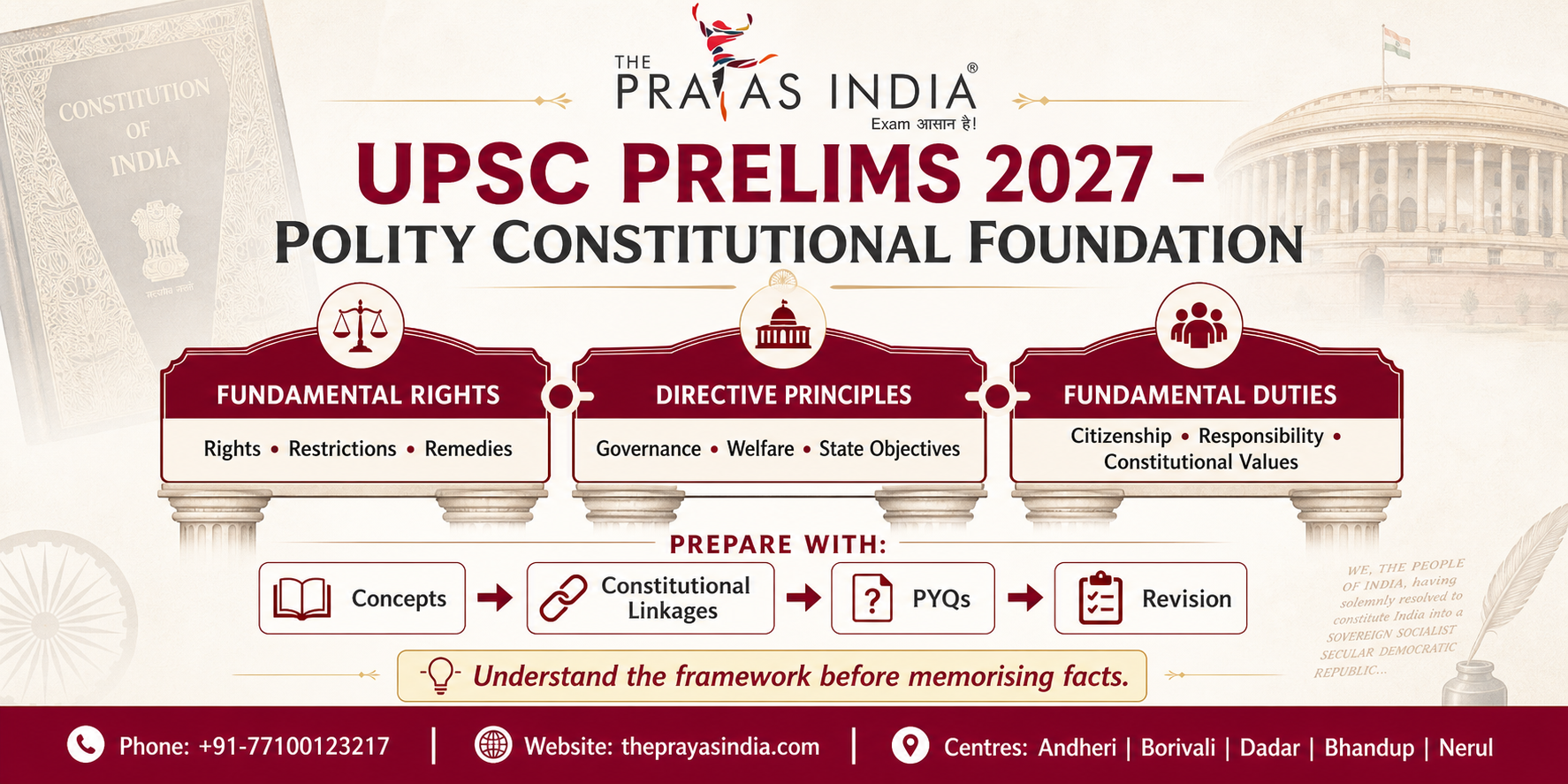
For example, do not study Fundamental Rights, Directive Principles and Fundamental Duties as three unrelated chapters. Understand how they collectively represent different constitutional dimensions of individual rights, governance objectives and civic responsibilities.
Similarly, understand why the Constitution combines federal and unitary features, why India follows a parliamentary system, and how constitutional supremacy interacts with judicial review.
Once the framework is clear, factual information becomes easier to retain.
How to Study the Preamble for UPSC Prelims
The Preamble is short, but it can generate conceptual questions. Do not restrict your preparation to memorising its wording.
Understand:
- The nature of the Indian state
- The meaning of sovereignty
- Secularism
- Socialism
- Democracy
- Republic
- Justice
- Liberty
- Equality
- Fraternity
- The significance of the constitutional amendment that changed the Preamble
The important point is to understand the constitutional meaning of these terms and their relationship with other provisions.
For Prelims, create short revision notes containing important concepts, historical developments and relevant judicial interpretations rather than filling several pages with copied material.
Step 2: Master Fundamental Rights, DPSPs and Fundamental Duties
These areas deserve repeated revision because they form an important conceptual foundation for understanding the Constitution.
Fundamental Rights
Study the categories of Fundamental Rights and understand:
- Who can exercise them
- Against whom they operate
- Whether they are absolute or subject to restrictions
- Important exceptions
- Constitutional remedies
- Reasonable restrictions
- Important judicial interpretations
Do not simply memorise Article numbers. Learn the relationship between rights and restrictions.
Questions can become difficult when multiple options contain statements that are individually familiar but differ in their precise constitutional application.
Directive Principles of State Policy
Understand their constitutional nature, relationship with Fundamental Rights and role in governance.
Focus on the broad categories and important provisions rather than attempting to memorise every line mechanically.
Fundamental Duties
Understand their constitutional basis, nature and relationship with citizenship and public responsibility.
The important goal is to recognise how these provisions function within the constitutional framework.
Step 3: Study the Union Executive
After building the constitutional foundation, move to the Union Executive.
Cover:
President of India
Study:
- Election
- Qualifications
- Term
- Impeachment
- Powers
- Veto powers
- Ordinance-making power
- Relationship with the Council of Ministers
- Constitutional position
The objective should be to understand how the office functions rather than memorising a list of powers.
Vice-President
Focus on:
- Election
- Qualifications
- Term
- Removal
- Role as Chairman of the Rajya Sabha
- Relationship with the President
Prime Minister and Council of Ministers
This is a particularly important conceptual area.
Understand:
- Appointment
- Collective responsibility
- Individual responsibility
- Cabinet and Council of Ministers
- Cabinet committees
- Role of the Prime Minister
- Relationship between the President and Council of Ministers
Questions often become difficult because several terms sound similar. Build comparison tables during revision.
For example:
| Concept | What You Should Understand |
|---|---|
| Council of Ministers | Constitutional body supporting and advising the President |
| Cabinet | Smaller core group within the Council of Ministers |
| Collective Responsibility | Political responsibility to the Lok Sabha |
| Prime Minister | Head of the Council of Ministers |
Step 4: Prepare Parliament Conceptually
Parliament is one of the largest areas within Polity preparation and should not be studied as a collection of isolated facts.
Begin with the structure of Parliament and then move towards its functioning.
Cover:
- Lok Sabha
- Rajya Sabha
- Qualifications and disqualifications
- Sessions
- Presiding officers
- Parliamentary privileges
- Legislative procedure
- Money Bills
- Financial Bills
- Ordinary Bills
- Constitutional Amendment Bills
- Budget
- Parliamentary committees
- Motions
- Devices of parliamentary control
- Anti-defection provisions
Pay Special Attention to Parliamentary Procedures
Do not just memorise definitions. Understand the differences between:
- Money Bill and Financial Bill
- Ordinary Bill and Constitutional Amendment Bill
- Adjournment and Prorogation
- Dissolution and Prorogation
- Question Hour and Zero Hour
- Ordinary majority and special majority
- Parliamentary committees and their functions
Creating comparison charts can significantly improve revision efficiency.
Step 5: Prepare the Indian Judiciary
The judiciary is another major area where conceptual clarity is more useful than excessive memorisation.
Study:
Supreme Court
- Composition
- Appointment of judges
- Qualifications
- Tenure
- Removal
- Jurisdiction
- Original jurisdiction
- Appellate jurisdiction
- Advisory jurisdiction
- Writ jurisdiction
- Judicial review
- Judicial activism
- Public Interest Litigation
- Contempt powers
High Courts
Understand their constitutional position, jurisdiction and relationship with subordinate courts.
Important Constitutional Concepts
Make sure you understand:
- Judicial review
- Judicial independence
- Separation of powers
- Basic Structure doctrine
- Constitutional remedies
- Writs
For writs, do not merely memorise names. Understand their purpose, scope and the situations in which they can be used.
Step 6: Study the State Government
Once the Union Executive and Parliament are clear, move to the State level.
Study:
- Governor
- Chief Minister
- State Council of Ministers
- State Legislature
- Legislative Assembly
- Legislative Council
- State legislative procedure
- High Court
- State-specific constitutional mechanisms
One of the most effective methods is to compare Union and State institutions.
For example:
| Union | State |
|---|---|
| President | Governor |
| Prime Minister | Chief Minister |
| Parliament | State Legislature |
| Supreme Court | High Court |
| Union Council of Ministers | State Council of Ministers |
Such comparisons help you identify similarities as well as important constitutional differences.
Step 7: Give Special Attention to Centre-State Relations
Centre-State relations are particularly useful because they connect constitutional theory with governance and current affairs.
Study them under three broad categories:
Legislative Relations
Understand the distribution of legislative powers and the constitutional framework governing Union and State legislation.
Administrative Relations
Study how administrative responsibilities and coordination operate between the Union and States.
Financial Relations
Understand the broad constitutional framework of taxation, distribution of revenues, grants and fiscal relationships.
Also study the broader issues surrounding federalism, cooperative federalism and institutional mechanisms for Union-State coordination.
Do not turn this section into a collection of newspaper articles. First understand the constitutional framework and then use current affairs to see how those provisions operate in practice.
How to Use Current Affairs for UPSC Polity Preparation
Current affairs should not become a separate Polity subject.
Instead, follow a static + current affairs integration model.
Suppose a major Supreme Court judgment appears in the news. Do not simply make a note of the case name.
Ask:
- What constitutional issue was involved?
- Which Article or constitutional principle is relevant?
- What institution was involved?
- What was the legal question?
- What broader constitutional concept does it illustrate?
- Is there a connection with a previous judgment?
- Could UPSC frame a conceptual question around this issue?
The same approach can be applied to Parliament, elections, constitutional bodies, federal relations, local government and rights-related developments.
This turns current affairs into revision material rather than an endless list of facts.
How to Read a Polity Book for UPSC Prelims 2027
A standard Polity reference book can provide the basic structure, but reading it repeatedly from the first page to the last page is not the most efficient revision method.
Use a three-stage reading process.
First Reading: Understanding
Read to understand the constitutional framework. Do not worry about memorising every detail.
Second Reading: Consolidation
Mark important concepts, comparisons, exceptions and areas that repeatedly appear in PYQs.
Third Reading: Revision
Convert the material into short notes, charts, tables and memory triggers.
After this, subsequent revisions should become increasingly faster.
The goal is to move from book-dependent preparation to notes-dependent revision.
How to Make Polity Notes for UPSC Prelims
Polity notes should be compact and revision-oriented.
Instead of writing:
“The President of India has several constitutional powers…”
Create a structured note:
President
- Election
- Qualification
- Term
- Impeachment
- Executive powers
- Legislative powers
- Financial powers
- Judicial powers
- Emergency-related powers
- Veto powers
- Ordinance power
Then add important exceptions and current-affairs connections.
Use tables for topics that are easily confused.
For example:
President vs Governor
Lok Sabha vs Rajya Sabha
Fundamental Rights vs DPSPs
Money Bill vs Financial Bill
Constitutional Body vs Statutory Body
Parliamentary Committee vs Constitutional Authority
This approach makes revision much faster before Prelims.
How Important Are UPSC Previous Year Questions for Polity?
Previous Year Questions are essential for understanding the nature of UPSC’s questioning.
The official UPSC website provides previous Civil Services Preliminary question papers, including General Studies Paper I and Paper II for recent examinations.
Do not use PYQs only as mock questions.
Use them to identify:
- Frequently tested concepts
- Question framing patterns
- Statement-based questions
- Constitutional exceptions
- Institution-specific concepts
- Current-affairs integration
- Elimination opportunities
After completing a Polity chapter, solve relevant PYQs.
For example, after studying Fundamental Rights, solve PYQs related to rights, restrictions, constitutional remedies and judicial interpretation.
This gives you a much clearer understanding of how much detail you actually need.
The Right Way to Use Polity PYQs
Use the following four-step method:
Step 1: Attempt the question without looking at the answer.
Step 2: Analyse every option, including the options you eliminated.
Step 3: Identify the underlying concept.
Step 4: Return to your source and revise that concept.
This is particularly important for statement-based questions.
If a question contains four statements and you identify one statement as incorrect, do not stop there. Understand why each statement is correct or incorrect.
This develops the elimination ability required for objective examinations.
Step 8: Prepare Constitutional Bodies Thoroughly
Constitutional bodies deserve special attention because they are directly connected with the constitutional framework and can be tested through both factual and conceptual questions. Instead of trying to memorise every detail in one sitting, study each institution through a fixed framework: constitutional basis, composition, appointment, tenure, removal, powers, functions, independence and important current developments.
Important constitutional bodies and institutions to cover include:
- Election Commission of India
- Union Public Service Commission
- Finance Commission
- Comptroller and Auditor General of India
- Attorney General of India
- National Commission for Scheduled Castes
- National Commission for Scheduled Tribes
- National Commission for Backward Classes
- Special Officer for Linguistic Minorities
- Goods and Services Tax Council
- Inter-State Council
For each institution, ask the same set of questions. Who appoints its members? What is the tenure? How can members be removed? What are its primary functions? Is it constitutional or statutory? What kind of independence does it have?
This method prevents constitutional-body preparation from becoming a random collection of facts.
Constitutional Body vs Statutory Body
This distinction should also be clear.
A constitutional body derives its authority directly from the Constitution, whereas a statutory body is created through legislation enacted by Parliament or a State Legislature.
However, simply memorising this distinction is not enough. During revision, maintain a comparison table containing the legal basis, appointment mechanism, functions and major powers of important institutions.
This can become especially useful when UPSC presents multiple statements about an institution and asks you to identify the correct combination.
Step 9: Study Panchayati Raj and Urban Local Government
Local government is explicitly included within the broad Polity and Governance area of the UPSC Prelims syllabus, so it should not be treated as a minor topic.
Study the constitutional framework of local government, particularly:
Panchayati Raj
Focus on:
- Constitutional recognition
- Three-tier structure
- Gram Sabha
- Composition
- Reservation
- Tenure
- Elections
- State Election Commission
- State Finance Commission
- Powers and responsibilities
- Eleventh Schedule
Urban Local Government
Cover:
- Municipalities
- Municipal corporations
- Nagar Panchayats
- Reservation
- Tenure
- Elections
- State Election Commission
- State Finance Commission
- Twelfth Schedule
- Urban governance
Do not study these chapters only as lists of constitutional provisions. Understand how decentralisation works and why local government was given constitutional status.
Current affairs related to local governance should be connected to this static framework.
Step 10: Understand Elections and Representation
Election-related Polity is another area where conceptual clarity is important.
Study:
- Election Commission of India
- Electoral rolls
- Representation of the People framework
- Qualifications for legislators
- Disqualifications
- Anti-defection provisions
- Election disputes
- Delimitation
- Voting and representation
- Political parties
- Electoral reforms
When studying election-related current affairs, always ask which constitutional provision, law or institution is involved.
For example, if an issue concerns the Election Commission, do not simply note the news event. Revise the constitutional basis of the institution and then connect the development to the relevant legal or constitutional framework.
This integrated approach is much more useful for UPSC than maintaining disconnected current-affairs notes.
Step 11: Prepare Emergency Provisions Carefully
Emergency provisions are a topic where small constitutional distinctions matter.
Study:
National Emergency
Understand:
- Constitutional basis
- Grounds
- Approval
- Duration
- Parliamentary control
- Effects on Fundamental Rights
- Effects on Centre-State relations
President’s Rule
Understand:
- Constitutional basis
- Conditions
- Parliamentary approval
- Duration
- Effects on State institutions
- Judicial review
- Financial Emergency
- Understand:
- Constitutional basis
- Conditions
- Consequences
- Constitutional status
Do not study these provisions simply by memorising Article numbers. Create a comparison table containing the trigger, approval requirement, duration, effects and safeguards.
Such tables are particularly useful during final revision.
Step 12: Study Constitutional Amendments and the Basic Structure Doctrine
Constitutional amendments should be studied selectively and conceptually.
You do not necessarily need to memorise every amendment in exhaustive detail. Instead, understand the constitutional amendment process and focus on amendments that significantly affected the constitutional framework or are repeatedly relevant to UPSC preparation.
Pay attention to:
- Amendment procedure
- Different majority requirements
- State ratification where applicable
- Limits on Parliament’s amending power
- Basic Structure doctrine
- Important constitutional developments arising from major amendments
The Basic Structure doctrine is especially important because it helps explain the relationship between parliamentary constitutional amendment power and constitutional limitations.
When studying important judgments, focus on the constitutional principle established or clarified, rather than attempting to memorise case names without understanding their significance.
Step 13: Build a Strong Understanding of Governance and Public Policy
Polity preparation should not stop at constitutional institutions.
The official syllabus also includes Public Policy and Rights Issues, making governance an important part of the broader preparation framework.
Study governance through themes such as:
- Transparency
- Accountability
- Citizen participation
- E-governance
- Public service delivery
- Social welfare
- Institutional accountability
- Rights-based governance
- Administrative reforms
- Government schemes and policies
The key is to connect governance topics with the institutions and constitutional principles you have already studied.
For example, when reading about transparency, connect it with accountability and access to information. When studying welfare schemes, understand the broader governance objective rather than memorising only launch dates and ministry names.
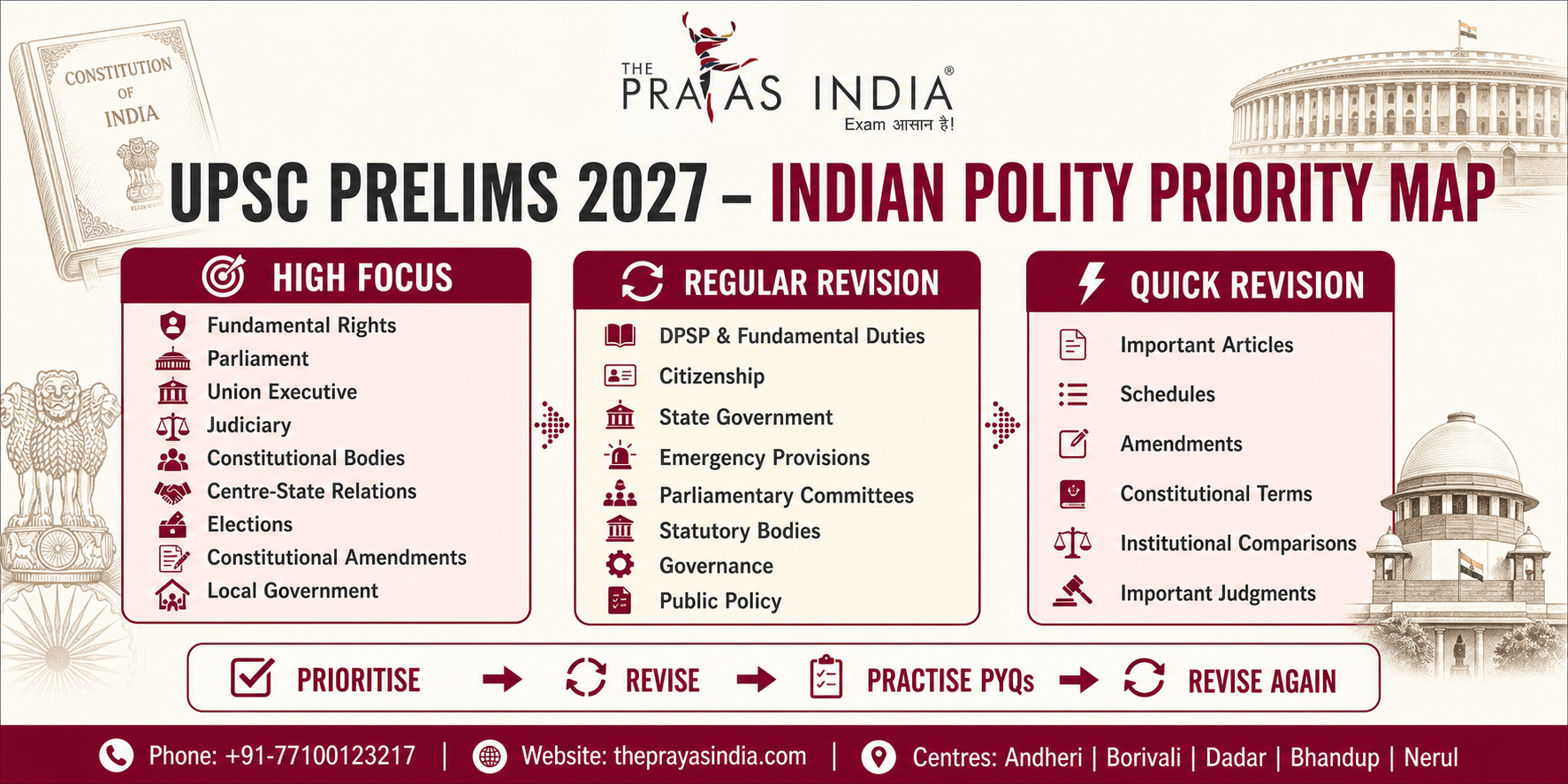
How to Prioritise Indian Polity Topics for UPSC Prelims 2027
Not every Polity chapter requires the same amount of revision time. However, avoid treating any topic as permanently “unimportant” simply because you do not frequently see questions from it.
A practical priority framework can help.
High-Focus Areas
Give substantial attention to:
- Fundamental Rights
- Parliament
- President and Prime Minister
- Supreme Court and High Courts
- Constitutional bodies
- Centre-State relations
- Elections
- Constitutional amendments
- Local government
- Basic Structure
- Important constitutional developments
Medium-Focus Areas
Regularly revise:
- Citizenship
- Directive Principles
- Fundamental Duties
- State Government
- Parliamentary committees
- Emergency provisions
- Statutory bodies
- Governance
- Public policy
- Rights-related issues
Revision-Focus Areas
Keep concise notes for:
- Important Articles
- Constitutional schedules
- Important amendments
- Constitutional terminology
- Important committees
- Institutional comparisons
- Frequently confused concepts
This does not mean that UPSC will necessarily ask more questions from one category in 2027. It is simply a practical way to allocate study and revision time.
How to Prepare Indian Polity in 30 Days
A 30-day Polity plan can be useful for candidates who want to establish or strengthen their foundation. It should not be treated as a substitute for long-term revision, but it can provide a structured starting point.
Days 1–5: Constitutional Foundation
Cover:
- Historical background
- Constituent Assembly
- Salient features
- Preamble
- Citizenship
- Fundamental Rights
Spend the final part of each day solving relevant PYQs.
Days 6–8: DPSP, Duties and Amendments
Study:
- Directive Principles
- Fundamental Duties
- Constitutional amendment process
- Basic Structure doctrine
Create concise comparison notes.
Days 9–12: Union Executive
Cover:
- President
- Vice-President
- Prime Minister
- Council of Ministers
- Cabinet
- Attorney General
Use comparison tables wherever concepts overlap.
Days 13–16: Parliament
Cover:
- Lok Sabha
- Rajya Sabha
- Presiding officers
- Parliamentary procedures
- Bills
- Budget
- Parliamentary committees
- Parliamentary privileges
- Anti-defection
Solve PYQs after completing each major area.
Days 17–19: Judiciary
Study:
- Supreme Court
- High Courts
- Judicial review
- Writs
- PIL
- Judicial independence
- Important constitutional principles
Days 20–22: State Government and Federalism
Cover:
- Governor
- Chief Minister
- State Council of Ministers
- State Legislature
- Centre-State relations
- Inter-State relations
Days 23–25: Constitutional Bodies and Local Government
Cover:
- Election Commission
- UPSC
- Finance Commission
- CAG
- Constitutional commissions
- Panchayati Raj
- Municipalities
Days 26–27: Elections, Governance and Rights Issues
Revise:
- Elections
- Representation
- Disqualification
- Governance
- Public policy
- Rights-related issues
Days 28–30: PYQs, Mock Tests and Revision
Use these final days to:
- Solve mixed Polity PYQs
- Take sectional tests
- Analyse mistakes
- Revise weak areas
- Review short notes
- Revisit important constitutional concepts
The purpose of the 30-day plan is to build a strong first cycle. Multiple revision cycles will still be required for Prelims 2027.
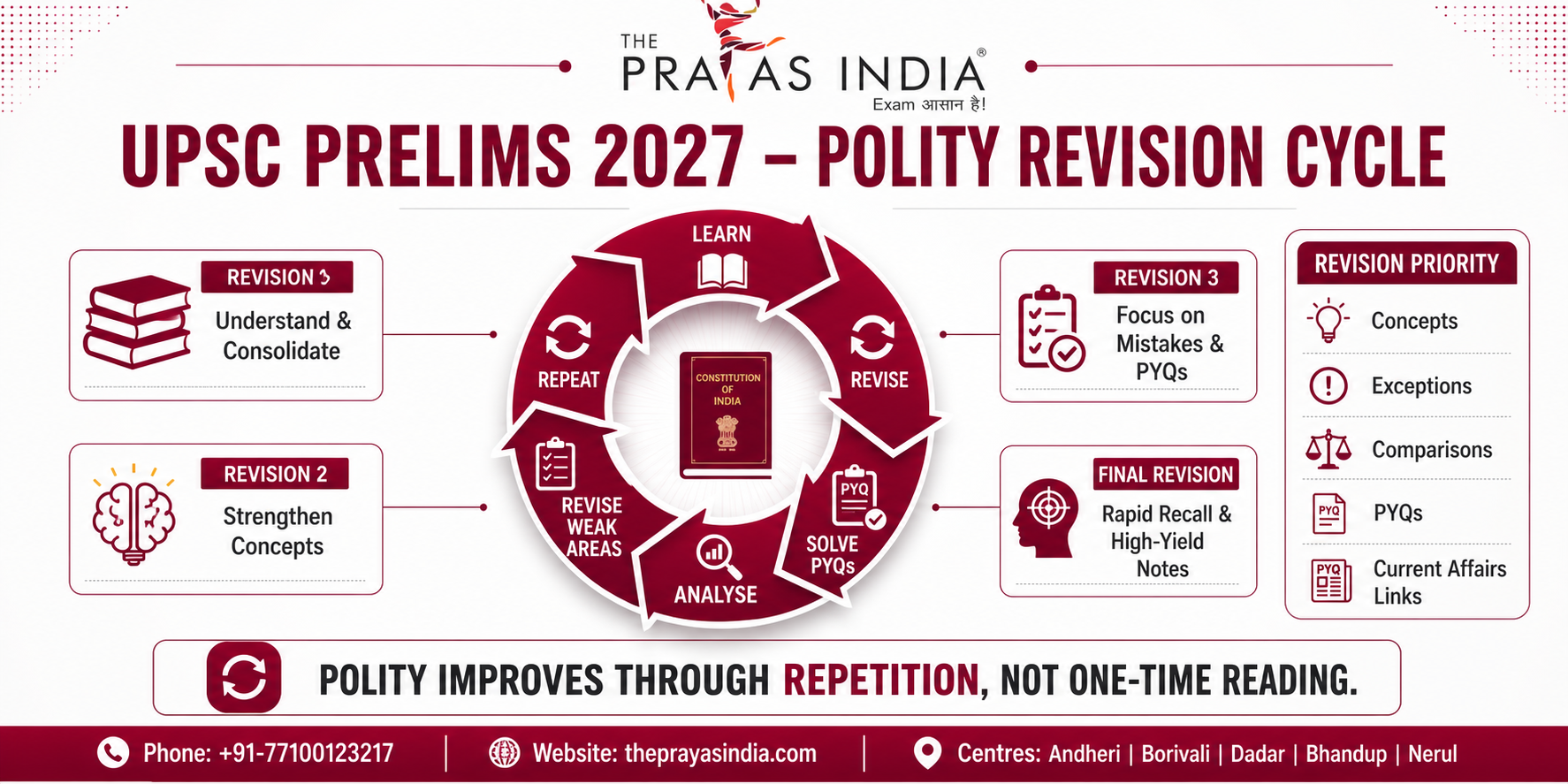
How to Revise Indian Polity for UPSC Prelims 2027
Polity benefits significantly from repeated revision because the subject contains a mixture of concepts, provisions, institutional details and exceptions.
A useful revision cycle can be:
First Revision: Within a few days of completing a topic.
Second Revision: After approximately one to two weeks.
Third Revision: After another few weeks.
Final Revision: During the dedicated Prelims revision phase.
The exact interval can be adjusted according to your retention and preparation schedule.
During revision, do not reread everything with equal intensity. Focus increasingly on:
- Mistakes
- Confusing concepts
- Exceptions
- Frequently tested areas
- PYQs
- Short notes
- Current-affairs connections
This gradually converts your preparation from learning-heavy to revision-heavy.
How to Use Mock Tests for Indian Polity
Once you have completed a substantial portion of Polity, sectional tests can help identify weak areas.
Do not judge your Polity preparation only by the number of questions you answer correctly.
After each test, classify your mistakes:
Conceptual Mistake: You did not understand the provision.
Factual Mistake: You forgot a specific detail.
Confusion Mistake: You mixed up two similar concepts.
Reading Mistake: You misunderstood the statement.
Elimination Mistake: You eliminated the correct option incorrectly.
This classification is important because each type requires a different solution.
For conceptual mistakes, return to the source.
For factual mistakes, revise your notes.
For confusion mistakes, create comparison tables.
For reading mistakes, practise statement-based questions.
For elimination mistakes, analyse why each option was right or wrong.
Common Mistakes to Avoid While Preparing Polity
1. Trying to Memorise the Constitution Without Understanding It
Memorisation has a role, but UPSC preparation requires conceptual understanding. Learn the relationship between provisions rather than treating every Article as an isolated fact.
2. Using Too Many Sources
Multiple books, websites, PDFs and coaching notes can create duplication. Choose a limited set of reliable resources and revise them repeatedly.
3. Ignoring PYQs
PYQs help you understand the level and style of questioning. They should be part of preparation from the beginning rather than being reserved for the final month.
4. Studying Current Affairs Separately
Current affairs should be connected with static Polity. This makes both subjects easier to revise.
5. Making Extremely Long Notes
If your notes become almost as long as your source book, they will not serve their purpose during revision. Keep them concise and focused on concepts, comparisons, exceptions and mistakes.
6. Ignoring Governance
Polity is not limited to constitutional Articles. Governance, public policy and rights-related issues are also part of the official syllabus framework.
7. Focusing Only on Article Numbers
Knowing Article numbers can help, but Article-number memorisation should not replace understanding constitutional principles.
A Practical Daily Routine for UPSC Polity Preparation
If you are studying Polity as part of a broader UPSC schedule, your daily Polity routine does not need to consume the entire day.
A practical session could include:
60–90 minutes: Conceptual reading
20–30 minutes: Revision of previously studied material
30–45 minutes: PYQs or practice questions
15–20 minutes: Current-affairs integration
10 minutes: Error/quick-note revision
The exact duration should be adjusted according to your overall preparation schedule.
The important principle is consistency. Studying Polity for several hours once a week is generally less useful than maintaining regular contact with the subject through reading, revision and questions.
How to Connect Indian Polity With Other UPSC Subjects
One of the biggest advantages of strong Polity preparation is that it overlaps with several other areas of the UPSC syllabus.
Polity + History
The evolution of constitutional institutions becomes easier when you understand India’s constitutional history.
Polity + Economy
Budget, taxation, fiscal federalism and public policy involve both constitutional and economic concepts.
Polity + Geography
Federal relations, local governance and resource-related administration can have geographical dimensions.
Polity + Environment
Environmental governance involves institutions, legislation, regulatory mechanisms and judicial interventions.
Polity + Current Affairs
This is the most important connection. Current constitutional and governance developments can become much easier to understand once the static framework is clear.
This integrated approach prevents UPSC preparation from becoming a collection of disconnected subjects.
Final Strategy for Indian Polity for UPSC Prelims 2027
A strong Polity preparation strategy can be summarised in seven stages:
1. Understand the Syllabus
Know the broad areas covered under Indian Polity and Governance.
2. Build the Constitutional Foundation
Study the Constitution, rights, institutions, Parliament, judiciary and federal structure.
3. Use One Core Source
Avoid continuously switching between multiple books and notes.
4. Integrate Current Affairs
Connect important developments with the relevant constitutional or governance concept.
5. Solve PYQs
Use previous questions to understand UPSC’s style of questioning and identify recurring conceptual areas.
6. Revise Repeatedly
Use short notes, tables, comparisons and error-based revision.
7. Test Yourself
Use sectional tests and full Prelims mocks to measure retention, accuracy and question-solving ability.
The goal is not to know every possible fact about Indian Polity. The goal is to develop a strong understanding of the constitutional framework and the ability to apply that understanding to unfamiliar questions.
For UPSC Prelims 2027, candidates should also keep checking official UPSC notifications and syllabus updates once released, because any 2027-specific examination details should be based on the official notification rather than assumptions from previous cycles.
Key Takeaways
Indian Polity can become a strong component of UPSC Prelims preparation when studied systematically. The subject should be approached through a combination of constitutional understanding, selective factual learning, current-affairs integration, PYQ practice and repeated revision.
Remember these principles:
- Understand before memorising.
- Use the Constitution as your conceptual foundation.
- Study institutions through their powers, functions and relationships.
- Use comparison tables for confusing concepts.
- Connect current affairs with static Polity.
- Solve PYQs after completing major topics.
- Maintain a concise error notebook.
- Revise multiple times.
- Do not rely on one reading of your Polity source.
- Keep your preparation aligned with the latest official UPSC information.
A disciplined preparation cycle can make Polity considerably more manageable and can also create a foundation that supports your Mains preparation later.
Prepare for UPSC CSE 2027 with Structured Guidance
UPSC preparation requires consistency across multiple subjects, regular revision and the ability to connect static concepts with current developments. For aspirants preparing for CSE 2027, structured guidance can help bring together conceptual learning, practice, revision and test-based preparation.
The Prayas India offers UPSC-oriented preparation support designed around structured learning, regular practice, revision and exam-focused guidance.
If you are beginning your UPSC CSE 2027 preparation or looking to strengthen your existing strategy, a structured preparation program can help you maintain consistency and build a systematic study routine.
UPSC CSE 2027 Indian Polity FAQs
How should I start Indian Polity preparation for UPSC Prelims 2027?
Start with the Constitution and build a clear understanding of the Preamble, Fundamental Rights, DPSP, Fundamental Duties, Parliament, Executive, Judiciary, federal relations, constitutional bodies and local government. After building the basics, connect these concepts with current affairs and solve UPSC Previous Year Questions regularly.
Which topics are important in Indian Polity for UPSC Prelims?
Important areas include Fundamental Rights, DPSP, Parliament, President and Vice-President, Prime Minister and Council of Ministers, Supreme Court and High Courts, constitutional and statutory bodies, Centre-State relations, Panchayati Raj, elections, emergency provisions, constitutional amendments, governance and important constitutional developments.
Is reading the Constitution necessary for UPSC Polity preparation?
A complete article-by-article reading is not necessary for most aspirants, but familiarity with important constitutional provisions is valuable. Focus on understanding the structure, important Articles, constitutional bodies, rights, duties, institutional powers and major constitutional relationships.
How important are UPSC PYQs for Indian Polity?
PYQs are essential because they help you understand how UPSC frames conceptual, statement-based and application-oriented questions. Instead of solving them only after completing the syllabus, use them throughout preparation to identify recurring themes and improve your understanding.
How can I connect Polity with current affairs?
Whenever a current issue involves Parliament, the Supreme Court, constitutional bodies, elections, federal relations, rights, government schemes or governance, connect the news with the underlying constitutional concept. This makes current affairs more useful for Prelims preparation and reduces the need for isolated memorisation.
How many revisions are required for Polity before UPSC Prelims?
There is no fixed number of revisions that works for every aspirant. The focus should be on repeated revision of important concepts, your notes, PYQ-based learning and areas where you make mistakes. A structured cycle of learning, revision, testing and error correction is more useful than counting revisions alone.
What is the best way to make Polity notes for UPSC?
Keep notes concise and revision-friendly. Focus on constitutional provisions, institutional roles, important comparisons, exceptions, landmark developments, current-affairs connections and mistakes identified through PYQs or mock tests. Avoid copying entire textbook paragraphs into your notes.
Can I prepare Indian Polity effectively in 30 days?
A 30-day plan can be useful for structured revision or strengthening Polity, especially when you already have some foundation. For beginners, the same period may be used to build the basics, solve selected PYQs and begin revision. The depth of preparation should be adjusted according to your starting level and overall UPSC study schedule.
Build a Strong UPSC CSE 2027 Foundation
Indian Polity requires more than memorising Articles and constitutional facts. With structured guidance, regular revision, PYQ-based practice and mock-test analysis, aspirants can build a stronger approach to UPSC Prelims preparation.
Prepare for UPSC CSE 2027 with The Prayas India and work systematically on concepts, current affairs, practice and revision.