How to Prepare Geography for UPSC CSE 2027: Complete Strategy for Prelims & Mains | The Prayas India
Geography is one of the most interconnected subjects in the UPSC Civil Services Examination. It is not limited to memorising rivers, mountains, climate classifications or locations on a map. Geography helps aspirants understand how physical processes shape the Earth, how resources are distributed, why industries develop in particular regions, how populations interact with their surroundings and why events such as cyclones, earthquakes, floods, droughts and changing weather patterns affect societies and economies.
For UPSC CSE 2027 aspirants, Geography should therefore be approached as a combination of conceptual understanding, maps, current affairs, atlas-based learning, previous year questions and repeated revision. The objective should not be to memorise every geographical fact available in a book. Instead, the preparation should help you understand relationships between physical geography, Indian geography, human geography, resources, environment and contemporary developments.
The latest available UPSC Civil Services Preliminary syllabus includes “Indian and World Geography—Physical, Social, Economic Geography of India and the World.” The Mains General Studies-I syllabus also includes world physical geography, natural-resource distribution, industrial location factors and important geophysical phenomena.
This makes Geography relevant across both Prelims and Mains. A well-structured preparation strategy can also help connect Geography with Environment, Economy, Agriculture, Disaster Management, Society and Current Affairs.
Important for UPSC CSE 2027
The official UPSC CSE 2027 Civil Services Examination notification is not yet available. This article uses the latest available UPSC syllabus and examination framework as the preparation base. Aspirants should check the official UPSC notification once released for any changes.
Why Geography Is Important for UPSC CSE 2027
Geography occupies an unusual position in UPSC preparation because it combines static concepts with constantly changing real-world developments. A question about a cyclone, for example, may require knowledge of atmospheric circulation, pressure systems, ocean temperatures, coastal geography and the location of the affected region. Similarly, a question about agriculture can involve soil, climate, irrigation, cropping patterns, water availability, markets and regional geography.
The subject also has strong map-based and visual dimensions. Understanding a river system on a map is generally more useful than memorising a list of rivers. Similarly, knowing the location of mountain passes, mineral belts, ports, islands, straits and important physical features can make many questions easier to analyse.
For Mains, Geography becomes even more analytical. The official GS-I syllabus includes physical geography, natural-resource distribution, factors responsible for the location of industries and important geophysical phenomena such as earthquakes, tsunamis and cyclones.
Therefore, your preparation should develop three abilities:
- Conceptual understanding – knowing why geographical processes happen.
- Spatial understanding – knowing where important features are located.
- Analytical application – connecting geographical concepts with current events and real-world problems.
Step 1: Understand the Geography Syllabus Before Starting
One of the most common mistakes aspirants make is beginning with a large textbook without first understanding the UPSC syllabus. This often leads to excessive reading and inadequate revision.
Before studying Geography, divide the syllabus into manageable sections.
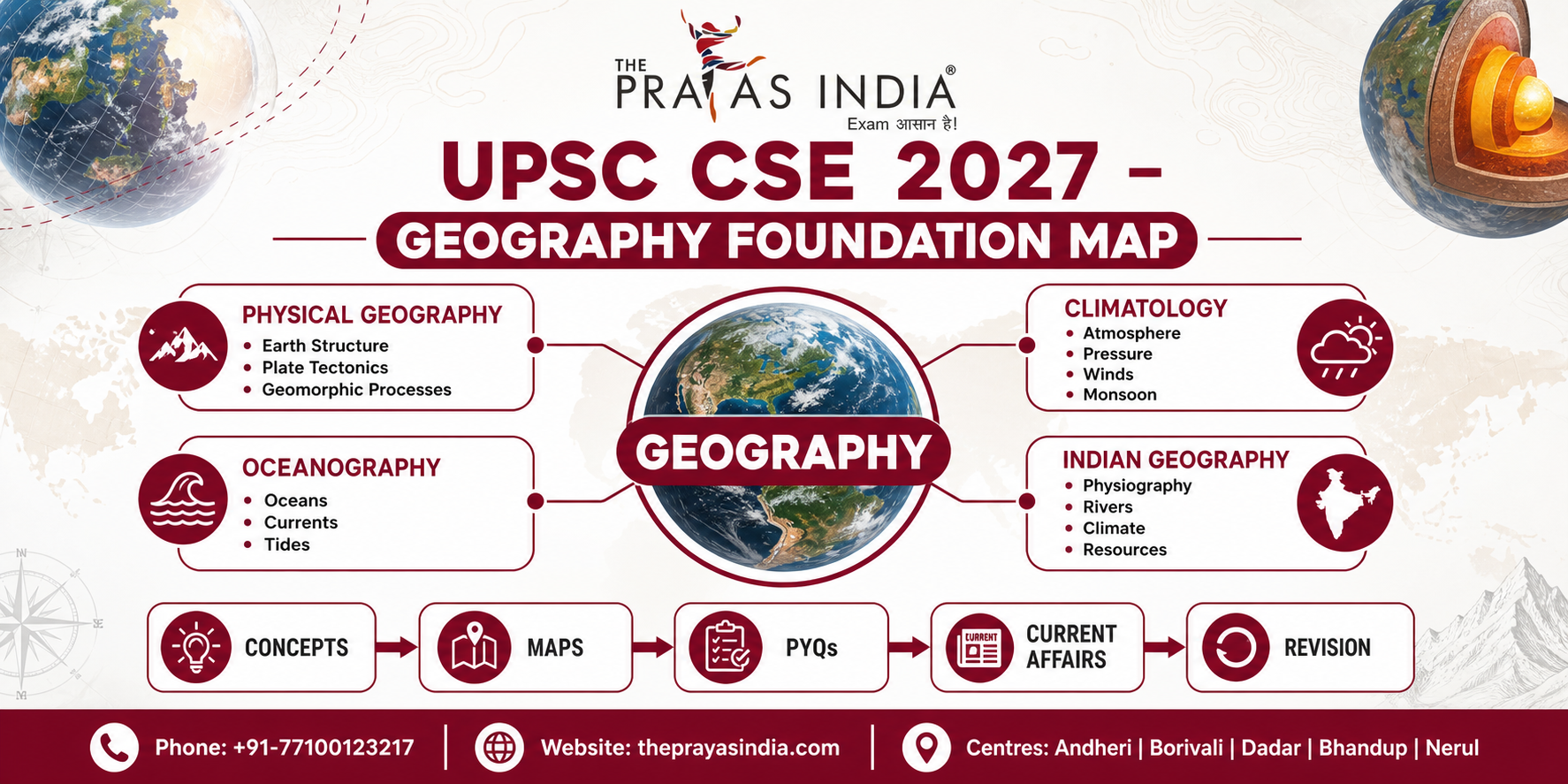
Physical Geography
This includes the basic processes that shape the Earth and its atmosphere.
Important areas include:
- Structure of the Earth
- Plate tectonics
- Continental drift
- Earthquakes
- Volcanoes
- Rocks and minerals
- Geomorphic processes
- Weathering
- Erosion
- Landforms
- Rivers
- Glaciers
- Oceans
- Ocean currents
- Atmosphere
- Temperature
- Pressure belts
- Winds
- Monsoon
- Cyclones
- Climate
- El Niño and La Niña
- Natural hazards
Indian Geography
Indian Geography should be studied in an integrated manner.
Important areas include:
- Physiographic divisions of India
- Himalayas
- Northern Plains
- Peninsular Plateau
- Coastal Plains
- Islands
- Major rivers and drainage systems
- Indian climate
- Indian monsoon
- Soils
- Natural vegetation
- Agriculture
- Irrigation
- Mineral resources
- Energy resources
- Industries
- Transport
- Population
- Urbanisation
- Regional development
- Disaster-prone regions
World Geography
World Geography requires a combination of concepts and maps.
Focus on:
- Continents
- Major mountain systems
- Plate boundaries
- Important rivers
- Deserts
- Grasslands
- Climatic regions
- Ocean currents
- Important seas and gulfs
- Straits and channels
- Resource-rich regions
- Major agricultural regions
- Industrial regions
- Important ports and trade routes
Human and Economic Geography
These areas become particularly useful for connecting Geography with Mains GS-I and current affairs.
Study:
- Population distribution
- Population growth
- Migration
- Demographic transition
- Urbanisation
- Settlement patterns
- Resources
- Agriculture
- Industries
- Transport
- Trade
- Regional development
- Resource-based industries
- Industrial location factors
The important point is to understand the relationship between these areas rather than treating them as isolated chapters.
Step 2: Build Your Physical Geography Foundation
Physical Geography should generally be your starting point because it provides the conceptual foundation for understanding many other areas.
For example, if you understand atmospheric pressure, wind movement and ocean temperatures, understanding monsoons becomes easier. If you understand plate tectonics, earthquakes, volcanoes and mountain formation become easier to connect.
Start With the Earth
Begin with:
- Interior structure of the Earth
- Crust, mantle and core
- Lithosphere and asthenosphere
- Continental drift
- Plate tectonics
- Types of plate boundaries
- Seafloor spreading
- Subduction
- Earthquakes
- Volcanoes
Do not simply memorise definitions.
Ask questions such as:
Why are earthquakes concentrated in particular regions?
Why are volcanoes common along some plate boundaries?
Why are young fold mountains associated with tectonic activity?
This approach converts Geography from a factual subject into a logical subject.
Study Geomorphic Processes
Next, understand the processes responsible for creating and modifying landforms.
Focus on:
- Weathering
- Erosion
- Transportation
- Deposition
- River action
- Wind action
- Glacial action
- Coastal processes
- Karst processes
Then connect these processes with landforms such as:
- Valleys
- Waterfalls
- Meanders
- Oxbow lakes
- Floodplains
- Deltas
- Alluvial fans
- Sand dunes
- Moraines
- Caves
- Cliffs
- Beaches
Instead of learning these as independent facts, understand the process → landform relationship.
Step 3: Master Climatology Instead of Memorising Weather Facts
Climatology is one of the most important areas of Geography because it connects directly with the Indian monsoon, agriculture, disasters, environment and current affairs.
Begin with the basics:
- Composition of atmosphere
- Layers of atmosphere
- Insolation
- Heat budget
- Temperature distribution
- Atmospheric pressure
- Pressure belts
- Planetary winds
- Local winds
- Humidity
- Clouds
- Precipitation
- Jet streams
- Air masses
- Fronts
- Cyclones
Once these concepts are clear, move towards global climate systems and the Indian monsoon.
Understanding the Indian Monsoon
Do not prepare the monsoon merely as a collection of facts.
Understand the mechanisms behind:
- Differential heating of land and sea
- Seasonal reversal of winds
- Inter-Tropical Convergence Zone
- Jet streams
- Tibetan Plateau
- Mascarene High
- Arabian Sea branch
- Bay of Bengal branch
- Retreating monsoon
- Western disturbances
- El Niño
- La Niña
- Indian Ocean Dipole
Then connect these concepts with current affairs.
For example, if an El Niño event is discussed in the news, your preparation should allow you to understand its possible relationship with atmospheric and oceanic conditions rather than simply remembering its name.
Step 4: Use Maps as a Daily Geography Tool
Map work is not an additional activity that should be postponed until the final months. It should become part of your daily Geography preparation.
Keep an atlas beside you while studying.
Whenever you encounter a geographical location in a book, newspaper or current-affairs material, locate it on the map.
Important Map Categories
Physical Features
Mark:
- Mountain ranges
- Plateaus
- Deserts
- Rivers
- Lakes
- Seas
- Gulfs
- Straits
- Islands
- Important passes
India
Pay particular attention to:
- Himalayan ranges
- Major rivers
- River origins
- Tributaries
- Deltas
- Important lakes
- Coastal regions
- Mineral belts
- Major agricultural regions
- National parks and important ecological regions
World
Track:
- Major mountain ranges
- Deserts
- Important rivers
- Conflict or strategically important geographical regions
- Major straits
- Important seas and gulfs
- Resource-rich regions
- Major ports
- Important islands
The 10-Minute Map Rule
A practical approach is to spend approximately 10 minutes a day on map-based revision.
You can take one region at a time rather than attempting the entire world map every day.
For example:
Monday: Indian Himalayas
Tuesday: Peninsular rivers
Wednesday: Indian coastal regions
Thursday: West Asia
Friday: Africa
Saturday: Europe and Central Asia
Sunday: Revision
The exact schedule can be adjusted according to your preparation timetable. The purpose is to make geographical locations familiar through repeated exposure.
Step 5: Prepare Indian Geography Through Interconnections
Indian Geography should not be studied as separate chapters such as rivers, soils, agriculture and industries.
Instead, build connections.
For example:
Climate → Soil → Cropping Pattern → Irrigation → Agriculture → Industry → Population → Urbanisation
This approach makes your preparation more useful for both Prelims and Mains.
Physiography of India
Start with the major physical divisions:
- Himalayan Mountains
- Northern Plains
- Peninsular Plateau
- Indian Desert
- Coastal Plains
- Islands
Understand their formation, characteristics and geographical significance.
For the Himalayas, for example, do not restrict your preparation to the names of ranges. Study their relationship with:
- River systems
- Climate
- Biodiversity
- Agriculture
- Tourism
- Natural hazards
- Glaciers
- Water resources
- Human settlements
This makes the topic much easier to revise because one concept supports multiple areas.
Step 6: Study Indian Rivers and Drainage Systems With Maps
Indian drainage is a high-value area for conceptual and map-based preparation.
Divide it into:
Himalayan Drainage
Study:
- Indus system
- Ganga system
- Brahmaputra system
- River origins
- Major tributaries
- Drainage characteristics
- Flooding
- Sedimentation
- Deltas
Peninsular Drainage
Focus on:
- Godavari
- Krishna
- Kaveri
- Mahanadi
- Narmada
- Tapi
- Drainage patterns
- East-flowing and west-flowing rivers
Do not memorise river names in isolation.
Learn their source, direction, tributaries, states covered, major projects, drainage pattern and outlet.
Whenever possible, draw a rough map from memory.
That simple practice can improve both recall and spatial understanding.
Step 7: Connect Geography With Current Affairs
This is one of the most important parts of UPSC Geography preparation.
Static Geography tells you how something works.
Current affairs tell you where, when and why it matters now.
Suppose the news reports a major cyclone. Do not merely note the cyclone’s name.
Ask:
- Where did it form?
- What ocean basin was involved?
- Why did it intensify?
- What atmospheric conditions supported it?
- What was the sea-surface temperature?
- Which coastline was affected?
- What physical features influenced its movement?
- What were its social and economic impacts?
- What disaster-management challenges emerged?
This transforms current affairs into Geography revision.
Topics That Frequently Benefit From Current-Affairs Integration
Keep an eye on developments related to:
- Cyclones
- Earthquakes
- Volcanic eruptions
- Floods
- Droughts
- Heatwaves
- Glacial changes
- Sea-level changes
- Ocean currents
- El Niño and La Niña
- Monsoon variability
- River disputes
- Water resources
- New mineral discoveries
- Critical minerals
- Agricultural geography
- Industrial corridors
- Ports
- New infrastructure projects
- Changing land-use patterns
The goal is not to collect endless newspaper notes. The goal is to identify the geographical concept behind the news.
Step 8: Choose Geography Sources Carefully
A major problem in UPSC preparation is collecting too many resources.
Geography does not require five different books for every topic. A better approach is to use a limited number of sources repeatedly.
Your resource structure can include:
1. Basic School-Level Geography
Use NCERT-level material to develop foundational concepts.
Pay attention to:
- Physical Geography
- Indian Geography
- Human Geography
- Resources
- Agriculture
- Industries
- Population
- Maps
2. One Standard Geography Source
Choose one reliable standard source for systematic coverage of physical and Indian Geography.
The objective is not to read multiple books simultaneously.
3. Atlas
Use an atlas consistently rather than treating it as a reference book that stays unused on your shelf.
4. Current Affairs
Use one consistent current-affairs source and extract only geographically relevant information.
5. UPSC Previous Year Questions
PYQs should be treated as an essential preparation source, not merely as a final-stage test.
The UPSC officially publishes previous question papers, including Civil Services Preliminary General Studies papers.
Step 9: Learn How to Make Geography Notes
Good Geography notes should be visual, concise and connected.
Avoid writing long paragraphs copied directly from books.
Instead, use:
- Flowcharts
- Diagrams
- Maps
- Tables
- Cause-and-effect chains
- Short comparisons
- Keywords
- Examples
For example:
Monsoon Notes
Land-Sea Heating Difference
↓
Pressure Changes
↓
Seasonal Wind Reversal
↓
Moisture Transport
↓
Orographic Effect
↓
Rainfall Distribution
This is much easier to revise than several pages of continuous text.
Maintain a Separate Map Notebook
You can also maintain a dedicated Geography map notebook containing:
- Important rivers
- Mountain ranges
- Passes
- Minerals
- Agricultural regions
- Industrial regions
- Ports
- Islands
- Important world locations
- Current-affairs locations
The notebook should be designed for quick revision rather than detailed theory.
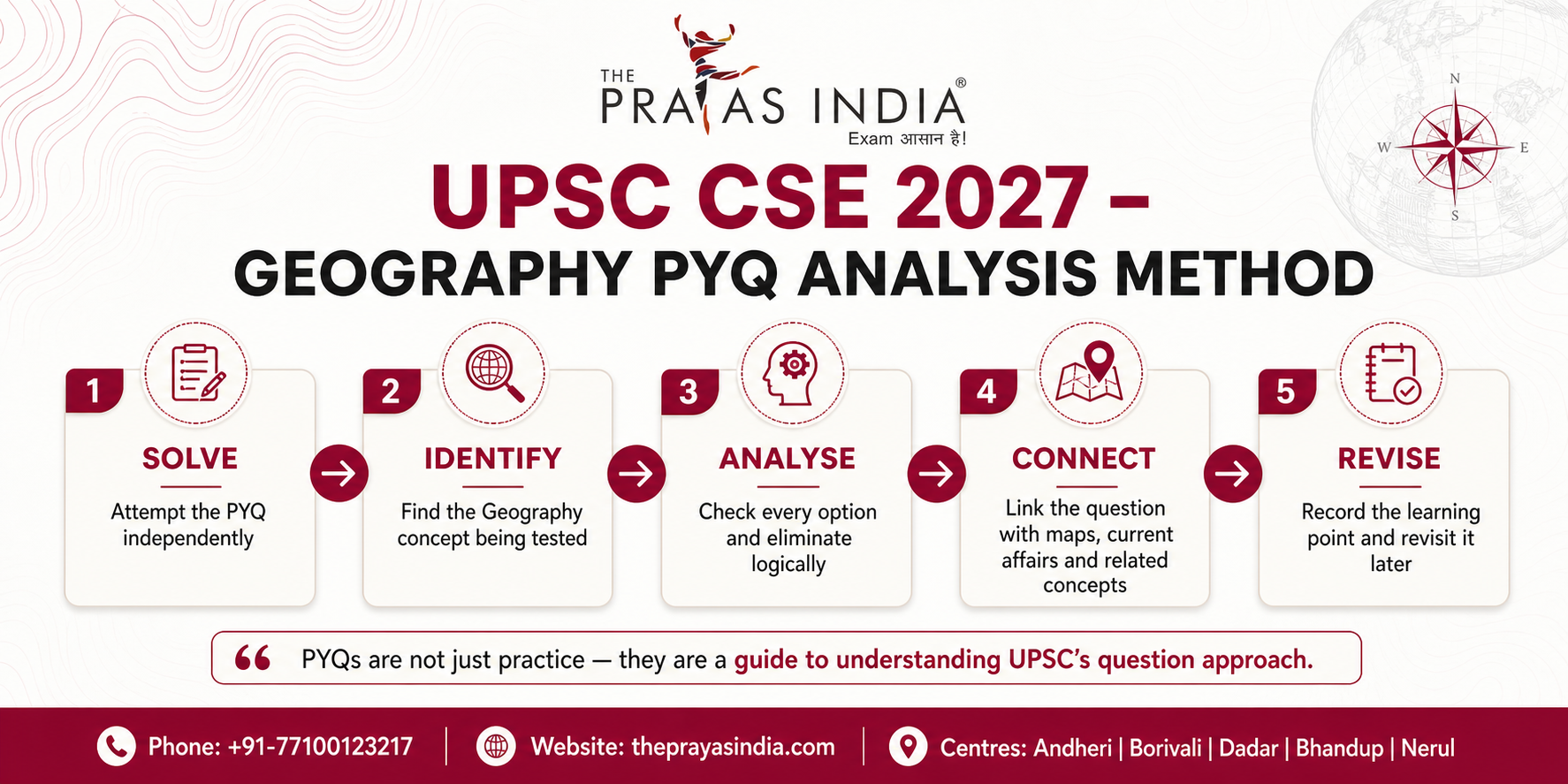
Step 10: Use Previous Year Questions to Understand UPSC’s Approach
Reading the syllabus tells you what UPSC officially includes. PYQs help you understand how that knowledge can be tested.
After completing a Geography topic, solve relevant previous year questions.
Do not simply check the answer.
Analyse:
What concept was tested?
Was the question factual or conceptual?
Was a map involved?
Were multiple statements used?
What made the incorrect options incorrect?
Can the same concept be tested differently?
This analysis is particularly important because UPSC questions often require conceptual application rather than direct textbook reproduction.
A good PYQ practice method is:
First Attempt
Solve the question without referring to notes.
Second Stage
Check the correct answer and analyse all options.
Third Stage
Return to the relevant concept.
Fourth Stage
Write down only the important learning point.
Fifth Stage
Revisit the question during revision.
This converts PYQs into a learning tool.
How to Approach Geography Differently for Prelims and Mains
Although the same foundational knowledge supports both stages, your approach should be different.
For Prelims
Focus more on:
- Conceptual clarity
- Maps
- Location-based facts
- Physical geography
- Indian geography
- Current geographical events
- Elimination techniques
- PYQs
- Objective practice
- Rapid revision
Prelims preparation should make you capable of recognising relationships and eliminating incorrect statements.
For Mains
The focus becomes more analytical.
You should be able to explain:
- Causes
- Processes
- Impacts
- Regional differences
- Interconnections
- Examples
- Solutions
For example, instead of simply knowing that floods occur in a region, Mains preparation should allow you to discuss the physical and human causes of flooding, its socio-economic consequences and possible mitigation measures.
The official GS-I syllabus explicitly includes physical geography, natural-resource distribution, industrial location factors and geophysical phenomena, making analytical understanding important for Mains preparation.
How to Balance Static Geography and Current Affairs
A common mistake is to spend too much time reading current-affairs compilations without strengthening static concepts.
The better sequence is:
Static Concept → Current Event → Map Location → PYQ/Question Practice → Revision
For example:
Static Topic
Cyclones
Current Event
A major cyclone develops in the Bay of Bengal.
Map Work
Locate the Bay of Bengal, surrounding coastlines and affected regions.
Conceptual Link
Sea-surface temperature + atmospheric conditions + pressure system + wind circulation.
Mains Link
Disaster preparedness, coastal vulnerability, infrastructure and livelihoods.
One current event can therefore revise multiple dimensions of Geography.
Common Mistakes to Avoid in Geography Preparation
1. Memorising Without Understanding
Geography becomes difficult when every fact is treated separately. Concepts should come first.
2. Ignoring Maps
Aspirants often read hundreds of pages but spend very little time locating places on maps.
Make map practice a regular part of your preparation.
3. Collecting Too Many Books
Multiple sources often create duplication rather than better understanding.
Choose limited sources and revise them repeatedly.
4. Ignoring Current Affairs
Geography is strongly connected with real-world events. Static preparation alone may leave gaps in application.
5. Delaying PYQs
Do not wait until the last month to solve PYQs. Use them while completing topics.
6. Making Excessively Long Notes
Your notes should reduce revision time, not increase it.
7. Treating Prelims and Mains as Completely Separate
The same conceptual foundation can support both stages. The difference should mainly be in the way you practise and express your knowledge.
What Your Geography Preparation Should Look Like
By the end of your initial preparation phase, you should have five things:
1. A clear conceptual foundation
You should understand major physical and human geography processes.
2. A working knowledge of Indian and World maps
You should be comfortable locating important geographical features.
3. Concise revision notes
Your notes should contain only information that genuinely helps you revise.
4. A PYQ-based understanding
You should know how UPSC has tested geographical concepts.
5. A current-affairs connection
You should be able to connect geographical concepts with contemporary events.
This combination is far more useful than simply completing a Geography book.
Key Summary
A strong UPSC CSE 2027 Geography strategy should begin with the syllabus and then move systematically from concepts to maps, PYQs and current affairs.
Start with Physical Geography because it provides the foundation for understanding climate, oceans, landforms and natural hazards. Move to Indian Geography and develop an integrated understanding of physiography, rivers, climate, agriculture, resources and industries. At the same time, use maps regularly and connect current events with static concepts.
Most importantly, avoid treating Geography as a subject that can be completed through one reading. The real improvement comes through repeated revision, map practice, PYQ analysis and application.
Step 11: Prepare Indian Resources and Economic Geography
After completing Physical Geography and the basic framework of Indian Geography, move towards resources and economic activities. This portion becomes particularly useful because Geography overlaps with Economy, Environment, Agriculture, Infrastructure and current affairs.
Do not prepare resources simply by making lists of locations. Try to understand the geographical reasons behind their distribution.
Mineral Resources
Important areas include:
- Iron ore
- Manganese
- Bauxite
- Copper
- Mica
- Limestone
- Coal
- Petroleum
- Natural gas
- Critical and strategic minerals
For every major mineral, try to understand:
Where is it found? → Why is it found there? → How is it extracted? → Where is it processed? → What industries depend on it?
This approach makes resource geography much easier to remember.
For example, instead of memorising mineral-producing states independently, connect geological structure with mineral distribution and then connect mineral availability with industrial location.
Energy Resources
Prepare both conventional and emerging energy sources.
Focus on:
- Coal
- Petroleum
- Natural gas
- Hydropower
- Solar energy
- Wind energy
- Nuclear energy
- Biomass
- Geothermal energy
- Tidal and ocean energy
- Green hydrogen-related developments
Current affairs should be integrated here. If a new energy project, mineral discovery, transmission corridor or renewable-energy initiative appears in the news, locate it on the map and understand its geographical significance.
Step 12: Study Indian Agriculture Geographically
Agriculture should not be prepared as a collection of crop names.
Understand the relationship between:
Climate + Soil + Water + Relief + Temperature + Technology + Markets = Agricultural Pattern
For major crops, study:
- Temperature requirements
- Rainfall requirements
- Soil conditions
- Major producing regions
- Irrigation dependence
- Cropping seasons
- Major challenges
- Important agricultural developments
Major Cropping Areas
Pay attention to:
- Rice
- Wheat
- Maize
- Millets
- Pulses
- Cotton
- Sugarcane
- Tea
- Coffee
- Rubber
- Jute
- Oilseeds
- Fruits and horticultural crops
Understand Kharif, Rabi and Zaid cropping patterns and connect them with India’s climatic conditions.
Agriculture and Current Affairs
Agriculture-related news can be converted into Geography preparation.
For example, if a particular crop is in the news because of changing production, exports, rainfall or government policy, ask:
- Which regions produce it?
- What climate does it require?
- What soil is suitable?
- Is irrigation important?
- What geographical factors affect productivity?
- Which regions are expanding or losing production?
- How could climate variability affect the crop?
This converts a current-affairs topic into a multi-dimensional Geography topic.
Step 13: Understand Industrial Location
Industrial Geography is particularly useful for Mains because the location of industries can be explained through multiple geographical and economic factors.
When studying an industry, ask:
Why is the industry located there?
Possible factors include:
- Raw materials
- Labour
- Power
- Water
- Transport
- Markets
- Capital
- Technology
- Government policy
- Ports
- Infrastructure
- Agglomeration advantages
For example, a port-based industry may benefit from access to imported raw materials and export markets, while a resource-oriented industry may locate closer to the source of its raw material.
Study major industrial sectors such as:
- Iron and steel
- Textiles
- Cement
- Automobile
- Petrochemicals
- Food processing
- Electronics
- Pharmaceuticals
- Information technology
Do not focus only on memorising industrial locations. Understand the factors responsible for industrial location because the same framework can be applied to unfamiliar examples.
Step 14: Cover Population, Migration and Urbanisation
Population Geography connects Geography with Society, Economy and governance.
Important areas include:
- Population distribution
- Population density
- Population growth
- Demographic transition
- Fertility
- Mortality
- Migration
- Internal migration
- Urbanisation
- Rural-urban transition
- Megacities
- Urban challenges
- Regional disparities
For India, understand why population distribution is uneven.
Consider:
- Relief
- Climate
- Water availability
- Soil
- Agriculture
- Employment
- Industrialisation
- Infrastructure
- Historical development
Urbanisation
Urbanisation should be studied beyond definitions.
Understand issues such as:
- Urban sprawl
- Housing
- Traffic congestion
- Pollution
- Waste management
- Water supply
- Heat islands
- Informal settlements
- Urban flooding
- Infrastructure pressure
These themes can also be connected with Environment, Disaster Management and Governance.
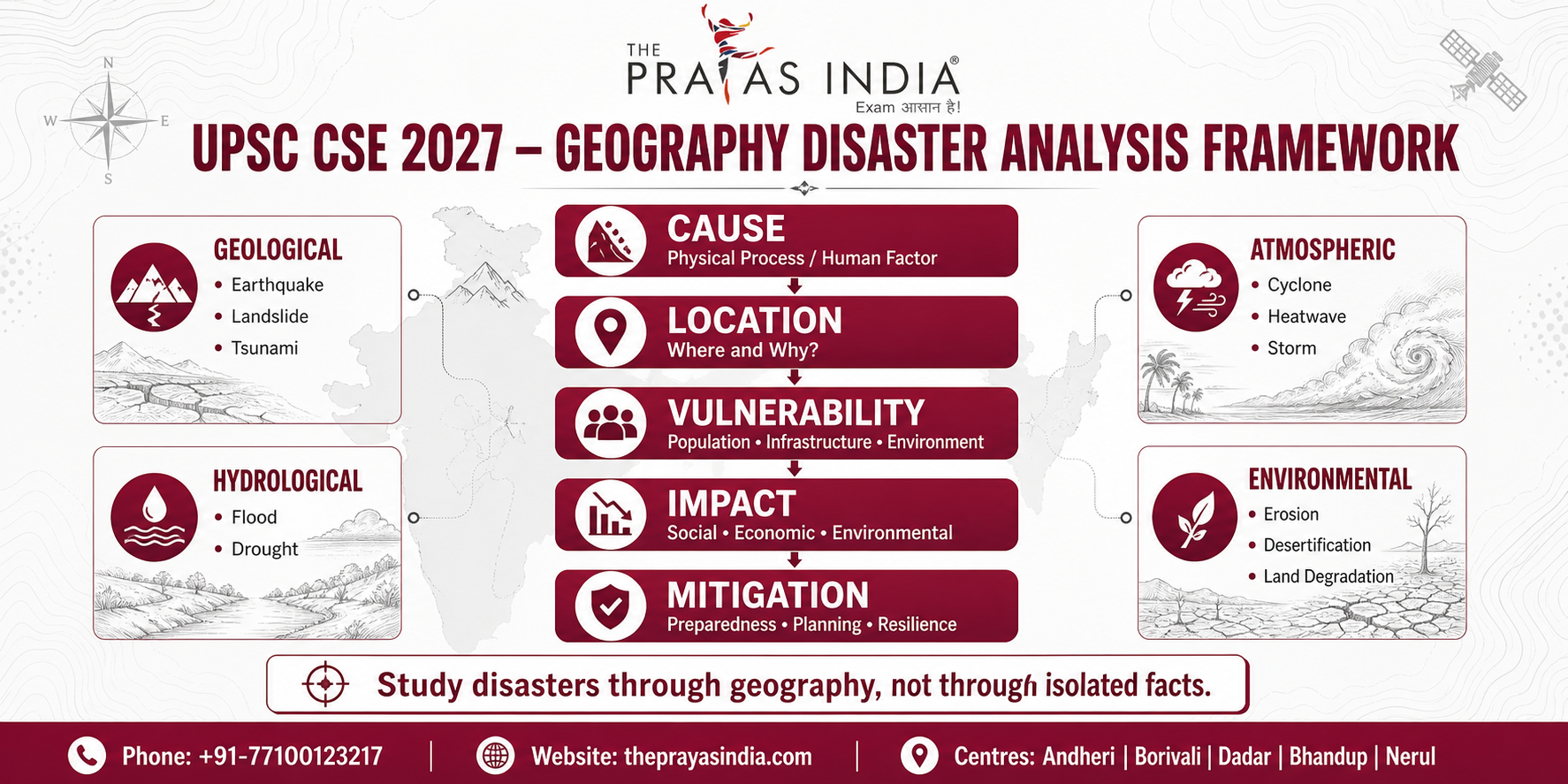
Step 15: Prepare Disaster Geography Through Causes and Spatial Patterns
Disaster-related Geography is highly interconnected with Physical Geography.
Instead of memorising disasters separately, classify them according to their physical processes.
Geological Hazards
- Earthquakes
- Volcanic eruptions
- Landslides
- Tsunamis
Atmospheric and Hydrological Hazards
- Cyclones
- Floods
- Droughts
- Heatwaves
- Cloudbursts
Human-Environment Interactions
- Land degradation
- Desertification
- Coastal erosion
- Urban flooding
- Water stress
For every disaster, understand:
Cause → Location → Vulnerability → Impact → Preparedness → Mitigation
For example, earthquake preparation should not end with knowing the definition of an earthquake. You should understand plate boundaries, seismic zones, vulnerable regions, building vulnerability and disaster preparedness.
This approach is useful for both Prelims and Mains.
Step 16: Integrate Geography With Other UPSC Subjects
One of the biggest advantages of Geography is its overlap with several parts of the UPSC syllabus.
Geography + Environment
Connect:
- Forests
- Biodiversity
- Climate change
- Wetlands
- Coastal ecosystems
- Glaciers
- Desertification
- Ocean ecosystems
Geography + Economy
Connect:
- Resources
- Agriculture
- Industries
- Infrastructure
- Ports
- Logistics
- Energy
- Regional development
Geography + Society
Connect:
- Population
- Migration
- Urbanisation
- Regional disparities
- Human settlements
- Vulnerability
Geography + Disaster Management
Connect:
- Earthquakes
- Floods
- Cyclones
- Landslides
- Droughts
- Coastal hazards
This integrated approach prevents repeated study of the same concepts across different subjects.
Step 17: Create a Geography Revision System
The first reading of Geography creates familiarity. Revision creates retention.
A practical revision system can use three layers.
Revision 1: Concept Revision
After completing a topic, revise the basic concepts.
Ask:
- Can I explain the topic without looking at my book?
- Can I draw the relevant diagram?
- Can I locate important features on a map?
Revision 2: PYQ Revision
Return to questions related to the topic.
Identify:
- Concepts repeatedly tested
- Common traps
- Important factual areas
- Statement-based patterns
Revision 3: Rapid Revision
During the final preparation phase, use:
- Short notes
- Maps
- Diagrams
- Tables
- Error notebook
- Current-affairs connections
The objective should be to reduce the amount of material you need to revisit each time.
Step 18: Maintain a Geography Error Notebook
Your error notebook should contain more than wrong answers.
Divide it into four sections:
Concept Errors
You did not understand the underlying concept.
Factual Errors
You forgot an important geographical fact or location.
Map Errors
You were unable to identify or locate a place correctly.
Question-Interpretation Errors
You knew the topic but misunderstood what the question was asking.
This classification is important because each error requires a different solution.
If you repeatedly make conceptual errors, revise the theory.
If you repeatedly make map errors, increase atlas practice.
If you repeatedly forget facts, improve spaced revision.
If you misread questions, practise more carefully and analyse the wording.
Step 19: Use Mock Tests Strategically
Mock tests should not be used merely to generate a score.
Their primary purpose is to identify weaknesses.
After every Geography test, classify questions into:
Correct + Confident
No major action required.
Correct + Guess
Review the concept because the answer may not be reliable.
Incorrect + Concept Known
Analyse the mistake and question wording.
Incorrect + Concept Unknown
Return to the topic and revise it.
Unattempted + Solvable
Identify whether the problem was time, confusion or lack of confidence.
This analysis can reveal weaknesses that normal reading may not expose.
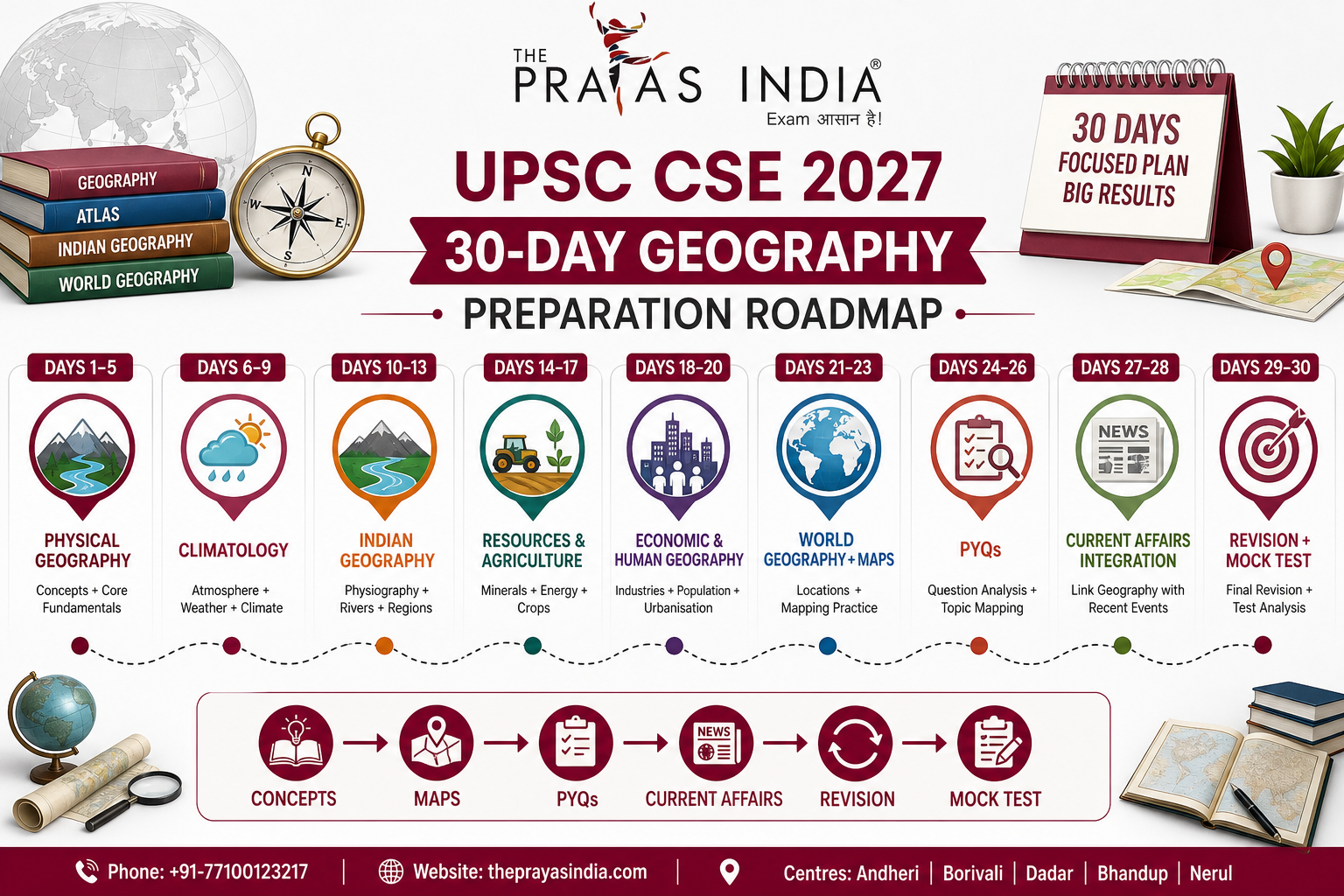
Step 20: Follow a 30-Day Geography Preparation Plan
A 30-day plan can be used either for focused preparation or for systematic revision. The exact number of hours should be adjusted according to your overall UPSC schedule.
Days 1–5: Physical Geography
Cover:
- Earth structure
- Plate tectonics
- Geomorphic processes
- Landforms
- Earthquakes
- Volcanoes
Daily map practice should accompany the theory.
Days 6–9: Climatology
Study:
- Atmosphere
- Temperature
- Pressure
- Winds
- Humidity
- Clouds
- Precipitation
- Cyclones
- Jet streams
- Monsoon
- El Niño and La Niña
Days 10–13: Indian Geography
Focus on:
- Physiography
- Himalayas
- Northern Plains
- Peninsular Plateau
- Coastal regions
- Islands
- River systems
- Indian climate
- Soils
Days 14–17: Resources and Agriculture
Cover:
- Minerals
- Energy
- Agriculture
- Cropping patterns
- Irrigation
- Major crops
- Resource distribution
Days 18–20: Economic and Human Geography
Study:
- Industries
- Industrial location
- Transport
- Population
- Migration
- Urbanisation
- Regional development
Days 21–23: World Geography and Maps
Revise:
- Mountains
- Rivers
- Deserts
- Climate regions
- Ocean currents
- Important seas and straits
- Resource regions
- Important global locations
Days 24–26: PYQs
Solve topic-wise Geography PYQs.
Do not merely count correct answers. Analyse why each option is correct or incorrect.
The official UPSC website provides previous question papers and should be used as the primary source for authentic PYQs.
Days 27–28: Current Affairs Integration
Revise geographical developments from your current-affairs notes.
Focus on:
- Cyclones
- Earthquakes
- Climate events
- Rivers
- Resources
- Agriculture
- Infrastructure
- Important locations
Day 29: Full Revision
Revise:
- Short notes
- Maps
- Diagrams
- Error notebook
- Important PYQs
Day 30: Geography Mock Test
Take a full-length Geography-focused test and analyse it carefully.
The purpose of Day 30 should not simply be to obtain a score. Use the test to identify the areas requiring another revision cycle.
30-Day Geography Cycle
The entire approach can be simplified into:
LEARN → MAP → PRACTISE → ANALYSE → REVISE
Repeat the cycle rather than treating the 30-day plan as a one-time activity.
Step 21: How Many Hours Should You Study Geography?
There is no universal number of hours that guarantees effective Geography preparation.
Your study time should depend on:
- Whether you are a beginner
- Your existing foundation
- Your overall UPSC timetable
- Whether you are preparing for Prelims or Mains
- Your performance in tests
For a beginner, the priority should be understanding concepts rather than trying to complete a fixed number of chapters every day.
A balanced Geography study session can include:
Concept Study → Map Practice → PYQs → Current Affairs → Revision
Even a relatively short but consistent map-practice session can be valuable when maintained over several months.
Step 22: Geography Preparation for Beginners
If you are starting UPSC Geography from zero, avoid beginning with advanced compilations.
Follow a gradual sequence:
Stage 1: Understand
Build basic concepts through school-level material and introductory resources.
Stage 2: Consolidate
Move to a standard Geography source and connect related concepts.
Stage 3: Visualise
Use maps, diagrams and atlas practice.
Stage 4: Apply
Solve UPSC PYQs and topic-wise questions.
Stage 5: Integrate
Connect Geography with current affairs, Environment, Economy and Disaster Management.
Stage 6: Revise
Repeatedly revise the same limited set of resources.
This progression prevents the common beginner problem of reading advanced material without understanding the fundamentals.
Common Geography Preparation Mistakes to Avoid
Mistake 1: Studying Geography Without a Map
Geography is inherently spatial. Maps should be part of preparation from the beginning.
Mistake 2: Memorising Every Fact
UPSC preparation requires prioritisation. Focus on concepts, recurring themes, important locations and current relevance.
Mistake 3: Ignoring Physical Geography
Physical Geography provides the foundation for understanding climate, rivers, disasters, agriculture and many environmental issues.
Mistake 4: Treating Current Affairs as Separate Notes
Current geographical events should be connected with static concepts.
Mistake 5: Solving PYQs Without Analysis
A score alone does not tell you why you made mistakes.
Mistake 6: Reading Too Many Sources
Limited resources with multiple revisions are generally easier to manage than a large collection of incomplete resources.
Mistake 7: Ignoring Mains Application
Even when preparing primarily for Prelims, understanding causes, impacts and geographical relationships creates stronger conceptual knowledge.
Final Geography Preparation Strategy for UPSC CSE 2027
A successful Geography preparation framework can be built around six pillars:
1. Syllabus
Know exactly what UPSC expects from Geography.
2. Concepts
Build a strong foundation in Physical, Indian, World, Human and Economic Geography.
3. Maps
Develop spatial awareness through regular atlas and map practice.
4. Current Affairs
Connect geographical developments with static concepts.
5. PYQs
Use previous questions to understand how UPSC applies geographical knowledge.
6. Revision and Testing
Repeated revision and mock-test analysis should become part of the preparation cycle.
The objective should not be to finish Geography once. The objective is to reach a stage where you can understand a geographical phenomenon, locate it, explain its causes, connect it with current affairs and apply the concept to a UPSC question.
A Simple Daily Geography Routine
If Geography is your primary subject for the day, a practical routine can look like this:
Session 1 – Concept Building
Study one major topic and focus on understanding rather than copying notes.
Session 2 – Map Practice
Locate relevant physical features, regions and current-affairs locations.
Session 3 – PYQs
Solve questions related to the topic studied.
Session 4 – Current Affairs
Identify geographical developments and connect them to static concepts.
Session 5 – Revision
Revise what you studied earlier instead of continuously adding new material.
This approach creates a continuous feedback loop between learning and application.
Final Takeaways
For UPSC CSE 2027, Geography preparation should be approached as an interconnected subject rather than a collection of facts.
Start with Physical Geography and understand the processes shaping the Earth. Build a strong foundation in Indian Geography, particularly physiography, rivers, climate, soils, agriculture and resources. Develop World Geography through maps and spatial understanding. Then connect these concepts with population, industries, urbanisation, disasters and current affairs.
Most importantly, do not separate Geography from maps and PYQs. A concept becomes much easier to retain when you can visualise it geographically and see how UPSC has tested it.
Your preparation cycle should ultimately become:
Concepts → Maps → PYQs → Current Affairs → Mock Tests → Error Analysis → Revision → Re-Test
That cycle is more valuable than repeatedly reading the same material without testing your understanding.
Geography Preparation With The Prayas India
UPSC CSE 2027 preparation requires a structured approach across Prelims and Mains. Geography becomes significantly more manageable when concepts, maps, current affairs, PYQs and revision are brought together instead of being studied independently.
A guided preparation environment can help aspirants maintain consistency, practise regularly and identify areas that need improvement.
For aspirants preparing for UPSC CSE 2027, The Prayas India provides structured preparation support across the Civil Services examination journey.
Admissions are open for UPSC preparation.
UPSC CSE 2027 Geography FAQs
How should I start Geography preparation for UPSC CSE 2027?
Start with the UPSC syllabus and build your foundation through Physical Geography. Gradually cover Indian Geography, World Geography, maps, resources, agriculture, economic geography and current affairs. Regular PYQ practice and revision should be included from the beginning.
Which Geography topics are important for UPSC Prelims?
Important areas include Physical Geography, Climatology, Oceanography, Indian physiography, rivers, climate, soils, agriculture, minerals, energy resources, industries, population, urbanisation, World Geography and important map locations.
Are maps important for UPSC Geography preparation?
Yes. Regular map practice helps you understand the location of mountains, rivers, plateaus, deserts, seas, straits, resources, agricultural regions and important places mentioned in current affairs.
How important are UPSC Geography PYQs?
PYQs are important for understanding how UPSC tests geographical concepts. Analyse not only the correct answer but also the reasoning behind every option and connect the question with the underlying concept and map.
How should I prepare current affairs for Geography?
Connect current events with static Geography. For example, if a cyclone is in the news, study its location, formation, atmospheric conditions, oceanic factors, movement and geographical impact instead of memorising only its name.
Are NCERTs enough for UPSC Geography?
NCERTs can provide a useful foundation, especially for beginners, but a complete preparation strategy should also include a standard Geography source, atlas practice, current affairs, UPSC PYQs, revision and mock tests.
How should I prepare Geography for UPSC Mains?
For Mains, focus on causes, processes, impacts, regional variations and solutions. Practise using maps, diagrams, examples and structured explanations while connecting Geography with Environment, Economy, Agriculture and Disaster Management.
Can I prepare UPSC Geography in 30 days?
A 30-day plan can be useful for focused revision or structured preparation, depending on your starting level. The plan should include concepts, maps, PYQs, current affairs, mock tests and repeated revision rather than only reading new material.
Prepare for UPSC CSE 2027 with a Structured Geography Strategy
Build stronger Geography preparation with conceptual learning, map practice, UPSC PYQs, current-affairs integration, revision and regular test practice.
Visit The Prayas India Centres
The Prayas India | UPSC CSE Preparation