Best IAS Coaching Institutes in Navi Mumbai: A Complete Guide to Choosing the Right UPSC Coaching
Introduction
Preparing for the UPSC Civil Services Examination (CSE) is a dream shared by lakhs of aspirants across India. Every year, candidates dedicate months—and often years—to preparing for one of the country’s most competitive examinations, hoping to earn a place in prestigious services such as the IAS, IPS, IFS, and other Central Civil Services.
However, succeeding in UPSC requires much more than completing a syllabus. Aspirants must develop conceptual clarity, analytical thinking, answer-writing skills, current affairs awareness, and the discipline to stay consistent over a long preparation cycle. This is where the role of a well-structured coaching institute becomes important.
While self-study remains an effective path for many candidates, a quality coaching institute can provide the right direction, reduce unnecessary confusion, and help aspirants prepare in a more organized and examination-oriented manner.
If you’re searching for the Best IAS Coaching Institutes in Navi Mumbai, this guide will help you understand what to look for in a coaching institute, why Navi Mumbai has become a preferred UPSC preparation hub, and how choosing the right guidance can significantly improve your preparation journey.
Why Choosing the Right IAS Coaching Institute Matters
Coaching Is About Direction, Not Dependence
Many aspirants believe that joining a coaching institute guarantees success. Others believe coaching is unnecessary. The reality lies somewhere in between.
A coaching institute cannot replace dedication, discipline, or self-study. What it can do is provide a structured roadmap that saves time, minimizes confusion, and helps students focus on what actually matters for the examination.
The right institute helps aspirants:
Build Strong Fundamentals
A solid understanding of subjects like Polity, History, Geography, Economy, Environment, and Science forms the backbone of UPSC preparation.
Follow a Planned Study Schedule
Instead of studying randomly, students learn according to a systematic academic calendar that covers the syllabus in a logical sequence.
Practice Consistently
Regular mock tests, assignments, and answer-writing exercises help students evaluate their progress and identify areas that need improvement.
Stay Motivated
Preparing for UPSC is a marathon, not a sprint. Continuous mentorship and academic guidance help aspirants maintain consistency throughout the preparation journey.
Understanding the UPSC Civil Services Examination
Why UPSC Is Different from Other Competitive Exams
Unlike many competitive examinations that focus primarily on factual knowledge, UPSC evaluates a candidate’s ability to think critically, analyse issues from multiple perspectives, and make balanced decisions.
The examination is conducted in three stages, each assessing different skills.
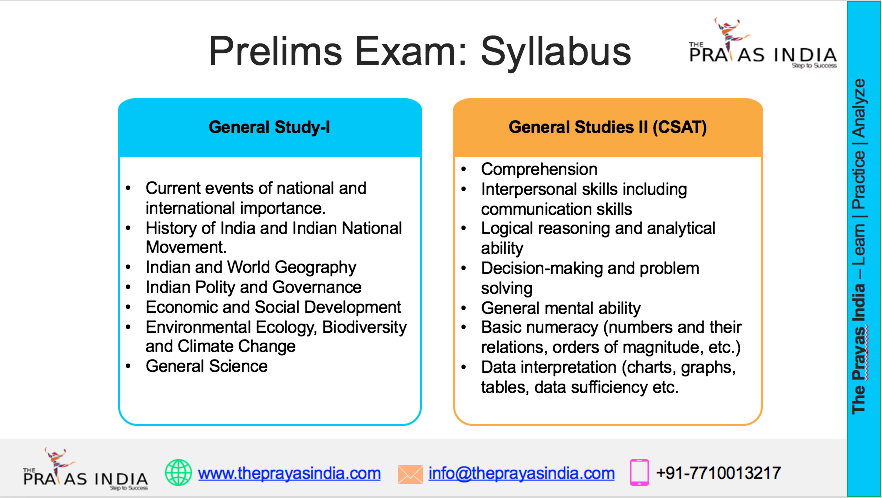
Preliminary Examination
The Preliminary Examination is an objective-type screening test that checks conceptual clarity, factual understanding, and decision-making under time constraints.
Focus Areas
- General Studies
- Current Affairs
- CSAT
- Previous Year Questions (PYQs)
- Mock Test Practice
Aspirants need both speed and accuracy to clear this stage.
Main Examination
The Mains Examination is descriptive in nature and demands analytical thinking, structured writing, and deep conceptual understanding.
Skills Evaluated
- Logical reasoning
- Balanced arguments
- Effective answer writing
- Time management
- Multi-dimensional analysis
A candidate who can communicate ideas clearly often performs better than someone who simply memorizes information.
Personality Test (Interview)
The final stage assesses personality rather than academic knowledge alone.
The Interview Board evaluates:
- Communication skills
- Confidence
- Presence of mind
- Ethical reasoning
- Administrative aptitude
- Awareness of national and international issues
Preparation for the interview begins long before reaching the final stage. Developing confidence and analytical thinking should be part of the overall preparation strategy.
What Should You Look for in an IAS Coaching Institute?
Choosing a coaching institute should never be based only on advertisements or popularity. Instead, aspirants should evaluate the academic quality and support system offered by the institute.
Experienced Faculty
Faculty members play a crucial role in helping students understand complex topics in a simplified manner.
A Good Faculty Team Should
- Explain concepts clearly.
- Connect static subjects with current affairs.
- Teach according to the latest UPSC pattern.
- Encourage analytical thinking instead of rote learning.
Structured Study Plan
One of the biggest advantages of coaching is a planned learning schedule.
A structured study plan generally includes:
Classroom Learning
Subjects are covered in a systematic sequence to ensure complete syllabus coverage.
Revision Sessions
Periodic revision strengthens retention and improves recall during examinations.
Assignments
Practice exercises reinforce classroom learning and encourage self-study.
Performance Tracking
Regular assessments help students monitor their progress and make timely improvements.
Updated Study Material
The quality of study material directly impacts preparation.
A good coaching institute should provide:
Foundation Notes
Easy-to-understand material for beginners.
Subject-Wise Notes
Comprehensive coverage aligned with the UPSC syllabus.
Current Affairs Material
Regular updates covering important national and international developments.
Practice Questions
Topic-wise and subject-wise questions to strengthen conceptual understanding.
Regular Test Series
Mock tests are essential for measuring preparation and building confidence.
A well-designed test series should include:
Topic-Wise Tests
To evaluate understanding of individual subjects.
Full-Length Mock Tests
To simulate actual examination conditions.
Detailed Feedback
Helping students identify strengths, weaknesses, and areas requiring additional revision.
Personalized Mentorship
Every aspirant faces unique challenges during preparation.
Some struggle with answer writing, while others need help with time management or revision planning.
Mentorship provides personalized guidance that helps students stay focused, improve steadily, and overcome preparation challenges more effectively.
Why Navi Mumbai Is Becoming a UPSC Preparation Hub
Over the last few years, Navi Mumbai has emerged as a preferred destination for UPSC aspirants due to its excellent infrastructure, educational environment, and connectivity.
Students from Nerul, Vashi, CBD Belapur, Seawoods, Kharghar, Panvel, Airoli, Ghansoli, Sanpada, Turbhe, and nearby areas can access quality coaching without spending several hours commuting every day.
A shorter commute offers significant advantages:
More Time for Preparation
Students can dedicate additional hours to revision, answer writing, newspaper reading, and mock test practice.
Better Study-Life Balance
Reduced travel fatigue helps maintain consistency throughout the long preparation cycle.
Access to Academic Resources
Navi Mumbai offers a growing ecosystem of libraries, study spaces, and coaching institutes that support serious aspirants.
Key Takeaways
- UPSC preparation requires consistency, strategy, and conceptual clarity.
- Coaching should support self-study—not replace it.
- Experienced faculty, structured planning, mentorship, and regular testing are essential factors while selecting a coaching institute.
- Navi Mumbai has become an excellent location for Civil Services preparation because of its accessibility and academic ecosystem.
- Choosing the right coaching institute is one of the most important investments in your UPSC journey.
Why The Prayas India is Among the Best IAS Coaching Institutes in Navi Mumbai
Choosing an IAS coaching institute is one of the most important decisions an aspirant makes during the UPSC preparation journey. While determination and self-study remain the foundation of success, the right coaching institute provides structure, expert guidance, accountability, and a competitive learning environment.
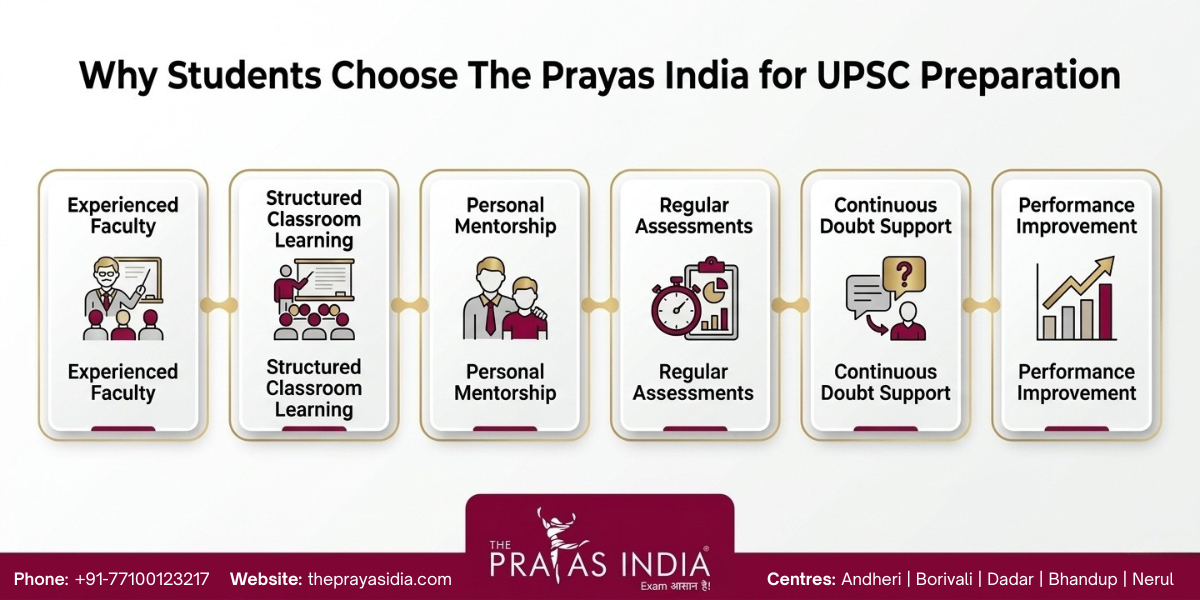
Among the various coaching institutes available in Navi Mumbai, The Prayas India has earned the trust of aspirants by focusing on conceptual learning, academic discipline, continuous mentorship, and examination-oriented preparation. Instead of promoting shortcut techniques, the institute emphasizes building a strong foundation that helps students perform confidently in every stage of the Civil Services Examination.
Whether you are a beginner, a working professional, or a repeat aspirant, understanding what differentiates a coaching institute can help you make a well-informed decision.
A Student-First Learning Approach
Every UPSC Aspirant Has Different Requirements
No two students prepare in the same way.
Some candidates require help understanding the basics of Polity or Economy, while others struggle with answer writing, revision planning, or maintaining consistency. A standardized teaching approach often fails to address these individual challenges.
The Prayas India follows a student-centric methodology where academic guidance is designed around the learner’s needs rather than expecting every student to adapt to a single pace.
Strong Foundation Before Advanced Preparation
Students are first encouraged to develop conceptual clarity before moving toward advanced analytical topics required in UPSC Mains.
Continuous Academic Monitoring
Regular classroom interaction and performance reviews help students identify weak areas early and improve them systematically.
Sustainable Preparation Strategy
Instead of encouraging unrealistic study schedules, students learn to build habits that can be maintained consistently throughout the preparation cycle.
Experienced Faculty That Simplifies Complex Concepts
Learning Beyond Memorization
UPSC rewards conceptual understanding and analytical thinking, not rote learning.
Faculty members at The Prayas India focus on helping students understand why a concept is important, how it is connected to the syllabus, and where it can be applied in the examination.
Concept-Based Teaching
Complex topics are broken down into simple explanations that are easier to understand and remember.
Examination-Oriented Perspective
Teaching remains aligned with the latest UPSC syllabus, previous year question trends, and evolving examination patterns.
Real-World Examples
Current affairs, constitutional developments, government initiatives, reports, and contemporary issues are incorporated into classroom discussions to make learning more practical.
Structured Classroom Learning
A Systematic Roadmap for UPSC Preparation
One of the biggest reasons aspirants lose confidence is the absence of a structured study plan.
Random preparation often results in incomplete syllabus coverage and ineffective revision.
At The Prayas India, classroom learning follows a carefully planned academic calendar.
Sequential Subject Coverage
Subjects are taught in a logical order, allowing students to build knowledge progressively.
Scheduled Revision Sessions
Dedicated revision classes reinforce important concepts and improve long-term retention.
Classroom Assignments
Assignments encourage students to apply concepts independently and strengthen self-study habits.
Progress Evaluation
Regular assessments help students monitor preparation and make timely improvements.
A structured academic framework ensures that preparation remains organized throughout the year.
Personalized Mentorship Throughout the Preparation Journey
Guidance Beyond Classroom Lectures
Preparing for UPSC is a long journey filled with challenges, uncertainty, and changing priorities.
Many students require guidance not only for academic concepts but also for planning, motivation, and strategy.
Mentorship helps bridge this gap.
Study Planning
Students receive guidance on creating realistic daily, weekly, and monthly study plans.
Performance Review
Mentors regularly analyse progress and suggest improvements based on classroom performance and mock tests.
Doubt Resolution
Conceptual doubts are addressed promptly so that learning remains uninterrupted.
Motivation & Accountability
Regular interaction encourages students to stay consistent and committed throughout their preparation.
Comprehensive Academic Support
Learning Continues Beyond the Classroom
Effective UPSC preparation extends far beyond daily lectures.
Students need ongoing academic support to reinforce learning and improve steadily.
The Prayas India encourages continuous engagement through multiple learning activities.
Doubt-Solving Sessions
Students receive opportunities to clarify concepts directly with faculty members.
Academic Discussions
Important national and international developments are discussed regularly to strengthen analytical thinking.
Revision Planning
Faculty members help students prepare realistic revision schedules that improve retention.
Performance Analysis
Detailed feedback after assessments enables students to identify mistakes and refine their preparation strategy.
Building Analytical Thinking
Developing the Skills UPSC Actually Tests
UPSC increasingly evaluates a candidate’s ability to analyse issues rather than simply recall facts.
Students are encouraged to develop multidimensional thinking while studying every subject.
Connecting Static Subjects with Current Affairs
Topics from Polity, Economy, Geography, Environment, and International Relations are linked with contemporary developments.
Evidence-Based Arguments
Students learn to support answers using constitutional provisions, committee reports, government initiatives, and authentic examples.
Balanced Perspective
The focus remains on developing objective, well-reasoned answers instead of one-dimensional opinions.
A Disciplined Learning Environment
Consistency Creates Results
One of the defining characteristics of successful UPSC aspirants is consistency.
Rather than depending on occasional bursts of motivation, students are encouraged to build disciplined study habits.
These habits include:
- Daily study planning.
- Regular revision.
- Continuous answer-writing practice.
- Mock test participation.
- Self-evaluation after every assessment.
Such habits not only improve academic performance but also prepare aspirants for the demanding nature of the Civil Services Examination.
Accessible Centres Across Mumbai & Navi Mumbai
The Prayas India has established multiple centres to make quality UPSC coaching accessible to students across Mumbai and Navi Mumbai.
Centres
- Andheri
- Borivali
- Dadar
- Thane
- Nerul
- Bhandup
Students from Vashi, CBD Belapur, Seawoods, Kharghar, Panvel, Airoli, Ghansoli, Sanpada, Turbhe, and nearby locations can conveniently attend classes at the Nerul centre while benefiting from structured academic guidance and continuous mentorship.
Key Takeaways
- A structured coaching environment reduces confusion during UPSC preparation.
- Experienced faculty simplify complex concepts through conceptual teaching.
- Personalized mentorship helps students remain consistent and focused.
- Classroom learning combined with continuous academic support creates a strong preparation ecosystem.
- Discipline, planning, and regular evaluation are essential for long-term success.
Comprehensive Study Material, Test Series & Answer Writing Support for UPSC Success
A well-planned UPSC preparation strategy goes far beyond attending classroom lectures. The real difference between an average preparation journey and an effective one lies in how consistently a student revises concepts, practises questions, writes answers, and analyses performance.
Many aspirants spend months collecting books, downloading PDFs, and following multiple online sources. While having access to information is easier than ever before, managing that information effectively has become one of the biggest challenges in UPSC preparation.
This is where a structured academic ecosystem becomes valuable. Instead of overwhelming students with endless resources, The Prayas India focuses on providing organized study material, continuous evaluation, and practical learning support that helps aspirants prepare according to the latest UPSC Civil Services Examination pattern.
Comprehensive Study Material Designed Around the UPSC Syllabus
Quality Resources Matter More Than Quantity
One of the most common mistakes made by UPSC aspirants is trying to study from too many books simultaneously.
Rather than improving preparation, this usually creates confusion and leaves students with incomplete knowledge across multiple subjects.
A structured coaching programme simplifies this challenge by providing well-organized study material aligned with the UPSC syllabus.
Foundation Material
Beginners are introduced to fundamental concepts through simplified notes that gradually build conceptual clarity.
Subject-Wise Study Notes
Every major General Studies subject is covered in a structured manner, making it easier for students to understand and revise.
Current Affairs Integration
Instead of treating current affairs as a separate subject, important developments are connected with static topics such as Polity, Economy, Geography, Environment, Governance, and International Relations.
Revision-Oriented Content
Study material is designed in a way that makes multiple revisions easier before the examination.
Current Affairs Preparation That Goes Beyond Newspaper Reading
Understanding the ‘Why’ Behind Every Event
Reading newspapers is an essential habit for every UPSC aspirant, but simply reading headlines is not enough.
The examination expects candidates to analyse events, understand their impact, and connect them with the syllabus.
A systematic current affairs programme helps students develop this analytical approach.
Daily News Analysis
Important national and international developments are discussed with an examination-oriented perspective.
Monthly Current Affairs Compilation
Well-organized compilations help students revise important events without depending on scattered resources.
Government Schemes & Policies
Important government initiatives are explained along with their objectives, benefits, challenges, and examination relevance.
Editorial Discussions
Editorials are analysed to help students develop balanced viewpoints and improve answer writing.
Smart Resource Management for Better Productivity
Avoiding Information Overload
Many aspirants spend more time searching for the “best” resources than actually studying them.
A disciplined preparation strategy focuses on mastering limited, reliable resources instead of constantly changing study material.
Students are encouraged to:
Complete One Resource Before Starting Another
This improves conceptual clarity and prevents fragmented preparation.
Revise Multiple Times
Repeated revision is far more effective than reading new books continuously.
Focus on Understanding
UPSC rewards conceptual application rather than memorization.
Analyse Previous Year Questions
Previous Year Questions (PYQs) provide valuable insights into the examination pattern and help students prioritise important topics.
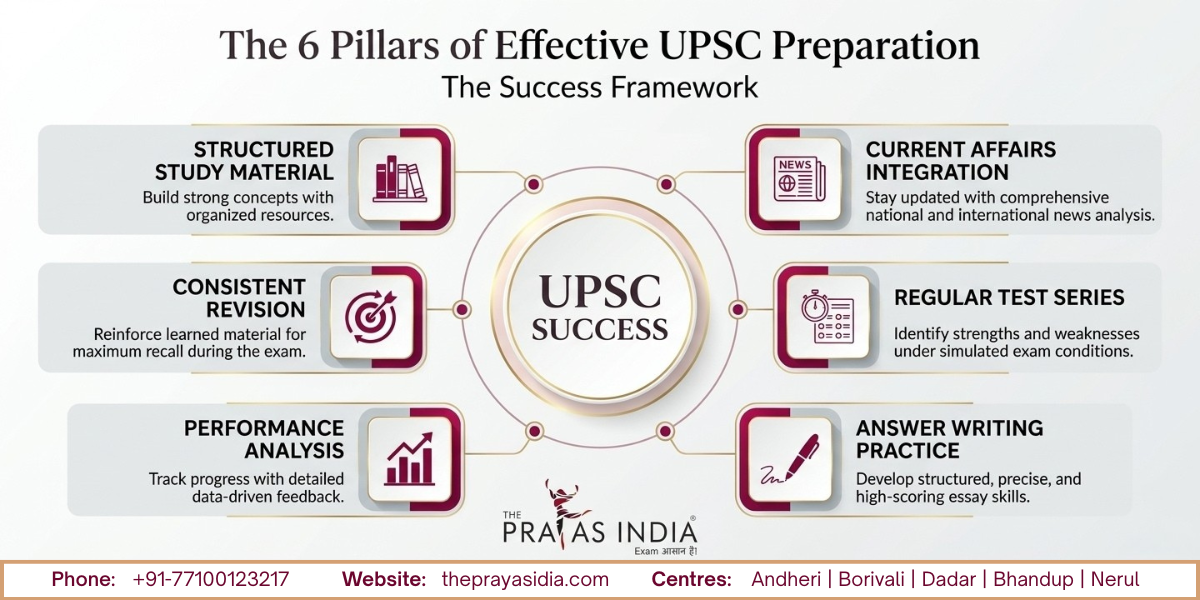
Regular Test Series That Builds Examination Confidence
Why Mock Tests Are Essential
Many aspirants delay taking mock tests until the final months of preparation.
This often leads to poor time management, lack of confidence, and unnecessary examination pressure.
Regular testing helps students evaluate preparation continuously.
Topic-Wise Tests
These tests strengthen understanding of individual subjects.
Sectional Assessments
Students gradually improve performance across broader portions of the syllabus.
Full-Length Prelims Mock Tests
Simulated examination conditions help students improve speed, accuracy, and decision-making.
Mains Practice Tests
Descriptive tests prepare students for structured answer writing under time constraints.
Answer Writing: The Backbone of UPSC Mains Preparation
Knowledge Alone Is Not Enough
Many aspirants possess excellent subject knowledge but fail to score well in the Mains Examination because they struggle to present their ideas effectively.
Answer writing should become a regular habit rather than an activity reserved for the final months.
Understanding the Demand of the Question
Students learn how to interpret directive words such as Discuss, Analyse, Evaluate, and Critically Examine.
Structured Presentation
Well-organized introductions, logical body paragraphs, and meaningful conclusions improve answer quality.
Effective Use of Examples
Constitutional provisions, committee recommendations, reports, and current affairs enrich answers and demonstrate analytical understanding.
Time Management
Regular writing practice helps students complete answers within the prescribed time limit.
Essay & Ethics Preparation
Scoring Well in High-Impact Papers
Essay and Ethics papers often play a decisive role in the final merit list.
These papers require a different preparation strategy compared to factual subjects.
Essay Writing
Students learn how to:
- Interpret the essay topic.
- Create logical outlines.
- Develop balanced arguments.
- Maintain flow throughout the essay.
- Write impactful conclusions.
Ethics Preparation
Students develop ethical reasoning by analysing case studies, administrative dilemmas, and governance-related situations from multiple perspectives.
Performance Analysis That Leads to Continuous Improvement
Learning From Every Test
Writing tests alone does not improve performance.
Real improvement comes from understanding mistakes and making corrective changes.
A structured evaluation system helps students identify:
Strong Areas
Subjects that require only regular revision.
Weak Areas
Topics needing additional conceptual clarity or practice.
Time Management Issues
Students learn where they spend excessive time during examinations.
Revision Priorities
Performance reports help students revise strategically rather than randomly.
Flexible Learning Through Online & Offline Support
Learning Beyond the Classroom
Modern UPSC preparation often combines classroom learning with digital academic support.
This allows students to continue learning even if they occasionally miss classes or require additional revision.
Depending on the programme, students may receive support through:
- Digital study resources.
- Recorded sessions for revision.
- Online assessments.
- Practice assignments.
- Academic updates.
This blended approach makes preparation more flexible without compromising academic quality.
Why Continuous Evaluation Matters
Preparing for UPSC is a long-term process.
Students who regularly assess their progress are generally better positioned to improve before the actual examination.
A preparation ecosystem that combines study material, current affairs, mock tests, answer writing, and performance analysis creates a strong foundation for success.
Instead of focusing only on completing the syllabus, aspirants gradually develop the skills required to perform confidently in every stage of the Civil Services Examination.
Key Takeaways
- Quality study material is more valuable than collecting multiple resources.
- Current affairs should be connected with the static syllabus.
- Mock tests improve confidence, accuracy, and time management.
- Regular answer writing is essential for Mains success.
- Continuous performance analysis helps students improve systematically.
UPSC Preparation Strategy – How to Prepare for Prelims, Mains & Interview Effectively
Preparing for the UPSC Civil Services Examination is not about studying endlessly—it is about following the right strategy at the right time. Every stage of the examination demands a different approach, and aspirants who understand this distinction generally prepare more efficiently than those who study every subject in the same manner.
Many candidates spend months completing books without evaluating whether their preparation matches the actual expectations of the examination. A structured preparation plan helps aspirants balance syllabus completion, revision, answer writing, current affairs, and mock tests without feeling overwhelmed.
This is where experienced academic guidance plays an important role. Instead of preparing in isolation, students benefit from a roadmap that gradually builds confidence and keeps preparation aligned with the latest UPSC pattern.
Preparing for the UPSC Preliminary Examination
Building a Strong Foundation Before the First Stage
The Preliminary Examination is often considered one of the toughest filters in the UPSC selection process. Every year, thousands of well-prepared aspirants miss the cut-off because they underestimate revision, practice, or time management.
Success in Prelims depends on conceptual clarity rather than memorizing isolated facts.
Understand the Syllabus Thoroughly
Before opening any book, aspirants should carefully study the official UPSC syllabus to understand the scope of every subject.
Strengthen Static Subjects
History, Geography, Indian Polity, Economy, Environment, Science & Technology, and Art & Culture should be studied systematically.
Practice Previous Year Questions
Previous Year Questions (PYQs) help aspirants understand the changing trend of UPSC questions and identify high-priority topics.
Solve Mock Tests Regularly
Mock tests improve:
- Accuracy
- Time management
- Question selection
- Elimination techniques
- Confidence under examination pressure
Developing an Effective Strategy for UPSC Mains
Beyond Knowledge—Presentation Matters
Unlike Prelims, the Mains Examination evaluates a candidate’s ability to analyse, organise, and communicate ideas within a limited time.
Many aspirants possess sufficient knowledge but struggle to present their answers effectively.
Learn the Art of Answer Writing
Good answers are:
- Well-structured.
- Analytical.
- Balanced.
- Relevant to the question.
- Supported by facts and examples.
Practice Every Week
Regular writing practice helps students improve speed and clarity while reducing hesitation during the actual examination.
Use Multi-Dimensional Thinking
UPSC appreciates answers that examine an issue from multiple perspectives such as:
- Political
- Economic
- Social
- Environmental
- Ethical
- Administrative
This approach reflects mature decision-making and deeper understanding.
The Importance of Revision in UPSC Preparation
Reading Once Is Never Enough
One of the biggest reasons aspirants struggle during examinations is insufficient revision.
Studying new material continuously without revisiting previously covered topics significantly reduces retention.
An effective revision strategy includes:
Weekly Revision
Revisit important topics studied during the week.
Monthly Revision
Consolidate all major subjects completed during the month.
Subject-Wise Revision
Focus on one subject at a time before integrating multiple subjects.
Current Affairs Revision
Monthly compilations and short notes make revision faster and more efficient.
Consistent revision gradually improves recall and reduces examination anxiety.
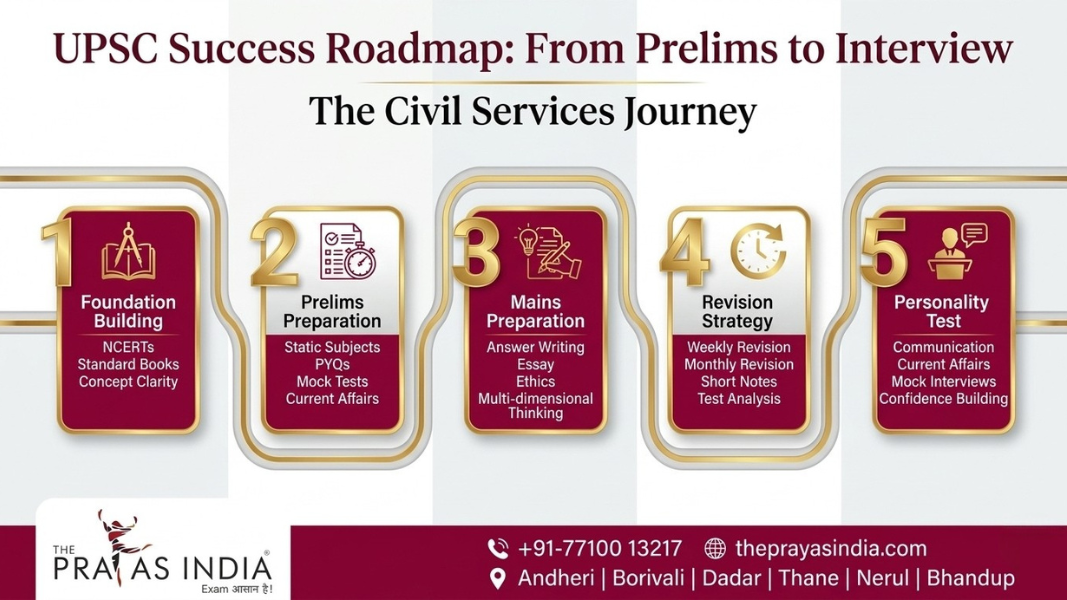
Preparing for the UPSC Personality Test
Personality Matters More Than Memorization
The Personality Test is often misunderstood as an examination of factual knowledge.
In reality, the Interview Board evaluates qualities expected from a future civil servant.
Candidates are assessed on:
Communication Skills
Expressing ideas clearly and confidently.
Decision-Making Ability
Presenting balanced opinions on complex issues.
Ethical Thinking
Demonstrating integrity, empathy, and administrative maturity.
Awareness
Understanding national, international, and socio-economic developments.
Interview preparation should begin well before the final stage by developing analytical thinking and staying updated with current affairs.
Common Mistakes UPSC Aspirants Should Avoid
Small Errors Can Delay Success
Many candidates work extremely hard but unknowingly repeat preparation mistakes that reduce their overall performance.
Depending on Too Many Resources
Collecting books is not the same as studying them.
Mastering a limited number of quality resources is far more effective.
Ignoring Answer Writing
Waiting until after Prelims to start answer writing often leaves insufficient time to develop writing skills.
Skipping Mock Tests
Fear of low scores prevents many aspirants from taking regular mock tests.
However, mock tests are learning tools—not judgement tools.
Lack of Revision
Without revision, even well-understood concepts become difficult to recall during examinations.
Inconsistent Study Routine
Long study hours for a few days followed by extended breaks rarely produce consistent results.
Daily discipline is more valuable than occasional bursts of motivation.
Self-Study vs Coaching: Which Is Better?
There Is No Universal Answer
Many successful candidates have cleared UPSC through self-study, while many others have benefited significantly from structured coaching.
The choice depends on:
Your Academic Background
Beginners often benefit from expert guidance to understand the syllabus and select appropriate resources.
Time Availability
Working professionals may require structured schedules and flexible learning options.
Need for Mentorship
Students who require accountability and regular feedback often perform better within a guided academic environment.
A good coaching institute should enhance self-study rather than replace it.
How Strategic Mentorship Improves Preparation
Guidance at Every Stage
One of the biggest advantages of a structured learning environment is continuous mentorship.
The Prayas India supports aspirants through:
Academic Planning
Helping students create realistic preparation schedules.
Progress Monitoring
Regular performance reviews identify strengths and areas requiring improvement.
Examination Strategy
Faculty members guide students on revision, test attempts, and answer-writing techniques based on individual progress.
Confidence Building
Continuous interaction encourages students to remain motivated throughout the long preparation cycle.
Why a Balanced Strategy Delivers Better Results
UPSC preparation is rarely successful through hard work alone.
Success generally comes from combining:
- Conceptual clarity
- Planned study schedules
- Consistent revision
- Current affairs integration
- Mock tests
- Answer writing
- Mentorship
- Self-evaluation
When these elements work together, aspirants prepare more confidently and improve steadily throughout the examination cycle.
Key Takeaways
- Every stage of UPSC requires a different preparation strategy.
- Regular revision is essential for long-term retention.
- Answer writing should begin early in the preparation journey.
- Mock tests help improve confidence and examination performance.
- Strategic mentorship helps aspirants avoid common preparation mistakes.
Why The Prayas India is a Preferred Choice for UPSC Aspirants in Navi Mumbai – FAQs, Comparison Checklist & Final Thoughts
Choosing an IAS coaching institute is more than selecting a classroom—it is about finding an academic partner that can guide you throughout one of the most challenging examination journeys in India. While determination and self-study remain the foundation of success, the right coaching institute can help aspirants prepare more systematically, avoid common mistakes, and remain consistent from the first day of preparation until the Personality Test.
For students searching for the Best IAS Coaching Institutes in Navi Mumbai, the decision should be based on academic quality, faculty expertise, mentorship, study resources, and long-term support rather than advertisements or promotional claims.
Why Many UPSC Aspirants Choose The Prayas India
A Learning Ecosystem Designed Around Student Success
Over the years, The Prayas India has built a reputation for providing structured UPSC preparation supported by experienced faculty, organized study material, continuous mentorship, and examination-oriented learning.
Rather than encouraging students to depend on numerous books and disconnected resources, the institute focuses on building conceptual clarity and disciplined preparation through a systematic academic approach.
Students preparing with The Prayas India benefit from:
Experienced Faculty
Faculty members simplify complex topics and teach according to the latest UPSC examination trends.
Comprehensive Study Material
Students receive organized resources that simplify revision and reduce unnecessary information overload.
Regular Test Series
Continuous assessments help aspirants evaluate their preparation and improve steadily.
Answer Writing Practice
Students develop the writing skills required to perform confidently in the UPSC Mains Examination.
Personalized Mentorship
Individual guidance helps aspirants plan their preparation, overcome weaknesses, and maintain consistency.
Interview Guidance
Mock interviews and personality development sessions help students prepare for the final stage of the Civil Services Examination.
How to Compare IAS Coaching Institutes Before Taking Admission
Don’t Choose an Institute Based Only on Advertisements
Before enrolling in any UPSC coaching institute, every aspirant should evaluate the institute using objective academic parameters.
| Evaluation Parameter | What You Should Look For |
|---|---|
| Faculty | Experienced teachers with conceptual teaching approach |
| Study Material | Updated, syllabus-oriented and easy to revise |
| Test Series | Regular Prelims & Mains practice with detailed feedback |
| Mentorship | Individual guidance and strategy support |
| Current Affairs | Daily analysis with monthly compilations |
| Answer Writing | Continuous writing practice and evaluation |
| Interview Preparation | Mock interviews and personality development |
| Academic Support | Doubt solving, revision sessions and performance tracking |
Choosing an institute using these parameters is far more reliable than relying on marketing claims alone.
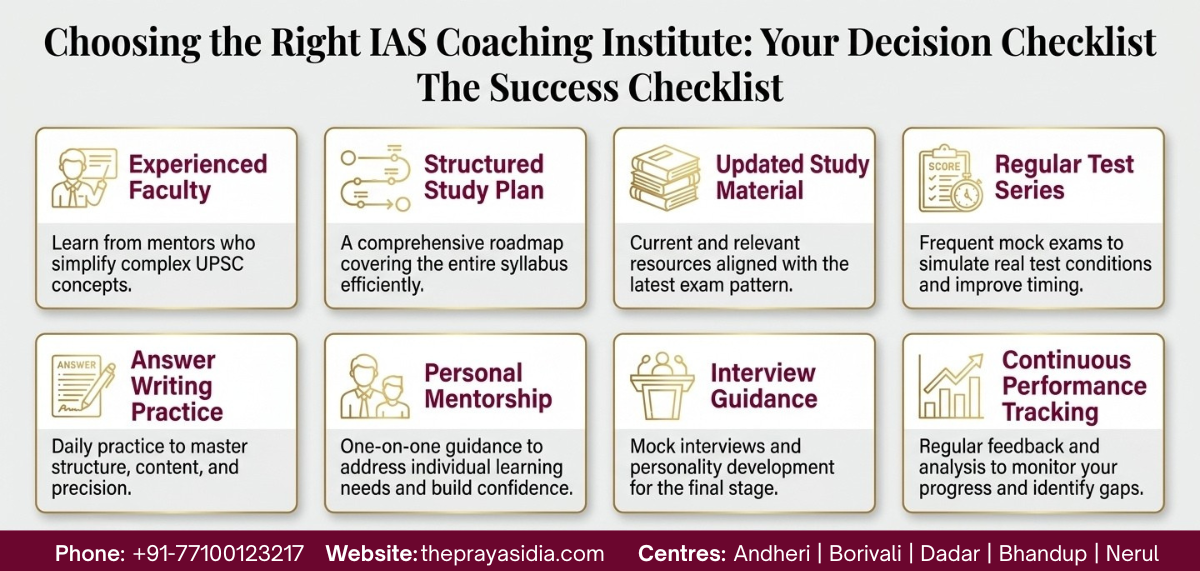
Frequently Asked Questions (FAQs)
Which is the best IAS coaching institute in Navi Mumbai?
The ideal IAS coaching institute is one that offers experienced faculty, structured classroom programmes, updated study material, regular test series, answer-writing practice, mentorship, and interview guidance. Aspirants should compare institutes based on academic quality, student support, and learning methodology rather than promotional claims.
Is coaching necessary to clear the UPSC Civil Services Examination?
No. Coaching is not mandatory to clear UPSC. Many candidates succeed through self-study. However, structured coaching provides guidance, planning, mentorship, and regular evaluation, which can be particularly beneficial for beginners, working professionals, and aspirants looking for a disciplined preparation framework.
When should I start preparing for UPSC?
The ideal time depends on your academic and professional circumstances. Many aspirants begin during graduation, while others start after completing their degree or while working. Starting early generally allows more time for conceptual learning, revision, and answer-writing practice.
Can working professionals prepare for UPSC?
Yes. Many successful Civil Services candidates have prepared while working full-time. A well-planned study schedule, consistent revision, and flexible academic support make it possible to balance work and UPSC preparation.
How important is answer writing for UPSC Mains?
Answer writing is one of the most important aspects of Mains preparation. Regular writing practice improves analytical thinking, presentation, structure, and time management, which significantly influence final scores.
How should beginners start UPSC preparation?
Beginners should first understand the official UPSC syllabus and examination pattern. They should then build a strong foundation through NCERT textbooks, standard reference books, current affairs, and consistent revision before moving to advanced preparation.
How often should I revise during UPSC preparation?
Revision should be a continuous process. Weekly revision, monthly revision, short notes, and regular mock tests help improve retention and examination performance.
Does current affairs matter in every stage of UPSC?
Yes. Current affairs play an important role in the Preliminary Examination, Mains Examination, and Personality Test. Aspirants should focus not only on reading news but also on understanding its relevance to the UPSC syllabus.
Begin Your UPSC Journey with The Right Guidance
Every Civil Services aspirant begins with a dream, but transforming that dream into reality requires planning, discipline, and continuous improvement.
If you are looking for one of the Best IAS Coaching Institutes in Navi Mumbai, The Prayas India offers a comprehensive learning environment designed to support aspirants through every stage of the UPSC Civil Services Examination—from conceptual learning and classroom teaching to answer-writing practice, mock tests, mentorship, and interview guidance.
Whether you are a beginner, a working professional, or preparing for another attempt, choosing the right academic ecosystem can help you prepare with greater confidence and clarity.
Contact The Prayas India
📞 Phone: +91-77100 13217
🌐 Website: theprayasindia.com
📍 Address: F-105 1st Floor, Nerul West Station, Nerul West, Maharashtra 400706
Our Centres
Connect with our academic counsellors to understand the course structure, batch timings, mentorship model, and preparation strategy best suited to your UPSC goals.
Final Thoughts
The UPSC Civil Services Examination is not merely a test of knowledge—it is a test of perseverance, discipline, analytical thinking, and continuous self-improvement.
While success ultimately depends on your dedication, learning within a structured academic environment can make your preparation more focused, organized, and efficient.
With experienced faculty, comprehensive study material, regular assessments, personalized mentorship, and a student-centric learning approach, The Prayas India continues to support aspirants striving to build successful careers in the Civil Services.
If you are committed to achieving your UPSC dream, start your preparation with a clear strategy, stay consistent, and keep improving every day. The journey may be challenging, but with the right guidance and persistent effort, your goal is within reach.