How Does Mentorship Help in UPSC Preparation? | Best UPSC Coaching in Mumbai | The Prayas India
UPSC preparation is often described as a long journey of reading, revising, practising and testing yourself repeatedly. But for many aspirants, the real challenge is not finding enough study material. It is deciding what to study, what to ignore, how much to revise, when to practise answer writing and whether the preparation is actually moving in the right direction. This is where mentorship can become an important part of the preparation process.
A serious UPSC aspirant can spend months studying independently and still remain uncertain about whether the approach is correct. There may be too many books, websites, current affairs sources, test series and strategy videos competing for attention. Without a clear system of prioritisation, preparation can gradually become extensive but unfocused. Mentorship can provide a structured framework within which the aspirant can make better academic decisions.
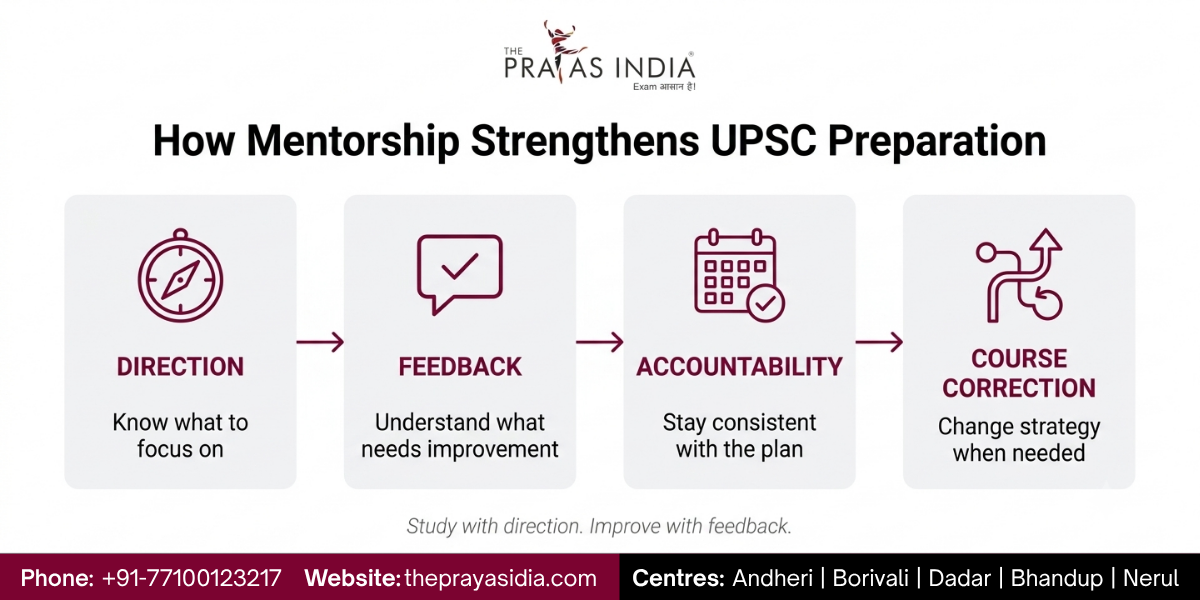
Mentorship does not mean that someone prepares for the examination on the student’s behalf. Its real purpose is to provide direction, feedback, accountability and course correction. A good mentor helps an aspirant understand where they currently stand, what needs improvement and what should be done next. This becomes particularly valuable in UPSC because the examination rewards not just knowledge, but also the ability to apply knowledge within a demanding time and answer-writing framework.
For students considering UPSC coaching in Mumbai, mentorship should therefore be viewed as an important part of the overall preparation ecosystem rather than an additional feature. Classroom learning can provide concepts and content, while mentorship can help the aspirant connect that learning with a practical preparation plan.
UPSC Preparation Is Not Just About Studying More
One of the most common misconceptions among UPSC aspirants is that longer study hours automatically lead to better preparation. In reality, the quality and direction of those hours matter considerably.
An aspirant may spend six hours studying a subject but still struggle to remember important concepts during revision. Another student may read extensively about current affairs without understanding how those issues can be connected with the UPSC syllabus. Someone preparing for Mains may write answers regularly but receive no meaningful feedback about structure, relevance or presentation.
These situations demonstrate why preparation requires more than effort. Effort needs direction.
A mentor can help identify whether the aspirant is spending time on activities that actually contribute to examination readiness. If too much time is being spent on low-priority resources, the mentor can help simplify the approach. If revision is being postponed because the student is constantly trying to complete new material, the mentor can help rebalance the schedule.
The objective is not to make preparation easier. It is to make preparation more purposeful.
The Mentor’s Role in Creating Direction
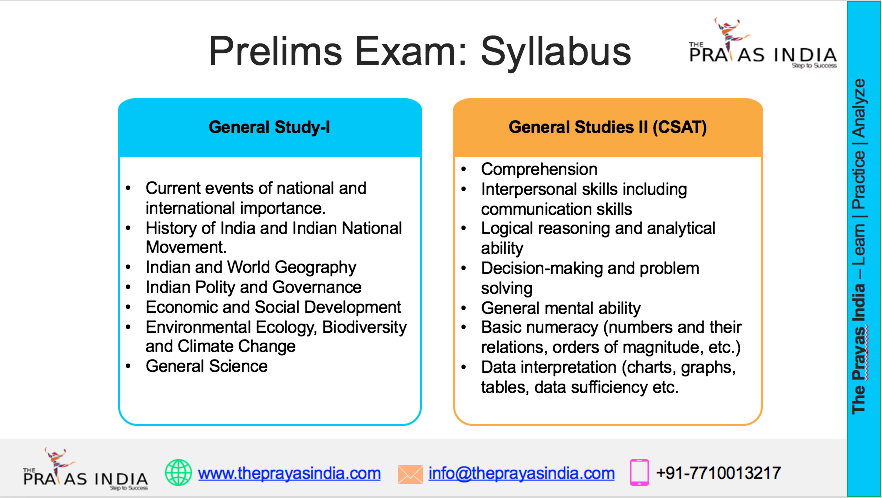
The UPSC syllabus is broad enough to make even disciplined aspirants feel overwhelmed. The challenge becomes particularly visible when students try to prepare for multiple subjects simultaneously while also following current affairs and practising for Prelims and Mains.
A mentor can help convert this broad syllabus into manageable priorities. Instead of approaching the entire examination as one enormous target, the aspirant can work through smaller academic goals with a clear sequence.
For example, a mentor may help a student decide when to focus on foundational concepts, when to increase answer-writing practice, how to integrate current affairs with static subjects and when to shift greater attention towards revision and mock tests.
This direction is particularly useful because UPSC preparation changes over time. A strategy that works during the initial months may not be suitable close to the examination. Mentorship allows the preparation plan to evolve according to the aspirant’s stage, performance and remaining time.
Personalised Guidance Matters
Every UPSC aspirant begins with a different academic background, different strengths and different weaknesses. Some students are comfortable with reading-heavy subjects but struggle with answer writing. Others may have strong conceptual understanding but find it difficult to complete papers within the prescribed time.
A standard study plan cannot address all these differences equally well.
Mentorship creates an opportunity for personalised preparation guidance. Instead of giving every student exactly the same solution, a mentor can look at the student’s performance and identify the areas requiring attention.
A student who is consistently scoring well in a particular area may not need to spend excessive time repeating the same material. That time could be redirected towards a weaker area. Similarly, an aspirant struggling with answer writing may need more writing practice and feedback rather than simply reading another book.
Personalisation makes the preparation process more efficient because the student spends more time addressing actual gaps.
Mentorship and Study-Plan Management
Creating a UPSC timetable is relatively easy. Following a realistic timetable for several months is much harder.
Aspirants often create ambitious schedules that include several hours of reading, current affairs, optional preparation, answer writing, revision and tests every day. When the plan becomes difficult to maintain, the student may feel that the entire preparation has gone off track.
A mentor can help create a study plan that reflects the student’s actual capacity and preparation stage. Instead of filling every hour with tasks, the plan can prioritise activities that have the highest academic value.
Regular review is equally important. If a student consistently fails to complete a particular task, the problem may not always be a lack of discipline. The schedule itself may be unrealistic. Mentorship can help identify such problems and adjust the plan before they become larger preparation gaps.
The aim is to create a sustainable routine rather than a perfect timetable that lasts only a few days.
Feedback Can Change the Quality of Preparation
One of the biggest advantages of mentorship is access to feedback.
When students study independently, they often evaluate themselves based on how much they have completed. But completion does not necessarily indicate quality.
A student may finish an entire set of Mains answers but still have problems with introductions, conclusions, structure, examples or relevance. Similarly, an aspirant may complete multiple mock tests without understanding why certain mistakes keep repeating.
Constructive feedback provides another perspective.
A mentor can review the student’s work and identify patterns that may not be obvious to the student. Over time, this feedback can help the aspirant understand what a better answer, better revision strategy or better test-taking approach looks like.
The most useful feedback is not simply “good” or “bad.” It explains what should change and how the student can change it.
Mentorship Helps With Course Correction
UPSC preparation rarely progresses exactly according to the original plan. A student may initially perform well in a subject and then encounter difficulties at a later stage. A strategy that seemed effective during the first few months may stop producing results.
Without regular evaluation, students may continue following an ineffective approach simply because they have already invested significant time in it.
Mentorship provides an opportunity for course correction.
Suppose an aspirant has completed extensive reading but is unable to produce good Mains answers. The appropriate response may not be to read more. The student may need to shift towards answer writing, timed practice and feedback.
Similarly, if repeated mock tests show that a student is losing marks because of poor question selection, simply attempting more mocks may not solve the issue. The preparation needs a strategic adjustment.
This ability to recognise a problem and change direction early can save considerable time.
Building Consistency Through Accountability
Consistency is one of the biggest challenges in long-term UPSC preparation. Motivation naturally fluctuates, while the syllabus continues to demand regular effort.
Mentorship can introduce a layer of accountability into the preparation process. When students know that their progress will be reviewed, they are more likely to maintain a regular study routine and complete important preparation tasks.
Accountability should not mean creating unnecessary pressure. Its purpose is to ensure that plans translate into action.
A mentor can help an aspirant review what was planned, what was completed, what remained pending and why it remained pending. This makes it easier to identify whether the issue is time management, unrealistic planning, lack of clarity or simply inconsistent execution.
Over time, this process can help students develop greater ownership of their preparation.
Mentorship and UPSC Mains Answer Writing
Mains answer writing is an area where personalised feedback can be particularly valuable.
Knowing the subject matter is only one part of writing a good UPSC answer. The aspirant also needs to understand how to interpret the question, organise arguments, maintain relevance, use appropriate examples and conclude effectively within the available time.
A student may feel that an answer is comprehensive because it contains a lot of information. However, a mentor may identify that the answer lacks a clear structure or does not address the exact demand of the question.
Regular evaluation can help students gradually understand these differences.
The process can become:
Write → Receive Feedback → Identify the Gap → Rewrite → Practise Again.
This repeated cycle can help improve answer-writing quality far more effectively than simply reading model answers.
Mentorship Helps Integrate Current Affairs With Static Preparation
Current affairs can become overwhelming when treated as a separate subject. Aspirants may collect large amounts of information from newspapers, magazines, websites and monthly compilations without knowing how much of it is actually useful for the examination.
Mentorship can help students understand how current developments connect with the static syllabus.
For example, an issue related to governance can be linked with relevant concepts in the Polity or Governance portions of the syllabus. Economic developments can be connected with core economic concepts, while environmental developments can be integrated with Ecology and Environment preparation.
This approach reduces random information collection and encourages syllabus-oriented current-affairs preparation.
The goal is not to remember every news story. It is to identify information that can strengthen understanding and answer quality.
Choosing the Right Resources
Another area where mentorship can save time is resource selection.
UPSC preparation has no shortage of books, online courses, PDFs, test series, current-affairs compilations and strategy content. The problem is often not lack of resources but resource overload.
Aspirants can easily fall into a cycle of constantly searching for a “better” book or a “better” source while postponing revision and practice.
A mentor can help create a more focused resource list based on the student’s needs. Once the core resources are identified, the emphasis can shift towards repeated revision, practice and application.
This can prevent preparation from becoming a continuous process of collecting material.
Mentorship During Prelims Preparation
Prelims requires a different style of preparation from Mains. The focus shifts towards factual retention, conceptual clarity, question-solving speed, elimination techniques and managing negative marking.
Mentorship can help aspirants review mock-test performance and identify patterns in their attempts.
If a student is attempting too many uncertain questions, the strategy may need adjustment. If the student is leaving too many questions despite knowing the concepts, question selection and confidence may need attention.
Similarly, repeated mistakes in certain areas can indicate that revision needs to become more targeted.
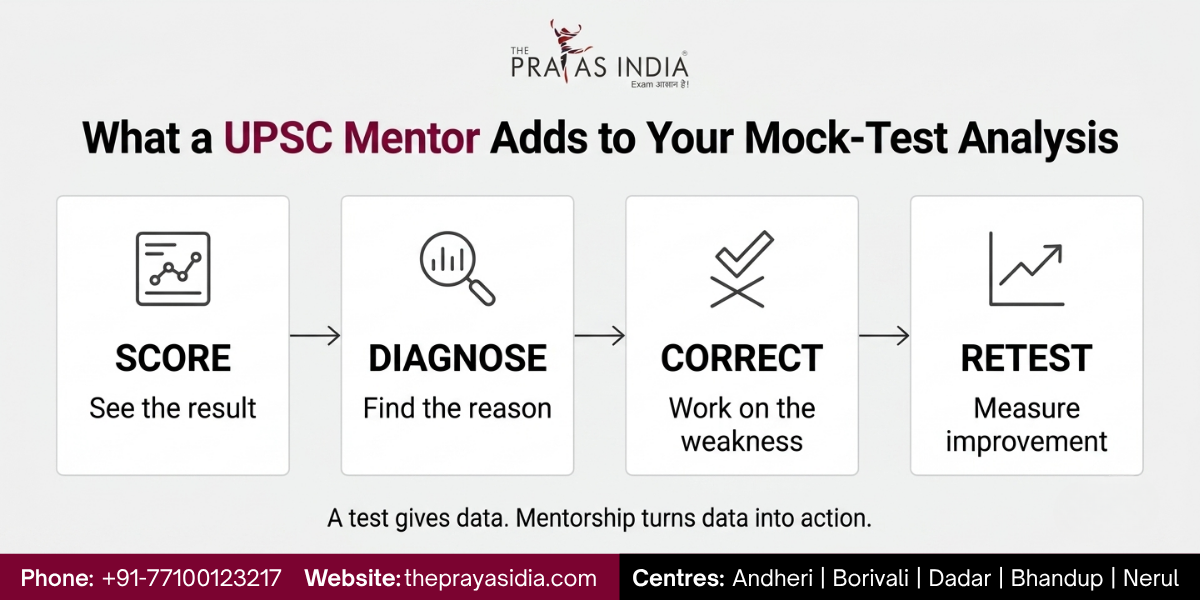
Mentorship can therefore help translate mock-test results into specific preparation actions instead of leaving students with only a numerical score.
Key Takeaway
Mentorship is not a replacement for hard work. It is a system that can make hard work more directed, measurable and adaptable.
For a UPSC aspirant, having access to guidance can help reduce uncertainty around study priorities, revision, answer writing, current affairs, mock-test performance and time management. More importantly, regular feedback can help identify problems before they become deeply established habits.
The strongest value of mentorship lies in the continuous process of evaluation and correction. Instead of following one rigid strategy for months, aspirants can assess their performance and make informed changes.
A useful way to think about mentorship is:
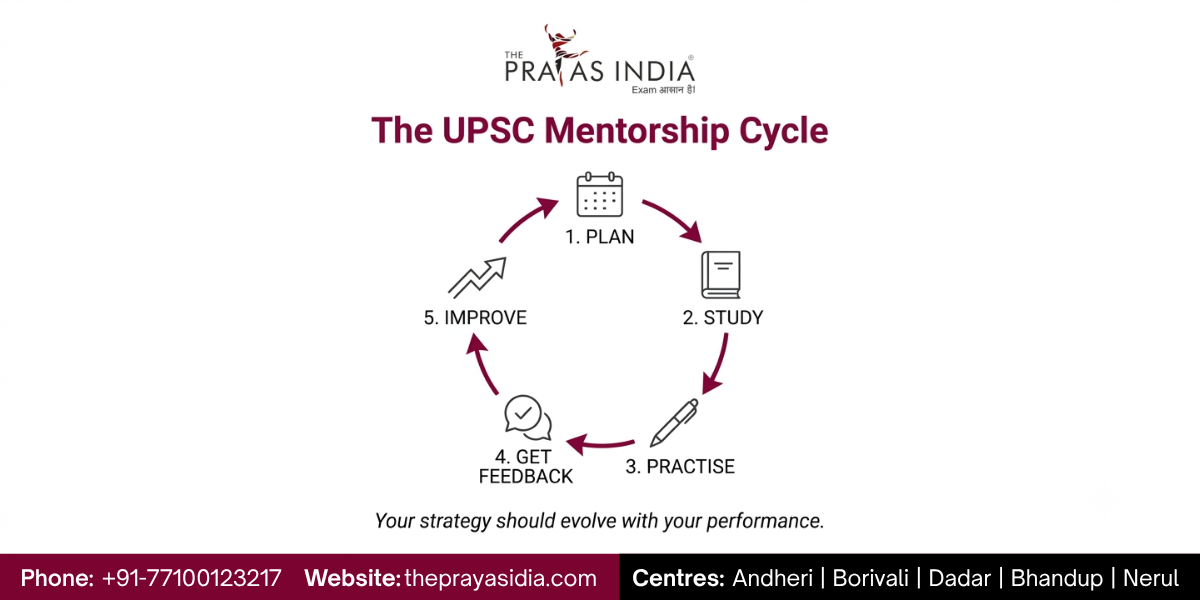
Direction → Practice → Feedback → Correction → Consistency → Improvement
For students looking at UPSC coaching in Mumbai, a preparation programme that combines classroom learning with structured mentorship can provide a more complete preparation environment.
Mentor vs Teacher: The Difference Matters
A teacher and a mentor can both play important roles in UPSC preparation, but their functions are not exactly the same.
A teacher primarily focuses on teaching the subject. The teacher explains concepts, discusses topics, provides academic inputs and helps students understand the syllabus.
A mentor looks at the preparation from a broader perspective. The mentor may help the student decide how to organise study hours, which areas require more attention, how to interpret test performance, when to revise, how to improve answer writing and when the preparation strategy needs to change.
In practice, the roles can overlap. A strong UPSC preparation ecosystem can benefit from both effective teaching and meaningful mentorship.
For an aspirant, the important point is that completing classes does not automatically guarantee that the preparation is progressing correctly. There must also be a mechanism through which performance and strategy are regularly reviewed.
Mentorship for Beginners: Building the Right Foundation
Students beginning UPSC preparation often face a different challenge from experienced aspirants. They may not know how deeply a topic should be studied, which resources should be prioritised or how the Prelims and Mains stages are connected.
The early stage of preparation is therefore less about studying everything and more about building the right habits and understanding the examination.
A mentor can help a beginner understand the UPSC syllabus, previous-year question papers, basic resource selection, revision cycles and the importance of answer writing. This can prevent several common mistakes, such as collecting excessive study material, postponing revision or spending months studying without practising questions.
Early guidance can also help students develop realistic expectations. UPSC is a long-term examination, and sustainable preparation is generally more useful than an extremely aggressive timetable that cannot be maintained.
Mentorship for Repeat Aspirants
Repeat aspirants often need a different kind of guidance because they already have experience with the examination.
The key question is not simply, “What should I study again?”
It is:
“What prevented me from converting my previous preparation into the desired result?”
The answer could be inadequate revision, poor Prelims strategy, weak answer writing, insufficient test practice, optional-subject issues, time management or inconsistent execution.
A mentor can help a repeat aspirant conduct a more objective review of the previous attempt. Instead of starting the entire preparation from zero, the student can identify what worked, what failed and what needs to change.
This approach can make the second attempt more targeted and prevent the aspirant from repeating the same preparation cycle without addressing its weaknesses.
Personalised Study Planning
A useful UPSC study plan should reflect the aspirant’s actual situation.
A college student, a working professional and a full-time aspirant may all require different schedules. Similarly, a beginner who has several months available will need a different plan from an aspirant who is approaching Prelims.
Mentorship can help convert broad preparation goals into practical weekly and monthly targets. The focus should be on creating a plan that can realistically be executed.
A personalised plan can also account for revision. Many aspirants create schedules dominated by new topics and underestimate the time required to revisit previously studied material.
A better approach is to maintain a balance between learning, revision, practice and testing.
This balance can evolve as the examination approaches.
Mentorship for UPSC Optional Preparation
The optional subject can become an important part of the Mains preparation strategy, yet aspirants often struggle with resource selection, answer-writing expectations and syllabus coverage.
Mentorship can help students approach the optional subject more systematically. Instead of continuously adding resources, the aspirant can identify a core source, understand the syllabus, study previous-year questions and practise answers according to the requirements of the subject.
Regular review can also help identify whether the student is merely completing the optional syllabus or actually developing the ability to produce examination-ready answers.
The same principle applies here: completion is not the same as readiness.
Making Answer Writing a Continuous Process
Many aspirants postpone Mains answer writing until they feel that their syllabus is almost complete. This can create a problem because writing under examination conditions is a skill that develops through practice.
Mentorship can help integrate answer writing into the preparation schedule at an appropriate stage.
Initially, the focus may be on understanding the demand of questions and creating a basic answer structure. With practice, the aspirant can work on introductions, arguments, examples, diagrams, conclusions and time management.
Feedback becomes especially important here because students may not recognise their own recurring writing patterns.
A mentor can point out whether answers are becoming repetitive, whether arguments are sufficiently balanced or whether the response is actually addressing the demand of the question.
Mentorship and Mock-Test Analysis
Mock tests are most valuable when they lead to corrective action.
A student may score poorly in a test and conclude that more studying is required. But the real problem may be something completely different.
Perhaps the student knows the material but spends too much time on individual questions. Maybe excessive attempts are leading to negative marking. Perhaps revision is inadequate, causing previously studied information to be forgotten.
A mentor can help analyse these patterns objectively.
Instead of saying, “My score is low,” the student can identify:
What went wrong → Why it happened → What should change → How to practise it → When to test it again.
This creates a much stronger feedback loop.
Mentorship and Current-Affairs Preparation
Current affairs preparation can easily become inefficient because of the enormous volume of information available every day.
Aspirants may read newspapers, follow daily news updates, watch analysis videos and collect monthly compilations, yet still struggle to recall useful examples during answer writing.
Mentorship can help bring structure to this process.
Instead of treating every news item as equally important, aspirants can learn to connect current developments with the UPSC syllabus and previous-year question trends. This makes current affairs more useful for both Prelims and Mains.
For Mains, the focus can be on developing examples, case studies, statistics, government initiatives and contemporary developments that can strengthen arguments. For Prelims, the emphasis may be on factual and conceptual information relevant to the examination.
The result is a more focused approach to current affairs rather than an endless accumulation of information.
Mentorship Helps Control Resource Overload
Resource overload is one of the most common problems in UPSC preparation.
An aspirant may begin with one standard book, then discover another recommended source, followed by an online PDF, a coaching compilation and several strategy videos. Eventually, the student has more material than can realistically be revised.
Mentorship can help create boundaries.
A mentor can guide the student towards a limited set of reliable resources and encourage repeated revision instead of continuous resource switching.
This is important because one well-revised source can be more useful than five partially studied sources.
The purpose is not to restrict learning. It is to prevent preparation from becoming fragmented.
Accountability Without Unnecessary Pressure
Accountability works best when it encourages consistency rather than fear.
A mentor can help students review their weekly targets, but the purpose should be to understand performance honestly. If a target was not completed, the discussion should focus on the reason.
Was the target unrealistic? Was too much time spent on low-priority tasks? Was there a lack of understanding? Did unexpected responsibilities affect the schedule?
Once the reason is clear, the plan can be adjusted.
This creates a healthier preparation system where accountability becomes a tool for self-correction rather than punishment.
How to Make Mentorship Effective
Mentorship is most useful when the student actively participates in the process.
An aspirant should not expect the mentor to provide a perfect daily schedule and solve every preparation problem. The student still needs to study consistently, complete assignments, practise questions and reflect honestly on performance.
Before a mentorship session, it can be useful to prepare specific questions.
Instead of saying:
“My preparation isn’t going well.”
Ask:
“My last three tests show that I am losing marks mainly because of incorrect attempts. How should I modify my attempt strategy?”
Specific questions make mentorship more productive.
Similarly, students should maintain records of mock scores, answer-writing feedback, pending topics and revision progress. This gives the mentor meaningful information to work with.
What to Look for in UPSC Mentorship
Not every mentorship programme will provide the same level of value. Aspirants should evaluate the system before choosing one.
Look for a programme that offers:
- Regular performance review
- Personalised academic guidance
- Answer-writing feedback
- Mock-test analysis
- Study-plan monitoring
- Current-affairs integration
- Prelims and Mains strategy support
- Clear communication
- Practical course correction
The quality of mentorship depends not simply on the number of interactions but on whether those interactions result in clear and actionable improvements.
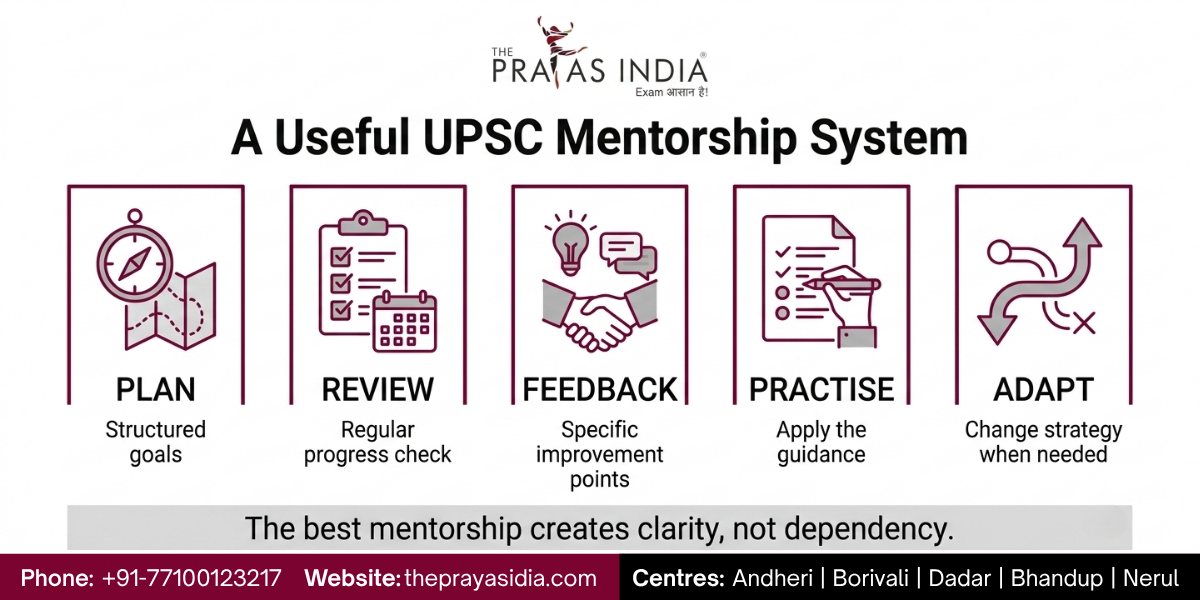
Common Mentorship Mistakes to Avoid
Mentorship can be valuable, but it should not become another source of confusion. One common mistake is constantly seeking new advice from different mentors, teachers and online personalities. Conflicting strategies can make it difficult to maintain consistency.
Another mistake is becoming completely dependent on a mentor. Guidance should help the aspirant become more capable of making independent decisions, not make every decision on their behalf.
Students should also avoid expecting instant results. Mentorship is a process of gradual improvement. A single discussion cannot transform answer writing, revision or time management overnight.
Finally, mentorship is ineffective when the student does not implement the feedback. Even the most useful advice has little value if it remains in a notebook and never becomes part of the preparation routine.
How The Prayas India Can Support UPSC Aspirants
A structured UPSC preparation programme can bring together classroom learning, practice, testing and guidance so that students do not have to manage every part of the preparation independently.
At The Prayas India, mentorship can be positioned as part of this broader preparation process. Students can work towards understanding the examination, following a structured study plan, practising answer writing, analysing performance and making course corrections based on feedback.
For aspirants preparing in Mumbai, an integrated approach can provide a more organised learning environment while allowing students to identify and work on individual weaknesses.
The objective is not simply to complete the syllabus. It is to help students move from studying information to developing examination readiness.
How Mentorship Can Improve the Overall UPSC Preparation Cycle
A strong preparation system can be visualised as a continuous cycle rather than a straight line.
The student first identifies a target, studies the relevant material and practises questions. Performance is then evaluated through tests or answer writing. Feedback identifies weaknesses, after which the strategy is adjusted.
The student then repeats the process.
This cycle is important because UPSC preparation is dynamic. As the student’s performance changes, the preparation strategy should change as well.
A mentor can act as a guide within this cycle, helping the aspirant identify problems earlier and make more informed adjustments.
The ultimate goal is greater clarity and independence, not permanent dependence on external guidance.
FAQs
1. How does mentorship help in UPSC preparation?
Mentorship can provide direction, personalised feedback, accountability and course correction. It helps aspirants identify weaknesses and make their preparation more structured.
2. Is UPSC mentorship necessary for every aspirant?
Not necessarily. Some students can prepare independently with strong self-discipline and a clear strategy. However, mentorship can be valuable for aspirants who need structured guidance, regular feedback or help identifying preparation gaps.
3. What is the difference between UPSC coaching and mentorship?
Coaching generally focuses on teaching the syllabus and building subject knowledge. Mentorship focuses more on the individual's preparation strategy, performance, planning, feedback and course correction. A good programme can combine both.
4. Can mentorship help UPSC beginners?
Yes. Beginners can benefit from guidance on understanding the syllabus, selecting resources, planning preparation, integratig Prelims and Mains and developing consistent study habits.
5. Can repeat UPSC aspirants benefit from mentorship?
Yes. Repeat aspirants can use mentorship to objectively analyse their previous attempt, identify recurring weaknesses and develop a revised strategy instead of repeating the same preparation approach.
6. Can a mentor help with UPSC Mains answer writing?
Yes. Regular feedback can help students improve answer structure, relevance, introductions, conclusions, examples, presentation and time management.
7. Can mentorship help with UPSC Prelims?
Yes. Mentorship can help analyse mock-test performance, identify weak areas, improve question selection and develop a more effective revision and test-taking strategy.
8. How often should UPSC mentorship sessions happen?
There is no universal frequency. The ideal schedule depends on the student's preparation stage and requirements. What matters most is that reviews are regular enough to identify problems and implement corrective action.
9. Can mentorship help with current affairs?
Yes. Mentorship can help aspirants connect current affairs with the static syllabus and identify information that is useful for Prelims, Mains answers and essay preparation.
10. How can I make my UPSC mentorship sessions more effective?
Maintain records of your study progress, mock scores, answer-writing feedback and pending topics. Come to each session with specific questions and implement the agreed action points afterward.
11. What should I look for in a UPSC mentorship programme?
Look for personalised guidance, regular performance review, answer-writing feedback, mock analysis, study-plan support, Prelims and Mains strategy and actionable course correction.
12. Is mentorship useful for UPSC preparation in Mumbai?
Yes. Aspirants in Mumbai can benefit from a structured coaching environment that combines classroom learning with personalised guidance, testing and performance review.
Final Takeaway
UPSC preparation demands knowledge, but knowledge alone does not guarantee effective examination performance. Aspirants also need to know how to plan, practise, evaluate and improve.
This is where meaningful mentorship can make a difference.
A mentor can help an aspirant avoid unnecessary resource overload, identify weaknesses, improve answer writing, interpret mock-test results, manage preparation priorities and make course corrections at the right time.
The most useful mentorship does not create dependence. It gradually helps students become more confident and capable of evaluating their own preparation.
A simple way to understand the process is:
Plan → Study → Practise → Test → Get Feedback → Correct → Repeat
For students searching for the best UPSC coaching in Mumbai, choosing a programme that combines strong teaching with structured mentorship can provide a more complete preparation experience.
At The Prayas India, the focus can be on helping aspirants build a disciplined, feedback-driven and examination-oriented preparation process.
Contact Us
- Call Now: +91-77100 13217
- Website: theprayasindia.com
- Centres: Andheri | Borivali | Dadar | Nerul | Bhandup