How to Analyse UPSC Previous Year Question Papers: A Complete Guide for Aspirants
Preparing for the UPSC Civil Services Examination requires a combination of conceptual understanding, consistent revision, current affairs awareness and regular practice. However, one preparation resource that every serious UPSC aspirant should use is Previous Year Question Papers (PYQs).
Many students download UPSC question papers, solve a few questions and check their scores. But effective preparation requires much more than simply attempting questions. Aspirants need to understand why a question was asked, which syllabus topic it represents, what concepts are being tested and how UPSC frames questions.
If you are preparing for the Civil Services Examination in Navi Mumbai, learning how to analyse UPSC previous year question papers can help you develop a more focused study strategy.
For students exploring IAS Coaching in Nerul, PYQ analysis is also an important topic to discuss while understanding an institute’s teaching methodology and preparation approach.
In this guide, we will explain how to analyse UPSC Previous Year Question Papers systematically, identify recurring themes, improve answer-writing skills and use previous questions to make preparation more effective.
Why Are UPSC Previous Year Question Papers Important?
UPSC Previous Year Question Papers provide valuable insight into the examination pattern and the way questions are designed.
The syllabus explains what candidates need to study, while previous year questions provide examples of how different topics are tested.
Here are some important benefits of analysing PYQs.
1. Understand the UPSC Examination Pattern
UPSC questions are designed to assess conceptual understanding, analytical ability and awareness of different subjects.
- By reviewing previous papers, aspirants can become familiar with:
- Types of questions asked in the examination
- Subject-wise distribution of questions
- Difficulty levels
- Question formats
- Static and current affairs connections
- Areas requiring deeper conceptual understanding
This understanding can help candidates prepare more strategically.
2. Identify Important Syllabus Areas
Not every topic receives equal attention in every examination.
Previous year papers can help aspirants identify topics that have appeared repeatedly and understand the different dimensions from which UPSC approaches them.
For example, Indian Polity questions may involve Parliament, Fundamental Rights, Constitutional Bodies, Federalism and Governance.
However, candidates should remember that previous appearances do not guarantee that a topic will be repeated in the next examination.
3. Improve Conceptual Understanding
Sometimes, a question appears unfamiliar even when the underlying concept has already been studied.
This happens because UPSC may test the same concept through a different statement, example or application.
Analysing previous questions helps aspirants understand how fundamental concepts are connected with practical situations.
4. Improve Time Management
Regular practice with previous year question papers helps candidates understand how to manage examination time.
It also helps them recognise questions that require careful reading, elimination techniques or deeper analysis.
5. Build Confidence Through Practice
Attempting previous papers under examination-like conditions helps candidates become familiar with the actual testing environment.
It also provides an opportunity to identify weak areas before appearing for the examination.
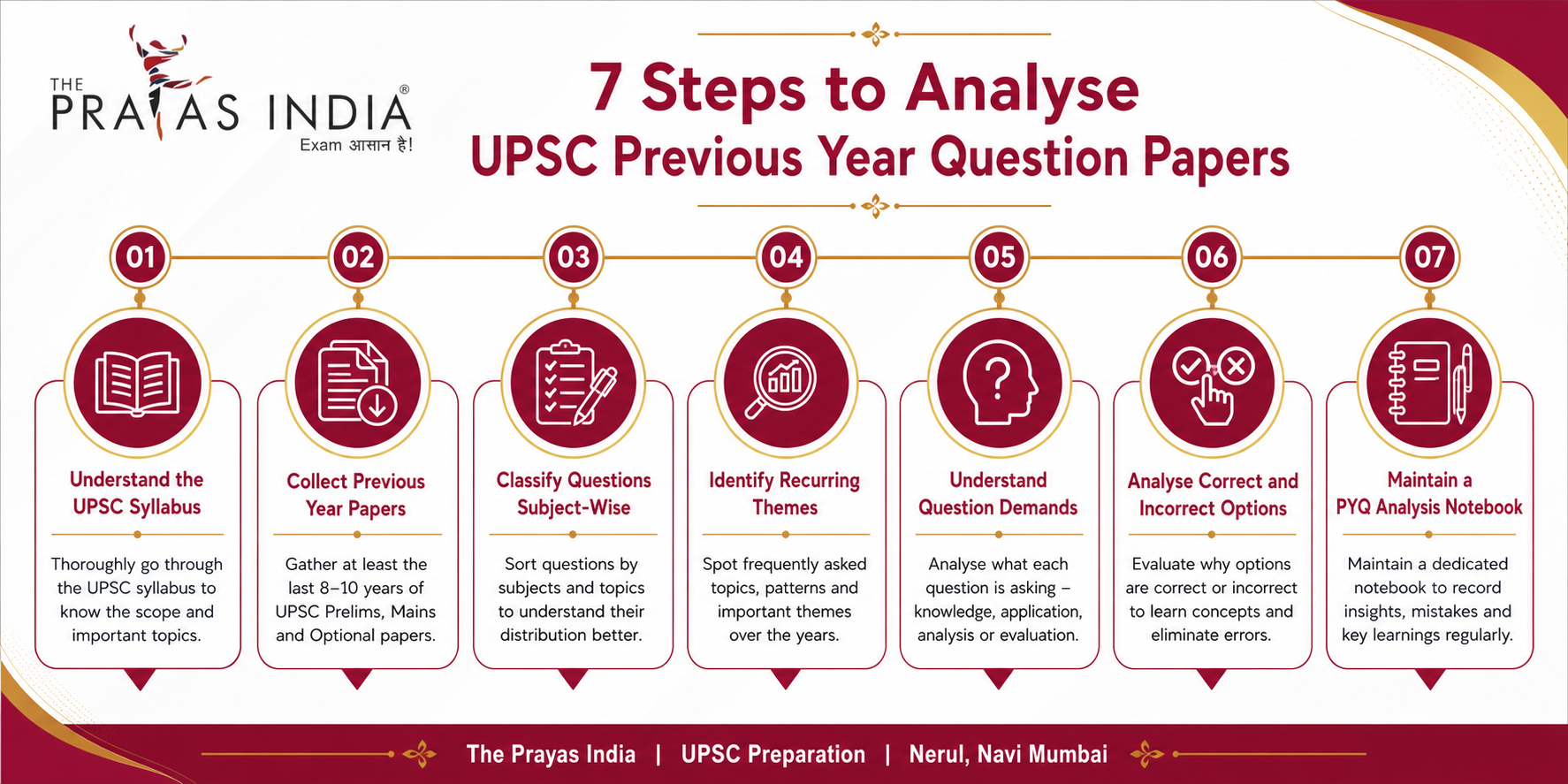
Step-by-Step Guide: How to Analyse UPSC Previous Year Question Papers
Simply solving question papers is not enough. Aspirants should follow a systematic approach to extract maximum learning from every paper.
Step 1: Understand the UPSC Syllabus First
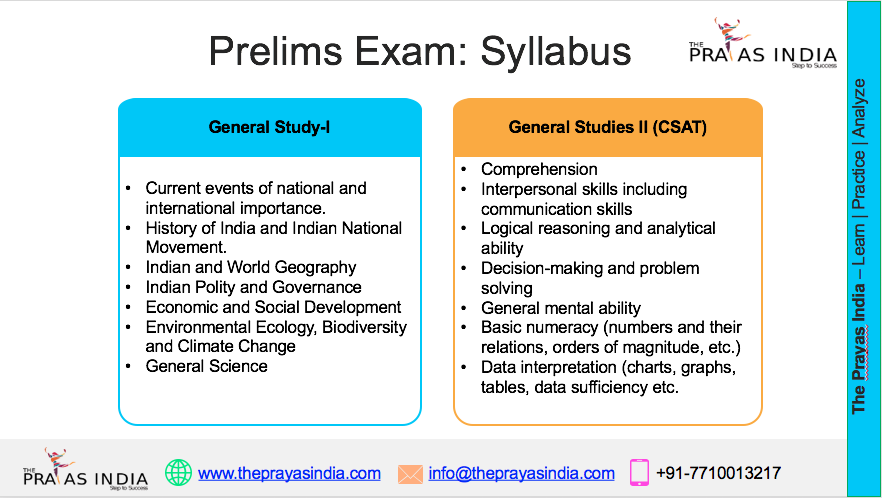
Before analysing previous year questions, download and understand the latest official UPSC Civil Services Examination syllabus.
Divide the syllabus into major subjects and smaller topics.
For example:
- General Studies Paper I
- Indian History
- Indian National Movement
- Indian and World Geography
- Indian Society
- Art and Culture
General Studies Paper II
- Indian Constitution
- Polity
- Governance
- Social Justice
- International Relations
General Studies Paper III
- Indian Economy
- Agriculture
- Science and Technology
- Environment
- Internal Security
- Disaster Management
General Studies Paper IV
- Ethics
- Integrity
- Aptitude
- Emotional Intelligence
- Case Studies
Once you understand the syllabus, you can connect every previous year question with its relevant topic.
This prevents random preparation and helps you study with a clear objective.
Step 2: Collect Previous Year Question Papers
Collect official UPSC question papers from the UPSC website.
You should organise papers separately for:
- Civil Services Preliminary Examination – General Studies Paper I
- Civil Services Preliminary Examination – CSAT Paper II
- Civil Services Main Examination – General Studies Papers I to IV
- Essay Paper
- Optional Subject Papers
Begin with the most recent papers and gradually move towards older papers.
It is useful to maintain separate folders for Prelims and Mains because their question formats and evaluation requirements are different.
Step 3: Analyse Questions Subject-Wise
Avoid analysing the entire paper without a proper classification system.
Divide questions into different subjects and topics.
For example:
| Subject | Topics to Track |
|---|---|
| History | Ancient, Medieval, Modern, Art and Culture |
| Geography | Physical, Indian and World Geography |
| Polity | Constitution, Parliament, Judiciary, Governance |
| Economy | Banking, Inflation, Budget, Agriculture |
| Environment | Biodiversity, Climate Change, Ecology |
| Science | Space, Biotechnology, Technology |
This subject-wise analysis helps you understand which topics have received attention across different years.
For students preparing through UPSC coaching in Navi Mumbai, maintaining such a topic-wise record can also make classroom learning and self-study more organised.
Step 4: Identify Repeated Themes
One of the most useful aspects of UPSC PYQ analysis is identifying recurring themes.
For example, in Indian Polity, aspirants may observe questions relating to:
- Fundamental Rights
- Constitutional Amendments
- Parliament
- Supreme Court
- Federal Structure
- Constitutional Bodies
Instead of memorising previous questions, study the complete concept behind them.
For example, if you encounter a question about Fundamental Rights, revise the relevant constitutional provisions, important Supreme Court interpretations and related constitutional developments.
The objective is to understand the subject in depth rather than predict the next question.
Step 5: Understand the Question’s Demand
UPSC questions often test more than factual knowledge.
Consider the following instruction words:
- Discuss
- Examine
- Analyse
- Evaluate
- Critically Examine
- Comment
- Explain
Each instruction has a different expectation.
For example, a question asking you to examine a policy requires an explanation of its different dimensions.
A question asking you to critically analyse something requires you to consider both positive and negative aspects before reaching a balanced conclusion.
Understanding these terms is particularly important for Mains answer-writing practice.
Step 6: Analyse Incorrect Options in Prelims
Prelims preparation should not end after checking the correct answer.
Study all the options, including the incorrect ones.
Ask yourself:
- Why is the correct option right?
- Why are the other options incorrect?
- Which concept is being tested?
- Does the question connect with a current affairs issue?
- What additional information should I revise?
This process improves conceptual clarity and develops the ability to eliminate incorrect options.
Step 7: Connect Previous Questions with Current Affairs
UPSC frequently examines subjects through contemporary developments.
For example:
- Environmental issues can connect with biodiversity and climate policies.
- Economic developments can connect with inflation and monetary policy.
- International events can connect with India’s foreign relations.
- Government schemes can connect with governance and social justice.
While analysing previous papers, identify the static concepts behind questions and connect them with relevant current affairs.
However, do not assume that every current affairs topic will become an examination question.
Step 8: Maintain a PYQ Analysis Notebook
Maintaining a separate notebook for previous year question analysis can be extremely useful.
You can organise it using the following format:
| Year | Subject | Topic | Key Concept | Preparation Status |
|---|---|---|---|---|
| 2025 | Polity | Parliament | Parliamentary procedures | Needs Revision |
| 2024 | Economy | Inflation | Monetary policy | Revised |
| 2023 | Environment | Biodiversity | Conservation | Practice Required |
| 2022 | Geography | Physical Geography | Climatology | Revised |
These are illustrative entries, not a verified classification of actual UPSC questions.
Your notebook should help you track what you have studied, what requires revision and where you are making mistakes.
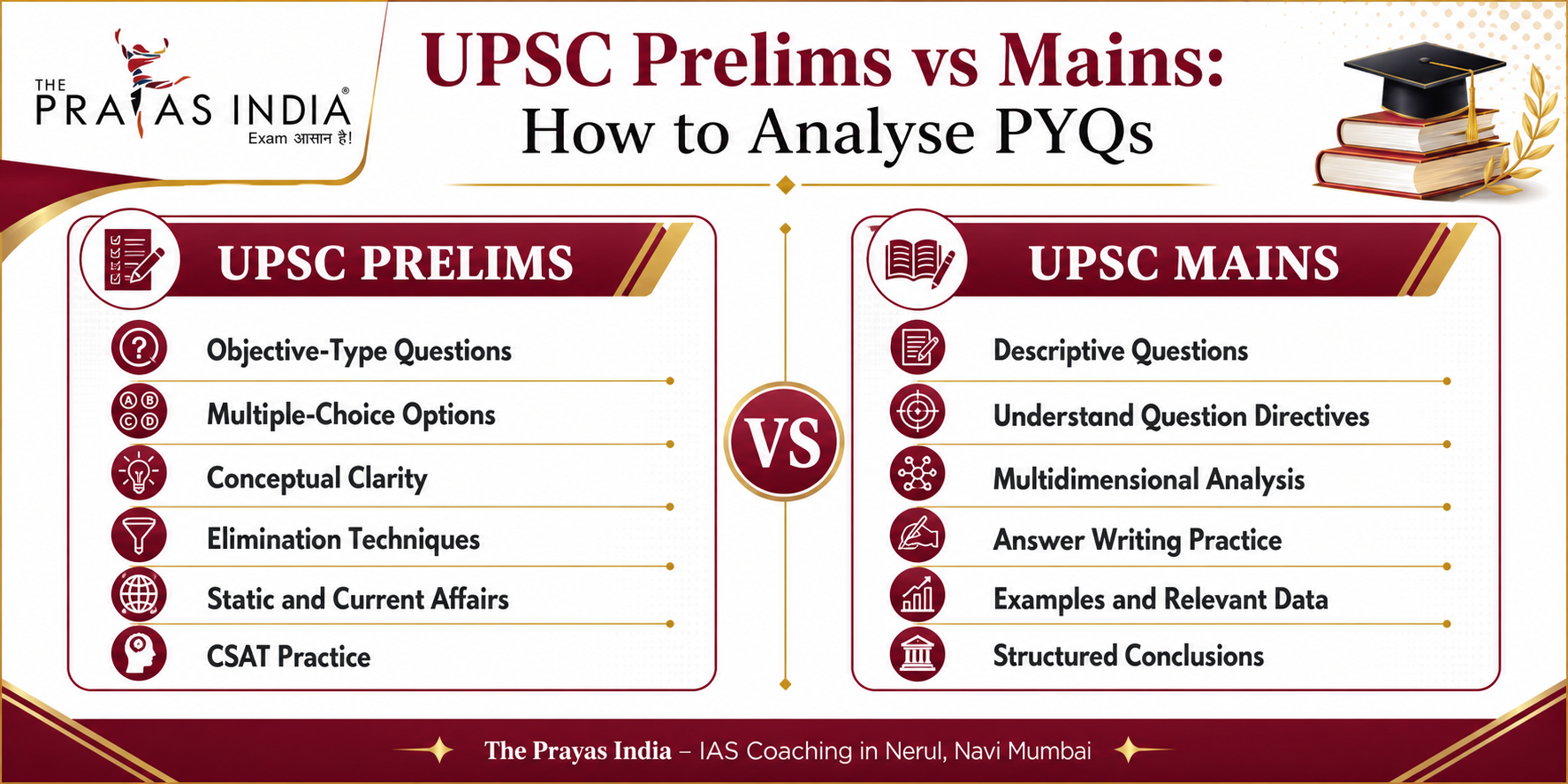
How to Analyse UPSC Prelims Previous Year Question Papers
The Preliminary Examination tests conceptual understanding, factual awareness and the ability to evaluate multiple statements.
Aspirants should focus on the following areas.
1. Statement-Based Questions
Many questions require candidates to evaluate multiple statements.
Practise identifying small factual differences and understanding the exact meaning of each statement.
2. Elimination Techniques
Elimination can be useful when you are unsure about an answer.
However, avoid guessing randomly. Develop elimination skills through conceptual understanding and regular practice.
3. Static and Current Affairs Integration
Identify whether a question tests a static concept, a current development or a combination of both.
This will help you understand how to connect your newspaper reading with textbook preparation.
4. CSAT Question Analysis
Do not ignore CSAT.
- Analyse questions related to:
- Reading comprehension
- Logical reasoning
- Basic numeracy
- Data interpretation
- Analytical ability
CSAT is qualifying in nature, but candidates must achieve the prescribed qualifying marks.
How to Analyse UPSC Mains Previous Year Question Papers
Mains preparation requires a different approach because questions demand descriptive and analytical answers.
Aspirants should evaluate the following factors.
1. Understand the Directive
Identify whether the question asks you to discuss, examine, analyse, evaluate or critically examine a topic.
Your answer should directly address the directive.
2. Identify Different Dimensions
A single topic can be examined from several perspectives.
For example, urbanisation can be analysed through:
- Economic development
- Infrastructure
- Environmental sustainability
- Migration
- Housing
- Governance
- Social inequality
Developing a multidimensional approach improves answer quality.
3. Practise Structured Answer Writing
A good Mains answer generally includes:
- Introduction
- Main Body
- Relevant examples
- Facts or data where appropriate
- Balanced analysis
- Conclusion
Avoid writing unnecessary information that does not address the question.
4. Improve Answer Presentation
Use headings, subheadings, relevant examples and diagrams wherever appropriate.
Your answer should be easy to understand and logically organised.
5. Review Your Answers
After writing an answer, evaluate it against the question’s demand.
Check whether you have addressed all important dimensions and completed the answer within the prescribed word limit.
Common Mistakes to Avoid While Analysing UPSC PYQs
Many aspirants spend considerable time solving previous papers but fail to use them effectively.
Avoid these common mistakes:
1. Memorising Questions Without Understanding Concepts
UPSC can test the same topic through a completely different question. Focus on understanding concepts rather than memorising answers.
2. Ignoring the Official Syllabus
Do not analyse questions without connecting them to the syllabus.
3. Focusing Only on Frequently Asked Topics
Repeated themes are useful for understanding examination trends, but they should not become the only areas of preparation.
4. Ignoring CSAT
Candidates should regularly practise CSAT and ensure that they meet the qualifying requirement.
5. Not Revising Mistakes
Every incorrect answer should become a learning opportunity.
6. Depending on Predictions
No coaching institute, teacher or previous year analysis can guarantee the questions that will appear in the next examination.
Aspirants should maintain comprehensive syllabus-based preparation.
How The Prayas India, Nerul Can Help You Explore UPSC Preparation
For students living in Nerul and surrounding areas of Navi Mumbai, finding suitable guidance is an important part of the preparation journey.
The Prayas India has a branch in Nerul where aspirants can enquire about currently available UPSC and IAS preparation programmes.
Students exploring Best IAS Coaching in Navi Mumbai or Top UPSC Coaching in Navi Mumbai should compare institutes based on their teaching methodology, syllabus coverage, faculty guidance, study support and available practice opportunities.
At The Prayas India, interested students can visit the Nerul centre and enquire about:
- Available UPSC preparation programmes
- Course structure and syllabus coverage
- Teaching methodology
- Batch timings
- Study materials and learning support
- Test practice and answer-writing guidance
- Admission procedure and fee details
For aspirants searching for Best UPSC Coaching in Nerul or Top IAS Coaching in Nerul, visiting the centre can help them understand whether the available programmes match their preparation requirements.
Why Is PYQ Analysis Important for Every UPSC Aspirant?
Whether you study independently or attend coaching classes, previous year question paper analysis should remain an important part of your preparation.
It helps you:
- Understand the examination pattern.
- Connect the syllabus with actual questions.
- Identify conceptual weaknesses.
- Improve answer-writing skills.
- Practise examination-oriented thinking.
- Develop a more organised revision strategy.
Students looking for Best IAS Coaching in Nerul should also consider whether their preparation routine includes regular PYQ discussions and question-based learning.
Start Your UPSC Preparation with a Smarter Strategy
Success in UPSC preparation depends on consistent effort, conceptual understanding, regular revision and effective practice.
Previous year question papers are not merely practice material. They are an important resource for understanding how UPSC tests knowledge and analytical ability.
If you are preparing for the Civil Services Examination in Navi Mumbai, start analysing previous papers systematically. Connect every question with the syllabus, understand the concepts, identify mistakes and revise regularly.
For students looking for IAS Coaching in Nerul, The Prayas India provides an opportunity to explore available preparation programmes and discuss their learning requirements.
Visit The Prayas India – Nerul Branch
- Address: F-105, 1st Floor, Nerul West, Nerul, Maharashtra 400706
- Contact: +91 7710013217
Take a more organised approach to UPSC preparation with consistent PYQ analysis and focused learning.
Frequently Asked Questions – UPSC Previous Year Question Papers
Why are UPSC Previous Year Question Papers important?
UPSC Previous Year Question Papers help aspirants understand the examination pattern, identify important syllabus areas, practise questions and improve conceptual clarity. They also provide insight into how UPSC frames questions.
How many years of UPSC PYQs should I analyse?
Aspirants can begin by analysing the previous 10 years of available question papers, keeping the relevance of the syllabus and examination pattern in mind. Focus on understanding concepts rather than simply counting repeated questions.
Should I analyse UPSC Prelims and Mains papers separately?
Yes. Prelims requires objective-question practice, conceptual understanding and elimination skills, while Mains requires analytical thinking, structured answers and effective presentation. Analysing both separately helps aspirants prepare according to the demands of each stage.
How should beginners start UPSC PYQ analysis?
Beginners should first understand the official UPSC syllabus, collect previous year papers and classify questions subject-wise. They should then connect each question with its relevant topic and revise the underlying concepts.
Can PYQ analysis help improve UPSC Mains answer writing?
Yes. Analysing Mains questions helps aspirants understand question directives, identify different dimensions of a topic and practise writing structured answers within the prescribed word limit.
Where can I find UPSC Previous Year Question Papers?
Previous year question papers are available through the official Union Public Service Commission website. Aspirants should refer to official papers for accurate examination material and practise using the latest relevant syllabus.
How does PYQ analysis help in UPSC preparation?
PYQ analysis helps aspirants recognise question trends, understand the depth of topics, improve revision and practise exam-oriented problem-solving. It also helps students identify areas that need more attention.
Where can I enquire about UPSC coaching in Nerul?
You can visit The Prayas India at F-105, 1st Floor, Nerul West, Nerul, Maharashtra 400706, or call +91-77100 13217 to enquire about currently available UPSC preparation programmes.
Start Your UPSC Preparation with The Prayas India Nerul
Looking for structured guidance for your Civil Services preparation? Connect with The Prayas India, Nerul, to enquire about available UPSC programmes, classroom guidance and preparation support. Build a consistent study routine with focused learning and regular practice.
Address:
F-105, 1st Floor, Nerul West, Nerul, Maharashtra 400706
Serving UPSC Aspirants From:
Nerul | Seawoods | CBD Belapur | Juinagar | Sanpada | Vashi | Navi Mumbai