How to Analyse Your UPSC Mains Answers | Best UPSC CSE Coaching in Mumbai | The Prayas India
UPSC Mains preparation does not improve simply because you write more answers. The real improvement begins when you learn how to evaluate those answers honestly, identify recurring weaknesses and deliberately correct them in the next practice cycle.
Many aspirants follow a familiar routine. They study a topic, read a question, write an answer within the prescribed time and then move on to the next question. After a few weeks, they may have written dozens of answers, but their marks remain inconsistent. The problem is often not a lack of effort. It is the absence of a structured answer-analysis process.
A good UPSC Mains answer is not judged only by how much information it contains. The answer must respond directly to the demand of the question, demonstrate conceptual understanding, use relevant examples and current affairs where appropriate, maintain a logical structure and present the content within the available time and word limit.
This is why UPSC Mains answer analysis should become a regular part of preparation rather than something students do occasionally before the examination.
For aspirants looking for Best UPSC CSE Coaching in Mumbai, this aspect of preparation is particularly important. A structured coaching environment can provide answer-writing practice, evaluation, faculty feedback and mentorship, but students also need to develop the ability to analyse their own answers. Self-evaluation and expert feedback work best when they complement each other.
Why Writing More Answers Does Not Automatically Improve Your UPSC Mains Performance
Answer writing is often treated as a numbers game.
An aspirant may say, “I have written 100 answers,” and assume that this automatically indicates strong preparation. However, the number of answers written tells you very little about the quality of learning taking place between those attempts.
Imagine a student repeatedly makes the same mistakes:
- The introduction takes too long.
- The answer does not address every part of the question.
- Arguments remain generic.
- Examples are missing.
- The conclusion is repetitive.
- The answer exceeds the word limit.
- The student spends too much time on the first few questions.
If these issues are never identified, writing another fifty answers may simply reinforce the same habits.
Effective answer writing follows a different cycle:
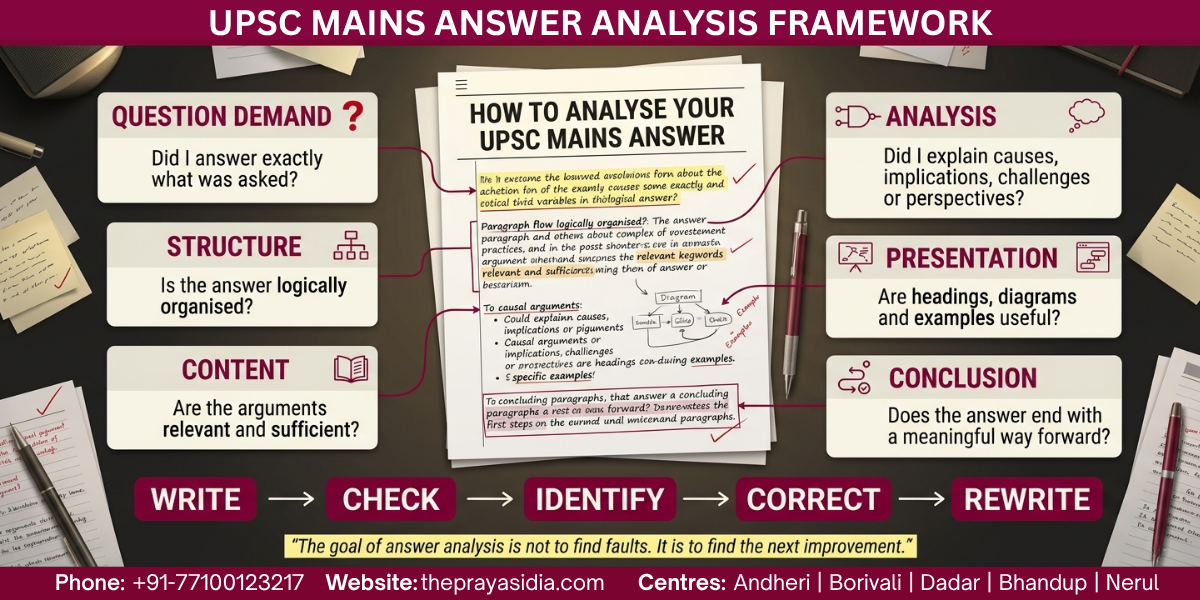
Write → Evaluate → Identify the Problem → Correct It → Practise Again
The purpose of analysis is therefore not to criticise your answer.
It is to understand why the answer received the marks it did and what specifically needs to change.
What Should You Analyse in a UPSC Mains Answer?
A useful answer-analysis system should look beyond grammar or handwriting.
You need to evaluate the answer at multiple levels.
| Area | What You Should Check |
|---|---|
| Question Demand | Did you answer exactly what was asked? |
| Introduction | Is the opening relevant and concise? |
| Structure | Is the answer organised logically? |
| Content | Are the arguments relevant and sufficient? |
| Depth | Have you analysed rather than merely described? |
| Examples | Are examples specific and useful? |
| Current Affairs | Where relevant, have contemporary examples been integrated? |
| Presentation | Are headings, subheadings, diagrams or flowcharts useful? |
| Conclusion | Does it provide a meaningful closure? |
| Word Limit | Is the answer appropriately controlled? |
| Time | Did you complete it within the planned time? |
| Overall Relevance | Does every paragraph contribute to answering the question? |
This checklist can initially feel extensive, but with practice it becomes much faster.
The objective is eventually to develop an internal habit where you can identify these issues almost automatically.
Step 1: Analyse the Question Before Analysing Your Answer
One of the most overlooked aspects of answer evaluation is the question itself.
Before deciding whether your answer was good or bad, return to the original question.
Ask:
What exactly was the examiner asking me to do?
UPSC questions can contain multiple layers.
A question may ask you to:
- Explain
- Discuss
- Analyse
- Examine
- Critically examine
- Evaluate
- Compare
- Illustrate
- Comment
These directives influence the nature of the answer.
For example, if a question asks you to critically examine an issue, merely explaining the issue is unlikely to be sufficient. You need to demonstrate understanding of different dimensions, identify limitations or counterarguments and arrive at a balanced assessment.
Similarly, a question asking you to analyse something requires more than listing facts.
You need to establish relationships, causes, consequences, implications or competing dimensions depending on the context.
Therefore, the first question in your self-evaluation should be:
Did my answer fulfil the exact demand of the question?
If the answer is no, improving vocabulary or adding more examples will not solve the fundamental problem.
Use a Question-Demand Framework
After completing an answer, break the question into its components.
Suppose the question contains:
Context + Directive + Core Issue + Multiple Dimensions
Your answer should respond to each meaningful component.
You can use a simple table during practice:
| Question Component | Did My Answer Address It? |
|---|---|
| Context | Yes / No |
| Main Demand | Yes / No |
| Dimension 1 | Yes / No |
| Dimension 2 | Yes / No |
| Counterpoint | Yes / No |
| Way Forward | Yes / No |
This exercise is particularly useful when your answers look detailed but still receive mediocre feedback.
Sometimes the problem is not insufficient content.
It is misdirected content.
Step 2: Check Whether Your Introduction Actually Introduces the Answer
The introduction should prepare the reader for the discussion that follows.
Many aspirants spend too much time trying to create impressive introductions.
They use lengthy definitions, complicated statements or unrelated historical background.
A better introduction is usually one that establishes relevance quickly.
Depending on the question, an introduction could use:
- A concise definition
- A relevant constitutional provision
- A significant fact or statistic
- A contemporary development
- A brief contextual statement
- A suitable example
- A short conceptual explanation
The key is relevance.
After reading your introduction, ask:
Does the examiner immediately understand what issue I am going to address?
If the answer is unclear, the introduction needs revision.
Introduction Analysis: A Practical Checklist
After every answer, check:
Relevance
Does the introduction connect directly with the question?
Brevity
Did you spend too many words establishing the context?
Direction
Does it naturally lead towards the body of the answer?
Accuracy
Are the facts, constitutional references or definitions correct?
Originality
Does the introduction demonstrate understanding rather than sounding copied from a generic template?
You do not need a different “fancy” introduction for every question.
You need an introduction that gets the answer moving in the right direction.
Step 3: Examine the Structure of the Body
The body carries most of the analytical weight of the answer.
This is where you need to determine whether your points actually address the question.
A common weakness in UPSC Mains answers is information dumping.
The student knows the topic and writes everything they remember.
The answer may contain several facts, committees, schemes, constitutional provisions and examples, yet still lack a clear argument.
Why?
Because information is not the same as analysis.
A well-structured answer should have a visible logical progression.
For example:
Issue → Causes → Impact → Challenges → Solutions
Or:
Current Situation → Positive Dimensions → Concerns → Institutional Response → Way Forward
The exact structure should depend on the question.
There is no single template that should be mechanically applied everywhere.
How to Identify an Information-Dumping Answer
Read your own answer and ask:
Can I identify the main argument of each paragraph?
If you cannot, the paragraph may contain too many disconnected points.
Next ask:
Does each point help answer the question?
If you find yourself thinking, “This fact is related to the topic, so I included it,” that is a warning sign.
The standard should be higher:
This fact strengthens my answer to this specific question.
That distinction can significantly improve answer quality.
Step 4: Analyse Whether You Have Provided Enough Dimensions
UPSC Mains questions often reward multidimensional thinking.
An issue may have:
- Social dimensions
- Economic dimensions
- Political dimensions
- Administrative dimensions
- Environmental dimensions
- Ethical dimensions
- Constitutional dimensions
- Technological dimensions
- International dimensions
But multidimensionality does not mean forcing every possible dimension into every answer.
The dimensions should emerge naturally from the question.
For example, a governance-related question may require you to consider institutional capacity, citizen outcomes, technology, accountability and implementation challenges.
A social issue may require social, economic, cultural and gender-related perspectives.
During analysis, ask:
Did I examine the issue from the dimensions that were actually relevant?
If your answer covers only one perspective, it may appear incomplete even when the information itself is correct.
Step 5: Separate Description from Analysis
This is one of the most important skills for UPSC Mains.
Consider a descriptive statement:
“Urbanisation is increasing rapidly in India.”
That is information.
An analytical answer needs to explore:
Why is it happening?
What consequences does it create?
Which groups are affected?
What institutional challenges emerge?
What opportunities does it create?
What interventions can improve outcomes?
The exact dimensions depend on the question, but the principle remains the same.
When analysing your answer, highlight sentences that merely describe the issue.
Then ask whether you followed those statements with meaningful interpretation.
A useful self-check is:
Fact + Explanation + Implication
For example:
Fact: A policy has expanded access to a particular service.
Explanation: This reduces a specific structural barrier.
Implication: It can improve inclusion, but implementation capacity may determine whether the benefit reaches vulnerable groups.
This is closer to analytical writing than simply mentioning the policy.
Step 6: Evaluate the Quality of Your Examples
Examples can make an answer more concrete, but only when used correctly.
An answer filled with random examples is not necessarily stronger.
The best examples are:
- Relevant
- Specific
- Accurate
- Recent where appropriate
- Directly connected to the argument
For instance, instead of writing a generic sentence about “technology improving governance,” a specific and relevant example can demonstrate the point more effectively.
However, do not insert examples merely to make the answer appear sophisticated.
Ask:
Does this example prove, explain or strengthen the argument I have made?
If the answer is yes, retain it.
If it is merely decorative, remove it.
Step 7: Check Your Use of Current Affairs
Current affairs should support your answer rather than dominate it.
A common problem among aspirants is trying to insert current affairs into every paragraph.
This can make the answer look forced.
Instead, current affairs should be used where they add value.
You can use them to:
- Establish contemporary relevance
- Provide evidence
- Demonstrate recent developments
- Illustrate implementation challenges
- Support an argument
- Strengthen the conclusion or way forward
The quality of integration matters more than the number of current-affairs references.
A single highly relevant example can be more effective than five loosely connected references.
Step 8: Analyse Your Conclusion
A conclusion should not feel like the answer suddenly stopped because the word limit was reached.
It should provide closure.
Depending on the question, the conclusion can:
- Summarise the central argument
- Present a balanced perspective
- Suggest a practical way forward
- Connect the issue with constitutional values
- Highlight the broader objective
- Provide a forward-looking perspective
Do not force motivational quotes into every answer.
A simple, relevant conclusion can be more effective than a dramatic statement.
When reviewing your answer, ask:
Does my conclusion logically emerge from the discussion?
If the body discusses challenges and the conclusion suddenly introduces an unrelated idea, the transition needs improvement.
Step 9: Check Your Presentation
UPSC Mains is a written examination, so presentation matters.
However, presentation does not mean decorating the answer.
Your objective is to make the answer easy to read and easy to evaluate.
Look at:
- Paragraph length
- Headings
- Subheadings
- Underlining
- Numbering
- Diagrams
- Flowcharts
- Spacing
- Legibility
A well-presented answer allows the examiner to identify your arguments quickly.
But visual elements should support the content.
If you use a diagram, ask:
Does this diagram explain something faster than words would?
If yes, use it.
If not, it may simply consume valuable time.
How to Analyse Your Diagrams and Flowcharts
Diagrams are particularly useful when they simplify relationships.
They can help represent:
Cause → Effect
Process
Cycle
Institutional Relationship
Stakeholder Interaction
Problem → Intervention → Outcome
But a poorly drawn diagram can become a distraction.
After every answer containing a diagram, evaluate:
| Question | Evaluation |
|---|---|
| Is it relevant? | Yes / No |
| Is it understandable? | Yes / No |
| Does it save words? | Yes / No |
| Does it add analytical value? | Yes / No |
| Did it take too much time? | Yes / No |
This prevents you from using diagrams simply because someone suggested that “diagrams fetch more marks.”
Step 10: Analyse Your Word Limit and Time Management
A strong answer written too slowly can create problems later in the paper.
This is why time analysis should happen alongside content analysis.
After completing an answer, record:
Question → Time Taken → Word Count → Quality
For example:
| Answer | Time | Word Count | Observation |
|---|---|---|---|
| Q1 | 9 min | 150 | Good structure |
| Q2 | 11 min | 160 | Too much time |
| Q3 | 8 min | 145 | Efficient |
| Q4 | 10 min | 155 | Introduction too long |
You may discover that your biggest problem is not content.
It may be that you spend too much time thinking about the introduction or trying to create elaborate conclusions.
That is why timing should be measured rather than guessed.
Step 11: Compare Your Answer with a Better Answer Carefully
Model answers can be useful, but they can also create confusion.
The objective is not to reproduce somebody else’s answer.
Instead, compare the architecture of the answers.
Ask:
Did the model answer identify a demand that I missed?
Did it include a dimension I overlooked?
Was its structure clearer?
Did it use a better example?
Did it provide stronger analysis?
Was the conclusion more relevant?
This comparison can reveal gaps in your thinking.
Do not become obsessed with copying exact phrases.
UPSC preparation should develop your ability to construct answers independently.
A Better Method: Compare by Components
Instead of reading the model answer and thinking:
“Mine looks bad.”
Break the comparison down.
| Component | My Answer | Better Reference | What I Need to Improve |
|---|---|---|---|
| Introduction | Generic | Direct and contextual | Improve relevance |
| Structure | 3 paragraphs | Clear subheadings | Improve organisation |
| Content | Limited dimensions | Multi-dimensional | Add perspectives |
| Examples | Generic | Specific | Improve examples |
| Analysis | Mostly descriptive | Cause-effect reasoning | Explain implications |
| Conclusion | Repetitive | Forward-looking | Improve closure |
This converts comparison into an actionable learning exercise.
Don’t Give Yourself a Fake Score
Self-evaluation can become ineffective if you are either too harsh or too generous.
Some students give themselves very high marks because the answer “looks good.”
Others give themselves extremely low marks because they compare their answer with an ideal reference answer.
Neither approach is particularly useful.
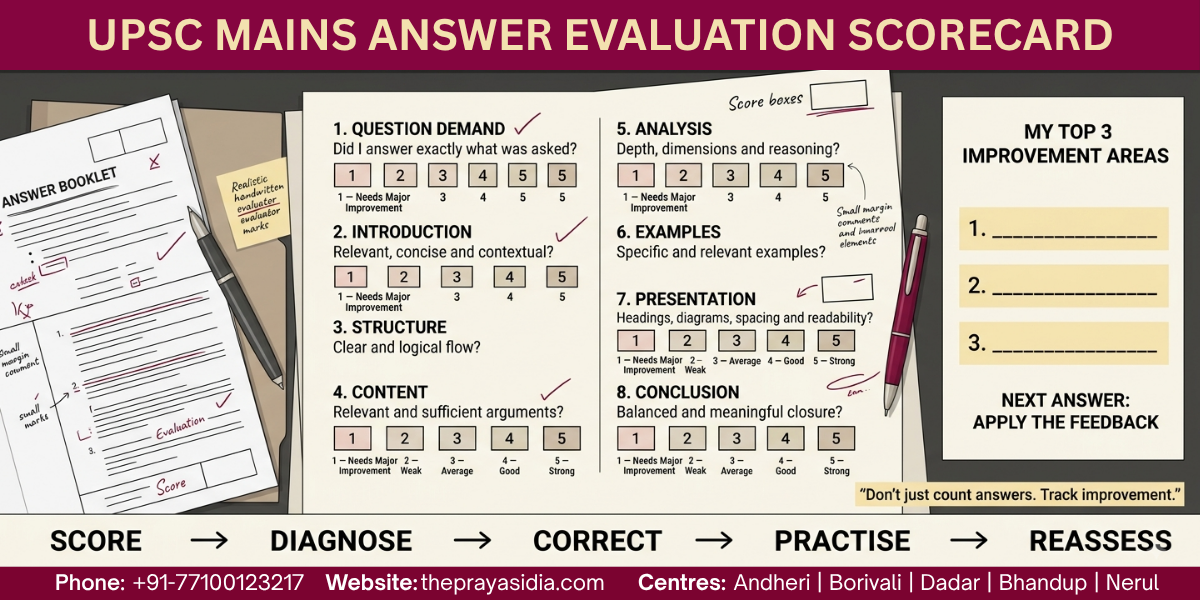
Instead of focusing only on the absolute score, create a quality scorecard.
For example:
| Parameter | Rating |
|---|---|
| Question Demand | 4/5 |
| Structure | 3/5 |
| Content | 3/5 |
| Analysis | 2/5 |
| Examples | 3/5 |
| Presentation | 4/5 |
| Conclusion | 3/5 |
| Time Management | 2/5 |
Now you know where the problem lies.
The next practice session should specifically address the weakest parameters.
The Most Important Part: Create an Improvement Action
After analysis, write only two or three priority corrections.
Do not create a list of twenty mistakes.
For example:
This Week’s Focus
- Make introductions shorter.
- Add at least two dimensions to analytical questions.
- Practise completing answers within the planned time.
This makes improvement measurable.
The next set of answers should test whether those corrections actually worked.
Answer Writing Should Work Like a Feedback Loop
Think of your preparation as a continuous loop:
Answer Writing
↓
Evaluation
↓
Problem Identification
↓
Targeted Practice
↓
Expert Feedback
↓
Improved Answer
↓
New Evaluation
This is much more powerful than simply accumulating answer-writing numbers.
And this is one area where structured UPSC coaching in Mumbai can provide additional value.
A faculty member may identify a problem that the student cannot see independently, such as weak prioritisation, superficial analysis or failure to address the precise demand of the question.
Self-analysis tells you what you notice.
Expert evaluation can sometimes reveal what you have been missing.
How Professional Feedback Can Improve Self-Evaluation
Suppose a student believes:
“My answers lack content.”
After evaluation, the faculty may discover that the student actually knows sufficient content but does not organise it around the question demand.
That changes the solution completely.
The student does not necessarily need more books.
They may need better answer structuring and analytical thinking.
Another student may think:
“My writing speed is poor.”
But analysis may show that the real problem is spending too much time on introductions and repeatedly rewriting sentences.
Again, the solution is different.
This is why feedback should not merely be:
“Good answer.”
or
“Needs improvement.”
Useful feedback should explain:
What is wrong → Why it is wrong → How to fix it.
What a Good UPSC Mains Evaluation System Should Ideally Include
For aspirants evaluating Best UPSC CSE Coaching in Mumbai, answer evaluation should be one of the factors they examine before joining.
A useful system can include:
| Evaluation Element | Purpose |
|---|---|
| Regular Answer Writing | Develop consistency |
| Faculty Evaluation | Identify blind spots |
| Detailed Feedback | Understand specific weaknesses |
| Model Structures | Learn better organisation |
| Rewriting Practice | Convert feedback into improvement |
| Progress Tracking | Measure development |
| Mentorship | Adjust individual strategy |
The exact format can differ between institutes, but the underlying objective should remain the same:
Feedback should lead to improvement.
Create Your Own UPSC Mains Answer Evaluation Sheet
If you analyse every answer differently, it becomes difficult to identify long-term patterns. A standard evaluation sheet solves this problem.
After every practice session, spend a few minutes reviewing your answer against the same parameters.
| Evaluation Parameter | Questions to Ask |
|---|---|
| Question Demand | Did I answer every part of the question? |
| Introduction | Is it relevant, concise and contextual? |
| Structure | Is there a clear beginning, discussion and conclusion? |
| Content | Are my points relevant and sufficiently developed? |
| Analysis | Did I explain causes, effects, challenges or implications? |
| Examples | Are my examples specific and relevant? |
| Current Affairs | Have I used contemporary examples where useful? |
| Balance | Have I considered multiple perspectives where required? |
| Presentation | Is the answer easy to scan and evaluate? |
| Conclusion | Does it provide meaningful closure? |
| Word Limit | Did I stay within the expected range? |
| Time | Did I complete the answer efficiently? |
Do not try to improve every parameter simultaneously.
After analysing several answers, identify the two most repeated weaknesses and make those your immediate improvement targets.
Maintain an Answer-Writing Performance Tracker
Your answer tracker should not become another complicated notebook.
A simple spreadsheet or notebook is enough.
For example:
| Date | Subject | Question Type | Main Weakness | Time | Next Action |
|---|---|---|---|---|---|
| 5 Aug | GS-II | Governance | Generic examples | 9 min | Add specific cases |
| 7 Aug | GS-III | Economy | Weak analysis | 10 min | Practise cause-effect structure |
| 9 Aug | GS-I | Society | Poor conclusion | 8 min | Improve way-forward endings |
| 11 Aug | Ethics | Case Study | Weak prioritisation | 12 min | Practise stakeholder analysis |
After four or five weeks, this tracker can reveal patterns that individual answer reviews cannot.
You may discover that your answers are consistently strong in content but weak in conclusions.
Or perhaps your content is adequate but your time management is poor.
This is valuable information because it changes how you prepare.
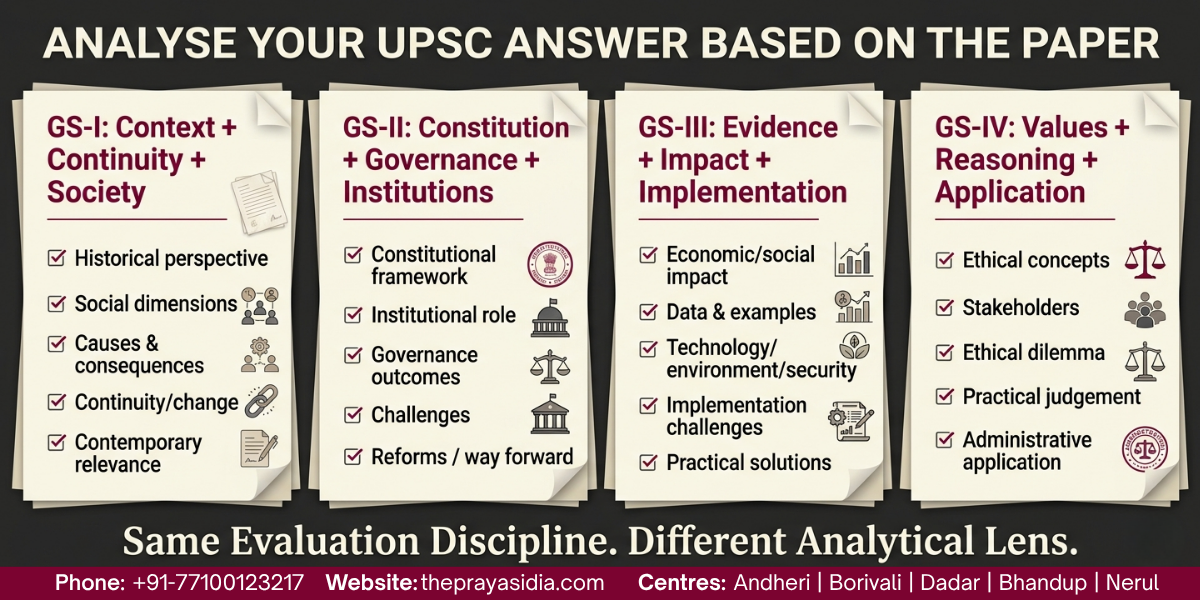
How to Analyse GS Answers Differently
General Studies answers cannot always be evaluated using exactly the same approach.
Different papers require different kinds of thinking.
For example, a GS-I question may require historical, geographical, social or cultural understanding. GS-II may demand constitutional, governance, institutional or international perspectives. GS-III can require economic, technological, environmental, security or disaster-management dimensions.
Therefore, after checking the basic answer-writing parameters, ask:
What kind of thinking does this particular GS paper require?
GS Paper I: Look for Context, Continuity and Interconnections
In GS-I, students often make the mistake of writing textbook-style descriptions.
If the question concerns a historical development, simply describing events may not be sufficient if the directive requires analysis.
Similarly, in society-related questions, merely listing social problems may not address the deeper causes, consequences and possible interventions.
When analysing GS-I answers, check whether you have included relevant dimensions such as:
- Historical context
- Causes
- Consequences
- Continuity and change
- Social impact
- Regional variation
- Contemporary relevance
The dimensions should be selected according to the question rather than inserted mechanically.
GS Paper II: Examine Institutions, Processes and Outcomes
GS-II answers often benefit from a clear understanding of how institutions function.
When evaluating an answer on governance, Constitution, Parliament, judiciary, federalism, welfare delivery or international relations, ask:
Have I discussed both the formal framework and the practical outcome?
For example, an answer about a constitutional mechanism may become stronger when it connects:
Constitutional Provision → Institutional Role → Practical Challenge → Impact → Reform
This creates a more complete response than simply reproducing constitutional provisions.
When analysing your GS-II answer, check whether your points remain descriptive or whether they explain the actual governance implications.
GS Paper III: Focus on Evidence and Implementation
GS-III questions often require candidates to connect concepts with real-world outcomes.
Depending on the question, relevant dimensions may include:
- Economic impact
- Employment
- Productivity
- Technology
- Environment
- Security
- Infrastructure
- Resource management
- Institutional capacity
- Implementation challenges
This is also a paper where data, reports, examples and government initiatives can add value when used accurately.
But do not turn the answer into a collection of statistics.
A statistic should support an argument.
Ask:
What does this data demonstrate?
If you cannot explain why you included a number, it may not be necessary.
GS Paper IV: Evaluate the Quality of Your Ethical Reasoning
Ethics requires a somewhat different evaluation approach.
A student may know numerous ethical terms and still struggle to write a convincing answer.
Why?
Because Ethics is not merely about definitions.
It is also about application, reasoning and judgement.
When analysing a GS-IV answer, examine:
- Conceptual clarity
- Appropriate examples
- Application to the situation
- Stakeholder perspective
- Ethical reasoning
- Balance between values
- Practicality of the solution
- Administrative sensitivity
For case studies, ask whether you clearly identified the ethical dilemmas and stakeholders before proposing solutions.
How to Analyse UPSC Ethics Case Studies
A case study should not become an emotional essay.
The examiner needs to see structured decision-making.
After writing a case study, check whether you addressed:
Stakeholders
Who is affected by the decision?
Ethical Issues
What competing values or dilemmas are involved?
Available Options
What realistic choices are available?
Evaluation
What are the advantages and limitations of each option?
Decision
Which option would you choose?
Justification
Why is your choice ethically and administratively defensible?
Implementation
How would you actually execute the decision?
This final element is frequently overlooked.
A theoretically perfect solution that cannot be implemented may not be convincing.
Essay Answers Need a Different Kind of Analysis
Essay evaluation requires a broader perspective.
You cannot evaluate an essay only by checking whether it contains enough facts.
An essay should demonstrate:
Understanding → Depth → Multiple Perspectives → Logical Progression → Coherence → Balanced Conclusion
After completing an essay, ask:
Did I understand the topic correctly?
Did I interpret the statement rather than simply write everything I know?
Did my arguments connect with each other?
Did I examine the topic from multiple relevant perspectives?
Did the essay remain focused throughout?
Did the conclusion bring the discussion together?
An essay may contain excellent examples and still be weak if the central argument is unclear.
The Most Important Essay Question: Did I Stay on the Topic?
This is one of the easiest ways to analyse an essay.
Take each major paragraph and write its central idea in five or six words.
If you cannot explain why that paragraph contributes to the essay topic, you may have gone off track.
For example:
Topic → Technology and human values
If half the essay becomes a general discussion about technological development without connecting it to human values, the content may be relevant to the broad subject but not sufficiently relevant to the specific topic.
UPSC rewards relevance.
Knowing a lot is not enough.
You must demonstrate that knowledge within the boundaries of the question.
How Often Should You Get Your UPSC Mains Answers Evaluated?
There is no universal number that works for every aspirant.
However, evaluation should be frequent enough to identify mistakes before they become habits.
A practical approach is:
| Preparation Stage | Evaluation Approach |
|---|---|
| Early Preparation | Focus on structure and question demand |
| Middle Preparation | Regular evaluated answers |
| Advanced Preparation | Timed evaluated tests |
| Prelims-to-Mains Transition | Intensive answer-writing practice |
| Mains-Focused Phase | Full-length papers + detailed evaluation |
The key is consistency.
Writing twenty answers and getting none evaluated may be less useful than writing ten answers and receiving detailed feedback on each.
Should You Evaluate Every Answer Yourself?
Self-evaluation is essential, but it should not be your only source of feedback.
There are certain weaknesses you may not recognise because they have become habitual.
For example, you might believe your introductions are concise because they look short to you.
A faculty evaluator may notice that you are spending too many words defining the background and leaving less space for analysis.
Similarly, you may think your answer is multidimensional because it contains several points, while an evaluator may identify that all those points are actually repeating the same argument.
This is where external feedback becomes valuable.
Self-Analysis vs Expert Evaluation
Both serve different purposes.
| Self-Analysis | Expert Evaluation |
|---|---|
| Immediate | Structured external perspective |
| Builds self-awareness | Identifies blind spots |
| Can be done regularly | Provides specialised feedback |
| Helps track personal patterns | Helps benchmark answer quality |
| Develops independent judgement | Provides corrective direction |
The ideal preparation system combines both.
Write independently → Analyse yourself → Get expert feedback → Compare → Rewrite.
This process develops both answer-writing ability and self-correction skills.
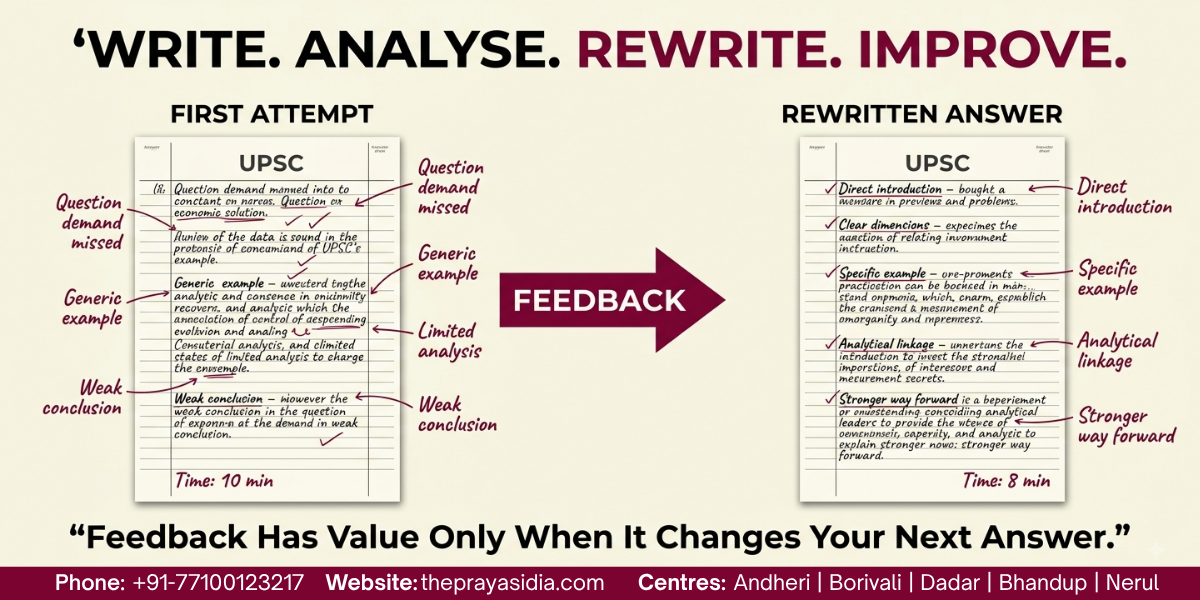
The Importance of Rewriting Weak Answers
One of the most underused techniques in UPSC Mains preparation is rewriting.
Students receive feedback, read it once and then move on to the next question.
But feedback becomes useful only when you apply it.
Suppose your evaluator says:
“Good content, but the answer lacks structure and analysis.”
Do not simply note that comment.
Rewrite the answer.
Try to reorganise it using:
Introduction → Arguments → Counterpoint → Analysis → Way Forward → Conclusion
Then compare the two versions.
The difference becomes much easier to understand when you see the improvement on paper.
Use the 24–48 Hour Rewrite Rule
When you receive detailed feedback, try to rewrite the answer within the next one or two days.
Why?
Because the question and your original approach are still fresh in your mind.
During the rewrite, do not simply change words.
Change the thinking structure.
Ask:
- What did I miss?
- What did I over-write?
- Which argument should come earlier?
- Where can I add analysis?
- Which example is unnecessary?
- Can I make the conclusion more relevant?
This turns feedback into a practical skill.
Create a Personal “Recurring Mistakes” List
By the time you have written several dozen answers, you should have a list of your most common errors.
For example:
Content Problems
- Generic examples
- Insufficient dimensions
- Weak factual support
Structure Problems
- Long introductions
- Unclear headings
- Repetitive body
Analytical Problems
- Description instead of analysis
- No counterargument
- Weak cause-effect relationships
Presentation Problems
- Overcrowded paragraphs
- Poor diagrams
- Inconsistent underlining
Time Problems
- Slow introduction
- Overthinking difficult questions
- Excessive time on conclusions
This list becomes your personal answer-writing syllabus.
How The Prayas India Can Support UPSC Mains Answer Preparation
For an aspirant looking for Best UPSC CSE Coaching in Mumbai, answer evaluation should be one of the areas considered before taking admission.
The value of a coaching institute is not limited to classroom lectures. For Mains preparation, students can benefit from a structured ecosystem that connects learning with answer writing and feedback.
A well-designed preparation system should help students understand the syllabus and question demand, practise answer writing, receive meaningful evaluation and identify areas requiring improvement.
At The Prayas India, students preparing for UPSC CSE can approach their Mains preparation through a structured learning and practice environment, where conceptual preparation can be combined with answer-writing practice, test-based preparation and guidance.
However, coaching should be viewed as a support system rather than a replacement for individual effort.
The student still needs to read, think, write, revise and analyse consistently.
The strongest results come when the aspirant actively uses the feedback provided instead of treating evaluation as a simple marksheet.
What Should You Ask Before Joining UPSC CSE Coaching in Mumbai?
If you are considering joining a UPSC coaching institute, do not make your decision based only on faculty names, advertisements or general claims.
Ask practical questions.
| Area | What You Should Find Out |
|---|---|
| Answer Writing | How regularly is answer writing practised? |
| Evaluation | Who evaluates the answers? |
| Feedback | Is detailed feedback provided? |
| Mentorship | Can students discuss individual weaknesses? |
| Test Series | Are GS and other Mains tests included? |
| Revision | How is revision integrated into the course? |
| Doubt Support | How can students resolve academic doubts? |
| Study Material | Is the material structured and revision-friendly? |
| Batch Size | Will students receive adequate academic interaction? |
| Location & Timing | Can you attend consistently? |
These questions can help you distinguish between a coaching programme that simply delivers content and one that provides a broader preparation framework.
Common Mistakes Aspirants Make While Analysing UPSC Mains Answers
Mistake 1: Looking Only at Marks
Marks are useful, but they do not explain the entire problem.
A low score could result from weak content, poor structure, insufficient analysis, poor question interpretation or time management.
Always look at why the marks were lost.
Mistake 2: Comparing Your Answer Word-for-Word with a Model Answer
A model answer is a learning reference, not a script.
Focus on ideas, structure, dimensions and presentation rather than copying language.
Mistake 3: Trying to Improve Everything at Once
Too many correction points create confusion.
Choose two or three priorities.
Mistake 4: Ignoring Time
An answer can look excellent in an untimed environment but become impractical in the examination.
Practise under realistic time constraints.
Mistake 5: Writing Without Understanding the Directive
“Discuss,” “analyse,” “evaluate” and “critically examine” are not interchangeable.
The demand determines the nature of your response.
Mistake 6: Not Rewriting
Reading feedback is not the same as implementing feedback.
Rewrite important weak answers.
Mistake 7: Adding Content Instead of Improving Relevance
When marks are low, students often respond by reading more books.
Sometimes the real problem is not knowledge.
It is answer application.
A 30-Day Answer Analysis Improvement Plan
If you want to improve answer quality systematically, use a 30-day cycle.
Days 1–7: Identify Your Baseline
Write answers under timed conditions and analyse:
- Question demand
- Structure
- Content
- Time
- Presentation
Do not try to overhaul everything yet.
Days 8–15: Fix Structural Problems
Focus on:
- Introductions
- Headings
- Logical sequencing
- Conclusions
- Word management
Days 16–22: Improve Analysis
Focus on:
- Multiple dimensions
- Cause-effect relationships
- Counterarguments
- Examples
- Current affairs integration
Days 23–27: Improve Speed
Practise timed answers and identify where you lose minutes.
Days 28–30: Reassess
Compare your new answers with your initial answers.
Ask:
What has improved?
What remains weak?
What should become the next month’s priority?
This makes answer writing measurable.
A Practical Daily Routine for UPSC Mains Answer Analysis
You do not need to spend hours analysing every answer.
For a single practice answer, a structured 15–20 minute review can be useful.
First 3 Minutes
Read the question again and identify its demand.
Next 5 Minutes
Review your introduction, structure and content.
Next 5 Minutes
Identify missing dimensions, weak analysis and poor examples.
Next 3 Minutes
Check time, word count and presentation.
Final Few Minutes
Write two specific improvements for your next answer.
The exact duration can vary, but the important point is to make analysis a regular habit.
How to Know That Your Answer Writing Is Actually Improving
Improvement is not always visible through marks immediately.
Look for other indicators.
You should gradually notice that:
- You understand question demands faster.
- Your introductions become shorter and more relevant.
- Your arguments become more structured.
- You use fewer generic points.
- Your examples become more specific.
- Your answers become more multidimensional.
- You complete answers more comfortably within time.
- You need less time to decide the structure.
- Your conclusions become more meaningful.
- The same mistakes appear less frequently.
These are signs that your answer-writing process is becoming more mature.
The Goal Is Not to Write the “Perfect” UPSC Answer
There is no single perfect answer format that guarantees marks.
UPSC Mains questions can be approached in different legitimate ways.
One candidate may use a diagram.
Another may use a concise table.
One may begin with a definition.
Another may begin with a contemporary example.
What matters is whether the approach effectively addresses the question.
Therefore, do not become obsessed with copying a particular answer-writing style.
Develop a style that is:
Relevant + Structured + Analytical + Balanced + Time-Efficient
That combination is far more useful than decorative presentation.
The Complete UPSC Mains Answer Analysis Framework
By now, you can reduce the entire process to one framework:
1. Understand
What is the question asking?
2. Write
Construct the answer within the time and word limit.
3. Evaluate
Check demand, structure, content, analysis, examples and presentation.
4. Identify
Find the two or three most important weaknesses.
5. Correct
Study or practise specifically for those weaknesses.
6. Rewrite
Apply the feedback to the same or a similar question.
7. Track
Record whether the problem continues.
8. Repeat
Use the process consistently.
This is how answer writing evolves from a routine exercise into a measurable preparation system.
Frequently Asked Questions About UPSC Mains Answer Analysis
1. How should I analyse my UPSC Mains answers?
Start by checking whether you addressed the exact question demand. Then evaluate your introduction, structure, content, analysis, examples, current-affairs usage, presentation, conclusion, word limit and time. Finally, identify two or three specific improvements for your next answer.
2. How many UPSC Mains answers should I write every day?
There is no fixed number suitable for everyone. Quality and feedback matter more than simply increasing the count. A smaller number of well-analysed answers can be more useful than writing many answers without reviewing them.
3. Should I get every UPSC answer evaluated by a faculty member?
Regular expert evaluation is valuable, especially when you are developing answer-writing skills. However, you should also learn self-evaluation so that you can identify and correct recurring mistakes independently.
4. Why are my UPSC Mains answers not improving despite regular practice?
The problem may be that you are practising without analysing. If the same mistakes are repeated without targeted correction, additional answer writing may not produce significant improvement. Review your answers and identify the specific reason for stagnant performance.
5. How important is answer structure in UPSC Mains?
Structure is important because it helps communicate your ideas clearly. A logical introduction, organised body and relevant conclusion make it easier for the examiner to follow your argument.
6. Should I use diagrams in every UPSC Mains answer?
No. Diagrams should be used when they genuinely simplify an explanation or improve presentation. Forcing diagrams into every answer can waste time and space.
7. How can I improve analytical writing for UPSC Mains?
Move beyond simply stating facts. Ask why something happens, what its implications are, which stakeholders are affected, what challenges exist and what solutions are possible. Practise connecting evidence with arguments.
8. How often should I rewrite weak UPSC answers?
Whenever an answer exposes an important recurring weakness, rewriting it can be useful. The purpose is to apply feedback immediately rather than simply reading the evaluation and moving on.
9. Is UPSC coaching necessary for Mains answer writing?
Not necessarily. A disciplined aspirant can practise independently. However, structured coaching can be valuable for students who want regular evaluation, faculty feedback, mentorship and a systematic testing environment.
10. What should I look for in the best UPSC CSE coaching in Mumbai?
Look at faculty quality, course structure, answer-writing practice, evaluation methodology, test series, mentorship, doubt support, study material, batch size, schedule and overall learning environment. Choose an institute based on your actual preparation needs rather than promotional claims.
Final Takeaway
UPSC Mains answer writing is not simply about putting everything you know onto paper.
It is about selecting the right information, organising it around the question, analysing the issue from relevant perspectives and communicating your understanding within strict time and word constraints.
That is why answer analysis should be treated as seriously as answer writing itself.
If you write an answer and move on, you gain practice.
If you write, analyse and correct the answer, you gain a repeatable skill.
The ideal cycle is simple:
Write → Evaluate → Receive Feedback → Correct → Rewrite → Improve
For aspirants preparing with professional guidance, a good UPSC CSE coaching institute in Mumbai should ideally support this cycle through structured classes, answer-writing practice, evaluation, test series and mentorship.
The Prayas India can be considered by aspirants who want a structured preparation environment, but the institute should be evaluated on the basis of its current faculty, course structure, answer evaluation system, mentorship and overall academic support.
Ultimately, your goal should not be to write an answer that merely looks impressive.
Your goal should be to write an answer that makes the examiner think:
The candidate understood the question, understood the issue and presented a balanced, relevant and well-reasoned response.
That is the standard worth building towards throughout your UPSC Mains preparation.
Contact Us
📞 Call Now: +91-77100 13217
🌐 Website: theprayasindia.com