How to Balance UPSC Prelims and Mains Preparation | Best UPSC Coaching in Mumbai | The Prayas India
UPSC Civil Services Examination preparation becomes significantly more demanding when aspirants try to treat Prelims and Mains as two completely separate stages. Prelims tests objective knowledge, elimination skills, speed and accuracy, while Mains requires analytical thinking, structured writing, depth of understanding and the ability to present arguments within a limited word count. Yet, preparing for them independently for long periods can create an unnecessary gap between knowledge acquisition and answer-writing ability.
A more effective approach is to build preparation in layers. The same core subjects should gradually serve both stages, while the emphasis changes according to the examination cycle. An aspirant preparing seriously for UPSC should therefore understand not only what to study, but also when to shift the intensity between Prelims-oriented practice and Mains-oriented development.
For students considering UPSC coaching in Mumbai, this becomes an important part of the admission decision. A coaching programme should ideally help aspirants develop an integrated preparation strategy instead of treating Prelims and Mains as disconnected courses. The objective is to create continuity so that preparation for one stage strengthens performance in the other.
Prelims and Mains Are Different, But Your Preparation Should Not Be
The biggest mistake aspirants make is thinking that Prelims preparation and Mains preparation require two entirely different sets of knowledge.
They do not.
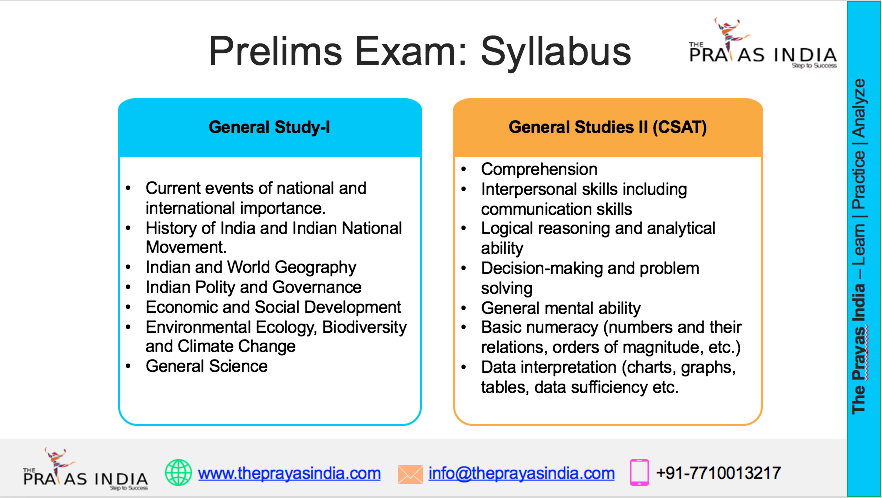
The examination formats are different, but the foundation overlaps considerably. Polity, Economy, History, Geography, Environment, Science and Technology, International Relations and current affairs contribute to preparation across stages. What changes is the way that knowledge needs to be processed and applied.
For Prelims, you need to recognise facts, understand concepts, eliminate incorrect options and make decisions quickly. For Mains, you need to use the same conceptual foundation to explain causes, consequences, challenges, reforms and possible solutions.
This means that reading a topic once should ideally serve more than one purpose.
For example, while studying a constitutional issue, a Prelims-oriented learner may focus on relevant Articles, provisions, institutions and factual distinctions. A Mains-oriented learner should additionally understand the constitutional philosophy, contemporary debates, implementation challenges and possible reforms.
This integrated approach prevents duplication of effort.
Instead of studying a subject twice, you develop a deeper understanding once and then practise using it in two different examination formats.
Start With an Integrated Foundation
Before worrying about the exact number of hours to allocate to Prelims and Mains, build a strong foundation in the common General Studies areas.
This stage should focus on conceptual clarity rather than excessive test-taking.
Aspirants often rush towards mock tests because they want measurable progress. However, if the underlying concepts are weak, repeated testing may simply reproduce the same mistakes.
A stronger foundation comes from combining standard study material with current affairs and regular revision. As you complete each topic, ask yourself two questions:
Could I identify this concept correctly in a Prelims question?
Could I explain its relevance in a Mains answer?
If the answer to both is yes, you are building integrated preparation.
This method also makes revision more efficient because your notes can contain both factual information and analytical dimensions rather than separate sets of material for each stage.
Understand the Difference in Skill Requirements
Integrated preparation does not mean that Prelims and Mains should receive exactly equal attention throughout the year.
The skills required are different.
Prelims requires speed, accuracy, recall, elimination and the ability to handle uncertainty. Mains requires comprehension, analytical depth, answer structure, writing speed and the ability to communicate a balanced argument.
An aspirant who spends months only reading may develop knowledge but struggle to convert it into marks.
Similarly, someone who spends excessive time solving objective questions may become comfortable with Prelims patterns but remain underprepared for Mains answer writing.
The preparation strategy should therefore develop both sets of skills progressively.
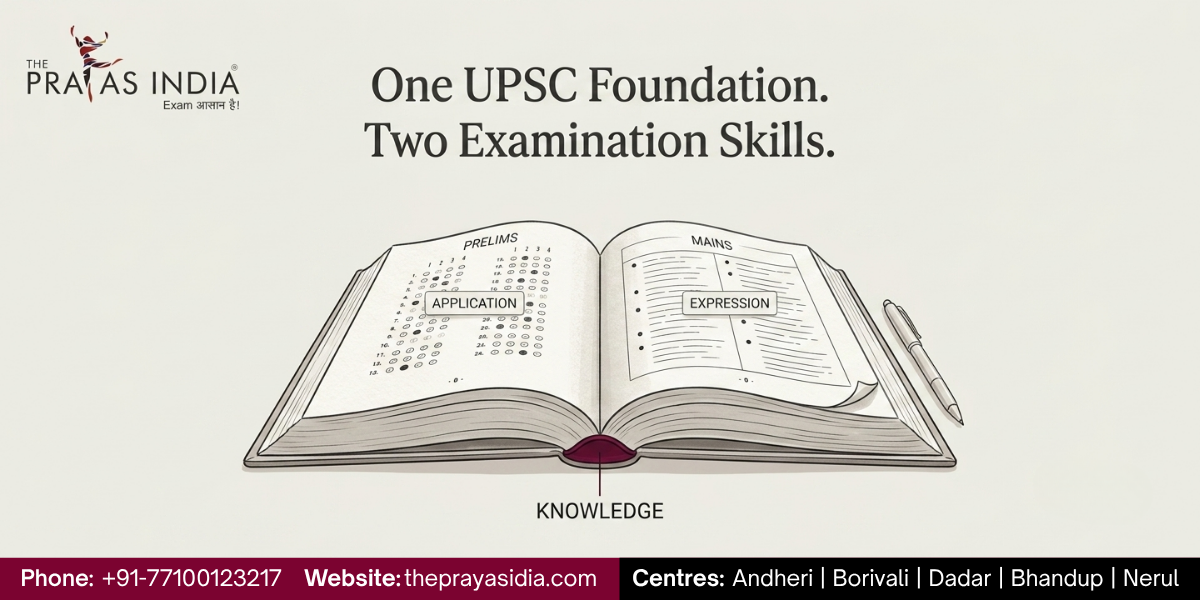
Reading builds the knowledge base.
MCQ practice develops Prelims application.
Answer writing develops Mains expression.
Revision connects all three.
The Right Balance Changes With the Examination Cycle
There is no single Prelims-Mains ratio that should be followed throughout the entire UPSC preparation journey.
The balance should change according to the examination calendar and your level of preparation.
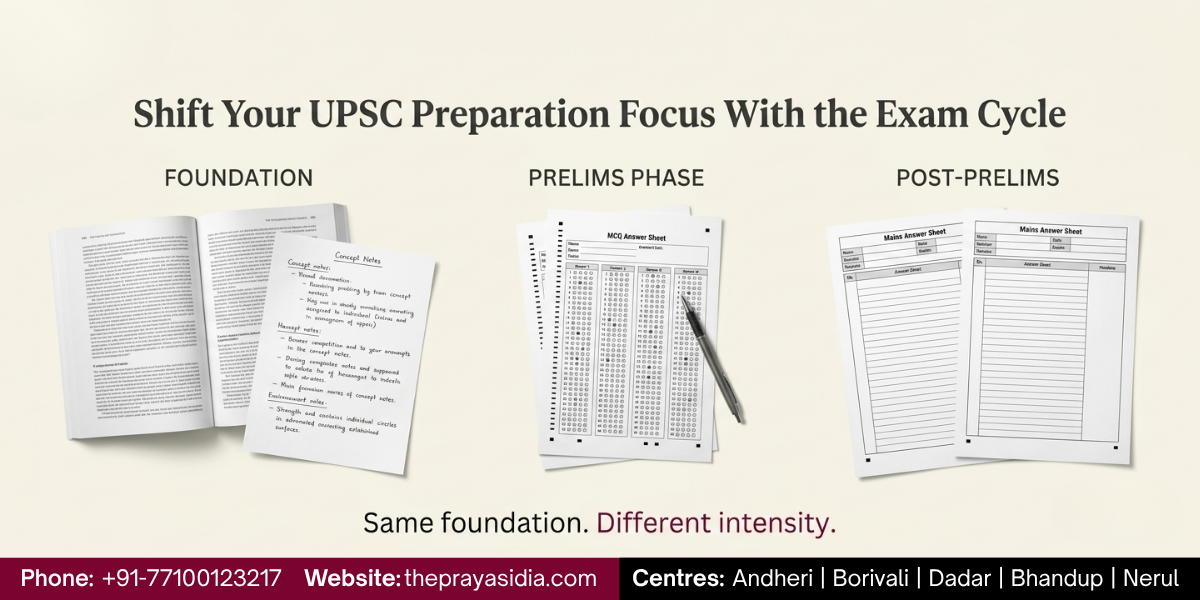
During the foundation stage, aspirants can maintain meaningful exposure to both objective practice and answer writing. As Prelims approaches, objective practice, revision, mock tests and elimination techniques naturally become more important.
After Prelims, the preparation focus needs to move rapidly towards Mains because the available time becomes limited.
This is why aspirants should not ask only, “How many hours should I study for Prelims and Mains?”
A more useful question is:
“What does my current stage require most?”
Your answer may be different three months from now.
Build Subject Knowledge in a Way That Serves Both Stages
An integrated subject strategy begins with understanding rather than memorisation.
Suppose you are studying the Indian Parliament. For Prelims, you should know constitutional provisions, parliamentary procedures, types of motions, committees and relevant institutional details. For Mains, you should additionally understand the role of Parliament in accountability, legislative scrutiny, representation and democratic governance.
Similarly, while studying the Indian economy, objective preparation may require familiarity with concepts such as inflation, monetary policy, fiscal policy and external-sector indicators. Mains preparation requires you to connect those concepts with employment, growth, inequality, welfare, reforms and contemporary policy challenges.
The deeper your conceptual understanding becomes, the easier it is to switch between objective and descriptive questions.
This is particularly important for aspirants who have limited preparation time. Studying every topic twice in completely different ways can create an unnecessarily heavy workload.
Use Current Affairs as a Bridge Between Prelims and Mains
Current affairs should not be treated as a separate subject that you study only through monthly compilations.
Its real value lies in connecting static concepts with contemporary developments.
A major Supreme Court judgment can reinforce your understanding of constitutional principles. A new government scheme can be studied through the lens of governance, welfare delivery and social justice. An environmental development can connect static concepts with current policy, international agreements and ecological challenges.
This makes current affairs useful for both stages.
For Prelims, identify facts, institutions, reports, species, locations, schemes and important provisions.
For Mains, go one step further. Ask:
Why is this important?
What are the underlying challenges?
Who is affected?
What are the broader implications?
What reforms or solutions are possible?
This habit turns current affairs from a memory exercise into analytical preparation.
Don’t Wait Until After Prelims to Learn Answer Writing
One of the most common preparation gaps occurs when aspirants postpone Mains answer writing completely until after Prelims.
The logic seems reasonable: “First I will clear Prelims, then I will prepare for Mains.”
The problem is that Mains requires a different skill set, and writing ability cannot be developed overnight.
You do not need to spend several hours every day writing answers during the early stages of preparation. But regular exposure is valuable.
Even a small number of answers each week can help you learn how to interpret questions, structure introductions, develop arguments, use examples and conclude effectively.
The objective during the foundation stage is not perfection.
It is familiarity.
By the time Prelims approaches, you should have developed enough writing experience that the post-Prelims transition does not feel like starting an entirely new preparation journey.
Build a Prelims-Oriented Practice Layer
While Mains-oriented reading continues, Prelims preparation should gradually develop through objective practice.
Start with topic-wise questions after completing a subject or chapter. This helps identify whether you can apply the concepts you have studied.
Over time, introduce mixed-question practice so that you are no longer relying on the chapter name to tell you which concept is being tested.
Eventually, full-length mock tests become important for evaluating speed, accuracy, question selection and stamina.
However, simply increasing the number of tests is not enough.
Every test should generate useful feedback.
If you repeatedly make errors in questions involving similar concepts, the solution may require conceptual revision. If you know the concept but select the wrong option under pressure, the issue may be interpretation or elimination. If you leave too many questions because of time pressure, your problem may be attempt strategy.
The test is only the measurement.
The improvement comes from the analysis.
Build Mains Preparation Through Thinking, Not Just Writing
Mains answer writing is often misunderstood as simply writing more.
In reality, the quality of thinking determines the quality of writing.
Before writing an answer, you need to identify what the question is asking. A “discuss” question may require multiple dimensions. An “analyse” question demands examination of relationships and implications. An “evaluate” question requires judgement supported by arguments.
Developing this ability starts even before you begin writing full answers.
When reading a topic, practise looking at it from multiple dimensions: social, economic, political, ethical, environmental, administrative, technological and international.
This habit strengthens your ability to generate relevant points under examination pressure.
Use a Common Notes System
Maintaining completely separate notes for Prelims and Mains can make revision cumbersome.
A better approach is to maintain a core set of subject notes and add analytical layers to them.
For example, a topic page can contain:
- Key facts and concepts for Prelims
- Important constitutional or institutional provisions
- Current examples
- Relevant government initiatives
- Major challenges
- Committee or report references
- Possible solutions
- Useful data or case studies
- A few potential Mains angles
The purpose is not to create huge notes.
It is to create high-value revision material.
Your notes should become shorter and more useful with every revision cycle.
Avoid Creating Two Separate Preparation Identities
Aspirants sometimes develop one identity as a “Prelims student” and another as a “Mains student.” This creates unnecessary psychological pressure.
Your preparation should be viewed as one continuous process.
When you study Polity, you are building knowledge that can appear in both objective and descriptive forms.
When you read current affairs, you are building factual awareness as well as analytical context.
When you solve MCQs, you are strengthening application and elimination.
When you write answers, you are learning to express the same knowledge.
This perspective makes the transition between stages smoother and prevents the feeling that clearing Prelims means beginning UPSC preparation all over again.
Where Professional UPSC Coaching Can Add Value
The biggest advantage of structured coaching is not simply access to classes. For many aspirants, the more important benefit is having an organised preparation framework.
Aspirants often struggle with questions such as which resources to follow, how much current affairs to cover, when to begin answer writing, how frequently to take tests and how to revise an expanding syllabus.
Professional guidance can help bring structure to these decisions.
For students evaluating UPSC coaching in Mumbai, the quality of the programme should therefore be assessed beyond classroom teaching. Look at how the institute approaches the Prelims-Mains transition, whether it provides regular assessment, whether answer writing receives meaningful feedback, how current affairs are integrated and whether the overall academic plan supports long-term preparation.
The right coaching environment should complement self-study rather than attempt to replace it.
Admission Decisions Should Be Based on Preparation Needs
UPSC coaching is a significant academic commitment, so the decision to join should be based on what you actually need.
If you are comfortable selecting resources, planning your study schedule, evaluating your performance and getting feedback independently, self-study may work well for you.
If you repeatedly struggle with structure, consistency, answer evaluation, test analysis or deciding how to balance Prelims and Mains, professional guidance may provide meaningful support.
Students considering The Prayas India should evaluate the available UPSC programme according to their own preparation stage, learning requirements and expectations from coaching.
An admission decision should not be based simply on the label of “best coaching.”
It should be based on whether the learning environment can help solve the specific problems you are facing.
Key Takeaway
Balancing UPSC Prelims and Mains preparation does not mean dividing your day mechanically between two examinations.
It means building a common foundation and gradually developing the different skills required by each stage.
During the foundation period, focus on conceptual understanding and integrated notes. Connect static subjects with current affairs, practise objective questions regularly and introduce answer writing early enough to develop familiarity. As Prelims approaches, increase the intensity of objective practice, revision and mock tests without completely disconnecting from Mains-oriented thinking.
The most effective strategy is therefore not Prelims versus Mains.
It is Prelims through strong fundamentals and Mains through deeper application of those fundamentals.
For aspirants considering UPSC coaching in Mumbai, the same principle should guide the admission decision: look for a preparation system that builds continuity between stages rather than treating them as isolated examinations.
The Balance Should Change With Your Preparation Stage
The Prelims-Mains balance should never be treated as a permanent percentage.
An aspirant in the foundation stage may need substantial time for reading, conceptual clarity, basic MCQ practice and introductory answer writing. A candidate who is several months away from Prelims may need a much stronger focus on revision, objective questions and test analysis. Once Prelims is over, the preparation equation changes dramatically because Mains becomes the immediate priority.
This means that a good study plan is dynamic.
Instead of asking whether you should spend 50% of your time on Prelims and 50% on Mains, first identify where you are in the preparation cycle. Then decide which skill currently requires the greatest improvement.
If your conceptual base is weak, more reading and revision may be necessary. If your knowledge is strong but your objective scores are inconsistent, test practice and analysis should take priority. If you perform well in Prelims mocks but struggle to write structured answers, Mains-oriented practice cannot be ignored.
The balance should follow your actual preparation gap, not an arbitrary timetable.
Foundation Stage: Build Knowledge for Both Examinations
In the early phase, the primary objective should be to understand the syllabus and build a dependable knowledge base.
This is the stage where aspirants should avoid excessive resource accumulation. Following multiple books, websites, coaching notes and video channels for the same subject can create the illusion of preparation while making revision increasingly difficult.
Choose reliable resources and work through them thoroughly.
As you study each subject, develop the habit of identifying both factual and analytical dimensions. A topic should ideally generate information that can help you solve an objective question as well as ideas that can eventually be used in a Mains answer.
At this stage, answer writing can remain limited but regular. The purpose is to become comfortable with question interpretation, structure and concise expression rather than trying to produce model answers immediately.
Prelims-Focused Phase: Increase Testing Without Abandoning Mains
As Prelims approaches, the intensity of objective preparation should naturally increase.
Revision cycles become more frequent. Topic-wise MCQs gradually give way to mixed practice and full-length tests. Time management and question selection become more important because knowledge alone does not guarantee a strong Prelims score.
However, completely abandoning Mains preparation can create a problem later.
You do not need to write multiple Mains answers every day during the final Prelims phase. But maintaining some connection with analytical thinking can make the post-Prelims transition easier.
For example, you can continue making short analytical notes from important current affairs or occasionally revise Mains-oriented dimensions of major issues.
The objective is to keep the analytical muscle active without allowing it to consume the time required for Prelims revision and testing.
The Final Prelims Phase Should Be About Consolidation
The last few weeks before Prelims should not become a period of uncontrolled syllabus expansion.
This is the time to consolidate.
Instead of constantly searching for new material, revisit important sources, revise your notes, analyse mock tests and identify recurring weaknesses.
Aspirants often become anxious during this period and start collecting new current-affairs compilations, new test series and additional study material. This can increase uncertainty rather than improve performance.
Your preparation at this point should become narrower and more focused.
The closer you move towards the examination, the more valuable revision quality becomes compared with resource quantity.
Use Mock Tests as Diagnostic Tools
Mock tests should not be treated simply as score-producing exercises.
A low score may reveal weak concepts. A high score may still conceal poor time management or excessive dependence on elimination. A student can even achieve a good score while making several avoidable mistakes.
After every mock, analyse at least four dimensions: knowledge, accuracy, time and decision-making.
Questions you got wrong because you did not know the concept indicate a knowledge gap.
Questions you knew but marked incorrectly indicate an accuracy or interpretation issue.
Questions you could have solved but left because of time indicate a time-management problem.
Questions that consumed several minutes without producing a result may indicate poor question selection.
This analysis helps you decide what to do next rather than simply telling you whether the previous mock was good or bad.
The 24–48 Hours After Prelims Matter
Once Prelims is over, aspirants should avoid spending too much time analysing whether they will qualify based on unofficial answer keys and speculative cut-offs.
The examination is over. Your immediate priority should be preparation for the next stage.
The first step is to organise your Mains resources and return to answer writing quickly.
This does not mean that you should ignore the Prelims experience completely. A brief review of your performance can help identify mistakes for future attempts, but it should not consume several days when Mains preparation time is limited.
The post-Prelims period should therefore be treated as a transition, not a break.
Move Quickly Into Mains Answer Writing
After Prelims, answer writing should become much more intensive.
The challenge is that Mains preparation is not only about remembering information. You need to produce structured responses within a fixed time and word limit.
This requires practice.
Begin with questions from familiar topics so that the focus initially remains on structure and expression. Gradually introduce questions that require multiple dimensions and contemporary examples.
With practice, develop a repeatable answer framework: understand the demand of the question, identify the relevant dimensions, organise the argument logically and finish with a balanced conclusion.
Do not try to make every answer visually elaborate.
Content relevance, clarity, structure and effective use of examples matter more than decorative presentation.
Integrate Examples, Data and Current Affairs Into Mains Preparation
A strong Mains answer becomes more convincing when abstract arguments are supported by relevant examples, data, constitutional provisions, committee recommendations, government initiatives or real-world cases.
However, collecting hundreds of statistics is not the objective.
The goal is to maintain a small bank of reliable and usable examples.
For each major topic, try to remember a few relevant references that can be adapted across questions.
For example, instead of memorising a large collection of unrelated statistics about healthcare, understand a few useful indicators and connect them with issues such as accessibility, affordability, public health infrastructure and human development.
This makes revision easier and improves the practical value of your current-affairs preparation.
Create a Separate Mains Revision Layer
Your Prelims notes may be useful for Mains, but they may not be sufficient on their own.
After completing the major foundation subjects, create a compact Mains-oriented revision layer containing important themes, examples, arguments, government initiatives, committee recommendations and potential solutions.
This layer should be concise.
The closer you get to Mains, the more valuable short, revisable material becomes.
Aspirants often create enormous notes during the preparation period and then discover that they cannot revise them effectively. The better approach is to continuously compress information.
Read broadly.
Understand deeply.
Revise selectively.
Keep Ethics and Optional Preparation in the System
Balancing Prelims and Mains does not mean focusing only on General Studies.
UPSC Mains also includes Essay, Ethics and the Optional Subject, each requiring its own preparation strategy.
Aspirants who postpone these areas until after Prelims may find the post-Prelims period extremely compressed.
The exact distribution will depend on your stage and strengths, but your long-term study plan should ensure that these components do not remain completely untouched for months.
This is another reason integrated planning matters.
A preparation schedule must consider the complete examination rather than allowing one stage or one subject to consume all available time.
Build a Weekly Study System That Can Survive Busy Periods
A practical UPSC timetable should account for the fact that your productivity will not remain identical throughout the year.
Some weeks will be dominated by revision. Others may require more answer writing, mock tests or current affairs.
Instead of creating a timetable that allocates exactly the same amount of time to every activity every day, build weekly priorities.
For example, one week may focus on revising Polity and Economy while maintaining answer writing. Another week may prioritise Environment and current affairs alongside Prelims testing.
This allows your schedule to remain flexible without becoming directionless.
A weekly review at the end of the cycle can help you decide whether your priorities need to change.
Use the “Study–Test–Analyse–Correct” Cycle
Aspirants sometimes separate studying and testing into completely different phases.
A more effective model is cyclical.
Study the concept.
Test your understanding.
Analyse the mistakes.
Correct the weakness.
Then return to testing.
This cycle applies to both Prelims and Mains.
For Prelims, the process may involve studying a topic, solving MCQs, analysing incorrect answers and revising the concept.
For Mains, it may involve studying a theme, writing an answer, identifying structural weaknesses and rewriting or improving the approach.
The value comes from completing the entire cycle rather than stopping after studying or testing.
Avoid Overloading Your Schedule With Coaching Classes
Professional coaching can provide useful structure, but attending more classes does not automatically mean better preparation.
An aspirant needs sufficient time for self-study, revision, practice and test analysis.
This is especially important when evaluating UPSC coaching in Mumbai.
Before taking admission, understand how much time the programme requires outside classroom sessions. Ask whether the schedule leaves enough room for independent study and whether the test programme provides meaningful feedback.
A well-designed coaching system should help you use your time more effectively rather than consuming all of it.
How to Evaluate UPSC Coaching Before Admission
Aspirants often search for the “best UPSC coaching in Mumbai,” but the word best has little meaning without understanding individual requirements.
A better evaluation process begins with specific questions.
Does the programme provide a structured syllabus plan?
How are Prelims and Mains connected?
Is answer writing introduced early?
Are tests conducted regularly?
Is there meaningful performance analysis?
How are doubts addressed?
How is current affairs integrated?
Does the schedule leave adequate time for self-study?
These questions can help you evaluate whether a coaching programme matches your preparation style.
For students considering The Prayas India, admission should similarly be based on the programme’s suitability for your preparation stage, learning needs and expectations rather than on promotional claims alone.
When Coaching Can Be Particularly Useful
Structured UPSC coaching can be valuable for aspirants who struggle to create a consistent study framework independently.
It may also help candidates who find it difficult to identify reliable resources, need regular testing, want feedback on answer writing or require external accountability.
However, coaching is not a replacement for individual effort.
The UPSC examination rewards independent understanding, revision and application. Even with professional guidance, self-study remains central to the preparation process.
The most useful coaching environment is therefore one that makes self-study more organised and productive.
Common Mistakes While Balancing Prelims and Mains
One common mistake is completely ignoring Mains until Prelims.
Another is spending too much time on answer writing when the Prelims examination is very close.
Some aspirants also collect separate resources for every stage, creating unnecessary duplication.
Another frequent problem is treating current affairs as a memory exercise instead of connecting them with static subjects.
Finally, many aspirants keep studying without testing themselves and discover their weaknesses only when the examination is approaching.
Avoiding these mistakes requires a preparation system that changes with the examination cycle.
Final Takeaway
Balancing UPSC Prelims and Mains is not about splitting your study hours into two rigid portions.
It is about creating a common knowledge foundation and gradually changing the way you use that knowledge.
In the foundation phase, prioritise conceptual clarity and integrated notes. Introduce both MCQ practice and answer writing early enough to develop familiarity with their respective demands. As Prelims approaches, shift more time towards revision, objective practice, mock tests and performance analysis while maintaining a limited connection with Mains-oriented thinking.
After Prelims, transition quickly into intensive Mains preparation rather than treating the result period as an extended break.
For aspirants considering UPSC coaching in Mumbai, the same principle applies to the admission decision. Look beyond the number of classes and evaluate whether the programme provides a structured pathway, meaningful testing, answer-writing support, current-affairs integration and sufficient time for self-study.
The ultimate objective is not to prepare separately for two examinations.
It is to develop the knowledge, application, analytical thinking and writing ability required to move successfully through the complete UPSC Civil Services Examination.
Contact Us
- Call Now: +91-77100 13217
- Website: theprayasindia.com
- Centres: Andheri | Borivali | Dadar | Nerul | Bhandup
Frequently Asked Questions
1. Can I prepare for UPSC Prelims and Mains simultaneously?
Yes. Integrated preparation is generally more efficient because many subjects overlap. The intensity of Prelims and Mains preparation should change according to your stage in the examination cycle.
2. When should I start Mains answer writing?
It is useful to introduce answer writing before Prelims rather than waiting until the result. Early practice helps you understand question demands and develop writing structure.
3. Should I stop Mains preparation completely before Prelims?
Not necessarily. Prelims should become the dominant priority as the examination approaches, but maintaining limited Mains-oriented reading or analytical thinking can make the post-Prelims transition smoother.
4. How much time should I devote to Prelims and Mains?
There is no universal ratio. Your allocation should depend on your preparation stage, strengths, weaknesses and proximity to the examination.
5. How can current affairs help both Prelims and Mains?
Current affairs can provide factual information for Prelims and examples, context, data and analytical dimensions for Mains. Connecting current developments with static subjects makes preparation more useful for both stages.
6. Should I take Prelims mock tests while preparing for Mains?
Yes. Regular objective practice and mock tests can help develop speed, accuracy and question-selection skills. The frequency should increase as Prelims approaches.
7. Is answer writing necessary before clearing Prelims?
It is not necessary to spend most of your time on it, but some early practice can be valuable. It reduces the risk of starting Mains answer writing from scratch after Prelims.
8. How should I revise for both Prelims and Mains?
Create concise integrated notes and add a Mains-oriented analytical layer. Revise factual information for Prelims while retaining examples, arguments and contemporary dimensions for Mains.
9. What should I do immediately after UPSC Prelims?
Avoid spending excessive time on speculation about results. Briefly review your performance and begin organising your Mains preparation, including answer writing, Essay, Ethics, Optional and General Studies.
10. Can UPSC coaching help with balancing Prelims and Mains?
A structured coaching programme can help with planning, testing, answer writing and academic direction. However, its usefulness depends on whether the programme fits your individual preparation needs and leaves sufficient time for self-study.
11. What should I check before joining UPSC coaching in Mumbai?
Evaluate faculty, study material, test programmes, answer-writing support, doubt resolution, current-affairs integration, schedule and the amount of self-study required alongside classes.
12. Is The Prayas India suitable for UPSC preparation?
Aspirants considering The Prayas India should evaluate its UPSC programme based on their preparation stage, learning requirements, desired academic support and expectations from coaching before making an admission decision.