How to Build a UPSC Study Plan That Actually Works | Best UPSC CSE Coaching in Mumbai | The Pryas India
Success in UPSC Begins with a System, Not a Timetable.
Every year, thousands of aspirants begin their UPSC Civil Services Examination preparation with remarkable enthusiasm. They purchase recommended books, download toppers’ timetables, subscribe to current affairs magazines, and promise themselves that this attempt will be different. The first few weeks are usually filled with motivation, long study hours, and ambitious goals. However, as the syllabus unfolds and the sheer volume of information becomes apparent, that initial excitement often gives way to uncertainty.
The problem is rarely a lack of dedication. Most aspirants are willing to work hard. What they struggle with is knowing how to organise that hard work. They keep studying every day but remain unsure whether they are moving in the right direction. Some spend excessive time on one subject while ignoring another. Others keep collecting new resources instead of mastering the ones they already have. Many reach the end of a month feeling exhausted, only to realise that they have completed very little of what they originally planned.
The difference between a productive aspirant and a frustrated one is often not intelligence or effort. It is the presence of a well-designed study system. A realistic study plan provides direction, removes unnecessary confusion, and helps students convert daily effort into measurable progress. It acts as a roadmap that connects every study session with the larger goal of clearing the examination.
A successful UPSC preparation strategy is therefore not built around studying for the maximum number of hours. It is built around studying the right topics, in the right sequence, with consistent revision and regular self-evaluation.
The Planning Mistake Almost Everyone Makes
One of the biggest misconceptions about UPSC preparation is that success depends on following an extremely strict timetable. Aspirants often download study schedules from the internet that promise twelve or fourteen hours of daily study. For a few days, these plans appear exciting. They look organised, ambitious, and disciplined.
The problem begins when real life intervenes.
College assignments, office responsibilities, family commitments, health issues, or simply mental fatigue make it impossible to follow such rigid schedules every day. Missing one day’s target creates guilt. That guilt gradually turns into inconsistency, and before long, the carefully designed timetable is abandoned altogether.
The issue is not that the student lacks discipline. The issue is that the timetable was never designed around the student’s own circumstances.
An effective UPSC study plan should adapt to your life instead of forcing your life to adapt to an unrealistic schedule. It should provide flexibility without compromising consistency. Missing a few hours of study should not mean losing an entire week’s momentum.
Planning is not about creating a perfect calendar. It is about creating a system that continues to function even when preparation does not go exactly as expected.
A Year Cannot Be Managed Without a Map
Unlike many competitive examinations that revolve around a limited syllabus, UPSC demands preparation across multiple disciplines. History, Geography, Polity, Economy, Environment, Science and Technology, Ethics, Current Affairs, Essay Writing, and an Optional Subject all compete for your attention at the same time.
Trying to study these subjects randomly usually leads to two common problems. Either students spend several weeks on one subject while neglecting the others, or they keep switching between topics so frequently that nothing is revised properly. In both situations, progress appears visible in daily study sessions but remains weak when viewed over several months.
This is why every serious aspirant needs a study plan that divides the syllabus into manageable stages. Instead of thinking about the entire UPSC syllabus at once, the preparation should be broken into smaller academic milestones. Each milestone should have a clear objective, a realistic completion target, and sufficient time for revision before moving ahead.
A study plan is not meant to make preparation more complicated. Its purpose is to simplify decision-making. When students know exactly what needs to be studied each day, they spend less time wondering where to begin and more time focusing on meaningful learning.
Building a System Instead of a Schedule
Many aspirants use the words study plan and timetable interchangeably, even though they represent two very different ideas.
A timetable tells you when to study.
A study system explains what to study, why it matters, how to revise it, and when to evaluate your progress.
That distinction is what separates consistent preparation from random hard work.
For example, instead of deciding that every morning will be dedicated to Polity, a study system asks additional questions. Which chapter should be completed this week? When will it be revised? How will the concepts be tested? What happens if the target is not achieved? The answers to these questions create a preparation framework that continues working even when small disruptions occur.
Students who build systems rarely panic after an unproductive day because they always know how to recover. Students who depend entirely on rigid schedules often feel that one missed target has ruined the entire plan.
A successful UPSC aspirant does not simply follow a calendar. They follow a structured learning process that keeps moving forward despite occasional setbacks.
Know Where You Are Before Deciding Where to Go
Every UPSC aspirant begins from a different starting point. Some have already completed the NCERTs, while others are opening them for the first time. Some are full-time aspirants, whereas others balance preparation alongside college or a demanding job. A study plan that works exceptionally well for one student may become unrealistic for another.
The first step in building an effective study plan is therefore an honest assessment of your current position. Identify the subjects you are comfortable with, the areas that require additional attention, the number of hours you can study consistently, and the resources you genuinely need. Once these factors become clear, it becomes much easier to create a preparation strategy that is both practical and sustainable.
At The Prayas India, students are encouraged to build personalised preparation plans rather than blindly following generic timetables. With experienced faculty, structured study material, regular mock tests, personalised doubt-solving support, and continuous mentorship, aspirants receive the guidance needed to organise their preparation effectively and maintain consistency throughout the long UPSC journey.
Building the Framework
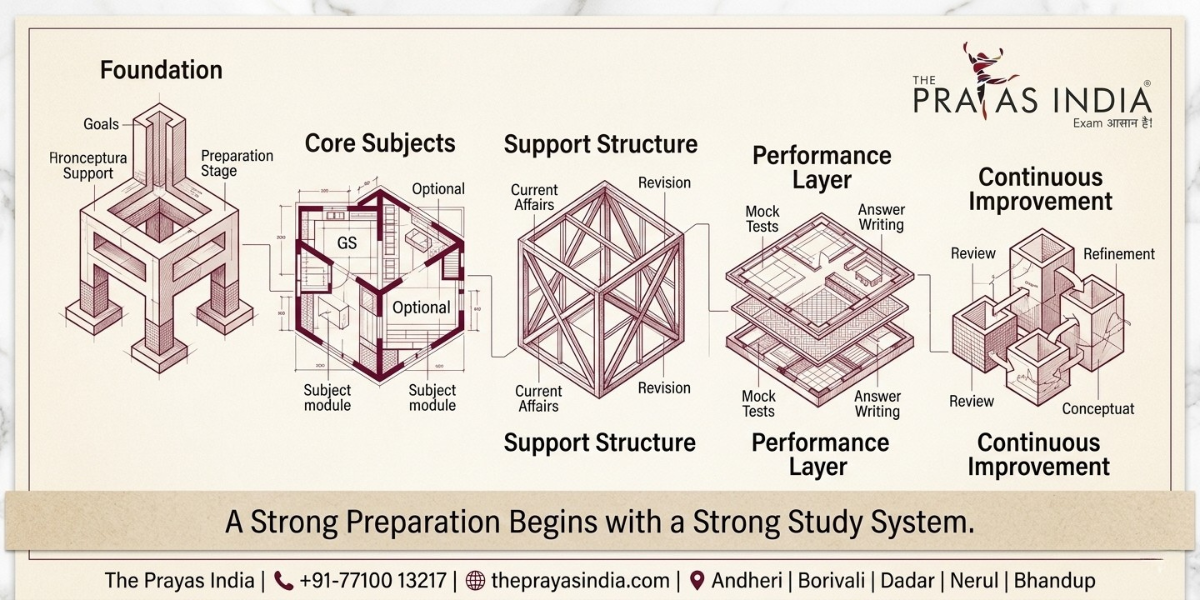
A Study Plan Becomes Effective Only When Every Subject Has a Defined Place.
One of the biggest reasons UPSC aspirants feel overwhelmed is that they try to study everything at once. The syllabus appears endless, current affairs never stop, new books keep getting recommended, and every topper seems to follow a different strategy. In this situation, many students confuse being busy with being productive. They spend long hours studying but struggle to measure real progress because their preparation lacks a structured framework.
A practical UPSC study plan does not attempt to cover the entire syllabus simultaneously. Instead, it divides preparation into manageable components that work together throughout the year. Every subject should have a specific role, every study session should have a clear objective, and every week should move you one step closer to completing the syllabus. Once preparation becomes systematic, students stop worrying about how much is left and begin focusing on what needs to be completed today.
Divide the Syllabus Before You Divide Your Time
Many aspirants create a daily timetable before understanding the syllabus itself. This approach often leads to imbalance because some subjects naturally require more time than others.
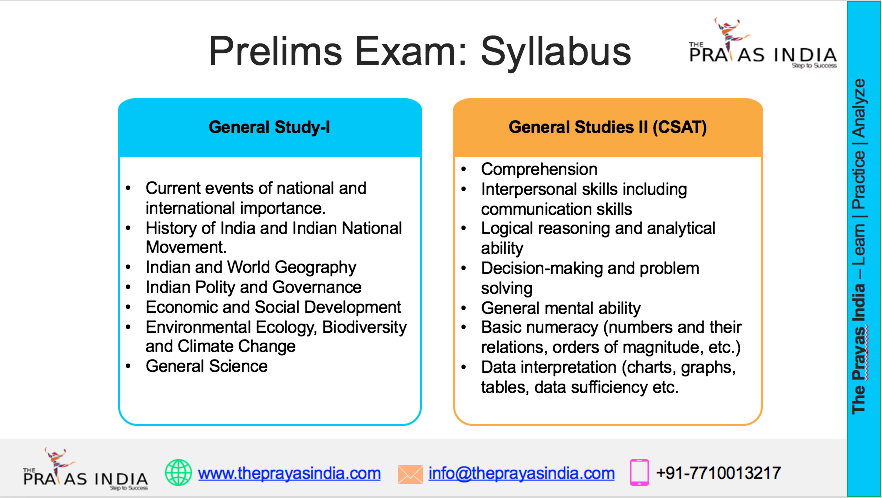
The first step should always be breaking the UPSC syllabus into logical categories. Instead of looking at it as one massive document, organise it into study blocks that can be managed independently.
For example:
- General Studies Foundation – History, Geography, Polity, Economy, Environment, Science & Technology
- Current Affairs – Newspapers, magazines, government reports, monthly compilations
- Optional Subject – Concept building, answer writing, revision
- CSAT – Aptitude, comprehension, reasoning, quantitative practice
- Answer Writing & Essay – Regular practice with feedback
- Revision & Mock Tests – Continuous evaluation and improvement
Once these components are clearly identified, it becomes much easier to distribute your study hours without neglecting any important area.
A study plan built around academic priorities remains stable throughout the year, whereas a plan built around random daily targets usually falls apart after a few weeks.
Resource Management Is More Important Than Resource Collection
One of the most common mistakes in UPSC preparation is believing that more books automatically lead to better preparation.
In reality, excessive resources often create unnecessary confusion.
Aspirants begin with standard books, then purchase additional guides after watching YouTube videos, download multiple PDFs from Telegram channels, subscribe to several current affairs magazines, and finally realise they no longer have enough time to revise what they have already studied.
The problem is not the availability of resources.
The problem is the inability to manage them effectively.
A successful study plan should define what to study before deciding what to buy.
Instead of collecting five different books on the same topic, choose one reliable source, complete it thoroughly, revise it multiple times, and supplement it only where genuinely necessary.
Remember, UPSC rewards conceptual clarity far more than the number of books you own.
Current Affairs Should Become a Daily Habit
Many aspirants postpone current affairs until they finish the static syllabus. Unfortunately, that approach rarely works because current affairs are not a separate subject—they are connected with almost every stage of the examination.
Whether it is Polity, Economy, Environment, International Relations, or Essay Writing, contemporary developments continuously interact with static concepts.
Instead of treating current affairs as an additional burden, integrate them naturally into your daily routine.
A simple approach works remarkably well:
- Read one reliable newspaper consistently.
- Maintain concise digital or handwritten notes.
- Revise weekly instead of waiting for monthly compilations.
- Link every important issue with the relevant static subject.
- Avoid making unnecessarily lengthy notes that are never revised.
Consistency is more valuable than spending several hours on current affairs once every week.
Give Your Optional Subject Equal Importance
Many students spend months focusing entirely on General Studies and postpone their Optional Subject until much later.
This strategy often creates unnecessary pressure because the Optional Subject contributes significantly to the overall Mains score.
An effective study plan ensures that the Optional Subject progresses alongside General Studies rather than competing with it.
Even if the daily study hours allocated to the Optional Subject are comparatively fewer, maintaining regular continuity prevents last-minute panic and allows sufficient time for revision and answer writing later in the preparation cycle.
The objective is balance—not equal hours every day, but consistent progress every week.
Every Week Should Have a Purpose
One reason students lose motivation is that every week begins without a clearly defined objective.
Instead of deciding each morning what to study, plan your week before it begins.
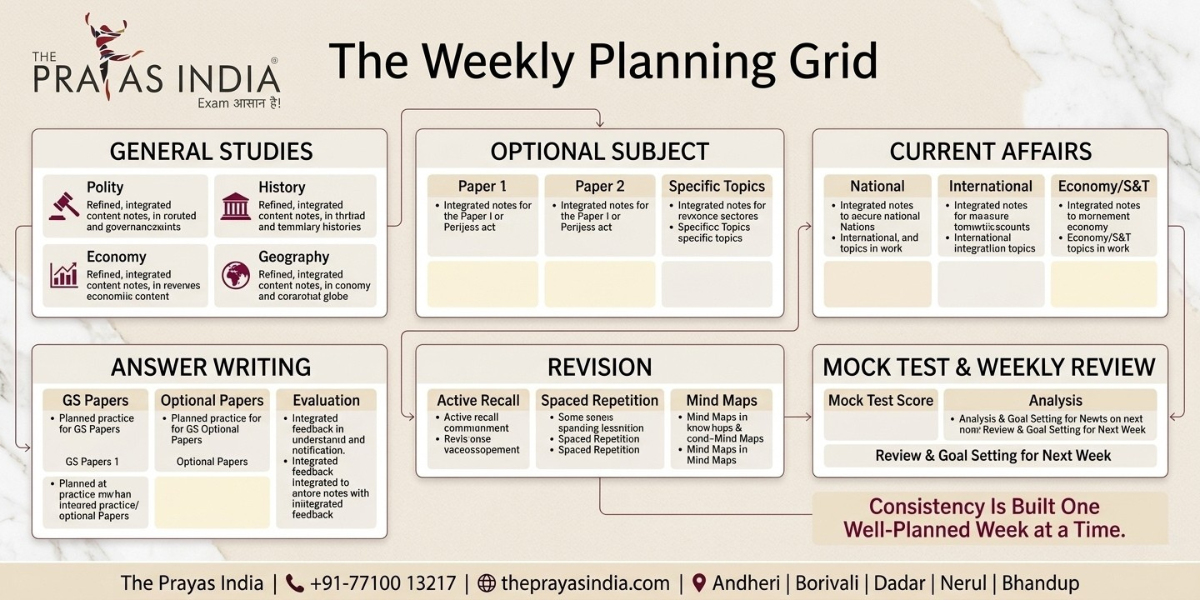
A weekly study framework provides flexibility while maintaining accountability.
A well-balanced week may include:
- Completion of one major General Studies topic.
- Progress in the Optional Subject.
- Daily current affairs.
- Two or three answer-writing sessions.
- One revision block.
- One mock test or sectional practice.
- A weekly performance review.
This approach helps students monitor progress regularly instead of waiting until the end of the month.
Quality of Revision Determines Long-Term Retention
Completing the syllabus once is not enough for UPSC.
Without systematic revision, even well-understood concepts gradually fade from memory.
A practical study plan therefore includes revision from the very beginning rather than leaving it for the final months.
Many successful aspirants follow a simple principle:
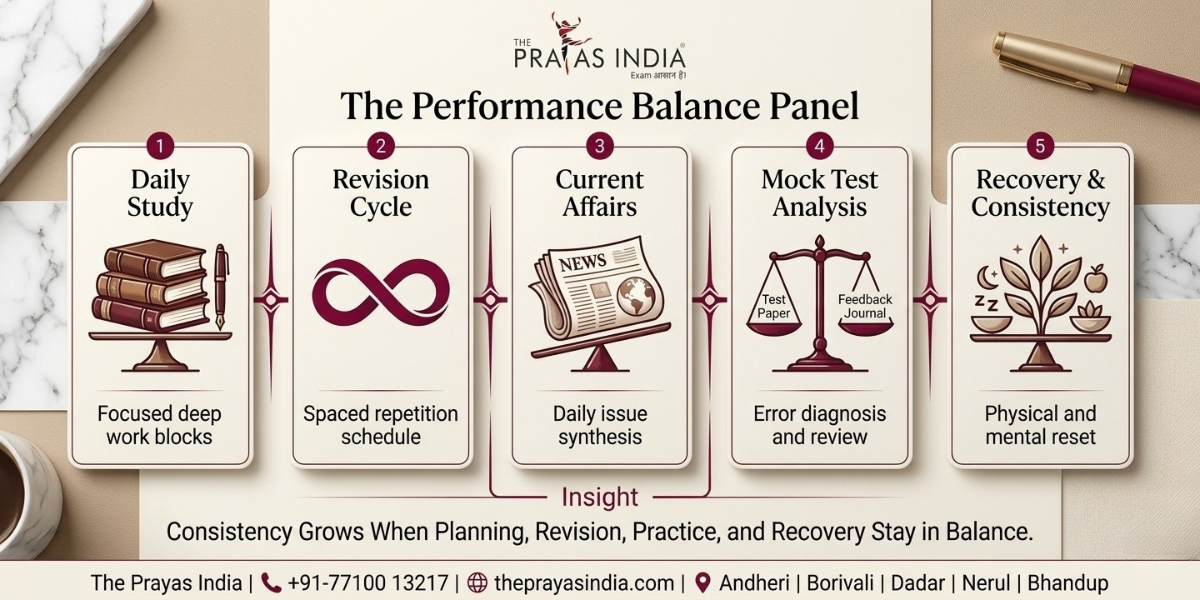
Study → Revise → Practise → Review
This cycle repeats continuously throughout preparation.
Revision should not feel like starting from the beginning every time. Proper notes, highlighted concepts, and organised study material reduce revision time significantly and improve retention before both Prelims and Mains.
Students who revise consistently often feel calmer during the examination because information remains familiar rather than forgotten.
Don’t Measure Progress Only by Study Hours
One of the biggest myths surrounding UPSC preparation is that longer study hours automatically guarantee better performance.
In reality, ten focused hours with a structured plan are often more productive than fourteen unplanned hours filled with distractions and constant switching between subjects.
Instead of asking yourself:
“How many hours did I study today?”
Ask:
- What concepts did I understand?
- What topics did I complete?
- What did I revise?
- What mistakes did I identify?
- What will I improve tomorrow?
Progress should always be measured through learning outcomes rather than the number of hours spent at the study table.
A Structured Plan Creates Consistency
Every aspirant experiences days when motivation is low. There will be weeks when progress feels slow and mock scores fail to improve. During these phases, students who rely only on motivation often lose momentum.
A structured study plan acts as a stabilising system.
Instead of wondering what to study next, students simply follow the process they have already designed. This reduces decision fatigue and allows consistency to continue even during challenging periods.
At The Prayas India, aspirants are guided to build personalised study plans that align with their preparation stage, available study time, and examination goals. Supported by experienced faculty, structured study material, regular mock tests, personalised doubt-solving sessions, and continuous mentorship, students learn how to prepare systematically rather than depending on random daily targets.
Turning Your Plan into Daily Progress
A Great Study Plan Works Only When It Becomes Part of Your Everyday Routine.
Creating a well-structured study plan is an important milestone, but it is only the beginning of the UPSC journey. Many aspirants spend days designing detailed schedules, organising study material, and setting ambitious monthly targets. Yet, after a few weeks, those carefully prepared plans are quietly abandoned.
The reason is simple. Planning feels productive, but execution demands discipline.
A successful UPSC aspirant does not spend excessive time perfecting the timetable. Instead, they focus on building routines that can be followed consistently for months. Small, repeated actions create momentum, and that momentum gradually transforms into confidence.
The objective is not to have the most attractive study planner. The objective is to ensure that every day contributes meaningfully to your overall preparation.
Design a Routine You Can Actually Follow
One of the biggest mistakes aspirants make is copying the daily routine of toppers without considering their own circumstances.
A full-time aspirant, a college student, and a working professional all have different responsibilities. Naturally, their preparation strategies should also be different.
Instead of asking,
“How many hours should I study?”
Ask yourself,
“How many focused hours can I realistically maintain every day for the next twelve months?”
The answer to this question forms the foundation of a sustainable study routine.
A realistic plan always outperforms an ambitious plan that survives for only two weeks.
Your routine should include uninterrupted study sessions, short breaks, revision time, current affairs, and adequate rest. When preparation becomes part of your daily lifestyle rather than a temporary challenge, consistency becomes much easier to maintain.
Revision Should Be Planned, Not Postponed
Many aspirants keep moving from one topic to another without revisiting what they have already studied. Initially, this creates the illusion of rapid progress because the syllabus appears to be moving forward. However, after a few months, previously studied subjects begin to fade from memory.
This is where systematic revision becomes indispensable.
Revision should never be treated as a separate phase that begins after syllabus completion. It should be integrated into your preparation from the very first week.
An effective revision cycle may look like this:
- Revise key concepts within 24 hours of studying them.
- Review the same topic again at the end of the week.
- Conduct a broader revision at the end of every month.
- Revisit important subjects before every mock test.
This layered approach strengthens retention and significantly reduces the pressure of last-minute preparation before the examination.
Students often underestimate how much confidence regular revision creates. Walking into the examination hall becomes far less stressful when concepts have been revised multiple times rather than read only once.
Mock Tests Are Not Merely Performance Checks
Many aspirants judge their preparation solely by mock test scores.
A poor score creates anxiety.
A good score creates temporary satisfaction.
Neither reaction is particularly useful.
The real purpose of a mock test is diagnosis.
It identifies conceptual weaknesses, highlights recurring mistakes, and reveals whether your preparation strategy is actually working.
Every mock test should therefore be followed by detailed analysis.
Ask questions such as:
- Which sections consumed excessive time?
- Which mistakes were conceptual rather than careless?
- Which topics require immediate revision?
- Which questions should have been attempted differently?
- What patterns are repeating across multiple tests?
These answers contribute far more to improvement than simply recording the final score.
The objective is not to collect mock tests.
The objective is to learn from every one of them.
Weekly Reviews Keep Preparation on Track
Imagine driving towards an unfamiliar destination without checking the map even once.
Preparation without regular review works in exactly the same way.
Weekly reviews help aspirants understand whether they are progressing according to plan or gradually drifting away from their targets.
A weekly review does not need to be complicated.
Simply evaluate:
- Topics completed.
- Pending work.
- Revision completed.
- Mock performance.
- Current affairs coverage.
- Weak areas requiring additional attention.
This small habit prevents minor delays from becoming major academic setbacks.
Instead of reacting at the end of the month, students correct their preparation every single week.
Consistency Is More Valuable Than Motivation
Motivation is often celebrated in competitive examinations, but it is one of the least reliable factors in long-term preparation.
Some days you will feel energetic.
Other days you may struggle to complete even a few study sessions.
If your preparation depends entirely on motivation, inconsistency becomes inevitable.
Consistency works differently.
It encourages students to study because the routine already exists, not because they feel inspired on a particular day.
Successful UPSC aspirants rarely wait to feel motivated before opening their books.
They simply follow the process they have built over time.
Eventually, disciplined habits replace emotional decision-making.
That transition marks the beginning of serious preparation.
Avoid Burnout by Planning Recovery
UPSC preparation is often compared to a marathon, and for good reason.
It demands sustained effort over a long period.
Many aspirants mistakenly believe that studying continuously without breaks demonstrates dedication. In reality, prolonged mental fatigue reduces concentration, lowers productivity, and eventually leads to burnout.
A good study plan therefore includes recovery.
Short breaks during study sessions, adequate sleep, moderate physical activity, and occasional relaxation improve learning far more than endless hours at the desk.
Rest should never be viewed as wasted time.
It is part of the preparation process because an exhausted mind cannot perform at its full potential.
Students who learn how to balance discipline with recovery usually remain consistent throughout the entire preparation cycle.
Adapt Your Plan Instead of Abandoning It
No study plan remains perfect for an entire year.
Unexpected situations arise.
Some subjects require more time than expected.
Mock test performance may reveal new weaknesses.
Work schedules may change.
The solution is not to discard the entire plan.
It is to adjust it.
Flexible planning allows aspirants to respond intelligently without losing momentum.
When a strategy is reviewed and refined regularly, preparation continues moving forward even when circumstances change.
The most successful study plans are not the most rigid.
They are the ones that evolve with the student’s progress.
Guidance Makes Execution Easier
Building a study plan independently is possible, but maintaining it consistently over several months is where many aspirants need support.
Experienced mentors help students identify unrealistic goals, improve study balance, prioritise important topics, and modify preparation strategies whenever required.
At The Prayas India, UPSC aspirants receive structured academic guidance throughout every stage of preparation. From personalised study planning and experienced faculty to comprehensive study material, regular mock tests, continuous doubt-solving sessions, and performance reviews, every element is designed to help students remain consistent and focused throughout the long preparation journey.
Rather than leaving aspirants to manage everything alone, the emphasis remains on building a preparation system that continues delivering results month after month.
Making Your Study Plan Work Until the Final Examination
A Successful UPSC Journey Is Built on Consistency, Reflection, and Continuous Improvement.
Creating a study plan is often the easiest part of UPSC preparation. Following that plan with discipline for several months is where the real challenge begins. As the examination approaches, many aspirants start questioning whether they have covered enough, revised sufficiently, or chosen the right strategy. These doubts are natural, but they should never become the reason for abandoning a structured preparation process.
An effective study plan is not judged by how impressive it looks on paper. It is judged by how well it helps you progress every single week. Every completed chapter, every revision session, every mock test, and every improvement made after analysing mistakes contributes to the final outcome. Success in UPSC is rarely the result of extraordinary effort on a single day. It is usually the outcome of ordinary efforts repeated consistently over a long period.
The final phase of planning should therefore focus less on adding new resources and more on strengthening the system you have already built.
Common Study Planning Mistakes That Slow Down Preparation
Even sincere aspirants sometimes make planning mistakes that reduce the effectiveness of their preparation. Recognising these issues early can save months of unnecessary effort.
Some of the most common mistakes include:
- Constantly changing study plans after watching topper interviews or strategy videos.
- Purchasing new books before completing the existing resources.
- Ignoring revision while focusing only on syllabus completion.
- Studying according to mood instead of following a structured routine.
- Measuring productivity only through study hours instead of actual learning.
- Avoiding mock tests until the syllabus is fully completed.
- Neglecting physical and mental well-being during long preparation phases.
None of these mistakes appear serious in isolation. However, when repeated over several months, they create inconsistency and reduce overall preparation quality.
The objective should always be steady improvement rather than constant experimentation.
Your Study Plan Should Evolve with Your Preparation
A study plan created on the first day of preparation cannot remain unchanged until the examination.
As your understanding improves, your priorities also change.
During the initial months, the emphasis should remain on concept building and syllabus coverage. Once the fundamentals become stronger, more time should gradually shift towards answer writing, revision, mock tests, and performance analysis.
This evolution is a sign of progress.
Students often assume that modifying their study plan means they failed to create a good one. In reality, refinement is an essential part of long-term preparation.
The best study plans are flexible enough to respond to changing academic needs without losing their overall structure.
Frequently Asked Questions
Should I prepare all subjects every day?
Not necessarily. A balanced weekly plan is generally more practical than trying to study every subject daily. The important point is ensuring that no major subject remains neglected for an extended period.
How many hours should I study for UPSC every day?
There is no universally correct number. The ideal study duration depends on your preparation stage, background, and personal responsibilities. Consistent, focused study sessions are significantly more valuable than extremely long hours that cannot be maintained.
When should I start answer writing practice?
Answer writing should begin once the basic conceptual foundation has been developed. Waiting until the final months often leaves insufficient time to improve structure, presentation, and analytical thinking.
How often should I revise?
Revision should be integrated into your study plan from the beginning. Weekly, monthly, and subject-wise revision cycles improve retention and reduce pressure before both Prelims and Mains.
Can self-study alone be enough?
Many aspirants have succeeded through self-study. However, structured guidance, regular feedback, mentorship, and performance evaluation often make preparation more organised and help students avoid common mistakes that consume valuable time.
A Practical UPSC Study Plan Checklist
Before moving into the intensive phase of preparation, ensure that your study plan answers the following questions.
Planning
✓ Have I divided the syllabus into manageable stages?
✓ Have I selected limited and reliable study resources?
✓ Have I created realistic weekly targets?
Learning
✓ Am I building conceptual understanding instead of memorising facts?
✓ Am I giving adequate time to my Optional Subject?
✓ Am I integrating Current Affairs with static subjects?
Revision
✓ Is revision included every week?
✓ Are my notes concise and easy to revise?
✓ Do I revisit previously studied topics regularly?
Evaluation
✓ Am I attempting mock tests consistently?
✓ Do I analyse every mock test thoroughly?
✓ Am I modifying my strategy based on performance?
Consistency
✓ Can I realistically follow this study plan for several months?
✓ Does my routine include sufficient recovery and rest?
✓ Am I improving steadily instead of comparing myself with others?
If your answer to most of these questions is “Yes,” your preparation is moving in a healthy direction.
Why Structured Guidance Makes Planning More Effective
A study plan provides direction, but maintaining that direction throughout the UPSC journey often requires experienced academic support. As preparation progresses, students encounter conceptual difficulties, fluctuating mock scores, changing priorities, and moments of self-doubt. During these phases, timely guidance helps aspirants make informed adjustments instead of making impulsive decisions.
At The Prayas India, UPSC preparation is designed around structured learning rather than isolated study sessions. Students benefit from experienced faculty, comprehensive study material, regular mock tests, personalised doubt-solving sessions, answer-writing guidance, continuous mentorship, and performance reviews that help them stay focused throughout the preparation cycle. Instead of following generic strategies, aspirants receive academic support that adapts to their individual progress and long-term goals.
The objective is not simply to help students complete the syllabus. It is to help them build a preparation system that remains effective from the first day of study until the final examination.
Final Thoughts
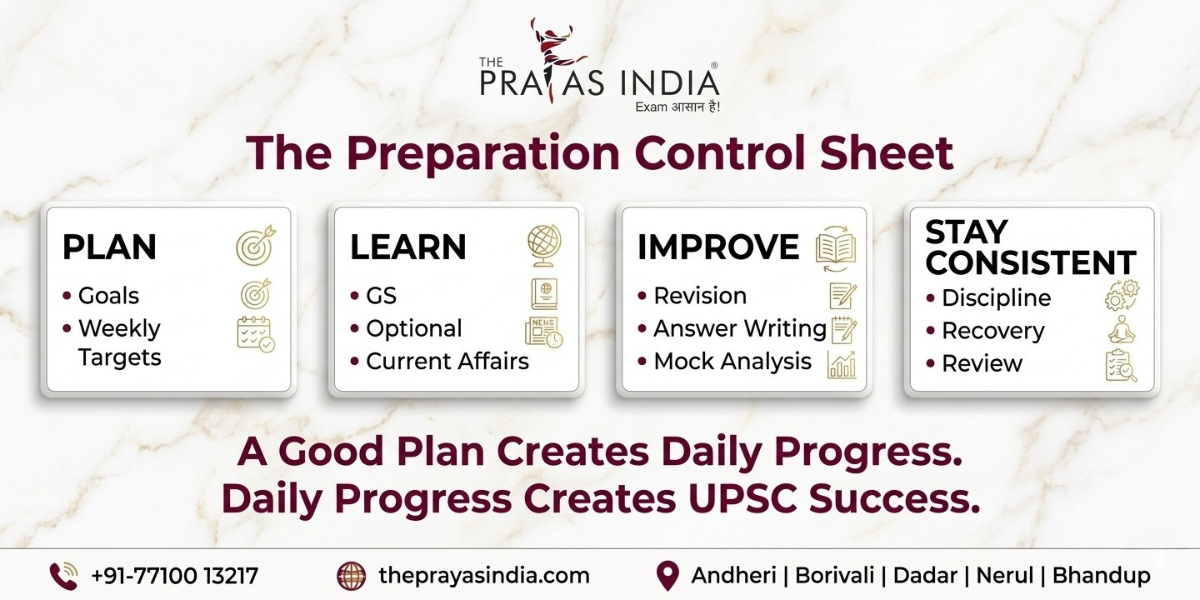
Building a UPSC study plan is not about creating the perfect timetable—it is about creating a preparation system that you can follow consistently for months. The aspirants who succeed are not always those who study the longest or collect the most resources. More often, they are the ones who maintain discipline, revise regularly, analyse their performance honestly, and continue improving one step at a time.
Remember that your study plan is a living framework. Review it, refine it, and adapt it as your preparation evolves, but never lose sight of the larger goal. Every focused study session, every thoughtful revision, and every lesson learned from a mock test brings you closer to success.
Prepare with clarity, stay consistent, and trust the process. A structured plan followed with commitment can transform preparation into performance.
Ready to begin your UPSC CSE journey with expert guidance?
📞 Call: +91-77100 13217
🌐 Website: https://theprayasindia.com