How to Choose the Best UPSC Coaching in Mumbai: A Practical Guide for Serious Aspirants | The Prayas India
Preparing for the UPSC Civil Services Examination is not simply about studying for more hours. The real challenge is knowing what to study, how to study, what to revise and how to measure your progress.
For an aspirant in Mumbai, choosing the right coaching institute can therefore become an important part of the preparation strategy. There are several institutes offering UPSC courses, but every institute may not provide the same level of academic guidance, mentorship, testing or individual attention.
So, instead of asking only “Which is the best UPSC coaching in Mumbai?”, a better question is:
“Which UPSC coaching institute offers the right preparation system for my goals?”
This distinction is important because UPSC preparation is a long-term process. The right institute should not merely help you complete the syllabus. It should help you develop the skills required to perform well in Prelims, Mains and eventually the Personality Test.
Why Choosing the Right UPSC Coaching Matters
The UPSC syllabus covers a wide range of subjects, from History, Geography and Polity to Economy, Environment, Ethics, Essay and Current Affairs.
A beginner can easily become overwhelmed by the amount of available information.
One source recommends a particular book. Another suggests a different newspaper. Multiple websites provide current-affairs material, while social media adds even more preparation content.
This often leads to a common problem:
Too many resources, but no clear preparation direction.
A good UPSC coaching programme can help solve this problem by providing a structured learning path.
Instead of spending weeks deciding what to study, an aspirant can focus on:
Learn → Practise → Test → Analyse → Improve → Revise
That structure can be particularly useful for first-time aspirants who are still learning how UPSC works.
Evaluate the Faculty Before Taking Admission
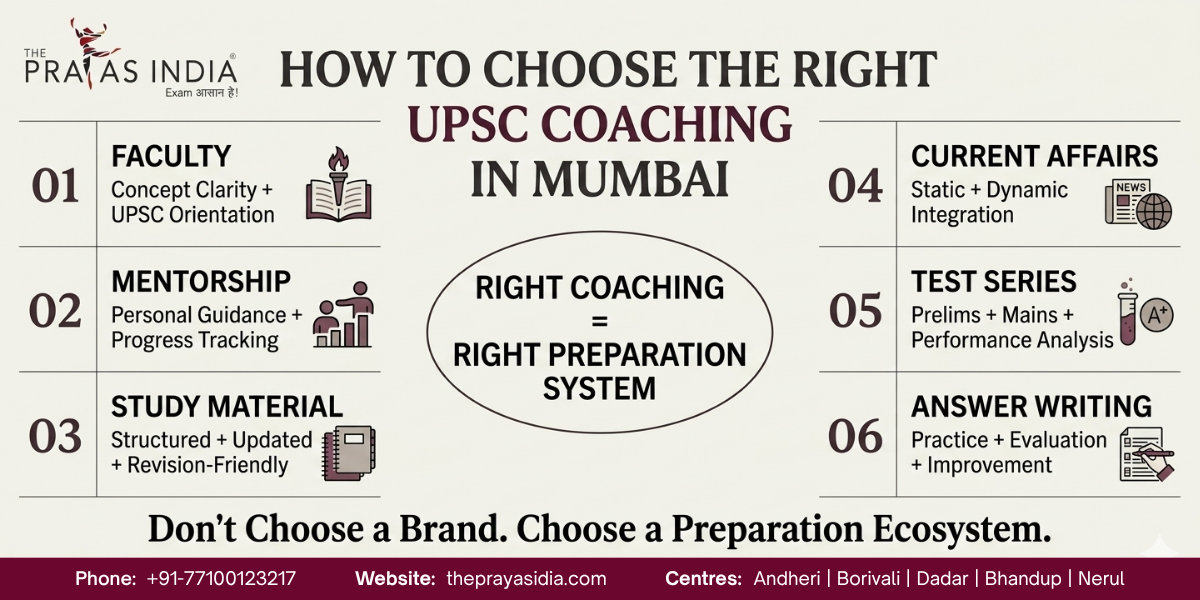
Faculty quality should be one of the first things you evaluate when comparing UPSC coaching in Mumbai.
A good UPSC teacher should do more than explain textbook concepts. The teaching should be connected to the actual requirements of the Civil Services Examination.
For every major topic, students should ideally understand:
- What is important for Prelims?
- What requires deeper understanding for Mains?
- How does the topic connect with current affairs?
- How has UPSC approached similar topics in previous years?
- How can the topic be used in an answer?
For example, studying Parliament should not be limited to memorising constitutional provisions. A serious aspirant should also understand parliamentary committees, legislative accountability, parliamentary disruptions, important constitutional provisions and contemporary debates.
This is what makes UPSC-oriented teaching different from simply completing a textbook.
What should you check?
Before joining an institute, attend a demo class if possible.
Pay attention to:
Concept clarity: Is the topic being explained in a simple and logical manner?
Exam orientation: Is the discussion connected to UPSC requirements?
Current-affairs integration: Are contemporary examples being used?
Doubt resolution: Can students ask questions and receive proper explanations?
The objective is not to find the most entertaining classroom.
It is to find faculty who can make complex subjects easier to understand and easier to revise.
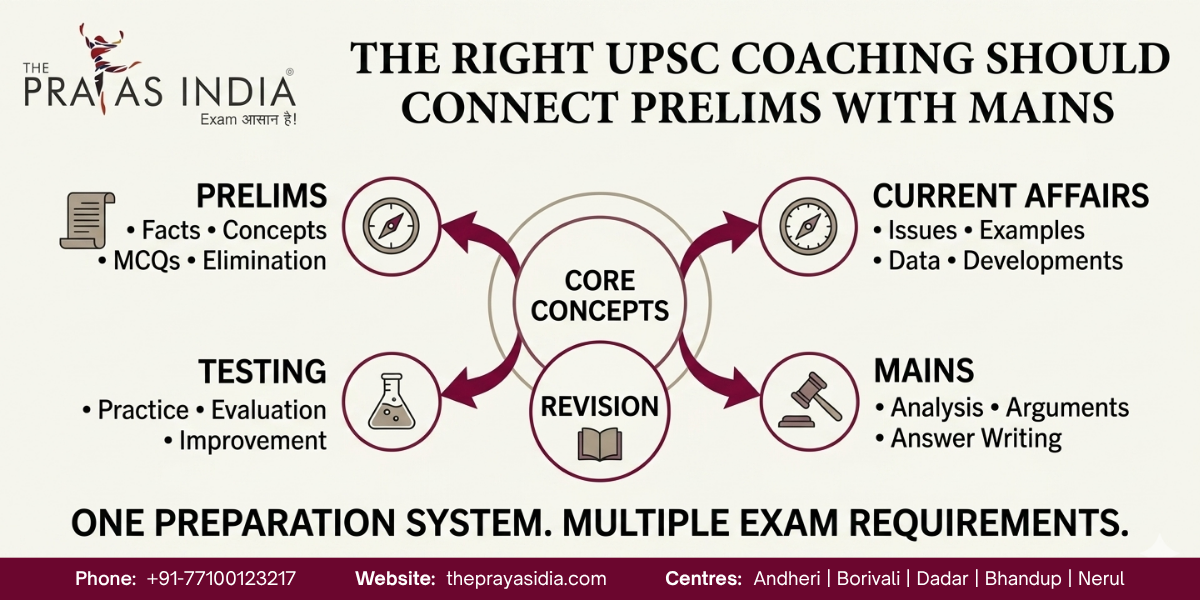
Look for an Integrated Prelims and Mains Strategy
One of the common mistakes made by beginners is treating Prelims and Mains preparation as two completely separate journeys.
They are different stages, but preparation can be integrated.
For example, while studying Indian Economy, you can simultaneously build:
- Prelims conceptual knowledge
- Current-affairs understanding
- Mains analytical perspective
- Answer-writing content
Similarly, studying Environment can involve both factual preparation for Prelims and analytical preparation for Mains.
A strong coaching programme should therefore provide a clear connection between:
Prelims + Mains + Current Affairs + Answer Writing + Testing
This approach can reduce duplication of effort and make revision more efficient.
The Prayas India’s UPSC programmes currently include integrated components such as Prelims GS and CSAT, Mains GS, Essay, answer writing and test series, depending on the programme. This type of integrated structure is useful for aspirants who want to prepare systematically rather than study each stage in isolation.
Check the Quality of Study Material
UPSC preparation does not require collecting every book, PDF and magazine available online.
In fact, excessive study material can become a problem.
The more sources you collect, the more difficult revision becomes.
Before joining a Best UPSC Coaching in Mumbai, check whether the institute provides study material that is:
Structured
The content should follow the UPSC syllabus rather than presenting information randomly.
Updated
Important current developments should be incorporated where relevant.
Concise
The material should help you focus on important concepts instead of increasing your reading burden.
Revision-Friendly
You should be able to revisit the material multiple times before the examination.
PYQ-Oriented
Previous-year questions should help you understand the type and depth of questions UPSC asks.
The purpose of coaching material should not be to replace every standard source.
Instead, it should help students organise their preparation and reduce unnecessary resource hunting.
Don’t Ignore Current Affairs Support
Current affairs are an important component of UPSC preparation, but reading the news alone does not guarantee useful preparation.
The real skill is understanding how current events connect with the static syllabus.
Suppose a major development takes place in India’s foreign policy.
An aspirant should be able to connect it with:
International Relations → India’s strategic interests → Neighbourhood Policy → Global institutions → Current Affairs → Mains Answer Writing
Similarly, a new environmental policy can be studied from multiple perspectives:
Environment + Governance + Economy + Sustainable Development + Current Affairs
This is why current-affairs guidance should be evaluated before taking admission.
Look for an institute that provides:
- Daily current affairs
- Editorial analysis
- Prelims-oriented current affairs
- Mains-oriented issue analysis
- Current-affairs quizzes
- Current-affairs-based answer writing
- Regular revision
The goal should be to convert current affairs from a daily information load into usable UPSC content.
Mentorship Can Make a Major Difference
Books and lectures provide information.
Mentorship provides direction.
This becomes particularly important because UPSC preparation rarely follows a perfectly straight path.
An aspirant may perform well in one subject but struggle in another. Someone may understand concepts but score poorly in tests. Another student may write good answers but struggle with time management.
A useful mentorship system should help identify these problems early.
Before joining an institute, ask:
- Is there a dedicated mentor?
- Are student performances reviewed?
- Can students discuss their preparation strategy?
- Are doubts addressed regularly?
- Is feedback provided after tests?
- Can students get guidance when they fall behind?
The Prayas India currently highlights personalised mentorship, progress tracking and doubt resolution within its UPSC preparation programmes.
For a long examination cycle, this type of academic support can help an aspirant avoid making the same preparation mistakes repeatedly.
Evaluate the Test Series Before You Enrol
A UPSC coaching institute may have good classrooms and experienced faculty, but your preparation still needs regular testing.
Tests tell you whether you can apply what you have studied under examination conditions.
For Prelims, regular tests help improve:
- Accuracy
- Elimination techniques
- Question selection
- Time management
- Revision
- Pressure handling
For Mains, tests help develop:
- Answer structure
- Analytical thinking
- Content selection
- Time management
- Introduction and conclusion
- Presentation
However, don’t judge a test series only by the number of tests.
Ask a more important question:
How useful is the evaluation?
Writing 50 tests without understanding your mistakes may not produce the improvement you expect.
A good test programme should help you identify:
What went wrong → Why it went wrong → How to improve it → How to avoid repeating it
This feedback loop is an important part of serious UPSC preparation.
When comparing UPSC coaching in Mumbai, therefore, ask about the frequency of tests, evaluation process, feedback mechanism and performance tracking.
Answer Writing Should Begin Early
Many aspirants make the mistake of postponing Mains answer writing until after Prelims.
That can make the transition to Mains extremely difficult.
UPSC Mains requires candidates to present information in a structured, analytical and time-bound manner.
Knowing the answer is only one part of the process.
You also need to know:
- How to interpret the question
- What the demand of the question is
- What points to include
- How to structure the answer
- How much detail is appropriate
- How to use examples and data
- How to conclude effectively
A good coaching programme should provide regular opportunities to practise answer writing and receive feedback.
The objective isn’t simply to write more.
It is to write better with every test.
Consider Batch Size and Individual Attention
Batch size is another factor worth considering before taking admission.
A very large classroom may provide good infrastructure, but students should also consider how much interaction they will actually receive.
Ask:
Can I ask questions during or after class?
Will my answers be evaluated?
Can I interact with mentors?
Will my performance be tracked?
How accessible are faculty members?
Individual attention doesn’t necessarily mean that every class must have a very small number of students.
What matters is whether the institute has a system that allows students to receive academic support when they need it.
For a long-term examination like UPSC, this support can become especially valuable when an aspirant starts struggling with consistency or test performance.
Compare the Complete Course, Not Just the Fee
Course fees naturally matter when selecting a UPSC coaching institute.
However, comparing institutes purely on price can sometimes give you an incomplete picture.
A course may appear affordable initially but require students to purchase additional resources for:
- Test series
- Current affairs
- Answer evaluation
- Mentorship
- Additional study material
- Essay preparation
Therefore, before taking admission, ask what is actually included in the programme.
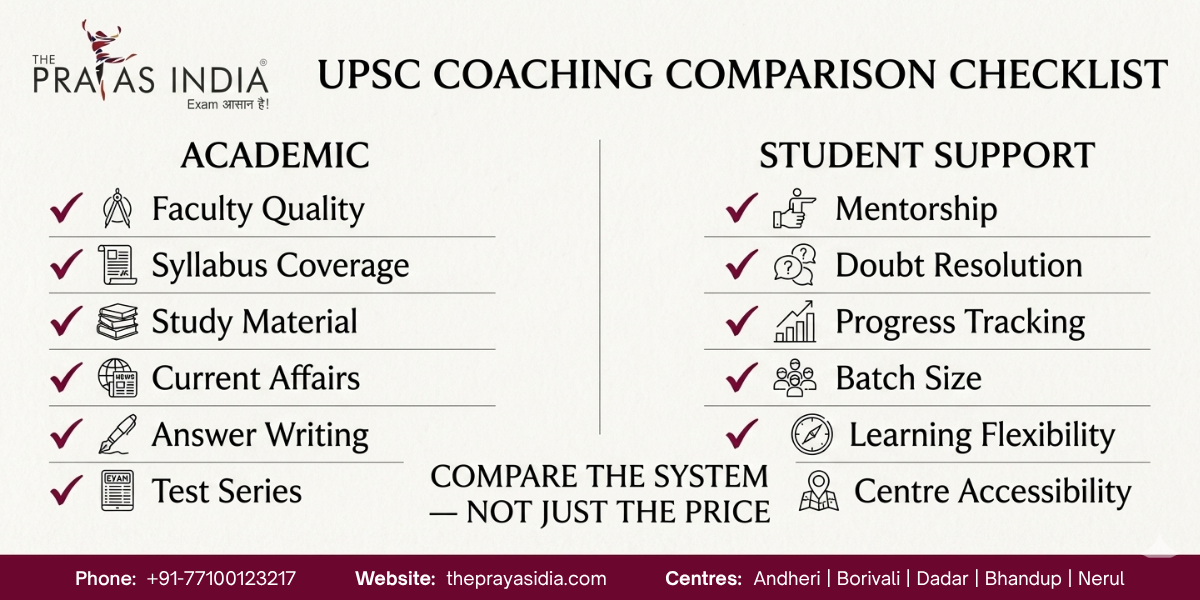
Compare:
Course Coverage
Study Material
Current Affairs
Prelims Tests
Mains Tests
Answer Evaluation
Mentorship
Doubt Resolution
Interview Guidance
Online/Offline Support
The objective should be to identify the overall value of the programme, rather than simply choosing the lowest fee.
Location and Learning Flexibility Matter in Mumbai
Mumbai’s travel time can have a direct impact on an aspirant’s daily routine.
If you are attending classroom coaching, consider how easily you can travel to the centre without sacrificing several hours every day.
At the same time, location should not become the only deciding factor.
A coaching centre five minutes away may not necessarily be the right academic choice.
Evaluate:
Location + Faculty + Mentorship + Tests + Study Material + Learning Support
as one complete package.
For students who are simultaneously pursuing college or employment, flexibility can be particularly important.
Check whether the institute offers suitable classroom schedules and online learning support where applicable.
The Prayas India currently offers UPSC preparation through offline and online formats, with programmes designed for different stages of aspirants.
Attend a Demo Class Before Taking Admission
A demo class can tell you more about an institute’s teaching style than a brochure.
But don’t judge the demo class only by whether you enjoyed it.
Observe the actual teaching process.
Is the explanation structured?
Does the teacher build the topic step by step?
Is the content UPSC-oriented?
Does the faculty connect the topic with the syllabus and examination?
Are examples relevant?
Does the teacher use current developments and previous-year questions effectively?
Can beginners follow the class?
This is particularly important if you are attempting UPSC for the first time.
Are questions encouraged?
A good classroom should allow students to clarify their doubts.
After the demo, ask yourself:
“Can I realistically learn this subject in this teaching environment for several months?”
If the answer is yes, the institute deserves further consideration.
Speak to Current Students Before Joining
Promotional material can tell you what an institute offers.
Current students can tell you how the system actually works.
If possible, speak to students and ask specific questions instead of simply asking whether they “like the institute.”
For example:
- How responsive are the mentors?
- How frequently are tests conducted?
- How is answer writing evaluated?
- Are doubts resolved quickly?
- Is the study material manageable?
- Are classes regular?
- How much self-study is expected?
- How useful are current-affairs sessions?
One review should never determine your decision.
Instead, look for consistent patterns in student experiences.
Don’t Choose an Institute Only Because of Its Results
Results are certainly an important factor when evaluating UPSC coaching.
However, they should not be the only factor.
A result advertisement cannot tell you the complete preparation journey of a student.
Instead of asking only:
“How many selections did the institute produce?”
also ask:
“What preparation system does the institute provide?”
Look at the academic infrastructure behind the result:
- Faculty
- Mentorship
- Test series
- Answer evaluation
- Current affairs
- Study material
- Student support
- Performance tracking
Your goal should be to find a coaching system that can support your preparation, not simply an institute with impressive promotional numbers.
Understand What Happens After You Join
Before paying the admission fee, ask the institute to explain the complete preparation journey.
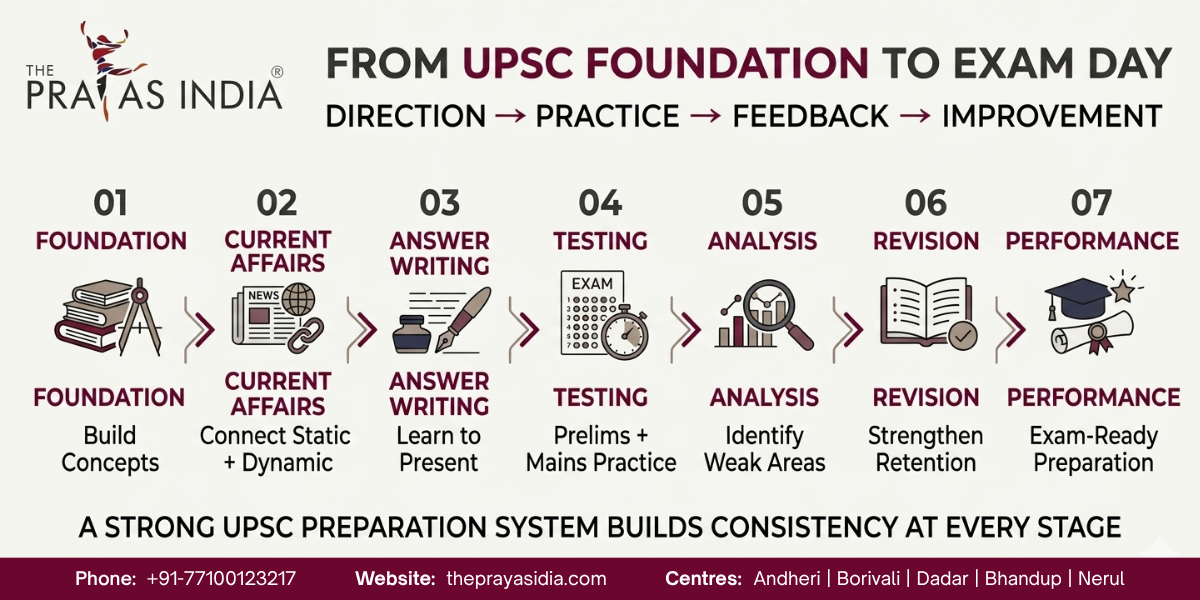
Ideally, the process should have a clear progression:
Foundation
↓
Concept Building
↓
Current Affairs
↓
Answer Writing
↓
Sectional Tests
↓
Full-Length Tests
↓
Performance Analysis
↓
Revision
↓
Prelims
↓
Mains
↓
Interview
This gives an aspirant clarity about what the next stage of preparation will look like.
The Prayas India’s current UPSC programmes cover different components of the Civil Services preparation journey, including Prelims, Mains, current affairs, answer writing, test series, mentorship and interview-oriented guidance.
This integrated structure can be useful for aspirants who prefer having a defined preparation roadmap instead of managing every stage independently.
Why The Prayas India Can Be Considered for UPSC Preparation
For aspirants searching for the Best UPSC Coaching in Mumbai, the final decision should come down to the quality and structure of the preparation system.
The Prayas India offers UPSC programmes that combine classroom/online learning with components such as:
- Prelims preparation
- Mains preparation
- Current affairs
- Answer writing
- Test series
- Study material
- Mentorship
- Performance tracking
This approach is particularly relevant for students who want more than classroom lectures and prefer a structured preparation ecosystem.
For beginners, the right foundation can help establish a consistent study routine.
For more experienced aspirants, testing, answer evaluation and mentorship can help identify gaps in preparation.
The important point is to select a programme according to your current level, target attempt and preparation requirements.
Five Questions to Ask Before Taking UPSC Admission
Before making the final decision, ask yourself these five questions:
1. Will I understand the teaching?
A good faculty should make complex subjects easier, not more confusing.
2. Will I receive enough guidance?
A structured mentorship system can help you identify problems before they become major gaps.
3. Is Prelims and Mains preparation properly integrated?
Your preparation should build knowledge that can be used across stages.
4. Will my performance be regularly tested?
Without testing, it is difficult to know whether your preparation is actually improving.
5. Can I follow this system for the long term?
UPSC preparation requires consistency. The best course is one that you can realistically follow.
Conclusion
Choosing the Best UPSC Coaching in Mumbai should be treated as an academic decision, not an impulsive purchase.
Don’t choose an institute only because of its advertisements, location, fee or result claims.
Instead, evaluate the complete preparation ecosystem:
Faculty → Study Material → Current Affairs → Mentorship → Answer Writing → Test Series → Performance Analysis
Attend a demo class. Compare programmes. Speak with students. Understand what is included in the course. Most importantly, check whether the institute’s teaching and support system matches your target attempt and preparation level.
For serious aspirants, the right coaching should provide more than lectures.
It should provide direction, discipline, practice, feedback and a structured path towards the examination.
If you are evaluating UPSC coaching in Mumbai, The Prayas India can be considered as an option for aspirants looking for integrated Prelims and Mains preparation with current-affairs support, answer-writing practice, testing and mentorship.
Ultimately, there is no single coaching institute that is automatically the “best” for every aspirant.
The best choice is the institute whose faculty, preparation system, mentorship and academic support fit your UPSC journey.
Make that decision carefully — because the right preparation environment can save you months of confusion and help you focus on what actually matters: consistent preparation and measurable improvement.
Contact Us
- 📞 Call Now: +91-77100 13217
- 🌐 Website: theprayasindia.com
- 📍 Centres: Andheri | Borivali | Dadar | Nerul | Bhandup