How to Choose the Right CSE 2027 Programme | Best UPSC CSE Coaching in Mumbai | The Prayas India
Choosing a UPSC CSE 2027 programme is not simply a matter of comparing course fees, lecture hours or the number of study materials included in a package. For a serious aspirant, the more important question is whether the programme can provide a structured preparation system that remains useful across the different stages of the Civil Services Examination.
The UPSC journey requires candidates to move from conceptual learning to objective practice, analytical answer writing, revision, testing and eventually personality-test preparation. The official examination framework itself is designed around different stages and different competencies. A programme that focuses only on completing General Studies lectures may therefore leave important parts of the preparation to the candidate.
For CSE 2027 aspirants, this decision becomes even more important because there is still enough time to build a strong foundation, but not enough time to prepare without a clear direction. The right programme should help you use this preparation window intelligently rather than simply giving you more content to consume.
Start With Your Own UPSC Preparation Profile
Before comparing coaching programmes, understand what kind of aspirant you are. The right programme for a college student beginning from scratch may not be the right programme for someone who has already completed one cycle of UPSC preparation. Similarly, a working professional may require a different schedule and delivery format from a full-time aspirant.
This is the first filter that should be applied when evaluating a CSE 2027 programme. Instead of asking, “Which coaching is the best?”, start by asking, “Which type of programme matches my present preparation level and the amount of time I can realistically commit?”
Consider factors such as:
- Are you preparing for UPSC for the first time?
- Have you already covered NCERTs or standard books?
- Have you attempted Prelims before?
- Is your Mains answer writing already developed?
- Have you finalised your Optional Subject?
- Are you a full-time aspirant, college student or working professional?
- Do you need classroom accountability or can you maintain discipline independently?
- Do you need complete GS + CSAT preparation or only selected components?
This self-assessment prevents one of the most common mistakes in coaching selection: choosing a programme because it appears comprehensive without checking whether it actually fits your preparation stage.
The Programme Should Fit the Aspirant, Not the Other Way Around
A good UPSC programme should give an aspirant a realistic route from their current level to the examination. If a beginner is placed into an advanced test-heavy programme without adequate conceptual support, the candidate may struggle. On the other hand, an experienced aspirant who spends another year only listening to basic lectures may lose valuable preparation time.
The programme structure should therefore be evaluated in relation to your starting point. A useful course should answer three questions clearly: Where am I starting from? What will I cover? How will my performance be monitored before the examination?
This is particularly important for CSE 2027 because the examination demands preparation across Prelims and Mains rather than isolated subject completion. A programme that integrates learning, practice, analysis and revision can provide a more coherent preparation journey.
Look Beyond the Number of Lectures
One of the easiest ways to compare coaching programmes is to compare lecture hours. However, lecture quantity alone does not tell you whether a programme is effective.
A programme may advertise hundreds of hours of classes, but the more important question is what happens before and after those classes. Are concepts connected to the syllabus? Are previous year questions discussed? Are students given opportunities to practise? Are answers evaluated? Is there structured revision? Are doubts addressed? Is performance monitored?
The value of a UPSC programme comes from the system surrounding the classroom, not merely from the classroom itself.
For example, The Prayas India describes its preparation approach around Learn, Practice and Analyse, supported by study resources, tests, performance analysis and mentoring. Its UPSC brochure also describes preparation support across Prelims, Mains and the Personality Test rather than treating classroom teaching as the entire preparation process.
That distinction matters because UPSC preparation is not a passive learning exercise. Aspirants eventually have to recall information under pressure, interpret questions, eliminate options, write structured answers and correct recurring mistakes.
A Strong Programme Should Have a Learning-to-Performance Cycle
When evaluating a CSE 2027 programme, look for a cycle that broadly follows:
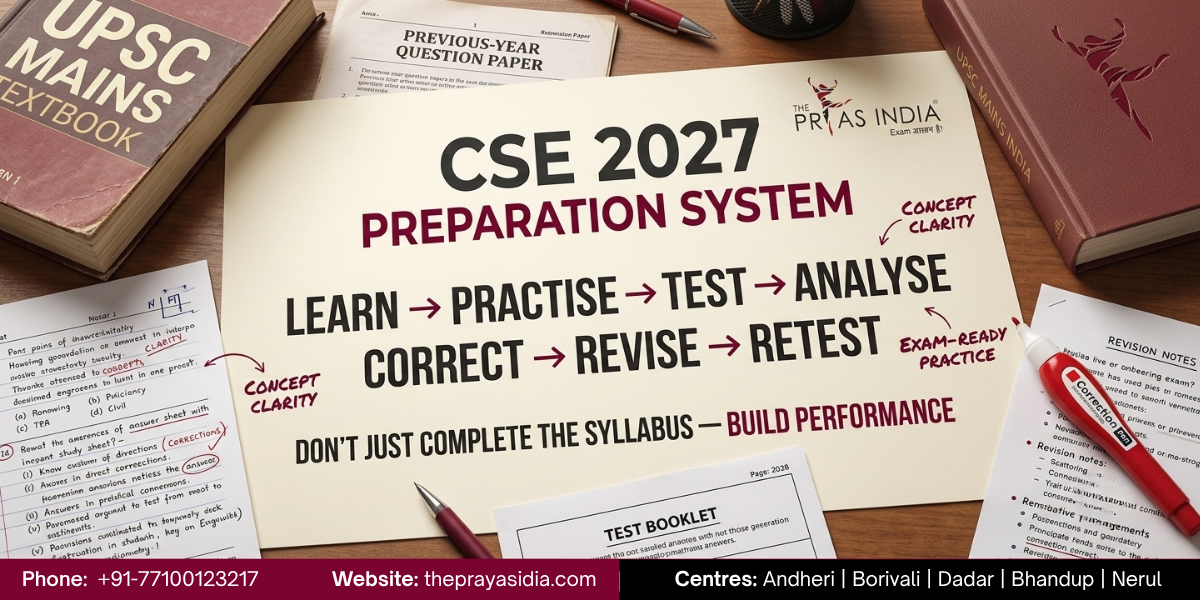
Learn → Practise → Test → Analyse → Correct → Revise → Retest
This cycle is more useful than simply counting how many lectures are included.
A candidate may understand a topic during a classroom session but still perform poorly in a Prelims test. Another candidate may know the content but struggle to convert it into a Mains answer. These gaps become visible only when learning is connected with testing and analysis.
That is why aspirants should evaluate the programme as a complete preparation ecosystem rather than a collection of video lectures or classroom sessions.
Evaluate the Prelims–Mains Integration
A major factor in choosing a CSE 2027 programme is whether Prelims and Mains are treated as completely separate stages or as connected components of the same preparation journey.
The Civil Services Examination requires a candidate to clear Prelims before progressing to Mains, but preparing for the two stages in complete isolation can create unnecessary pressure later. Mains demands analytical writing across General Studies, Essay and Optional, while Prelims requires objective accuracy, elimination skills, revision and test-taking discipline.
A well-designed programme should therefore help students understand the relationship between static concepts, current affairs, PYQs, Prelims MCQs and Mains answer writing.
For example, a topic such as Parliament should not remain limited to reading constitutional provisions. The aspirant should gradually understand how the subject can appear as a factual Prelims question, a conceptual question involving constitutional provisions, or a broader Mains question involving parliamentary functioning and accountability.
This integrated approach reduces duplication and allows one area of study to support multiple stages of the examination.
Questions to Ask About Prelims Support
Before joining a programme, examine the actual Prelims preparation system.
Look for:
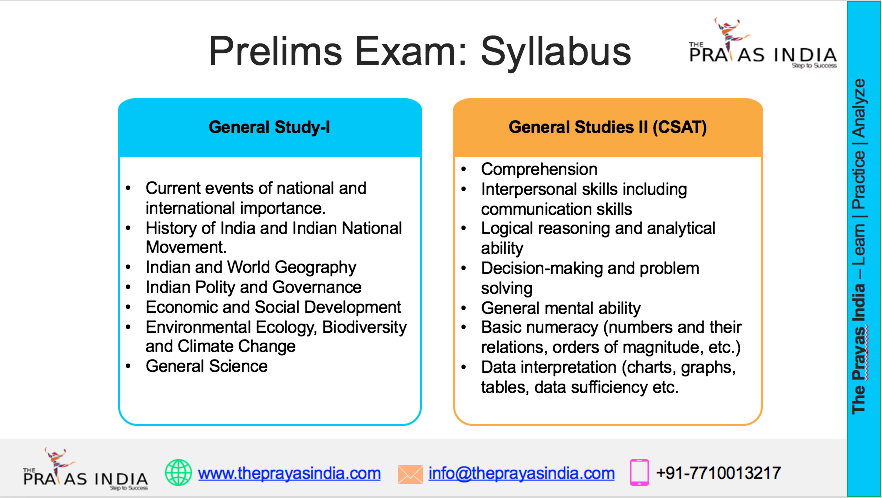
- Coverage of the complete GS syllabus.
- Dedicated CSAT preparation where required.
- Topic-wise and sectional tests.
- Full-length mock tests.
- Previous Year Question analysis.
- Regular revision cycles.
- Performance analysis after tests.
- Guidance on elimination and question selection.
- Current-affairs integration with static subjects.
The presence of a test series alone is not enough. The more important question is whether students receive a process for understanding their performance and correcting mistakes.
Mains Preparation Should Not Be an Afterthought
A common mistake among beginners is to postpone Mains preparation until after Prelims. While the intensity of Mains preparation naturally increases after clearing Prelims, the skills required for Mains cannot always be developed in a few weeks.
Answer writing is a skill that improves through repeated practice. Students need to learn how to interpret the demand of a question, structure an answer, use relevant examples, maintain balance and write within the prescribed word limit.
A CSE 2027 programme should therefore provide a gradual pathway towards Mains rather than treating answer writing as a last-minute activity.
The programme should ideally connect classroom learning with:
Concept → PYQ → Answer Writing → Evaluation → Feedback → Improvement
This is particularly valuable for beginners who may know the subject but have no idea how UPSC expects that knowledge to be presented.
Faculty Quality Matters, But Teaching System Matters More
Faculty members are naturally one of the first things aspirants evaluate while choosing coaching. Experience, subject knowledge and teaching ability are important. However, aspirants should avoid making their decision solely on the basis of individual faculty popularity.
A strong teacher can explain a difficult concept exceptionally well, but UPSC preparation extends far beyond individual classroom sessions. The candidate also needs structured revision, practice, testing, evaluation and strategic guidance.
Instead of asking only, “Who teaches this subject?”, ask:
- How is the subject connected to the UPSC syllabus?
- Are PYQs incorporated into teaching?
- Are current affairs integrated with static concepts?
- Is there adequate classroom practice?
- How are doubts handled?
- Is student performance tracked?
- Does the faculty or mentorship team help students correct their preparation strategy?
This broader evaluation gives a much more realistic picture of programme quality.
Test Series and Evaluation: The Often-Ignored Difference
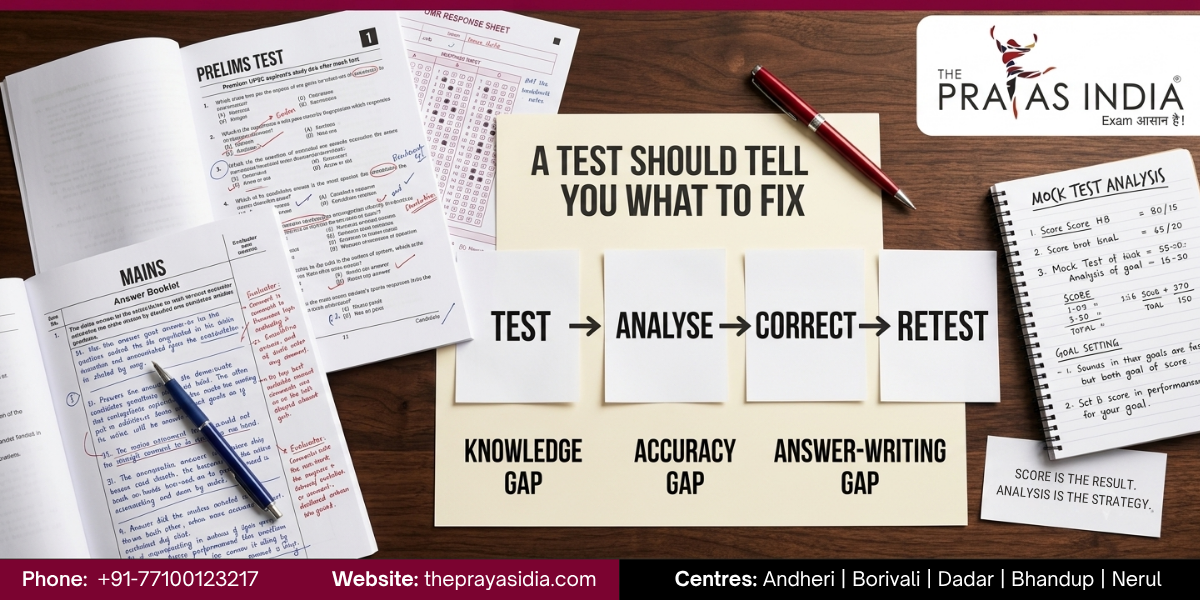
Many coaching programmes include tests, but the quality of evaluation can vary considerably. For UPSC, taking a test without analysing the result provides only limited value.
For Prelims, an aspirant should be able to identify whether errors came from lack of knowledge, confusion between options, poor elimination, over-attempting, careless reading or insufficient revision.
For Mains, the evaluation should go further. Students need to understand whether their answers lack structure, content depth, examples, introductions, conclusions, keywords or time management.
The purpose of testing should therefore be diagnosis, not merely score generation.
The Prayas India’s stated strategy places performance analysis and rectification of errors alongside learning and practice, which reflects the importance of converting test performance into actionable preparation changes.
Study Material: Quantity Should Not Be the Main Criterion
Another common mistake is choosing a UPSC programme because it provides a very large quantity of study material. More PDFs, more books and more monthly compilations do not automatically translate into better preparation.
The better question is whether the material is organised around the syllabus and can realistically be revised.
A useful study package should help an aspirant distinguish between foundational reading, standard references, current affairs, PYQs, revision material and test practice. The candidate should know what is essential and what is supplementary.
This becomes especially important for CSE 2027 because the longer preparation window can create a false sense that there is enough time to read everything. In reality, effective UPSC preparation depends heavily on selecting, revising and applying information.
The ideal programme should reduce resource confusion rather than increase it.
Mentorship Should Lead to Course Correction
Mentorship is another feature that should be evaluated carefully. Simply assigning a mentor or creating a communication group does not automatically constitute effective mentorship.
Useful mentorship should help answer practical questions such as:
- Am I following the right study sequence?
- Is my current booklist manageable?
- Am I spending too much time on one subject?
- When should I begin answer writing?
- How should I respond to poor mock-test performance?
- Is my revision frequency adequate?
- Should my preparation strategy change as the examination approaches?
For beginners, this kind of guidance can prevent months of inefficient preparation.
The objective of mentorship should not be to make every aspirant follow an identical timetable. It should help create an individual preparation strategy within a structured programme.
The Right CSE 2027 Programme Is a Preparation System
Ultimately, choosing a UPSC CSE 2027 programme should come down to one central question:
Does this programme provide a complete system that can take me from learning to exam performance?
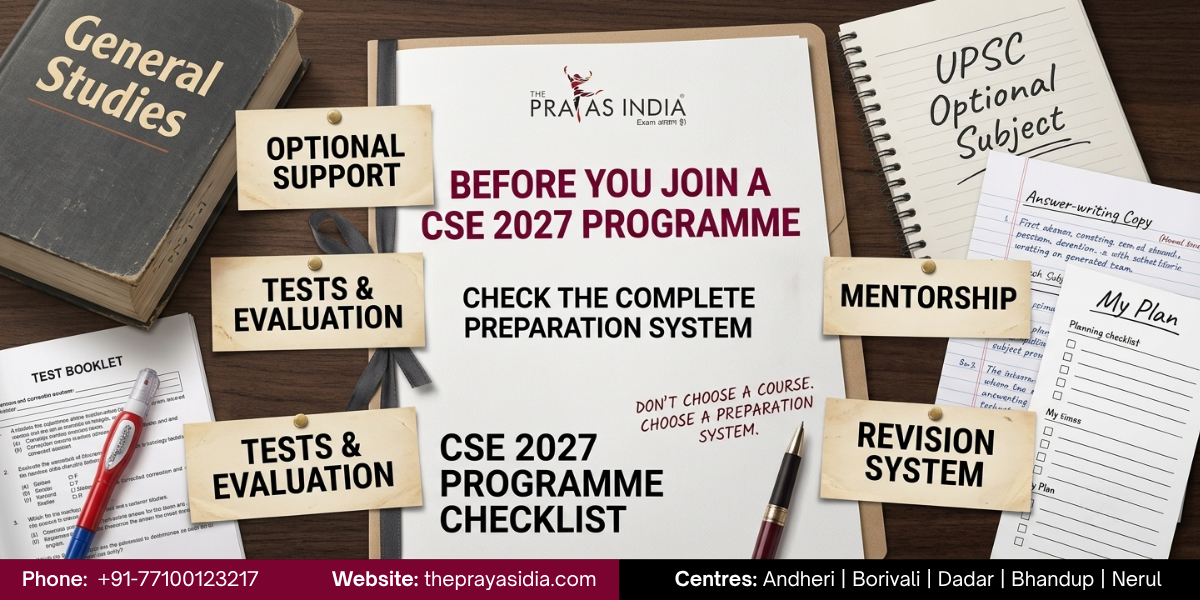
A serious aspirant should look beyond advertising claims and compare the actual preparation ecosystem — faculty, syllabus coverage, Prelims practice, Mains answer writing, Optional support, current-affairs integration, test series, evaluation, mentorship, revision and access to learning resources.
For aspirants looking for UPSC CSE coaching in Mumbai, The Prayas India positions its UPSC preparation around structured learning, practice, analysis, mentoring and support across the examination stages. Its published UPSC strategy also highlights classroom teaching, study material, doubt solving, one-to-one mentoring, mock tests, performance analysis and digital learning support.
The next step is to understand how these features should be compared in practical terms — especially programme duration, classroom vs online mode, Prelims–Mains integration, Optional preparation, test frequency, mentorship and the specific needs of a CSE 2027 aspirant.
That comparison forms the foundation for making a more informed admission decision rather than simply selecting the most visible or most heavily advertised course.
Compare the Programme Before You Compare the Price
Choosing a UPSC CSE 2027 programme becomes easier once you stop looking at coaching as a single product. A serious programme is a combination of classroom teaching, study material, testing, answer writing, revision, mentoring, doubt resolution and strategic guidance. The right choice is therefore not necessarily the programme with the longest course duration or the largest collection of study material. It is the programme that gives you the strongest preparation system for your particular stage.
The UPSC Annual Calendar 2027 has already been published by the Commission, giving aspirants an official planning reference for the upcoming examination cycle. This makes the present stage particularly useful for evaluating a CSE 2027 programme carefully rather than joining a course simply because admissions have opened.
Classroom, Online or Hybrid: Choose Based on Your Preparation Behaviour
The delivery mode of a UPSC programme can have a significant impact on consistency. There is no universally superior format. The better option depends on how you study, how much external accountability you need and how much flexibility your schedule requires.
Offline Classroom Programmes
Classroom coaching can be useful for aspirants who learn better through direct interaction and benefit from a fixed study routine. Travelling to a centre, attending scheduled classes and studying alongside other serious aspirants can create a stronger sense of accountability.
For a beginner, the classroom environment can also make it easier to ask questions immediately, understand difficult concepts through discussion and maintain a predictable preparation rhythm.
However, classroom coaching requires commitment. If commuting takes several hours every day or the schedule clashes with college or work, the advantages can quickly reduce. An aspirant should therefore evaluate not just the classroom quality but also the practical feasibility of attending regularly.
Online Programmes
Online preparation can offer greater flexibility. Students can study from home, revisit classes and organise their daily schedule around work, college or other commitments.
But flexibility also creates responsibility. An online programme is useful only when the student actually follows the schedule, completes tests and maintains revision discipline.
For aspirants who repeatedly postpone recorded lectures, accumulate backlogs or avoid tests, the flexibility of online learning can become a disadvantage.
Hybrid Learning
A hybrid approach can combine the advantages of structured guidance and flexible revision. It can be particularly useful when students want access to classroom-style guidance while also requiring digital resources for revision and additional practice.
The right question is therefore not “Is online better than offline?”
It is:
“Which format will help me study consistently for the next several months?”
That is the format worth choosing.
Course Duration Should Match the CSE 2027 Preparation Cycle
Duration is another factor that is frequently misunderstood. A longer programme is not automatically better. A shorter programme is not automatically more efficient.
The important question is whether the duration gives adequate time for the preparation stages to develop progressively.
A serious CSE 2027 programme should ideally provide enough room for:
- Foundation and conceptual clarity
- GS syllabus coverage
- Current-affairs integration
- PYQ-based preparation
- Prelims practice
- CSAT preparation
- Mains answer writing
- Essay development
- Revision
- Mock tests
- Performance analysis
- Strategic course correction
The Prayas India currently describes its Target Course as a one-year integrated programme covering Prelims, Mains and Personality Test preparation, with features including study material, daily answer writing, quizzes, progress tracking, mentorship and test-based preparation.
The exact programme, batch schedule and admission details should always be checked for the relevant CSE 2027 intake before enrolment.
Avoid Choosing a Programme Only Because It Is “Long”
More months do not necessarily mean more preparation.
If a programme spends too much time completing lectures and leaves insufficient time for practice and revision, the additional duration may not provide meaningful value.
Similarly, a programme that compresses the syllabus so aggressively that students cannot revise or test themselves may create another problem.
The ideal structure should create a reasonable progression:
Foundation → Coverage → Application → Testing → Revision → Exam Readiness
This progression matters much more than the number of months printed in the brochure.
Optional Subject Support Deserves Separate Attention
Optional preparation is one of the areas aspirants should evaluate carefully before selecting a comprehensive UPSC programme.
General Studies preparation and Optional preparation have different requirements. An Optional subject requires depth, specialised understanding, repeated answer writing and familiarity with the specific demand of the subject.
Therefore, if a programme includes GS but does not include your Optional, find out exactly how Optional preparation will be handled.
Ask:
- Is Optional coaching available separately?
- Does the programme offer subject-specific guidance?
- Are Optional PYQs discussed?
- Is answer writing evaluated?
- Are model approaches explained?
- Is there a dedicated test series?
- Can Optional preparation be integrated with the overall study plan?
The Prayas India lists a separate Prayas-तेजस UPSC CSE Optional offering among its UPSC programmes, indicating that Optional preparation can be treated as a distinct component rather than being ignored within the broader GS programme.
This is important because an aspirant should know the complete academic roadmap before joining.
Test Series: Ask What Happens After You Submit the Test
A test series should not be evaluated only by the number of tests included.
A good test is useful because it creates information about your preparation. After every test, the aspirant should ideally be able to identify what went wrong and what needs to change.
For Prelims, analysis can include:
- Questions answered incorrectly despite knowing the concept
- Questions lost because of poor elimination
- Questions left despite having sufficient knowledge
- Careless mistakes
- Time-management issues
- Repeated topic-wise weaknesses
- Current-affairs gaps
- Static-concept gaps
For Mains, the analysis becomes more detailed. The candidate needs to examine whether the answer addressed the demand of the question, used relevant examples, maintained structure, presented multiple dimensions and reached a balanced conclusion.
The Prayas India states that its preparation methodology follows a Learn → Practice → Analyse approach and includes performance tracking, quizzes, tests and progress monitoring.
This illustrates an important principle for aspirants: testing should not be the final stage of learning; it should become feedback for the next stage of learning.
Mentorship: Look for Course Correction, Not Just Availability
“Personal mentorship” sounds attractive in a brochure, but aspirants should understand what mentorship actually means before assigning value to it.
Effective mentorship should help an aspirant make better decisions.
Suppose a student is spending four hours every day on current affairs but is unable to revise static subjects. A mentor should be able to identify the imbalance and suggest a correction.
Similarly, if a student performs poorly in several Prelims tests, mentorship should help distinguish between a knowledge problem and an examination-strategy problem.
If a Mains answer repeatedly loses marks because of poor structure, the student needs specific feedback rather than a generic instruction to “write more answers.”
The Prayas India describes one-on-one mentor connect, progress tracking, doubt clearance and timetable/strategy support among its programme features.
When comparing coaching institutes, therefore, ask not simply “Do you provide mentorship?” but:
“How does mentorship change my preparation when my performance changes?”
That question reveals much more about the quality of the support system.
Study Material: Look for Revision Value
The best UPSC study material is not necessarily the material with the highest page count.
For an aspirant, the real value of study material is whether it can be:
Read → Understood → Revised → Applied → Recalled
A massive resource library can create confusion if students cannot identify what is essential.
Before joining a programme, understand:
- What study material is provided?
- Is it mapped to the syllabus?
- Is it regularly updated?
- Are PYQs incorporated?
- Is current affairs integrated?
- Is there concise revision material?
- Are practice questions included?
- Can the material realistically be revised multiple times?
The Prayas India states that its UPSC study material is designed around the syllabus and updated through its research and development process.
For an aspirant, however, the most important consideration remains practical usability. Material should reduce resource-hunting and help create a repeatable study system.
Fees vs Value: Compare the Entire Academic Package
Course fees naturally matter when selecting coaching. But comparing only the headline price can produce misleading conclusions.
Instead, calculate the academic value of what you are actually receiving.
For example, compare:
| Evaluation Area | Programme A | Programme B |
|---|---|---|
| GS Coverage | Complete / Partial | Complete / Partial |
| Prelims Tests | —— | —— |
| Mains Tests | —— | —— |
| Answer Evaluation | —— | —— |
| CSAT Support | —— | —— |
| Optional Support | —— | —— |
| Mentorship | —— | —— |
| Study Material | —— | —— |
| Doubt Resolution | —— | —— |
| Revision Support | —— | —— |
| Online Resources | —— | —— |
The objective is not to select the programme with the most features.
It is to identify the programme whose features are actually relevant to your preparation needs.
For example, a student who already has strong GS preparation may value testing and evaluation more than another set of basic lectures. A beginner may need stronger foundation support. A working professional may place greater importance on flexible access and recorded resources.
Value is therefore personal.
Red Flags to Watch Before Joining a UPSC Programme
Aspirants should also know what to avoid.
1. Unrealistic Success Promises
UPSC is a highly competitive examination. No coaching programme can guarantee selection. Be cautious of claims that suggest success is automatic after joining.
2. Excessive Focus on Faculty Names
A famous faculty member may be excellent, but one faculty member cannot compensate for weak testing, poor mentorship or inadequate evaluation.
3. Too Much Content, Too Little Revision
If the programme continuously adds new material without creating revision cycles, students can accumulate knowledge without developing recall.
4. Tests Without Analysis
A large number of mock tests has limited value if students receive scores but do not understand their mistakes.
5. Generic Timetables
A timetable that ignores whether the student is a beginner, repeater, college student or working professional may not be practical.
6. No Clear Answer-Writing Pathway
If Mains answer writing begins only after Prelims, beginners may find themselves trying to develop an important skill under extreme time pressure.
7. Unclear Optional Strategy
If the programme claims to be comprehensive but leaves Optional preparation undefined, understand the additional requirements before joining.

Which Programme Type Is Suitable for Different Aspirants?
The right CSE 2027 programme can look different for different candidates.
For a Complete Beginner
A beginner generally needs the highest level of structure. The programme should provide conceptual foundation, syllabus orientation, reading guidance, current-affairs integration, regular testing and gradual introduction to answer writing.
The biggest requirement is not simply teaching. It is reducing uncertainty.
A beginner should ideally finish each stage knowing what to study next rather than constantly searching for new resources.
For a College Student
A college student needs flexibility without losing structure.
The programme should allow the aspirant to manage academic commitments while gradually building UPSC preparation. A realistic schedule is more useful than a timetable that assumes full-time availability.
For a Working Professional
Working professionals need efficient resource selection and strong planning. A programme that helps prioritise high-value preparation, provides flexible learning access and tracks progress can be particularly useful.
For this category, the question is often not “How many hours can I study?” but “How can I make my available hours productive?”
For a Repeater
A repeater should not automatically join another complete beginner-level programme.
The first step should be diagnosis. Which stage caused the previous setback? Was it Prelims accuracy? Current affairs? Revision? CSAT? Mains answer writing? Optional? Time management?
The programme should address that gap instead of forcing the aspirant to repeat everything without modification.
Why Structured Preparation Can Matter for CSE 2027
Self-study remains an essential part of UPSC preparation. Coaching cannot replace independent reading, revision or practice.
However, structured guidance can reduce several avoidable problems: resource overload, inconsistent revision, poor test analysis, delayed answer writing and lack of preparation tracking.
The purpose of coaching should therefore not be to make students dependent on the institute.
It should help them become more organised, more analytical and more independent in their preparation decisions.
The Prayas India positions its UPSC preparation around structured learning, practice and analysis, with features such as progress tracking, mentorship, doubt resolution, study material and test-based preparation.
For aspirants looking specifically for UPSC CSE coaching in Mumbai, the institute has centres listed across Andheri, Borivali, Dadar, Bhandup and Nerul.
Why The Prayas India Can Be Considered for CSE 2027
Choosing an institute should ultimately come down to whether its preparation system matches your needs.
The Prayas India’s published UPSC Target Course structure includes preparation across Prelims, Mains and Personality Test, alongside study material, daily answer writing, quizzes, progress tracking and personalised mentorship.
Its broader UPSC ecosystem also includes separate offerings for Prelims test preparation, Optional, CSAT, hardcopy study material and one-to-one mentorship.
This type of modular ecosystem can be useful because UPSC preparation does not remain static throughout the year. An aspirant may initially need foundation support, later require intensive testing, then need more Mains answer-writing practice and eventually benefit from interview guidance.
A programme should therefore be evaluated not just for what it offers on the day of admission, but for how well it can support the changing requirements of the preparation cycle.
For a Mumbai-based aspirant, accessibility is another practical consideration. The Prayas India lists centres in Andheri, Borivali, Dadar, Bhandup and Nerul, allowing students to consider a classroom option based on their location and routine.
The Final CSE 2027 Programme-Selection Checklist
Before paying the admission fee, take a final look at the programme through these questions:
1. Does it match my current preparation level?
2. Does it provide a clear Prelims + Mains pathway?
3. Is CSAT adequately addressed?
4. When does answer writing begin?
5. How frequently will I be tested?
6. How are tests evaluated and analysed?
7. What happens if I repeatedly perform poorly?
8. Is there genuine mentorship and progress tracking?
9. How is Optional preparation handled?
10. Are study materials concise enough to revise?
11. Is the programme compatible with my daily schedule?
12. Can I realistically follow the programme for the entire preparation cycle?
If you cannot get clear answers to these questions, do not make the admission decision based only on advertisements, faculty photographs or fee discounts.
The right programme should make your preparation clearer, more structured and more measurable.
Final Takeaway: Choose the System That You Can Actually Follow
There is no single UPSC coaching programme that is perfect for every aspirant.
The best CSE 2027 programme is the one that matches your preparation stage, schedule, learning style and academic requirements while giving you enough structure to remain consistent.
For a beginner, that may mean a comprehensive foundation-to-examination programme. For a repeater, it may mean a more targeted combination of testing, mentorship and subject-specific support. For a working professional, flexibility may be as important as classroom access.
The key is to look beyond the question “Which coaching is best?”
Instead ask:
“Which preparation system will help me learn, practise, analyse, revise and improve consistently until CSE 2027?”
That is the question that can lead to a more informed coaching decision.
For aspirants exploring UPSC CSE coaching in Mumbai, The Prayas India provides a structured UPSC preparation ecosystem with classroom and online options, mentorship, testing, study resources and stage-wise preparation support. Programme details, batch schedules and current admission terms should be verified directly before enrolment.
Contact Us
- Call Now: +91-77100 13217
- Website: theprayasindia.com
- Centres: Andheri | Borivali | Dadar | Nerul | Bhandup
Frequently Asked Questions
1. When should I join a UPSC CSE 2027 programme?
The ideal time depends on your preparation level, but joining early enough to build a foundation, complete the syllabus, practise and revise is generally more useful than waiting until the examination is close.
2. Is coaching necessary for UPSC CSE 2027?
Coaching is not mandatory. Many aspirants use self-study successfully. However, structured coaching can provide a defined syllabus plan, mentorship, testing, evaluation and preparation accountability.
3. Should beginners choose a foundation or target programme?
A beginner should choose the programme whose structure matches the complete preparation journey ahead. The important factors are foundation support, syllabus coverage, Prelims and Mains integration, testing, mentorship and revision—not simply the label attached to the course.
4. Is online UPSC coaching better than offline coaching?
Neither format is universally better. Choose based on your learning behaviour, schedule, discipline, commute and need for classroom interaction.
5. Should I choose a programme that includes Optional coaching?
If Optional support is not included, check whether the institute provides a separate Optional programme or whether you will need to arrange it independently.
6. How important is a UPSC test series?
Very important. Tests provide a way to measure preparation, but their real value comes from analysis, feedback and correction.
7. When should I start answer writing for CSE 2027?
You should not wait until immediately before Mains to develop answer-writing ability. Gradual practice alongside GS preparation can help you improve structure, relevance and writing speed.
8. What should I check before paying for UPSC coaching?
Check syllabus coverage, faculty, study material, test series, answer evaluation, mentorship, Optional support, learning mode, revision strategy, doubt resolution and the programme's compatibility with your schedule.
9. How can I choose UPSC coaching in Mumbai?
Compare institutes based on academic structure rather than only location or reputation. Check whether the programme provides the complete preparation ecosystem you require and whether the centre is practical for your daily routine.
10. Does The Prayas India offer UPSC preparation in Mumbai?
Yes. The Prayas India lists UPSC centres including Andheri, Borivali, Dadar, Bhandup and Nerul, along with online learning options.