How to Prepare for UPSC Essay Paper? | Best UPSC Coaching in Mumbai | The Prayas India
Introduction: Why UPSC Essay Preparation Needs a Separate Strategy
The UPSC Essay Paper is often treated as a paper that can be prepared for at the last moment because it does not appear to demand the same kind of factual preparation as General Studies. This approach can become a serious disadvantage. A good essay requires much more than knowledge of current affairs or the ability to write grammatically correct sentences. It requires the candidate to understand the central idea of the topic, develop a logical line of thought, examine the issue from multiple perspectives and maintain coherence throughout the essay.
The Essay Paper gives aspirants an opportunity to demonstrate qualities that are not always visible through conventional factual answers. The candidate has to show clarity of thought, maturity of expression, balance, originality and the ability to connect seemingly different dimensions of an issue. A well-written essay should not feel like a collection of GS answers placed one after another. It should read like a continuous argument in which every paragraph contributes to the larger theme.
This is why essay preparation should ideally begin alongside General Studies preparation rather than after completing the entire syllabus. Your GS preparation provides the knowledge base, while dedicated essay practice teaches you how to organise that knowledge into a coherent and persuasive piece of writing. For aspirants preparing for the Civil Services Examination, developing this skill early can make essay writing less intimidating and considerably more systematic.
Understand What UPSC Expects from a Good Essay
The first step towards effective essay preparation is understanding the nature of the paper. UPSC does not simply reward essays that contain the maximum number of facts, government schemes or current-affairs examples. The quality of thought and the way ideas are organised are equally important.
A good essay should remain closely connected to the topic from beginning to end. The candidate should be able to establish the meaning of the topic, develop an argument around it and explore its implications without drifting into unrelated areas. The discussion should have an internal flow, meaning that one idea naturally leads to the next instead of appearing as an isolated point.
Another important requirement is balance. Most serious issues have multiple dimensions, and an essay becomes stronger when the candidate is able to recognise these different perspectives without losing the central argument. A discussion about economic growth, for example, can involve employment, inequality, social mobility, environmental sustainability, technological change, governance and human development. However, these dimensions should be connected to the topic rather than inserted simply to demonstrate knowledge.
The ultimate objective is to show that you can think about an issue comprehensively and communicate that thinking in a structured manner.
Do Not Treat Essay Writing as Extended GS Answer Writing
One of the most common mistakes among UPSC aspirants is approaching the essay paper as if it were a collection of lengthy General Studies answers. This usually results in an essay containing multiple headings, bullet points, schemes, constitutional provisions and facts but lacking a continuous narrative.
GS answers are generally built around the specific demand of the question. An essay requires a broader intellectual journey. You have greater freedom to explore the topic, but that freedom must be controlled through a central argument.
Suppose the topic is related to technology and human relationships. A GS-style approach might lead you to list the benefits of technology, challenges such as privacy and unemployment, government initiatives and a few solutions. An essay, however, should go deeper into the relationship between technological progress and human behaviour. You could explore how technology changes communication, influences social structures, creates new forms of opportunity, alters work, raises ethical questions and ultimately forces society to rethink the meaning of human connection.
The difference is not simply the length of the answer. The difference lies in how the ideas are connected. Your essay should have a beginning, a developing argument and a meaningful conclusion rather than functioning like a collection of disconnected notes.
Start with Topic Interpretation, Not the Introduction
When candidates see an essay topic in the examination, there is often a temptation to immediately start writing the introduction. This can be risky. Before writing the first paragraph, spend some time understanding exactly what the topic is asking you to explore.
This is particularly important for philosophical or abstract topics. A statement may appear simple on the surface but can contain several layers of meaning. If you interpret it too narrowly, the entire essay may move in the wrong direction.
Begin by identifying the important words in the topic and thinking about their literal as well as broader meaning. Ask yourself what relationship the topic establishes, whether it presents a cause-and-effect relationship, a contrast, a paradox or a philosophical observation. Then consider how that central idea can be connected with real-world examples.
You should also ask whether the topic has multiple interpretations. If it does, acknowledge those interpretations in your planning and decide which central understanding you will develop.
This initial thinking does not have to take a very long time. The objective is to ensure that when you begin writing, you already know what you want the essay to say and where you want the argument to go.
How to Decode a Philosophical Essay Topic
Philosophical essay topics can initially appear difficult because they may not directly mention familiar UPSC themes such as governance, economy or environment. However, many such topics become manageable once you break the statement into smaller ideas.
Take a hypothetical statement about how failure contributes to success. Instead of immediately searching your memory for famous personalities who failed, first ask what the statement actually means. You could examine failure as a source of learning, resilience, innovation and self-awareness. You could then question whether failure always leads to success or whether its value depends on how an individual or institution responds to it.
Once you begin asking such questions, the topic opens up into multiple dimensions.
For philosophical topics, move gradually from the abstract to the concrete. First explain the idea in simple terms. Then examine its broader implications for individuals, society, institutions, governance, economy or human development. Finally, connect the discussion with contemporary examples and arrive at a balanced conclusion.
This approach prevents the essay from becoming either too philosophical and disconnected from reality or too factual and disconnected from the original statement.
Choose an Essay Topic Based on Your Ability to Develop It
Topic selection is an important part of essay strategy, particularly when multiple topics are available. The most familiar topic is not automatically the best choice.
A topic may look attractive because you have studied the subject extensively, but you may discover after five minutes of brainstorming that you have only two or three meaningful arguments. Another topic may appear unfamiliar but give you several dimensions and examples once you understand its central idea.
Before selecting a topic, mentally test whether you can sustain the discussion. Think about the possible dimensions, examples, counterarguments and conclusion. If you can quickly develop a broad framework without forcing irrelevant information, the topic may be suitable for you.
A practical topic-selection checklist can include:
- Can I clearly explain what the topic means?
- Can I identify the central argument?
- Can I develop at least several meaningful dimensions?
- Do I have relevant examples to support the discussion?
- Can I present both positive and negative perspectives where required?
- Can I connect the topic with contemporary issues?
- Can I arrive at a mature and balanced conclusion?
- Can I remain focused on the topic throughout the essay?
The objective is not to choose the topic on which you know the most facts. It is to choose the topic on which you can think, argue and write most effectively.
Build a Central Thesis Before Writing the Essay
Once you have selected your topic, the next step should be developing a central argument. Think of this as the invisible thread that connects the entire essay.
Your thesis does not need to be a complicated academic statement. It can be a simple interpretation of what you believe the topic is ultimately trying to communicate. The rest of your essay should then examine that interpretation from different angles.
For example, consider a hypothetical topic around the idea that development without inclusion creates instability. Your central argument could be that economic progress becomes sustainable only when its benefits reach different sections of society and when institutions provide opportunities for participation and mobility.
From there, the essay can examine economic development, employment, education, healthcare, gender, regional inequality, technology, governance and environmental sustainability. Each dimension would contribute to the broader argument instead of becoming an independent mini-answer.
This is what separates a coherent essay from a compilation of information.
Build a Multi-Dimensional Framework
Once the central idea is clear, brainstorm the dimensions through which you can examine it. This is where your General Studies preparation becomes extremely useful.
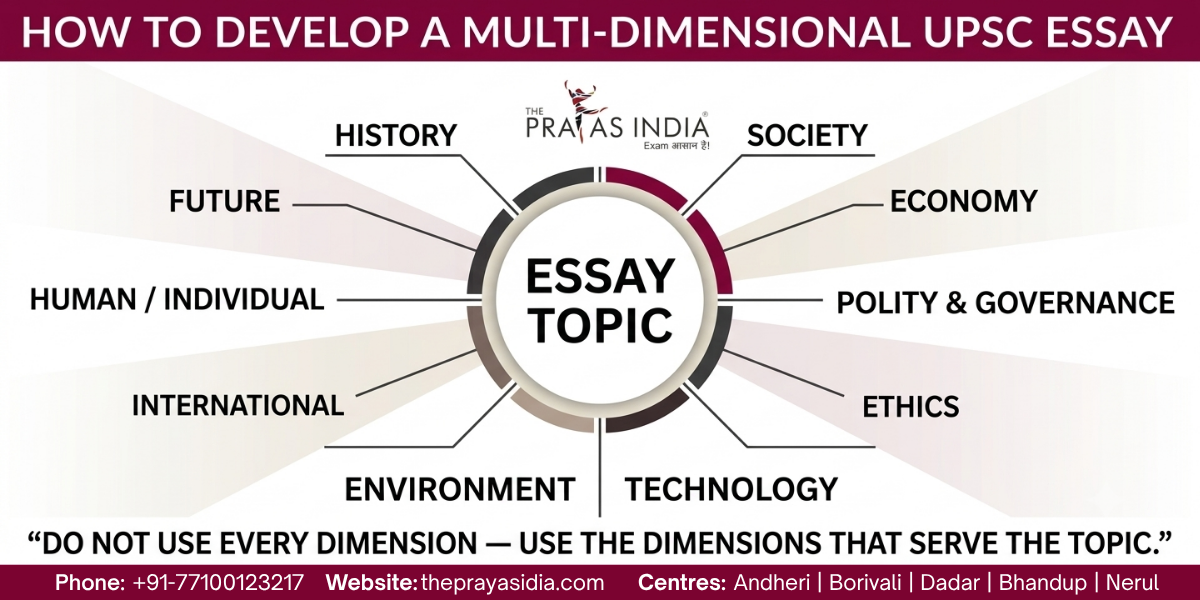
Depending on the topic, you may consider dimensions such as:
- Historical: How has the issue evolved over time?
- Social: What impact does it have on communities, families and social structures?
- Economic: How does it influence growth, employment, productivity or inequality?
- Political: What are its implications for democracy, representation and political institutions?
- Governance: What role do institutions, policies and administrative systems play?
- Ethical: What values, responsibilities or moral dilemmas are involved?
- Technological: How is technology changing the issue?
- Environmental: What are the ecological consequences or sustainability concerns?
- International: How does the issue relate to global developments and India’s position?
- Individual: How does the issue affect human behaviour, aspirations and choices?
- Future-oriented: What changes may emerge in the coming years?
You do not need to use every dimension in every essay. The purpose of brainstorming is to identify the dimensions that genuinely contribute to the topic. Select the strongest ones and arrange them logically.
Organise the Essay Around a Logical Flow
Once you have identified the dimensions, do not simply arrange them randomly. The sequence should feel natural to the reader.
A useful approach is to move from the individual to society, society to institutions and institutions to the larger national or global context, depending on the topic. Another approach is to move from causes to consequences and then towards solutions. Philosophical essays can move from conceptual interpretation to real-world application and finally to a broader reflection.
The best structure depends on the topic, but the underlying principle remains the same: the reader should never wonder why you have suddenly moved from one idea to another.
Use transitions between major sections. You do not need elaborate phrases. Even simple connections such as “At the societal level”, “This has wider implications for governance”, or “The technological dimension further complicates the issue” can make the flow more natural.
A well-organised essay should feel like the argument is progressively developing, not jumping from one subject to another.
The Introduction Should Create Direction
A good introduction does more than define the topic. It gives the examiner an early indication that you have understood the deeper meaning of the subject.
There are several ways to begin an essay. You can start with a brief interpretation of the statement, a contemporary situation, a historical reference, a philosophical observation, a short anecdote or a carefully chosen quotation. The method should depend on the topic.
However, do not force quotations into your introduction simply because they sound impressive. A simple and original interpretation is often more effective than a quotation that has little connection with the central argument.
Your introduction should gradually lead towards your broader interpretation. By the time the introduction ends, the examiner should have a clear idea about the direction in which the essay will proceed.
One useful approach is to move from meaning → context → central argument. This creates a natural transition into the body.
Avoid the Generic Introduction Trap
Many aspirants begin essays with lines such as “Since time immemorial, human beings have…” or “In today’s rapidly changing world…” These openings are not necessarily wrong, but they are extremely common and often add little value.
The introduction should demonstrate thought rather than merely occupy space.
If the topic is about artificial intelligence, for example, instead of beginning with a generic statement about technology transforming the world, you could begin by identifying the deeper tension between technological capability and human responsibility. That immediately provides a stronger conceptual direction.
Similarly, if the topic is about democracy, avoid spending half the introduction defining democracy unless the topic specifically requires it. Move quickly towards the particular argument that the topic demands.
The first paragraph should make the examiner feel that the candidate has something meaningful to say about the topic.
Develop Each Dimension with Depth
Once the introduction is complete, the body should develop the central argument through carefully selected dimensions. Each section should have a clear purpose.
A common mistake is to write very short paragraphs containing only a claim and a generic example. This creates the impression of breadth without depth. Instead, each major argument should be explained sufficiently so that the relationship between the idea and the essay topic is clear.
For instance, if discussing education in an essay about social mobility, do not merely state that education improves employment opportunities. Explain how access to quality education can influence skills, aspirations, social mobility and intergenerational inequality. Then support the argument with a relevant example or contemporary development.
The objective is not to write lengthy paragraphs for the sake of length. It is to make sure that each important idea is developed enough to contribute to the larger argument.
Use Examples as Evidence, Not Decoration
Examples are valuable in essays because they bring abstract arguments into the real world. They can demonstrate that you understand how an idea operates beyond theory.
Your examples can come from Indian history, contemporary governance, social movements, public policy, science and technology, literature, biographies, international developments or everyday social realities.
However, the example should always serve the argument.
If you are discussing leadership, for instance, mentioning a well-known personality is useful only when you explain what aspect of their leadership supports your argument. Similarly, if you mention a government initiative, briefly explain how it illustrates the principle you are discussing.
A strong essay usually contains a mixture of conceptual reasoning and concrete illustrations. The examples make the argument credible, while the reasoning prevents the essay from becoming a collection of stories.
Use Current Affairs Without Turning the Essay into a Newspaper Summary
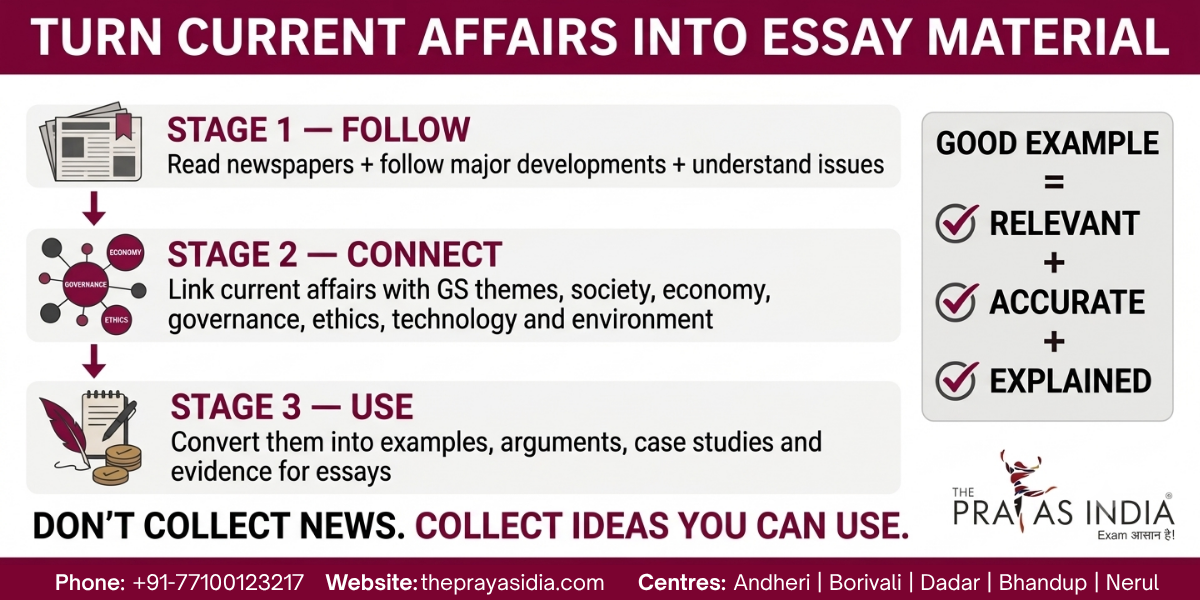
Current affairs can significantly strengthen essay writing, but only when they are integrated naturally.
A common mistake is to insert every recent event that appears even remotely connected to the topic. This can make the essay feel like a current-affairs compilation rather than a thoughtful discussion.
Instead, develop thematic current-affairs notes. If you are preparing the theme of technology, maintain examples related to artificial intelligence, digital governance, data privacy, employment and innovation. If you are studying women and society, organise examples around education, labour-force participation, political representation, health, safety and social norms.
This allows you to retrieve examples according to the theme of the essay rather than trying to remember events chronologically.
Your current affairs preparation should ultimately help answer one question: How can this real-world development strengthen or illustrate my argument?
Develop Counterarguments to Demonstrate Maturity
A strong essay should not present every issue as completely black or white. Where the topic allows it, acknowledging an alternative perspective can significantly improve the quality of the discussion.
Suppose your essay discusses technological advancement. You can explore how technology improves productivity and access to services while also examining concerns related to privacy, employment, inequality and ethical responsibility.
The purpose of presenting a counterargument is not to weaken your own position. It demonstrates that you understand the complexity of the issue and have considered competing perspectives before arriving at a balanced position.
This is particularly valuable in philosophical and abstract topics where multiple interpretations may be possible.
However, avoid creating artificial “for” and “against” sections if the topic does not require them. Balance should emerge naturally from the argument.
Bring Ethics and Human Values into the Essay Where Relevant
UPSC essays often become stronger when the candidate is able to connect policy and development issues with human values.
Questions involving technology, economic growth, governance, education, development or social change can often be examined through concepts such as dignity, equality, justice, freedom, accountability, compassion, sustainability and responsibility.
However, ethics should not be inserted mechanically. The connection must be relevant to the topic.
For example, an essay about artificial intelligence can explore not only technological efficiency but also questions of accountability, privacy, bias and human agency. Similarly, an essay on economic development can consider whether growth is meaningful when large sections of society remain excluded from its benefits.
This human dimension can help transform a technically competent essay into a more mature one.
Write with Continuity Instead of Overusing Headings
Headings can be useful in essay writing, particularly when they help organise a complex discussion. However, excessive headings can make the essay resemble a GS answer sheet.
The essay should maintain a sense of continuity. Each section should connect naturally to the next, and the reader should be able to follow your central argument without relying entirely on headings.
Instead of creating ten small headings for ten points, organise the essay into a few broad thematic sections. Within those sections, use paragraphs to develop the arguments.
The objective is to make the essay structured without making it mechanical.
How to Make the Conclusion More Effective
The conclusion should not simply repeat what you have already written. It should bring the different strands of your argument together and leave the essay with a sense of completion.
One effective approach is to return to the central idea from the introduction but view it at a broader level. If the essay began by discussing an individual or social dilemma, the conclusion can connect that dilemma with larger questions of governance, human development, sustainability or collective responsibility.
A good conclusion may also offer a constructive way forward. However, avoid turning every conclusion into a list of generic solutions such as “awareness, education and strict implementation”. The way forward should emerge naturally from the arguments developed in the essay.
For philosophical topics, the conclusion can sometimes take the form of a broader reflection on human values or society’s future. For policy-oriented topics, it may emphasise the need to balance competing objectives.
The best conclusion leaves the examiner with the feeling that the essay has completed a thought process rather than simply reached the last paragraph.
Practice Writing Before You Practise Writing Full Essays
Aspirants often make the mistake of jumping directly into full-length essay writing. While complete essays are essential, smaller exercises can make the learning process more efficient.
Start by practising introductions. Take different topics and spend a few minutes developing possible opening approaches. Then practise creating thesis statements and brainstorming dimensions. After that, work on writing conclusions that bring different arguments together.
Once these components become comfortable, begin writing complete essays under time constraints.
This staged approach allows you to identify specific weaknesses. If your introductions are strong but your body becomes repetitive, you know where to focus. If your ideas are good but your conclusion is weak, you can practise that separately rather than simply writing more essays without understanding the problem.
Maintain an Essay Topic Bank
A dedicated essay topic bank can become one of the most useful resources during UPSC preparation.
Instead of collecting hundreds of random topics, organise them thematically. You can create broad categories such as:
- Democracy and governance
- Education and human development
- Women and society
- Technology and humanity
- Economy and inclusive growth
- Environment and sustainability
- Ethics and values
- Science and innovation
- Globalisation and international relations
- Individual, society and civilisation
- Leadership and public service
- Philosophy and human behaviour
For every topic, note down possible interpretations, arguments, examples, quotations if genuinely useful and contemporary developments.
Over time, this becomes a repository of ideas rather than a collection of memorised essays.
The Importance of Essay Evaluation
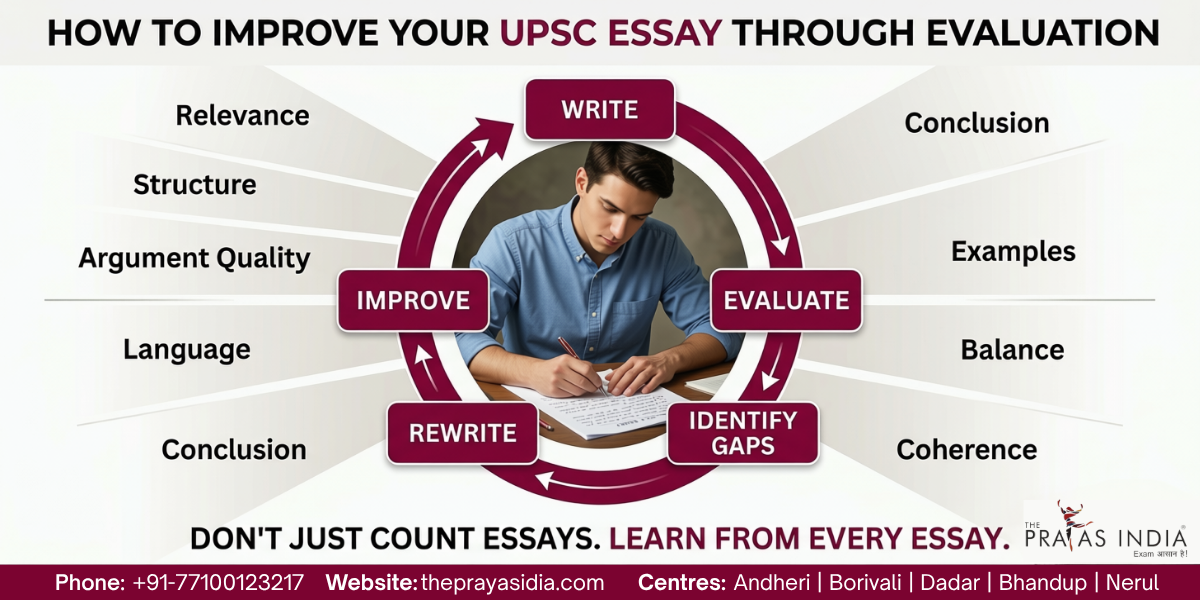
Writing an essay without evaluating it is like taking a mock test without checking the answers. You may spend several hours writing but remain unaware of the mistakes that are repeatedly affecting your score.
Evaluation should examine more than grammar and handwriting. You need to ask whether the essay remained relevant, whether the central argument was clear, whether the dimensions were sufficiently developed and whether the examples actually supported the arguments.
You should also evaluate the transitions between paragraphs. Did the essay flow naturally, or did it suddenly jump from one subject to another? Did the conclusion emerge logically from the discussion? Were some sections unnecessarily long while other important dimensions received little attention?
Feedback from an experienced mentor or faculty member can be particularly valuable because another reader may notice structural weaknesses that you have become accustomed to overlooking.
Create Your Own Repository of Examples
You do not need to memorise hundreds of examples for essay writing. Instead, build a compact repository of versatile examples that can be adapted across themes.
A single historical event may illustrate leadership, social transformation and institutional change. A government initiative may demonstrate inclusion, technology and governance. A Supreme Court judgment may be useful for discussions on rights, constitutional morality and institutional accountability.
The important part is understanding the example well enough to explain its relevance.
You should maintain examples across different categories such as history, contemporary India, public policy, social change, science and technology, international developments, biographies and literature. This gives you flexibility when dealing with unexpected essay topics.
Improve Your Language Without Trying to Sound Complicated
UPSC essays do not require unnecessarily complicated English. The examiner should understand your argument immediately.
Aspirants sometimes believe that sophisticated vocabulary will make an essay look more impressive. In reality, unclear language can weaken even a strong argument.
Aim for sentences that are precise, grammatically sound and easy to follow. Use technical terminology only when it adds meaning. Avoid excessive rhetorical language and unnecessarily long sentences.
Your objective should be to make complex ideas easy to understand, not to make simple ideas sound complicated.
Manage Time During the Essay Paper
Essay preparation should include time management from the beginning. A candidate may have excellent ideas but still struggle if too much time is spent on brainstorming or writing the first essay.
During practice, experiment with the amount of time required for topic selection and brainstorming. Develop a consistent planning process so that you can move from topic selection to writing without unnecessary hesitation.
Before writing, prepare a rough framework of the introduction, major dimensions, examples and conclusion. This does not need to be a detailed outline. A few keywords arranged logically can be enough to prevent you from losing direction midway through the essay.
Time management should ultimately allow you to write both essays with sufficient depth while leaving enough time for revision.
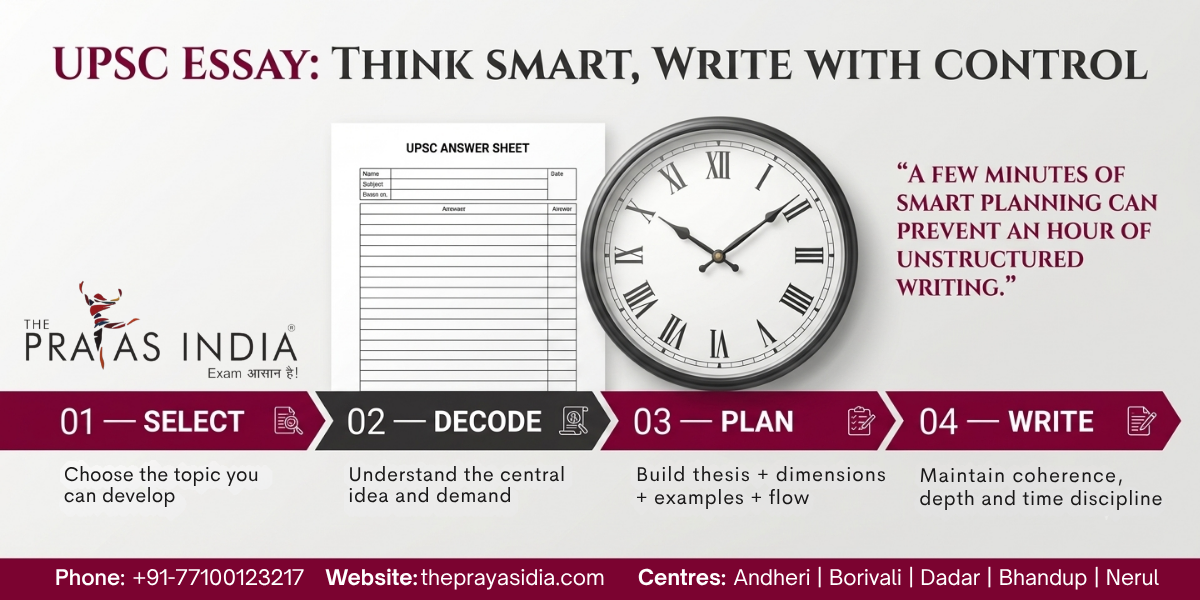
A Practical Weekly Essay Preparation Plan
Essay preparation becomes much easier when it is incorporated into your weekly UPSC routine rather than treated as an occasional activity.
During the initial stage, dedicate time each week to brainstorming topics and building arguments. You can select two or three topics and spend fifteen to twenty minutes developing their possible dimensions without writing complete essays.
As your preparation progresses, write one full essay regularly under timed conditions. After completing it, spend additional time evaluating the essay. Identify where you lost focus, which arguments were repetitive and whether your conclusion genuinely addressed the central idea.
In the later stages of preparation, increase the frequency of timed essay practice and simulate examination conditions. The objective is to reach a point where selecting a topic, planning the argument and writing the essay become familiar processes rather than stressful events.
How UPSC Coaching Can Support Essay Preparation
Essay writing is one area where structured guidance can be particularly useful because self-evaluation is often difficult. You may know the subject well and still fail to recognise that your arguments are repetitive, your essay lacks a central thesis or your conclusion is not sufficiently connected with the discussion.
A structured UPSC coaching programme can provide regular essay topics, evaluation, faculty feedback and opportunities to rewrite answers. This process helps aspirants understand not only what they wrote but also why the essay was effective or where it lost clarity and depth.
When choosing UPSC Coaching in Mumbai, aspirants should therefore look beyond classroom teaching. The quality of mentorship, answer-writing support, test evaluation, study material and feedback mechanism can make a meaningful difference to Mains preparation.
The Prayas India provides UPSC preparation support through centres in Andheri, Borivali, Dadar, Bhandup and Nerul. Aspirants looking for structured UPSC preparation and guidance can contact +91-77100 13217 for admission-related information.
Essay Preparation Is About Developing a Way of Thinking
The UPSC Essay Paper cannot be mastered by memorising a collection of ready-made essays. The examination can present unfamiliar topics, unexpected philosophical statements or contemporary issues that require you to think independently.
The most effective preparation is therefore built around understanding, brainstorming, structuring, writing, evaluating and improving.
Your General Studies preparation gives you the knowledge required to discuss society, economy, governance, ethics, technology, environment and international affairs. Essay practice teaches you how to connect those areas around a central idea and communicate them in a coherent manner.
Start by learning to decode topics. Build a repository of themes and examples. Practise developing a thesis. Learn to move between different dimensions without losing focus. Write regularly under time constraints and, most importantly, evaluate your essays honestly.
A strong essay is not necessarily the one containing the most facts or the most sophisticated vocabulary. It is the one in which the examiner can clearly see what you are trying to say, why you are saying it and how logically you have developed the argument.
For aspirants preparing for UPSC CSE and looking for structured UPSC Coaching in Mumbai, The Prayas India offers preparation support at Andheri, Borivali, Dadar, Bhandup and Nerul. For admission-related information, contact +91-77100 13217.
Move Beyond Ready-Made Content
One of the biggest limitations of relying heavily on ready-made essay material is that it can create a false sense of preparation. You may remember several quotations, examples and arguments, but an unexpected essay topic can still leave you uncertain about how to begin. UPSC does not guarantee that the topic will match the essays you have memorised, which is why preparation should focus on developing the ability to think rather than reproducing prepared content.
Instead of memorising complete essays, prepare ideas, arguments, examples and frameworks. If you understand why a particular example is relevant, you can adapt it to different topics. Similarly, if you understand the relationship between concepts such as development, inclusion, sustainability and human dignity, you can use those ideas across several essay themes.
This approach also makes your writing more natural. Rather than trying to remember exact sentences from a model answer, you can construct an argument in your own words. That gives the essay a more authentic flow and allows you to respond to the specific demand of the topic.
Build a Flexible Bank of Quotations
Quotations can add value to an essay when they are relevant and correctly used. However, quotations should support your argument rather than become the foundation of the essay.
Instead of memorising dozens of quotations, maintain a smaller collection organised by themes. You can have quotations related to leadership, democracy, education, freedom, justice, human values, science, development, peace and society. More importantly, understand the context in which each quotation can be used.
A quotation should ideally perform a specific function. It can introduce a philosophical idea, strengthen an argument or provide a meaningful transition. If the quotation does not contribute to the discussion, there is little benefit in inserting it merely to make the essay appear sophisticated.
In an examination, a relevant original argument is always more valuable than an impressive quotation that has been forced into the essay.
Develop the Habit of Connecting Different Subjects
The best essays often demonstrate the ability to connect different areas of knowledge. This is one reason why comprehensive GS preparation can become a major advantage in the Essay Paper.
An issue that initially appears to belong to one subject may actually have implications across several areas. Artificial intelligence, for instance, is not merely a science and technology topic. It can be discussed in relation to employment, education, privacy, governance, ethics, inequality, national security and international competition.
Similarly, climate change is not simply an environmental issue. It has economic consequences, affects agriculture and livelihoods, creates migration pressures, influences public health and raises questions of intergenerational justice.
During preparation, develop the habit of asking:
“What else does this issue affect?”
That simple question can help you discover additional dimensions and prevent your essay from becoming too narrow.
Use the Introduction and Conclusion as Anchors
The introduction and conclusion should have a relationship with each other. The introduction establishes the central idea, while the conclusion should demonstrate how your discussion has developed that idea.
This does not mean repeating the same sentences. Instead, think of the two sections as the opening and closing points of the same intellectual journey.
If the introduction establishes that technological progress creates both opportunities and responsibilities, the body can explore those opportunities and challenges through different dimensions. The conclusion can then return to the broader principle that technological advancement becomes meaningful when it remains aligned with human welfare, ethical responsibility and inclusive development.
This creates a sense of completeness.
An essay in which the conclusion suddenly introduces an unrelated idea can feel unfinished even if the body is strong. Therefore, while practising, read only your introduction and conclusion together and ask whether they appear to belong to the same essay.
Learn to Handle Abstract and Contemporary Topics Differently
Not every UPSC essay topic should be approached in exactly the same way. Abstract philosophical topics often require greater emphasis on interpretation and conceptual development, while contemporary topics may allow greater use of current affairs and policy examples.
For an abstract topic, begin by understanding the philosophical meaning and then gradually connect it with real-life situations. Avoid rushing into examples before establishing the central concept.
For a contemporary topic, you can begin with a current development or a broader context before establishing your argument. From there, examine the issue through social, economic, political, ethical and other relevant dimensions.
The flexibility to change your approach according to the topic is an important part of essay preparation. There is no single introduction template or body structure that works equally well for every topic.
Practice Brainstorming Under Time Pressure
Essay brainstorming should eventually become a timed exercise. In the beginning, you may take considerable time to identify dimensions because you are still developing the habit. With regular practice, the process should become faster.
Select a topic and give yourself a limited amount of time to create a rough framework. Write down the central interpretation, possible dimensions, supporting examples, counterarguments and a possible conclusion.
Do not worry about writing complete sentences at this stage. The objective is to train your brain to generate and organise ideas quickly.
After completing the framework, examine whether your dimensions are genuinely different. If five points are essentially saying the same thing in different words, the framework lacks breadth. If the dimensions are disconnected from the central topic, the framework lacks relevance.
This exercise is particularly useful because it improves both idea generation and examination-time decision-making.
Analyse Previous UPSC Essay Topics
Previous years’ essay topics are among the most valuable resources for understanding the nature of the paper. They can reveal recurring themes, the range of philosophical and contemporary subjects and the level of interpretation expected.
However, do not simply read previous essays and memorise their structures. Use previous topics as practice material.
Take an old topic and attempt to interpret it independently before looking at any model discussion. Compare your framework with other approaches later. This can help you discover dimensions that you initially missed.
You can also categorise previous topics into broad themes such as:
- Human values and philosophy
- Democracy and institutions
- Society and social change
- Women and gender
- Education and knowledge
- Technology and humanity
- Economic development
- Environment and sustainability
- Leadership and public service
- Globalisation and international relations
Over time, these categories help you identify recurring intellectual themes and prepare more strategically.
Avoid These Common UPSC Essay Mistakes
Many essay problems are not caused by a lack of knowledge. They occur because candidates lose control over structure, relevance or time.
Some common mistakes include:
- Misinterpreting the topic: A well-written essay on the wrong interpretation cannot perform well.
- Writing everything you know: Relevant knowledge is useful; unrelated knowledge weakens the essay.
- Using excessive headings: Too many headings can make the essay look like a GS answer.
- Overloading the essay with facts: Facts should support arguments rather than replace them.
- Using forced quotations: A quotation without relevance adds little value.
- Repeating the same argument: Different paragraphs should ideally contribute different dimensions.
- Ignoring counter-perspectives: Complex issues often require a balanced discussion.
- Writing a generic conclusion: The conclusion should emerge from the essay’s argument.
- Poor time management: Spending too long planning or writing one essay can affect the overall paper.
- Not getting evaluated: Without feedback, repeated structural weaknesses may remain unnoticed.
The purpose of identifying these mistakes is not to create a rigid checklist. It is to develop awareness of the areas that commonly reduce the quality of otherwise knowledgeable essays.
How to Create an Effective Essay Notebook
A dedicated essay notebook can make preparation significantly more organised. Instead of maintaining separate notes for every possible topic, create sections based on broad themes.
For each theme, maintain four categories: core ideas, arguments, examples and quotations. Add current developments only when they provide long-term value.
For example, under “Technology and Society”, you might maintain arguments related to productivity, employment, education, privacy, inequality, human relationships and ethical responsibility. You can then add a few strong examples under each dimension.
The objective is to create a resource that can be revised quickly before the examination. Avoid turning the notebook into another massive study material that takes weeks to revise.
A compact and well-organised repository is much more useful than hundreds of pages of disconnected information.
Use Mock Essays as a Diagnostic Tool
Full-length essay tests should not be treated only as opportunities to obtain a score. They should be used to understand how you perform under examination conditions.
After every mock essay, review it after a short gap. First read it as a normal reader rather than as its writer. Ask yourself whether the argument is easy to follow and whether the essay remains connected to the topic.
Then evaluate specific areas such as interpretation, structure, depth, examples, balance, language, transitions and conclusion.
Create a simple record of recurring weaknesses. If your essays repeatedly have strong introductions but weak conclusions, focus your next practice session on conclusions. If your body contains many dimensions but little depth, practise developing arguments instead of adding more points.
This creates a feedback loop between writing and improvement.
How to Improve Your Essay Score Through Revision
Revision for the Essay Paper should not mean reading the same model essays repeatedly. It should involve revisiting your own mistakes and strengthening your repository of ideas.
Before a mock test, revise broad themes rather than trying to predict the exact topic. Review important examples, constitutional values, historical developments, contemporary issues, philosophical concepts and versatile case studies.
You should also revisit previous essay feedback. If a mentor has repeatedly pointed out problems with relevance, coherence or depth, make those areas a specific focus during the next test.
The goal of revision is to make your thinking faster, broader and more organised.
A Practical 8-Week UPSC Essay Preparation Plan
Candidates who have limited time can still improve their essay writing if they follow a structured plan rather than attempting random essays.
Weeks 1–2: Understand the Paper and Build Foundations
Focus on understanding different types of essay topics. Practise interpreting philosophical and contemporary statements, developing thesis statements and creating multi-dimensional frameworks. Write introductions and conclusions separately before moving into full essays.
Weeks 3–4: Build Content and Dimensions
Start organising your examples and arguments by themes. Connect your GS preparation with essay themes and practise brainstorming several topics every week. Write at least one complete essay under relaxed conditions and focus primarily on structure and relevance.
Weeks 5–6: Introduce Timed Practice
Start writing full essays under examination-like time constraints. After every essay, conduct a detailed self-evaluation and seek external feedback where possible. Focus on reducing repetition and improving transitions between ideas.
Weeks 7–8: Simulate the Examination
Write complete essay papers under strict conditions. Practise topic selection, planning and time allocation. Analyse your performance after every test and revise the areas where you consistently lose marks.
This plan can be modified according to your preparation stage, but the underlying principle should remain the same: practice must become progressively closer to actual examination conditions.
What Should You Read for UPSC Essay Preparation?
There is no single book that can teach you how to write a high-scoring essay. Essay preparation is better supported by combining different sources of knowledge.
Your General Studies material should provide the foundation. Newspapers and current-affairs resources can provide contemporary examples. Previous UPSC essay topics can develop your understanding of the paper. Good-quality non-fiction, biographies and philosophical writings can improve your ability to think about broader human and social questions.
However, reading alone will not improve essay writing. You must regularly convert what you read into arguments and examples.
After reading an important issue, ask yourself how it could be used in an essay. What is the central debate? What are the opposing perspectives? What values are involved? What examples can support either side? How does the issue affect individuals, society and institutions?
This habit turns passive reading into essay-oriented learning.
Why Mentorship Can Make Essay Preparation More Effective
Essay writing is one of the areas where personalised feedback can accelerate improvement. A candidate may know that an essay is “not good enough” but may not understand whether the actual problem lies in interpretation, structure, content, language or argument development.
A mentor can identify these patterns more objectively and help the candidate focus on the right areas. Regular evaluation also creates accountability, making it less likely that essay practice will be postponed because of the demands of the GS syllabus.
For aspirants looking for UPSC Coaching in Mumbai, The Prayas India focuses on structured preparation, mentorship and exam-oriented guidance. Its centres are located in Andheri, Borivali, Dadar, Bhandup and Nerul, giving aspirants multiple options for classroom-based UPSC preparation.
For admission-related information, students can contact +91-77100 13217.
Final Strategy: How to Prepare for the UPSC Essay Paper
Preparing for the UPSC Essay Paper is ultimately about developing a disciplined way of thinking. You do not need to know everything about every subject, nor do you need to memorise hundreds of quotations and ready-made essays.
You need to develop the ability to understand an unfamiliar topic, identify its central idea, generate relevant dimensions, connect those dimensions logically, support your arguments with appropriate examples and reach a balanced conclusion.
The most effective preparation therefore follows a simple cycle: read, think, brainstorm, write, evaluate and improve.
Use your GS preparation as the knowledge foundation, but practise essay writing as a separate skill. Maintain a thematic repository of examples and arguments, study previous UPSC essay topics, practise introductions and conclusions, write full essays under timed conditions and get your work evaluated regularly.
Most importantly, do not measure your progress only by the number of essays you have written. Measure it by whether your interpretation is becoming sharper, your arguments are becoming deeper, your structure is becoming more coherent and your writing is becoming more controlled.
For serious UPSC aspirants, essay preparation should not begin a few weeks before Mains. It should gradually become part of the larger preparation journey. With consistent practice and the right feedback, an essay paper that initially appears unpredictable can become a much more manageable and scoring component of UPSC Mains.
Contact Us
- 📞 Call Now: +91-77100 13217
- 🌐 Website: theprayasindia.com
- 📍 Centres: Andheri | Borivali | Dadar | Nerul | Bhandup
FAQs
1. How should I start preparing for the UPSC Essay Paper?
Start by understanding how essay topics are framed and practise interpreting their central ideas. Build a thematic repository of arguments and examples from your GS preparation, then gradually begin practising introductions, conclusions, brainstorming and full-length essays under timed conditions.
2. When should I start UPSC Essay preparation?
It is better to begin essay preparation alongside General Studies rather than waiting until the Mains examination is approaching. Regular practice gives you enough time to improve structure, coherence, argument development and writing speed.
3. How many essays should I write before UPSC Mains?
No fixed number guarantees a good score. Quality of practice is more important than quantity. A candidate who writes fewer essays but evaluates them carefully and works on recurring weaknesses may improve more than someone who writes many essays without meaningful feedback.
4. Should I memorise model essays for UPSC?
No. Memorising complete essays can make your preparation rigid and may not help when UPSC presents an unfamiliar topic. It is more useful to understand themes, arguments, examples and frameworks that can be adapted according to the actual question.
5. How important are quotations in the UPSC Essay Paper?
Quotations can add value when they are relevant and correctly integrated into the argument. However, they are not a substitute for original reasoning. A well-developed argument is more important than using a large number of quotations.
6. How can I improve my UPSC essay structure?
Start with a clear interpretation of the topic and develop a central argument before writing. Organise the body through relevant dimensions and ensure that each section contributes to the overall theme. Regular evaluation can help identify problems with flow, repetition and relevance.
7. How can current affairs help in UPSC Essay preparation?
Current affairs provide real-world examples that can strengthen conceptual arguments. Instead of collecting news randomly, organise important developments around themes such as governance, technology, economy, society, environment, ethics and international relations.
8. Is coaching necessary for UPSC Essay preparation?
Coaching is not mandatory, but structured guidance and regular evaluation can be useful, particularly if you find it difficult to identify weaknesses in your own writing. Mentorship can help improve interpretation, structure, content selection and answer presentation.
9. How can I choose the right essay topic in UPSC Mains?
Choose a topic based on your ability to interpret and develop it rather than simply selecting the subject you are most familiar with. Before deciding, check whether you can identify several relevant dimensions, examples, counterarguments and a clear conclusion.
10. How can The Prayas India help with UPSC preparation in Mumbai?
The Prayas India provides structured UPSC preparation and guidance for aspirants in Mumbai, with centres at Andheri, Borivali, Dadar, Bhandup and Nerul. Aspirants can contact +91-77100 13217 for admission-related information and course details.