How to Prepare for UPSC Personality Test After Mains | Best UPSC CSE Coaching in Mumbai | The Prayas India
Clearing the UPSC Civil Services Mains examination is a significant milestone, but it is not the final stage of the selection process. For candidates who qualify for the Personality Test, the nature of preparation changes considerably. The focus moves away from writing structured answers under time pressure and towards demonstrating judgement, awareness, balance, clarity of thought and a mature understanding of issues.
The UPSC Personality Test is not simply another examination that can be prepared for by memorising a large number of facts. It is an interaction designed to assess the candidate’s overall suitability for a career in public service. This means that preparation has to become more personal, analytical and conversational. Candidates need to understand their own application form, develop informed opinions on important issues, remain aware of their surroundings and learn how to communicate those thoughts naturally.
For many aspirants, this transition can be uncomfortable. After months of intensive Mains preparation, it is tempting to continue studying in exactly the same way—collecting notes, memorising facts and reading increasingly detailed material. However, Personality Test preparation requires a different mindset. The objective is not to know everything. It is to become comfortable discussing what you know, acknowledging what you do not know and presenting your reasoning with confidence and balance.
For aspirants looking for UPSC CSE coaching in Mumbai, this stage can also benefit from structured guidance. Interview preparation becomes considerably more effective when candidates receive personalised feedback, realistic mock interactions and expert guidance on their DAF, communication and issue-based responses.
Understand What Changes After UPSC Mains
The first step after Mains is to recognise that the preparation strategy has to change. During the written examination, candidates have limited space and time to present their arguments. The Personality Test is conversational. A board member may begin with a straightforward question and then take the discussion into an unexpected direction based on your response.
This means that simply preparing hundreds of probable questions is unlikely to be enough. You need to develop the ability to think aloud, connect different areas of knowledge and respond calmly when the conversation moves away from what you had anticipated.
The interview preparation phase should therefore focus on four broad abilities:
- Awareness: Understanding important national, international, economic, social and administrative developments.
- Analysis: Looking at issues from multiple perspectives rather than taking simplistic positions.
- Communication: Expressing ideas clearly, briefly and logically.
- Personality: Demonstrating composure, honesty, maturity and balanced judgement.
These qualities cannot be built effectively in a few days. The earlier you begin adapting to the interview format, the more natural your responses are likely to become.
Your DAF Should Become the Centre of Your Preparation
The Detailed Application Form, or DAF, should be one of the first things a candidate revisits after Mains. Every detail mentioned in the form can potentially become a conversation point. Your educational background, place of birth, hobbies, work experience, achievements, optional subject, service preferences and other details may all lead to questions.
Candidates sometimes make the mistake of preparing only general current affairs while giving insufficient attention to their own profile. This can create an uncomfortable situation during the interview because questions about personal information are often more difficult to answer naturally than questions from a newspaper.
Start by reading your DAF line by line. Do not simply highlight important words. Ask yourself what a board member could reasonably ask about each entry and, more importantly, what follow-up questions could emerge from your answer.
For every major DAF component, prepare around three layers:
Layer 1 — Basic Understanding:
Can you explain the subject clearly in simple language?
Layer 2 — Analytical Understanding:
Can you discuss its opportunities, challenges, limitations or wider implications?
Layer 3 — Personal Perspective:
Can you explain why the subject interests you or how your experience shaped your perspective?
This third layer is particularly important. The Personality Test is about the candidate, not merely the candidate’s knowledge. Your answers should therefore sound like informed personal responses rather than rehearsed textbook paragraphs.
Prepare Your Educational Background Thoroughly
Your graduation subject is one of the most obvious areas from which questions can emerge. Candidates should therefore revisit the fundamental concepts of their academic discipline, especially those that connect with contemporary developments or public policy.
However, this does not mean studying the entire university syllabus again. The objective is to regain conceptual confidence. If you studied economics, for example, you should be comfortable discussing fundamental economic concepts and connecting them to current issues. If your background is engineering, science or medicine, think about how your discipline interacts with governance, technology, infrastructure, public health or society.
Candidates should prepare answers to questions such as:
- Why did you choose this field?
- Which part of your academic background interests you most?
- How is your subject relevant to public administration?
- What limitations or challenges does your field currently face?
- Has your academic background influenced your way of thinking?
The strongest answers are rarely the most complicated ones. They are usually the ones where the candidate demonstrates genuine understanding and can explain the idea without unnecessary technical language.
Your Hometown Can Become a Major Interview Theme
Your district, city, state or region may appear to be a simple DAF detail, but it can open the door to a wide range of questions. Candidates should know their area’s geography, economy, culture, major industries, social challenges, administrative structure and significant development issues.
The preparation should go beyond memorising facts such as population figures or historical dates. Think about the place from an administrator’s perspective. What are its major strengths? What problems require policy intervention? Which development initiatives have worked? Where are implementation gaps visible?
A useful hometown preparation framework includes:
- Geography and important natural resources.
- Economic activities and employment patterns.
- Major infrastructure challenges.
- Education and healthcare indicators.
- Social and demographic issues.
- Local governance and administration.
- Important cultural or historical features.
- Major recent developments and public-policy debates.
You should also be prepared for opinion-based questions. A board member may not simply ask what your city is famous for; they may ask what you would change if you were responsible for its administration. Such questions require practical thinking rather than memorised information.
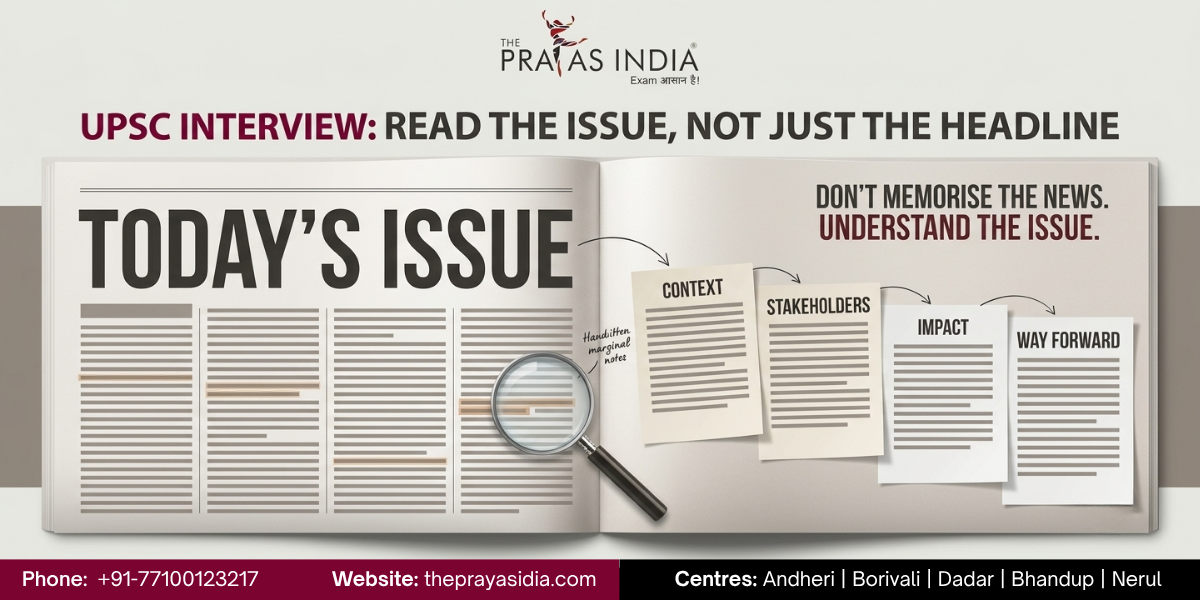
Current Affairs Should Be Prepared Through Issues, Not Headlines
Current affairs remains important after Mains, but the method of preparation should change. Reading dozens of headlines every day without developing an understanding of the underlying issues can create superficial knowledge.
For the Personality Test, candidates should move from headline collection to issue understanding. When an important development appears in the news, ask what caused it, who is affected, what the competing viewpoints are, what the government is doing and what implementation challenges may arise.
For major issues, develop a simple mental framework:
Context → Stakeholders → Challenges → Government Response → Way Forward
This framework allows you to approach unfamiliar questions more logically. You do not need to memorise a perfect answer for every current-affairs topic. You need to develop the ability to organise information when a question is asked.
For example, if the board asks about a new policy, your response should ideally move beyond describing the policy. You should be able to discuss its potential benefits, concerns, implementation challenges and possible improvements.
Develop a Balanced Opinion on Major Issues
One of the most important abilities tested during the Personality Test is the capacity to discuss an issue without becoming rigid or one-dimensional. Candidates often prepare strong opinions but forget that the board may deliberately challenge those opinions with a counterargument.
The objective is not to avoid taking a position. It is to demonstrate that you understand the complexity of the issue. A mature response can acknowledge the benefits of a policy while also recognising its limitations. Similarly, disagreement should be expressed through reasoning rather than emotional language.
When preparing major issues, deliberately ask yourself:
- What is the strongest argument in favour?
- What is the strongest argument against it?
- Which stakeholders may see the issue differently?
- What implementation challenges exist?
- What would be a practical way forward?
This habit creates intellectual flexibility. It also makes your responses less rehearsed because you are thinking through the issue rather than recalling a fixed paragraph.
Work on Your Communication Before Working on Your Vocabulary
Personality Test preparation is sometimes misunderstood as an exercise in improving English vocabulary or learning sophisticated phrases. In reality, clarity is far more important than complicated language.
A candidate who communicates a simple idea clearly is likely to make a stronger impression than someone who uses elaborate vocabulary but struggles to explain the actual point. Your objective should be to speak in a structured, natural and understandable manner.
Pay attention to:
- Speaking at a comfortable pace.
- Completing one idea before starting another.
- Avoiding unnecessary repetition.
- Using simple and precise language.
- Listening fully before responding.
- Taking a brief pause when you need to organise your thoughts.
If you naturally use English, Hindi or another language in daily communication, the focus should remain on clarity and confidence rather than artificially changing your speaking style.
Practise Answering Without Sounding Rehearsed
Mock interviews are useful, but memorising model answers can work against you. Once an answer becomes overly rehearsed, candidates often struggle when the board asks a slightly different follow-up question.
Instead, prepare answer frameworks rather than scripts. Know the important points you want to communicate, but allow yourself to express them naturally.
For example, if asked why you want to join the civil services, you should understand your own motivation clearly. You should not memorise a generic response filled with phrases about “serving the nation” unless those words genuinely represent your thinking.
A strong answer should be:
- Personal rather than generic.
- Specific rather than vague.
- Honest rather than impressive-sounding.
- Balanced rather than exaggerated.
- Conversational rather than memorised.
This is one of the reasons personalised interview guidance can be valuable. Feedback from an experienced mentor can identify habits that candidates themselves may not notice, such as excessive hand movement, lengthy answers, defensive responses or an unnatural speaking pattern.
Build Confidence Through Repeated Conversation
Confidence for the Personality Test does not come from reading more material indefinitely. It develops when you repeatedly put yourself in situations where you have to think and speak without complete preparation.
Discuss important issues with peers, mentors or teachers. Explain an editorial aloud. Pick a random DAF topic and speak about it for two minutes. Practise answering follow-up questions rather than only opening questions.
The objective is to make uncertainty comfortable.
You may encounter a question for which you do not know the answer. You may be asked to defend a position you had not considered. You may be interrupted or challenged. None of these situations should automatically create panic.
A mature response can simply acknowledge the limitation and then explain what you do know. The Personality Test does not require candidates to pretend to know everything.
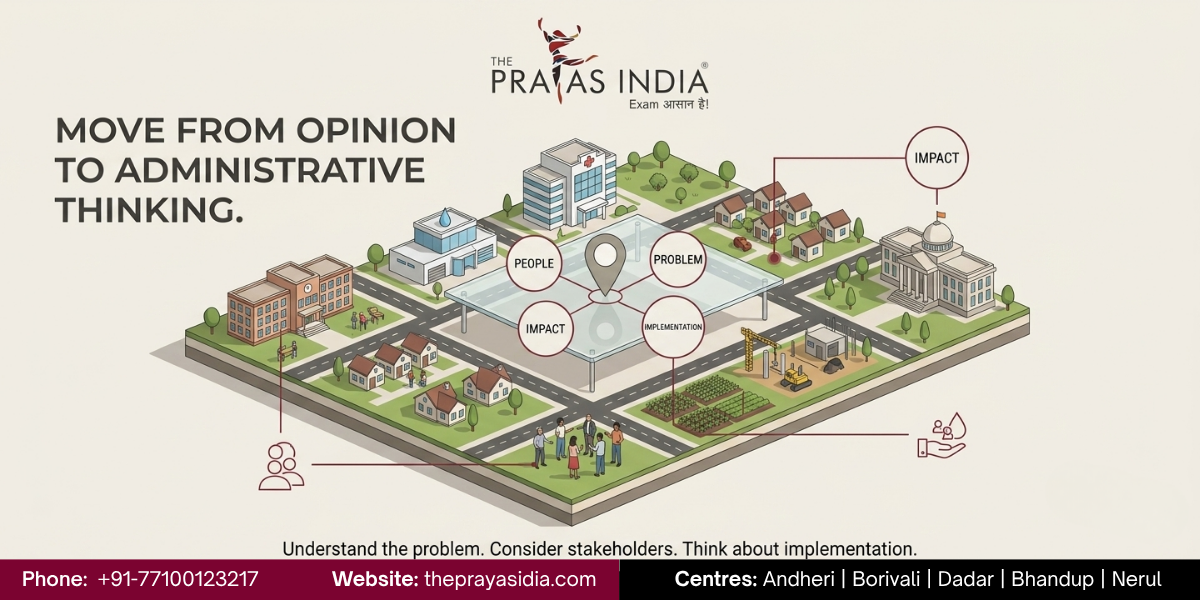
Start Thinking Like a Future Administrator
A useful way to strengthen Personality Test preparation is to approach issues from an administrative perspective. Instead of asking only whether a policy is good or bad, consider how it would actually be implemented.
Imagine that you are responsible for a district and have to address a difficult problem. What information would you need? Which departments would be involved? Which communities would be affected? What constraints would you face? How would you measure whether the intervention worked?
This style of thinking naturally improves the quality of interview responses because it introduces practicality into your answers.
For example, instead of simply saying that unemployment should be reduced, think about skill development, local industries, employability, migration, education quality, infrastructure and implementation capacity. The board is more interested in your reasoning process than in a slogan.
What to Avoid During Personality Test Preparation
The post-Mains phase can create anxiety, and that anxiety often pushes candidates towards unproductive preparation habits. One of the most common is trying to read everything. Candidates begin following multiple newspapers, websites, magazines, coaching notes and interview compilations simultaneously. The result is information overload rather than improved understanding.
Another mistake is preparing only “expected questions”. While question banks can help identify broad themes, the actual conversation can move in unexpected directions. A candidate who has developed reasoning ability will adapt much better than one who has memorised hundreds of prepared answers.
Avoid:
- Memorising model answers word-for-word.
- Trying to have an opinion on every issue.
- Using unnecessarily complicated vocabulary.
- Becoming defensive when the board challenges your view.
- Giving excessively long answers.
- Ignoring your DAF while focusing only on current affairs.
- Treating mock interviews as performance events rather than learning opportunities.
- Attempting to hide genuine gaps in knowledge.
The goal is not to manufacture a different personality for the interview. It is to present your actual personality with greater clarity, confidence and maturity.
The Importance of Personalised Mock Interviews
Once your basic preparation is underway, mock interviews should become an important component of your strategy. A mock should not simply replicate the atmosphere of the UPSC board. Its greater value lies in the feedback that follows it.
A useful mock interview should help you understand whether your answers are too long, whether your reasoning is clear, whether you become defensive under pressure, whether you adequately address the question and whether your body language supports your communication.
Different mentors may also notice different aspects of your personality. This is why multiple quality mock interactions can be more valuable than repeatedly giving the same predictable set of questions.
For serious aspirants, structured UPSC interview guidance in Mumbai can provide an environment where these issues are identified before the actual Personality Test. The objective is not to teach candidates what to say. It is to help them become more comfortable with thinking, listening and responding in a high-pressure conversation.
Build a Practical Post-Mains Interview Schedule
Your preparation schedule should be structured but flexible. Do not divide every day into long hours of passive reading. Instead, combine current affairs, DAF preparation, issue analysis, communication practice and mock interactions.
A balanced weekly structure could include:
| Preparation Area | Suggested Focus |
|---|---|
| DAF | Daily revision of one profile area |
| Current Affairs | Major issues and analytical reading |
| Communication | Speaking practice and discussions |
| Academic Background | Fundamentals + contemporary relevance |
| Hometown | Local issues, development and administration |
| Mock Interviews | Regular practice + detailed feedback |
| Revision | Personal notes and recurring weak areas |
The schedule should become increasingly interactive as the interview approaches. Reading remains important, but it should support your ability to think and communicate rather than replace it.
The Right Preparation Mindset
The Personality Test is ultimately a test of readiness for responsibility. That does not mean the board expects candidates to already know everything about administration. Rather, it expects evidence of qualities that can be developed into effective public-service behaviour: awareness, judgement, integrity, curiosity, composure and the ability to understand different perspectives.
This is why the strongest interview preparation is not about constructing a perfect candidate. It is about helping the candidate become a more thoughtful version of themselves.
After months of Mains preparation, it is natural to feel exhausted. However, this stage should not be approached with the same intensity as the written examination. The quality of your preparation matters more than the sheer quantity of material you consume.
For candidates preparing for the UPSC Personality Test, particularly those seeking UPSC CSE coaching in Mumbai, a structured approach combining DAF analysis, current-affairs discussions, personalised mentoring and realistic mock interviews can provide valuable direction.
The final objective is simple: listen carefully, think clearly, answer honestly and communicate with confidence. A candidate who can remain composed while thinking through an unfamiliar question is demonstrating exactly the kind of intellectual maturity that this stage is designed to assess.
Develop the Ability to Handle Counter-Questions
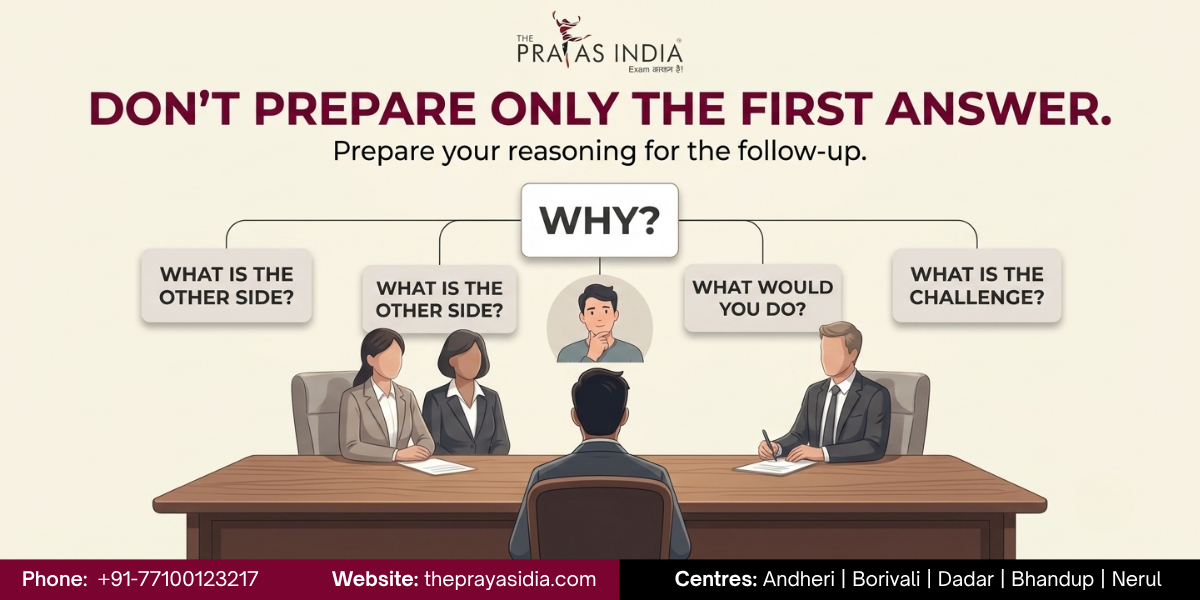
One of the biggest differences between a prepared answer and a strong Personality Test response is the ability to handle the question that comes after the answer. Candidates often prepare an excellent response to a likely question but become uncomfortable when the board challenges an assumption within that response.
This is why preparation should not stop at the first answer. For every major topic, practise asking yourself, “What could the board ask next?” If you say that a policy is beneficial, be prepared to explain its limitations. If you identify a problem, be prepared to suggest a practical solution. If you express an opinion, be prepared to explain the reasoning behind it.
This approach develops intellectual flexibility and prevents your preparation from becoming a collection of memorised responses. During mock interviews, mentors should deliberately introduce counter-questions so that candidates learn to remain composed when the conversation takes an unexpected turn.
A useful mental sequence is:
- Question: What exactly is being asked?
- Position: What do I actually think?
- Reason: Why do I think so?
- Counterpoint: What is the strongest opposing argument?
- Balance: What would be a practical way forward?
You do not have to follow this structure mechanically during the actual interview. Its purpose is to train your mind to consider more than one dimension of an issue.
Learn How to Say “I Don’t Know” Correctly
No candidate can know the answer to every question. The problem is not admitting that you do not know something; the problem arises when candidates attempt to bluff, invent information or continue speaking without confidence in what they are saying.
If you genuinely do not know the answer, a calm and honest response is preferable to an incorrect assertion. Similarly, if you know only part of the answer, you can clearly state the part you are confident about rather than pretending to possess complete knowledge.
This requires practice because pressure can make candidates feel that every question must be answered. Mock interviews are particularly useful here because they allow candidates to experience the discomfort of not knowing an answer in a controlled environment.
The objective is to develop confidence without overconfidence. A candidate who can acknowledge a knowledge gap without becoming nervous demonstrates considerably more composure than one who tries to answer every question at any cost.
Improve Body Language Without Making It Artificial
Body language matters during a Personality Test, but it should not become another performance that candidates consciously monitor every second. The most effective body language generally comes from being comfortable, attentive and engaged in the conversation.
Sit upright without becoming rigid. Maintain natural eye contact with the board member who asks the question while remaining aware of the entire panel. Listen carefully, avoid interrupting and take a short pause when necessary before answering.
Some common habits worth correcting include:
- Looking repeatedly at the floor or ceiling while answering.
- Excessive hand movements.
- Constantly adjusting clothes or objects.
- Speaking without looking at the board.
- Nodding excessively without listening carefully.
- Displaying visible irritation when challenged.
- Sitting so rigidly that the interaction becomes unnatural.
The goal is not to create a rehearsed body-language routine. It is to remove distracting habits so that your communication and personality remain the centre of attention.
Read Newspapers With an Interviewer’s Mindset
Current-affairs preparation should continue until the Personality Test, but candidates should change the way they consume information. Reading every article in detail is neither practical nor necessary. Instead, identify issues that have administrative, economic, social, constitutional, international or technological significance.
When reading an important story, try to move beyond “What happened?” and ask:
Why did it happen? Who is affected? What are the competing perspectives? What has the government done? What could be improved?
This method converts passive reading into analytical preparation.
Editorials can be particularly useful when used carefully. Rather than accepting the writer’s position as your own, examine the argument, identify assumptions and consider alternative viewpoints. This will help you form independent opinions instead of reproducing the language of newspapers or coaching notes.
Prepare for National and International Issues With Balance
The board may discuss issues that are politically, socially or economically sensitive. Candidates should therefore develop the ability to distinguish between informed analysis and emotional reaction.
On contentious subjects, avoid extreme statements unless you have a very strong factual and constitutional basis for making them. At the same time, excessive neutrality can make your answers vague. The objective is to present a reasoned position while acknowledging legitimate concerns on the other side.
For major issues, prepare:
- The background and context.
- Relevant constitutional or institutional dimensions.
- Major stakeholders.
- Potential benefits.
- Possible concerns.
- Implementation challenges.
- Examples from India or other countries where relevant.
- A practical and balanced way forward.
This framework is particularly useful for issues involving governance, federalism, economy, technology, social policy, environment, international relations and public administration.
Build a Strong Personal Introduction
Questions about your background can appear simple, but they often become the opening through which the board understands your personality. Candidates should therefore prepare a concise personal introduction without turning it into a speech.
Your introduction should naturally cover relevant aspects of your educational or professional journey and the experiences that have shaped your interest in public service. It should not sound like a memorised biography.
The best preparation method is to identify the important transitions in your life and understand why they happened. If you changed your academic field, explain the reason. If you have work experience, understand what you learned from it. If you have pursued a hobby for several years, be ready to discuss what it taught you.
The board may be more interested in the reasoning behind your choices than in the choices themselves.
Hobbies and Interests Need Genuine Preparation
Hobbies are frequently underestimated because candidates assume that a hobby mentioned in the DAF is merely a personal detail. In reality, it can become one of the most conversational areas of the interview.
If you have mentioned reading, sports, music, photography, travelling, cooking, gardening or another activity, prepare it genuinely. You should know enough about the activity to discuss why you enjoy it, what you have learned from it and how it fits into your life.
Do not add an impressive-sounding hobby merely because you think it will create better questions. A genuine interest gives you an area where conversation can become natural and confident. A superficial hobby, on the other hand, can create unnecessary difficulty when the board begins asking follow-up questions.
Prepare Your Optional Subject Beyond Mains Notes
Candidates often assume that their optional subject preparation is complete once Mains is over. For the Personality Test, however, the subject may return in a different form.
The board may connect your optional subject with current affairs, governance or practical issues. Therefore, revise the fundamental concepts and think about how your subject relates to contemporary India.
The objective is not to prepare another Mains answer bank. Instead, regain enough conceptual confidence to explain basic ideas clearly and connect them with real-world situations.
Understand the Civil Services and Your Service Preference
UPSC Personality Test preparation should also include awareness of the services for which you have expressed preferences. Candidates should understand the broad responsibilities, working environment and challenges associated with the services they are interested in.
You may be asked why you prefer one service over another or how your background could contribute to public administration. Your answer should be based on genuine understanding rather than perceived prestige.
This preparation also helps you think beyond the immediate goal of clearing the examination. Civil services selection is ultimately about assuming public responsibility, and your responses should reflect an understanding of that responsibility.

Create a Final-Week Interview Preparation System
The final week should not be treated as an opportunity to learn the entire world. By this point, candidates should focus on consolidation and confidence. Excessive new material can increase anxiety without significantly improving performance.
Use the final days to revisit your DAF, major current-affairs themes, personal profile, hometown, educational background, hobbies and key national issues. Continue mock interactions, but give equal importance to the feedback after each mock.
A sensible final-week checklist includes:
- Review the complete DAF.
- Revise important current-affairs issues.
- Practise personal and profile-based questions.
- Review major national and international developments.
- Attend realistic mock interviews.
- Analyse communication and body-language feedback.
- Revisit areas where previous mocks exposed weakness.
- Maintain a normal sleep and daily routine.
- Avoid last-minute information overload.
The final objective is to enter the interview room mentally prepared rather than exhausted from excessive revision.
How The Prayas India Can Help With UPSC Personality Test Preparation
The transition from Mains preparation to Personality Test preparation is not simply a change in the syllabus. It is a change in the nature of preparation itself. Candidates need an environment where they can discuss issues, test their reasoning, practise spontaneous responses and receive honest feedback.
For aspirants looking for UPSC CSE coaching in Mumbai, structured interview guidance can help bring these components together. The Prayas India can support candidates through a preparation approach focused on DAF analysis, current-affairs discussions, mock interviews, personalised feedback and communication practice.
The value of interview guidance lies not in providing a list of “expected questions” but in helping candidates become comfortable with unexpected questions. A good mock should challenge assumptions, test reasoning and identify communication habits that may otherwise remain unnoticed.
This is particularly important for candidates who have successfully cleared the written stages and now need to make the final transition from answer writing to face-to-face communication.
From Mains Candidate to Interview-Ready Aspirant
The Personality Test requires a different version of preparation, but it does not require you to become a different person. Your academic background, experiences, interests and opinions are already part of your profile. The task is to understand them deeply enough to discuss them with clarity and maturity.
The most effective candidates are not necessarily those who have memorised the largest number of interview questions. They are the ones who can listen carefully, think before answering, acknowledge uncertainty, consider different perspectives and communicate their reasoning without becoming defensive.
As you prepare, keep returning to five principles:
- Know your DAF.
- Understand current issues.
- Think beyond one-sided opinions.
- Practise spontaneous communication.
- Use mock interviews to improve, not merely to rehearse.
With the right preparation strategy and consistent feedback, the Personality Test can become less about predicting questions and more about demonstrating the qualities you have developed throughout your UPSC journey.
For serious aspirants targeting the final stage of the Civil Services Examination, The Prayas India’s UPSC CSE coaching in Mumbai offers a structured environment for continuing that journey with focused guidance and interview-oriented preparation.
Contact Us
- Call Now: +91-77100 13217
- Website: theprayasindia.com
- Centres: Andheri | Borivali | Dadar | Nerul | Bhandup
Frequently Asked Questions
1. When should I start preparing for the UPSC Personality Test after Mains?
It is better to begin as soon as possible after Mains rather than waiting for the interview schedule. Early preparation gives you time to analyse your DAF, follow current affairs, identify weak areas in communication and participate in multiple mock interactions.
2. Is the UPSC Personality Test based entirely on the DAF?
No. The DAF is extremely important because it provides several potential areas of discussion, but the board can also ask about current affairs, national and international issues, your academic background, optional subject, hobbies, governance and broader areas relevant to the Personality Test.
3. How should I prepare my DAF for the UPSC interview?
Read every line of your DAF carefully and identify possible questions and follow-ups. Prepare factual knowledge as well as analytical and personal perspectives related to your education, hometown, work experience, hobbies, achievements and other details mentioned in the form.
4. How important are current affairs for the UPSC Personality Test?
Current affairs are important because they provide the context for many discussions. However, candidates should focus on understanding major issues rather than memorising large numbers of facts. Be prepared to discuss context, stakeholders, competing viewpoints, challenges and possible solutions.
5. How many mock interviews should I take?
There is no fixed ideal number. The quality of the mock and the feedback you receive is more important than the number alone. Candidates should take enough mocks to become comfortable with the interview environment while using the feedback to correct recurring weaknesses.
6. What should I do if I don't know an answer in the interview?
Remain calm and be honest. If you genuinely do not know the answer, acknowledge it politely rather than guessing or inventing information. The ability to handle a knowledge gap with composure is preferable to giving a confident but incorrect answer.
7. Should I memorise answers for the UPSC Personality Test?
No. Memorise key facts and understand important issues, but avoid memorising complete answers word-for-word. Rehearsed responses can become difficult to adapt when the board asks a follow-up or changes the direction of the conversation.
8. How can I improve my communication for the UPSC interview?
Practise speaking regularly through discussions, mock interviews and issue-based conversations. Focus on clarity, logical structure, listening, appropriate pace and concise responses. You can also record practice sessions to identify repetitive or distracting communication habits.
9. Is UPSC interview coaching useful after clearing Mains?
Structured interview coaching can be useful because the Personality Test requires a different preparation approach from Mains. DAF analysis, mock interviews, current-affairs discussions and personalised feedback can help candidates identify gaps that may be difficult to recognise through self-preparation alone.
10. Which is the best UPSC CSE coaching in Mumbai for interview preparation?
Candidates should evaluate coaching programmes based on the quality of mentorship, DAF analysis, mock interviews, feedback, current-affairs discussions and the overall interview-preparation methodology. Aspirants looking for structured UPSC CSE preparation and interview guidance in Mumbai can consider The Prayas India.