How to Start UPSC 2027 Preparation from Zero: A Complete Beginner’s Roadmap 2027
Starting UPSC Civil Services Examination (CSE) preparation from zero can feel overwhelming. The syllabus is extensive, the number of books and resources available online is enormous, and beginners often struggle to understand where to start, what to study first, how much time to devote to each subject, and when to begin answer writing and mock-test practice.
The good news is that a beginner does not need to know everything on the first day. UPSC preparation is a gradual process in which conceptual clarity, consistent study, revision, current affairs, answer writing and regular testing have to develop together. The biggest challenge at the beginning is not studying for long hours; it is building a preparation system that can be followed consistently for months.
For a first-time aspirant, the right approach is to understand the examination, decode the syllabus, create a realistic study plan, select limited and reliable resources, build strong fundamentals and gradually move towards Prelims and Mains-oriented preparation.
This complete beginner’s roadmap explains how to start UPSC preparation from zero and how to move from the foundation stage to a structured preparation strategy.
What Is UPSC CSE and Why Should You Understand the Exam Before Studying?
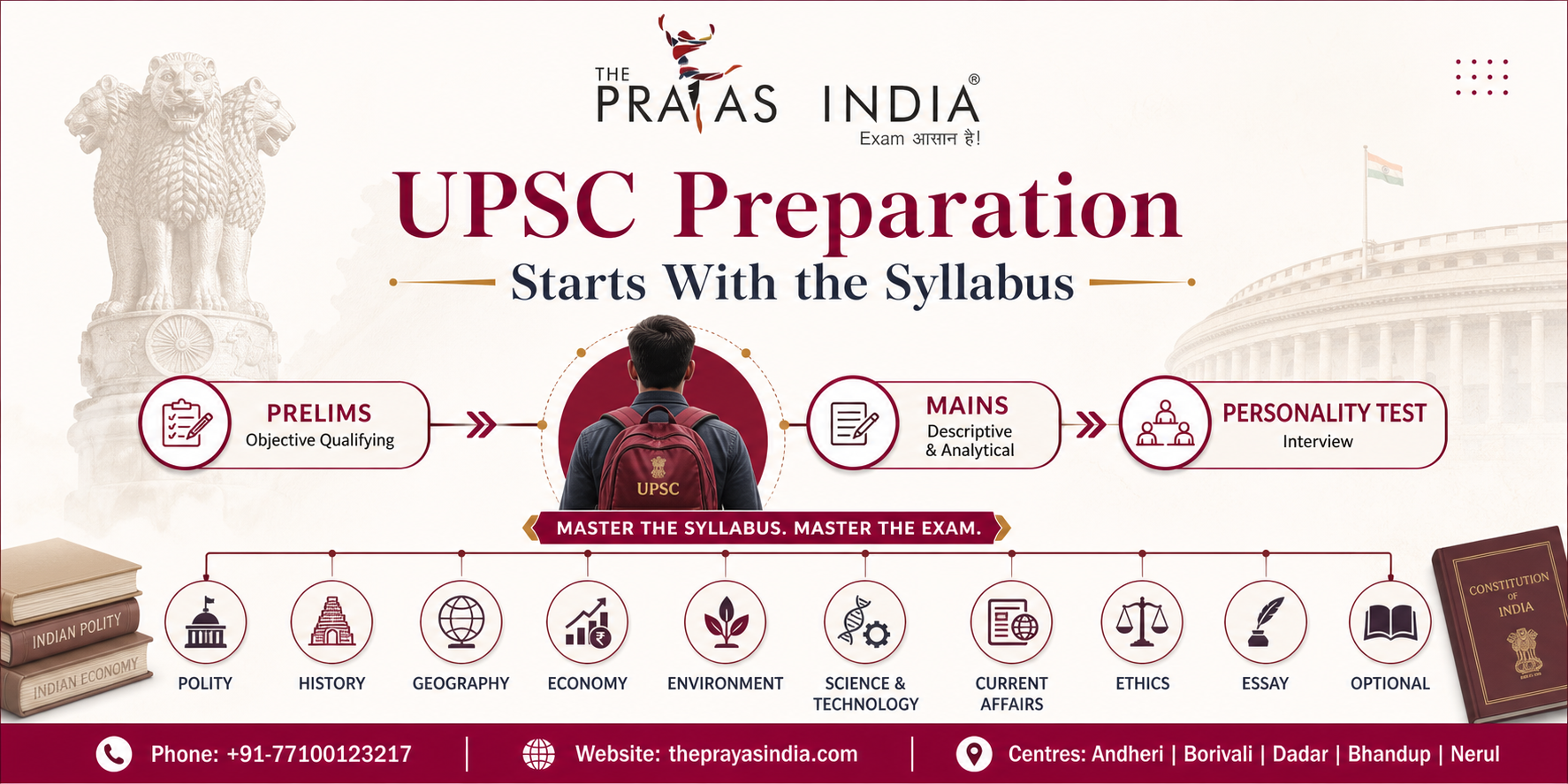
Before opening the first book, a beginner should understand the structure of the UPSC Civil Services Examination. The examination broadly consists of the Preliminary Examination, the Main Examination and the Personality Test.
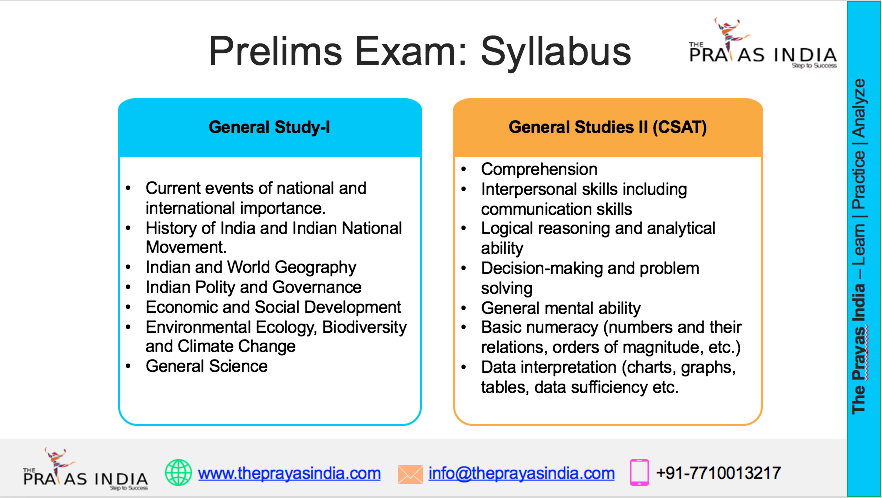
The Preliminary Examination is the screening stage. It includes General Studies Paper I and General Studies Paper II, commonly known as CSAT. Candidates who qualify the prescribed requirements of the Preliminary Examination move towards the Main Examination.
The Main Examination is substantially more descriptive and includes the Essay paper, General Studies papers, Optional Subject papers and qualifying language papers. The Personality Test is conducted for candidates who qualify through the required stages of the written examination.
Understanding this structure is important because UPSC preparation cannot be treated as a single-subject or single-stage exercise. The skills required for Prelims and Mains overlap in many areas, but the way you prepare and practise for each stage is different.
A beginner should therefore avoid making the common mistake of preparing only for the immediate examination stage without understanding the larger UPSC cycle.
Step 1: Understand the UPSC Syllabus Before Choosing Books
One of the most important rules for a beginner is simple: the syllabus should come before the booklist.
Many new aspirants begin preparation by purchasing multiple books recommended by different toppers, watching long lists of YouTube videos and downloading large amounts of study material. This creates the illusion of preparation but often leads to source overload.
Instead, begin with the official UPSC syllabus and divide it into manageable areas.
For General Studies, the broad preparation areas include:
- Indian Heritage and Culture
- History
- Geography
- Indian Polity and Governance
- Social Issues
- Economy
- Environment and Ecology
- Science and Technology
- Internal Security
- International Relations
- Ethics
- Current Affairs
- Disaster Management and related areas
For the Mains examination, also understand the requirements of Essay, Optional Subject and the qualifying papers.
The syllabus should remain accessible throughout your preparation. Whenever you study a topic, ask yourself:
Where does this topic fit into the UPSC syllabus?
This simple habit helps prevent unnecessary reading and keeps preparation examination-oriented.
Step 2: Understand the Difference Between Prelims and Mains Preparation
A beginner often asks, “Should I prepare for Prelims first or Mains first?”
The better approach is to understand that UPSC preparation is interconnected.
Prelims demands conceptual understanding, factual awareness, elimination skills and extensive practice with objective questions. Mains requires deeper understanding, analytical thinking, structured writing, examples, arguments and the ability to present a balanced answer within a limited word and time framework.
Therefore, foundational preparation should be integrated from the beginning.
For example, while studying Fundamental Rights in Polity, do not restrict yourself to memorising Articles. Understand their constitutional significance, landmark developments and contemporary relevance. This helps both Prelims and Mains preparation.
Similarly, while studying the Indian economy, concepts such as inflation, monetary policy, fiscal policy, taxation and growth should be understood conceptually rather than memorised as isolated definitions.
This integrated approach reduces duplication and makes revision more efficient.
Step 3: Start With NCERTs and Build Your Foundation
For someone genuinely starting from zero, jumping immediately into advanced reference books can make preparation unnecessarily difficult.
NCERT textbooks can help beginners develop basic conceptual understanding in subjects such as History, Geography, Economics and Political Science. They should not be treated as the complete UPSC preparation material, but they can provide a useful foundation.
The purpose of this stage is not to finish every textbook as quickly as possible. Instead, focus on understanding fundamental concepts and developing familiarity with the terminology used in the examination.
For example, a beginner who has never studied macroeconomics may find advanced economy material difficult. Building basic understanding first can make subsequent preparation significantly easier.
The same principle applies to Geography, Polity and History.
Once the fundamentals are clear, move towards a limited set of standard UPSC-oriented sources.
Step 4: Build a Limited and Reliable Booklist
The internet provides thousands of UPSC booklists. Following all of them is neither necessary nor practical.
A better strategy is to create a limited source list for each subject.
Your source selection should answer three questions:
- Is the source reliable?
- Does it adequately cover the UPSC syllabus?
- Can I revise it multiple times?
The third question is particularly important.
A 500-page resource that you read once is generally less useful than a focused resource that you can understand, revise and recall multiple times.
Your preparation should therefore move towards limited sources + repeated revision + continuous practice rather than unlimited sources.
A typical beginner may eventually build a core resource set covering:
- Polity
- Modern Indian History
- Geography
- Economy
- Environment
- Science and Technology
- Art and Culture
- Ethics
- Current Affairs
- Optional Subject
The exact resources may differ according to the candidate’s background, optional subject and learning requirements.
Step 5: Decide How You Will Prepare Before You Start Studying Seriously
This is an important decision for beginners.
UPSC preparation can involve self-study, classroom coaching, online courses, mentorship programmes, test series or a combination of these approaches.
Self-study provides flexibility, but it requires the aspirant to independently design the syllabus plan, identify appropriate resources, track progress, analyse tests and resolve preparation-related doubts.
A structured programme can provide a predefined learning path, faculty guidance, regular assessments, study material, doubt-solving support and a disciplined study environment.
Neither approach should be selected merely because it is popular among other aspirants. The right choice depends on your academic background, availability of time, learning style, discipline, existing knowledge and ability to independently structure your preparation.
For a complete beginner who is unsure about what to study, how to sequence subjects or how to evaluate progress, structured guidance can reduce the uncertainty involved in the initial stages.
Step 6: Create a Realistic Daily Study Routine
One of the biggest mistakes beginners make is creating unrealistic timetables.
A student may decide to study 12–14 hours from the first day and prepare an extremely detailed timetable. After a few days, the schedule becomes difficult to sustain, and the student starts feeling that preparation is failing.
Instead, create a routine that you can realistically maintain.
Your daily schedule should ideally include different kinds of preparation rather than spending the entire day reading.
For example, a study day can include:
- One major static subject
- Current affairs
- Revision
- MCQ practice
- Mains answer-writing practice after the foundation becomes sufficiently strong
- Optional Subject preparation
- Short breaks and recovery time
The exact number of study hours should depend on your circumstances. A college student, working professional and full-time aspirant may require completely different schedules.
The important metric is not simply the number of hours spent at the desk. It is the amount of meaningful learning, revision and practice completed consistently.
Step 7: Learn How to Study a UPSC Topic
Reading a chapter once is not the same as preparing it for UPSC.
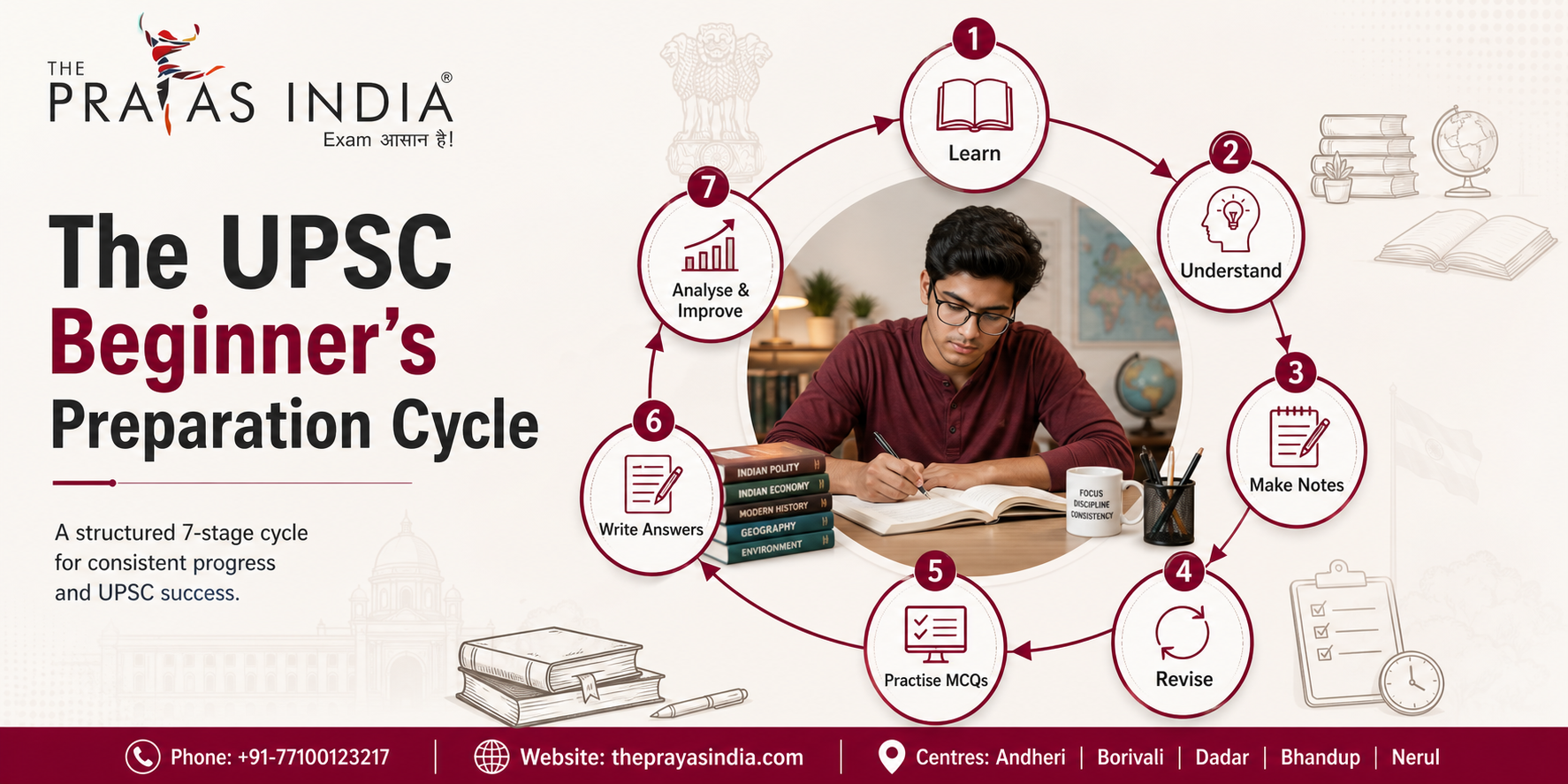
When studying a topic, try to move through four stages:
Understand → Consolidate → Revise → Practise
Suppose you are studying Parliamentary Committees.
First, understand what they are and why they exist. Then identify important types, functions and constitutional or parliamentary relevance. Next, revise the information. Finally, practise questions related to the topic.
For Mains-oriented topics, go one step further. Think about examples, contemporary relevance, challenges, government initiatives, constitutional provisions, committee recommendations and possible solutions.
This gradually converts passive reading into active preparation.
Step 8: Make Current Affairs a Daily Habit
Current affairs are an essential part of UPSC preparation, but beginners frequently make the mistake of consuming too much information.
Reading multiple newspapers, websites, magazines, Telegram channels, social-media updates and monthly compilations simultaneously can consume several hours without necessarily improving preparation.
Instead, select a reliable current-affairs source and follow it consistently.
The objective is not to memorise every event. You need to understand issues that have relevance to the UPSC syllabus.
For example, if a major environmental issue appears in the news, connect it with:
- Environmental concepts
- Relevant laws and institutions
- Government policies
- International commitments
- Challenges
- Possible solutions
This creates a connection between static subjects and current affairs.
Over time, current affairs should become an extension of your static preparation rather than a completely separate subject.
Step 9: Start Making Notes Carefully
Beginners often spend too much time making notes.
The purpose of notes is to make revision easier, not to reproduce the textbook.
A useful note should contain information that you are likely to forget, important conceptual connections, relevant examples, data where appropriate and points useful for answering questions.
Avoid rewriting entire chapters.
For Mains preparation, notes can gradually be organised under categories such as:
Issue → Causes → Impact → Challenges → Government Initiatives → Examples → Way Forward
This structure can help develop analytical thinking and answer-writing ability.
Digital notes can be useful for candidates who prefer searchable and easily editable material, while handwritten notes may work better for others. The method matters less than whether the notes are concise, organised and repeatedly revised.
Step 10: Do Not Wait Until the End to Start Revision
Revision should not be treated as an activity reserved for the final months.
If you study a topic today and do not revisit it for several months, much of the information will become difficult to recall.
A practical revision cycle can involve:
- Quick revision after completing a topic
- Revision after a few days
- Subject-level revision after completing multiple topics
- Periodic cumulative revision
- Revision through tests and questions
The exact schedule can vary, but the principle remains the same: learning without revision creates weak retention.
For UPSC, repeated exposure to the same material is often more valuable than continuously adding new sources.
Step 11: Introduce MCQ Practice Gradually
Prelims preparation requires more than reading.
Multiple-choice questions help you understand how concepts are tested and gradually develop elimination and analytical skills.
Beginners should not become obsessed with test scores in the early stages. Initially, the purpose of MCQ practice is to identify knowledge gaps and understand question patterns.
After completing a topic, solve relevant questions and analyse every mistake.
Ask:
- Did I not know the concept?
- Did I misread the question?
- Did I make an assumption?
- Did I eliminate the options incorrectly?
- Did I confuse two similar concepts?
The analysis of mistakes is often more useful than simply checking the score.
Step 12: Introduce Answer Writing at the Right Stage
A common misconception is that beginners should immediately write multiple Mains answers every day.
For someone starting from zero, the initial priority should be conceptual foundation. However, once basic familiarity with the major subjects develops, answer writing should gradually become part of the preparation.
Start with understanding the structure of a good answer.
A basic answer framework may include:
Introduction → Core Analysis → Examples/Evidence → Challenges or Counterpoints → Way Forward → Conclusion
The structure will vary according to the question.
The goal is to develop the ability to answer exactly what the question asks rather than writing everything you know about the topic.
Regular feedback is particularly important because a beginner may not be able to identify weaknesses in structure, relevance, depth or presentation independently.
Step 13: Choose Your Optional Subject Carefully
The Optional Subject is an important component of the Mains examination and therefore deserves a structured decision.
Do not choose an optional solely because someone secured a high score in it or because a particular subject is considered popular.
Consider:
- Your academic background
- Genuine interest in the subject
- Availability of reliable resources
- Syllabus length and structure
- Availability of guidance
- Previous exposure to the subject
- Your ability to sustain preparation for the subject
Once selected, avoid repeatedly changing your optional without a substantial reason.
Frequent switching can consume valuable preparation time and prevent sufficient depth from developing.
Step 14: Track Your Preparation With Measurable Targets
“Study Polity today” is not a sufficiently useful target.
A better target might be:
Complete a specific topic + revise previous material + solve 30 MCQs + analyse mistakes.
Similarly, instead of saying “prepare current affairs,” define what needs to be completed and revised.
Maintain a simple progress tracker covering:
- Syllabus completed
- Revision completed
- MCQs attempted
- Tests analysed
- Mains answers written
- Optional topics completed
- Current-affairs notes revised
This helps identify whether you are actually progressing or simply spending time studying.
Step 15: Develop an Integrated Prelims and Mains Strategy
As preparation progresses, avoid treating Prelims and Mains as completely separate examinations.
A topic such as Indian Polity can be prepared through multiple dimensions. You may first understand the constitutional concept, then study its factual aspects for Prelims, and finally develop analytical perspectives for Mains.
This integrated approach is particularly useful because it reduces duplication.
However, as the Prelims examination approaches, the preparation naturally becomes more focused on objective practice, revision, elimination techniques and test-taking skills. After qualifying Prelims, the preparation needs to shift strongly towards Mains-specific writing, revision and answer practice.
The strategy therefore needs to evolve according to the examination cycle.
Step 16: Learn to Analyse Mock Tests
Mock tests are useful only when analysed properly.
A common mistake is to take a test, check the score and immediately move to the next test.
Instead, divide mistakes into categories:
- Conceptual gap
- Factual gap
- Poor reading
- Incorrect elimination
- Guessing error
- Time-management issue
- Silly mistake
Then identify recurring patterns.
For example, if you repeatedly make errors in questions involving constitutional bodies, the problem may not be test-taking ability. You may need to revisit the underlying concepts.
Similarly, consistently losing marks because of rushed reading indicates a different problem.
Test analysis converts practice into improvement.
Step 17: Build a Preparation Strategy Around Your Personal Situation
There is no universal UPSC timetable that works equally well for everyone.
A full-time aspirant may be able to dedicate most of the day to preparation. A working professional may have only a few focused hours on weekdays and more time on weekends. A college student may need to balance classes, examinations and UPSC preparation.
Therefore, instead of copying another aspirant’s timetable, identify:
- Your available study hours
- Your academic strengths
- Your weak subjects
- Your optional subject
- Your preparation stage
- Your target attempt
- Your preferred learning method
- Your access to guidance and test practice
Then build the plan accordingly.
Step 18: Know When You Need Structured Guidance
Self-study can work for disciplined candidates who are comfortable designing their own strategy and evaluating their progress. But many beginners struggle not because they lack the willingness to work, but because they lack clarity about the process.
If you repeatedly face questions such as:
What should I study next?
Which sources should I follow?
Is my preparation on track?
How should I approach answer writing?
Why am I not improving in tests?
How should I manage Prelims and Mains together?
then structured guidance may help bring greater organisation to your preparation.
A classroom or guided programme can potentially provide a defined curriculum, faculty interaction, doubt-solving support, regular assessments, mentorship and a peer learning environment. The value of such support depends on the quality and structure of the programme, so aspirants should evaluate these aspects before making an admission decision.
For a beginner, the objective should not simply be to “join coaching.” The objective should be to identify whether the programme can provide the structure, academic support and accountability required for the candidate’s preparation needs.
A Practical Beginner’s Roadmap
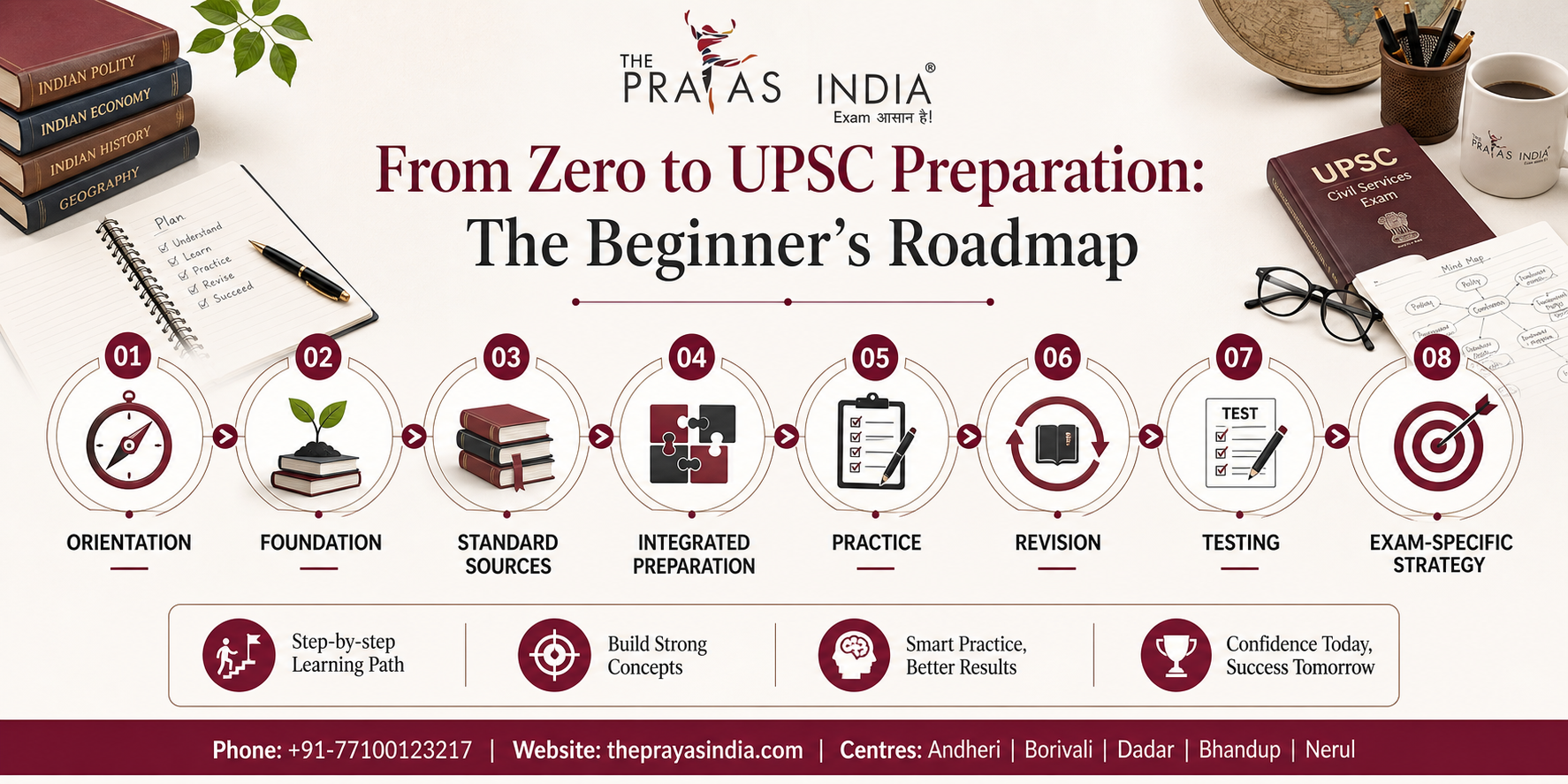
A beginner can broadly organise UPSC preparation into the following stages:
Stage 1: Orientation
Understand the examination structure, syllabus, previous-year questions and broad preparation requirements.
Stage 2: Foundation
Build basic conceptual understanding through NCERTs and introductory resources.
Stage 3: Standard Sources
Move towards limited, reliable subject-specific resources.
Stage 4: Integrated Preparation
Combine static subjects with current affairs and begin connecting concepts with contemporary issues.
Stage 5: Practice
Introduce MCQs, previous-year questions, answer writing and topic-wise tests.
Stage 6: Revision
Repeatedly revise completed subjects and reduce dependence on new sources.
Stage 7: Test-Based Preparation
Use full-length tests, detailed analysis and targeted revision to identify weaknesses.
Stage 8: Examination-Specific Preparation
As the examination approaches, progressively shift the balance towards the requirements of the relevant stage.
This roadmap provides structure while still allowing adjustments according to individual progress.
A Sample Weekly Framework for a Beginner
A beginner can also divide the week into different preparation activities rather than studying the same way every day.
For example:
| Preparation Area | Suggested Focus |
|---|---|
| Static Subject | Concept building and syllabus coverage |
| Current Affairs | Daily reading and issue-based notes |
| Revision | Previously completed topics |
| MCQs | Topic-wise practice and analysis |
| Mains | Gradual answer-writing practice |
| Optional | Consistent weekly progress |
| Previous-Year Questions | Understanding UPSC question trends |
| Test Analysis | Identifying recurring mistakes |
This is not a fixed timetable. Candidates should adjust the distribution according to their preparation stage and personal circumstances.
Common Mistakes Beginners Should Avoid
Starting early does not automatically guarantee effective preparation. The quality of the preparation process matters.
Collecting Too Many Resources
More books do not necessarily mean better preparation. Too many sources can make revision difficult.
Studying Without the Syllabus
Without referring to the syllabus, beginners may spend significant time studying topics that have limited relevance to their examination requirements.
Ignoring Previous-Year Questions
Previous-year questions help candidates understand what UPSC actually asks. They should be analysed alongside the syllabus and not treated merely as practice questions.
Delaying Revision
Completing new topics continuously without revisiting old ones creates weak retention.
Avoiding Tests Because the Preparation Is “Not Complete”
Tests can reveal weaknesses that ordinary reading does not reveal. They should be introduced progressively according to preparation stage.
Treating Current Affairs as a Separate Universe
Current affairs should be connected to static concepts and syllabus areas wherever possible.
Copying Someone Else’s Strategy
A topper’s timetable, booklist or study routine may not suit your academic background or available time.
Changing Sources Frequently
Repeatedly switching between teachers, books and online resources can create fragmented preparation.
How Previous-Year Questions Can Change Your Preparation
Previous-year questions are among the most valuable resources for understanding the examination.
Before completing a subject, look at relevant questions from previous examinations. This helps answer an important question:
What does UPSC actually expect from this topic?
For Prelims, previous-year questions help identify recurring conceptual areas and question styles.
For Mains, they help you understand the level of analysis expected and the way broad syllabus topics can be converted into specific questions.
A beginner does not need to solve every previous-year paper immediately. Initially, even analysing questions topic-wise can significantly improve understanding of the examination.
How to Know Whether Your Preparation Is Actually Improving
Preparation progress should not be measured only by the number of hours studied or books completed.
Look for measurable improvements:
- Can you explain a concept without looking at your notes?
- Can you identify where a topic fits into the syllabus?
- Can you solve more conceptual MCQs correctly?
- Are you making fewer repeated mistakes?
- Can you write a structured answer within the required time?
- Are your notes becoming shorter and more useful?
- Are you revising completed topics more efficiently?
- Can you connect current affairs with static subjects?
These indicators provide a better picture of preparation quality.
Should You Join UPSC Coaching as a Beginner?
This is one of the most important questions for students starting from zero.
There is no single answer for every aspirant. The decision depends on how independently you can plan, study, revise, practise and evaluate your preparation.
However, beginners should carefully evaluate what they actually need.
If you are comfortable creating your own study plan, selecting resources, tracking the syllabus, analysing tests and resolving doubts independently, you may prefer a largely self-directed approach.
If you find it difficult to structure your preparation, need regular academic guidance, want faculty support, benefit from a disciplined classroom environment or need systematic testing and mentorship, a structured UPSC programme may be worth considering.
Before taking admission, ask the institute about:
- Faculty and teaching methodology
- Course structure
- Syllabus coverage
- Study material
- Current-affairs support
- Doubt-solving mechanism
- Test series
- Answer-writing evaluation
- Mentorship
- Batch schedule
- Classroom or online support
- Revision strategy
- Support available during different preparation stages
The purpose of this evaluation is to ensure that the programme matches your actual preparation requirements rather than joining simply because a particular institute is popular.
Why a Structured UPSC Foundation Approach Can Help Beginners
For someone starting from zero, the initial months can involve too many decisions: which subject to begin with, which sources to use, how to divide time, when to revise, when to start testing and how to integrate current affairs.
A structured foundation approach can reduce some of this planning burden by providing a defined sequence for learning.
With appropriate faculty guidance, regular assessment and a systematic study plan, students can focus more consistently on learning and improving rather than repeatedly redesigning their preparation strategy.
This becomes especially relevant for aspirants who are starting their preparation for the first time and want an organised pathway from basic concepts to advanced examination practice.
The Prayas India for Structured UPSC Preparation
For aspirants who prefer guided preparation, The Prayas India offers a structured environment for UPSC CSE preparation, with an approach focused on systematic learning, conceptual clarity, practice and continuous preparation support.
Students considering admission should evaluate the programme according to their own requirements and understand the course structure, faculty support, test practice, mentorship and learning methodology before enrolling.
The key objective is to build a preparation system that takes a beginner from understanding the examination to developing the knowledge, practice and confidence required for the different stages of UPSC CSE.
Final Takeaway
Starting UPSC preparation from zero does not mean trying to complete the entire syllabus immediately. It means building the right foundation and gradually developing the skills required by the examination.
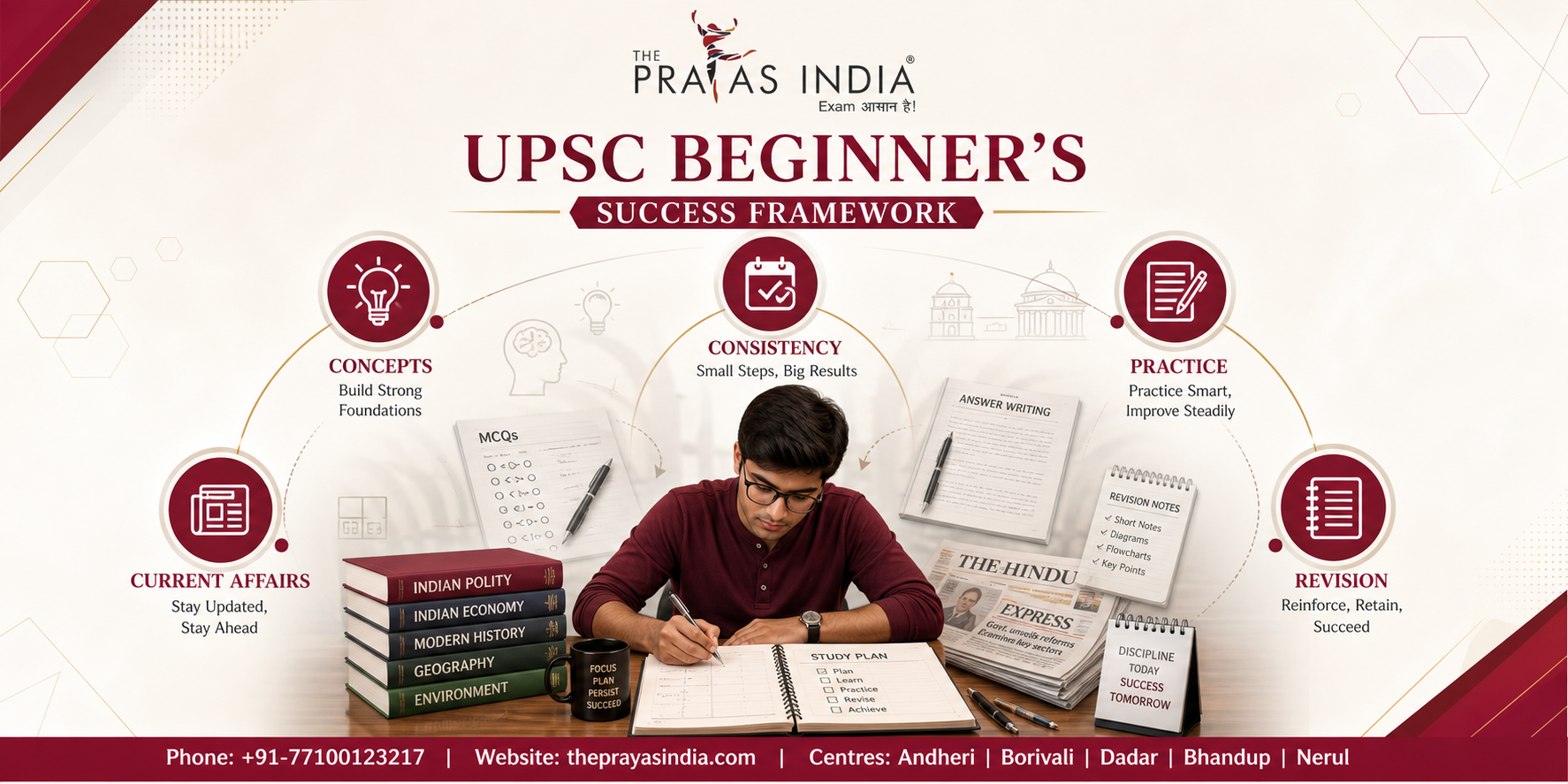
Begin with the syllabus. Understand the examination pattern. Build your fundamentals. Select limited and reliable sources. Develop a realistic study routine. Integrate current affairs with static subjects. Introduce MCQs and answer writing progressively. Revise repeatedly. Analyse your tests. Track your progress. Most importantly, do not allow resource overload and constant strategy changes to replace actual preparation.
If you are a beginner and feel confused about where to start, the first step is not to collect more material. The first step is to create a clear roadmap and decide what kind of academic support will help you follow it consistently.
Frequently Asked Questions
Can I start UPSC preparation from zero?
Yes. Many aspirants begin without prior UPSC-specific preparation. Start by understanding the syllabus and examination structure, then gradually build your concepts, current affairs, revision and practice.
How should a beginner start UPSC preparation?
Begin with the UPSC syllabus, previous-year questions and basic concepts. Select limited and reliable resources, create a realistic study routine and gradually introduce current affairs, MCQs, answer writing and revision.
Should I join UPSC coaching as a beginner?
The decision depends on your preparation needs. If you need structured guidance, regular assessments, faculty support, doubt solving and mentorship, a structured UPSC programme can help organise your preparation.
How many hours should a beginner study for UPSC?
There is no fixed number of hours that works for every aspirant. Focus on consistent, distraction-free study, revision and practice rather than simply counting the hours spent at the desk.
How do I choose the right UPSC coaching institute?
Evaluate faculty, teaching methodology, course structure, study material, current-affairs support, mentorship, doubt-solving, test series and answer-writing evaluation before making your decision.
Start Your UPSC Preparation With the Right Guidance
Starting UPSC preparation from zero becomes more structured with the right roadmap, expert guidance, regular practice and consistent mentorship. Explore The Prayas India’s UPSC CSE preparation programmes and find the right learning approach for your preparation journey.
Admissions Open for UPSC CSE Preparation
Call Now for Admission Enquiry
Visit Our UPSC Centres:
Andheri | Borivali | Dadar | Nerul | Bhandup
Connect with our team to understand the available UPSC preparation programmes,
batch options and admission process.