How to Write a 15-Marker Answer in UPSC Mains? | Best UPSC Coaching in Mumbai | The Prayas India
Introduction: A 15-Marker Is More Than a Longer Answer
In UPSC Mains, a 15-marker gives you more space than a 10-marker, but that does not mean you should simply write a longer version of the same answer. A good 15-marker requires a more developed argument, better use of dimensions, relevant examples and a conclusion that brings the discussion together. The challenge is to provide sufficient depth within a limited word count and time.
Many aspirants lose marks because they approach a 15-marker as a content-dumping exercise. They try to include everything they know about the topic, often moving from one fact to another without establishing a clear connection with the question. UPSC, however, rewards answers that remain relevant to the demand of the question while demonstrating analytical understanding.
The ideal 15-marker should therefore feel complete without becoming excessive. It should have a clear introduction, a well-organised body covering the important dimensions of the question and a concise conclusion. The answer should demonstrate that you understand not only the subject but also what the question is actually asking you to discuss.
For aspirants preparing for UPSC CSE, this distinction becomes particularly important as they move from basic content preparation towards answer-writing practice. Developing a structured approach to 15-mark questions can help improve relevance, presentation and analytical depth.
First Understand What UPSC Is Asking
Before writing anything, spend a few moments understanding the exact demand of the question. This is one of the most important steps because even a content-rich answer can underperform if it does not directly address the question.
Look carefully at the directive word used in the question. Words such as discuss, analyse, examine, evaluate, critically examine, comment, elucidate and critically discuss require different approaches. If the question asks you to analyse something, simply describing it is not enough. If it asks you to critically examine an issue, you need to discuss both its strengths and limitations before arriving at a balanced assessment.
You should also identify the subject, context and scope of the question. A broad topic such as federalism can produce very different answers depending on whether the question focuses on fiscal federalism, cooperative federalism, Centre-State relations or contemporary challenges. Your preparation may contain extensive information, but only the information relevant to the specific demand should enter the answer.
A useful habit is to mentally convert the question into a simple task before beginning. Ask yourself: What exactly am I being asked to explain, analyse, compare, evaluate or suggest? Once this becomes clear, your answer becomes much easier to structure.
The 15-Marker Structure: Introduction, Body and Conclusion
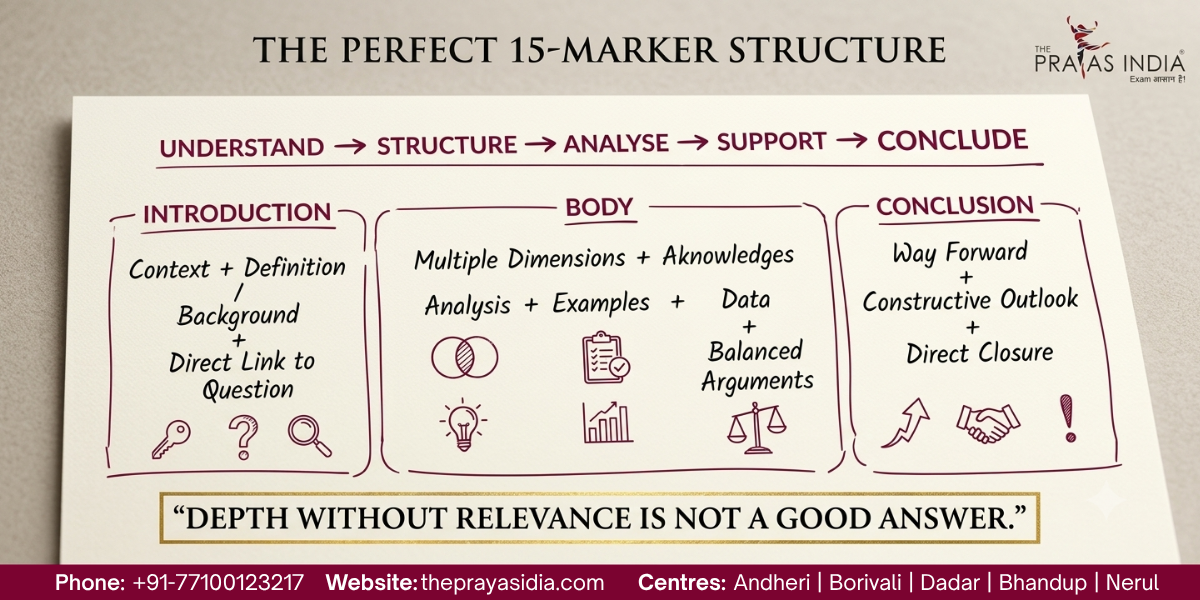
A strong 15-marker usually benefits from a clear three-part structure: introduction, body and conclusion. This does not mean every answer must look mechanically identical. The structure should provide direction while allowing you to adapt the content according to the question.
The introduction should establish the context and demonstrate that you understand the topic. The body should address the central demand of the question through logically arranged arguments and relevant dimensions. The conclusion should bring the discussion together and, wherever appropriate, provide a constructive or forward-looking perspective.
The biggest advantage of this structure is that it prevents your answer from becoming a collection of disconnected points. Instead, the examiner can clearly see how your argument develops from the introduction to the conclusion.
For a 15-marker, the body should receive the greatest attention because this is where you demonstrate your knowledge and analytical ability. However, the introduction and conclusion should not be treated as formalities. A well-written opening can establish relevance immediately, while a thoughtful conclusion can leave the examiner with a clear sense that the question has been adequately addressed.
How to Write an Effective Introduction
The introduction should be concise but meaningful. You do not need to spend a large portion of your answer defining every term mentioned in the question. Your objective is to establish context and enter the discussion quickly.
Depending on the topic, you can begin with a brief definition, constitutional provision, contemporary context, relevant report, historical background, data point or conceptual explanation. For example, if the question concerns the role of Parliament in Indian democracy, you could establish the constitutional significance of Parliament before moving into the specific issue raised by the question.
However, avoid writing an introduction that sounds like a textbook definition copied from memory. The introduction should connect directly with the question.
A useful test is simple: If the examiner reads only your introduction, will they understand that you have correctly interpreted the question? If the answer is yes, your introduction is doing its job.
Build the Body Around Dimensions, Not Random Points
The body is where many aspirants either become too brief or too repetitive. A 15-marker gives you enough room to explore the issue from multiple perspectives, but these perspectives must remain connected to the central demand.
Instead of writing ten unrelated points, organise your arguments into meaningful dimensions. Depending on the question, these may include political, economic, social, administrative, constitutional, ethical, environmental, technological, security or international dimensions.
For instance, if the question asks about the challenges associated with urbanisation, you could examine housing and infrastructure from a social perspective, municipal finances from an economic perspective, governance capacity from an administrative perspective and pollution from an environmental perspective. Such organisation demonstrates breadth without making the answer feel scattered.
The dimensions should not be inserted mechanically. Use only those perspectives that genuinely help answer the question. A shorter answer containing six relevant arguments is far stronger than an answer containing ten generic points simply because the candidate wanted to demonstrate multidimensional thinking.
Develop Each Point Instead of Listing It
This is particularly important for 15-mark answers.
A common weak pattern is:
Point → Point → Point → Point
The answer technically contains several arguments, but it does not demonstrate enough explanation.
Instead, develop your arguments using a simple progression:
Claim → Explanation → Example/Evidence → Link to the Question
For example, if discussing a governance challenge, first state the challenge, then explain why it matters, support it with an appropriate example or data point and finally connect it back to the larger issue being discussed.
This does not mean every point must become a long paragraph. The objective is to ensure that the examiner can see the reasoning behind your argument.
A well-developed answer often contains fewer points than a poorly structured answer, but each point contributes something meaningful.
Use Examples to Make Your Arguments Concrete
Examples can significantly improve the quality of a UPSC Mains answer when they are relevant and correctly used.
Depending on the subject, examples may come from constitutional provisions, Supreme Court judgments, government schemes, committees, reports, international experiences, historical events, administrative initiatives or contemporary developments.
However, examples should support your argument rather than replace it.
For instance, simply mentioning a government scheme does not demonstrate analysis. Explain briefly how the scheme illustrates the issue you are discussing. Similarly, mentioning a Supreme Court judgment is useful when it establishes a constitutional or legal principle relevant to the question.
The best examples are usually those that you can explain accurately and connect naturally with your argument. There is no need to force a famous example into every paragraph.
Use Data Carefully and Strategically
Data can make an answer more credible, but only when it is relevant and reasonably accurate.
Aspirants sometimes try to memorise large numbers from reports and then insert them into answers regardless of the question. This can make the answer feel artificial.
Instead, maintain a manageable collection of reliable statistics that can be used across important themes such as poverty, employment, education, health, agriculture, gender, urbanisation, environment and economic development.
Reports from institutions such as NITI Aayog, government ministries, the Economic Survey, Census-related sources and reputed international organisations can provide useful evidence.
If you are not confident about an exact figure, avoid inventing precision. A broadly accurate trend is preferable to a fabricated statistic.
How to Use Diagrams and Flowcharts in a 15-Marker
A well-placed diagram can improve presentation and communicate a complex relationship quickly.
You do not need to use diagrams in every answer. They are most useful when the topic involves a process, relationship, cycle, institutional structure or cause-and-effect chain.
For example, an answer on climate change can use a simple flowchart showing rising greenhouse gas emissions → warming → changes in weather patterns → economic and social impacts → adaptation requirements.
Similarly, governance questions can sometimes benefit from a simple stakeholder diagram.
The objective is not artistic presentation. The diagram should save time and improve clarity.
Maintain a Balanced Argument
UPSC Mains frequently rewards balance, especially when questions ask you to examine, critically analyse or evaluate an issue.
Balance does not mean refusing to take a position. It means recognising the complexity of the issue.
If the question asks about the benefits and challenges of a particular policy, discuss both. If it asks whether an institution has been effective, acknowledge its achievements as well as its limitations. If the question involves a controversial policy issue, distinguish between the intended objectives and implementation challenges.
A balanced answer demonstrates maturity because governance and public policy rarely operate in absolute terms.
The strongest answers often move from problem identification to analysis and then towards practical solutions.
How to Write a Strong Conclusion
The conclusion should not simply repeat the introduction. It should bring your argument together and, where appropriate, indicate a constructive way forward.
For policy-related questions, the conclusion can mention the need for better implementation, institutional coordination, capacity building, technology, inclusion or citizen participation, depending on the topic.
For analytical questions, the conclusion can provide a balanced judgement based on the arguments discussed.
For questions involving challenges, a forward-looking conclusion is often useful because it demonstrates that you are not merely identifying problems but also thinking about solutions.
Keep the conclusion concise. A few meaningful sentences are usually more effective than another long paragraph that introduces entirely new information.
Time Management: A 15-Marker Must Fit Into Your Overall Paper Strategy
Even an excellent answer has limited value if it takes too long to write.
UPSC Mains requires you to manage time across multiple questions, so your answer-writing strategy must be realistic under examination conditions.
During practice, do not simply practise writing beautiful answers without a timer. You need to learn how much content you can realistically produce within the time available.
Start with untimed practice while learning structure. Once you become comfortable, introduce time limits gradually. Eventually, practise complete tests where you have to make decisions about how much time each question deserves.
The objective is to reach a stage where you can quickly understand the question, create a mental framework and begin writing without spending several minutes planning every sentence.
Avoid These Common 15-Marker Mistakes
Aspirants often lose marks not because they lack knowledge but because they fail to convert their knowledge into an effective answer. One of the most common mistakes is writing everything they know about the topic instead of answering what was asked. Another is repeating the same argument in different words to increase the apparent length of the answer.
Other problems include overly long introductions, generic conclusions, excessive use of headings without explanation, unsupported claims, irrelevant examples and poor time management. Some candidates also use diagrams or quotations simply for presentation without adding substantive value.
You should also avoid trying to make every answer look identical. UPSC evaluates different kinds of questions, and your structure should respond to the question’s demand. A governance question may benefit from stakeholders and institutional solutions, while a historical question may require chronology, causes, consequences and continuity.
The best way to eliminate these mistakes is not simply to read model answers. You need to write your own answers, get them evaluated and identify recurring weaknesses.
The Role of Keywords in UPSC Mains Answers
Keywords help the examiner identify your understanding quickly.
For example, in a question on federalism, terms such as cooperative federalism, fiscal federalism, constitutional distribution of powers, Inter-State Council, GST Council and decentralisation may be relevant depending on the exact question.
However, keywords should not become decoration.
A good answer introduces a relevant term and then demonstrates that you understand its significance. Merely filling the answer with technical vocabulary without explanation can make it look superficial.
During revision, create topic-wise keyword lists, but practise using those keywords naturally within arguments.
How Answer Writing Practice Should Progress
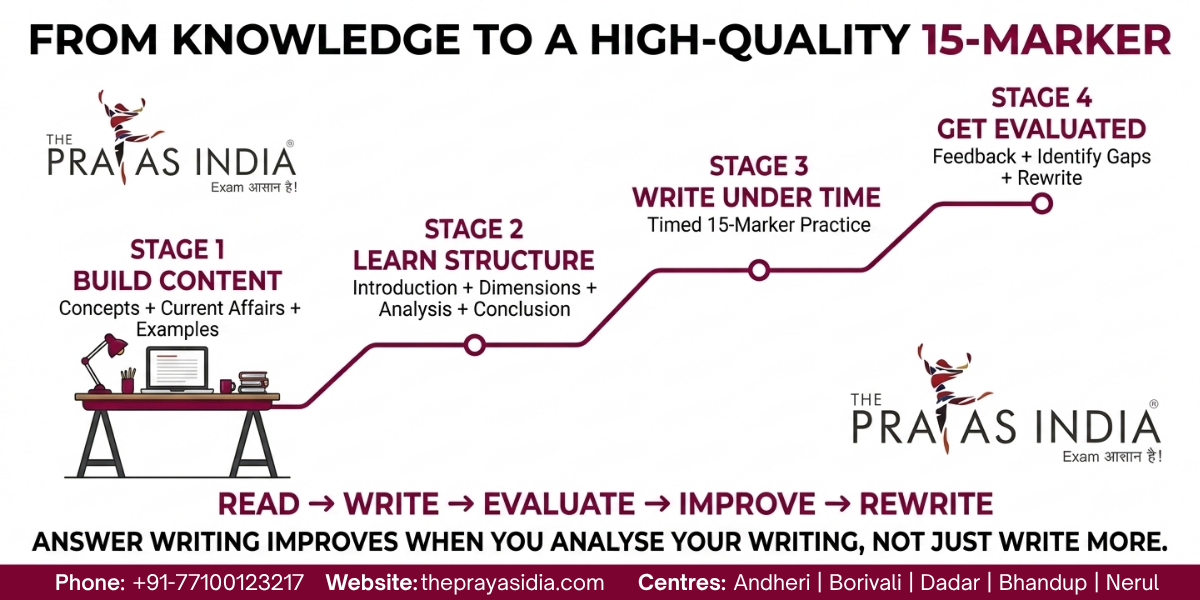
You do not need to begin your UPSC preparation by writing complete 15-mark answers every day. If your conceptual foundation is still developing, start by practising introductions, conclusions and individual arguments.
Once you become comfortable with the content, begin writing complete answers under time constraints.
After that, introduce sectional tests and eventually full-length Mains tests.
At every stage, focus on a specific improvement area. One week may focus on introductions and conclusions, another on adding dimensions, and another on improving examples and data.
This approach is more productive than simply writing dozens of answers without analysing them.
Build a Personal Framework Instead of Memorising a Model Answer
Model answers are useful for understanding how experienced candidates structure their responses, but memorising them word-for-word is not an effective strategy.
The UPSC syllabus is broad, and the examination can ask questions from unexpected angles. If you depend entirely on memorised answers, you may struggle when the question changes its wording or combines multiple themes.
Instead, develop answer frameworks for recurring themes.
For example, when preparing a topic such as urbanisation, you could build a framework covering infrastructure, housing, employment, governance, environment, migration, social inclusion and solutions. When a question appears, you can select the dimensions relevant to its specific demand.
This approach gives you flexibility while retaining the benefits of structured preparation.
How Current Affairs Can Strengthen a 15-Marker
Current affairs should not be treated as a separate collection of facts that you add randomly to Mains answers.
The strongest approach is to connect current developments with static concepts.
Suppose you are studying federalism. A recent Centre-State issue can provide a contemporary example, while the Constitution provides the conceptual foundation. Similarly, a recent environmental policy can be connected to constitutional provisions, sustainable development principles and institutional mechanisms.
This makes your answer more relevant and demonstrates that you understand how theoretical concepts operate in real-world governance.
For this reason, your current affairs notes should be organised around syllabus themes, not merely chronological events.
What Makes a 15-Marker Stand Out?
A high-quality 15-marker does not necessarily contain extraordinary information.
Often, it stands out because the candidate has done ordinary things exceptionally well. The answer directly addresses the question, uses relevant dimensions, explains rather than merely lists points, incorporates suitable examples and maintains a logical flow from beginning to end.
Presentation also matters. Clear handwriting, appropriate spacing, useful subheadings and relevant diagrams can make the answer easier to evaluate.
But presentation should support substance. A beautifully formatted answer with weak analysis cannot compensate for inadequate content.
The ideal answer combines relevance, structure, analysis, evidence and readability.
How UPSC Coaching Can Help Improve Answer Writing
Self-study can provide a strong foundation, but many aspirants struggle to objectively evaluate their own Mains answers. When you write an answer yourself, it can be difficult to identify whether your introduction is too generic, whether your dimensions are repetitive or whether your conclusion actually addresses the question.
This is where structured UPSC coaching and answer evaluation can become useful. Regular feedback can help identify patterns across multiple answers instead of treating each answer as an isolated exercise. Faculty guidance can also help aspirants understand how to convert static knowledge and current affairs into concise analytical arguments.
When choosing UPSC Coaching in Mumbai, aspirants should therefore look beyond classroom teaching. They should evaluate the quality of answer-writing practice, test series, feedback mechanisms, mentorship, study material and faculty interaction. A coaching programme that helps students repeatedly practise, evaluate and improve their answers can be particularly valuable for the Mains stage.
The Prayas India provides UPSC preparation support in Mumbai through centres at Andheri, Borivali, Dadar, Bhandup and Nerul. Aspirants can contact +91-77100 13217 to learn more about the available UPSC preparation programmes.

A Practical 15-Marker Checklist
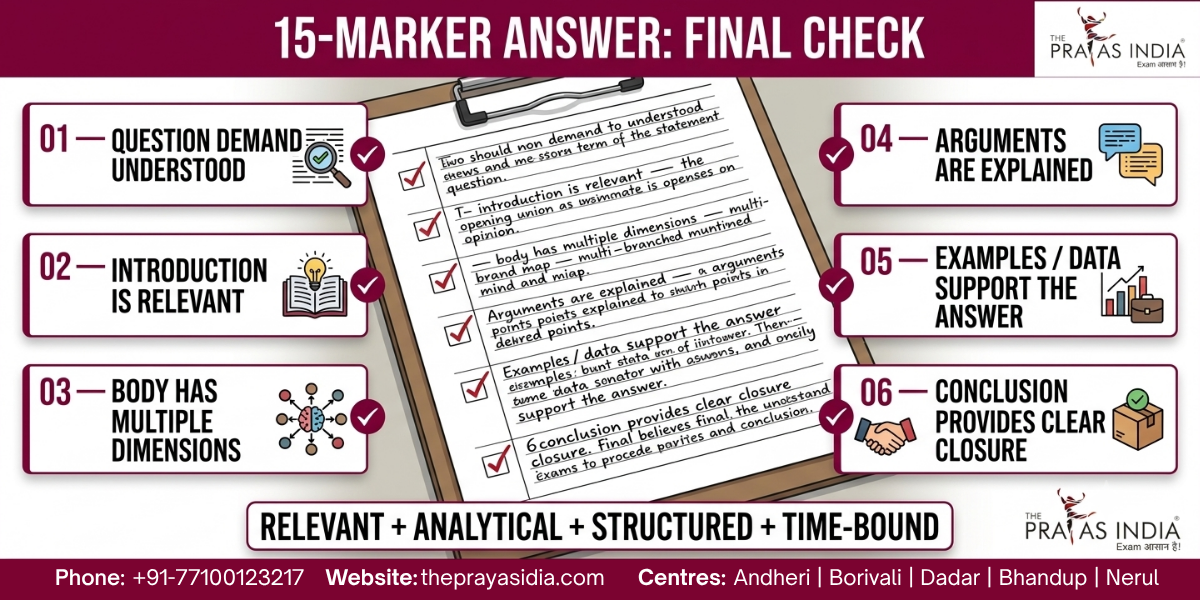
Before submitting a practice answer, ask yourself whether the answer has actually fulfilled the question’s demand. You should be able to identify a clear introduction, a body that covers the relevant dimensions and a conclusion that provides closure.
Then check whether your arguments are sufficiently explained. If you have written several points but each is only a phrase, the answer may lack analytical depth. Look for opportunities to add a short explanation, example or evidence where it genuinely strengthens the argument.
Finally, check relevance and time. An answer that contains excellent information but takes substantially longer than it should may create problems elsewhere in the paper.
A simple checklist can therefore include:
- Did I understand the directive?
- Did my introduction establish context?
- Did I address all major parts of the question?
- Did I use relevant dimensions?
- Did I explain my arguments rather than just list them?
- Did I include suitable examples, data or references where relevant?
- Did I maintain balance where required?
- Is my conclusion constructive and relevant?
- Did I complete the answer within the planned time?
Conclusion: Write for the Question, Not for the Examiner’s Attention
A strong 15-marker is not created by filling the page with information. It is created by understanding the question, selecting relevant knowledge and presenting that knowledge through a logical analytical structure.
The introduction should establish context without wasting valuable space. The body should explore the issue through relevant dimensions, with explanations and examples that demonstrate understanding. The conclusion should bring the discussion together and, where appropriate, provide a practical or forward-looking perspective.
Most importantly, answer writing should become a process of continuous improvement. Every practice answer should tell you something about your preparation: perhaps your content is strong but your analysis is weak, or your ideas are good but your time management is poor. Once these patterns are identified, targeted practice can gradually improve your performance.
For UPSC aspirants, the goal should not be to memorise a perfect answer for every possible topic. The goal should be to develop the ability to understand an unfamiliar question, organise relevant knowledge and produce a balanced, analytical response within the available time.
That is the skill that makes your preparation usable in the actual UPSC Mains examination.
Contact Us
📞 Call Now: +91-77100 13217
🌐 Website: theprayasindia.com
📍 Centres: Andheri | Borivali | Dadar | Nerul | Bhandup
FAQs
1. How many words should I write for a 15-marker in UPSC Mains?
A 15-marker generally has a prescribed word limit in the UPSC question paper, and candidates should aim to stay reasonably close to that limit. The focus should be on covering the question comprehensively rather than trying to exceed the word limit.
2. What is the ideal structure for a 15-marker UPSC answer?
A practical structure consists of a concise introduction, an analytical body covering relevant dimensions with examples or evidence, and a conclusion that provides clear closure or a constructive way forward.
3. How should I start a 15-marker answer?
Start by directly establishing the context of the question through a relevant definition, constitutional provision, contemporary development, data point or brief background. Avoid lengthy generic introductions.
4. How many points should I write in a 15-marker?
There is no fixed number of points. Focus on covering the important dimensions of the question with sufficient explanation rather than trying to maximise the number of bullet points.
5. Should I use examples in UPSC Mains answers?
Yes. Relevant examples from government initiatives, constitutional provisions, committees, reports, court judgments, historical developments or contemporary events can strengthen an argument when they are directly connected to the question.
6. Can diagrams improve a UPSC 15-marker answer?
A relevant and simple diagram can improve clarity, particularly when explaining processes, relationships, cycles or institutional structures. However, diagrams should support the argument rather than replace substantive content.
7. How can I improve my UPSC Mains answer writing?
Regular timed practice, detailed evaluation, identifying recurring mistakes and rewriting weak answers are among the most effective ways to improve. The objective should be continuous improvement rather than simply increasing the number of answers written.
8. Is answer writing necessary for UPSC Mains preparation?
Yes. Knowledge alone is not sufficient because UPSC Mains requires candidates to present their understanding within a limited word count and time. Regular answer writing helps develop structure, speed, relevance and analytical expression.
9. How important is current affairs in a 15-marker?
Current affairs can strengthen an answer when they are connected appropriately with the static syllabus. The strongest approach is to use current developments as evidence or examples rather than inserting unrelated facts.
10. Can UPSC coaching help with answer writing?
Structured coaching can provide regular practice, evaluation, feedback and mentorship, helping aspirants identify weaknesses that can be difficult to recognise through self-evaluation alone. When choosing UPSC coaching, aspirants should evaluate the quality of answer-writing support along with faculty, study material and test series.
11. Which is the best UPSC coaching in Mumbai?
The right institute depends on factors such as faculty, teaching methodology, answer-writing support, test series, mentorship, study material and individual learning requirements. The Prayas India has UPSC preparation centres at Andheri, Borivali, Dadar, Bhandup and Nerul.