Smart Time Management Tips for UPSC Aspirants | Best UPSC Coaching in Mumbai | The Prayas India
Introduction
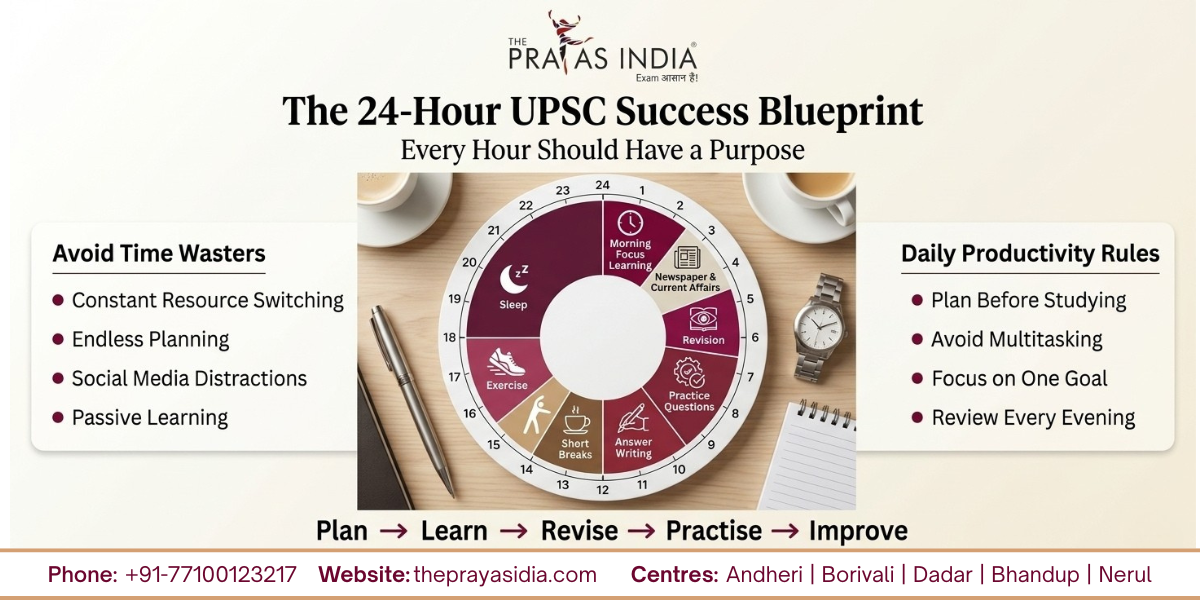
Every UPSC aspirant gets the same 24 hours in a day.
Yet, some candidates consistently complete their syllabus, revise regularly, stay updated with current affairs, and perform well in mock tests, while others struggle to keep pace despite spending long hours at their study table.
The difference is rarely the number of hours they study.
The real difference lies in how they manage those hours.
UPSC is one of the most demanding competitive examinations in India because it requires balancing multiple subjects, current affairs, answer writing, revision, and continuous self-evaluation. Without proper time management, even the most dedicated aspirants can feel overwhelmed.
This article explains how to manage your time intelligently so that every study session contributes meaningfully to your preparation.
UPSC Is Not Just a Knowledge Test
Many beginners believe that success depends only on reading more books.
In reality, UPSC rewards aspirants who know what to study, when to study, and how long to study.
Imagine two students:
The first studies for twelve hours without a clear plan.
The second studies for eight focused hours with predefined goals, regular revision, and minimal distractions.
In most cases, the second student makes faster and more consistent progress.
Time management transforms effort into measurable results.
Why Many Aspirants Feel They Never Have Enough Time
Almost every UPSC aspirant says,
“The syllabus is too vast.”
While the syllabus is undoubtedly extensive, the bigger issue is often unplanned preparation.
Common situations include:
- Spending excessive time on one subject while neglecting others.
- Reading multiple sources for the same topic.
- Postponing revision.
- Watching hours of study-related videos without actual learning.
- Constantly changing preparation strategies.
These habits consume valuable hours without adding proportional value to preparation.
Busy Doesn’t Always Mean Productive
There is an important difference between being busy and being productive.
Busy aspirants often:
- Rearrange notes repeatedly.
- Search for new resources every day.
- Spend hours planning but very little time executing.
- Study without setting specific objectives.
Productive aspirants usually:
- Decide their goals before beginning.
- Complete one task at a time.
- Revise consistently.
- Track progress every week.
The objective is not to remain occupied throughout the day.
The objective is to complete meaningful work.
Stop Measuring Preparation Only in Hours
One of the biggest misconceptions among UPSC aspirants is the belief that studying longer automatically leads to better results.
Instead of asking,
“How many hours did I study today?”
Ask,
“What did I actually complete today?”
For example:
Instead of saying,
“I studied for ten hours.”
Say,
“Today I completed Modern History, revised Polity notes, solved twenty CSAT questions, and wrote one answer-writing practice.”
This approach measures productivity rather than attendance.
The Biggest Time Wasters During UPSC Preparation
Many aspirants unknowingly lose two to four productive hours every day.
Some common reasons include:
Constantly Switching Resources
Beginning one book, moving to another, and then searching online for additional explanations creates confusion and slows learning.
Endless Note Making
Notes should simplify revision—not become another syllabus to complete.
Writing everything in detail often consumes time that could be spent revising or practising.
Overconsumption of Online Content
Educational videos can be useful.
However, continuously watching strategy discussions, topper interviews, and preparation tips without implementing them often creates an illusion of productivity.
Learning happens through active study, not passive consumption.
Perfectionism
Many students refuse to move forward until they feel they have mastered every concept.
UPSC preparation requires continuous progress.
Perfection comes gradually through repeated revision.
Lack of Daily Planning
Beginning the day without deciding what to study often leads to unnecessary delays and poor utilisation of time.
Even a simple daily checklist provides direction.
Understand Your Peak Productivity Hours
Not every hour of the day is equally productive.
Some students concentrate better in the early morning.
Others perform better during late evenings.
Observe your own routine for a week.
Identify the period when:
- Concentration is highest.
- Distractions are minimal.
- Complex topics become easier to understand.
Reserve these hours for demanding subjects such as Polity, Economy, Ethics, or Optional papers.
Routine tasks like newspaper reading or note organisation can be completed during lower-energy periods.
Time Management Begins Before You Open a Book
Many students believe time management starts when they begin studying.
In reality, it starts much earlier.
Ask yourself before every session:
- What is today’s priority?
- How much time will this topic require?
- What should I complete before taking a break?
- What will I revise today?
Starting with clarity reduces hesitation and improves focus.
One Day Does Not Decide Your Preparation
Some days will be highly productive.
Others may not go according to plan.
Avoid trying to “compensate” by studying excessively the next day.
Instead, return to your routine as quickly as possible.
UPSC preparation is a marathon.
Consistency over several months matters much more than one exceptional day.
Build a Routine That You Can Sustain
Many aspirants create ambitious timetables that look impressive on paper but become impossible to follow after a few days.
A better timetable is one that fits your lifestyle.
Whether you are a college student, a working professional, or a full-time aspirant, your study plan should be realistic enough to continue for months—not just a week.
The best schedule is not the busiest one.
It is the one you can follow consistently.
Good Time Management Reduces Stress
A clear plan eliminates unnecessary decision-making.
Instead of constantly wondering:
- What should I study now?
- Which subject is pending?
- Have I revised enough?
You simply follow your schedule.
This reduces mental fatigue and allows you to focus entirely on learning.
Planning creates confidence long before the examination arrives.
How to Plan a UPSC Study Schedule That You Can Actually Follow
Many UPSC aspirants spend hours creating beautiful timetables.
Unfortunately, most of those timetables survive for only three or four days.
Why?
Because they are designed around ideal situations, not real life.
A successful UPSC timetable is not the one that looks perfect on paper. It is the one you can follow consistently for months without feeling exhausted.
Instead of trying to copy someone else’s routine, build a schedule that matches your own responsibilities, energy levels, and learning style.
Don’t Fill Every Hour of the Day
One of the biggest mistakes aspirants make is planning every minute of their day.
For example:
6:00 – 7:00 AM
Newspaper
7:00 – 8:00 AM
Polity
8:00 – 9:00 AM
Economy
9:00 – 10:00 AM
History
This looks organised, but real life rarely follows such rigid planning.
Unexpected events, difficult topics, or personal responsibilities can easily disrupt the schedule.
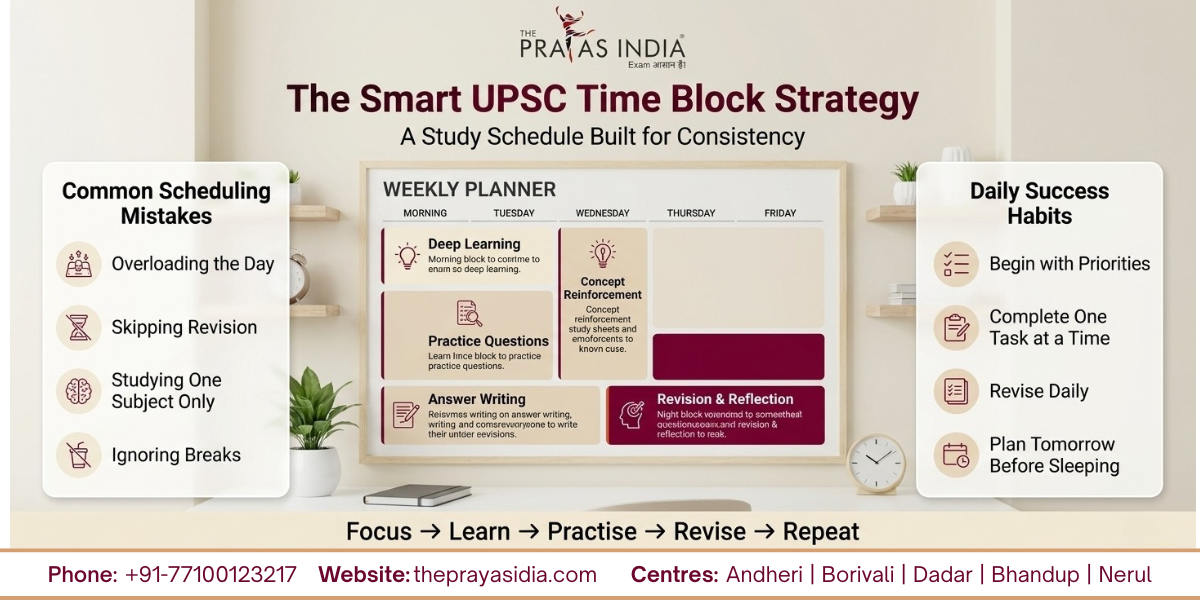
Instead, create study blocks.
For example:
Morning Block
Concept Learning
Afternoon Block
Practice & Revision
Evening Block
Current Affairs & Answer Writing
Study blocks provide flexibility while maintaining discipline.
Divide Your Day According to Energy Levels
Every task requires a different level of concentration.
Reserve your highest-energy hours for subjects that demand deeper understanding.
For example:
High Energy
- Polity
- Economy
- Ethics
- Optional Subject
- Environment
Medium Energy
- Geography
- Modern History
- Science & Technology
Lower Energy
- Newspaper Reading
- Current Affairs Revision
- Note Organisation
- Flashcards
This approach ensures your best concentration is spent where it matters most.
Never Study Only One Subject Every Day
Many aspirants spend an entire day studying a single subject.
Although this may seem productive, it often reduces retention and creates monotony.
Instead, rotate subjects strategically.
For example:
Morning
Polity
Afternoon
History
Evening
Current Affairs + Answer Writing
This keeps the brain engaged and improves long-term memory.
Make Revision a Daily Habit
Revision should never become a separate activity that happens only before the examination.
Instead, include revision in your daily timetable.
A simple rule works well:
- Learn new concepts.
- Revise previous topics.
- Practise questions.
This continuous cycle strengthens understanding and reduces last-minute pressure.
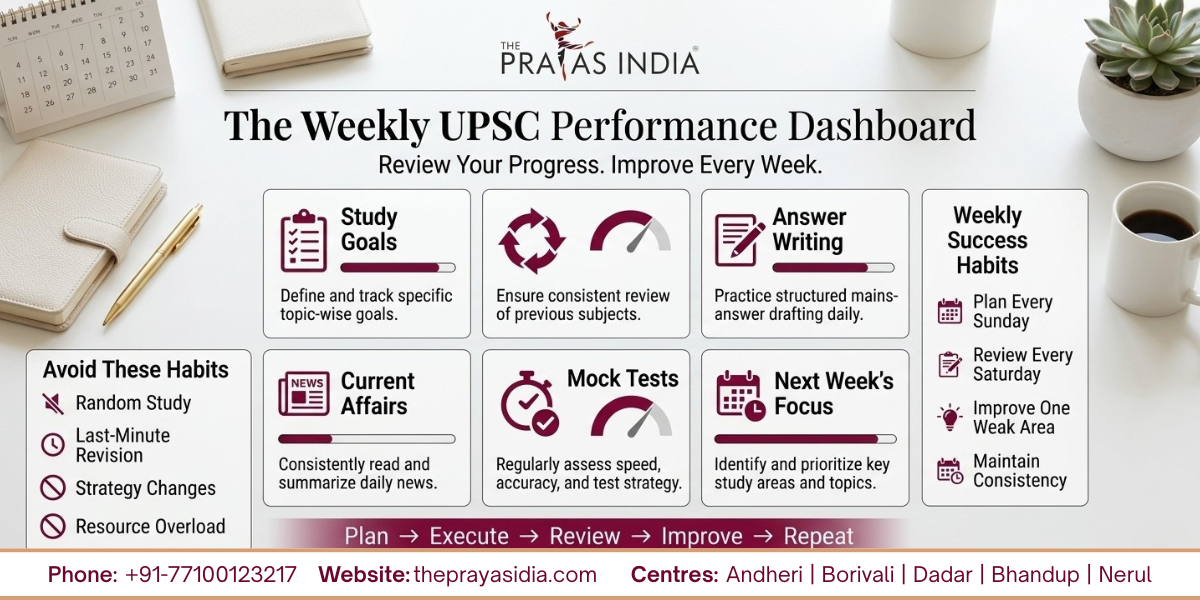
The Weekly Review Is More Important Than the Daily Plan
Many students become discouraged if one day goes badly.
Instead of evaluating yourself every evening, evaluate your progress every week.
Ask yourself:
- Which topics did I complete?
- Which subjects need additional attention?
- Did I revise enough?
- Am I improving my answer writing?
- What should I change next week?
Weekly reflection provides a more realistic picture of your preparation.
Create Separate Time for Answer Writing
One common mistake among UPSC aspirants is postponing answer writing until they complete the syllabus.
Unfortunately, answer writing is a skill that develops gradually.
Even fifteen to twenty minutes of regular practice can significantly improve:
- Structure
- Clarity
- Presentation
- Speed
- Confidence
Integrate answer writing into your timetable instead of treating it as an optional activity.
Give Every Subject a Fixed Place
Rather than deciding every morning what to study, assign specific days or blocks to important subjects.
For example:
Monday & Thursday
Polity
Tuesday & Friday
Economy
Wednesday & Saturday
History & Geography
Sunday
Revision + Mock Analysis
This removes unnecessary decision-making and creates consistency.
Don’t Ignore Breaks
Many aspirants believe taking breaks reduces productivity.
The opposite is often true.
Short breaks improve:
- Concentration
- Memory
- Mental freshness
- Motivation
Studying continuously for several hours without rest usually reduces learning efficiency.
Take short breaks between focused study sessions and use them to relax rather than scrolling through social media.
Plan Tomorrow Before Sleeping
A surprisingly effective habit is spending five minutes every night planning the next day.
Write down:
- Three priority tasks.
- One revision target.
- One practice objective.
When you begin studying the next morning, you already know exactly where to start.
This eliminates hesitation and saves valuable time.
Learn to Say “No”
Time management is not only about deciding what to study.
It is also about deciding what not to do.
Successful aspirants often avoid:
- Unnecessary social media discussions.
- Random preparation advice.
- Constant strategy changes.
- Excessive comparison with other students.
Protecting your study time is just as important as using it wisely.
Preparation Should Fit Your Lifestyle
Every UPSC aspirant has different circumstances.
Full-Time Aspirants
Can dedicate larger study blocks but should still avoid burnout.
College Students
Need shorter, focused sessions while balancing academics.
Working Professionals
Benefit from early morning or evening study routines supported by disciplined weekend planning.
The ideal timetable is the one you can sustain consistently—not the one with the highest number of study hours.
How Structured Guidance Saves Time
Many aspirants spend months trying to decide:
- Which book should I read?
- Which topic comes first?
- When should I revise?
- Am I preparing correctly?
These decisions consume valuable preparation time.
A structured learning environment reduces this uncertainty by providing a clear academic roadmap.
Instead of repeatedly changing resources or strategies, students can focus on learning, practising, and improving.
At The Prayas India, preparation follows an organised academic framework that helps aspirants use their time more effectively. With a planned study sequence, regular assessments, and systematic progress tracking, students spend less time planning and more time preparing with confidence.
Productivity Habits That Help UPSC Aspirants Stay Consistent
Creating a timetable is only the first step.
Following that timetable every day is the real challenge.
Most UPSC aspirants do not struggle because they lack motivation. They struggle because they lose consistency after a few weeks. The initial excitement fades, unexpected interruptions appear, and slowly the study routine becomes irregular.
This is where productivity habits become important.
Successful aspirants do not depend on motivation every morning. They build systems that make studying easier, more organised, and sustainable over the long term.
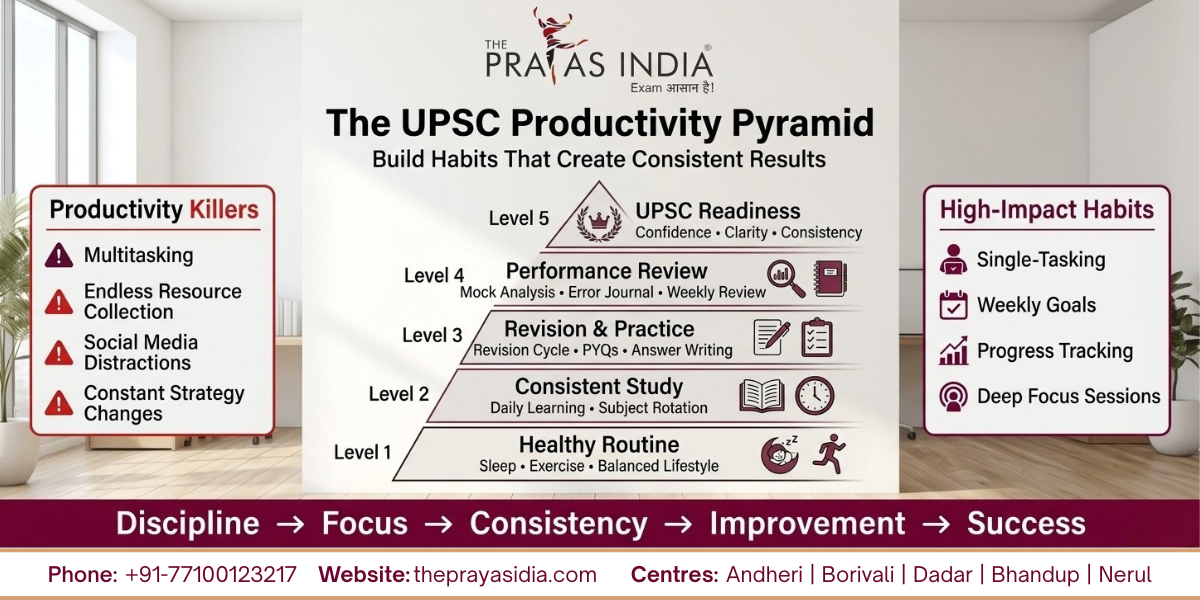
Focus on One Task at a Time
Multitasking is often misunderstood as productivity.
Many students try to read current affairs, reply to messages, watch explanation videos, and prepare notes at the same time.
Instead of saving time, this divides attention and reduces learning quality.
A better approach is to complete one clearly defined task before moving to the next.
For example:
- Read one chapter completely.
- Solve related questions.
- Revise key points.
- Then begin a new topic.
Single-tasking improves concentration and helps you finish work faster.
Create a Distraction-Free Study Zone
Your surroundings influence your productivity.
A cluttered study table often leads to a cluttered mind.
Keep only the materials required for the current session.
Avoid keeping unnecessary books, gadgets, or unrelated notes on your desk.
A clean study space reduces decision fatigue and helps you remain focused for longer periods.
Learn the Difference Between Reading and Retaining
Many aspirants spend hours reading but struggle to remember important concepts later.
Instead of continuously reading, actively test your memory.
After completing a topic:
- Close the book.
- Recall important concepts.
- Write short summaries.
- Solve a few questions without referring to notes.
This strengthens long-term retention and reduces revision time.
Follow the 80–20 Principle
Not every task contributes equally to your preparation.
Identify activities that produce the highest learning value.
For example:
High-impact activities:
- Understanding concepts.
- Revising regularly.
- Solving previous year questions.
- Answer writing.
- Mock test analysis.
Lower-impact activities:
- Rewriting neat notes repeatedly.
- Collecting too many study resources.
- Watching excessive strategy videos.
Prioritising high-impact work helps you make better use of limited study hours.
Build Weekly Targets Instead of Daily Pressure
Daily plans are useful, but unexpected events can sometimes disrupt them.
Weekly goals provide greater flexibility.
For example:
This week’s objective:
- Complete one Polity unit.
- Revise Modern History.
- Write five answers.
- Attempt one sectional test.
- Read current affairs every day.
Even if one day becomes less productive, you can still achieve your weekly target without feeling discouraged.
Keep an Error Journal
Every mistake you make during preparation teaches you something valuable.
Instead of forgetting those mistakes, record them.
Maintain a simple notebook where you note:
- Frequently forgotten facts.
- Incorrect concepts.
- Repeated calculation errors.
- Common answer-writing weaknesses.
Reviewing this journal regularly prevents the same mistakes from recurring.
Reduce Decision Fatigue
Every unnecessary decision consumes mental energy.
Questions like:
- Which subject should I study?
- Which book should I use?
- Which topic comes next?
may seem small, but they reduce productivity over time.
A predefined study plan removes these daily decisions and allows you to begin studying immediately.
The less time you spend deciding, the more time you spend learning.
Don’t Chase the “Perfect Day”
Many aspirants become disappointed because they compare every day with an unrealistic ideal schedule.
The truth is that every day will not be equally productive.
Some days:
- A topic may take longer than expected.
- Personal responsibilities may interrupt your routine.
- Energy levels may be lower.
Instead of giving up, simply return to your plan the next day.
Long-term consistency always outperforms occasional perfection.
Learn to Manage Mental Fatigue
UPSC preparation is mentally demanding.
Studying continuously without recovery eventually reduces concentration.
Include small habits that refresh your mind:
- Short walks.
- Light stretching.
- Adequate sleep.
- Healthy meals.
- Limited screen time outside study.
Productivity depends as much on recovery as it does on effort.
Track Progress, Not Just Time
Many aspirants proudly say,
“I studied for ten hours today.”
A better question is:
“What progress did I make today?”
Track meaningful indicators such as:
- Topics completed.
- Revision sessions finished.
- Practice questions solved.
- Answers written.
- Mock test scores.
- Weak areas improved.
Visible progress creates confidence and keeps preparation objective.
Consistency Beats Intensity
Studying twelve hours for three days and then taking several days off rarely produces good results.
Studying with discipline every day creates stronger habits and better retention.
Small, consistent improvements over several months lead to significant progress by the time the examination arrives.
UPSC preparation rewards persistence more than occasional bursts of hard work.
Why Structured Guidance Saves Valuable Time
One of the biggest reasons aspirants lose momentum is uncertainty.
They constantly wonder:
- Am I following the right sequence?
- Should I change my resources?
- Is my preparation moving in the right direction?
These questions consume both time and confidence.
A structured learning environment helps eliminate this uncertainty.
At The Prayas India, preparation is organised through a systematic academic plan that enables students to focus on learning instead of constantly redesigning their strategy. Regular assessments, planned revision, and continuous academic guidance help aspirants remain consistent throughout their preparation journey.
Rather than spending months experimenting with different approaches, students can dedicate their time to steady improvement and productive learning.
Turn Smart Planning into UPSC Success
Time management is not about studying every minute of the day. It is about ensuring that every hour you invest moves you closer to your goal.
Every successful UPSC aspirant has faced the same challenges—an extensive syllabus, multiple subjects, current affairs, revision pressure, and moments of self-doubt. What separates successful candidates is not extraordinary intelligence but the ability to stay organised and consistent over a long period.
The habits you build today will determine the quality of your preparation tomorrow.
The UPSC Time Management Checklist
Before ending each week, evaluate your preparation using this checklist.
Planning
- Did I prepare a realistic study plan?
- Did I follow my priorities instead of studying randomly?
- Did I complete the tasks I had planned?
Learning
- Did I study concepts with complete focus?
- Did I avoid unnecessary resource switching?
- Did I understand topics instead of memorising them?
Revision
- Did I revise previously studied topics?
- Did I update my short notes?
- Did I strengthen weak areas?
Practice
- Did I solve Previous Year Questions?
- Did I write answers regularly?
- Did I analyse my mistakes after practice?
Productivity
- Did I minimise distractions?
- Did I take meaningful breaks?
- Did I maintain consistency throughout the week?
Self-Improvement
- Did I review my overall progress?
- Did I identify areas requiring improvement?
- Did I plan next week’s preparation?
If most of your answers are “Yes,” your preparation is moving in the right direction.
Practical Habits That Save Time Every Week
Small improvements in your routine can save several hours every week.
Develop habits such as:
- Preparing tomorrow’s task list before sleeping.
- Keeping all study materials organised.
- Maintaining one revision notebook instead of multiple notebooks.
- Reading only reliable and relevant resources.
- Reviewing mistakes immediately after mock tests.
- Scheduling fixed time slots for current affairs.
These habits may appear simple, but their long-term impact is significant.
Common Time Management Mistakes Before the Examination
As the examination approaches, many aspirants unknowingly reduce their efficiency.
Avoid:
- Beginning completely new study resources.
- Ignoring revision in favour of new topics.
- Constantly changing preparation strategies.
- Comparing your study hours with others.
- Sacrificing sleep to study longer.
- Attempting to cover everything at the last moment.
The final phase should focus on improving confidence rather than increasing pressure.
Frequently Asked Questions
1. How many hours should a UPSC aspirant study daily?
There is no ideal number for everyone.
The emphasis should be on productive learning rather than long study hours. A realistic schedule followed consistently is more effective than studying excessively for a few days.
2. Should I prepare multiple subjects every day?
Yes.
Studying a combination of subjects improves concentration and prevents monotony. Subject rotation also supports better retention over time.
3. How much time should I spend on current affairs?
Current affairs should become part of your daily routine. Regular reading and revision are generally more effective than studying everything together at the end of the month.
4. How important is answer writing?
Answer writing is an essential component of UPSC preparation. It helps improve structure, presentation, analytical thinking, and time management for the Mains examination.
5. What should I do if I miss my study schedule?
Do not attempt to compensate by studying excessively the next day.
Instead, resume your routine immediately and continue with your preparation. Long-term consistency is more valuable than occasional perfection.
Why Students Choose The Prayas India for UPSC Preparation
Preparing for the UPSC Civil Services Examination requires much more than determination. It requires a structured approach that helps students manage their time, maintain consistency, and prepare with clarity.
At The Prayas India, the emphasis is on creating an organised preparation ecosystem where students can focus on learning instead of constantly redesigning their strategy.
Students value the institute because it promotes:
Planned Academic Progress
Preparation follows a systematic roadmap, allowing aspirants to move through the syllabus in a logical sequence while balancing learning, revision, and practice.
Performance-Based Preparation
Regular assessments help students understand where they are improving and where additional attention is needed.
Instead of guessing their progress, aspirants receive opportunities to evaluate themselves continuously.
Practical Time Management
Students learn how to allocate study hours efficiently, integrate current affairs into their routine, and balance concept learning with revision and answer writing.
This helps them prepare in a disciplined and sustainable manner.
A Focused Learning Environment
Being surrounded by serious UPSC aspirants creates a positive academic atmosphere that encourages consistency, accountability, and healthy competition.
Long-Term Preparation Support
UPSC preparation is a long journey.
Having an organised academic framework and continuous guidance allows students to stay focused, avoid unnecessary confusion, and make steady progress towards their goal.
Begin Your UPSC Journey with the Right Strategy
Managing time effectively is one of the most valuable skills an aspirant can develop during UPSC preparation. A well-planned schedule, consistent revision, regular answer writing, and continuous self-evaluation can make your preparation more organised and productive.
If you are looking for the Best UPSC Coaching in Mumbai, choose an institute that helps you prepare with a structured academic approach rather than leaving you to navigate the vast UPSC syllabus alone.
At The Prayas India, aspirants benefit from organised preparation planning, systematic academic guidance, regular performance evaluation, and an environment designed to encourage consistent improvement throughout the UPSC journey.
Admissions are now open for UPSC Civil Services preparation. Take the first step towards your dream career in the Civil Services with a preparation strategy that values planning, consistency, and continuous progress.
Contact The Prayas India
📞 Call: +91-77100 13217
🌐 Website: theprayasindia.com
Our Centres:
Conclusion
UPSC preparation is not a race against other aspirants—it is a test of your ability to remain disciplined over time. Smart time management allows you to cover the syllabus systematically, revise effectively, and improve your performance without unnecessary stress.
Remember, success is rarely the result of one extraordinary day of study. It is built through hundreds of productive days where small, consistent efforts accumulate into significant progress.
Plan wisely, stay consistent, review regularly, and trust the process. With the right preparation strategy and a structured learning environment, your UPSC goal becomes far more achievable.