UPSC Civil Services Exam Prelims CSAT (GS Paper-II) Analysis 2011–2025
The UPSC Civil Services Examination (CSE) is among the most competitive exams in India. Every year, lakhs of aspirants attempt this examination to join prestigious services such as the IAS, IPS, IFS, and other central services. The Prelims stage of UPSC CSE consists of two papers:
- General Studies Paper-I (GS-I) – testing current affairs and general knowledge
- General Studies Paper-II (GS-II) – popularly known as CSAT (Civil Services Aptitude Test)
UPSC CSE Notification 2026-27 Postponed
What is CSAT in UPSC?
The Civil Services Aptitude Test (CSAT) is the second paper of UPSC Prelims, designed to evaluate a candidate’s aptitude, logical reasoning, analytical skills, decision-making abilities, and reading comprehension. Unlike GS Paper-I, CSAT is a qualifying exam, and its marks do not contribute to the final Prelims merit list.
Key features of CSAT (GS Paper-II):
- Marks: 200
- Questions: 80 objective-type
- Duration: 2 hours
- Qualifying Marks: 33% (i.e., 66 out of 200)
- Medium: English & Hindi
- Purpose: Test aptitude and reasoning skills essential for an IAS officer
- Significance: Candidates must qualify CSAT to be eligible for Mains
Skills tested in CSAT include:
- Reading comprehension
- Logical and analytical reasoning
- Basic numeracy and mathematical problem-solving
- Decision-making and problem-solving
- Interpersonal and communication skills
UPSC CSE Exam Updates
Brief Timeline of UPSC CSAT (Prelims Paper-II)
The UPSC CSAT has evolved significantly since its inception, reflecting UPSC’s effort to balance knowledge assessment with aptitude testing:
| Year | Evolution of CSAT / Prelims Paper-2 |
|---|---|
| Before 2011 | Prelims followed the Kothari Committee (1979) recommendations: GS Paper (150 marks) + Optional Subject Paper (300 marks) |
| 2010–2011 | UPSC revised Prelims: Two compulsory papers, each 200 marks |
| 2011 | CSAT (GS Paper-II) introduced to assess aptitude, reasoning, and problem-solving skills |
| 2011–2014 | CSAT marks counted along with GS-I for Prelims merit |
| 2014 | Concerns about language and numeracy led to evaluation reforms |
| 2015 onwards | CSAT became a qualifying paper with 33% threshold; scores not counted in merit |
| Present | Pattern unchanged since 2015; aspirants must clear CSAT to appear for Mains |
Note: Understanding this timeline is crucial for aspirants to plan preparation strategy and allocate time effectively.
UPSC CSE 2026-27 Detailed Syllabus
UPSC CSAT Syllabus Topic-Wise
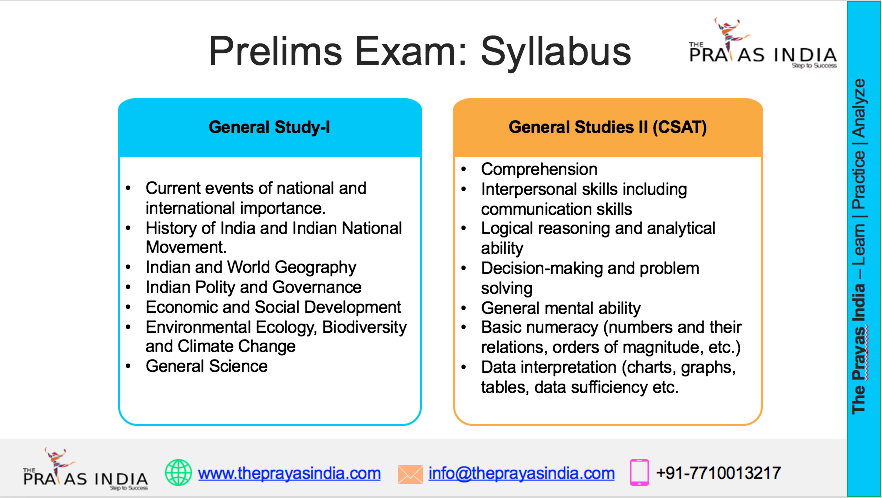
The CSAT syllabus emphasizes aptitude and reasoning skills, rather than factual knowledge:
1. Comprehension
- Reading passages (English/Hindi)
- Understanding ideas, tone, and context
- Making inferences and drawing conclusions
- Ability to summarise and interpret information
2. Interpersonal Skills & Logical Reasoning
- Decision-making and problem-solving
- Analytical reasoning (verbal and non-verbal)
- Logical puzzles, seating arrangements, coding-decoding, syllogisms
3. Basic Numeracy
- Arithmetic: percentages, ratio & proportion, averages
- Algebra, geometry, and mensuration basics
- Time, speed, distance, simple interest, profit & loss
- Data interpretation from tables, charts, and graphs
4. Data Interpretation & Analysis
- Pie charts, bar graphs, line charts
- Tables and data sets
- Case studies requiring calculation and reasoning
5. Decision Making & Problem Solving
- Evaluating options in administrative scenarios
- Prioritizing and selecting the best solution
- Ethical and logical decision-making
Preparation Tip: Focus on practicing comprehension passages, reasoning exercises, and basic numeracy questions regularly.
UPSC CSAT Exam Pattern 2026
| Parameter | Details |
|---|---|
| Mode | Offline (Pen & Paper) |
| Duration | 2 hours |
| Maximum Marks | 200 marks |
| Number of Questions | 80 MCQs |
| Marking Scheme | +2 marks for correct answer, -⅔ negative marking per wrong answer |
| Qualifying Marks | 33% (66 marks) |
| Medium | English & Hindi |
| Nature | Qualifying only |
| Skills Tested | Comprehension, reasoning, numeracy, decision-making |
UPSC CSE 2026-27 New Batches
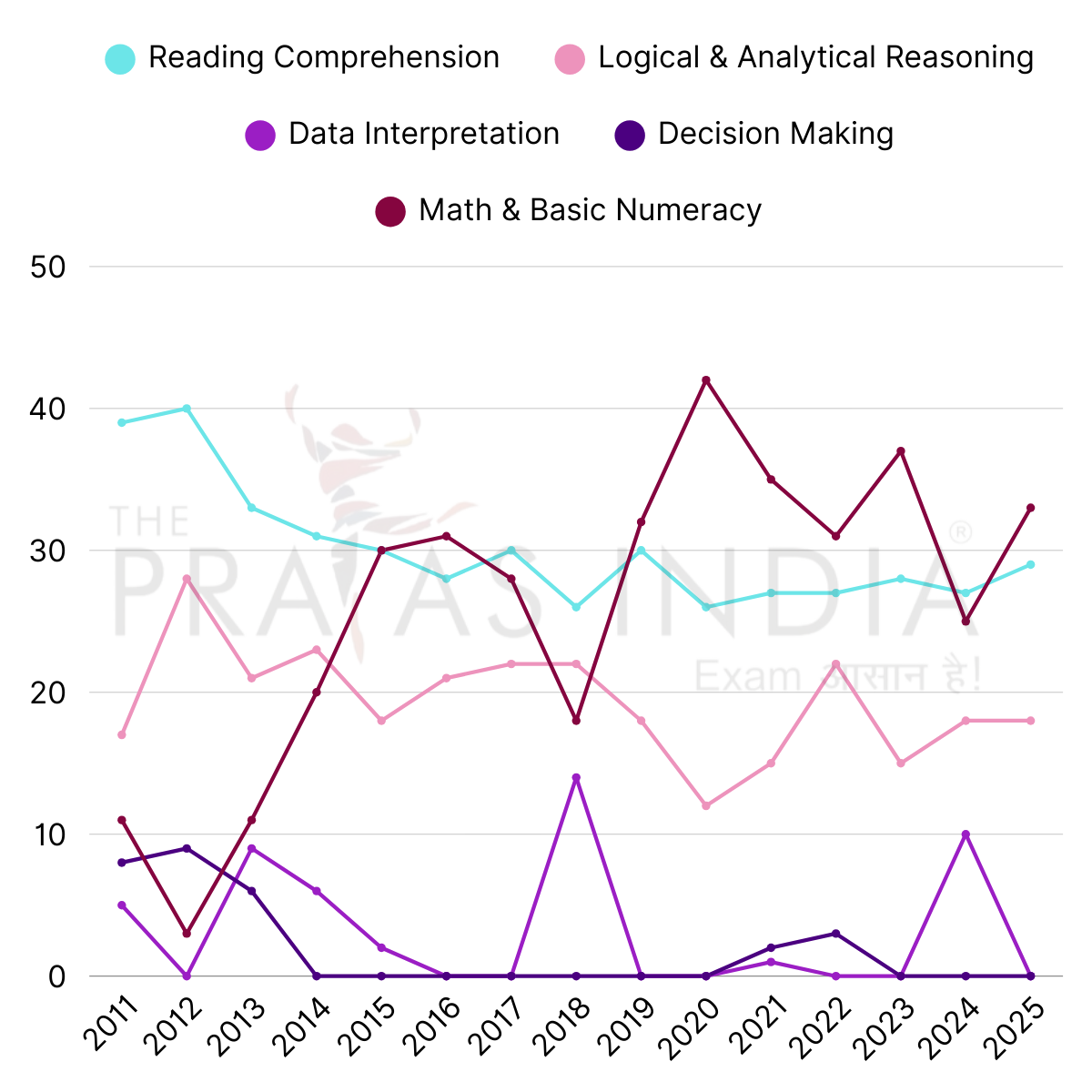
CSAT UPSC Trend Analysis (2011–2025)
Analyzing past trends helps aspirants understand topic-wise weightage, difficulty, and evolution of the CSAT paper.
| Year | Reading Comprehension | Logical & Analytical Reasoning | Data Interpretation | Decision Making | Math & Basic Numeracy |
|---|---|---|---|---|---|
| 2011 | 39 | 17 | 5 | 8 | 11 |
| 2012 | 40 | 28 | 0 | 9 | 3 |
| 2013 | 33 | 21 | 9 | 6 | 11 |
| 2014 | 31 | 23 | 6 | 0 | 20 |
| 2015 | 30 | 18 | 2 | 0 | 30 |
| 2016 | 28 | 21 | 0 | 0 | 31 |
| 2017 | 30 | 22 | 0 | 0 | 28 |
| 2018 | 26 | 22 | 14 | 0 | 18 |
| 2019 | 30 | 18 | 0 | 0 | 32 |
| 2020 | 26 | 12 | 0 | 0 | 42 |
| 2021 | 27 | 15 | 1 | 2 | 35 |
| 2022 | 27 | 22 | 0 | 3 | 31 |
| 2023 | 28 | 15 | 0 | 0 | 37 |
| 2024 | 27 | 18 | 10 | 0 | 25 |
| 2025 | 29 | 18 | 0 | 0 | 33 |
Key Observations:
- Reading comprehension consistently accounts for ~30–35% of questions
- Numeracy and basic arithmetic questions vary slightly each year
- Decision-making appears occasionally (case-based)
- Logical reasoning is stable and tests conceptual understanding
UPSC CSE Exam 2026-27 Test Series
UPSC CSAT Previous Year Paper (2014–2025)
Referring to the previous year’s question papers is crucial for understanding:
- Question types and patterns
- Topic weightage
- Difficulty level trends
Candidates are advised to download and practice previous CSAT papers from 2014–2025 to enhance time management and accuracy during exams. PDFs can be linked later on the website.
| Year | CSAT Paper | PDF Link |
|---|---|---|
| 2025 | UPSC CSAT General Studies Paper-II | Download PDF |
| 2024 | UPSC CSAT General Studies Paper-II | Download PDF |
| 2023 | UPSC CSAT General Studies Paper-II | Download PDF |
| 2022 | UPSC CSAT General Studies Paper-II | Download PDF |
| 2021 | UPSC CSAT General Studies Paper-II | Download PDF |
| 2020 | UPSC CSAT General Studies Paper-II | Download PDF |
| 2019 | UPSC CSAT General Studies Paper-II | Download PDF |
| 2018 | UPSC CSAT General Studies Paper-II | Download PDF |
| 2017 | UPSC CSAT General Studies Paper-II | Download PDF |
| 2016 | UPSC CSAT General Studies Paper-II | Download PDF |
| 2015 | UPSC CSAT General Studies Paper-II | Download PDF |
| 2014 | UPSC CSAT General Studies Paper-II | Download PDF |
Preparation Strategy for CSAT 2026
- Prioritize Qualifying Marks:
Aim for 100–120 marks to clear 33% threshold comfortably. - Mock Tests & Practice:
Solve 20–25 full-length mock tests to build speed and accuracy. - Topic-Wise Focus:
- Reading comprehension daily (editorials, UPSC notes)
- Logical reasoning and decision-making exercises
- Basic numeracy and data interpretation
- Time Management:
Practice 2-hour timed sessions to simulate exam conditions. - Avoid Over-Preparation:
CSAT is qualifying only, so avoid excessive time on high-level mathematics or reasoning beyond the syllabus.
Conclusion
The UPSC CSAT (GS Paper-II) is a qualifying hurdle that tests aptitude, logical reasoning, comprehension, and basic numeracy. From its inception in 2011 as a merit-counting paper to its current qualifying format since 2015, CSAT ensures candidates entering the Mains stage possess essential analytical skills.
Key takeaway: With focused preparation, practice of previous papers, and understanding topic-wise trends from 2011–2025, aspirants can clear CSAT efficiently and concentrate on GS Paper-I and optional subjects for Mains.
FAQs
1. What is UPSC CSAT?
Civil Services Aptitude Test (CSAT) is Prelims Paper-II, qualifying only, testing reasoning, comprehension, numeracy, and decision-making.
2. Does CSAT score count for Prelims merit?
No, since 2015, CSAT is qualifying only with 33% marks threshold.
3. What is the CSAT syllabus?
Comprehension, logical reasoning, basic numeracy, data interpretation, decision-making, and problem-solving.
4. How many questions are in CSAT 2026?
80 objective questions for 200 marks, 2 hours duration.
5. How to prepare for CSAT effectively?
Focus on past papers, mock tests, basic numeracy, reasoning exercises, and daily reading for comprehension.