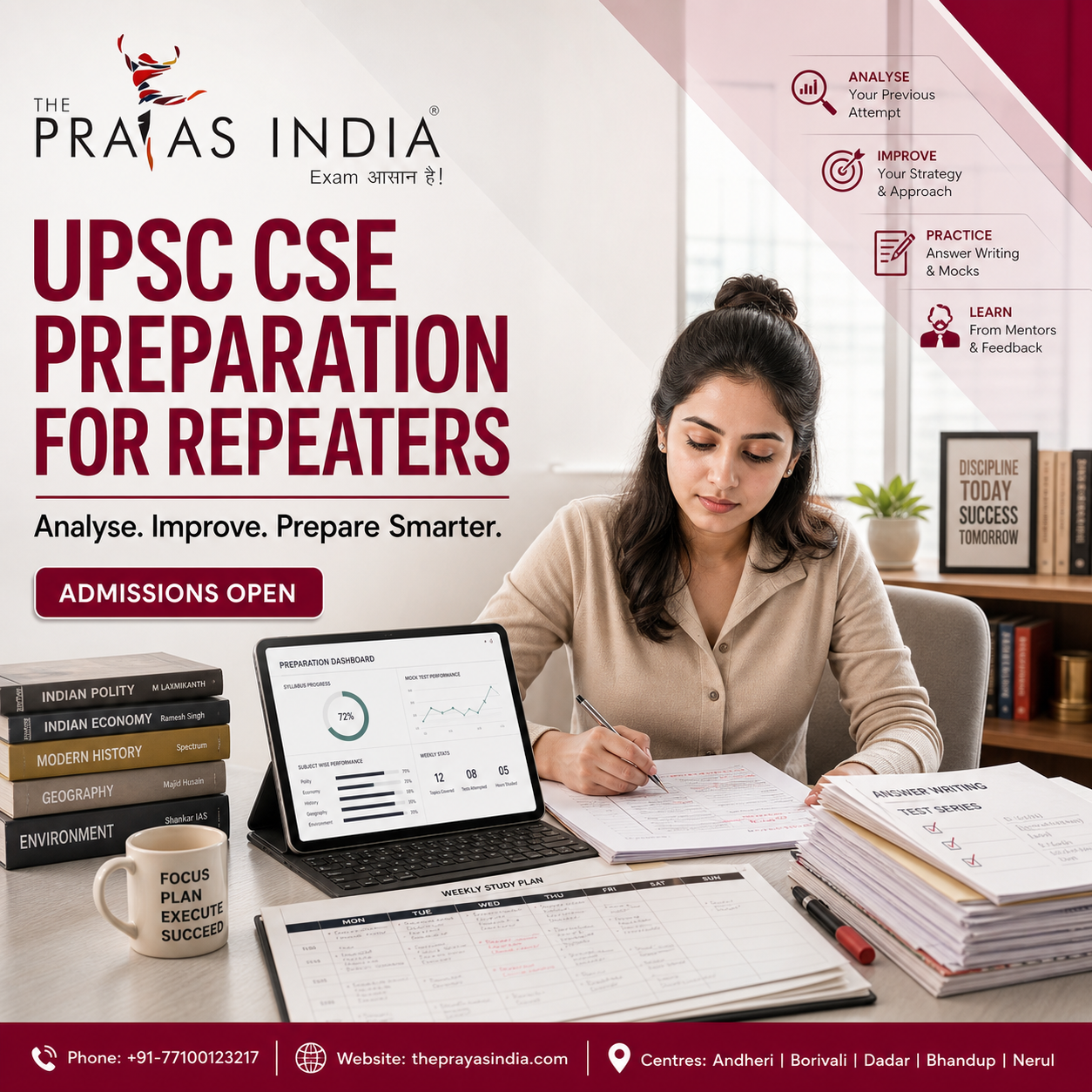
UPSC CSE 2027 Mentorship: How Personalised Guidance Can Improve Preparation | The Prayas India
Preparing for the UPSC Civil Services Examination is not simply about studying for a certain number of hours every day. The examination demands a combination of conceptual understanding, current affairs awareness, analytical thinking, answer-writing ability, revision, test practice and the discipline to stay consistent over a long preparation cycle. For an aspirant targeting UPSC CSE 2027, one of the biggest challenges is bringing all these elements together in a structured manner.
This is where UPSC mentorship can become an important part of the preparation process.
Many aspirants begin with enthusiasm, collect books and study materials, create timetables and start covering the syllabus. However, after a few months, common questions begin to appear: Am I studying the right topics? Are my sources sufficient? Should I spend more time on a particular subject? Why are my mock scores not improving? Is my answer writing actually getting better? When should I revise? How should I balance Prelims and Mains preparation?
Personalised mentorship is designed to address precisely these kinds of questions.
A mentor does not replace an aspirant’s effort. Instead, effective mentorship can help an aspirant identify priorities, evaluate progress, correct mistakes and make better preparation decisions throughout the UPSC journey.
For students preparing for UPSC CSE 2027, especially those looking for structured UPSC coaching in Mumbai, mentorship can provide an additional layer of academic direction and accountability.
UPSC Preparation Is a Long-Term Process, Not a Checklist
The UPSC syllabus is extensive, and completing every topic once does not guarantee examination readiness. An aspirant has to repeatedly move through different stages of learning: understanding a concept, revising it, connecting it with current affairs, practising questions and eventually applying that knowledge under examination conditions.
This makes preparation highly individual.
Two aspirants may have the same number of study hours but completely different requirements. One may have strong conceptual knowledge but poor answer writing. Another may write good answers but struggle with Prelims accuracy. A third aspirant may understand subjects well but continuously postpone revision. Someone preparing alongside college or employment may have limited daily study hours and therefore require a different strategy altogether.
A fixed study plan cannot always address these differences.
Personalised mentorship works around the aspirant’s actual preparation position rather than assuming that every student has identical strengths, weaknesses and circumstances.
The objective is not to create dependence on a mentor. The objective is to gradually help the aspirant become better at evaluating their own preparation.
What Does UPSC Mentorship Actually Mean?
UPSC mentorship is often misunderstood as simply receiving a timetable or having occasional conversations with a faculty member. In a serious preparation programme, mentorship can involve a much broader academic process.
A structured mentorship system may help an aspirant with:
- Understanding the UPSC syllabus and examination requirements
- Creating realistic preparation priorities
- Selecting and controlling study resources
- Tracking progress across subjects
- Analysing mock-test performance
- Identifying recurring mistakes
- Improving revision strategies
- Developing answer-writing habits
- Managing Prelims and Mains preparation
- Reviewing preparation milestones
- Adjusting the study plan when performance changes
- Maintaining consistency and accountability
The exact structure of mentorship varies between programmes. What matters is whether the guidance is connected to the student’s actual preparation and performance.
For UPSC CSE 2027 aspirants, this distinction is important because the preparation cycle is long enough for ineffective strategies to consume months if they are not reviewed in time.
The First Benefit: Knowing Where You Stand
One of the most useful functions of mentorship is helping an aspirant establish a realistic baseline.
Students sometimes evaluate preparation based on hours studied or the number of chapters completed. These numbers can be useful, but they do not always reveal whether the preparation is moving in the right direction.
For example, completing Polity once is different from being able to solve UPSC-level questions on Polity. Reading Modern History is different from remembering important themes and applying them to objective questions. Writing ten Mains answers is different from demonstrating improvement in structure, relevance, content and time management.
A mentor can examine preparation from a performance perspective rather than simply asking whether a particular chapter has been completed.
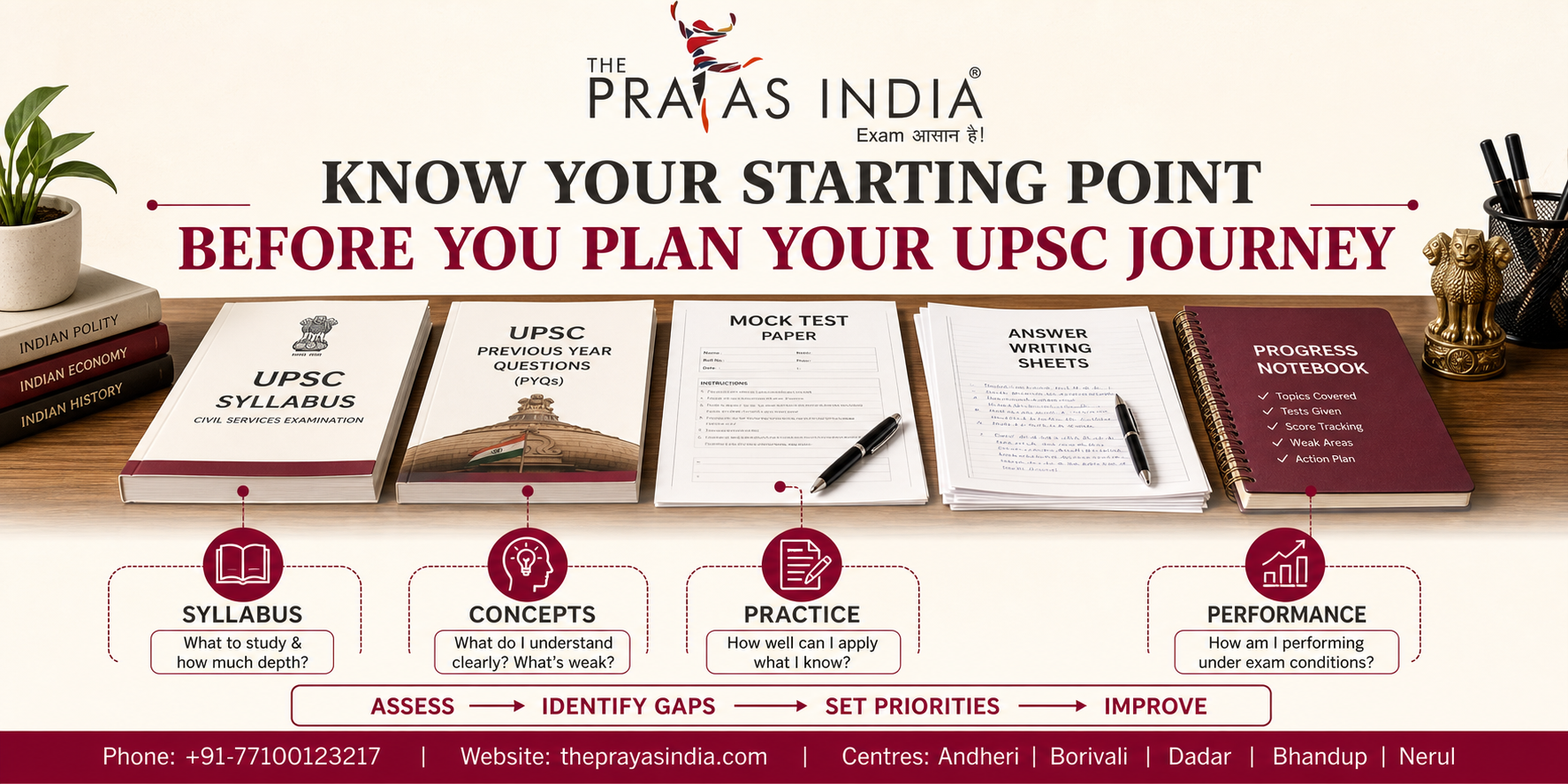
The evaluation can consider:
Coverage → Understanding → Revision → Practice → Performance
This gives the aspirant a clearer picture of what needs attention.
A practical diagnostic approach
At the beginning of mentorship, an aspirant can evaluate:
- Current syllabus coverage
- Strength in different GS subjects
- Current affairs preparation
- PYQ familiarity
- Prelims accuracy
- CSAT readiness
- Answer-writing practice
- Revision frequency
- Mock-test performance
- Consistency of study
This baseline can then become the reference point for future progress.
Personalised Study Planning for UPSC CSE 2027
A timetable looks productive on paper, but a useful timetable must reflect the aspirant’s actual situation.
For example, a beginner may need more time for foundational subjects, while a candidate who has already completed one cycle may need to focus more heavily on revision and testing. Similarly, an aspirant who is comfortable with GS but struggles with CSAT may need a completely different weekly allocation from someone whose conceptual base is still developing.
Mentorship can help convert a broad goal such as “prepare for UPSC CSE 2027” into smaller and measurable academic priorities.
Instead of asking, “What should I study today?”, the aspirant gradually starts thinking in terms of:
- What is my current priority?
- Which subject needs additional revision?
- Which topics are repeatedly causing errors?
- Which areas require more practice?
- What should I complete this week?
- What should be tested next?
- Which activities are consuming time without producing improvement?
This shift from activity-based preparation to outcome-based preparation can make the study process more focused.
Mentorship Can Help Prevent Resource Overload
One of the common problems in UPSC preparation is the continuous accumulation of resources.
An aspirant starts with one book, then discovers another recommendation, downloads multiple PDFs, follows several educators online and saves dozens of current-affairs materials. Eventually, the challenge is no longer finding information; it is deciding what to ignore.
This can lead to fragmented preparation.
A structured mentor can help students distinguish between:
Essential → Useful → Optional → Unnecessary
The goal is not to restrict learning but to prevent excessive resource switching.
For a 2027 aspirant, this is particularly relevant because there is enough time to build a strong foundation, but that time can be lost if every new source triggers a change in strategy.
A focused source list also makes revision easier because the aspirant knows which material should be revisited repeatedly.
From Doubt to Decision: The Role of a Mentor
UPSC preparation involves hundreds of small decisions.
Should I start answer writing now?
Should I complete another book?
Should I focus on Prelims or Mains?
How many questions should I attempt in a mock?
Why am I making the same mistakes?
Should I change my optional strategy?
How much current affairs should I revise?
Is my revision frequency sufficient?
Individually, these decisions may appear small. Collectively, they can significantly influence how an aspirant spends months of preparation.
A mentor’s role can be to bring structure to these decisions.
Instead of immediately changing strategy after every disappointing test, the aspirant can analyse the underlying reason. Instead of assuming that low marks mean “I need to study more,” the student can determine whether the actual issue is conceptual weakness, insufficient revision, poor question selection, careless errors or ineffective time management.
This distinction is extremely important.
More study is not always the answer. Better-directed study can be the answer.
Improving Preparation Through Regular Performance Review
A mentorship programme becomes more useful when guidance is connected to measurable performance.
For example, a student may take a Prelims mock and score below the expected level. The immediate reaction may be to study more chapters. But a detailed analysis could reveal that a significant portion of the lost marks came from questions the student actually knew but answered incorrectly due to rushing.
The solution in that case is not necessarily more content.
It may involve:
- Slowing down during question interpretation
- Improving elimination techniques
- Reducing careless errors
- Reviewing uncertain attempts
- Analysing negative marking patterns
- Practising timed questions
Similarly, in Mains preparation, low-quality answers may not always result from a lack of knowledge. The issue could be weak structure, poor introduction, inadequate examples, missing dimensions or failure to address the exact demand of the question.
Mentorship can help identify these patterns.
Mock Tests Become More Useful When They Are Analysed Properly
Taking mock tests is only one part of test-based preparation. The real learning often happens after the test.
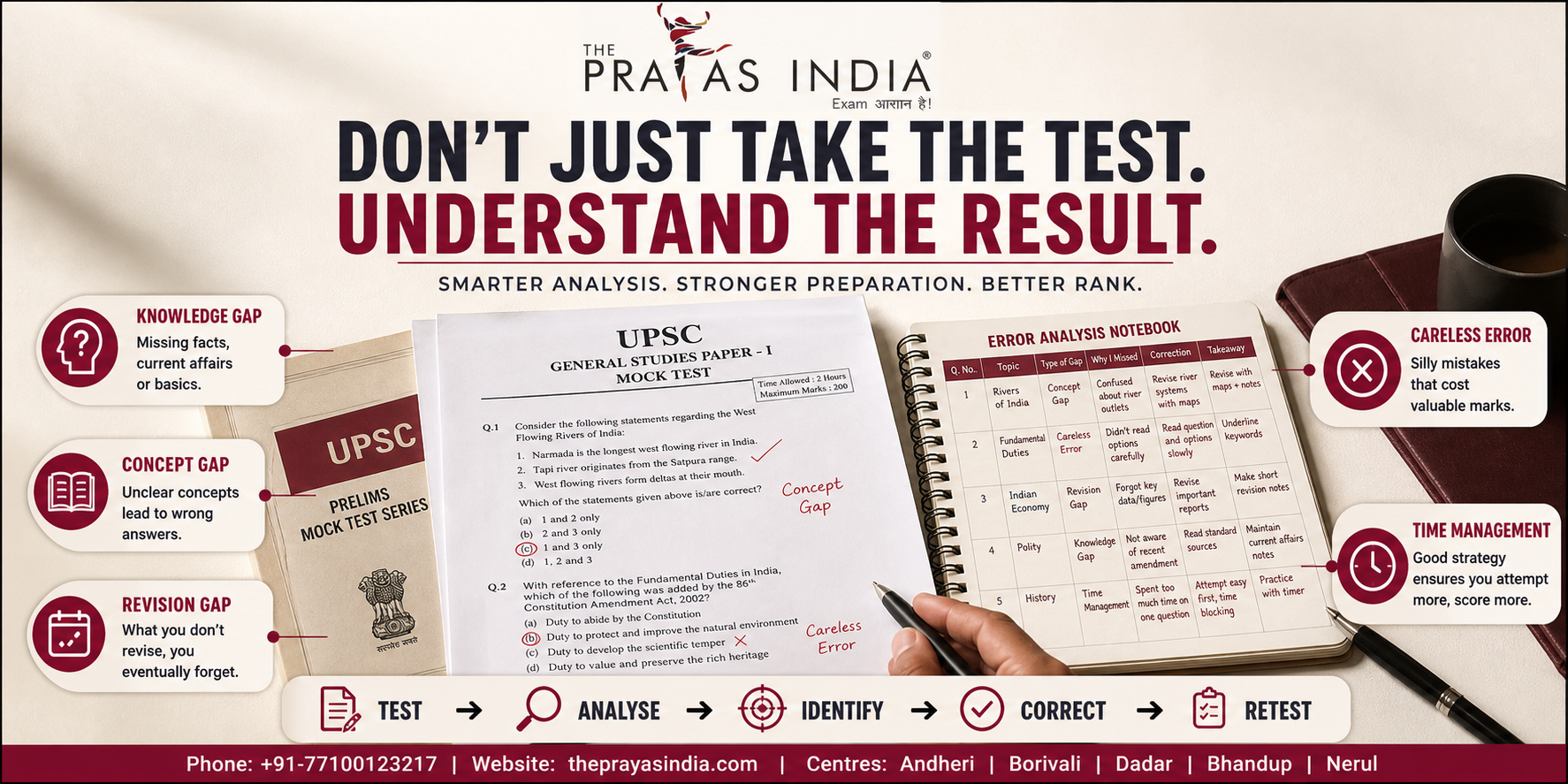
A mentor-supported review can divide mistakes into categories such as:
Knowledge Gap
The student did not know the concept or fact required to answer the question.
Conceptual Confusion
The student had studied the topic but misunderstood the underlying concept.
Revision Gap
The student had previously studied the information but could not recall it during the test.
Application Error
The student understood the topic but could not apply the knowledge to the question.
Careless Error
The student knew the answer but made an avoidable mistake.
Time-Management Issue
The student either spent too much time on difficult questions or failed to allocate time effectively.
This classification makes performance analysis more actionable.
Instead of writing “I scored low” in a notebook, the aspirant can write:
Knowledge Gap: 8 | Revision Gap: 5 | Careless Errors: 4 | Time Management: 3
The next study cycle can then be designed around these findings.
Personalised Guidance for Prelims Preparation
UPSC Prelims preparation requires a different type of discipline from simply reading books.
The aspirant has to balance static subjects, current affairs, PYQs, question practice, revision and mock tests. There is also the challenge of deciding which questions to attempt and which ones to leave.
A mentor can review these areas together rather than treating them as independent activities.
For example, if a student has reasonable knowledge but repeatedly loses marks because of over-attempting uncertain questions, the intervention may focus on decision-making and elimination practice.
If another student has good accuracy but attempts too few questions because of excessive caution, the strategy may require a different adjustment.
This illustrates an important principle:
The same score can have completely different causes.
Therefore, preparation should not be adjusted solely on the basis of marks. The reasons behind the marks matter.
Personalised Guidance for Mains Preparation
UPSC Mains requires candidates to transform knowledge into structured written responses.
An aspirant can read extensively and still struggle to write effective answers within the prescribed time. This is because answer writing is a separate skill involving interpretation, prioritisation, structure and concise presentation.
Regular mentorship can make answer writing more systematic.
A mentor or faculty reviewer can help an aspirant examine:
- Whether the answer addresses the exact demand of the question
- Quality of the introduction
- Logical structure of the body
- Use of relevant examples
- Inclusion of multiple dimensions
- Quality of the conclusion
- Balance between content and word limit
- Presentation and readability
- Repetition of points
- Time taken to complete the answer
The objective is not to make every answer identical. Good answer writing still requires the aspirant’s own understanding and expression.
The purpose of guidance is to help the student recognise patterns that can be improved.
Optional Subject Also Benefits From Strategic Review
The UPSC optional subject contributes significantly to the Mains preparation process, which makes planning and consistency particularly important.
An aspirant may understand the subject but struggle with syllabus coverage, answer practice or revision. Another may spend too much time searching for resources instead of developing command over the prescribed syllabus.
Mentorship can help bring the preparation back to the fundamental questions:
Is the syllabus being covered?
Are previous-year questions being analysed?
Is answer writing happening regularly?
Are notes revision-friendly?
Are weak areas being revisited?
Is the preparation aligned with the examination requirement?
For students taking optional subject classes through a structured coaching programme, mentorship can complement classroom learning by helping them monitor their individual progress.
The Value of an Error Log
An error log is one of the simplest tools that can make mentorship more effective.
Instead of merely recording marks, an aspirant can maintain a running record of repeated problems.
For example:
| Area | Repeated Issue | Corrective Action |
|---|---|---|
| Polity | Confusion between related provisions | Concept revision + PYQs |
| Economy | Weak conceptual application | Topic-wise practice |
| Environment | Poor recall | Spaced revision |
| CSAT | Time pressure | Timed practice |
| Mains | Weak introductions | Introduction practice |
Over time, the error log becomes a personalised map of the preparation.
A mentor can use this information to decide what should receive attention in the next study cycle.
Mentorship and Accountability
Self-study provides flexibility, but flexibility can sometimes turn into inconsistency.
An aspirant may postpone revision because a new topic appears more interesting. Mock tests may be delayed. Answer writing may be repeatedly pushed to “next week.” Difficult subjects may be avoided.
Regular mentorship introduces an external review mechanism.
This does not mean that students need someone to monitor every hour of their day. Effective accountability is more useful when it focuses on meaningful milestones.
For example:
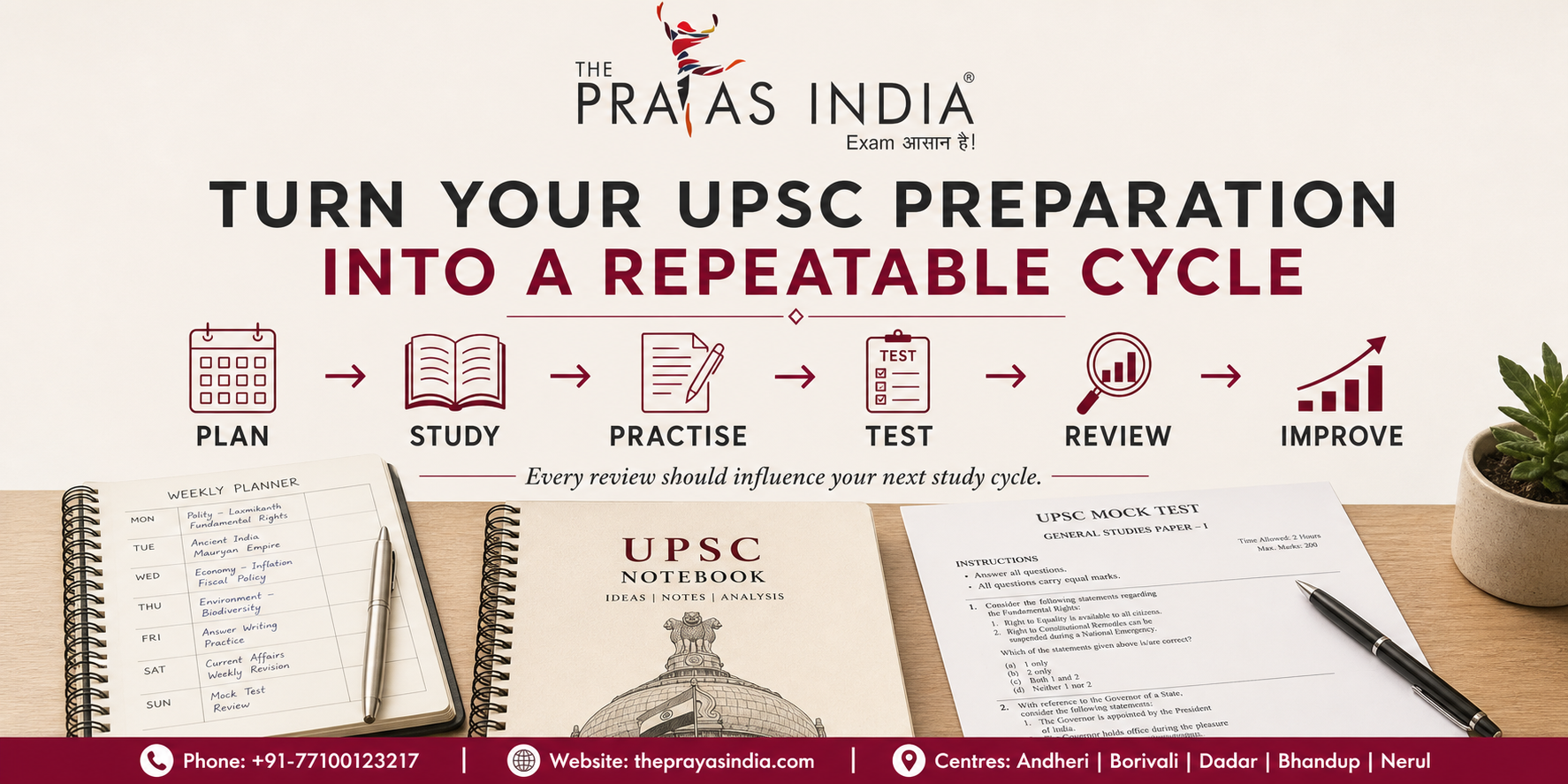
This Week: Complete selected Polity topics
Practice: Solve relevant PYQs
Test: Take one sectional test
Review: Analyse errors
Next Action: Revise weak areas
This creates a preparation loop where each stage informs the next.
Mentorship for Beginners vs Experienced Aspirants
Not every UPSC aspirant needs the same type of guidance.
For Beginners
A beginner may benefit from help with:
- Understanding the examination structure
- Breaking down the syllabus
- Building basic concepts
- Selecting standard resources
- Understanding PYQs
- Creating realistic study priorities
- Starting answer writing at the appropriate stage
- Building a sustainable routine
The biggest challenge for beginners is often not lack of effort but lack of direction.
For Experienced Aspirants
Candidates who have already completed substantial preparation may require a different approach.
Their priorities may include:
- Identifying persistent weaknesses
- Improving mock performance
- Strengthening revision
- Increasing answer-writing quality
- Analysing previous attempts
- Reducing avoidable mistakes
- Optimising time allocation
- Refining their Prelims strategy
For these aspirants, mentorship can be less about introducing the syllabus and more about diagnosing why existing preparation is not producing the expected performance.
Choosing a UPSC Mentorship Programme: Points to Evaluate
Students considering mentorship should look beyond the word “personalised” and understand how the programme actually works.
Before joining a mentorship programme, an aspirant can evaluate:
Is There Individual Performance Tracking?
A useful programme should have some mechanism to understand the student’s progress rather than providing exactly the same advice to everyone.
Is Feedback Specific?
“Study harder” is not meaningful feedback. Useful feedback identifies the problem and suggests a corrective action.
Are Tests Connected With Analysis?
Mock tests should not simply generate scores. Their results should influence subsequent preparation.
Is Answer Writing Reviewed?
For Mains aspirants, regular writing practice without meaningful feedback may limit improvement.
Is There Mentor Accessibility?
Students should understand how frequently they can receive guidance and through which mode.
Does the Programme Support Different Preparation Stages?
A beginner, a working professional and an experienced aspirant may have different requirements.
Is the Guidance Integrated With Classes?
Mentorship can be more useful when it works alongside lectures, study material, tests and revision rather than functioning as an isolated activity.
Online and Offline UPSC Mentorship: Understanding the Difference
Modern UPSC aspirants have access to both online and offline preparation options.
Online mentorship can offer flexibility, especially for students managing college, employment or other commitments. Digital interaction, live sessions, recorded lectures, online tests and progress discussions can allow students to continue preparation from different locations.
Offline mentorship offers a more physical classroom environment where students can interact directly with faculty and peers. For aspirants who prefer face-to-face academic interaction and a structured study environment, this format can be valuable.
The important consideration is not simply whether mentorship is online or offline. Students should evaluate whether the system provides consistent guidance, useful feedback, progress tracking and access to academic support.
How The Prayas India Can Support UPSC CSE 2027 Aspirants
For aspirants preparing for UPSC CSE 2027, The Prayas India combines structured preparation with academic guidance designed around the requirements of the Civil Services Examination.
The purpose of a structured coaching environment is not simply to provide lectures. A serious UPSC preparation ecosystem can bring together classroom or live learning, study resources, tests, revision, answer-writing practice and mentorship so that different parts of preparation work together.
At The Prayas India, aspirants can explore online and offline UPSC preparation options, allowing them to choose a learning format according to their circumstances.
The broader objective is to help students move through preparation with greater clarity: understand the syllabus, build concepts, practise consistently, evaluate performance and make informed adjustments.
For students preparing from Mumbai, access to physical centres across Andheri, Borivali, Dadar, Bhandup and Nerul can also provide an offline learning option alongside online preparation.
A Practical Mentorship Framework for UPSC CSE 2027
A well-structured mentorship journey can be divided into several stages.
Stage 1: Initial Assessment
Understand the student’s current preparation level, strengths, weaknesses, syllabus coverage and available study time.
Stage 2: Goal Setting
Convert the broad objective of UPSC CSE 2027 into realistic academic milestones.
Stage 3: Study Planning
Create subject-wise and phase-wise priorities instead of relying on a generic timetable.
Stage 4: Guided Practice
Integrate PYQs, MCQs, answer writing, sectional tests and full-length mocks according to the preparation stage.
Stage 5: Performance Review
Analyse test results and identify the reasons behind mistakes.
Stage 6: Strategy Correction
Modify the preparation plan where required rather than continuing with an ineffective strategy.
Stage 7: Revision and Consolidation
Repeatedly revisit important material so that learning becomes examination-ready.
Stage 8: Prelims and Mains Transition
Gradually shift the emphasis according to the examination calendar and preparation stage.
This creates a continuous feedback system rather than a fixed plan that remains unchanged for months.

A Sample Weekly Mentorship Cycle
Mentorship becomes easier to understand when it is connected to a practical weekly routine.
A student could begin the week by identifying three or four priority outcomes rather than creating an unrealistic list of twenty tasks.
For example:
Monday–Tuesday: Concept building
Wednesday: PYQ and topic-wise practice
Thursday: Revision
Friday: Current affairs integration
Saturday: Test or answer-writing practice
Sunday: Performance review and next-week planning
This is only an example. The actual schedule should depend on the student’s preparation stage, available hours and upcoming examination priorities.
The key principle is that every week should end with some form of review.
Without review, the student simply moves from one week to another. With review, each week can improve the next one.
Common Mistakes That Mentorship Can Help Identify
Even disciplined aspirants can make strategic mistakes during UPSC preparation.
Changing Resources Too Frequently
Repeatedly switching books, teachers or current-affairs sources can disrupt continuity.
Measuring Progress Only Through Study Hours
Ten hours of study do not automatically indicate ten hours of effective preparation.
Taking Tests Without Analysing Them
A mock score is useful only when the aspirant understands why the score occurred.
Delaying Answer Writing
Waiting until the end of the syllabus to begin writing practice can make it difficult to develop the skill gradually.
Ignoring Revision
Reading more material while forgetting previously studied material creates an illusion of progress.
Avoiding Weak Subjects
Students naturally prefer subjects they enjoy. Mentorship can help ensure that difficult but important areas are not repeatedly postponed.
Following a Timetable That Does Not Match Reality
A plan that looks perfect but cannot be followed consistently is less useful than a realistic plan that can be sustained.
Comparing Preparation With Other Aspirants
Different candidates have different backgrounds, available time and preparation stages. The more useful comparison is often between the aspirant’s current performance and their previous performance.
Mentorship Should Improve Independence, Not Dependence
An important aspect of good mentorship is that the student should gradually become better at making preparation decisions independently.
Initially, an aspirant may need help deciding what to study, how to analyse a test or how to structure an answer.
Over time, the student should begin asking better questions independently:
What caused this mistake?
Is this a knowledge gap or a revision gap?
Do I really need another resource?
Which topic should I revise first?
What does my mock-test data indicate?
Am I improving in accuracy?
Is my current strategy producing measurable progress?
This is one of the deeper benefits of personalised guidance.
The mentor provides direction, but the aspirant develops the ability to evaluate and improve their own preparation.
UPSC CSE 2027 Mentorship and Admissions at The Prayas India
For students beginning or strengthening their UPSC CSE 2027 preparation, choosing the right learning environment is an important part of the planning process.
The Prayas India offers UPSC preparation support through online and offline learning formats, allowing aspirants to select the mode that fits their study requirements.
A structured programme can be particularly useful for students who want more than isolated lectures and study material. The combination of classes, practice, tests, feedback and mentorship can create a more connected preparation process.
Students considering joining a UPSC programme should evaluate the course structure, faculty support, test practice, mentorship mechanism, learning format and overall academic ecosystem before making an admission decision.
Admissions for UPSC CSE 2027 preparation are open at The Prayas India.
Aspirants can enquire about the available programmes and understand which learning format and preparation structure may fit their current stage.
Final Takeaway
UPSC CSE 2027 preparation is a long journey, and the challenge is not simply covering a large syllabus. The bigger challenge is making the right preparation decisions repeatedly over several months.
Personalised mentorship can provide a structured feedback mechanism through which aspirants can understand their current position, identify weaknesses, analyse performance, adjust priorities and maintain consistency.
The real value of mentorship lies in turning preparation into a continuous cycle:
Study → Practise → Test → Analyse → Correct → Improve
For a beginner, this can provide direction. For an experienced aspirant, it can help identify persistent gaps. For students preparing through coaching, it can connect classroom learning with individual performance.
Ultimately, mentorship cannot substitute for an aspirant’s effort. But the right guidance can help ensure that that effort is directed towards the areas that matter most at each stage of the UPSC CSE 2027 journey.
For aspirants looking for a structured UPSC coaching and mentorship ecosystem in Mumbai, The Prayas India provides online and offline preparation options with academic support designed to help students approach the Civil Services Examination in a more organised and performance-oriented manner.
Frequently Asked Questions
1. What is UPSC CSE 2027 mentorship?
UPSC CSE 2027 mentorship is a structured guidance system in which an aspirant's preparation, performance and challenges are reviewed to provide personalised academic direction. It can include study planning, test analysis, answer-writing feedback, revision planning and progress tracking.
2. Is UPSC mentorship useful for beginners?
Yes. Beginners can use mentorship to understand the syllabus, organise resources, build a realistic study plan and avoid common preparation mistakes. The exact level of guidance required depends on the student's background and preparation stage.
3. Can experienced UPSC aspirants benefit from mentorship?
Yes. Experienced aspirants may use mentorship to identify persistent weaknesses, analyse mock-test performance, improve answer writing, refine revision strategies and address problems that have continued despite previous preparation.
4. Does mentorship replace self-study?
No. Mentorship supports self-study; it does not replace it. The aspirant still needs to read, revise, practise questions, write answers and take tests consistently.
5. Can mentorship help with UPSC Prelims?
Mentorship can support Prelims preparation through syllabus planning, PYQ analysis, mock-test review, accuracy improvement, revision planning and identification of recurring mistakes.
6. Can mentorship help with UPSC Mains answer writing?
Yes. Regular feedback can help aspirants identify issues related to question interpretation, answer structure, relevance, examples, presentation and time management.
7. Is online UPSC mentorship effective?
Online mentorship can be useful when it provides consistent interaction, meaningful feedback, progress tracking and access to relevant academic resources. Students should evaluate the actual structure of the programme rather than choosing solely on the basis of online or offline format.
8. Does The Prayas India provide UPSC coaching online and offline?
The Prayas India provides UPSC preparation through online and offline learning options. Students can enquire about the available programmes, classes, mentorship and academic support according to their preparation requirements.
9. Is UPSC CSE 2027 preparation suitable for students who are starting from scratch?
Yes. Students starting from scratch can begin by understanding the examination structure and syllabus, building conceptual foundations, studying from focused sources, analysing PYQs and gradually introducing practice and testing.
10. Where can I enquire about UPSC CSE 2027 admissions at The Prayas India?
Aspirants interested in UPSC CSE 2027 preparation can enquire with The Prayas India about available online and offline programmes, mentorship support, classes and admission options.