UPSC CSE 2027 Prelims GS Paper 1 Preparation | Best UPSC Coaching in Mumbai | The Prayas India
Absolutely. I’ll keep this admission-focused for The Prayas India, while making the article genuinely useful for UPSC aspirants rather than sounding like a direct advertisement. I’ll also keep the infographic prompts premium, visual, and low-text, with the exact placement mentioned inside the article. The feature image will have “ADMISSION OPEN” prominently displayed and the phone number in a large font.
How to Prepare for UPSC CSE 2027 Prelims GS Paper 1
UPSC Civil Services Examination (CSE) Prelims is the first major stage that aspirants must clear before moving towards Mains and the Interview. Among the two papers conducted in Prelims, General Studies Paper 1 (GS Paper 1) plays a decisive role because its marks are counted for determining the Prelims cutoff. For UPSC CSE 2027 aspirants, preparing GS Paper 1 effectively requires much more than simply reading newspapers, collecting study material, or attempting mock tests randomly.
The real challenge is to build a preparation system that combines conceptual clarity, current affairs, factual retention, repeated revision, intelligent elimination, and sufficient practice. Since the UPSC syllabus covers subjects ranging from Indian Polity and History to Geography, Economy, Environment, Science and Technology, and Current Affairs, students often feel overwhelmed when they begin preparation.
A structured approach can make the preparation significantly more manageable.
For aspirants targeting UPSC CSE 2027, starting early provides an important advantage. Instead of trying to complete the entire syllabus in a few months, students can gradually build their foundation, revise important topics multiple times, and use mock tests to identify weaknesses well before the examination.
For students who want structured guidance, classroom interaction, systematic study material, current-affairs support, and regular testing, The Prayas India provides UPSC preparation support through its coaching programs, helping aspirants create a more organised preparation journey.
Understanding UPSC CSE 2027 Prelims GS Paper 1
Before deciding how to prepare, aspirants should first understand what GS Paper 1 actually demands.
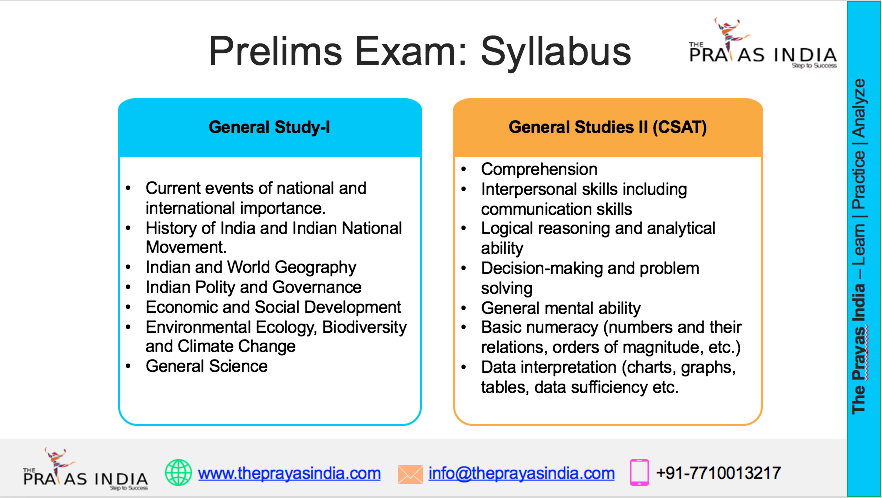
UPSC Prelims GS Paper 1 broadly covers:
- Current Events of National and International Importance
- History of India and Indian National Movement
- Indian and World Geography
- Indian Polity and Governance
- Economic and Social Development
- Environmental Ecology, Biodiversity and Climate Change
- General Science
The difficulty of GS Paper 1 does not come merely from the number of subjects. The examination often tests whether candidates can connect different areas of knowledge and apply concepts to unfamiliar questions.
For example, an aspirant may study Parliament under Polity, but an actual UPSC question may test the constitutional relationship between Parliament, the Executive and a particular institution. Similarly, Environment questions can combine basic ecological concepts with current developments, conventions, species, geographical regions or government initiatives.
Therefore, preparation should not be based on memorising isolated facts.
The goal should be to develop a strong conceptual foundation followed by repeated revision and question-oriented practice.
Start With the Syllabus, Not With Random Books
One of the most common mistakes in UPSC preparation is starting with multiple books, PDFs, YouTube videos and current-affairs sources without first understanding the syllabus.
The UPSC syllabus should become the central framework of your preparation.
Before beginning each subject, read the relevant syllabus points carefully. This allows you to distinguish between what deserves detailed study and what can be covered through selective reading.
For example, while preparing Polity, an aspirant should not approach the subject as an endless collection of constitutional facts. The syllabus should guide the preparation towards areas such as the Constitution, political system, Panchayati Raj, governance, rights issues, public policy and related developments.
Similarly, Geography preparation becomes more effective when physical geography, Indian geography, resources, agriculture, industries, climate and important geographical phenomena are connected rather than studied as unrelated chapters.
A simple approach is to maintain a syllabus tracker. Divide the syllabus into subjects and subtopics and mark them as:
- Not Started
- Studying
- First Revision
- Multiple Revisions
- Test Ready
This gives aspirants a realistic picture of their preparation instead of relying on the feeling that they have “studied a lot.”
Build Your Preparation Around Core Subjects
UPSC GS Paper 1 requires a strong foundation across several subjects. However, aspirants should avoid trying to complete everything simultaneously.
A better approach is to establish a core subject cycle.
1. Indian Polity
Polity is an important component of Prelims preparation because questions can test both static constitutional concepts and contemporary developments.
Begin with the basic structure of the Indian Constitution and gradually cover:
- Fundamental Rights
- Directive Principles
- Fundamental Duties
- Parliament
- President and Vice-President
- Prime Minister and Council of Ministers
- Supreme Court and High Courts
- Constitutional and statutory bodies
- Centre-State relations
- Local government
- Elections
- Constitutional amendments
- Governance-related developments
The objective should be conceptual understanding rather than blind memorisation.
When reading a topic, ask yourself:
What is the constitutional provision? What is its purpose? How does it work? What kind of question can UPSC create from it?
This approach makes revision and question-solving considerably more effective.
2. History and Art & Culture
History preparation should be divided into manageable sections rather than treated as one enormous subject.
Aspirants should generally build familiarity with:
- Ancient India
- Medieval India
- Modern India
- Indian National Movement
- Art and Culture
Modern Indian History often requires special attention because aspirants need to understand not only dates and personalities but also the sequence of events, causes, consequences and ideological developments.
For Art and Culture, selective preparation becomes particularly important. Rather than attempting to memorise every cultural fact available in books and PDFs, aspirants should focus on recurring themes and connect them with current developments wherever relevant.
3. Geography
Geography requires a combination of conceptual understanding and map-based learning.
Start with basic physical geography and then move towards Indian geography. Topics such as monsoon, rivers, mountains, soils, agriculture, resources, industries, climate and population become much easier when students understand the underlying geographical processes.
Maps should become part of regular preparation.
For example, whenever a current-affairs article mentions a country, river, mountain range, strait, sea, national park or region, locate it on a map.
This simple habit gradually develops geographical awareness without requiring separate memorisation of hundreds of locations.
4. Indian Economy
Economy can appear difficult initially because of unfamiliar terminology. Concepts such as inflation, fiscal deficit, monetary policy, GDP, balance of payments, banking and taxation can seem disconnected when studied individually.
The solution is to build the basics first.
Understand:
Concept → Mechanism → Indian Context → Current Development → UPSC Questions
Instead of simply memorising economic terms, understand how they influence the economy.
For instance, if you study inflation, understand its meaning, measurement, causes, impact, monetary policy response and relationship with other economic indicators.
Once the conceptual base is strong, current economic developments become considerably easier to understand.
How to Approach Environment and Ecology
Environment is an area where static knowledge and current affairs frequently overlap.
Aspirants should develop clarity about fundamental concepts such as:
- Ecosystems
- Food chains and food webs
- Biodiversity
- Protected areas
- Conservation
- Climate change
- Pollution
- Environmental conventions
- Species and habitats
- Environmental governance
The mistake is to prepare Environment entirely through current affairs.
Current affairs become meaningful only when the underlying concepts are clear.
For example, if a particular international environmental convention appears in the news, an aspirant should understand what the convention is, its objective, the issue it addresses and India’s broader relationship with it.
The same principle applies to species, protected areas and environmental terminology.
Science & Technology: Focus on Understanding, Not Technical Depth
Science and Technology questions can appear unpredictable, but aspirants do not necessarily need to study every scientific development in technical detail.
The focus should generally be on understanding the basic concept and its practical application.
Topics related to space technology, biotechnology, artificial intelligence, quantum technologies, defence technology, health-related technologies, energy technologies and emerging innovations may become relevant through current affairs.
Whenever a new technology appears in the news, ask:
What is it? How does it work at a basic level? What is its application? Why is it important?
This is more useful for Prelims than collecting highly technical information that is unlikely to be tested.
Current Affairs Should Be Integrated With Static Preparation
Current affairs is not a separate subject that should be studied only a few weeks before Prelims.
For UPSC CSE 2027, aspirants should gradually develop a system in which current affairs are connected to the static syllabus.
Suppose an important Supreme Court judgment appears in the news. It should be linked with the relevant constitutional concept.
If a new government scheme is launched, connect it with the relevant ministry, target group, economic or social objective and governance framework.
If a new species is in the news, locate its habitat and understand its ecological significance.
This approach reduces the burden of revising thousands of disconnected current-affairs facts.
How to Make Current Affairs Manageable
The biggest problem with current affairs is often information overload.
Aspirants may follow newspapers, monthly magazines, daily PDFs, Telegram channels, websites, YouTube videos and multiple compilations simultaneously. The result can be more information but less retention.
A better system is to choose one primary current-affairs source and supplement it only when necessary.
While reading current affairs, classify information into broad UPSC categories:
Polity | Economy | Environment | International Relations | Science & Technology | Geography | Social Issues
The aim should not be to remember every headline.
Instead, identify information that can potentially contribute to your understanding of the syllabus.
The Importance of Previous Year Questions
Previous Year Questions (PYQs) should not be treated merely as mock tests.
They are one of the most useful tools for understanding UPSC’s question-setting approach.
After completing a topic, solve relevant PYQs and analyse:
- What concept was tested?
- Was the question factual or conceptual?
- What clues were present?
- Why were the options framed in that manner?
- Could elimination be used?
- What additional concept does the question point towards?
This analysis is more valuable than simply recording a score.
A student who gets 60% of questions correct but deeply analyses the remaining 40% can potentially learn more than a student who repeatedly takes tests without reviewing mistakes.
Develop Elimination Skills
UPSC Prelims does not always provide questions where the correct answer can be recalled directly.
There will be questions where an aspirant knows only part of the information.
This is where elimination becomes important.
Elimination should not be based on random guessing. It should be developed through practice.
Look for:
- Absolute statements
- Extreme wording
- Conceptual inconsistencies
- Incorrect factual combinations
- Constitutional contradictions
- Geographical impossibilities
- Statements that conflict with known principles
However, elimination should remain evidence-based. Aspirants should avoid creating artificial rules such as “UPSC never uses this word” or “option C is usually correct.”
The objective is to improve the probability of reaching the correct answer using whatever information is available.
Build a Revision-First Strategy
Reading once is not preparation.
For a syllabus as extensive as UPSC, retention depends heavily on revision.
Aspirants preparing for 2027 should plan multiple revision cycles rather than waiting until the last few months.
A practical structure could look like:
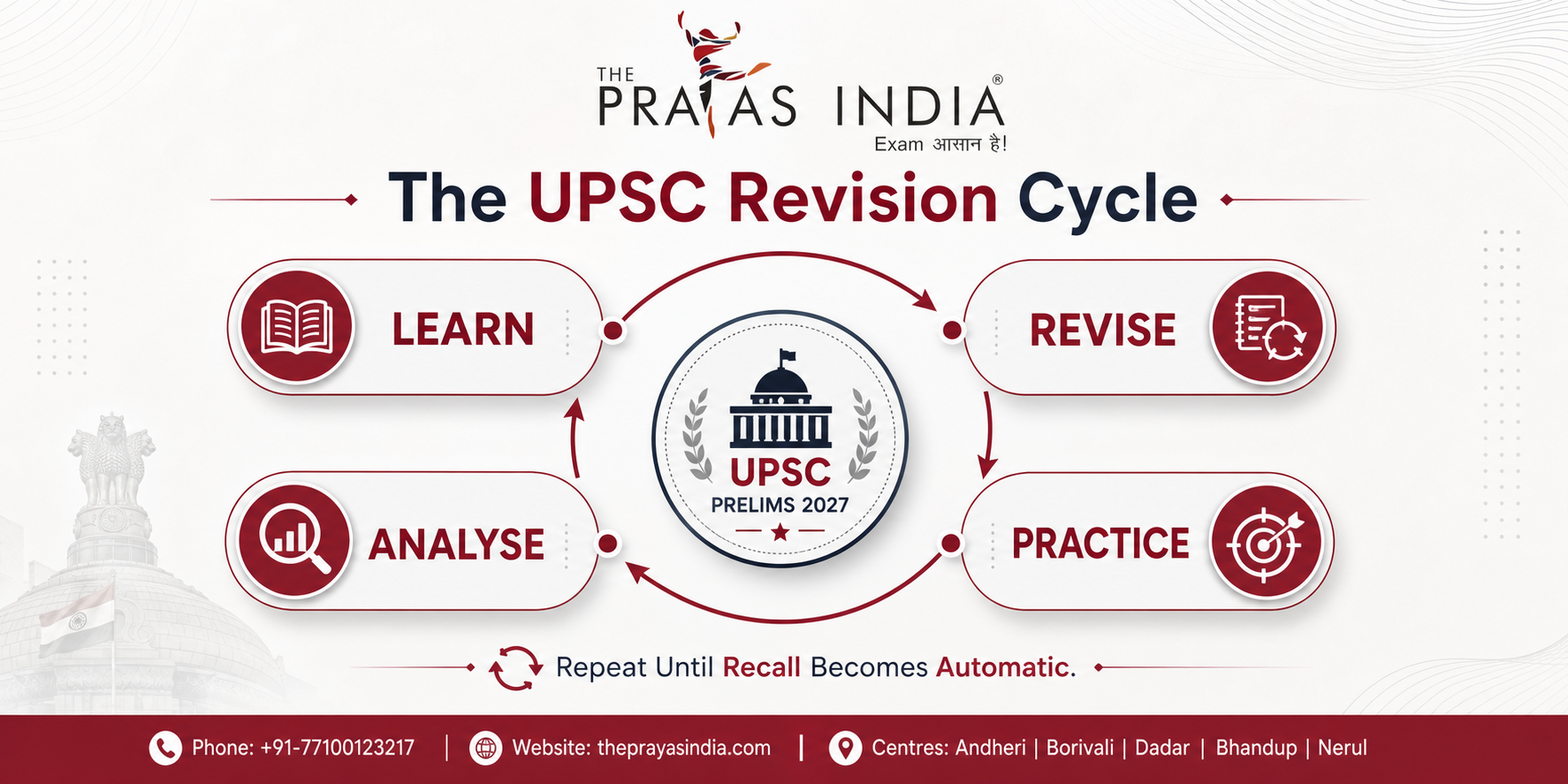
First Reading → Short Notes → First Revision → PYQs → Tests → Second Revision → Full-Length Tests → Final Revision
The notes created during preparation should become progressively shorter.
Your final revision material should not be another 500-page compilation.
It should contain the high-value information that you repeatedly forget or confuse.
Create a Realistic Daily Study Routine
A good preparation strategy should eventually translate into a sustainable daily routine.
Instead of creating a timetable that looks impressive but becomes impossible to follow, aspirants should divide the day into focused study blocks.
For example:
Foundation Phase
The focus can be on:
Static subject + Current Affairs + Revision + PYQs
Consolidation Phase
The focus can shift towards:
Static Revision + Current Affairs Revision + PYQs + Sectional Tests
Prelims-Focused Phase
The emphasis should increasingly become:
Revision + Full-Length Tests + Test Analysis + Weak Areas
The exact number of study hours will vary from student to student. What matters more is whether the available study time is being used consistently and whether the preparation is producing measurable improvement.
Test Practice Should Begin Before You Feel Ready
Many aspirants postpone tests because they believe they should first complete the syllabus.
This can create a problem.
Tests are not only evaluation tools; they are also learning tools.
A sectional test can reveal that a topic which seemed familiar during reading is actually difficult to apply in questions.
Similarly, repeated tests can reveal patterns such as:
- Knowledge gaps
- Poor question interpretation
- Weak elimination
- Excessive time consumption
- Careless mistakes
- Over-attempting
- Under-attempting
This is why a structured test series can become valuable during Prelims preparation.
At The Prayas India, aspirants preparing for UPSC can benefit from structured preparation support, including guidance, learning resources and test-oriented preparation designed to make the journey more systematic.
How Coaching Can Help in UPSC CSE 2027 Preparation
Self-study is an important part of UPSC preparation, but many aspirants struggle with three issues: direction, consistency and evaluation.
A structured coaching environment can help address these challenges by providing a defined preparation framework.
For an aspirant beginning UPSC CSE 2027 preparation, guidance can be particularly useful in understanding:
- What to study
- What not to over-study
- How to approach different subjects
- How to integrate current affairs
- How to use PYQs
- How to revise
- How to evaluate test performance
- How to manage the transition towards Mains preparation
The objective of coaching should not be to replace self-study. Instead, it should help students make their self-study more organised and accountable.
For aspirants who prefer structured learning, The Prayas India offers UPSC preparation support through online and offline learning options, allowing students to choose a learning format that suits their requirements.
Online or Offline UPSC Preparation: Which Approach Works for You?
There is no single preparation format that works identically for every aspirant.
Students who prefer classroom interaction, a fixed schedule and direct access to faculty may find offline learning useful.
Students who require flexibility because of college, work, travel or other commitments may prefer online learning.
The important consideration is not simply the format but whether the program provides the academic structure required for preparation.
Before joining a UPSC program, aspirants should examine:
- Faculty and teaching approach
- Course coverage
- Study material
- Current-affairs support
- Test series
- Doubt resolution
- Revision support
- Class schedule
- Online/offline flexibility
- Student support system
This is where aspirants should carefully evaluate their own preparation requirements before choosing a course.
Avoid These Common UPSC Prelims Mistakes
Even hardworking aspirants can lose valuable preparation time because of inefficient strategies.
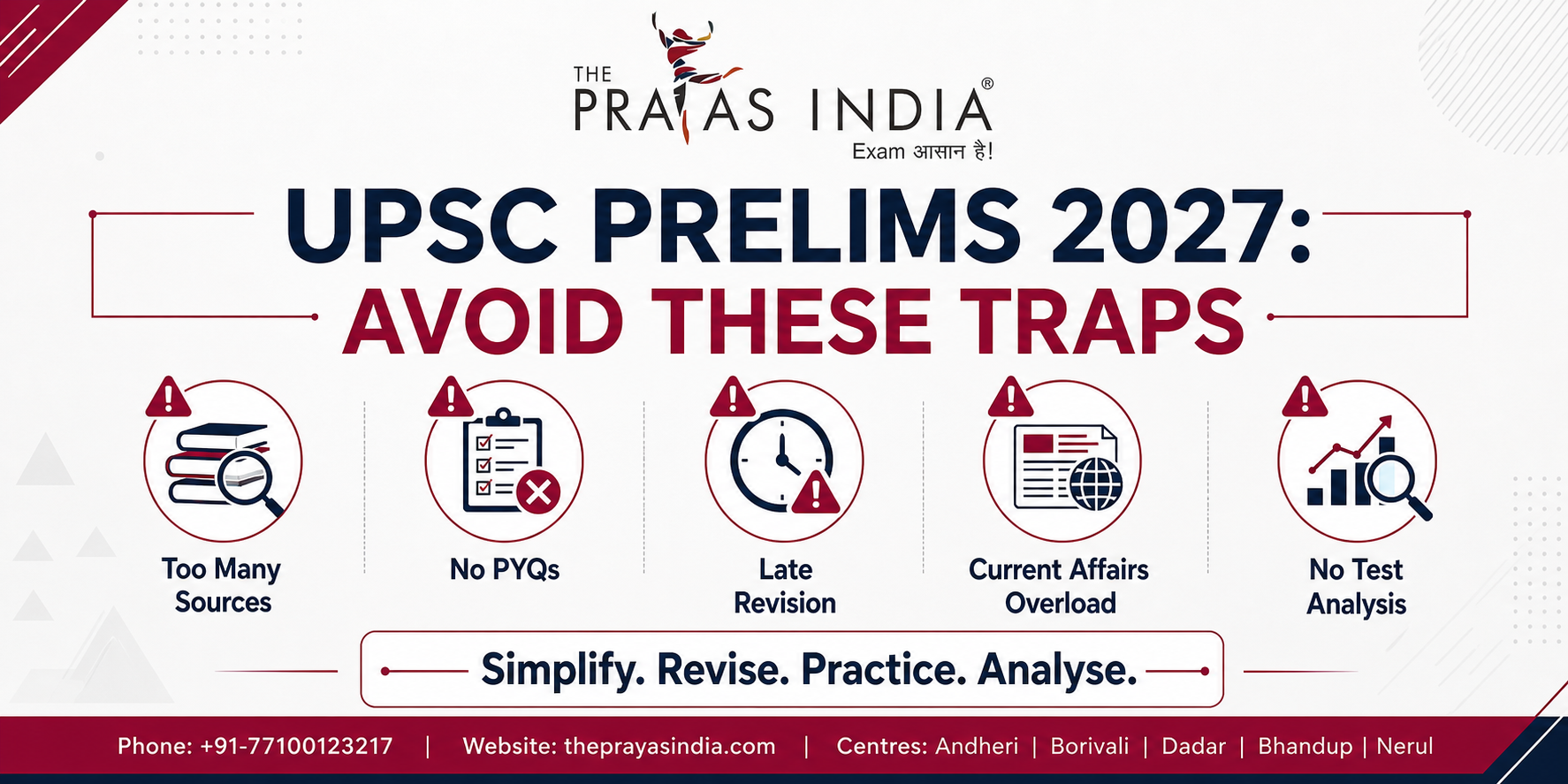
Studying Too Many Sources
More books do not automatically mean better preparation. Multiple sources often create unnecessary duplication.
Ignoring PYQs
Reading without analysing previous questions can disconnect preparation from the actual examination pattern.
Delaying Revision
If revision begins only after completing the syllabus, earlier topics may already have faded from memory.
Treating Current Affairs as Separate
Static concepts and current developments should increasingly be connected.
Taking Tests Without Analysis
A test score by itself tells you very little. The analysis after the test is where much of the learning happens.
Changing Strategy Frequently
Constantly switching teachers, books, test series or preparation methods can create inconsistency.
Preparing Only for Prelims
For a long-term UPSC aspirant, the broader CSE journey should remain in view. Preparation should gradually develop analytical and answer-writing abilities as well.
A Practical UPSC CSE 2027 Prelims Preparation Roadmap
Aspirants beginning preparation early can divide their journey into broad stages.
Stage 1: Build the Foundation
Start by understanding the syllabus and establishing basic conceptual knowledge across the major GS subjects.
The priority should be understanding rather than speed.
Stage 2: Consolidate
Once the first cycle of subjects is complete, begin systematic revision and PYQ practice.
This is also the stage where gaps in conceptual understanding become clearer.
Stage 3: Integrate Current Affairs
Connect important current developments with static subjects instead of treating current affairs as an independent collection of facts.
Stage 4: Increase Test Practice
Gradually introduce sectional tests and then full-length Prelims tests.
Focus on analysis rather than merely increasing the number of tests.
Stage 5: Prelims-Oriented Revision
As the examination approaches, preparation should become increasingly focused on revision, PYQs, mock tests, weak areas and factual consolidation.
At this stage, adding new sources should generally be avoided unless there is a clear reason.
How The Prayas India Can Support Your UPSC Journey
Preparing for UPSC CSE 2027 is a long-term commitment. Having a structured academic ecosystem can help aspirants maintain direction throughout the preparation cycle.
The Prayas India offers UPSC preparation through online and offline learning, allowing aspirants to select a mode based on their learning preferences and circumstances.
A structured program can provide students with a framework around which they can organise their self-study, revision, current affairs, practice and test preparation.
For aspirants who are beginning their UPSC CSE 2027 journey and want structured guidance instead of navigating the entire syllabus alone, exploring the available UPSC courses at The Prayas India can be a useful next step.
The most important thing is to begin with a clear plan and remain consistent long enough for that plan to produce results.
Final Strategy for UPSC CSE 2027 Prelims GS Paper 1
UPSC Prelims GS Paper 1 preparation is not about reading everything available.
It is about knowing what to study, understanding it properly, revising it repeatedly, practising UPSC-style questions and learning from mistakes.
Aspirants should build their preparation around a few core principles:
Understand the syllabus.
Build strong concepts.
Connect current affairs with static subjects.
Solve PYQs repeatedly.
Revise systematically.
Practise elimination.
Take tests regularly.
Analyse mistakes.
Avoid unnecessary sources.
Stay consistent.
For students targeting UPSC CSE 2027, starting early can make the preparation process more manageable because there is enough time to complete multiple cycles of learning and revision rather than rushing through the syllabus.
If you are looking for structured UPSC coaching with online and offline learning options, you can explore the UPSC programs offered by The Prayas India and choose a preparation approach that aligns with your study requirements.
The goal is not simply to complete the UPSC syllabus. The goal is to build enough clarity, retention and question-solving ability to handle the examination with confidence.
FAQs on UPSC CSE 2027 Prelims GS Paper 1 Preparation
1. How should I start preparing for UPSC CSE 2027 Prelims GS Paper 1?
Start by understanding the official syllabus and previous year questions. Build your foundation in Polity, History, Geography, Economy, Environment, Science and Current Affairs, while maintaining a regular revision and PYQ-solving routine.
2. Which subjects are covered in UPSC Prelims GS Paper 1?
UPSC Prelims GS Paper 1 broadly covers Current Affairs, Indian History and the National Movement, Indian and World Geography, Indian Polity and Governance, Economic and Social Development, Environment and Ecology, Biodiversity and Climate Change, and General Science.
3. When should I start preparing for UPSC CSE 2027 Prelims?
Aspirants targeting UPSC CSE 2027 can benefit from starting early. Beginning well in advance allows sufficient time for conceptual learning, revision, PYQ practice and mock tests instead of relying on last-minute preparation.
4. Is current affairs important for UPSC Prelims GS Paper 1?
Yes. Current affairs can contribute significantly to Prelims preparation and often overlap with static subjects. The most effective approach is to connect important current developments with concepts from Polity, Economy, Environment, Geography, Science and other areas of the syllabus.
5. How important are UPSC Previous Year Questions for Prelims preparation?
PYQs are extremely useful for understanding the nature and framing of UPSC questions. Aspirants should not merely solve them but analyse why each option is correct or incorrect and identify the underlying concept being tested.
6. How many hours should I study for UPSC CSE 2027?
There is no fixed number of hours that guarantees success. The more important factors are consistency, quality of study, revision, practice and progress. Aspirants should create a sustainable schedule that they can follow over the long term.
7. How can I improve my performance in UPSC Prelims mock tests?
Take tests regularly and, more importantly, analyse them thoroughly. Identify knowledge gaps, conceptual mistakes, incorrect elimination, careless errors, time-management issues and questions that you should have approached differently.
8. Is revision more important than reading multiple books for UPSC Prelims?
Effective revision is essential because UPSC preparation involves a large syllabus. Instead of continuously adding new sources, aspirants should aim to revise reliable study material multiple times and consolidate important information.
9. Can I prepare for UPSC CSE 2027 through online coaching?
Yes. Online coaching can provide structured classes, study material, recorded resources, tests and flexibility. It can be particularly useful for aspirants who require a learning schedule that fits around college, work or other commitments.
10. Does The Prayas India provide UPSC coaching for CSE 2027?
The Prayas India provides UPSC preparation support through online and offline learning options. Aspirants interested in structured guidance for UPSC CSE 2027 can explore the available programs and select the format that suits their preparation requirements.
11. Should I prepare only for Prelims while targeting UPSC CSE 2027?
Prelims should receive focused attention at the appropriate stage, but UPSC is an integrated examination process. Building conceptual clarity, analytical thinking and other foundational skills early can help create a smoother transition towards Mains preparation.
12. How can I prepare UPSC Prelims GS Paper 1 without feeling overwhelmed?
Break the syllabus into subjects and smaller topics, limit your sources, follow a realistic study schedule, revise regularly and gradually increase PYQ and mock-test practice. A structured coaching program can also provide direction and reduce the difficulty of planning everything independently.
Preparing for UPSC CSE 2027? Get Expert Guidance Now!
Don’t get overwhelmed by the massive syllabus. Connect with top IAS mentors at The Prayas India to structure your Prelims GS Paper 1 strategy and crack the exam with confidence.
Official Website: theprayasindia.com
Visit Our Mumbai Centres: