UPSC Interview Preparation After Mains: A Step-by-Step Roadmap | Best UPSC Coaching in Mumbai | The Prayas India
Clearing the UPSC Mains examination changes the nature of preparation completely. Until this stage, an aspirant has largely been judged through written answers, analytical depth, factual understanding, and the ability to perform under a demanding examination format. Once Mains is over, however, preparation has to move towards a very different kind of assessment: the UPSC Personality Test.
This transition is often underestimated. Many aspirants begin interview preparation only after receiving the interview call, while others start collecting possible questions without first understanding what the Personality Test actually demands. A better approach is to treat the post-Mains period as a structured transition from written-exam preparation to personality-oriented preparation.
For serious aspirants, this stage is not about memorising hundreds of questions. It is about developing clarity in your own profile, strengthening your understanding of current affairs, becoming comfortable discussing your Detailed Application Form (DAF), and learning to express balanced opinions under pressure.
For students considering structured UPSC guidance in Mumbai, this phase can also be an important point to evaluate whether their preparation environment provides interview-specific mentorship, personalised feedback, mock interviews, current-affairs discussions, and DAF-based preparation rather than simply extending the same classroom approach used for Prelims and Mains.
The First Shift: Stop Preparing for Mains
The first mistake after Mains is continuing exactly where written preparation stopped. Reading more material, making increasingly detailed notes, and trying to cover every possible current-affairs topic may create the feeling of preparation, but it does not necessarily improve interview performance.
The Personality Test requires a different skill set. The board is interested in how you think, how you respond when you do not know something, whether you can explain an opinion logically, and whether your answers reflect maturity and balance.
This does not mean that academic knowledge becomes irrelevant. On the contrary, your understanding of your optional subject, graduation subject, home state, work experience, hobbies, and important national and international developments can all become relevant. The difference lies in how you use that knowledge.
Instead of asking, “How much more do I need to study?”, an aspirant should begin asking:
- Can I explain my views clearly?
- Can I defend an opinion without becoming argumentative?
- Can I acknowledge another perspective?
- Can I admit that I do not know something?
- Can I connect an issue with its administrative implications?
- Can I remain composed when a question is unexpected?
This shift in mindset should happen immediately after Mains.
Step 1: Give Yourself a Short Reset, Then Start
A short break after Mains is reasonable. The examination process is mentally exhausting, and taking some time to recover can help restore concentration. However, an extended gap can make it difficult to rebuild momentum.
The ideal approach is to use the first few days to decompress while simultaneously creating a clear interview-preparation plan. Do not wait for the interview call to begin thinking about your profile. Your DAF, academic background, professional experience, interests, hometown, and personal journey should gradually become the foundation of your preparation.
The objective at this stage is not to conduct full-length mock interviews. It is to build the raw material from which meaningful interview preparation will later develop.
A simple starting exercise is to create a personal preparation file containing:
- Educational background
- Optional subject
- Graduation-related topics
- Work experience, if applicable
- Home district and state
- Hobbies and interests
- Achievements and responsibilities
- Significant events in your academic or professional journey
- Areas of special interest mentioned in your profile
- Important issues connected to your background
This document becomes the starting point for DAF-based preparation.
Step 2: Treat Your DAF as the Core Interview Document
For many aspirants, the DAF becomes one of the most important preparation documents because it provides the board with information about the candidate and creates several possible directions for conversation.
The mistake is to prepare the DAF as if it were a list of questions that can be memorised. Instead, every significant word or entry should be examined from multiple perspectives.
Suppose your profile mentions a particular subject, hobby, district, profession, organisation, or achievement. Preparation should move beyond its basic definition.
Ask yourself:
What is it? Why does it matter? What is its current relevance? What challenges are associated with it? What would an administrator need to know about it?
This method transforms DAF preparation from question prediction into genuine profile understanding.
Build a DAF Preparation Map
For every major DAF entry, prepare three layers:
Layer 1 — Personal
Be ready to explain your connection with the topic. Why did you choose it? What did you learn from it? How has it influenced you?
Layer 2 — Knowledge
Understand the basic concepts, recent developments, challenges, debates, and relevant data associated with it.
Layer 3 — Administrative Perspective
Think about how the issue affects governance, citizens, institutions, public policy, implementation, or service delivery.
This three-layer method is much more useful than preparing isolated answers to predictable questions.
Step 3: Build Your “Personal Story” Before Building Your Answers
A UPSC interview is not simply a general knowledge examination. The board is interacting with an individual. Your educational choices, career decisions, interests, failures, responsibilities, achievements, and experiences collectively form your personal story.
This is why rehearsed answers can sometimes sound unnatural. If an aspirant has not reflected on their own journey, even technically correct responses may lack authenticity.
Spend time understanding your own decisions.
If you changed your academic field, know the reason.
If you left a job for civil services preparation, be able to explain the decision maturely.
If you have a hobby, actually know why you enjoy it and what it has taught you.
If you come from a particular district or professional background, understand how that experience has shaped your perspective.
The goal is not to create a dramatic story. The goal is to develop self-awareness, because self-awareness allows you to answer personal questions naturally rather than searching for a prepared sentence.
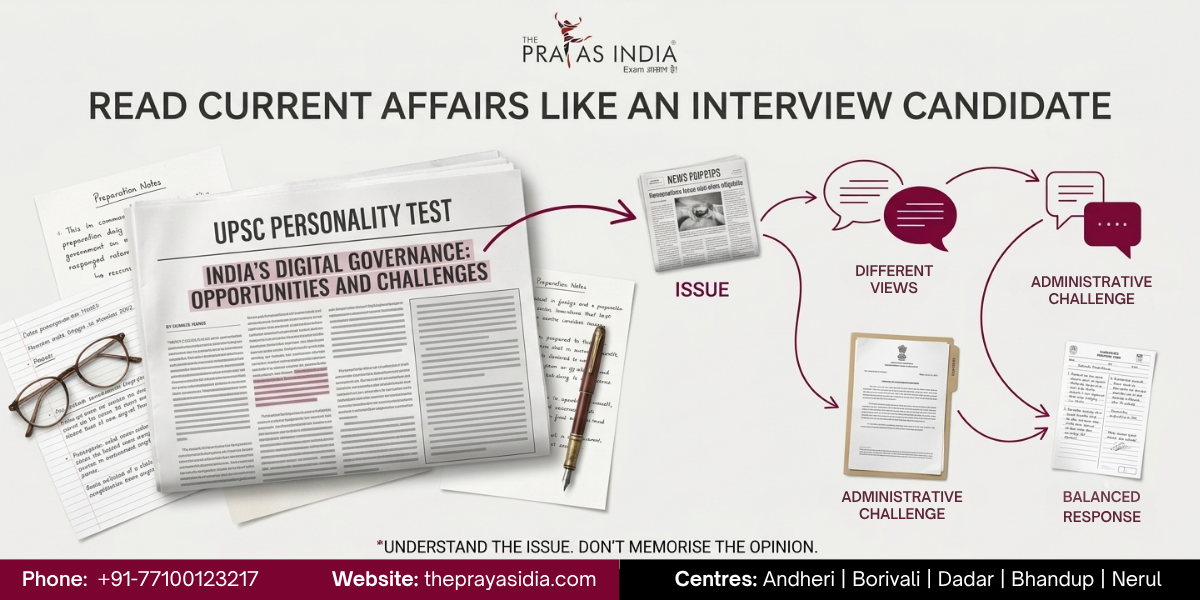
Step 4: Restart Current Affairs — But Change the Way You Read
Post-Mains current-affairs preparation should not become another race to accumulate information.
During Prelims and Mains preparation, aspirants often read current affairs with an examination-oriented objective: facts, schemes, reports, arguments, examples, data, and possible answer points. For the interview, the emphasis should gradually shift towards understanding issues and forming balanced perspectives.
For every major issue, try to understand:
- The basic context
- The competing viewpoints
- The government’s position
- The practical challenges
- The impact on citizens
- The possible administrative response
- The constitutional, economic, social, or ethical dimension where relevant
The interview board may not ask you to reproduce an editorial. It may instead ask a simple question that requires you to think on your feet.
That is why broad understanding is more valuable than memorised commentary.
Step 5: Develop Opinions Without Becoming Opinionated
One of the most important interview skills is learning the difference between having a reasoned opinion and being rigid about an opinion.
An aspirant may be asked about a controversial policy, social issue, economic decision, international development, technological change, or governance challenge. The objective is not necessarily to produce the “perfect” opinion.
A mature response recognises complexity.
Instead of immediately saying that a policy is completely good or completely bad, examine its intended objective, benefits, implementation difficulties, unintended consequences, and possible improvements. This demonstrates the ability to look at an issue from more than one perspective.
A useful internal structure is:
Context → Positive Dimension → Concern → Balanced Assessment → Possible Way Forward
This structure should not be memorised as a script. It should become a thinking habit.
For a future administrator, the ability to balance competing priorities is far more meaningful than simply taking a strong position on every issue.
Step 6: Start Speaking Before You Start Taking Mock Interviews
Interview preparation is partly a communication exercise. Reading silently cannot fully prepare an aspirant for the experience of answering questions aloud.
Begin with low-pressure speaking practice.
Pick one current issue and explain it aloud for two or three minutes. Then choose a DAF topic and answer a basic personal question. Record yourself occasionally and review the recording.
Look for practical issues such as:
- Are your answers unnecessarily long?
- Do you reach the main point quickly?
- Are you using complicated language unnecessarily?
- Do you sound memorised?
- Do you repeat the same words?
- Are you comfortable with pauses?
- Does your tone remain calm when discussing disagreement?
The objective is not to develop a polished “interview voice”. It is to make your natural communication clear, composed, concise, and structured.
Step 7: Prepare for Questions You Cannot Predict
Trying to predict every possible UPSC interview question is a losing strategy. The board can take a conversation in an unexpected direction, and even a familiar topic can produce an unfamiliar question.
Instead of building a list of thousands of questions, prepare question families.
For example, a hobby can lead to questions about its history, economic relevance, social impact, personal experience, recent developments, or policy concerns. A home district can lead towards geography, administration, infrastructure, local economy, social challenges, or development indicators.
This approach creates flexibility.
You are no longer preparing one answer for one question. You are developing enough understanding to handle several possible directions from the same topic.
The Role of Structured Coaching After Mains
The post-Mains phase is also the point where personalised guidance can become particularly valuable. Mains preparation often allows aspirants to work independently with books, notes, test series, and answer-writing practice. Interview preparation is more interactive.
An aspirant needs external observation because certain weaknesses are difficult to identify alone. You may believe that your answer is concise while actually speaking for too long. You may think you appear confident while your body language suggests nervousness. You may have strong knowledge but struggle to communicate it naturally.
This is where a structured UPSC coaching environment can add value through DAF analysis, current-affairs discussions, individual feedback, communication practice, and realistic mock interviews.
For aspirants in Mumbai, choosing a coaching institute at this stage should therefore be based not only on the institute’s Prelims or Mains reputation but also on the quality of its interview-specific mentoring and personalised feedback system.
Your Preparation Should Now Become More Personal
The post-Mains phase is not about studying everything again. It is about understanding yourself, your profile, and the issues you may be expected to discuss.
The strongest preparation roadmap therefore moves gradually from self-analysis to DAF analysis, from current-affairs understanding to opinion building, and from silent preparation to spoken practice.
The next stage should build on this foundation by introducing structured mock interviews, feedback cycles, body-language refinement, difficult-question handling, and a realistic final-week strategy.
The objective is not to manufacture a personality for the interview. It is to present your existing personality with greater clarity, awareness, balance, and confidence.
Step 8: Begin Structured Mock Interview Practice
Once your DAF preparation, current-affairs understanding, and basic speaking practice are in place, it is time to introduce mock interviews. However, mock interviews should not be treated as performances where the objective is simply to appear confident.
A useful mock interview should reveal gaps that are difficult to identify during self-practice. The interviewer should challenge your assumptions, ask follow-up questions, change the direction of the conversation, and observe how you respond when you are uncertain. The value lies less in the number of mocks you complete and more in the quality of the feedback you receive afterwards.
Your first mock may expose several issues at once. You might discover that your answers are too long, that you hesitate when questioned about your own DAF, or that you know an issue academically but struggle to explain it in simple language. These are not reasons for concern. They are precisely the weaknesses that mock interviews are designed to identify.
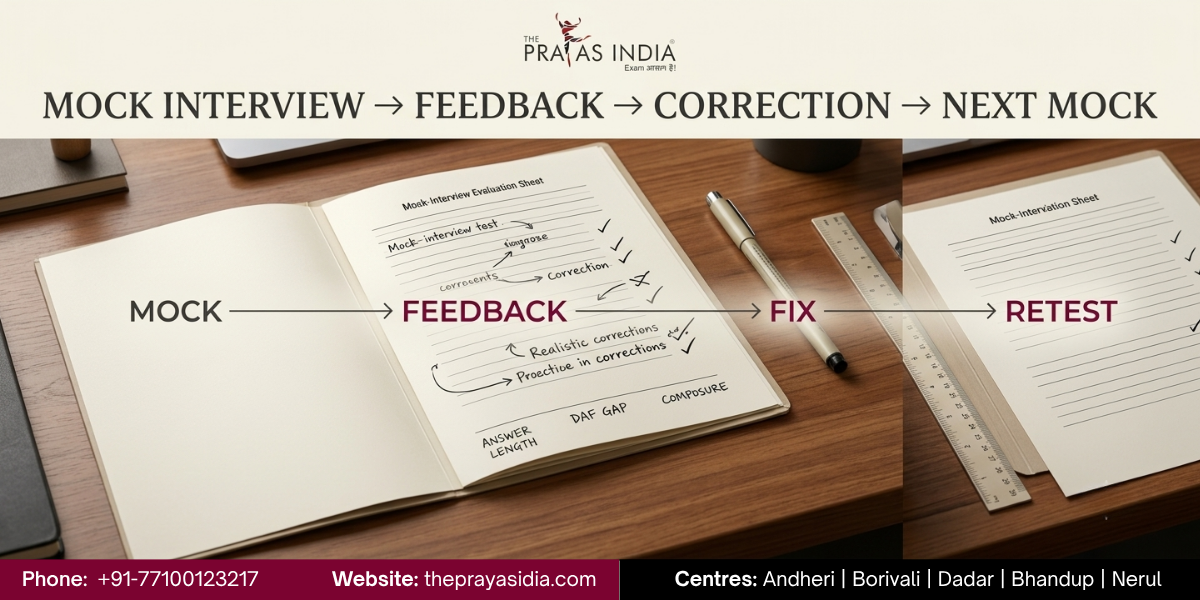
After every mock, maintain a short feedback sheet covering:
- Questions where you became uncomfortable
- Answers that lacked clarity
- Topics requiring additional preparation
- Repeated communication problems
- Body-language observations
- Unnecessary phrases or filler words
- Questions where you became defensive or overly certain
- Areas that improved compared with the previous mock
The next mock should then be influenced by this feedback. This creates a practice → feedback → correction → retest cycle rather than a collection of disconnected mock interviews.
Step 9: Learn to Handle “I Don’t Know”
One of the most underestimated interview skills is knowing how to respond when you genuinely do not know the answer.
UPSC interviews can move into areas that an aspirant has not specifically prepared. Trying to manufacture an answer can create a bigger problem than simply acknowledging the knowledge gap. Guessing confidently, inventing facts, or becoming visibly uncomfortable can affect the overall quality of the interaction.
A composed response such as acknowledging that you are not certain and then, where appropriate, sharing the limited understanding you do have can demonstrate intellectual honesty.
The important distinction is between not knowing and giving up. If you know part of the context, explain that part clearly. If you can logically reason from the information provided in the question, do so. If you genuinely have no knowledge of the subject, acknowledge it without unnecessary embarrassment.
The board is not testing whether you know everything. It is also observing how you behave when you encounter the limits of your knowledge.
Step 10: Refine Your Answering Style
At this stage, aspirants should focus on making their answers more natural and effective rather than trying to make them sound impressive.
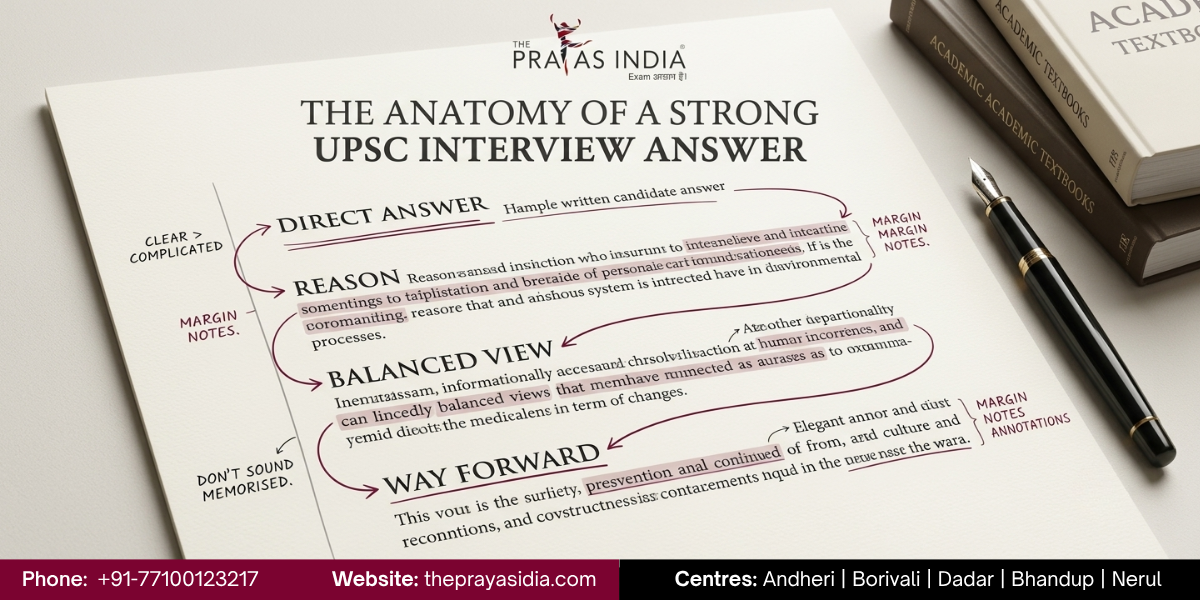
A good interview answer generally has a clear beginning, a logical middle, and a concise conclusion. The exact structure will depend on the question, but the candidate should avoid unnecessarily long introductions and unrelated background information.
For opinion-based questions, a balanced approach can help:
Context → Your assessment → Supporting reasoning → Concern or limitation → Way forward
For personal questions, authenticity is more important:
Direct answer → Personal reason → Relevant experience → Learning
For factual questions, avoid turning a simple question into a long lecture. Give the relevant information first and allow the board to decide whether it wants to explore the topic further.
This is particularly important because interview preparation can sometimes make candidates over-prepare answers. They begin trying to fit every question into a rehearsed framework. The result may sound polished but unnatural.
The better objective is structured spontaneity — being prepared enough to think clearly without sounding scripted.
Step 11: Work on Body Language Without Overacting
Body language matters, but it should never become a separate performance.
Maintain a comfortable sitting posture, listen carefully before responding, make natural eye contact, and avoid unnecessary movements. Your facial expressions should correspond naturally with the conversation. A serious question does not require a permanently serious face, and confidence does not require exaggerated gestures.
One of the best ways to improve body language is through video feedback. Recording mock sessions allows you to observe yourself from the interviewer’s perspective.
Look for simple corrections:
- Sit upright without becoming rigid.
- Avoid repeatedly adjusting your clothes, pen, chair, or hands.
- Listen fully before beginning your answer.
- Avoid interrupting.
- Maintain natural eye contact.
- Use hand gestures sparingly.
- Allow short pauses when thinking.
- Keep your facial expressions natural.
The objective is not to eliminate every movement. It is to remove distracting habits so that the board can focus on your answers.
Step 12: Prepare Your Home State, District and Local Issues
Your hometown can become an important area of interview discussion. Aspirants often prepare national and international affairs extensively while neglecting the place they know personally.
Your preparation should go beyond geography and historical facts. Understand the development profile of your district and state, major industries, agriculture, infrastructure, social challenges, environmental concerns, important government initiatives, and recent developments.
More importantly, think like an administrator.
If your district has a particular problem, what could be causing it? Which institutions are involved? What practical constraints exist? What would you prioritise if you were responsible for addressing the issue?
This transforms local knowledge into administrative thinking.
For candidates from Maharashtra and Mumbai, for example, issues surrounding urban infrastructure, housing, transport, migration, waste management, coastal ecology, employment, public health, and city planning can become useful areas of broader administrative discussion. The same principle applies to candidates from any state or district.
Step 13: Build a Final 15-Day Interview Routine
The final stage should not become an uncontrolled attempt to study everything. The closer the interview gets, the more important it becomes to prioritise revision, practice, and composure.
A practical final-phase routine can include:
Morning: Current affairs and major national/international developments.
Midday: DAF revision and background-specific topics.
Afternoon: One focused topic such as optional subject, home state, graduation, work experience, or hobby.
Evening: Speaking practice, mock interview, or discussion with a mentor.
Night: Review important observations and identify the next day’s preparation priorities.
The exact schedule should depend on the individual’s strengths and weaknesses. Someone with strong knowledge but weak communication needs more speaking practice. Someone who communicates naturally but has DAF-related gaps should allocate more time to profile preparation.
The final two weeks are therefore not about increasing the volume of preparation. They are about improving the quality and consistency of performance.
Step 14: Use Mock Interviews as Feedback, Not Validation
A common mistake is becoming emotionally dependent on mock-interview scores or panel reactions.
One mock may feel excellent. Another may feel unexpectedly difficult. Different panels may focus on completely different areas. Therefore, a single mock should never become a prediction of the final UPSC Personality Test result.
Instead, look for recurring patterns.
If three different interviewers identify the same weakness, it deserves immediate attention. If one panel asks an unusual question that nobody else has raised, it should not automatically become your biggest preparation priority.
Create a simple trend record:
- Communication
- DAF awareness
- Current affairs
- Analytical ability
- Balance of opinion
- Composure
- Listening
- Body language
The purpose is to identify consistent improvement, not chase a particular mock score.
Choosing UPSC Interview Guidance in Mumbai
The post-Mains phase is different enough from Prelims and Mains that the quality of guidance can directly influence how efficiently an aspirant uses the limited preparation window.
When evaluating UPSC coaching in Mumbai for the interview stage, aspirants should look beyond generic claims about faculty or study material. The more useful questions are practical: Is there DAF-based preparation? Are mock interviews personalised? Does the institute provide individual feedback? Are current affairs discussed from an interview perspective? Are candidates exposed to follow-up questioning? Is there a mechanism to track improvement?
A strong interview programme should complement an aspirant’s existing preparation rather than force every candidate into the same template.
At The Prayas India, the interview-preparation approach can be positioned around this need for personalised preparation — understanding the candidate’s profile, improving communication, strengthening issue-based thinking, and using mock interviews as feedback mechanisms.
For aspirants in Mumbai who have cleared or are preparing seriously for the UPSC Mains stage, this is also an important point to explore interview-focused mentorship and admissions rather than waiting until the final weeks.
A Practical Roadmap From Mains to Personality Test
The entire post-Mains journey can be viewed as a sequence rather than a single preparation phase:
Mains Completed
↓
Short Recovery + Preparation Reset
↓
DAF & Personal Profile Analysis
↓
Current Affairs With Balanced Perspectives
↓
Speaking & Communication Practice
↓
Structured Mock Interviews
↓
Individual Feedback & Correction
↓
Final Revision + Confidence Building
↓
UPSC Personality Test
This sequence keeps preparation focused. It prevents the common mistake of jumping directly into random mock interviews without building the underlying preparation first.
Final Preparation Checklist
Before entering the interview stage, an aspirant should be comfortable discussing their own profile and should have developed the ability to think through unfamiliar questions.
Knowledge Readiness
- DAF-related topics revised
- Optional and graduation basics refreshed
- Home state and district prepared
- Current affairs understood beyond headlines
- Major national and international issues reviewed
- Important constitutional, economic and governance themes revised
Communication Readiness
- Answers are clear and reasonably concise
- Speaking practice is regular
- Filler words are under control
- Listening skills are strong
- Opinions are expressed with balance
- Uncertainty can be handled calmly
Personality Readiness
- Personal decisions can be explained honestly
- Strengths and weaknesses are understood
- Failure and setbacks can be discussed maturely
- Disagreement does not trigger defensiveness
- Body language is natural
- Confidence does not become overconfidence
The Real Objective of UPSC Interview Preparation
The UPSC Personality Test should not be approached as a competition to produce the most impressive answer. The stronger objective is to demonstrate that you can think clearly, communicate responsibly, remain balanced, and respond with maturity.
After years of written preparation, candidates already possess a substantial knowledge base. The post-Mains phase is about converting that knowledge into clear thought and effective communication.
That is why the best preparation roadmap is not built around predicting questions. It is built around developing a candidate who can handle questions that were never predicted.
For aspirants looking for UPSC coaching in Mumbai, the interview stage is an opportunity to seek focused guidance, DAF analysis, realistic mock interviews, and personalised feedback. With the right preparation structure, the transition from Mains answer writing to Personality Test performance becomes much more manageable.
Contact Us
- Call Now: +91-77100 13217
- Website: theprayasindia.com
- Centres: Andheri | Borivali | Dadar | Nerul | Bhandup
Frequently Asked Questions
1. When should UPSC interview preparation start after Mains?
Interview preparation should ideally begin soon after Mains rather than waiting for the final interview call. A short recovery period is fine, but candidates can start with DAF analysis, current affairs revision, and speaking practice before moving into structured mock interviews.
2. Is DAF preparation important for the UPSC Personality Test?
Yes. Educational background, optional subject, hometown, hobbies, achievements, work experience, and other DAF entries can become possible areas of discussion. Candidates should understand both the personal and broader relevance of the information mentioned in their profile.
3. How many UPSC mock interviews should I take?
There is no fixed ideal number. Quality and feedback matter more than quantity. A smaller number of well-conducted mocks followed by detailed analysis can be more useful than repeatedly taking interviews without correcting recurring weaknesses.
4. What should I do if I do not know an interview question?
Stay composed and avoid inventing information. If you know part of the topic, explain what you genuinely know. If you do not know the answer, acknowledge it politely and move forward.
5. Should I prepare current affairs differently for the UPSC interview?
Yes. Interview preparation should focus more on understanding issues, competing perspectives, administrative implications, and practical solutions rather than simply memorising facts and editorial points.
6. Is UPSC coaching necessary after Mains?
It depends on the candidate. However, personalised DAF analysis, mock interviews, communication feedback, and external evaluation can be valuable because many interview weaknesses are difficult to identify through self-preparation alone.
7. What should I look for in UPSC interview coaching in Mumbai?
Look for DAF-based preparation, experienced interview panels, personalised feedback, current-affairs discussions, multiple mock-interview formats, communication guidance, and a system that tracks improvement rather than simply conducting interviews.
8. Can I prepare for the UPSC interview without taking mock interviews?
You can prepare independently, but mock interviews provide an important element that self-study cannot fully replicate: an external assessment of your answers, communication, composure, and body language.