UPSC Preparation Without a Strategy: 7 Signs You Need a Better Study System
Best UPSC Coaching in Mumbai | The Prayas India
UPSC preparation is often described as a test of hard work, patience and consistency. All three are important, but there is another factor that can quietly determine whether months of preparation are actually moving you towards the exam: strategy.
Many aspirants study for several hours every day and still feel uncertain about their progress. They read newspapers, complete standard books, watch lectures, make notes, solve questions and take tests, but at the end of the month they struggle to answer a simple question: “What has actually improved in my preparation?”
This is where the difference between working hard and preparing strategically becomes important.
A strategy does not necessarily mean following an extremely complicated timetable. It means knowing what you need to study, why you need to study it, how you will measure your performance, when you will revise it and what you will change if the approach is not producing results.
In other words, a good UPSC preparation system creates a connection between study, practice, testing, feedback and improvement.
If these elements are missing, preparation can slowly become a collection of disconnected activities. You may be studying every day, but not necessarily progressing every day.
Strategy Is More Than a Timetable
One of the most common misconceptions among UPSC aspirants is that having a timetable means having a strategy.
A timetable can tell you that you will study Polity from 9 AM to 11 AM, Current Affairs from 12 PM to 1 PM and answer writing in the evening. But it does not tell you what you are expected to achieve from those sessions.
A strategy goes one level deeper.
For example, instead of simply deciding to study Polity for two hours, a strategic approach could be to complete a specific topic, solve relevant UPSC Previous Year Questions, revise the important provisions and then test yourself through questions or answer writing.
The difference may appear small, but over several months it becomes significant.
A timetable controls time.
A strategy controls direction.
And for an examination as broad as UPSC Civil Services Examination, direction matters enormously.
How Do You Know If Your Preparation System Is Weak?
You don’t necessarily need to wait for a poor mock-test score to discover that your strategy has problems.
Your daily preparation itself can provide warning signs.
If you constantly change resources, cannot explain what you have achieved in the last month, write answers without understanding why your marks remain stagnant, or keep collecting current-affairs material without revising it, your problem may not be a lack of effort.
It may be a lack of structure.
The following seven signs can help you identify whether your UPSC preparation needs a better study system.
Sign 1: You Study Regularly but Cannot Measure Your Progress
One of the most important warning signs is being unable to clearly explain how your preparation has improved over the last few weeks.
You may have studied for five or six hours every day. You may have completed several chapters, attended classes, read newspapers and solved hundreds of questions. Yet, when you compare your current preparation with where you were a month ago, there is no clear evidence of improvement.
This does not mean that every aspect of UPSC preparation must be converted into a number. But some form of measurable progress is essential.
For Prelims, this could mean improved accuracy in sectional tests, better performance in PYQs or reduced time taken to solve questions. For Mains, it could mean better answer structure, improved content, stronger introductions and conclusions or better time management.
The important thing is to move beyond “I studied a lot” and ask “What can I do better now than I could four weeks ago?”
That question forces preparation to become outcome-oriented.
A simple monthly progress check can include:
- Mock-test scores and accuracy
- Number of questions solved
- Answer-writing performance
- Topics completed and revised
- Repeated mistakes
- Weak areas that have improved
- Topics that still require attention
If you cannot identify any meaningful change in these areas, it may be time to review your study system rather than simply increasing your study hours.
Sign 2: Your Study Material Keeps Increasing, But Revision Keeps Getting Delayed
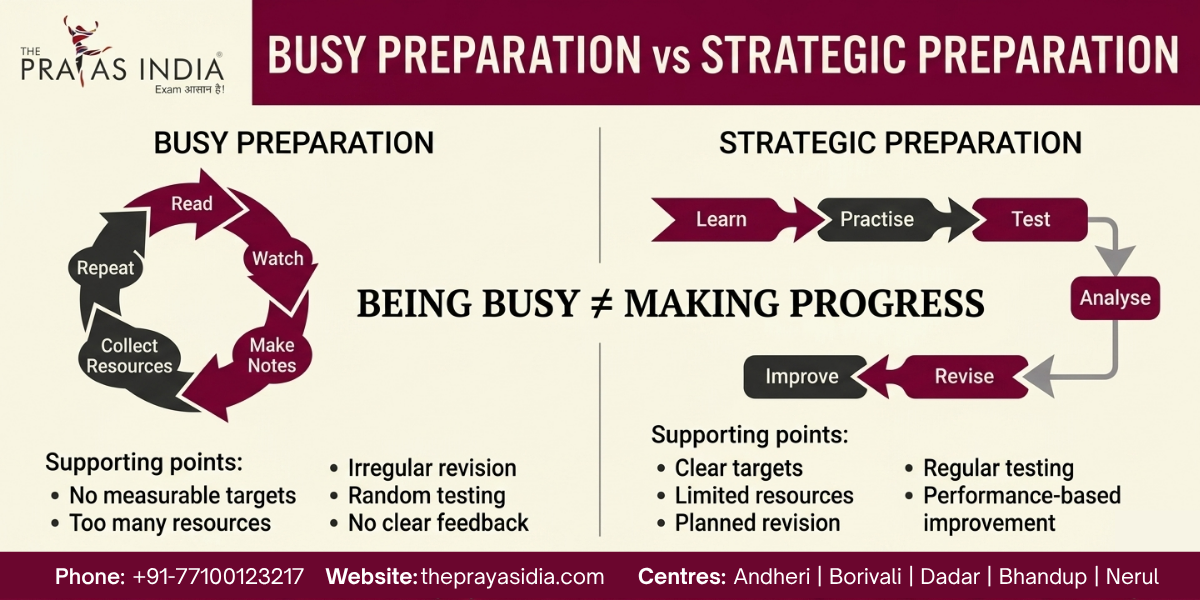
UPSC preparation naturally requires multiple sources, but there is a point at which additional material starts becoming a liability.
Aspirants often begin with one standard book and gradually add coaching notes, topper notes, PDFs, monthly magazines, online lectures, compilations and recommendations from different sources. Individually, each resource may look useful. The problem appears when all of them become part of the preparation plan.
The result is often a growing library and a shrinking revision cycle.
This is particularly dangerous because UPSC rewards retention and application, not the number of PDFs stored on your laptop.
Aspirant A may have fifteen sources for Polity but revise each one only once. Aspirant B may have two carefully selected sources and revise them multiple times along with PYQs. The second approach can often create stronger recall and better exam readiness.
The question you should repeatedly ask is:
“Will this new source improve my preparation, or will it simply increase what I need to revise?”
That question can save a considerable amount of time.
A practical system is to identify one dependable core source for each major subject, supplement it only when necessary, connect it with PYQs and then build concise revision material around it.
The objective should be to gradually reduce uncertainty and increase familiarity as the exam approaches.
Sign 3: You Keep Changing Your Preparation Strategy
UPSC preparation involves experimentation. You may discover that a particular revision method doesn’t work for you or that you need more answer-writing practice. Making such adjustments is completely normal.
The problem begins when your entire strategy keeps changing based on every new piece of advice you encounter.
One week you follow one timetable. The next week you adopt a topper’s routine. A few days later, you change your sources because someone recommends a different book. Then you discover another test series and change your preparation plan again.
This creates what can be called strategy hopping.
The danger is not just wasted time. Constantly changing your approach prevents you from collecting enough evidence to determine whether a particular method actually works for you.
A preparation strategy needs time to produce results.
If you decide to change your answer-writing approach, for example, you should ideally follow the revised method consistently for a reasonable period, evaluate your answers and then make a decision based on evidence.
Don’t change your entire system because someone else’s preparation looks more impressive.
Your strategy should reflect your:
- Current preparation level
- Strengths and weaknesses
- Available study hours
- Attempt stage
- Optional-subject requirements
- Prelims and Mains priorities
Adaptation is good. Constant switching is not.
Sign 4: You Read Current Affairs but Struggle to Use Them
Current affairs occupy a significant part of UPSC preparation, but merely consuming news does not automatically make your preparation stronger.
An aspirant can spend an hour every day reading the newspaper and still struggle to use relevant examples in a Mains answer.
The issue is usually the absence of a connection between current affairs and the UPSC syllabus.
Suppose you read about urban flooding. Instead of treating it as an isolated news story, a strategic approach would connect it with urbanisation, climate change, disaster management, municipal governance, infrastructure and environmental planning.
The same news item can therefore become useful across multiple areas of preparation.
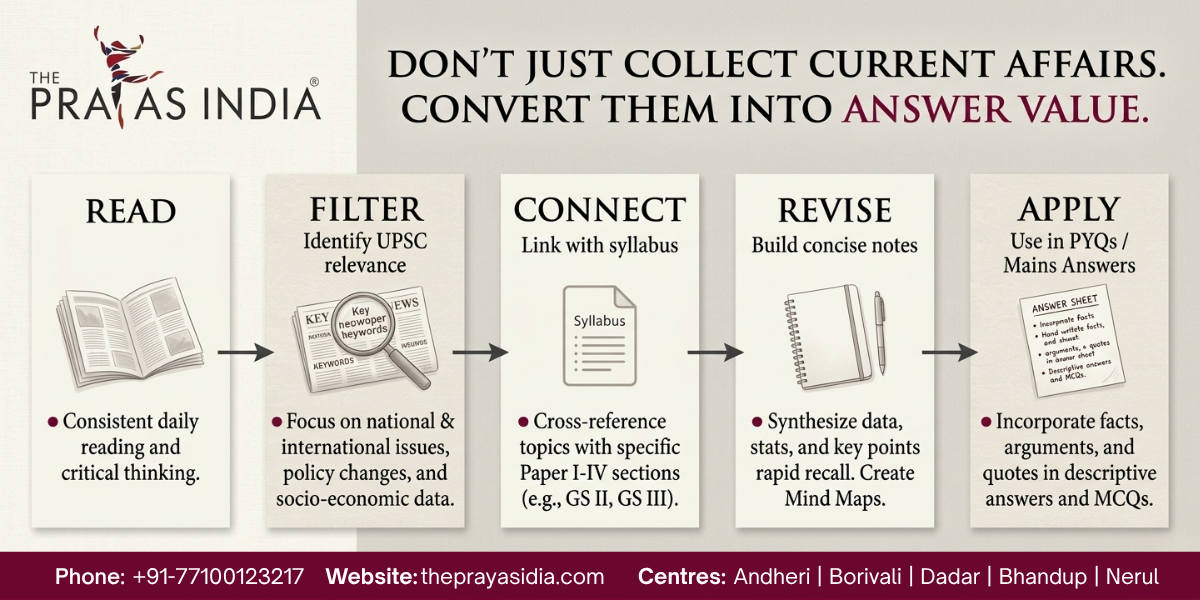
This is why current-affairs preparation should gradually move from information collection to information processing.
You don’t need to remember every event that appears in the newspaper. You need to identify the developments that have relevance to the syllabus and understand how they can be used in Prelims or Mains.
A useful process is:
Read → Identify relevance → Connect with syllabus → Make concise notes → Revise → Apply
That final step—application—is often missing from unstructured preparation.
Sign 5: You Write Mains Answers but Your Marks Are Not Improving
Writing answers is necessary for Mains preparation, but the number of answers you write is not the only metric that matters.
An aspirant can write hundreds of answers and still repeat the same problems—weak introductions, limited dimensions, poor examples, insufficient analysis or an ineffective conclusion.
This happens when answer writing becomes a production activity instead of a learning activity.
Every answer should give you some information about your current performance.
After completing an answer, you should know whether you understood the demand of the question, whether your structure was appropriate, whether you addressed all parts and whether your content was sufficient for the expected marks.
This is where evaluation and feedback become critical.
If you are repeatedly receiving feedback that your answers lack examples, for instance, the solution isn’t simply to write ten more answers. You need to deliberately practise incorporating relevant examples into your answers and then check whether the quality improves.
The same principle applies to structure, introductions, conclusions, diagrams, data, arguments and time management.
Answer writing improves when feedback changes the next answer.
Without that feedback loop, practice can become repetitive rather than progressive.
Don’t Confuse More Practice With Better Practice
This distinction is particularly important for UPSC.
More questions, more pages of notes and more answer-writing sessions may look like progress. But if the same weaknesses appear repeatedly, the quantity of practice is not solving the underlying problem.
A better system asks:
What mistake did I make? Why did I make it? What will I do differently next time?
That creates a direct connection between practice and improvement.
For serious aspirants, this is also one area where structured guidance can make a difference. A good mentor or coaching system should not simply provide more questions; it should help you understand where your preparation is falling short and how to correct it.
This is one factor worth evaluating when comparing options for UPSC Coaching in Mumbai.
The Common Thread Behind These Five Signs
At first glance, these problems appear unrelated.
One aspirant has too many books. Another changes strategies frequently. Someone else reads too much current affairs, while another writes answers without improving.
But underneath them is the same problem:
There is no reliable feedback loop connecting effort with outcomes.
A strong UPSC preparation system should continuously answer three questions:
What should I do next?
How well am I doing it?
What should I change based on the result?
Once those questions become part of your preparation routine, your study hours become more purposeful.
And that is where strategic preparation begins.
Building a Better UPSC Study System
The first five signs point towards a common issue: effort without a reliable feedback mechanism. You may be studying consistently, but if your resources, revision, testing and improvement process are not connected, preparation can become difficult to evaluate.
The good news is that a better system does not require you to completely restart your UPSC preparation. In most cases, you need to identify what is not working, remove unnecessary activities and create a process where every major study activity has a clear purpose.
The remaining two signs are especially important because they reveal whether your preparation is actually being tested against the demands of the examination.
Sign 6: You Take Tests, But Your Test Analysis Is Almost Non-Existent
Taking a UPSC mock test can feel productive. You spend several hours solving questions, check your score and perhaps compare it with a benchmark.
But if the process ends there, you are missing one of the most valuable parts of the test.
Analysis.
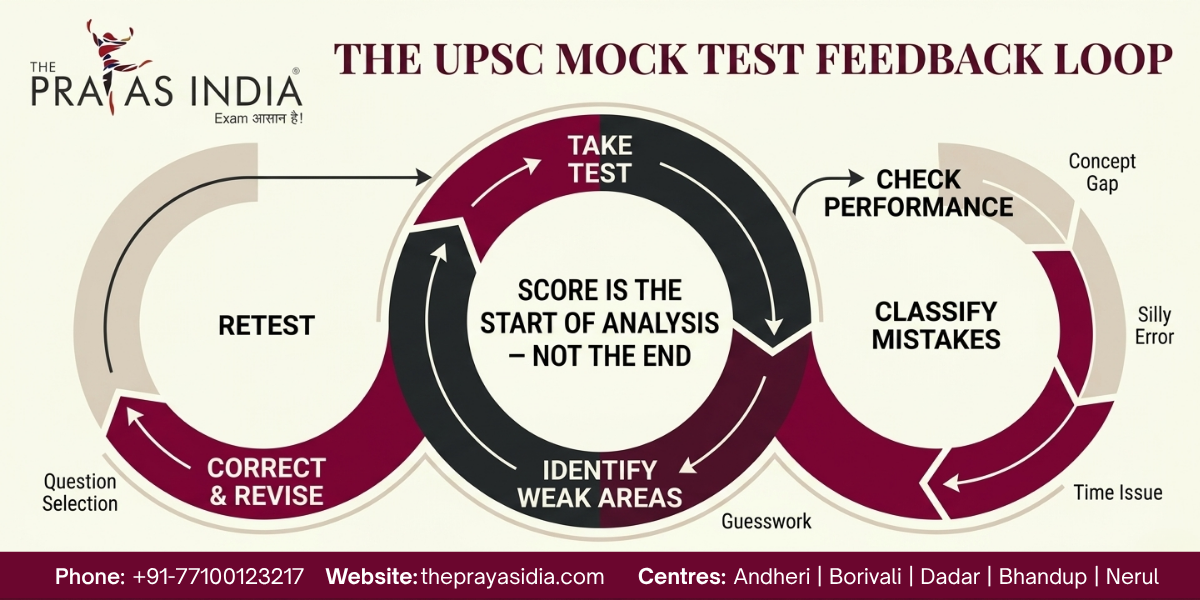
A mock test is not merely a measurement tool. It is a diagnostic tool.
Your score tells you where you stand on that particular test. Your mistakes tell you why you are standing there.
For Prelims, don’t look only at incorrect answers. Look at questions you guessed correctly, questions you spent too much time on and questions you left despite knowing the underlying concept. A lucky guess and a confident correct answer are not equivalent.
For Mains, the analysis should go beyond marks. Look at structure, relevance, depth, examples, balance, introduction, conclusion and time management.
A useful post-test routine can divide questions into four broad categories:
- Correct and confident: Maintain this level.
- Correct but guessed: Strengthen conceptual clarity.
- Incorrect but understood after analysis: Identify the specific gap.
- Incorrect and unclear even after review: Add the topic to your improvement plan.
This turns a mock test into a roadmap for the next phase of preparation.
The Real Value of a Mock Test Comes After the Score
Suppose you score poorly in a particular GS sectional test.
You could simply take another test.
Or you could identify that most errors came from two specific areas, revise those areas, solve relevant PYQs and then retest yourself.
The second approach is slower in the short term but much more useful in the long term.
This is why serious preparation should follow a cycle such as:
Test → Analyse → Identify Gap → Correct → Retest
If your test scores remain stagnant despite taking more and more mocks, the answer may not be more tests.
It may be better analysis.
Sign 7: Your Preparation Depends on Motivation Instead of a System
Motivation can help you begin UPSC preparation, but it cannot be the foundation of a multi-month or multi-year preparation journey.
There will be days when you feel highly motivated and study for eight hours. There will also be days when the syllabus feels overwhelming and you struggle to concentrate.
A strategy-dependent preparation system doesn’t require you to feel motivated every day.
It tells you what needs to be done even when motivation is low.
This is why a good study system should have minimum daily commitments rather than unrealistic targets.
For example, instead of deciding that you must complete six chapters every day, create a manageable structure involving a fixed amount of study, revision, question practice and testing.
On a highly productive day, you may exceed the target.
On a difficult day, you still complete the essential tasks.
This prevents one bad day from becoming one bad week.
Consistency in UPSC preparation is not about performing at maximum intensity every day. It is about maintaining forward movement even when circumstances are not ideal.
Build Your Own UPSC Preparation Operating System
Once you recognise these seven signs, the next step is not to create another complicated timetable.
You need a study system.
Think of it as an operating system for your preparation.
It should answer five basic questions:
What do I study?
This is determined by the UPSC syllabus, PYQs, your preparation stage and your selected sources.
How do I study?
This includes reading, note-making, active recall, question practice and answer writing.
How do I know whether I have learned it?
Through revision, PYQs, sectional tests, mock tests and answer evaluation.
How do I identify weaknesses?
Through regular analysis of mistakes and performance.
What do I do after identifying a weakness?
Create a targeted correction plan and test the area again.
This framework prevents preparation from becoming a random sequence of study sessions.
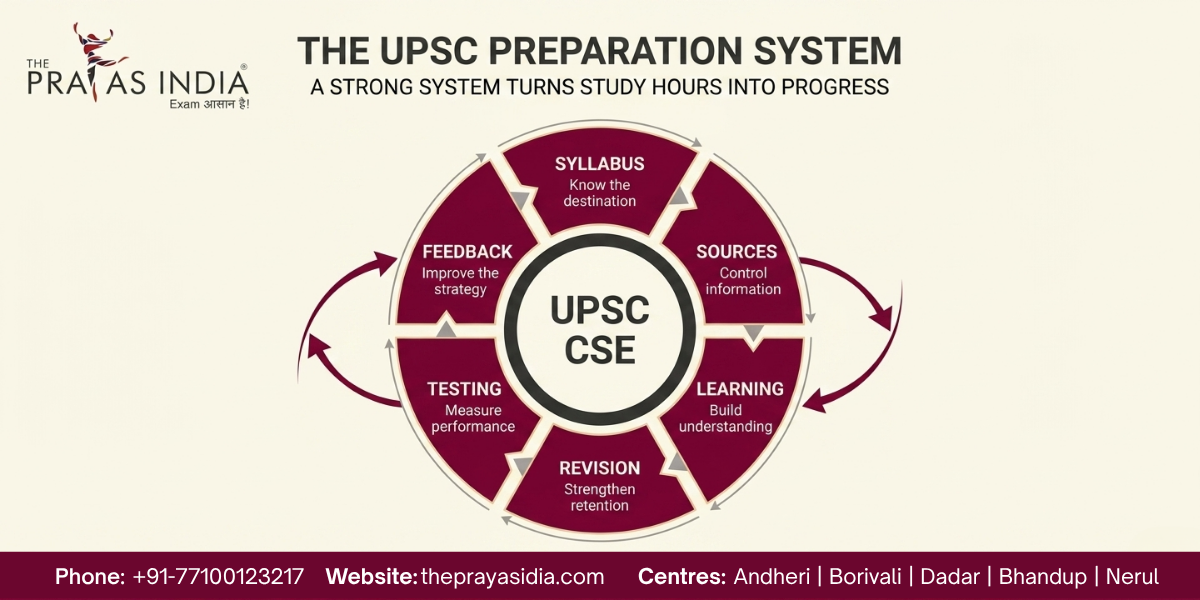
The 6-Part UPSC Study System
A practical preparation system can be built around six connected components.
1. Syllabus Mapping
Know exactly what the examination expects.
2. Limited Resources
Choose dependable sources instead of continuously expanding your material.
3. Active Learning
Don’t just read. Solve, recall, discuss, write and apply.
4. Planned Revision
Revisit important material at predefined intervals.
5. Testing
Use PYQs, sectional tests, mock tests and answer writing to measure performance.
6. Feedback
Use your results to decide what needs to change.
The sixth component is often neglected.
But without feedback, the other five can continue operating without telling you whether they are actually working.
When Should You Consider Structured UPSC Coaching?
Self-study can absolutely be part of UPSC preparation, but the question is whether you are able to build and maintain an effective system on your own.
Some aspirants are comfortable selecting sources, planning their syllabus, evaluating tests and correcting their weaknesses independently.
Others spend months trying to solve these problems themselves.
If you repeatedly find yourself facing the same difficulties—unclear study priorities, inconsistent revision, poor answer-writing feedback, uncertain test performance or constant resource switching—structured guidance may be worth considering.
This is where coaching should be viewed differently.
The value of a good coaching institute is not simply the number of classes it conducts. It should ideally help create structure, direction and accountability around your preparation.
When evaluating UPSC Coaching in Mumbai, therefore, don’t limit the comparison to faculty names or course duration.
Look at the complete preparation ecosystem.
What Should You Check Before Choosing the Best UPSC Coaching in Mumbai?
If you’re searching for the Best UPSC Coaching in Mumbai, consider whether the institute addresses the actual problems that aspirants face during preparation.
Faculty quality is important, but it is only one part of the decision. You should also understand how the institute approaches the syllabus, study material, current affairs, answer writing, Prelims testing, Mains evaluation and student mentorship.
A strong system should help you understand not just what to study, but also how to evaluate whether your preparation is working.
Before enrolling, look for:
- A structured and syllabus-oriented curriculum
- Experienced and accessible faculty
- Quality study material without unnecessary resource overload
- Regular Prelims and Mains testing
- Meaningful answer evaluation and feedback
- Doubt-solving support
- Mentorship or performance guidance
- A clear revision and test strategy
The right coaching environment should complement your self-study rather than replace it.
You will still have to put in the work. The purpose of structured guidance is to make that work more focused and measurable.
Why Mentorship Can Matter More Than More Study Material
A student who is struggling does not always need another book.
Sometimes they need someone to identify why the current approach isn’t working.
If your mock scores are stagnant, mentorship can help determine whether the issue is conceptual knowledge, revision, question selection, accuracy or time management.
If your Mains answers aren’t improving, feedback can reveal whether the problem is content, structure, analysis or presentation.
If your preparation keeps expanding without reaching completion, guidance can help bring the focus back to priorities.
This is one of the strongest reasons serious aspirants should evaluate mentorship while comparing Top UPSC Coaching in Mumbai.
The right guidance doesn’t make the UPSC journey easy.
It can, however, make the preparation process less directionless.
A 30-Day Strategy Audit for UPSC Aspirants
Before changing your entire preparation strategy, conduct a simple 30-day audit.
Look back at the previous month and evaluate four areas:
Learning
What subjects or topics did you actually complete?
Revision
How much of that material did you revisit?
Testing
How many meaningful tests or answer-writing sessions did you complete?
Improvement
What specific weaknesses have become better?
Now ask the most important question:
What should I stop doing next month?
This question is often more valuable than asking what else you should add.
Perhaps you need to stop collecting additional notes.
Perhaps you need to reduce passive lecture watching.
Perhaps you need to stop switching resources.
Perhaps you need to stop taking tests without analysis.
A good strategy is not only about deciding what to add.
It is also about deciding what no longer deserves your time.
A Better UPSC Study System: The Final Framework
A sustainable UPSC preparation system can be summarised as:
Know the syllabus.
Start with the examination, not with random study material.
Choose limited resources.
Give yourself enough time to revise what you already have.
Study actively.
Use questions, recall, discussion and answer writing—not only reading.
Test yourself regularly.
PYQs and mock tests should reveal your actual level.
Analyse performance.
Don’t stop at the score.
Fix specific weaknesses.
Turn mistakes into targeted study tasks.
Revise repeatedly.
Retention is built through repeated exposure.
Review your strategy.
Make changes based on evidence, not every new piece of advice.
This is what transforms preparation from a collection of activities into a system.
Final Takeaway: Hard Work Needs Direction
UPSC preparation without strategy can look impressive from the outside.
You may have long study hours, shelves full of books, extensive notes and hundreds of completed questions.
But the real question is simpler:
Is all that effort producing measurable improvement?
If you regularly study without knowing your progress, keep adding resources, constantly change strategies, consume current affairs without connecting them to the syllabus, write answers without meaningful feedback, take mocks without analysis or depend entirely on motivation, your preparation may need a better system.
The solution is not necessarily to study longer.
It is to create stronger connections between learning, revision, testing, feedback and improvement.
For aspirants who can build that system independently, self-study can remain a powerful approach. For those who repeatedly struggle with direction, evaluation and consistency, structured mentorship can provide valuable support.
If you’re considering the Best UPSC Coaching in Mumbai, look beyond advertisements and course promises. Evaluate whether the institute can genuinely provide the structure, faculty guidance, testing, feedback and mentorship that your preparation currently lacks.
Ultimately, UPSC success is not about doing everything.
It is about doing the right things consistently, reviewing the results honestly and improving the system along the way.
Don’t just prepare harder. Prepare with a system.
Contact Us
📞 Call Now: +91-77100 13217
🌐 Website: theprayasindia.com